Inditex Group Modern Slavery, Human Trafficking and Transparency in Supply Chain Statement FY2019 - inditex.com
←
→
Page content transcription
If your browser does not render page correctly, please read the page content below
Inditex Group Modern Slavery, Human Trafficking and Transparency in Supply Chain Statement FY2019
Inditex Group Modern Slavery, Human Trafficking
and Transparency in Supply Chain Statement
FY2019

           Inditex Group has always been fully committed to respecting, promoting and protecting
           Human Rights across its entire value chain, this being one of the main pillars of its business
           model. Inditex Group does not tolerate any form of modern slavery or human trafficking in its
           organization or in its supply chain, and undertakes to play an active role in promoting Human
           Rights and in proactively working towards the respect thereof.
           This Statement, made pursuant to Section 54 of the UK Modern Slavery Act 2015 (taking into
           account the Guidance issued by the UK Government on 20 April 2020 on modern slavery
           reporting during the COVID-19 pandemic), Section 14 of the Australia Modern Slavery Act
           2018 (Cth), and the California Transparency in Supply Chains Act 2010 (SB-657), addresses
           the measures on which the Group relies to prevent, mitigate and remedy the risk of modern
           slavery and human trafficking materializing. This Statement constitutes Inditex Group Modern
           Slavery, Human Trafficking and Transparency in Supply Chain Statement for the Financial year
           2019 (ended on 31 January 2020), and refers to both Industria de Diseño Textil, S.A. (Inditex,
           S.A.) and its subsidiaries (the “Company”, “Inditex” or the “Inditex Group”). It was approved
           by the Board of Directors in the meeting held on 9 June 2020, following a favourable report
           of the Sustainability Committee and the Social Advisory Board.

           Inditex’s Board of Directors is ultimately responsible for ensuring respect and protection of
           Human Rights, as an essential instrument for the sustainable development of the Company.
           Upon driving the Human Rights strategy, the Board is supported by the Audit and Compliance
           Committee, which assists it in the discharge of its supervision and control duties.

           A new board committee, the Sustainability Committee, was set up in 2019. This consulting and
           advisory body is responsible for advising the Board on the matters under its remit, overseeing
           and monitoring the motions on sustainability in the social and environmental field, in the field
           of health and safety of products that the Company sells, and for the relations with the different
           stakeholders in the field of sustainability, including matters relating to the implementation of
           the Group’s Human Rights strategy.

           Inditex also relies on a Social Advisory Board, which advises it on sustainability issues, and
           is composed of external or independent members, whether private individuals or companies.
           The Social Advisory Board plays a key role in the relationship with the stakeholders, as it is
           charged with formalizing the dialogue with the main representatives of the societies where
           our business is conducted.

           Likewise, in order to ensure compliance with the Code of Conduct and Responsible Practices
           and with the Code of Conduct for Manufacturers and Suppliers (jointly, the “Codes”), Inditex
           relies on the Committee of Ethics, which reports to the Board of Directors through the Audit and
           Compliance Committee. In addition to ensuring compliance with the above-mentioned Codes,
           the Committee of Ethics manages the Ethics Line, a consultation and grievance mechanism,
           which represents the third pillar upon which the Human Rights strategy is founded, reinforcing
           due diligence as it helps identify and timely address any potential negative impact for Human
           Rights, and strengthening the relations with stakeholders.

           2
For their part, sustainability teams are charged with managing and coordinating all the activities of Inditex Group aimed at ensuring compliance with the Code of Conduct for Manufacturers and Suppliers throughout the entire supply chain. 3
ABOUT US

       Inditex is a global fashion retailer present in five continents, in the Northern and Southern
       hemispheres.

       Its main business activity consists of offering the latest fashion trends (apparel, footwear, accessories
       and home textiles) with high quality and sustainability standards, at attractive prices and inspired
       by customer requirements.

       Inditex conducts business through eight brands: Zara, Pull & Bear, Massimo Dutti, Bershka,
       Stradivarius, Oysho, Zara Home and Uterqüe. Each of them operates through an integrated online
       and store model directly managed, except for certain markets where, for several reasons, business
       is conducted through franchises.

       In order to offer the latest fashion trends at the right time, meeting high standards of sustainability
       and with the required quality, Inditex has developed an integrated and flexible business model
       that is clearly customer-oriented.

       This model helps face business environment challenges. The strong competitiveness in the sector,
       driven by new technologies and an increasing awareness of environmental challenges, defines a
       context with a constantly evolving customer profile.

       This business model would not be operational without the integration and flexibility of every
       stage of Inditex’s value chain: design, production, logistics, stores and customers (with integrated
       physical and online points of sale).

       Inditex’s Code of Conduct and Responsible Practices sets out the values and principles that
       guide our actions and relations with our customers, shareholders, partners, suppliers and all the
       communities where Inditex is present.

       The people working in our Company make the sustained and sustainable development of this
       model possible: a diverse human team from 172 nationalities (154 nationalities in 2018), marked
       by its creative talent, its passion for fashion, teamwork, an enterprising spirit, permanent innovation
       and responsible effort.

       The goal of the Group is to provide fashion products that meet the most demanding sustainability
       and health and safety standards, built on respect and promotion of Human Rights, transparency
       and a permanent dialogue with our stakeholders.

       The strengths of Inditex’s shareholder value creation model and the company’s strong commitment
       to Human Rights and sustainability have provided us with a competitive advantage upon analyzing
       and responding to the consequences arising from the situation created by COVID-19 in the mid
       and long term1.

       Find out more about Inditex Group on https://www.inditex.com/en/about-us/who-we-are

       1 Further information about Inditex’s response and measures to face COVID-19 on page 20 of this Statement.

       4
INDITEX
SUPPLY CHAIN
All the suppliers and factories involved in producing the goods that Inditex sells are expressly
bound to abide by the values and responsible practices that are central to the Group, and
which are conveyed by the Sustainability department and also by the different buyers of
product teams.
In this regard, Inditex’s commitment and responsibility towards the responsible management
of its supply chain requires identifying working areas to contribute to the improvement of
working conditions in the sector in each of the markets where the Group operates, and
creating sustainable production environments. Inditex meets such challenges by setting and
implementing policies aligned with Human Rights and the fundamental labour standards, and
by establishing monitoring and direct cooperation tools with its suppliers, as well as via a
multilateral dialogue with organizations and institutions in these fields.
In 2019, Inditex’s supply chain2 was made up of 1,9853 non-exclusive suppliers in 51 markets,
working in 8,155 factories4.
The traceability of the supply chain is a first and essential step to manage it. With a global
supply chain, Inditex strives to draw attention to each and every player involved in production
of goods, to ensure that they all meet the Group’s commitments in the field of sustainability.
Inditex’s traceability strategy is based upon three main pillars: the traceability system, the
follow-up and raising awareness among suppliers and the traceability audits.
1. Traceability system:
Suppliers must register each and every factory that they intend to use for production, which
must undergo the relevant screening to be approved and authorized. Subsequently, and with
regard to every order placed with them, suppliers must identify the factories which will be
involved, in manufacture, detailing units and processes from raw materials to finished product.
2. Follow-up and raising awareness among suppliers:
All suppliers shall embrace the Group’s sustainability culture, as a pre-requisite to be able to
produce the items that Inditex places on the market.
Criteria used are stringent, as sustainability is at the core of the Group’s business model, but at
the same time, suppliers are provided with training, awareness-raising and support, to jointly
have a positive impact on the communities and act as leverage within the industry.
3. Traceability audits:
1,396 traceability audits were conducted in 2019 with the main purpose of verifying on site that
the goods of the Group are produced in factories previously authorized and duly declared with
2 The scope of the information reported about suppliers and manufacturers has been extended in 2019, to include suppliers and manufacturers of non-textile products who are also subject
to all the standards and programmes of the Group. Thus, the information reported does not compare to that reported in previous years
3 Suppliers of fashion items, with a production for Inditex of over 20,000 units/year for the 2019 Spring/Summer and Fall/Winter campaigns. Suppliers with lesser production represent 0.27%
on total production.
4 Factories declared by suppliers with the manufacturers’ management system for orders placed in 2019.
5the traceability management system. The traceability methodology has been updated in 2019. 247 cases of traceability non- compliance were reported, a higher number than in previous years. This is due to the fact that under the new methodology, inconsistencies can be detected more thoroughly. Non-compliance cases are classified in accordance with their seriousness and corrective plans are set in every case, that the supplier is compelled to implement. At any rate, repeated traceability non- compliance may lead to terminating the relationship with the supplier. On the other hand, purchase practices are also intrinsically related with sustainability of the supply chain and its management, as all purchase decisions of Inditex Group are subject to sustainability criteria. The approach of the Company regarding purchase practices promotes continuous dialogue and participation at all levels, including internal and external, thus passing on the commitment to Human Rights and labour rights also to the purchase process. Thus, Inditex buyers teams receive training and awareness is raised among them, given the impact of their activity on the supply chain. In 2019, training has been imparted at headquarters to 220 buyers and further to 75 buyers from local teams of different subsidiaries, such as Turkey, India and Bangladesh. The topics addressed in training included the link between responsible purchase practices and the critical points of the purchase and production life cycle, as well as the impact thereof on the wages and the life of the workers within the supply chain. In addition, the commitments implemented by ACT (Action, Collaboration, Transformation) initiative, of which the Company is an active participant, have been explained and how they are implemented within the Company. 6
POLICIES AND COMMITMENTS
INTERNAL RESPONSIBILITY AND
CERTIFICATION

          INTERNAL RESPONSIBILITY AND CERTIFICATION
          Inditex applies a zero tolerance policy on slavery, human trafficking and any form of forced
          labour in its supply chain.

          a)       Policies and internal regulations

          •        Policy on Human Rights of Inditex Group

          Inditex Group’s Policy on Human Rights was approved by the Board of Directors on 12 December
          2016, following favourable reports of the Audit and Compliance Committee (formerly, the Audit
          and Control Committee) and the Social Advisory Board, this latter representing the Group’s
          stakeholders.

          In the framework of the United Nations Guiding Principles on Business and Human Rights, the
          Policy on Human Rights defines Inditex’s stance regarding its commitment to respect internationally
          acknowledged Human Rights, and sets out the values and principles, which will guide its activities.

          Notwithstanding its commitment to all Human Rights, Inditex has identified those rights directly
          related to its supply chain, based upon the review of its business model and the expectations of
          its stakeholders.

          Rejection of forced labour is one of the rights singled out in the Inditex Policy on Human Rights.
          In this regard, such Policy reads: “Inditex rejects any form of forced or compulsory labour, as
          defined in ILO Convention 29. This extends both to its own employees and its entire supply
          chain, as well as to any natural and/or legal person related to Inditex. Inditex joined UN Global
          Compact in 2001, and adhered to its principle 4, according to which, businesses should uphold
          the elimination of all forms of forced and compulsory work or work done under coercion.”
          Compliance with Inditex’s Policy on Human Rights is mandatory for the whole Group and it can
          also be binding for third parties associated with Inditex. It has been disclosed to the different
          departments of the Company and is available to all the employees on the company’s intranet
          as well as on the corporate website (www.inditex.com). The enforcement of the Policy involves
          implementing and executing due diligence processes which allow Inditex to assess and, where
          appropriate, regularly identify current and/or potential impacts in the field of Human Rights.
          Further to such processes, appropriate measures are taken to prevent, monitor, mitigate or
          remedy any potential negative consequences and foster positive impacts throughout the entire
          supply chain.

          •        Corporate Social Responsibility Policy of Inditex Group

          The Corporate Social Responsibility Policy was approved by the Board of Directors on 9 December
          2015, following a favourable report of the Audit and Compliance Committee (formerly, the Audit
          and Control Committee).

          The Policy defines the principles endorsed by Inditex and its group in the relations with the
          stakeholders, encouraging the inclusion of sustainability practices across its entire business
          model. It also allows for the understanding, disclosure and application of Inditex’s corporate

          7
culture, based on its sustainable business model, understanding such sustainability as an offer of fashion goods in strict observance of Human and Social Rights within the supply chain, based upon transparency and a permanent dialogue with the stakeholders. • Code of Conduct and Responsible Practices of Inditex Group The Code of Conduct and Responsible Practices is the main policy that inspires and governs all of the Group’s operations and provides the binding principles that apply in each and every area of its activities. The purpose of the Code consists of exacting an ethical and responsible professional conduct from Inditex and its entire workforce in the conduct of its business anywhere in the world, as part of its culture of ethics and compliance. Approved in 2012 by the Board of Directors, this Code strengthens awareness and enforcement of Inditex’s ethical culture, deeply rooted in respecting Human and Labour Rights and in the effective inclusion of all the employees, respecting their diversity. • Policy on Criminal Risks Prevention of Inditex Group The Policy on Criminal Risks Prevention was approved by the Board of Directors on 19 July 2016, following a favourable report of the Audit and Compliance Committee (formerly, the Audit and Control Committee). The Policy on Criminal Risks Prevention seeks to exact an ethical and responsible standard or professional conduct from the Group and its entire workforce and, in particular, to prevent the commission of any criminal offences, including offences related to human trafficking. This Policy addresses the commitments to ethical and responsible conduct covered in the Code of Conduct of Responsible Practices, establishing a link between such commitments and the prevention of criminal offences and acts by employees and the Group. • Code of Conduct for Manufacturers and Suppliers of Inditex Group The Code of Conduct for Manufacturers and Suppliers was approved by the Board of Directors in 2001 and amended in 2012. It is enforced across the entire supply chain, including all tiers and processes. Upon commencing work for Inditex, all direct suppliers accept and undertake to meet Inditex Minimum Requirements, which include compliance with the Inditex Code of Conduct for Manufacturers and Suppliers, which explicitly prohibits slavery and human trafficking and is complemented by applicable national laws and international standards. The first section of the Code of Conduct for Manufacturers and Suppliers provides that: “Inditex shall not allow any form of forced or involuntary labour in their manufacturers and suppliers. They may not require their employees to make any kind of “deposits”, nor are they entitled to retain employees’ identity documents. Manufacturers shall acknowledge the right of their employees to leave their employer after reasonable notice.” The Code of Conduct for Manufacturers and Suppliers specifies that “aspects related to such limitations will be governed by Conventions 29 and 105 of International Labour Organization (ILO)”. Find out more about our policies on https://www.inditex.com/en/how-we-do-business/right-to-wear 8
b)       Commitments and initiatives

•        The Ten Principles of United Nations Global Compact

Since 2001, Inditex has been a signatory of the United Nations Global Compact and it commits
to respect and promote its ten universally recognized principles, which include, among others,
(4) the elimination of all forms of forced and compulsory labour and (5) the effective abolition
of child labour.

•        Commitment to the Sustainable Development Goals (SDGs)

Inditex has always been fully committed to sustainability and respect for Human Rights throughout
its value chain. In this regard, we have committed to the 17 Sustainable Development Goals
(SDGs). Inditex’s sustainable strategy is aligned with the commitment to working towards the
objectives set by the SDGs for 2030, which include decent work conditions and the eradication of
child labour, modern forms of slavery and human trafficking.

•        Ethical Trading Initiative (ETI)

Inditex has been a member of ETI since October 2005 to improve working conditions for workers.
ETI is an alliance of companies, international trade unions, and non-governmental organizations
that promotes individual and collective initiatives to eradicate modern slavery. ETI’s Base Code
covers any manner of forced labour. Individual and collective initiatives to eradicate modern
slavery are encouraged from the organization.

•        Global Framework Agreement with IndustriALL

The Global Framework Agreement (GFA) was executed in 2007 by and between Inditex and
IndustriALL Global Union, the International Federation of trade unions which represents 50 million
workers in 140 countries. The GFA protects and promotes best working conditions throughout the
entire supply chain, and it represented a key milestone in the industry, as it was the first to extend
to a global supply chain and to create a space for the exchange of ideas and proceedings
regarding workers’ rights. The GFA was renewed in 2019, with the creation of a Global Trade
Union Committee to represent the workers of the production areas where we operate.

•        Public-Private Partnership with the International Labour Organization (ILO)

Entered into in 2017, the Partnership is aimed at the joint promotion between Inditex and ILO of
respect for the fundamental principles and rights at work in the supply chain of the cotton sector.
Its expected term is three years.

•        ILO’s Better Work Programme

The Better Work Programme is a platform to improve compliance with labour regulations and
competitiveness of global supply chains. Inditex has been a member since October 2007. In
the course of this partnership, Inditex and Better Work executed on 9 October 2013 a specific
collaboration agreement whereby Inditex became a direct buyer partner of the Better Work
Programme.

9
•       Participation in United Nations Global Compact Decent Work in the Global Supply
Chains Platform

Inditex is part of the United Nations Global Compact Decent Work in the Global Supply Chains
Platform. This is an alliance of companies and other agents which seeks to make progress by
means of collective actions to ensure decent work conditions and namely to eradicate forced
labour, modern slavery and child labour.

•        ACT (Action, Collaboration, Transformation)

This is a collaboration initiative between retail brands, suppliers and trade unions to transform the
industry and achieve living wages in the sector through collective bargaining. Inditex has been
an active participant in ACT since 2015.

•        Better than Cash Alliance

An alliance of governments, companies and large international organizations based within the
UN that seek globally promoting the transition from cash to digital payments. Inditex is focused
on achieving digitalization across its supply chain.

•        Accord on Fire and Building Safety in Bangladesh

An agreement executed by international brands and retailers, local and international trade
unions and NGOs, for the purposes of ensuring lasting improvements in working conditions of the
textile industry in Bangladesh. Inditex is a founding member and sits on the Steering Committee.
This Agreement was signed on 13 May 2013 and renewed in June 2018 (the Transition Accord).

•        Participation in Shift’s Business Learning Programme

Shift is a non-profit organization specializing in Human Rights, led by Professor John Ruggie, the
author of the UN Guiding Principles on Business and Human Rights. This leading program in
Human Rights involves companies of all sectors willing to work towards implementing the UN
Guiding Principles on Business and Human Rights.

Find out more about our commitments and initiatives on https://www.inditex.com/en/how-we-do-
business/right-to-wear

10
DUE DILIGENCE
PROCESS
        Due diligence is the second main driving force of Inditex’s Human Rights Strategy; the political
        commitment reflected in the Policy on Human Rights being the first, and grievance mechanisms,
        the third.

        Due diligence entails identifying and prioritizing potential impacts on Human Rights throughout
        the value chain, to subsequently integrate the findings into the different processes of the
        Group. Key areas of the Company, such as Sustainability, Internal Audit, Human Resources or
        Risk Management are involved in designing due diligence processes, which are continuously
        reviewed and updated.

        One of the findings of the due diligence process is the new social management strategy for the
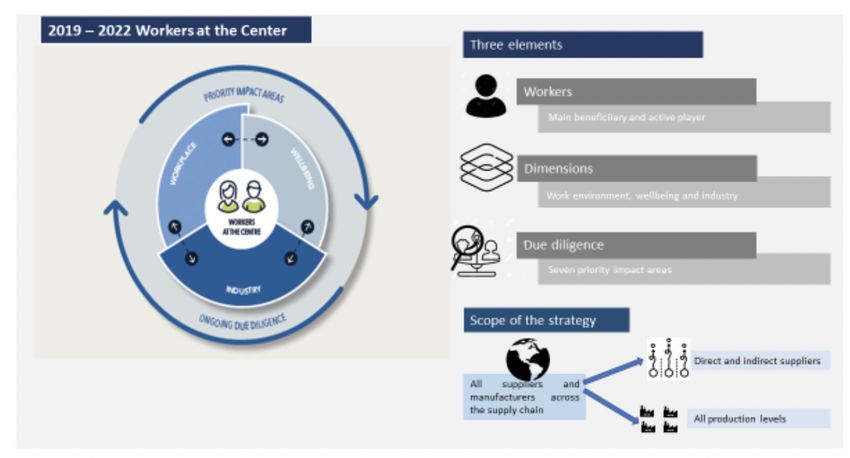
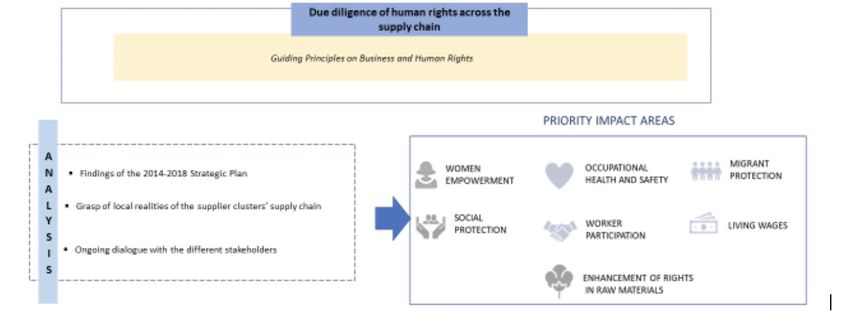
        supply chain known as the “2019-2022 Workers at the Centre” strategy, which has identified seven
        priority impact areas based upon the process.

        DUE DILIGENCE IN THE SUPPLY CHAIN: “2019-2022 WORKERS AT THE
        CENTRE” STRATEGY
        Inditex has launched in 2019 a new strategy for the social management of the supply chain: the
        “2019-2022 Workers at the Centre” strategy. It replaces the previous “2014-2018 Strategic Plan
        for a Stable and Sustainable Supply Chain” and revolves around the premise of understanding
        and meeting the needs of workers, their families and the communities where they live, for the
        purposes of promoting decent work and sustainable production environments. Due diligence is
        one of the three main pillars of the new “2019-2022 Workers at the Centre” strategy.

        In this regard, in partnership with Shift, a benchmark in the field of Guiding Principles on Business
        and Human Rights, Inditex has carried out a due diligence of all potential impacts on Human
        Rights across the supply chain, identifying and prioritizing them. To do so, the findings of the
        previous 2014-2018 Strategic Plan, the information gathered via the dialogue with the different
        stakeholders and the knowledge of the local realities within the supply chain, garnered by the
        different local Social Sustainability teams, have served as the starting point. The findings have
        materialized in maps showing the most relevant impacts on Human Rights at each of the 12

        11
clusters of suppliers that Inditex has5. This has allowed to determine the priority impact areas, which represent the global priorities upon which the 2019-2022 Strategy is focused. A work group is assigned to each priority impact area, charged with implementing the individual strategy of the area. Such work groups are composed of local experts from the different clusters of Inditex. Thus, the experience of each local team adds up to face the global challenges of the industry and find solutions valid for the entire supply chain, but applicable at local level at the same time, always considering the different realities existing in each market. In 2019, 66 individuals in 12 countries were responsible for the due diligence process in the field of Human Rights across Inditex’s supply chain, in partnership with 793 external experts. The other two elements of the “2019-2022 Workers at the Centre” strategy are workers themselves and the three dimensions relating to workers wherein the impacts reached through the strategy materialize. Workers are at the centre of the strategy not only as beneficiaries but as active players. Suppliers’ responsibility and workers’ empowerment are key for the success of such approach. In turn, impact materializes in the following three dimensions: 1. The workplace: it is there where respect for Human and Labour Rights must be ensured through the evaluation, improvement and follow-up of the factories. 2. Workers’ wellbeing. Based on the experience gained at factories’ level, Inditex implements more thorough and progressive programmes to have an impact and achieve changes in the life of the workers and in their communities. 3. The industry. This dimension has been added to strategically promote efforts, at the same time that the company partners with different stakeholders (including NGOs, organizations of civil society, our own suppliers, other brands, etc.,) to drive systematic and effective changes towards sustainability. As a result of the due diligence process above referred, out of the seven priority impact areas included in the “2019-2022 Workers at the Centre” strategy, four areas especially stand out with regard to the supervision of the supply chain in the field of forced or involuntary labour. Namely: protection of migrants, women’s empowerment, social protection and protection of workers’ rights in the production of raw materials. 5 Find out more about Inditex’s clusters the section headed “Effectiveness and Continuous Improvement”. 12
I) PROTECTION OF MIGRANTS
Inditex maintains a zero tolerance policy against exploitation of any workers across the supply
chain, as provided in the Code of Conduct for Manufacturers and Suppliers. In the materialisation
of this approach, special attention is paid to migrants and refugees, being the most potentially
vulnerable groups as regards such abuses.

Inditex relies on a strategy to protect migrants revolving around three specific goals, which allows
it to remedy any potential irregular situation, promote fair labour practices for migrants and
encourage work cohesiveness.

This strategy is based upon strict analysis and an effective monitoring of the conditions of migrant
workers present in the supply chain to ensure that no violation of their rights exist. Where any
violation of their rights is detected, Inditex sets in train remediation to protect workers. These
remediation plans may rely on the collaboration of external bodies, in addition to the involvement
of suppliers, manufacturers and commercial teams. For instance, in Turkey, the Group supports
the Refugee Support Centre (MUDEM) NGO through a framework agreement.

In 2019, 70 remediation plans were launched in Turkey, in partnership with 55 suppliers and
manufacturers and with the support of MUDEM. Such plans reached 59 refugee workers and
91 migrants, who received the support and advice of Inditex’s teams and the NGO above to
become regularized workers.

In addition to individual remediation plans, projects focusing on protection of migrants and
cohesion of the supply chain and in the community are implemented. To develop such projects,
and to broach the challenges relating to recruitment and employment of migrants, the cooperation
of the various stakeholders is required. Therefore, Inditex is a partner of key players, such as the
International Labour Organization, ACNUR, Ethical Trading Initiative, employers’ associations and
other brands, suppliers and NGOs. In addition, the Group is a member of the Tent Partnership
for Refugees platform.

PROGRAMME TO PREVENT UNSAFE MIGRATION IN INDIA

In India, most of the young people not of legal working age who migrate, do so to work. That is
why it is essential to strengthen the prevention of this type of migration in origin communities. This
is the goal of Sankalp programme that Inditex has set in train in partnership with Pratham NGO.

In India, migration from rural to urban areas has increased in recent years. Thus, Sankalp
programme focuses on those states where migration originates: Uttar Pradesh and Bihar. Training
measures are implemented in those states, such as establishing help points at coach stations
and railway stations. Individuals who are potentially at risk are identified at such help points
and their situation is considered in detail for the purposes of providing them with the required
remediation, where necessary, and ensuring that they get back home.

Contemporaneously, training is imparted to local authorities at such exit points to achieve a better
implementation of prevention systems. In addition, regular visits are paid to the minors’ homes
and the involvement of their parents and communities is sought to promote their education.

13
Below are some of the main results of Sankalp programme in 2019:

-         Unsafe migration was prevented in 507 cases

-      9,500 people were made aware of the importance of preventing unsafe migration and
underage work

-         4,135 migrant adults were made aware of their rights

II) WOMEN’S EMPOWERMENT
Inditex’s strategy for the empowerment of women in the supply chain was approved in 2017 and
renewed in the framework of the new “2019-2022 Workers at the Centre” strategy. It focuses on
promoting equal rights and opportunities for male and female workers across the supply chain.

The strategy revolves around three pillars: –health, protection and empowerment– and is based
upon different tools for continuous improvement, supplemented by a gender perspective that
allows broaching women-related sensitive issues and implementing specific gender-related
measures and practices.

                        TARGET                                          MAIN PROGRAMMES AND INITIATIVES
                                                                        IN 2019

     HEALTH             Guarantee access to health, and in particular   -Sakhi Health programme in India
                        maternity services and reproductive health.
                                                                        -Project with Medicus Mundi Sur in Morocco
                                                                        to improve health and social conditions in
                                                                        the textile sector in the country
     PROTECTION         Promoting zero tolerance policies and           -Gender approach in HR management
                        practices to prevent and manage                 in Turkey.
                        harassment in the workplace
                                                                        -Sowbhagyam project in India.
                                                                        -Sakhi Worker Wellbeing programme in
                                                                        India
                                                                        -Training sessions in India to prevent
                                                                        sexual harassment at the workplace.
                                                                        -Protection project with Medicus Mundi
                                                                        Sur

     EMPOWERMENT        Involving female workers in financial,          -BSR’s Finance project in Bangladesh and
                        leadership or empowerment programmes            India.
                                                                        -MIG SCORE project from the International
                                                                        Labour Organization (ILO) in Turkey.
                                                                        -Together Strong project in Turkey.
                                                                        -Education and awareness-raising in
                                                                        Turkey

14
PROMOTING HUMAN AND LABOUR RIGHTS IN SPINNING MILLS IN SOUTH INDIA
For the purposes of promoting Human and Labour Rights in spinning mills in South India, Inditex’s
approach is threefold: it covers the community, the supply chain, and changes of policies.
In line with the first dimension of such approach, the “Sowbhagyam” programme was launched
in 2013, in partnership with a local expert, SAVE (Social Awareness and Voluntary Education),
with the main goal of establishing a strong, successful and replicable model for participation in
community. At present, the project is focused on improving interaction with recruitment agents
and preparing a handbook with tools regarding commitment to the community, including
guidelines to implement the project itself, for the purposes of replicating it.
The other two dimensions are addressed through commitments with ETI and AMCO, respectively.
Inditex works with ETI in the Nalam Programme, under which workers in spinning mills are
given training on their labour rights, health issues, grievance mechanisms and prevention of
harassment at the workplace.
Inditex is also involved in ETI’s TNMS (Tamil Nadu Multi- Stakeholder) programme, and is a
member of the Local Consultative Committee.
The AMCO (Amsterdam Coalition), of which Inditex is a founding member, was established
in 2015 by several brands, with the goal of promoting changes of policies in India aimed at
ensuring responsible working practices, focusing on spinning mills in the south of the country.
In the pursuit of such goal, AMCO has engaged in dialogue with the Indian government, and
collaborated with the Confederation of Indian Industry.
Find out more about women’s empowerment on www.inditex.com/web/guest/our-commitment-
to-people/our-suppliers/workers-at-the-center/womens-empowerment
III) SOCIAL PROTECTION
Social protection is defined as the set of policies and programmes designed to reduce and
prevent vulnerability in the lifetime of people. Social protection extends not only to workers, but
also to their families, including young people not of legal working age. For such reason, within
the scope of the Social Protection priority area, a specific work line is included to collaborate
with local communities to alleviate poverty and prevent child labour.
It should be noted that the Code of Conduct for Manufacturers and Suppliers of the Inditex
Group provides that: “Manufacturers and suppliers shall not employ minors. Inditex defines
minors as those persons who have not yet reached their 16th birthday. In cases where local
legislation stipulates a higher minimum age, the higher limit shall apply”.
Inditex relies on a number of mechanisms to establish compliance with this provision of the
Code and, where necessary, set in train a Remediation Plan (the “Plan”) aimed at providing
potentially impacted people with the appropriate remediation.
15REMEDIATION PLAN OF LABOUR BY PEOPLE NOT OF LEGAL WORKING AGE
One of the potential consequences of poverty is that young people not of legal working age
actually go to work, as the lack of income in their families may result in minors being forced
to drop out from school to contribute to the family’s income.
Inditex relies on a Remediation Plan procedure which is implemented in such cases where
employment at factories of young people not of legal working age are identified. The Plan
seeks to protect people and ensure their rights, in particular, their right to education. Thus,
upon launching the Plan, the supplier shall be responsible for ensuring the education of the
minors until they either become of legal working age, or they reach the age at provided
in the Code of Conduct for Manufacturers and Suppliers, should it be higher. While the
education of these minors is ensured, the supplier shall either hire another member of the
family, or pay a sum equivalent to the wages that the minor used to be paid, to ensure a
source of income for their family.
Another key aspect of the Plan refers to the implementation of preventive measures by the
supplier, to prevent that situation being repeated. Such Plans are developed in partnership
with local organizations, such as Pratham in India or ÇYDD (Association for the Support of
Contemporary Living) in Turkey.
In addition to setting in train such individual remediation plans, different programmes are
implemented in the communities to prevent this type of situation and address the root
cause of any potential reasons of employment of young people not of legal working age.
IV) RAW MATERIALS
Raw materials are key to any supply chain, including in the textile sector. Without them, no
goods could be produced. Being the farthest link in the supply chain, and considering the
complex structure of their production (production process for each raw material are completely
different, from large production companies to individual works, and from natural raw materials
to man-made ones), workers in this sector live a different reality than workers at factories of
finished goods.
Inditex relies on a strategy to protect labour rights upon producing raw materials. Such strategy
was consolidated in 2019 within the framework of the “2019-2022 Workers at the Centre”
programme. The Group has a holistic approach regarding protection of the rights of the
workers involved in such production, joining forces with several actors, including local and
international organizations, and communities themselves. By way of an example, in order to
foster sustainability across the cotton’s supply chain, Inditex collaborates with other agents
in the sector, besides ILO, such as Better Cotton Initiative (BCI), Textile Exchange or Organic
Cotton Accelerator.
16PUBLIC PRIVATE PARTNERSHIP WITH THE INTERNATIONAL LABOUR ORGANIZATION (ILO)
FOR THE COTTON SUPPLY CHAIN
The Public Private Partnership (PPP) with ILO is Inditex’s main initiative to promote the wellbeing
of the workers involved in the production of raw materials, in particular of cotton.
The PPP seeks to promote the fundamental labour principles and rights in cotton-producing
communities, and contribute to the sustainability of the supply chain of this raw material. PPP was
signed in 2017 and since that date, Inditex has collaborated with ILO to promote fundamental
rights in cotton-producing communities in India, Pakistan, China and Mali. To achieve it, a
cooperative approach with different stakeholders nationally and in the communities themselves
is key.
To implement this Agreement, local representatives of ILO were appointed in 2018 as project
coordinators, responsible for initiating the activities that fall within the scope of the project with
the support of Inditex’s local Sustainability teams.
Likewise, in 2019 a round of consultations took place to involve a larger number of stakeholders
to implement the agreement. Additionally, training was imparted to the communities involved
in cotton production and harvesting in Pakistan. During such training sessions, awareness was
raised among cotton workers and their families regarding their fundamental labour rights,
specific health and safety issues, social dialogue and information about applicable laws and
regulations.
Within the framework of this Agreement, in which China is a collaborating party, projects are
also being developed in the provinces of Hebei, Shandong, Hubei and Anhui.
Find out more about Inditex collaboration with ILO on https://www.inditex.com/en/how-we-do-
business/right-to-wear/partnerships
A number of reports were released in 2019, denouncing potential non-compliance practices
in social and labour matters in some regions of central Asia, where Inditex does not have
commercial relations with any factory.
Additionally, Inditex conducts thorough due diligence across our supply chain in the region
through our internal teams and expert external partners to ensure the absence of forced labour
and compliance with our Code of Conduct and international labour standards, including:
• Actions at Community level within the Public Private Partnership with the International Labour
Organization to enhance human and labour rights covering the fundamental rights and principles
at work, including the prevention of forced labour.
• Actions at Industry level, as established in the UN Guiding Principles on Business and Human
Rights and in collaboration with the relevant stakeholders to promote the human and labour
rights of workers within the global textile supply chain.
• Furthermore, Inditex is a signatory to the “Uzbek Cotton Pledge” for the eradication of forced
labour in the production of cotton in Uzbekistan. https://www.sourcingnetwork.org/uzbek-cotton-pledge
17RISK MANAGEMENT
SUPPLIERS’ VERIFICATION AND
AUDITS
The “2019-2022 Workers at the Centre” strategy and the activities in the priority impact areas
identified through due diligence are supplemented with cross-cutting actions aimed at verifying
and ensuring compliance with the Code of Conduct for Manufacturers and Suppliers, - which
provides that any form of forced labour is expressly prohibited -, and with international regulations,
as well as at working with the suppliers and the stakeholders towards the continuous improvement
of the supply chain.
All the facilities required to produce the goods that Inditex places on the market must comply with
the Code of Conduct for Manufacturers and Suppliers. In order to ensure such compliance, Inditex
subjects all its suppliers and factories to different procedures and assessments regarding Human
and Labour Rights. One of the main tools used to that end are different types of audits. Thanks
to the requirement for maximum quality, and to the information gathered from such audits, Inditex
can identify key areas for the development and implementation of projects to empower workers,
placing them at the centre of activities, in order to guarantee their labour rights.
Prior to becoming part of Inditex’s supply chain, every potential supplier and manufacturer is
subject to a pre-assessment, to verify that no violation of Human Rights of its workers exists,
ensuring that only those who meet the Group’s sustainability standards may become part of the
supply chain. During pre-assessment audits, one of the elements reviewed is the prohibition of
forced labour. In 2019, Inditex carried out 2,789 pre-assessment audits.
Subsequently, every supplier and factory in Inditex’s supply chain is subject to periodic social
audits. The methodology used in social audits was designed in 2007, jointly with the former
International Textile and Garment and Leather Workers’ Federation (ITGLWF), (currently part of
IndustriALL Global Union), the University of Northumbria (UK) and the Cambridge Centre for
Business and Public Sector Ethics.
The main purpose of social audits is to verify the level of compliance with the Code of Conduct for
Manufacturers and Suppliers and launch Corrective Action Plans, where appropriate, to ensure
respect for Human and Labour rights and remedy any detected non-compliance. Social audits
can be conducted both by internal and external auditors, always without prior notice to the
company to be audited.
Each audit includes tools allowing for the identification of any form of forced labour, and for
the verification of issues such as retention of documentation, freedom of movement and the
termination of agreements, the use of agents for recruiting staff and their relationship with the
workers, including any potential payment of hiring fees, among others. 6,411 social audits were
conducted in 2019.
In addition to social audits, Inditex also conducts special audits, which focus on verifying compliance
with a certain section of the Inditex Code of Conduct for Manufacturers and Suppliers, where a
potential non-compliance is detected, for the purposes of preventing, monitoring or remedying
any risks. 1,619 special audits were conducted in 2019.
18TYPE OF AUDIT NUMBER
Traceability 1,396
Pre-assessment 2,789
Social 6,411
Especial 1,619
TOTAL 12,215
EFFECTIVENES AND
CONTINUOUS IMPROVEMENT
In order to implement the “2019-2022 Workers at the Centre” Strategy, and enforce the sustainability
policies and procedures of the Group across the entire supply chain, Inditex deems it essential to
work in the field and understand the specific reality and description of the countries where its supply
chain extends. This is the reason why management of the supply chain revolves suppliers’ clusters.
These clusters offer space for cooperation and dialogue with the aim of promoting a sustainable
production environment in a strategic geographical area and within the framework of compliance
with Human Rights and fundamental labour rights. Clusters are made up of local professionals
with wide experience in the field of sustainability, with different sets of skills and capacities, which
conform multidisciplinary teams allowing engaging in a fluid cooperation relationship with suppliers,
manufacturers and the different organizations within their sphere of influence.
In 2019, the Group had 12 supplier clusters, which accounted for 96% of its total production: Spain,
Portugal, Morocco, Turkey, India, Bangladesh, Pakistan, Vietnam, China, Cambodia, Brazil and
Argentina.
Clusters pay a key role to consolidate relations with suppliers as they are made up of local experts
with experience in the field of sustainability. Such professionals offer their varied sets of skills and
capacities, conforming multidisciplinary teams thus allowing them to understand and address the
different local realities of the supply chain and help suppliers face global challenges.
In this regard, daily work carried out by members of the clusters with suppliers and manufacturers is
key to ensure the continuous improvement of workers’ working conditions. In addition to the action
taken in each priority impact area for such purposes, Corrective Action Plans represent another
main tool on which Inditex relies for optimizing the supply chain from the perspective of respect and
promotion of Human and labour Rights.
Each audit immediately triggers a Corrective Action Plan that establish the measures to be taken by
the supplier or the manufacturer to improve their level of compliance with the Code of Conduct for
Manufacturers and Suppliers, as well as the terms accorded to implement them, which will vary in
length based upon a number of factors, such as impact on workers’ rights. Any supplier wishing to
engage in a commercial relationship with Inditex is bound to perform these Corrective Action Plans,
and for these purposes, they rely on the full support and dedication of Inditex’s Sustainability Teams.
19In addition to internal teams, other stakeholders such as NGOs, trade unions or other civil society
organizations can be involved in such plans.
Corrective Action Plans mainly target: (i) the establishment of measures aimed at mitigating
and/or remedying potential non-compliances with the Code of Conduct for Manufacturers and
Suppliers; and (ii) prevention, to avoid further breaches in the future.
With regard to the most sensitive aspects of the Code of Conduct for Manufacturers and Suppliers,
the duration of the Plan is restricted to six months. Once this period is over, a new social audit is
carried out to assess the degree of implementation of the corrective measures carried out. If it is
found that the necessary measures have not been implemented, the factory or supplier is blocked
and can no longer work for Inditex. 400 Corrective Actions Plans were implemented in 2019.
Blocking a supplier or a factory is a last resort. Therefore, Inditex’s support to suppliers and factories
is not limited to carrying out the Corrective Action Plans where evidence of non-compliance exists,
but instead, different courses of action are followed to prevent non-compliance and proactively
seek continuous improvement of the supply chain. The Group targets the continuous collaboration
in its relations with the suppliers, and cooperation with them to improve their own supply chains,
and to promote Human and labour Rights of their workers.
TRAINING AND
AWARENESS-RAISING
Training and raising awareness among suppliers is key to make progress towards the joint
continuous improvement of the supply chain from the perspective of Human and labour Rights.
Inditex’s Sustainability teams advise suppliers, are in constant communication with them and train
them to share the Group’s goals, thus raising awareness on respect and promotion of Human
Rights and workers’ wellbeing.
Training programs include topics both relating to procedures and requirements of the Company,
including the Code of Conduct for Manufacturers and Suppliers, and to priority impact areas
identified through due diligence. Individual awareness-raising and group training is provided,
the latter run by internal teams or in partnership with reputable organizations in different areas
of knowledge. In this regard, mention should be made of the training run in 2019 together with
IndustriALL, the International Labour Organization, Better Work or BSR, inter alia.
1,018 suppliers were trained in groups and 565 individual meetings were held with 461 suppliers
in 2019.
20GRIEVANCE
MECHANISMS
The third pillar of the Inditex Group’s Human Rights strategy, together with the Policy on Human
Rights and due diligence, is grievance mechanisms.
The Ethics Line (formerly, the Whistle Blowing Channel), managed by the Committee of Ethics, is
the main grievance mechanism of the Company. Any group employee, manufacturer, supplier or
third party with a direct relation and a lawful business or professional interest at all levels and in
all geographies (the “Parties Concerned”) may use the Ethics Line, even in an anonymous manner:
i) to raise queries and doubts about the construction or enforcement of the Codes of Conduct, and
of any other internal regulations of conduct of the Group; and ii) to report any breach of the Codes
and/or any other internal regulations of conduct affecting Inditex or its Group, which fall within the
remit of the Committee of Ethics, by employees, manufacturers, suppliers or third parties with whom
Inditex is engaged in an employment, business or direct professional relationship.
The Committee of Ethics is responsible for overseeing the Ethics Line and driving any necessary
investigation, and for proposing the relevant remediation, prevention and awareness-raising
measures, as the case may be. The proceedings of the Ethics Line are described in the Ethics Line
Procedure.
The Ethics Line Procedure was amended in 2019 for the purposes of bringing some of its provisions
into line with the regulatory requirements in the field of personal data protection and of rights of
users of reporting mechanisms, as well as with best international practices in the field of Human
Rights, and in ethics line and protection of rights of reporting parties. The Ethics Line Procedure
explains and reinforces the guarantees and protective measures for the parties in the process, i.e.:
(i) the utmost confidentiality; (ii) non-retaliation in respect of Parties Concerned acting in good faith;
(iii) presumption of innocence and preserving the reported parties’ honour; (iv) the parties’ right
to be heard; and, (v) the appropriate processing of personal data gathered in the scope of the
investigation.
In 2019, the Ethics Line has processed 310 cases. Further to the relevant investigations, no evidence
was found in any of them of violation of Human Rights, either of Inditex’s employees, or of its
suppliers of goods and/or service providers.
Find out more about the Committee of Ethics and the Ethics Line in the following link:
https://www.inditex.com/en/corporate-ethics
21DUE DILIGENCE AND ACTION
TO FIGHT COVID-19
The fashion retail industry, of which Inditex is part, has been seriously affected by the situation
created by the COVID-19 outbreak. From the very beginning, the entire value chain has seen
changes in its usual operations as a result of such pandemic, from store closures in different
markets, to fostering remote working to protect employees, or monitoring jointly carried out with the
suppliers. The impact materializes not only during the pandemic itself, but has also entailed a new
framework with changes to measures relating to health and safety, as well as consumption patterns
of society and the organization and setting of the supply chain.
In the current environment, the due diligence process regarding human rights takes on strategic
importance in order to identify potential impacts on human rights across the value chain resulting
from COVID-19 and detect potential emerging risks arising from the situation.
At Inditex, sustainability and respect for Human and labour Rights are present in all processes and
decision-making, throughout the elements which make up this value chain. Each process must be
evaluated from the perspective of this new framework, for the purposes of ensuring its sustainability,
and preventing or, where appropriate, remedying any potential impact on Human Rights, both of
workers across the supply chain, and of the Group’s own employees and customers.
In this situation, grievance mechanisms, and in particular, the Ethics Line, reinforce due diligence
processes, as they help identify and manage in a timely manner, any potential negative impacts
on Human Rights. In this regard, the Ethics Line remains available to all employees and suppliers,
and to certain third parties, to report any potential impact or issue relating to Human Rights with
regard to COVID-19.
Inditex has always been committed to promoting Human and labour Rights. This commitment is key
to try to minimize the impact of the situation created by COVID-19 in the communities where the
Company is present, and to protect Human and labour Rights also in this context, as well as in the
framework of the new paradigm built following the pandemic.
EMPLOYEES’ HEALTH AND SAFETY
To ensure compliance with the Health and Safety Policy of the Inditex Group, a global action plan
to manage the crisis was launched from the beginning of the COVID-19 pandemic. In this Plan,
the health and safety of individuals is a priority. It has been dynamically implemented, which has
allowed the encompassing of requirements set by the different competent government and health
authorities, based upon the general evolution of the situation. As a result, hygienic and organization
measures have been established to reduce risk of exposure and/or spreading of COVID-19 at work
areas, and all processes and operations have been adapted on an ongoing basis in line with the
requirements and guidelines of local authorities. The main implemented measures include, without
limitation:
- Awareness-raising, information and training actions, about COVID-19 risk and prevention
22at the workplace for all employees regarding their job, and the protection and management of the public, including without limitation, campaigns to promote hygiene and washing of hands, training courses, disclosure of relevant information issued by health authorities and the World Health Organization. - Reinforcing policies on management of attendance, absenteeism and work resumption to reduce the risk of spreading COVID-19. Likewise, protection of vulnerable workers during all stages of the process has been a priority. - Measures relating to social distancing, including the operational reorganization of tasks and workspaces, installing signs and markers at the work centres and introducing organizational measures at different environments for the purposes of ensuring protection of both staff and the public. - Encouraging remote working for all the jobs where this is possible and providing new computer material and additional resources to enable remote working for a larger number of employees. Information and remote working risk management campaigns have been produced. - Additional cleaning and disinfecting procedures at the workplace, for equipment, devices, and product itself, and for disposal of potentially contaminated waste - Provision of hygienic material including masks, gloves and hand sanitizers for employees, customers and third parties’ use, as required by public authorities and in accordance with the health and safety standards of the Group. - Liaising with external companies and other parties concerned regarding measures to prevent COVID-19. Inditex has stayed at all times in constant communication with its employees, as Human Resources and Occupational Health and Safety Departments have liaised in training and advising on the risks and the measures from time to time taken. SUPPLY CHAIN The COVID-19 pandemic and its effects in terms of health and economy have led to significant disruptions in the global supply chains, with a huge social impact on the textile production line, and consequently on its workers, of varying intensity depending on the country where they are based. However, certain challenges are common. Inditex’s answer to face such challenges has revolved around three action lines: health, responsible purchasing practices, and collaboration with stakeholders. Courses of action relating to risk management in the supply chain, such as conduct of audits, have continued during this situation, and will be kept in the future, for the purposes of verifying that as a result of COVID-19, no violation of workers’ rights occurs, including in the field of health and safety, payment of wages, prohibition of forced labour, or decent recruitment and employment practices. 23
You can also read


