INFECTIOUS DISEASES AND ACUTE
         MEDICINE PHYSICIAN
TAURANGA AND WHAKATANE HOSPITALS
BAY OF PLENTY DISTRICT HEALTH BOARD
←
→
Page content transcription
If your browser does not render page correctly, please read the page content below
INFECTIOUS DISEASES AND ACUTE
MEDICINE PHYSICIAN
TAURANGA AND WHAKATANE HOSPITALS
BAY OF PLENTY DISTRICT HEALTH BOARD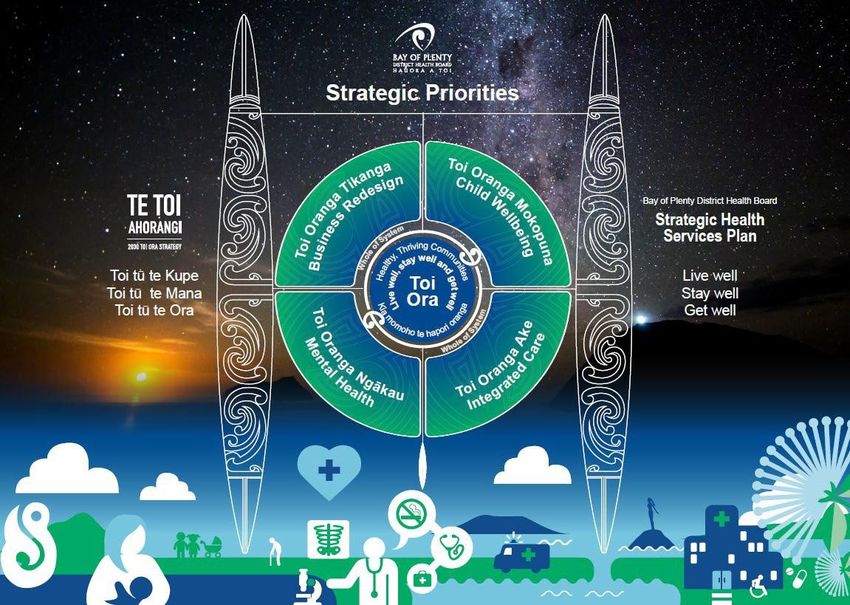
TABLE OF CONTENTS

Executive Summary

Bay of Plenty District Health Board

Living in the Bay of Plenty

Position Description

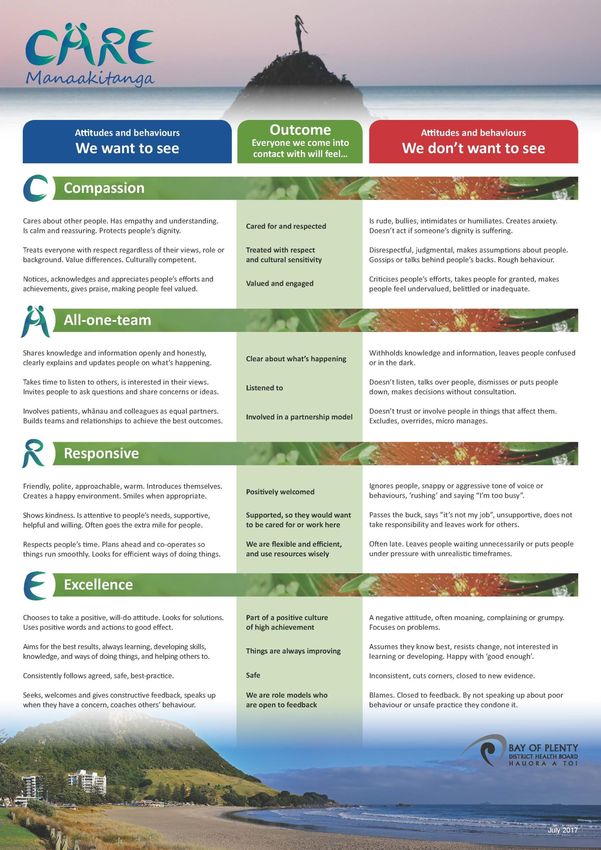
BOPDHB CARE Values
EXECUTIVE SUMMARY
•   Values-Based Organisational Leadership committed to growing in our understanding of our Te Tiriti responsibilities,
    our partnership with Iwi, and our drive to identify and address inequities
•   Innovative integrated health and social service delivery
•   Investing in Community and Regional Partnerships
•   Commitment to population health and wellbeing and playing our part alongside others in making progress in
    addressing the social determinants of health.

The Bay of Plenty District Health Board has the vision of achieving Healthy, Thriving Communities – Kia
Momoho Te Hāpori Oranga. Fundamental to realising this vision is our commitment to supporting iwi,
kaupapa Māori partners and Māori communities to achieve Toi Ora. Toi Ora is a vision for all descendants of
Toi in te Moana ā Toi (Bay of Plenty) where all live flourishing lives that allow achievement of aspirations
and hopes. At the heart of our vision is an understanding that wellbeing goes far beyond the health sector
and is grounded in mana-enhancing relationships.

Background

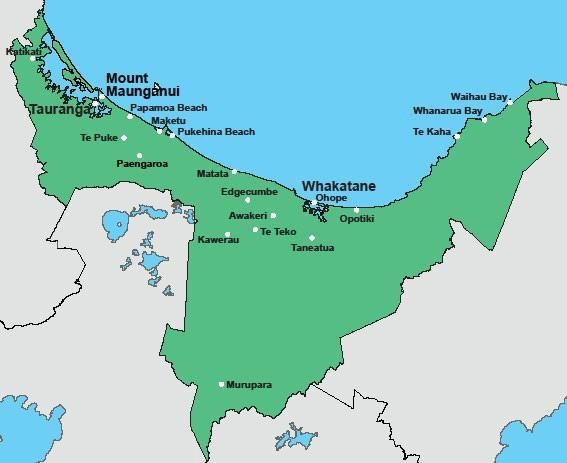
The Bay of Plenty District Health Board (BOPDHB) covers an area of 9,666 square kilometres and serves
a population of 234,350. 32% of the population are under 25 and 25% identify as having Māori
ethnicity. The area served stretches from Waihi Beach in the north-west to Whangaparaoa on the East
Cape and inland to the Urewera, Kaimai and Mamaku ranges. These boundaries take in the major
population centres of Tauranga, Katikati, Te Puke, Whakatāne, Kawerau and Ōpōtiki. Eighteen Iwi are
located within the BOPDHB area.

Services provided by the BOPDHB consist of the hospitals in Tauranga and Whakatāne, and community, dental and
public health services which provide primary care, health promotion and health protection services.
Overview of BOPDHB Strategic Intent

                                Healthy, thriving communities
                                Kia Momoho Te Hāpori ōranga.

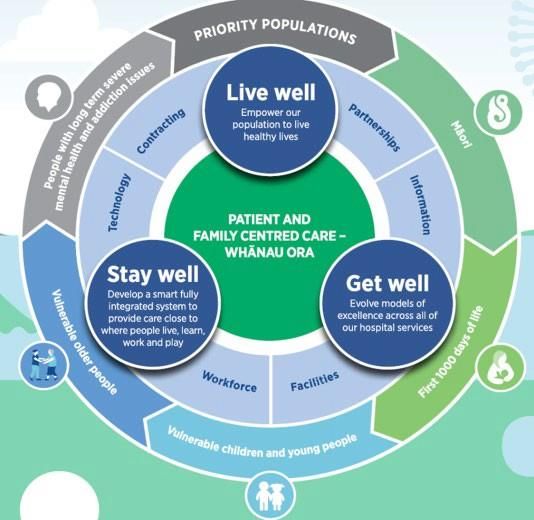
Our commitment to the vision of Healthy, Thriving Communities – Kia Momoho Te Hāpori Oranga translates to three
strategic objectives; Live Well, Get well, Stay well, and involves a shift in our models of care and a strengthening of
our approaches with our primary, community and kaupapa Māori partners.

Te Toi Ahorangi is the BOPDHB Māori Health Rūnanga strategy for supporting iwi, kaupapa Māori partners and Māori
communities to achieve Toi Ora. Te Toi Ahorangi is a statement of the aspirations, priorities and values of tangata
whenua. As a strategy activated by our Rūnanga on behalf of our iwi and kaupapa Māori partners, accelerating Te
Toi Ahorangi accelerates tangata whenua wellbeing priorities, affirms Te Ao Maori values and practices.

In order to progress towards and achieve Toi Ora, Te Toi Ahorangi is founded upon core tangata whenua values
articulated in Ngā Pou Mana o Io and He Pou Oranga Tangata Whenua – including Manaakitanga and
whanaungatanga.

An outcome of Ngā Toi Au Rangi will be that the DHB transforms to a Te Tiriti o Waitangi led organisation which will
be the first of the DHB’s and many crown entities from across the country to have transformed for that purpose. In
addition, this will be a tangible commitment to advancing equity for Māori.
While there are two strategic currents to help deliver on the Boards aspirations, they come together to form part of
a single waka; Te Waka O Toi – our vessel for change. Te Waka O Toi provides the strategic platform for a Tiriti based
partnership working together to ensure our collective aspirations and contributions are upheld and support our
strategic objectives and priorities. Te Waka O Toi – our vessel for change is reflected in the following diagram;

The three strategic objectives; Live Well, Get Well, Stay Well provide direction and areas of system focus for our
Annual Plan. While each strategic objective can be pursued independent of the others, when implemented together
they will have a much bigger impact.

The four strategic priorities; Toi Oranga Mokopuna (Enhancing Child Health and Wellbeing), Toi Oranga Ngakau
(Mental Wellbeing and Addiction), Toi Oranga Tikanga (Business Redesign) and Toi Oranga Ake (Integrated
Healthcare) are key programmes of work that have a series of actions that make up our Annual Plan along with
other Government priorities.
The following information is provided for overseas candidates relocating to the Bay of Plenty region New
Zealand. Relocating to a new country or even within New Zealand is a significant step. Given that you are
contemplating applying for a role in the Bay of Plenty, you may well have already started your research
process. There are a lot of things to consider before moving, particularly if you are relocating with a
family. Within this document, we hope to provide you with as much information as possible and links to
websites which will assist you with your decision to move to the Bay of Plenty.

VISA REQUIREMENTS & IMMIGRATION
To work in New Zealand, you need to either be an Australian or New Zealand citizen, Australian
Permanent Resident or have a valid visa that has full work rights for New Zealand.

Further detail on Immigrating to New Zealand can be found with Immigration New Zealand
https://www.immigration.govt.nz/new-zealand-visas

                                    Catchment area of the Bay of Plenty DHB
TAURANGA
Tauranga is the largest city in the Coastal Bay of Plenty and is home to approximately 146,200 people. Tauranga
is one of New Zealand’s main centres for business, international trade, culture, fashion and horticultural science.
The Port of Tauranga is New Zealand’s largest port.

Tauranga means ‘place of rest or anchorage’ in Māori and while the sparkling harbour and magnificent views
make it a great place to relax and recharge, there’s also plenty to keep you busy. Go sailing, surfing, fishing or
dolphin watching and soak up the stunning coastal environment.

Central to Auckland, Rotorua and Hamilton, and just a 15-minute drive from one of New Zealand's most popular
beach towns, Mount Maunganui.

Due to its rapid population growth, Tauranga has become New Zealand’s fifth-largest city.

WHAKATĀNE
The main centre for the eastern Bay of Plenty, Whakatāne is one of the sunniest towns in New Zealand. 90
kilometres east of Tauranga and 89 kilometres north-east of Rotorua, at the mouth of the Whakatāne River.

Whakatāne has an urban population of approximately 16,500, making it New Zealand’s 33rd largest urban area,
and the Bay of Plenty’s third largest urban area behind Tauranga and Rotorua. In addition 21,000 people live in
the surrounding townships of Te Kaha, Opotiki and Kawerau within Eastern Bay of Plenty region.

Whakatāne is also known for its fishing – more yellowfin tuna are caught here than anywhere else in the
country. Other attractions include the museum, an observatory and Māori historical sites. The Ngā Tapuwae o
Toi walkway leads to pā sites (old fortified villages), native forest and seabird colonies.

Whakatāne is also very close to Ōhope, a 10km white sandy beach, which has a small settlement and is perfect
for camping, surfing, walking and relaxing in the sun.

The brief overview above hopefully captures your interest in researching more into a move to the Bay of
Plenty region. This information came from:
    •   https://www.newzealandnow.govt.nz/regions-nz/bay-of-plenty
    •   https://www.newzealand.com
Position Title                   Infectious Diseases and General Medicine- Senior
                                  Medical Officer

 Service Group                    Medical Cluster
 Reports to                       Medical Leader – Medical Cluster
 Direct Reports                   Nil
 Issue Date                       April 2021
 Approved By                      Medical Leader - Medical

The Bay of Plenty District Health Board
The District Health Board’s fundamental purpose is to improve, promote and protect the health
of the whole population within its district, and to promote the independence of people with
disabilities.

Vision:     Healthy, thriving communities.
Mission:    Enabling communities to achieve
Our Values: Compassion, All-one-team, Responsive, Excellence

The Bay of Plenty District Health Board (BOPDHB) is committed to Te Tiriti o Waitangi and
seeks to uphold the articles and the rights of Tangata Whenua in accordance with the United
Nations Declaration on the Rights of Indigenous Peoples. We seek meaningful engagement
in decision-making with tāngata whenua at strategic, operational and service level.

Delivering this commitment is through:
    •       the implementation of the BOPDHB’s Te Toi Ahorangi 2030 Strategy, that re-
            enlivens the gifted He Pou Oranga Tāngata Whenua Determinants of Health
            framework from the 18 iwi residing within the BOPDHB geographic boundaries;
    •       partnering with iwi and Māori to achieve their aspirations for health and well-being.

All staff have a part to play in this commitment.

Primary Purpose
   •     To lead and support the provision of high quality (safe, timely, equitable, effective,
         efficient and person-centred) management of patients referred to the Bay of Plenty
         DHB Infectious Diseases and General Medical Service for to improve health
         outcomes and experience with a focus on continuous improvement.
   •     To support clinicians to develop and deliver services which are continuously
         improving and at the forefront of teaching, research and clinical excellence for
         improved patient and family/whanau experience at both individual and population
         levels
   •     Ensuring that we deliver equity, for Tangata Whenua, is central to our commitment
         under Te Tiriti o Waitangi, healthcare quality & safety and is undertaken in a
         manner which integrates iwi understandings and aspirations.
Key Responsibilities      Outcomes

To lead and support       •   Provide high quality and person-centred health services and
the provision of high         clinical practice (investigation, diagnosis, treatment and care
quality (safe, timely,        planning) for patients across inpatient and outpatient settings
equitable, effective,         which not only meets accepted practice and professional
efficient person-             standards (e.g. Royal Australasian College of Infectious
centred) management           Diseases) but is continuously improving
of patients referred to
Specialist Infectious     •   Provide leadership, participate and support continuously
Disease and General           improving high quality core operational duties and activities
Medical services at           such as:
Bay of Plenty DHB                  o Assessment, stabilisation and treatment of acute
service                                inpatients.
                                   o Co-ordinate and work in partnership with clinical, allied
                                       health, administrative teams in a multidisciplinary
                                       manner to ensure seamless healthcare delivery for
                                       patients
                                   o Conduct ward rounds and clinical review to enable
                                       rapid evaluation, planning of care and treatment or
                                       referral and transfer of patients to the most appropriate
                                       setting/environment
                                   o Provide telephone advice and consultation from within
                                       and outside the organisation
                                   o Patient and staff safety by demonstrating and adhering
                                       to best practices (e.g. hand hygiene, infection
                                       prevention control) across work practices, equipment
                                       and work areas
                                   o Participate in Departmental meetings, both clinical and
                                       business (e.g. morbidity and mortality, grand rounds)
                                   o Healthcare quality, patient safety and improvement
                                       initiatives and programmes
                                   o Participate on the acute on-call General Medical roster
                                       (including afterhours acutes) and when rostered on for
                                       acute cover be immediately available for telephone
                                       consultation at all times and be available in person
                                       within 20 minutes
                          •   Be responsible for maintaining his/her knowledge and skills by
                              self-managing         continuing    professional    development,
                              credentialling and core educational activities (e.g. infection
                              prevention and control) through appropriate mechanisms such
                              as peer discussion, relevant literature/internet access of
                              literature, attendance and participation in professional/clinical
                              meetings and conferences
To support the            •   Provide clinical direction and leadership by contributing to
Medical Leader and            activities such as:
Head of Department                 o Supporting medical colleagues within the hospitals,
to deliver a speciality                regionally and within primary care to improve the
Infectious Diseases                    management of people referred to service for
service which is                       secondary specialist care.
continuously
improving and at the o Collaboration with multi- and interdisciplinary teams in
forefront of teaching, the hospitals, regionally and within the community
research and clinical o Development of pathways for the care of patients with
excellence for better Infectious Disease presentations.
health outcomes and o Peer review and audit at a local and national level
patient experience at o Provide advice to the DHB on future planning and
both individual and strategic direction
population levels o Develop and maintain an educational collegial
relationship with specialist colleagues across the
Midlands Region
o Development of Infectious Diseases Services by
working with patients and their whanau, Midlands
Regional services, the multidisciplinary team, providers
and Planning and Funding on service direction,
meeting Health Targets and the District Annual Plans
and other relevant programs.
o Advancement of integrated care across primary,
community and secondary care – locally and regionally
o Administrative duties that can be reasonably expected
of a specialist such as contributing to planning,
contracting and other organisational activities, budget
management and costing exercises when requested
• Lead and support the monitoring and improvement of service
quality and contribute to:
o The measurement, analysis and reporting of national
and regional clinical excellence and quality indicators
and quality and safety improvement programmes (e.g.
Choosing Wisely)
o Participate in quality assurance, customer
satisfaction, clinical audit, and peer review activities.
o Ensure equity, in particular for Māori, is central to
service development, planning and improvement and
in a manner, which integrates iwi understandings and
aspirations
o Healthcare and environmental sustainability
• Lead and support teaching by actively contributing to the acute
medical roster and provide appropriate and high quality
oversight, clinical academic detailing, mentoring, education
and pastoral care and peer support of resident medical
officers, students and other relevant peer colleagues such as
Specialist Nurses, community groups, GPs and other
providers
• Champion and cultivate a data driven evidence-informed
culture and coach clinicians, managers and others to more
effectively and routinely use data to improve healthcare quality
across safety, timeliness, effective, equity, efficient and
person-centred domains
• Lead and support research and clinical excellence (e.g.
research outputs, grants, networks, and collaborations) for
better health outcomes and patient experience at both
individual and population levels
To ensure equity, in • Work in partnership with the Pou Haumanu, Pou Tikanga and
particular for Māori, is Pou Matai Rongoa to drive Māori responsiveness, to embed
central to healthcare tikanga Māori values into the core activities of the service.quality & safety • Meaningful collaboration and participation in quality
measurement and in a improvements for Tangata Whenua in partnership with the
manner, which Manukura
integrates iwi • Ensure the professional and political integrity of BOPDHB by
understandings and carrying out all functions in accordance with te Tiriti o
aspirations Waitangi and the aspirations of Te Toi Ahorangi in
partnership with Māori Health Gain and Development Te Toi
Ahorangi
• Understand equity from a Treaty perspective Achieving equity
in health outcomes
• Demonstrate Manaakitanga best practices including authentic
partnership, consultation, mahitahi approaches to decision
making and improvement.
• Protection of Māori needs, values and beliefs
• Effectiveness for Māori
• Adjust and create health / Toi Ora intelligence systems that
identify, articulate and enable quality services for Māori – in
alignment with He Pou Oranga Tāngata Whenua and
covering health, quality and safety.
• Demonstrate commitment to Ngā Au Rangi (Strategic
Currents) of Te Toi Ahorangi.
• Show sensitivity to cultural, spiritual, and social complexity in
the workforce and patient populations.
• Align work with the regional equity strategy
Recognises individual • Recognise individual responsibility for workplace Health and
responsibility for Safety under the Health and Safety at Work Act 2015
workplace Health and • Ensure a safe working environment and safe working practices
Safety under the • Ensure a culturally safe workplace for all staff and consumer
Health and Safety at groups
Work Act 2015 • Work with Health & safety to ensure all accidents/incidents in
the workplace are investigated; hazards are recognised, and
adequate controls are put in place
Key Relationships
Internal External
• Medical Leader – Medical • External agencies such as but not limited
Services to:
• Nurse Leader-Medical o General Practitioners
Services o Iwi providers
• Business Leader-Medical o Community based providers
Services o Ministry of Health
• Senior and Junior medical o Midland Health Share – Te
officers from all services Manawa Taki
• Nursing staff including o Coronial Officers
Infection Prevention and o Other governmental agents and
Control nurse specialists services
• Primary Health Providers o Medical Council of New Zealand
• Allied Health Professionals o Royal Australasian College of
Physicians
o Whanau, Hapu and Iwi• Support Staff, including o Ministry of Health
Orderlies, Administration o Health Quality and Safety
and Information Technology Commission
• Other o HealthRoundTable
Management/Business Staff o Toi Te Ora
• Health Quality and Safety o Health Advocacy Services
staff o External auditors
• Māori Health Gains and o Professional bodies
Development
• Governance & Quality staff
• Innovation & Improvment
staff
• Planning and Funding
Person Specification
Essential Desirable
Critical To be successful in this role you will need to:
Success • Be courageous and willing to challenge status quo in a professional
Factors manner
• Know yourself, your limitations and your ‘why’ and your unique
contributions
• Operate within, exude, and embed our CARE values.
• Be an expert in empowering individuals and teams to flourish
• See possibilities, potential, and tangible opportunities to create an
outstanding, integrated healthcare system
• Be highly engaging and envisioning
• Be able to listen, learn and interpret your expertise for our local
unique environment
• Be able to take people with you
• Be passionate about the wellbeing of our people and our patients.
• Not settle for mediocrity
• Love what you do
Qualifications • Eligible for registration or • Registered as a Medical
already vocationally registered Practitioner by the Medical
with the Medical Council of Council of New Zealand.
New Zealand • Other medical qualifications
• Hold Fellowship of the Royal • Management or other graduate
Australasian College of level qualifications
Physicians or equivalent, in • Mātauranga Māori
Infectious Diseases qualifications.
• Te reo Māori (NCEA level 3-4)
and/ or enrolled / prepared to
work towards fluency in te reo
Māori
Clinical Skills • Proficiency in management of • Experience and interest in
Infectious Diseases. leading the development of
• Competency in management of subspecialist Infectious
all general medical Disease services with a focus
presentations and conditions. on integrated care.Medical • Relevant experience in • Change Management and
Experience Infectious Disease specialist leadership skills - have an
and services. understanding of the issues
management • Service development surrounding equity of access
• Quality initiative and health care provision in
• Clinical governance New Zealand, in particular how
it pertains to Infectious Disease
Specialist Services.
Teaching, • Evidence of participation in, • Formal training/ qualification in
Audit & and commitment to Clinical medical education.
Research audit. • Original research.
• Experience of, and commitment • Publications.
to teaching undergraduate and • Success in obtaining funding
postgraduate students. for research from external
• Ability to conduct effective bodies.
literature reviews, critically • Ability to supervise post-
analyse, synthesise and graduate research.
summarise data into relevant, • Research, evaluation and
meaningful and simple-to- analytical skills. Able to
understand information effectively analyse
data/information and relate to
the medical, nephrology and
health policy criteria.
Attributes • Compassionate with high emotional intelligence, communication, and
interpersonal skills with an ability to bring people together to work
towards common goals
• Strong leadership, coaching, training, and development skills and
accepts responsibility for own practice
• Well organised and adaptable with an ability to meet deadlines
• Effective programme management facilitation, relationship, oral and
written communication skills
• Computer literate and proficient with the use of Microsoft packages
and other e.g. Excel, Word, PPT. Excellent analytical skills and skilled
in translating legislation, regulations, and policies into operational
systems
• Broad and balanced perspective – able to adopt a lateral approach in
decision making and the development and sharing of ideas.
• Effective and efficient resource management
• Able to keep a sense of proportion when working in challenging
situations and make logical and realistic decisions under pressure.
• Has appropriate knowledge of New Zealand legislation with regard to
the broad range of patient rights, clinical
responsibilities/accountability and Ministry of Health strategy
documents.
• Ensures an environment that promotes innovation and motivation of
other team members.
• Skilled communicator. Written and oral presentations are articulate,
relevant and concise.
• Interpersonal skills. Demonstrated skills in the sharing of ideas along
with an open and honest communication style with colleagues and
multi-disciplinary team members, supports development of “the
teams” and others.• Integrity and self-motivation. Has energy, initiative and enthusiasm.
Able to critically reflect on own practice with realistic confidence in
own knowledge and achievements.
• Personal management skills. Demonstrates sound organizational
practices including time management.
You agree to demonstrate flexibility and a willingness to perform a variety of tasks to
promote and support BOPDHB initiatives. This includes the delivery of services across
BOPDHB sites (Tauranga and Whakatane Hospitals along with DHB sites that may be
developed for future service delivery) and flexibility around rostering within the team.
You are required to meet the Health and Safety at Work Act 2015 requirements as set out in
the BOPDHB Health and Safety policies and protocols. This includes completing successfully
any health and safety training provided by the BOPDHB.
You are required to maintain a standard of health which will allow for the performance of all
duties and functions of the position. All BOPDHB sites are smokefree environments.
Health Practitioners Competence Assurance Act 2003
1. You are required to maintain your current competency-based practicing certificate.
2. You must notify your Manager of any changes to scope or conditions on practice
(determined by Regulatory Authority).
3. You must complete the requirements of any competency programme.
4. You must notify your employer of concerns relating to the risk of harm to the public of
another health practitioner practicing below the required standard of competence.
5. Know the provisions of the HPCAA as the governing legislation.
Vulnerable Children Act 2014
Due to this position having contact with children and the BOPDHB’s commitment to child
protection, you will be subject to ‘safety checks’ under the Vulnerable Children Act at the
time of hire and thereafter as per the relevant legislationYou can also read


