Influenza Updates - WHO Collaborating Centre for ...
←
→
Page content transcription
If your browser does not render page correctly, please read the page content below
Influenza Updates
The newsletter of the WHO Collaborating Centre for Reference and
Research on Influenza in Melbourne
@WHOCCFluMelb Volume 8, Issue 1, May 2019
Preparation for the upcoming influenza season
The first few months of 2019 has seen unusually elevated levels of inter-seasonal
influenza in most parts of Australia, and as such we been receiving a higher number of
samples than usual for this time of year. We do not yet know whether this year’s
influenza season will be particularly severe in Australia or other countries with a similar
seasonality. Nevertheless, with winter and/or the influenza season approaching over
the next few month in many countries, we expect that the number of samples
submitted to the Centre will increase leading up to the next WHO Consultation on the
Composition of Influenza Vaccines for the Southern Hemisphere in September 2019.
Please note the following points:
please send us your samples as soon as possible after collection, as they are
most useful when they have been collected recently
we accept both viral isolates and/or original clinical specimens
we need to receive samples by the end of August at the very latest (and
preferably earlier) in order to process them in time for the Consultation.
the WHO Shipping Fund Project (SFP) is available to assist National Influenza
Centres in covering the cost of shipping samples to WHO Collaborating Centres
up to four times per year. It is recommended that one of the shipments be in July
to mid-August. If you have any questions about shipping samples or would like
information about accessing the WHO Shipping Fund, please contact us at
whoflu@influenzacentre.org.
Timing for sending samples to a WHO Collaborating Centre
Circulation of influenza viruses, Western Pacific Region of WHO
Figure adapted from FluNet: http://www.who.int/influenza/gisrs_laboratory/flunet/en/
1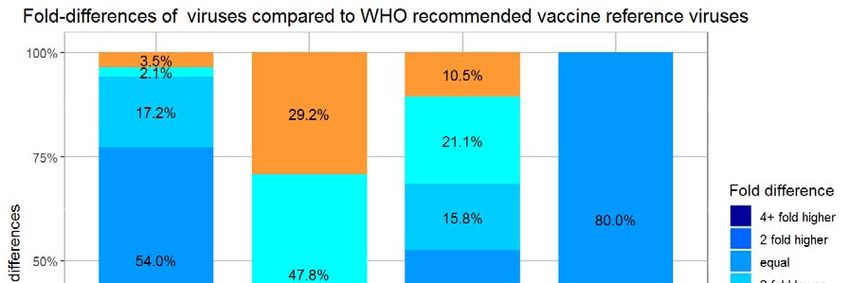
Recommendations for Northern Hemisphere 2019-2020 vaccine announced
The WHO Consultation on the Composition of Influenza Vaccines for the Northern Hemisphere 2019-
2020 was held in Beijing, China on 18-20 February 2019. Following the Consultation, WHO made the
following recommendation:
It is recommended that egg based quadrivalent vaccines for use in the 2019-2020 northern
hemisphere influenza season contain the following:
an A/Brisbane/02/2018 (H1N1)pdm09-like virus;
an A/Kansas/14/2017 (H3N2)-like virus; *
a B/Colorado/06/2017-like virus (B/Victoria/2/87 lineage); and
a B/Phuket/3073/2013-like virus (B/Yamagata/16/88 lineage).
It is recommended that the influenza B virus component of trivalent vaccines for use in the
2019-2020 northern hemisphere influenza season be a B/Colorado/06/2017-like virus of the
B/Victoria/2/87-lineage.
* The recommended A(H3N2) component was announced on 21 March 2019.
The recommendation includes a change in
the A(H1N1)pdm09 and A(H3N2) components
of the egg-based vaccine compared to the
previous vaccine recommendations (for the
southern hemisphere 2019). The change in
the recommended A(H1N1)pdm09
component was based on differences in the
response of recent circulating viruses to
human post-vaccination sera compared to
the cell- and egg-grown viruses of the
previous A(H1N1)pdm09 vaccine strain.
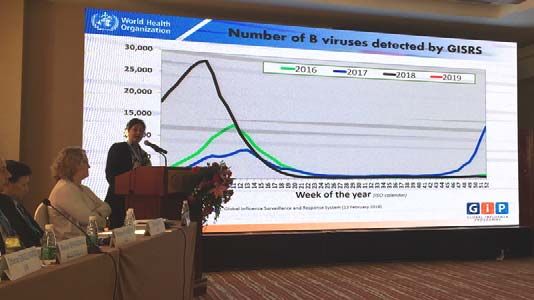
Centre director Kanta Subbarao presents data at the WHO Consultation
The recommendation for the A(H3N2) on the Composition of Influenza Vaccines for the Northern Hemisphere
2019-2020.
component of the vaccine was postponed by
one month—such a delay is very unusual and has only happened once in the previous 20 years. The
delay was due to the continual rapid evolution of circulating A(H3N2) viruses, and in particular a recent
increase in the proportion of one group of antigenically distinct A(H3N2) viruses circulating in some
countries. Postponing the recommendation enabled more time to monitor circulating viruses and
characterise potential vaccine viruses. Ultimately, the recommended A(H3N2) component was
changed due to differences in the antigenic properties of recently circulating viruses compared to the
previous A(H3N2) vaccine strain.
Contribution of National Influenza Centres to the vaccine
We thank everyone who sent us influenza samples in 2-3 months prior to the Consultation. Your
viruses provided essential data on recently circulating strains and helped to inform the choice of
recommended vaccine strains.
We are especially pleased that the newly recommended A(H1N1)pdm09 virus, A/Brisbane/02/2018,
was originally submitted to our Centre by the Queensland Health Forensic and Scientific Services. This
is in addition to B/Phuket/3073/2013, which was first included in the WHO vaccine recommendation
in September 2014 and previously sent to the Centre by the Thai National Influenza Centre (Bangkok,
Thailand) in 2013.
In this context, we would like to acknowledge the contribution and critical role played by WHO
National Influenza Centres and other submitting laboratories in providing influenza samples to WHO
Collaborating Centres, not only for the purposes of analysis and surveillance, but also for the
provision of potential vaccine candidates. Please continue to send us your samples, as of course the
influenza virus continues to circulate and evolve, and need for constant surveillance remains.
2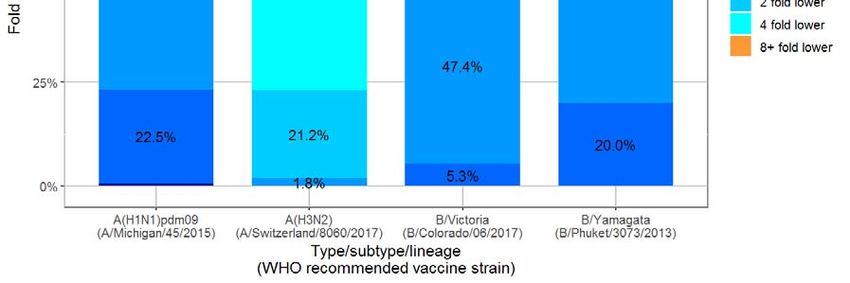
Australian Influenza Symposium and Australian Respiratory Virology Meeting
SAVE THE DATE: The 13th Australian Influenza Symposium will be held on 28–29 October 2019,
followed by the Australian Respiratory Virology Meeting on 30th October. Both meetings will be held
at the Queensland University of Technology, Brisbane.

An invitation to register and further details will be emailed to the symposium mailing list in coming
months. If you have attended either of these meetings in the past you will be on the mailing list. If
your contact details have changed or if you wish to be added to the mailing list, please register your
details here. Details will also be provided on the Centre website: http://www.influenzacentre.org/
news_symposium.htm

Farewell and good luck
It is with sadness but good wishes that we announce the departure of three long-standing staff
members from the Centre. We thank Chris, Rob and Aeron for their invaluable contributions to the
Centre and the global influenza surveillance community over many years, and wish them all the very
best for the future.
 Mr Chris Durrant retired from his position as laboratory manager in June 2018 after 51 years’
 continuous service at the Centre and its predecessor at the Commonwealth Serum Laboratories
 (CSL). Chris was an integral member of the Centre’s laboratory team and his longstanding
 knowledge of the Centre’s processes and history will be missed.

                  Mr     Robert   Shaw                           A/Prof Aeron Hurt joined the Centre
                  retired    from    his                         in 1999. As Head of Antiviral Drug
                  position as Head of                            Sensitivity,  Aeron    oversaw     the
                  Antigenic Analysis in                          establishment of routine testing of
                  March 2019 after 29                            viruses for sensitivity to antiviral
                  years at the Centre.                           drugs for surveillance purposes since
                  Rob joined the Centre                          2001. He also established a research
                  two years prior to its                         group with interests in Antivirals and
 designation as a WHO Collaborating             Animal Influenza Viruses. Aeron leaves the Centre in
 Centre, and oversaw antigenic analyses         July 2019 to take up his new position as Principal
 of viruses for surveillance and vaccine        International Medical Director – Influenza, at Roche in
 development purposes.                          Switzerland.

Upcoming meetings and conferences
Staff from our Centre will be attending and presenting posters and talks at the following meetings
during 2019. Please contact us if you would like to meet us at any of these meetings.

Australasian Ornithological Conference                      Options X for the Control of Influenza
3–5 July 2019; Darwin, Australia                            28 August –1 September 2019; Singapore
https://www.aocdarwin.com/                                  https://2019.isirv.org/
This conference provides a forum for the exchange of        This conference is held every 3-4 years and is
information     and    ideas    between  avian-based        the largest international conference focusing
researchers and conservationists throughout the             exclusively on influenza prevention, control
Australasian region. The conference will include a          and treatment, including seasonal influenza
symposium on disease in birds, including avian              and pandemic preparedness.
influenza.

Communicable Diseases Control Conference 2019                        Australasian       Virology       Society
19–21 November 2019; Canberra, Australia                             (ASV10)
https://www.phaa.net.au/events/event/communicable-diseases-          2–5 December 2019; Queenstown,
control-conference-2019                                              New Zealand        https://avs.org.au/avs-
This theme of year’s conference is Controlling communicable          meetings/avs10-2019/
diseases – mobilising evidence, action and partnerships. This will   This conference is held biennially to
include emergence or re-emergence of infectious agents,              discuss recent advancements in
complex outbreaks, resistant microorganisms, genomics, and           virology and to facilitate the ongoing
effective interventions, along with high rates of disease in          collaboration of virology professionals.
rural and remote Australia.
                                                      3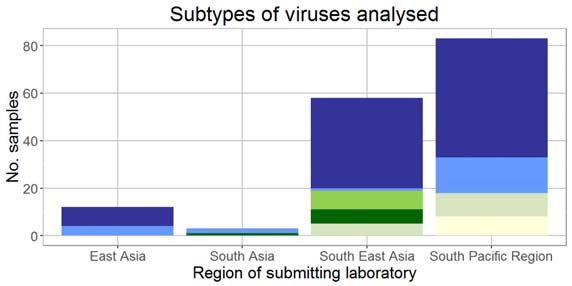
Recent activity at the Centre (1 January — 30 April 2019)
Below is a summary of surveillance activities at the Centre from 1 January to 30 April. We have been
especially busy for this time of year due to unusually elevated levels of influenza activity in Australia during
the Southern Hemisphere summer. We anticipate that the next few months will continue to be busy as the
Southern Hemisphere influenza season commences.
Samples received
The Centre received 2546 influenza samples from the laboratories and institutions listed below during the
period 1 January—30 April 2019 .
AUSTRALIA: Canberra Hospital, Westmead CAMBODIA: Institut Pasteur du Cambodge
Hospital, John Hunter Hospital, Lismore Base MACAU: Public Health Laboratory
Hospital, Prince of Wales Hospital, The Children’s
NEW CALEDONIA: Institut Pasteur
Hospital at Westmead, Royal Darwin Hospital,
Queensland Health Forensic and Scientific NEW ZEALAND: Institute of Environmental
Services, Sullivan Nicolaides Pathology, SA Science and Research
Pathology, Hobart Pathology, Royal Children’s PHILIPPINES: Research Institute for Tropical
Hospital, Alfred Hospital, Monash Medical Center, Medicine
Royal Children’s Hospital Molecular Microbiology SINGAPORE: National Public Health Laboratory
Department, Royal Melbourne Hospital, VIDRL,
SOLOMON ISLANDS: National Referral Hospital
PathWest QEII Medical Centre
SRI LANKA: Medical Research Institute
BRUNEI: RIPAS Hospital
THAILAND: Thai National Influenza Center
Neuraminidase inhibitor
Genetic analysis: Sequencing
susceptibility: A total of 1376
Antigenic analysis: was performed on 492 HA, 482
influenza isolates were tested by
A total of 1470 influenza NA, 381 MP and 14 NS genes
neuraminidase inhibition (NAI)
isolates were analysed by HI from 496 viruses by Sanger
assay for susceptibility to
assay. sequencing or Next Generation
oseltamivir, zanamivir, peramivir
Sequencing (NGS) techniques.
and laninamivr.
No. of viruses analysed by No. of viruses tested by NAI No. of viruses sequenced by
HI assay* assay* NGS or Sanger sequencing
A(H1N1)pdm09
A(H1N1)pdm09
A(H1N1)pdm09
Mixed type A/B
Country of
B/Yamagata
B/Yamagata
B/Yamagata
B/Victoria
B/Victoria
B/Victoria
subtyped
submitting
A(H3N2)
A(H3N2)
A(H3N2)
A mixed
A mixed
A mixed
subtype
laboratory
Australia 683 313 1 25 28 611 290 4 26 38 131 194 1 15 23 2
Brunei 5 5 1 5 1 1 4 2 1
Cambodia 39 1 6 21 39 1 6 21 1 3 5
Fiji 11 1 16 13 16 3 6
Macau SAR 29 10 1 29 10 1 8 5 1
Malaysia 30 24 23 19 29 24 22 19 7 3 18 8
New Caledonia 2
New Zealand 12 2
Philippines 13 2 17 13 2 17 2 5 3
Singapore 21 16 8 10 21 16 8 10
Sri Lanka 7 13 14 4 7 13 14 4 4 9 12 1
Thailand 16 15 3 5 16 15 3 5 8 7 3 5
Total 857 410 1 99 103 770 385 4 98 119 166 223 1 56 48 2
* Subtypes and lineages are based on analysis of HA and in some cases confirmed by genetic analysis of NA.
Isolation of viruses in eggs
The Centre undertakes primary isolation of selected viruses in eggs to obtain potential vaccine strains.
From 1 January to 30 April 2019, 5 A(H1N1)pdm09, 8 A(H3N2) and 6 B/Victoria viruses were successfully
isolated in eggs at the Centre.
4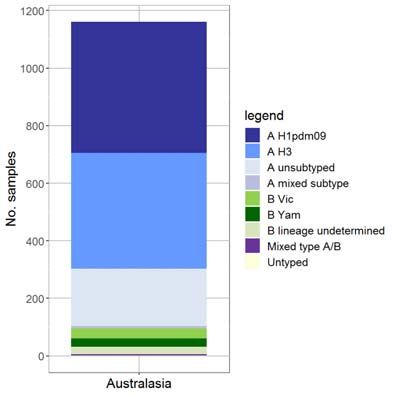
Surveillance update: Virus activity 1 January—30 April 2019

The data below are results for viruses collected between 1 January and 30 April 2019 that have been
analysed at the Centre as of 7 May 2019.
Virus types/subtypes†
The type and subtype/lineage of 1317 viruses have been
determined. Of viruses analysed to date, A(H1N1)pdm09 have
predominated (41.9%), followed by A(H3N2) viruses (32.3%).

†
    Subtypes and lineages are based on analysis of the HA and in some cases confirmed by genetic analysis of NA.

Antigenic analysis†
A total of 422 viruses were tested using the haemagglutination inhibition (HI) assay. Viruses were identified
as low-reactors if their titre with reference antiserum was at least 8-fold lower than the titre of the
reference virus. The majority of viruses were antigenically similar to their respective 2019 Southern
Hemisphere vaccine reference strains, however, a larger proportion of A(H3N2) viruses were low reactors
to the A/Switerland/8060/2017 reference strain.

     †
         Subtypes and lineages are based on analysis of the HA and in some cases confirmed by genetic analysis of NA.

                                                                               5
Genetic analysis: focus on A(H3N2)
Sequencing and phylogenetic analysis of A/Dunedin/1/2019 feb
A/Newcastle/50/2019 mar
haemagglutinin (HA) genes of viruses
A/Victoria/909/2019 feb
A/Macau/600004/2019 jan
A/Macau/600114/2019 jan
circulating during January–April 2019, show an
A/Newcastle/2/2019 jan
A/Newcastle/5/2019 jan
A/South Australia/51/2019 feb
A/Sydney/35/2019 feb
increasing proportion of viruses in the A/Sydney/45/2019 feb
A/South Australia/250/2018 dec
A/Newcastle/42/2019 mar
3C.2a1b subclade, as well as a smaller number
A/Perth/1000/2019 jan
A/Hawkes Bay/1/2019 mar
A/Sydney/53/2019 mar
of viruses falling into the 3C.3a clades.
A/Victoria/2123/2018 oct
A1b+131K A/Canberra/345/2018 dec
A/South Australia/243/2018 dec
A/Newcastle/3/2019 jan
A/Darwin/35/2019 jan
A/Newcastle/158/2018 dec 3C.2a1b+131K
A/Townsville/44/2018 nov
A/Darwin/3/2019 jan
A/Victoria/2500/2018 dec
A/South Australia/1000/2019 jan
A/Townsville/1005/2018 dec
A/Newcastle/105/2018 dec
A/Brisbane/176/2018 dec
Legend A/Newcastle/148/2018 dec
A/Chanthaburi/2967/2018 dec
Reference strains A/Newcastle/83/2018e dec
A/Newcastle/82/2018e dec
A/Perth/15/2019 jan
CURRENT VACCINE STRAIN A/Victoria/1/2019 jan
A/Victoria/2/2019 jan
Viruses collected in 2019 A/Sri Lanka/1/2019 jan
A/Sri Lanka/2/2019 jan
} Brackets indicate clades A/Malaysia/RP3325/2018 sep
A/Victoria/40/2018 nov
Scale bar represents 0.3% nucleotide A/Victoria/2139/2018 nov
A/Victoria/23/2018 oct
sequence difference between viruses A/Philippines/13/2017 sep
A/Philippines/49/2018 jul
A/South Australia/186/2018 nov
A/Victoria/9/2019 jan
A/South Australia/161/2018 nov
A/Sydney/22/2018e mar
A/Singapore/KK0130/2018e jan 3C.2a1b+135N
A/Singapore/GP0454/2018e feb
A/South Australia/120/2018 oct
A/Singapore/GP0077/2018e jan
niidA/Kanagawa/IC1725/2018e jan
A/Sri Lanka/93/2017e nov
A/Fiji/71/2017 sep
A/Victoria/2104/2018 oct
A/South Australia/167/2018 nov
A/South Australia/233/2018 dec
A/South Australia/171/2018 nov
A/Victoria/2152/2018 nov
A/Sri Lanka/62/2018 dec
A/Perth/1/2019 jan
A/Sydney/1006/2019 jan
A/Newcastle/106/2018 dec 3C.2a1b+135K
A/South Australia/153/2018 nov
A/Macau/606804/2018 dec
A/South Australia/4/2019 jan
A/Hong Kong/681/2018e
A/Abu Dhabi/240/2018e
A/Netherlands/10260/2018e feb
A/Victoria/653/2017e
A/Victoria/624/2017e
A/Newcastle/36/2017e
A/Kanagawa/ZC1617/2017e
A/RhodeIsland/01/2018e jan
A/Kanagawa/IC1745/2018e
A/Singapore/KK0259/2018e mar
A/Nebraska/01/2018e jan
A/Brisbane/01/2018e jan
A/Wisconsin/04/2018e jan
A/Brisbane/28/2018e feb
A/Singapore/KK0199/2018e feb
A/Kanagawa/AC1740/2018e
A/Kanagawa/IC1718/2018e
A/Kentucky/03/2018e jan
A/SWITZERLAND/8060/2017e
A/South Australia/274/2017e dec
A/Brisbane/43/2018e apr 3C.2a2
A/Kentucky/1/2018e jan
A/Maine/2/2018e
A/Newcastle/146/2018 dec
A/Sydney/544/2018
A/Saraburi/279/2018 oct
A/Tasmania/1001/2018 oct
A/Sydney/1038/2018 nov
A/Brisbane/161/2018 oct
A/Fiji/71/2018 oct
A/Sydney/179/2018 oct
A/South Australia/214/2018 dec
A/South Australia/10/2018e apr
A/Brisbane/168/2018 nov
A/Perth/172/2018 oct 3C.2a3
A/Singapore/TT1374/2016e
A/Michigan/15/2014
A/Victoria/746/2017e sep
A/Hong Kong/4801/2014e
A/Canberra/19/2019 jan
A/Newcastle/623/2019 feb
A/Newcastle/631/2019 mar
A/Sydney/740/2019 feb
A/Victoria/703/2019 apr
A/KANSAS/14/2017e
A/Canberra/23/2019 feb 3C.3a
A/South Australia/218/2019 mar
A/Perth/103/2018 sep
A/Perth/1008/2018 jul
A/Perth/1001/2018 jun
A/Brisbane/34/2018e mar
A/Newcastle/78/2017 jun
A/Newcastle/51/2017 mar
A/SWITZERLAND/9715293/2013e
A/Texas/50/2012e
0.003
Neuraminidase inhibitor susceptibility
Viral isolates are routinely tested for their susceptibility to
the antiviral drugs oseltamivir (Tamiflu), zanamivir Type/subtype/ No. viruses tested
(Relenza), peramivir and laninamivir using the lineage† by NAI assay
neuraminidase inhibition (NAI) assay. Of 484 viruses tested, A(H1N1)pdm09 248
none showed highly reduced inhibition to any of the
neuraminidase inhibitors. A(H3N2) 195
A mixed subtype 2
Viruses with reduced inhibition by antiviral drugs in the NAI
assay undergo genetic analysis of the neuraminidase gene B/Victoria 22
to detect mutations associated with the functional change.
B/Yamagata 17
The relationship between reduced inhibition and the
†
clinical effectiveness of a neuraminidase inhibitor is not Subtypes and lineages are based on analysis of the HA
well understood. Further studies would be required to and in some cases confirmed by genetic analysis of NA.
determine whether a virus with reduced inhibition in the
NAI assay is clinically resistant.
6 WHO Collabora ng Centre for Reference and Research on Influenza
Peter Doherty Ins tute for Infec on and Immunity
792 Elizabeth Street, Melbourne VIC 3000, Australia
ph: +61 3 9342 9300 Fax: +61 3 9342 9329
Email: whoflu@influenzacentre.org h p://www.influenzacentre.orgYou can also read


