Insights from a Sole Survivor: Quercus castaneifolia - Harvard University
←
→
Page content transcription
If your browser does not render page correctly, please read the page content below
Insights from a Sole Survivor: Quercus castaneifolia

Peter J. Zale

O
         aks (Quercus spp.) have become a world-      the species’ identity to be Quercus castaneifo-
         wide symbol of tree conservation. Of         lia, chestnut-leaf oak, and that the accession
         the approximately 450 described oak          had a provenance linked to the wilds of north-
species, at least 175 are of conservation concern     ern Iran. In my further investigations, I learned
and many require further conservation assess-         more about its natural history and, eventually,
ments (Oldfield and Eastwood, 2007; Jerome            saw it growing in its native habitat.
et al., 2017). To aid in these efforts, public
gardens around the world have invested sig-           Taxonomy and geography of
nificant energy to develop taxonomically and          chestnut-leaf oak
geographically exhaustive, genetically diverse        Quercus castaneifolia was first described in
oak collections with high conservation value.         1831, and belongs to Section Cerris and Subsec-
Aside from their importance as landscape and          tion Cerris, a placement within the genus that
garden specimens, maintaining living collec-          has remained stable since Camus’ 1936 mono-
tions of oaks in public gardens is particularly       graph. However, the taxonomy within Q. cas-
important because recalcitrant (desiccation           taneifolia has been debated, with at least eight
intolerant) oak seeds cannot be stored long           intraspecific botanical taxa (varieties, subspe-
term in germplasm repositories, highlighting          cies, and formae) described based on differences
an increased need for ex situ conservation of         in leaf, acorn, trichome, foliar epidermis, and
individual trees and improvements in collec-          pollen morphology (Panahi et al., 2011). Molec-
tion practices. Within the United States, the         ular analysis using Amplified Fragment Length
American Public Gardens Association (APGA)            Polymorphisms (AFLP) indicated that the dif-
has recognized the efforts of 20 public gardens       ferences at the molecular level were not enough
who have formed a Plant Collections Network           to distinguish among the previously proposed
Quercus multisite collection to tackle some of        intraspecific taxa, except for Q. castaneifolia
these efforts (APGA, 2017).                           subsp. aitchisoniana, and that molecular varia-
   Benchmarking studies have become an                tion in some cases was indicative of introgres-
important tool to help these and other gardens        sion from other species (Azadbakht et al., 2015).
prioritize their conservation and collecting          Presently, the botanical community considers
efforts by revealing the diversity of oaks in their   Q. castaneifolia to be a single polymorphic or
collections relative to those in cultivation else-    highly variable species (Rix and Kirkham, 2009;
where. Gaps, or missing species, reveal areas         The Plant List, 2017).
for future development, and the identification           In addition to its distinct leaf characters,
of species (or clones) uniquely or poorly repre-      diagnostic morphological features of this spe-
sented in cultivation can indicate those in need      cies include its linear bud scales, and curi-
of further preservation and distribution. How-        ously elongated, but variably sized, ellipsoidal
ever, the power of benchmarking is predicated         acorns—maturing in two years—that reach 2
on the quality of records and the verification        to 4.5 cm (0.78 to 1.78 in) in length and have
of species to accurate identity. In 2015, verifi-     cupules or caps covered with prominent scales
cation of tree plantings on perimeter areas of        (see inside front cover). The branching habit of
Longwood Gardens revealed a mysterious oak            mature trees is variable, ranging from upright
bearing an incorrect label. An exercise in cura-      with a dominant central leader, to a spreading
torial sleuthing led me on a chase to discover        structure devoid of a strong central leader that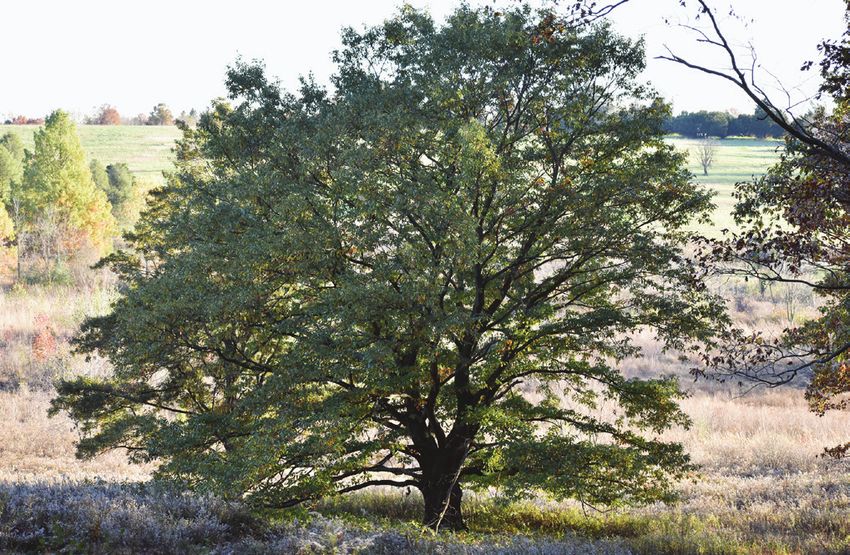
36 Arnoldia 75/3                     •   February 2018

   LONGWOOD GARDENS

                      Quercus castaneifolia is aptly named, with leaves [7 to 20 cm (2.8 to 7.9 in) long and 3 to 6 cm (1.2
                      to 2.4 in) wide] resembling those of the sweet or Spanish chestnut (Castanea sativa). This herbarium
                      voucher was collected from the specimen growing at Longwood Gardens.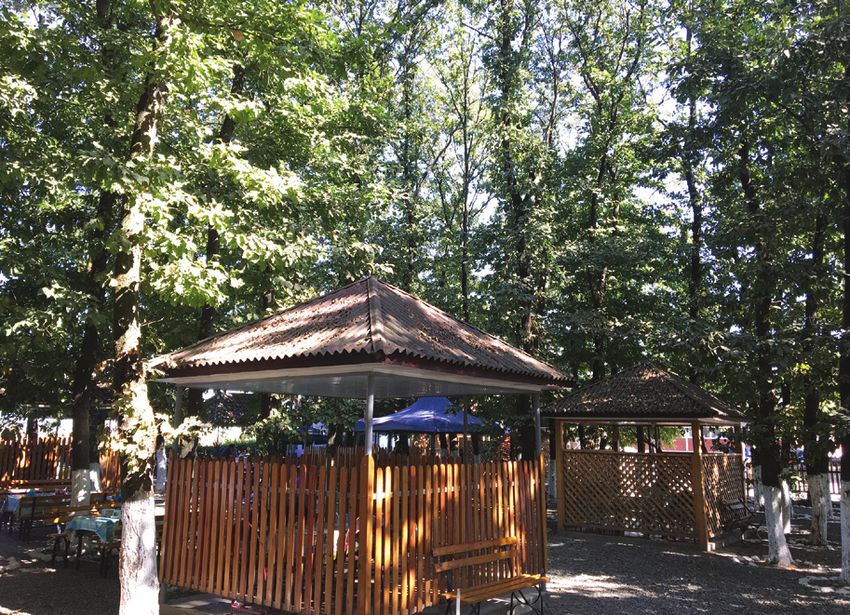
Quercus castaneifolia 37

                                                              climate of Iran’s Alborz Mountains (Panahi
                                                              et al., 2011). In some of these areas, Quercus
                                                              castaneifolia can form pure stands, although
                                                              it becomes a member of Fagus orientalis (ori-
                                                              ental beech)-dominated forest above 1200 m
                                                              (3937 ft). It is a minor forest component in the
                                                              eastern portion of its range, in areas dominated
                                                              by Platycladus orientalis (Oriental arborvitae)
                                                              (Menitsky, 2005). One study indicated that Q.
                                                              castaneifolia comprises 6.5% of the total Hyr-
                                                              canian Forest, belying the fact that it is among
                                                              the most commonly encountered species in the
                                                              region (Panahi et al., 2011). It has yet to be ana-
                                                              lyzed for Red Listing to determine its conserva-
                                                              tion status (Oldfield and Eastwood, 2017).

                                                              The Specimen at Longwood Gardens
The natural range of Quercus castaneifolia (shown in green)   In the 1950s Longwood Gardens became part of
extends from Azerbaijan’s Talysh Mountains along the south-
                                                              a large-scale project called the Michaux Quer-
ern border of the Caspian Sea to Gorgan, Golestan Province,
Iran (map modified from Sales and Hedge, 1996).               cetum. This project began as a partnership
                                                              between the Morris Arboretum of the Univer-
      results in a distinctly rounded canopy. In the          sity of Pennsylvania and the Northeastern For-
      wild trees can reach heights of 45 m (148 ft),          est Experiment Station of the USDA, and was
      but 10 to 25 m (33 to 82 ft) tall and wide seems        financed in part by the Michaux Fund of the
      more typical, particularly in cultivated trees.         American Philosophical Society. The primary
      Fall color develops late in the season in hues of       purpose of the study was to develop a large-scale
      clear yellow and brown.                                 provenance test of US native oak species with
         Chestnut-leaf oak is a member of the Hyrca-          the goal of selecting genetically superior trees
      nian Forest (from “Hyrcania”, the Greek form            for breeding and forestry purposes. Another
      of an old Persian word describing the region of         part of the project was defined loosely as “pre-
      Gorgan or Asterabad, Iran), a relict forest wide-       liminary tests of exotic oak species from all
      spread during the Tertiary Period (65 to 15 mil-        temperate oak-inhabited parts of the northern
      lion years ago) and now occurring only on the           hemisphere” (Schramm and Schreiner, 1954).
      mountain ranges that surround the southern              Little information exists on the full extent
      Caspian Sea. The forest is a well-defined glacial       of exotic species of oaks trialed in the vari-
      refugium rich in endemic species, including             ous Querceta, but in 1968, several exotic oaks
      this oak (Milne and Abbott, 2002). Through-             were planted adjacent to the original Michaux
      out its range, it grows from sea level to 2400 m        Quercetum here in Longwood Gardens.
      (7875 ft) in elevation, and is reported to grow            Among these were oak seedlings bearing
      on the northern aspects of mountain slopes.             USDA Plant Introduction (PI) numbers 228074
      (My personal observations, however, indicate a          and 228075, both originally collected in 1955 as
      more general distribution, at least in Azerbai-         acorns by USDA Agricultural Explorer Howard
      jan.) In the Talysh Mountains of southeastern           Scott (H. S.) Gentry in northeastern Iran. The
      Azerbaijan and northwestern Iran, it is a com-          Plant Introduction Inventory (USDA, 1964),
      ponent of the Quercus-Buxus Forest that once            records Gentry’s description for the collections,
      dominated the Caspian Coastal Plain, and the            each listed as yet-to-be-identified Quercus sp.
      Quercus-Carpinus Forest in the lowlands to              For PI 228074: “Col. Nol. 15709. Twenty-five
      1200 m (3937 ft). The latter forest type transi-        miles south of Kalow, Caspian slope of Alborz.
      tions to the Quercus-Zelkova Forest in the drier        Sept. 12, 1955. Elevation 6,000 feet. Second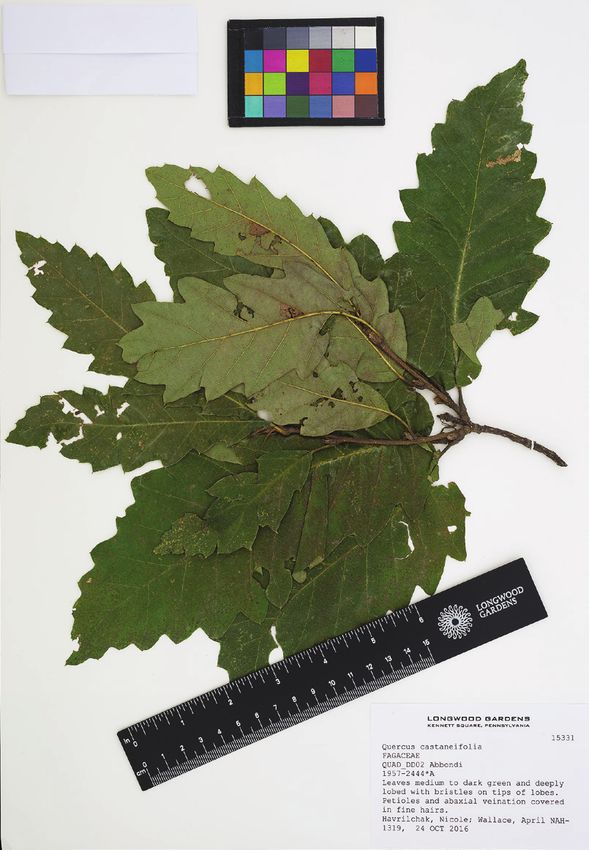
38 Arnoldia 75/3      •   February 2018
PETER ZALE

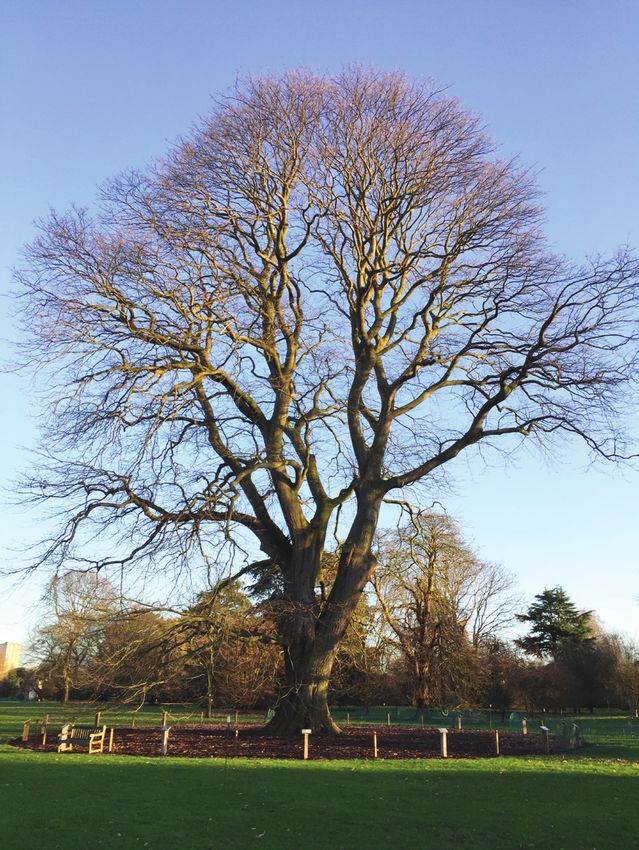
             In 2016, the specimen at Longwood Gardens (accession 1957-2444*A) was 15.5 m (50.9 ft) tall and 21.9 m (71.9 ft) wide, and
             had a DBH (diameter at breast height) of 112.5 cm (44.3 in). It has an ascending branching pattern and a distinctly rounded,
             spreading crown.

                   growth from cut trees.” And, for PI 228075:                 ing slip from the USPIG linked that accession
                   “Col. No. 15799. Fifty-four miles east of Gorgan.           to one of Gentry’s collections: PI 228075 (acces-
                   Sept. 15, 1955. Spreading tree to 30 feet high.”            sion 1957-2443 was assigned to PI 228074). It
                   These were grown at the US Plant Introduction               appears as if one seedling of each collection per-
                   Garden (USPIG) in Glenn Dale, Maryland, and                 ished in the first few years. In 1971, an inven-
                   in September 1957 Longwood Gardens received                 tory of the Quercetum indicated that the two
                   three seedlings of PI 228074 and two of 228075,             remaining seedlings of PI 228074 had perished
                   which were planted in the research nursery and              due to sun scald, but no update was given for
                   later near the Michaux Quercetum.                           PI 228075. Using Gentry’s original collection
                      The Michaux Quercetum and adjacent oak                   notes of the tree’s nativity, I used the distinct
                   plantings received little attention for the next            shape of the tree’s leaves, acorns, and linear
                   five decades, providing a true test of a tree’s             bud scales to confirm the identify as Q. cas-
                   ability to survive with relative neglect. During            taneifolia. Further research indicated that it
                   the summer of 2015, the plant records office                is the only remaining tree in cultivation from
                   was inventorying trees in this part of Longwood             Gentry’s collection, and is thus unique among
                   Gardens and ‘rediscovered’ an unidentified oak              cultivated accessions of this species in public
                   tree. It was then brought to my attention and               gardens worldwide.
                   I began the detective work. An old planting                    Because of its unique lineage, and the rarity
                   map indicated the tree was Longwood Gardens                 of wild-collected Q. castaneifolia in the US
                   accession 1957-2444*A, and the original pack-               (see below), I collected acorns in 2016. Oaks are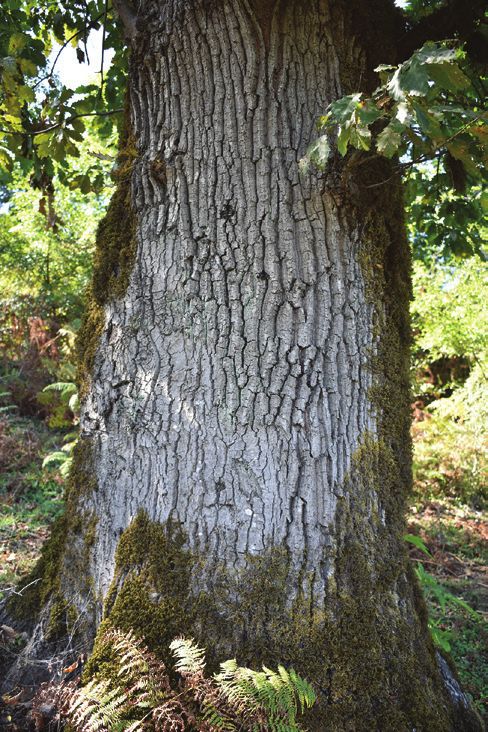
Quercus castaneifolia 39

                                                                                                                    TONY KIRKHAM

The Kew specimen (accession 1969-15985) is one of the largest trees at Kew, and is the largest chestnut-leaf oak
in the British Isles. In 2016 it was approximately 35 m (115 ft) tall, 30 m (98 ft) wide, and had a DBH of 2.52 m
(8.26 ft) at 1.5 m (4.9 ft).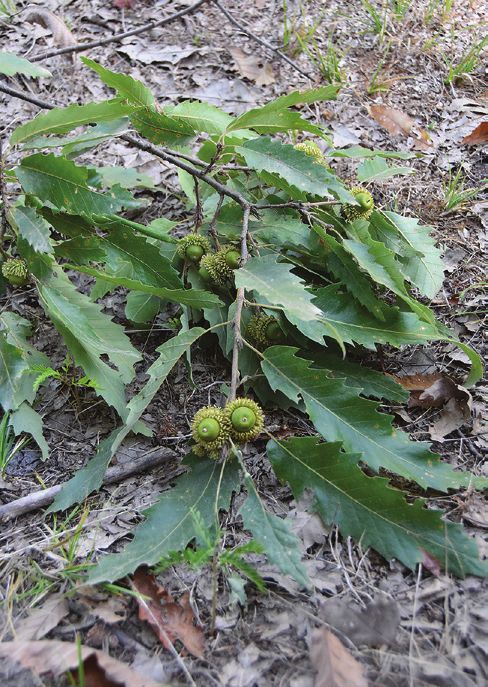
40 Arnoldia 75/3    •   February 2018

anemophilous (wind-pollinated) species that           multisite Quercus group indicated 19 living
generally rely on fertilization from genetically      accessions of Quercus castaneifolia in nine
different individuals of the same species for         gardens. Of these, 16 are of garden or nurs-
successful seed development. But there is some        ery origin, two are from wild collections, and
evidence that oaks have the ability for self-         one is actually a hybrid: Q. castaneifolia × Q.
pollination on a limited basis (Yacine and            cerris. Interestingly, the two wild plants are
Bouras, 1997). Of the 24 seeds collected, 12          1994 accessions growing at the UC Davis Arbo-
germinated and the resultant seedlings so far         retum and originally came from Dr. Ahmad
appear to be true-to-type, despite extensive          Mossadegh, Professor of Silviculture at the Uni-
nearby plantings of US native and exotic spe-         versity of Tehran. He collected seeds from the
cies including Quercus macranthera (Cauca-            Loveh Region, near Gorgan, Iran at an elevation
sian oak), which is reported to hybridize with        of 830 m (2723 ft). This source locality, similar
Q. castaneifolia. Despite promising initial           to that of the Longwood specimen, indicates
results, verification to identity will have to        that all of the known wild-sourced material
wait until the seedlings mature. If anything,         in cultivation in the US comes from a similar
they can serve as understock to graft scions          place in the eastern extent of the species range.
from the original tree, which would preserve          In addition to growing in the institutions men-
the exact genetic lineage.                            tioned above, chestnut-leaf oak is also at the
                                                      Bartlett Tree Research Arboretum (Charlotte,
Chestnut-leaf Oak in Cultivation                      NC), Denver Botanic Garden, Cornell Botanic
The Botanic Gardens Conservation Interna-             Gardens (Ithaca, NY), and Morton Arboretum
tional (BGCI) PlantSearch website indicated           (Lisle, IL). Its ability to grow in such diverse
that 68 public gardens worldwide (mostly in           places suggests a tolerance to extremes of heat
Europe) grow this species. For comparison, 148        and cold (USDA Hardiness Zones 5 to 9), as
gardens list the commonly grown Quercus               well as drought and a range of soil types. It is
cerris (Turkey oak), while 54 gardens list the        worth experimenting growing the tree in colder
less common Quercus libani (Lebanon oak).             and drier regions where the palette of available
Perhaps the best-known specimen in culti-             landscape trees is limited.
vation is the tree growing behind the Water              Quercus castaneifolia, recognized for its
Lily house at Kew Gardens, London. Widely             durability and ornamental qualities, has a num-
accepted as the first introduction of the species     ber of selections. Aimée Camus, in her 1936 Les
to cultivation in western Europe, the accession       Chênes: Monographie du genre Quercus, was
was received as seed in 1843 and was reputedly        the first to mention four cultivars (then formae)
planted in 1846 by William Hooker himself (Rix        of Q. castaneifolia: ‘Asplenifolia’, ‘Filicifolia’,
and Kirkham, 2009). This imposing specimen is         ‘Aureovariegata’, and ‘Pyramidalis’. Although
one of the most recognized trees in the collec-       there were no descriptions provided, it is likely
tion at Kew and was one of few to survive the         that the first two had fern-like, and the third
great storm of 1987 without damage.                   had variegated leaves; the fourth likely had
   Records of this species in cultivation in the      a narrow, yet not fastigiate, habit. No plants
United States are few. Some of the largest are        bearing these names have been found living in
two 1938 trees (239-38*A and D) at the Arnold         modern collections. Several other cultivars in
Arboretum of Harvard University, which came           Europe bear the place name where the origi-
from the Mount Mashuk Forest Garden Experi-           nal plant was selected. ‘Sopron’, ‘Zorgvlied’,
mental Station in Pyatigorsk, Russia (North-          and ‘Zuiderpark’ originated in European parks
ern Caucasus), which is outside of the species        or cities, and have not been widely propagated
natural range. The larger of the two (239-38*D)       or distributed. Though listed as a selection of
stands 22.33 m (73.3 ft) tall, has a spread of 18.3   chestnut-leaf oak, ‘Algerensis’ appears to be
m (60 ft), and a DBH of 98.6 cm (38.8 in). A          synonym for Quercus afares, the Algerian oak,
query of the most current inventory (2014) of         a morphologically similar species from the
the members of the Plant Collections Network          coastal Atlas Mountains of Algeria and Tunisia.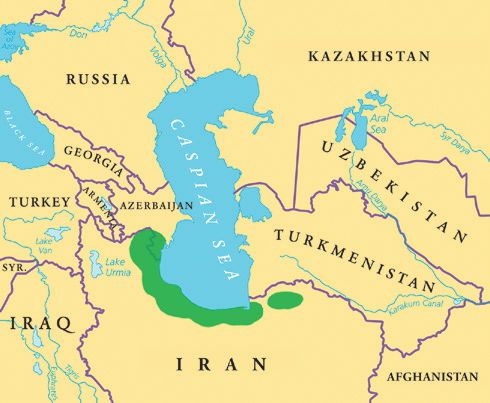
Quercus castaneifolia 41

                      Perhaps the most common cultivar is ‘Green           castaneifolia ECOS Form, an open-pollinated
                   Spire’ (note spelling, as numerous sources have         strain sold as both seeds and seedlings from
                   it listed as ‘Greenspire’), selected and intro-         their original trees. According to their website
                   duced by Hillier and Sons Nursery (Winchester,          description, the trees were originally obtained
                   UK). It is described as “a broadly columnar form        by growing acorns from gardens and arboreta,
                   of compact habit, raised in our nurseries about         and may represent hybrids between Q. casta-
                   1948. A vigorous, tall tree. Probably Q. casta-         neifolia, Q. cerris, and Q. acutissima (sawtooth
                   neifolia × Q. libani” (Hillier Nurseries, 1991).        oak). They were reported to be the fastest grow-
                   This selection has become available in the US           ing oaks in their nursery, reaching nearly 2 m
                   and its putative hybrid origin requires verifica-       (6.6 ft) in height after two years from seed.
                   tion. The species is known to hybridize with
                   others (particularly within Section Cerris), and        Quercus castaneifolia in Azerbaijan
                   although hybrids are poorly represented in culti-       From 9 to 22 September, 2017, the Plant Collec-
                   vation, could prove valuable for creating widely        tions Collaborative (PCC, 14 US public gardens
                   adaptable, drought-tolerant trees suitable for          with similar interests in domestic and inter-
                   managed landscapes, notably urban forests.              national plant exploration) organized and per-
                   Oikos Tree Crops (Kalamazoo, MI) offers Q.              formed a plant collecting trip to the Republic
                                                                           of Azerbaijan. Participants included Phil Doug-
PETER ZALE

                                                                           las (Chicago Botanic Garden), Matt Lobdell
                                                                           (Morton Arboretum), Vince Marrocco (Morris
                                                                           Arboretum of the University of Pennsylvania),
                                                                           and myself. Henrik Sjöman of the Gothenburg
                                                                           Botanical Garden (Sweden) joined us for the last
                                                                           week of the trip. Among the collection targets
                                                                           developed during trip planning was Quercus
                                                                           castaneifolia, no doubt inspired by my now
                                                                           familiarity with Longwood’s single specimen.
                                                                              We were pleasantly surprised to find the
                                                                           species ubiquitous in the Lankaran Region of
                                                                           southern Azerbaijan, in the wild as well as a
                                                                           cultivated tree. It grew at sea level and was still
                                                                           abundant at 1500 m (4921 ft) in elevation, the
                                                                           highest point we reached between Lerik and
                                                                           Orand. We found it with other characteristic
                                                                           species of the Hyrcanian Forest: Acer veluti-
                                                                           num (velvet maple), Buxus sempervirens (com-
                                                                           mon boxwood), Carpinus betulus (European
                                                                           hornbeam), Parrotia persica (Persian ironwood),
                                                                           and Zelkova carpinifolia (Caucasian zelkova).
                                                                           Trunks of old, open-grown trees were often
                                                                           massive and supported a distinctive branch-
                                                                           ing structure with a tall, straight central leader
                                                                           and irregular branches that resulted in a loosely
                                                                           rounded crown. Unfortunately, none of the trees
                                                                           bore mature acorns, and our guide, Dr. Haçiaga
                                                                           Sofarov, Deputy-Director of Hyrcan National
                                                                           Park in Lankaran, indicated that they would not
                                                                           be ready until late-October or early-November.
             A large tree near Lankaran, Azerbaijan, had grey-brown bark   This corresponds to the timing of seed matura-
             with prominent, vertical ridges.                              tion of the tree at Longwood, but differs from
42 Arnoldia 75/3 • February 2018
ernmost extent of its range will increase the
HENRIK SJÖMAN
presence of wild-origin Q. castaneifolia at pub-
lic gardens across the US,
Conclusion
Curatorial mysteries, like the story of Gentry’s
unidentified oak, are found in public gardens
throughout the world. When acknowledged
and solved, they not only enrich the collections
and institutions where they exist, but also the
greater public garden, horticulture, and botani-
cal communities. As is the case for Quercus
castaneifolia at Longwood Gardens, unravel-
ing this mystery helped us inform, revise, and
add value to our plant collections, their data,
and our broader collections development objec-
tives. The project shed new light on an under-
represented and under-collected species worthy
of greater attention, and I hope this work serves
to open new avenues of germplasm preserva-
tion, acquisition, and interpretation.
References
APGA (American Public Gardens Association). 2007–
2017. The plant collections network Quercus
multisite group. Available at: https://
publicgardens.org/programs/plant-collections-
network/collections-showcase/quercus-
multisite. (Accessed 30 November 2017).
The acorns found on trees near Lankaran, Azerbaijan were Azadbakht, M., I. Mehregan, M. Assadi and T. Nejadsattari.
unripe in mid-September of 2017, foiling the collectors’ plans. 2015. Phylogenetic Relationships in Quercus
castaneifolia C.A. Mey. in Hyrcanian forests of
Iran based on AFLP markers. Journal of UMP
Gentry’s field collection date of September 15,
Social Sciences and Technology Management
1955, suggesting that acorns may mature earlier 3:237–246.
in the southeastern part of the species range.
Bean, W.J. 1976. Trees and shrubs Hardy in the British
Chestnut-leaf oak is perhaps the most widely Isles, Volume III. 8th revised edition. Butler and
cultivated tree in the Lankaran Region. We Tanner Limited, London, U.K.
immediately encountered extensive plantings Camus, A. 1936. Les Chênes: Monographie du genre
used as windbreaks amongst the vast agricul- Quercus. Paul Lechevalier and Fils, Paris, France.
tural expanses that dominate the Caspian Low- Hillier Nurseries. 1991. Hillier’s Manual of Trees &
lands. Street trees were also common, which Shrubs. David and Charles, London.
thrived despite compaction from surrounding
Jerome, D., E. Beckman, L. Kenny, C.S. Kua, and M.
sidewalks and streets, late-summer heat and Westwood. 2017. The Red List of U.S. Oaks.
drought, pollution from vehicle exhaust and The Morton Arboretum, Lisle, IL.
general neglect. PCC members are again plan- Krüssman, G. 1978. Manual of Cultivated Broad-leaf
ning an autumn 2018 trip again to southern Trees and Shrubs. Volume III, PRU-Z. Timber
Azerbaijan to make collections of this and other Press, Portland, Oregon, U.S.
important, under-represented species. Hope- Lancaster, R. 1974. Paradise found. Journal of the Royal
fully, our success in capturing the northwest- Horticultural Society 99:103–109.Quercus castaneifolia 43
PETER ZALE
A restaurant nestled in a shelterbelt of chestnut-leaf oak north of Lankaran, Azerbaijan. Like cultivated trees observed
elsewhere, the trunks were painted white, supposedly as a preventative measure against trunk damaging insects.
Menitsky, Y.L. 2005. Oaks of Asia. Science Publishers, Snyers, C. 2014. A natural hybrid? Available at: http://
Enfield, New Hampshire, U.S. www.internationaloaksociety.org/content/
Milne, R.I. and R.J. Abbott. 2002. The origin and evolution natural-hybrid/ (Accessed: 30 November 2017)
of Tertiary relict flora. Advances in Botanical The Plant List. 2017. Version 1.1. Published on the
Research 38:281–314. DOI: 10.1016/S0065- I n t e r n e t ; h t t p : / / w w w. t h e p l a n t l i s t . o r g /
2296(02)38033-9 (Accessed: 28 November 2017).
Oldfield, S. and A. Eastwood. The Red List of Oaks. Flora Trehane, P. 2007–2015. The Oak Names Checklist.
and Fauna International, Cambridge, UK. Available at: http://oaknames.org/search/
Panahi, P., Z. Jamzad, M. R. Pourmajidian, A. Fallah, and goodnames.asp. (Accessed: 30 November 2016).
M. Pourhashemi. 2011. A revision of chestnut-
USDA (U.S. Dept. of Agriculture). 1964. Plant Inventory
leaved oak (Quercus castaneifolia C. A. Mey.;
No. 163. Plant Industry Station, Beltsville,
Fagaceae) in Hyrcanian Forests of Iran. Caspian
Journal of Environmental Sciences 9:145–158. Maryland, U.S.
Rix, M. and T. Kirkham. 2009. Quercus castaneifolia. Yacine, A. and F. Bouras. 1997. Self- and cross-pollination
Curtis’s Botanical Magazine 26:54–63. effects on pollen tube growth and seed set in
holm oak Quercus ilex L. (Fagaceae). Annals of
Sales, F., and I.C. Hedge. 1996. Biogeographical aspects Forestry Science 54:447–462.
of selected SW Asiatic woody taxa. Annalen
des Naturhistorischen Museums in Wien. 98B
Supplement:149–161. Peter Zale, Ph.D., is the Associate Director for
Schramm, J.R. and E.J. Schreiner. 1954. The Michaux Conservation, Plant Breeding, and Collections at
Quercetum. Morris Arboretum Bulletin 5:54–57. Longwood Gardens in Kennett Square, PA.You can also read


