Investigating the Thermal Biology and Behaviour of Captive Radiated Tortoises
←
→
Page content transcription
If your browser does not render page correctly, please read the page content below
MedDocs Publishers

                                                                                                                       ISSN: 2639-4391

                                      Journal of Veterinary Medicine and Animal Sciences
                                                                                                        Open Access | Research Article

  Investigating the Thermal Biology and Behaviour
            of Captive Radiated Tortoises
Avraham Terespolsky; James Edward Brereton*
University Centre Sparsholt, England

  *Corresponding Author(s): James Edward Brereton                            Abstract
 University Centre Sparsholt, Westley Lane, Sparsholt,                        Thermoregulation is integral to the maintenance of rep-
 Winchester, Hampshire, SO21 2NF, England.                                tile biological function and health, and therefore is a key
 Email: James.Brereton@sparsholt.ac.uk                                    area of investigation for herpetologists. To investigate the
                                                                          relationship between core body temperature and behav-
                                                                          iour, a behavioural study was conducted in which iButton
                                                                          data loggers were placed on a group of captive radiated tor-
Received: Nov 09, 2020                                                    toises (Astrochelys radiata) located at Sparsholt College’s
Accepted: Jan 04, 2021                                                    Animal Management Centre, in Hampshire, UK. Correla-
                                                                          tions between core body temperature and specific behav-
Published Online: Jan 08, 2021
                                                                          iours were covered. Body mass had a significant effect on
Journal: Journal of Veterinary Medicine and Animal Sciences               average core body temperature (P=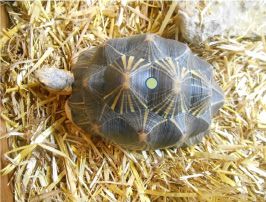
MedDocs Publishers

    The radiated tortoise is found in a dry region consisting of                     physical characteristics and a GoPro video camera was used in
brush and woodland habitats [5]. A. radiata is herbivorous and                       tandem with first-person monitoring to ensure accuracy and
feeds by grazing on grasses, though it will on occasion feed on                      identification of behaviour and of each individual. An ethogram
fruits and succulents, and it is well documented to indulge on                       consisting of nine state and six event behaviours was produced
invasive Opuntia spp cacti.                                                          and refined from the extensive Ethograms provided by [7,8].
                                                                                     This was used to define exhibited behaviours (Table 2). A range
   While body temperature has been previously researched in                          of behaviours were observed and recorded in the study. The
chelonians [1,2,6], comparisons between body temperature                             study intended to investigate thermal effects on all aspects of
and behaviour would be valuable for animal managers. This                            tortoise behaviour, rather than just those behaviours which are
could allow keepers to determine how behaviour changes as                            already known to be affected by temperature.
body temperature increases toward optimal.
   Methods
   The aims of our study were to determine whether the body
temperatures of smaller and larger radiated tortoises differed
across the normal daily routine in captivity, and to investigate
the effect of tortoise body temperature on their activity bud-
gets.
   The study site
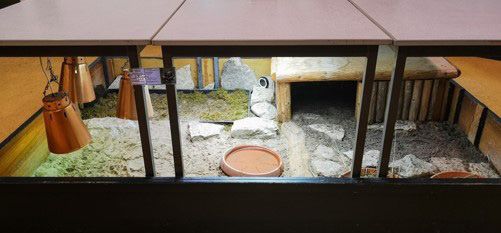
   Five radiated tortoises (two males and 3 females) were lo-
cated at Sparsholt College’s Animal Management Centre, and                             Plate 1: A. radiata enclosure. Basking area with UV on the left,
housed in an open-top enclosure within a heated reptile room                          UV in the middle and cool end to the right. Humid area situated
(W93” x D60” x H34”), with a surface area of 3.6 m2. A tempera-                       above the hot end (Authors own, 2019).
ture gradient design is implemented with the use of three heat
lamps giving hot spots from between 29-37oC on one side and
a heated area at the cool side around 25oC with UVA/B lamps
                                                                                       Table 1: Summary of information pertaining to identification
along 3/4th of the enclosure. The substrate consisted of sand                         number, gender, size and weight of radiated tortoises at the time
and small rocks along with a moss section, the animals had ac-                        of the study.
cess to a large hide box in the cool area (Plate 1, Figure 1), a
shallow water bowl and two food bowls. The tortoises wee cus-
                                                                                          Tortoise                             Plastron length           Body mass
tom seizures and therefore exact ages were unknown. Further                            Identification
                                                                                                                Sex
                                                                                                                                (Centimetres)            (Kilograms)
details on sizes and weight can be found on (Table 1).
                                                                                             1                  Male                 24.7                   4.26
   Activity and behavioural monitoring
                                                                                             2              Female                    26                    4.27
   Behavioural observations were conducted using instanta-
                                                                                             3                  Male                  23                    3.28
neous focal sampling at 60 second intervals for 1-hour time
periods, resulting in 63 hours of observations per tortoise. The                             4              Female                   20.1                   2.15
study took place between 0830-1730 on days with no classes
                                                                                             5              Female                    21                    2.51
such as weekends or holidays. Each tortoise was identifiable by

  Table 2: Ethogram used to record state and event behaviours of the radiated tortoises. Adapted from [7,8].

 State Behaviours                              Description                                  Event behaviours                               Description

                    Eyes open or closed (could be sleeping), static position. limbs
      Resting                                                                               Exploratory Sniff          Sniffing or putting its beak up to an object.
                    and head out or partially out.

                    While sitting or standing, head elevated or level looking                                          A noise made by the tortoise expelling air
       Alert                                                                                Hiss
                    around.                                                                                            from its lungs.

                    Head down, towards the substrate or subject to investigate
     Foraging                                                                               Mandible Rub               Male places its head on a female’s shell.
                    area of interest.

                    Interaction involved with the process of eating such as biting
     Feeding                                                                                Ram                        A tortoise ramming another.
                    and chewing food items. Includes drinking behaviour.

                    Tortoise standing or sitting under heat source in any position in                                  Two animals are face to face exploring the
     Basking                                                                                Social Sniff
                    order to absorb warmth.                                                                            head/face of the other.

                    Animal in a position to attempt to be out of sight such inside                                     Opens mouth wide, usually momentary.
      Hiding                                                                                Yawn
                    its hides, under an object or the substrate.

                    Tortoise is situated in water. Water temperature varied across
     Soaking
                    the project but was not recorded for this study.

                    Moving at its regular gait. Tortoise is not eating during this
     Walking
                    time.

Journal of Veterinary Medicine and Animal Sciences                              2
MedDocs Publishers

  Temperature                                                           temperature, an average of the carapace and plastron was gen-
                                                                        erated for use in statistical tests. Tortoises showed a predictable
   To investigate the body temperature of the tortoises, tem-
                                                                        increase in body temperature throughout the day (Figure 1).
perature/humidity data loggers (iButtons) were attached to
both the carapace and plastron on each animal. They were se-
cured via surgical tape and located on the 2nd vertebral scute
(Figure 2) and on the left abdominal scute in the concavity of
the plastron to avoid being scraped off. The data loggers were
attached at least 15 minutes before the commencement of the
study to avoid interference of behavioural data. The error rate
was +/- 0.1oC.

                                                                          Figure 1: Effect of time of day on plastron and carapace tem-
                                                                         perature, +/- standard deviation.

                                                                           Effect of body size on temperature
                                                                           On average, the temperature of the five tortoises used in the
                                                                        study differed. The larger tortoises, 1 and 2, showed consider-
                                                                        ably higher temperature means at 30.75oC and 32.36oC respec-
                                                                        tively. The smaller tortoises 3, 4 and 5 showed lower body tem-
                                                                        perature means at 29.27oC, 29.97oC and 30.5oC. The variance
                                                                        between large and small mean tortoise body temperatures was
                                                                        1.64oC hotter for larger individuals. Mean body temperature
   Plate 2: An illustration Showing iButton location placement on
                                                                        showed a predictable change throughout the course of the day
  the carapace.                                                         (Figure 2).

  Statistical analysis
   Collated data sheets were produced using means for plastron
and carapace temperature and humidity along with behavioural
observations per hour per individual. The body temperature of
each tortoise was calculated by taking the mean of the carapace
and plastron recorded temperatures. State behaviour percent-
ages were calculated to present individual and group activity
budgets for the tortoises.
   Statistical analyses were performed using Minitab version 23
and behavioural and temperature data were found to be not                  Figure 2: Relationship between time of day and average body
normally distributed. A Wilcoxon test was used to compare the            temperature (as calculated using plastron and carapace tempera-
iButton outputs for carapace and plastron temperatures. Spear-           tures), +/- standard deviation. Tortoises 1-5 are shown in different
man’s Correlation Coefficient tests were used to find potential          lines: See Table 1 for information on individuals.
relationships between core body temperature and basking and
feeding behaviour. We analysed the effect time of day and tem-             Behaviour and temperature
perature on active or inactive behaviour.
                                                                           Average body temperatures derived from the carapace and
  Results                                                               plastron iButton were compared against the behaviour of tor-
                                                                        toises. An activity budget was developed (Figure 3), comparing
  Difference between carapace and plastron temperature
                                                                        the behaviour of tortoises under a range of temperature cat-
   The temperatures recorded from iButtons on the plastron              egories. Some behaviours, notably basking and inactivity, ap-
and carapace of each tortoise were summarised for each hour of          peared to become more prevalent when tortoises were warm,
observations. The temperatures recorded from the carapace`s             whereas hiding and feeding decreased as environmental tem-
iButtons were higher than those recorded from the plastrons,            perature decreased. Similarly, body temperature categories
with average temperatures of 32.45oC and 28.55oC (+/- 2.07)             were developed to compare the occurrence of behaviours (Fig-
respectively. A Wilcoxon test revealed that the difference be-          ure 4). Ramming occurred less frequently when tortoises were
tween carapace and plastron temperatures was significant (Z=            warmer, whereas both social and exploratory sniffs became
70157, n=5, P
MedDocs Publishers

  Figure 3: Activity budget for tortoises at different temperatures,         Figure 6: Correlation between feeding behaviour and mean
 as recorded using an average of plastron and carapace tempera-             temperature (as based on recorded from iButtons).
 tures.

                                                                              Discussion
                                                                              The purpose of this project was to investigate the behaviour
                                                                           changes of radiated tortoises in association with daily changes
                                                                           in environmental temperature. Several significant changes in
                                                                           behaviour were identified in relation to carapace and plastron
                                                                           temperature. Specifically, there was a weak, negative correla-
                                                                           tion between feeding and body temperature, and a positive cor-
                                                                           relation between basking and body temperature.
                                                                              Effect of time on temperature
                                                                              Overall, the current study identified a significant difference
                                                                           between the iButton temperatures gathered from the carapac-
                                                                           es and plastrons of radiated tortoises. However, both plastron
                                                                           and carapace temperatures may be affected by environmental
                                                                           variables due to their contact with substrates or light sources
  Figure 4: Number of occurrences of each event behaviour per
 hour, categorised by average carapace and plastron body tempera-
                                                                           respectively [9]. When both measures were considered in the
 ture recordings.                                                          form of a mean temperature, the values showed some similarity
                                                                           to skin and carapace measures collected by [9] for the leopard
                                                                           tortoise (Stygmochelys pardalis) in captivity. Alternative tech-
  Carapace and plastron body temperature recordings
                                                                           niques for measuring core body temperature include surgically
    Spearman’s rank correlations were selected to investigate              inserted or cloacal probes, or ingested sensors (Huot-Daubre-
the relationship between behaviour and temperature. Overall,               mont et al., 1996) [10]. However, many animal collections pro-
there was a significant positive correlation between the aver-             hibit invasive procedures, and as such many techniques for
age body temperature of a tortoise and the percentage of time              assessing body temperature are unavailable. This method of
it spent basking (r= 0.485, P
MedDocs Publishers
zones. Future applications
Behaviour and temperature As a study that shows radiated tortoise activity budgets un-
der different temperature gradients, this study has some appli-
The current study found increased behaviour shifts with cation to captive collections. The behavioural and temperature
increased body temperatures. Environmental temperature di- results could be used by curators of animal collections, to make
rectly determines the activity of tortoises and warmer temper- comparisons with their own stock. For example, early career
atures promote increased activity, whereas low temperatures researchers such as undergraduates may not always be aware
and extreme highs limit tortoise movement [13]. The radiated of the impact of temperature on reptile behaviour, particularly
tortoises in this study were most active and exhibited a greater if they have only studied endotherm behaviour previously [19-
range and frequency of behaviours when body temperatures 22]. Further investigations of the behaviour and temperature
were between 26oC and 34oC. This is similar to research under- of captive tortoise species may help keepers to better evaluate
taken in the wild on Hermann’s tortoises [14] (Testudo herman- the suitability of their captive environments in relation to the
ni), leopard tortoises (Geochelone pardalis) [15] and Aldabra species they keep. The study methodology could also be ap-
tortoises (Aldabrachelys gigantea) [11] which showed similar plied to other commonly housed species, such as the Horsefield
temperatures and were most active between 26oC and 32oC. (Agrionemys horsefieldii) or Hermann’s tortoise.
In the current study, basking and hiding behaviour correlated The iButton placement technique employed during this
with high and low temperatures respectively. Ramming, an ag- study, including the fitting process, was performed rapidly with
gressive behaviour, was seen most commonly when tortoises minimal handling. Brief handling has little effect on stress as op-
were cooler. This has been observed in gopher tortoises (Go- posed to subjection of longer-term handling and added stress-
pherus polyphemus) where competition for thermal hotspots ors, which in turn influences the behaviour of radiated tortoises
further constrain effective thermoregulation [16]. However, it [5]. Alternative techniques involving ingestion or implantation,
should be noted that [16] study was conducted on wild indi- are invasive methods that could cause high stress and hence
viduals, therefore the motivation for ramming may be different. distort behaviour. Furthermore, risk of choking or impaction
For the radiated tortoises in the study, ramming may have been in smaller individuals is a cause for ethical concern and could
associated with competition over the most effective basking result in research being prohibited. The method implemented
spots. in the current study aims to reduce stress and maintain animal
In contrast, social and environmental behavioural interac- well-being as well as being universally repeatable on various
tions were more prevalent at warmer body temperatures. It has sizes and species of animals.
long been known that reptiles become more alert once they Conclusion
have reached their optimal body temperature [17]. However,
newer studies have also demonstrated heightened social and Overall, the current study found that iButtons could detect
problem solving abilities in red footed tortoises (Geochelone daily changes in tortoise temperature. Larger tortoises had
carbonaria) when at warmer temperatures [18]. While radiated higher mean body temperatures, which is in-keeping with prior
tortoises are not highly gregarious in the wild [5], it is interest- research. The behaviour of the captive radiated tortoises also
ing to note that aggressive behaviours decreased and more af- changed as body temperatures changed, with more basking
filiative social behaviours increased once body temperatures and social interaction shown as temperature increased. iBut-
were higher. tons may be used in future for other captive animal collections
where there are restrictions on the types of invasive measure-
One behaviour associated with the loss of heat, and also ments that can be used, in order to better assess the thermal
potentially rehydration, is soaking. Tortoises appeared to make suitability of exhibit design.
use of their water and engage in soaking behaviour most when
at body temperatures between 26oC and 34oC. Movement into Acknowledgement
water is known to be an effective strategy for cooling for both
endotherms and ectotherms, and tortoises have been seen en- The authors would like to thank the staff at Sparsholt Col-
gaging in this behaviour both in the wild and in captivity [8]. lege’s Animal Management Centre for their support and advice
The limited use of water when body temperatures were cooler throughout the duration of the project. In particular, the au-
suggests that the primary purpose of soaking was to cool down. thors would like to thank Gary Clarke, Gary Miller, Emma Lawlor
As large, ectothermic herbivores, there are also challenges as- and Tom Starkey for their input. The authors would also like to
sociated with the digestion of food. At cooler temperatures, ec- thank Shelby Brereton and an anonymous reviewer for com-
totherm digestion may be slowed [1,12], potentially resulting ments on previous versions of this manuscript.
in reduced appetite or feeding behaviour. In the current study, References
a negative correlation was identified, in which feeding behav-
iour declined with body temperature. This may be an artefact 1. Meek R, Avery RA. Allometry in Testudo sulcata: a reappraisal.
of the body temperatures observed: the lowest temperatures Herpetological Journal. 1988; 1: 246-247.
recorded were over 20oC, whereas the mean highest body 2. Lambert MR. Temperature, activity and field sighting in the
temperatures (using plastron and carapace temperatures com- Mediterranean spur-thighed or common garden tortoise Tes-
bined) were closer to 40oC. It is possible that temperature was tudo graeca L. Biological Conservation. 1981; 21: 39-54.
not a limiting factor for feeding behaviour, even at the cooler
3. Falcon W, Baxter RP, Furrer S, Bauert M, Hatt JM, et al. Patterns
temperatures. The higher temperatures, by contrast, may have of activity and body temperature of Aldabra giant tortoises in
resulted in the tortoises seeking shade rather than feeding. relation to environmental temperature. Ecology and Evolution.
2018; 8: 2108-2121.
4. Hailey A, Coulson IM. Temperature and the tropical tortoise Ki-
Journal of Veterinary Medicine and Animal Sciences 5MedDocs Publishers
nixys spekii. Constraints on activity level and body temperature. 14. Meek R. The thermal ecology of Hermanns tortoise (Testudo
Journal of Zoology. 1996; 240: 523-536. hermanni) in summer and autumn in Yugoslavia. Journal of Zo-
ology. 1988; 215: 99-111.
5. Currylow AF, Louis EE, Crocker DE. Stress response to handling
is short lived but may reflect personalities in a wild, Critically 15. Hailey A, Loveridge JP. Body temperatures of captive tortoises at
Endangered tortoise species. Conservation Physiology. 2017; 5: high altitude in Zimbabwe, with comments on the use of” living
1-10. models”. Herpetological Journal. 1998; 8: 79-84.
6. Wood SC, Lykkeboe G, Johansen K, Weber RE. Maloiy GMO. 16. Radzio TA, Cox JA, Spotila J, O’Connor MP. Aggression, Combat,
Temperature acclimation in the pancake tortoise, Malacocher- and Apparent Burrow Competition in Hatchling and Juvenile Go-
sus tornieri: metabolic rate, blood pH, oxygen affinity and red pher Tortoises (Gopherus polyphemus). Chelonian Conservation
cell organic phosphates. Comparative Biochemistry and Physiol- and Biology. 2016; 15: 231-237.
ogy Part A: Physiology. 1978; 59: 155-160.
17. Stebbins RC. Body temperature studies in South African lizards.
7. Liu Y, Wang J, Shi H, Murphy RW, Hong M, et al. Ethogram of Koedoe. 1961; 4: 54-67.
Sacalia quadriocellata (Reptilia: Testudines: Geoemydidae) in
Captivity. Journal of Herpetology. 2009; 43: 318-325. 18. Wilkinson A, Kuenstner K, Mueller J, Huber L. Social learning in
a non-social reptile (Geochelone carbonaria). Biology Letters.
8. Ruby DE, Niblick HA. A Behavioral Inventory of the Desert Tor- 2010; 6: 614-616.
toise: Development of an Ethogram. Herpetological Mono-
graphs. 1994; 8: 88-102. 19. Rose P, Evans C, Coffin R, Miller R, Nash S. Using student-centred
research to evidence-base exhibition of reptiles and amphib-
9. McMaster MK, Downs CT. Thermal variability in body tempera- ians: three species-specific case studies. Journal of Zoo and
ture in an ectotherm: Are cloacal temperatures good indicators Aquarium Research. 2014; 2: 25-32.
of tortoise body temperature? Journal of Thermal Biology. 2013;
38: 163-168. 20. Golubovic A, Bonnet X, Djordjevic S, Djurakic M, Tomovic L. Vari-
ations in righting behaviour across Hermann’s tortoise popula-
10. Huot-Daubremont C, Bradshaw D, Grenot C. Temperature regu- tions. Journal of Zoology. 2013; 291: 69-75.
lation in the tortoise Testudo hermanni, studied with indwelling
probes. Amphibia-Reptilia. 1996; 17: 91-102. 21. Mafli A, Wakamatsu K, Roulin A. Melanin-based coloration pre-
dicts aggressiveness and boldness in captive eastern Hermann’s
11. Falcon W, Hansen DM. Island rewilding with giant tortoises in an tortoises. Animal Behaviour. 2011; 81: 859-863.
era of climate change. Philosophical Transactions of the Royal
Society B: Biological Sciences. 2018; 373: 1-8. 22. Ritz J, Clauss M, Streich W, Hatt JM. Variation in Growth and
Potentially Associated Health Status in Hermann’s and Spur-
12. Gillooly JF, Brown JH, West GB, Savage VM, Charnov EL. Effects Thighed Tortoise (Testudo hermanni and Testudo graeca). Zoo
of Size and Temperature on Metabolic Rate. Science. 2001; 293: Biology. 2012; 31: 121-128.
2248-2251.
13. Drabik-Hamshare M, Downs CT. Movement of leopard tortoises
in response to environmental and climatic variables in a semi-
arid environment. Molecular Ecology. 2017; 5: 5-11.
Journal of Veterinary Medicine and Animal Sciences 6You can also read


