Investor Information May - June 2019 - Regions Financial Corporation
←
→
Page content transcription
If your browser does not render page correctly, please read the page content below

Investor Information May - June 2019
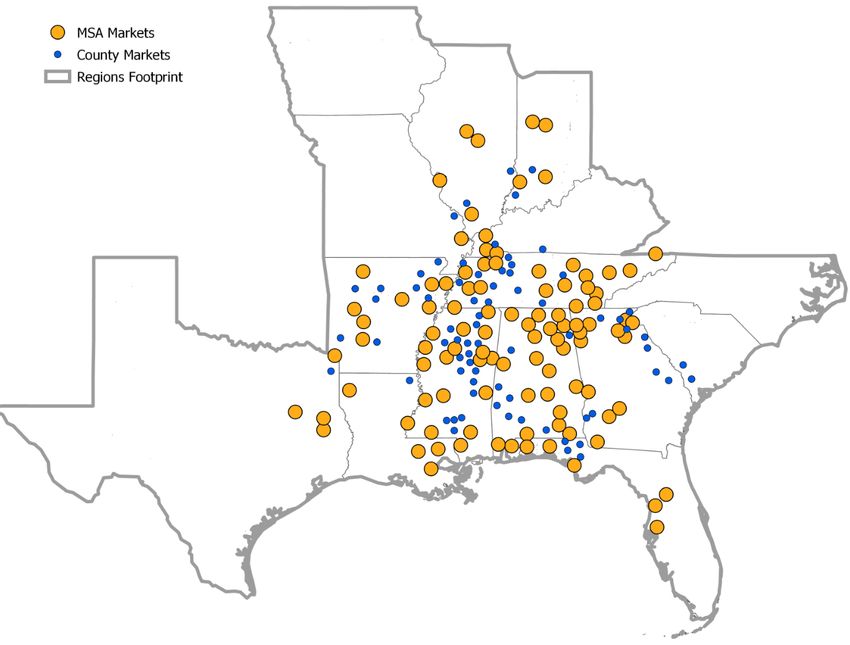
Table of contents

      Topic                                          Page #
      Profile and Strategy                           3-10
      Net Interest Income and Asset Sensitivity      11-16
      Fee Income and Efficiencies                    17-20
      Balance Sheet                                  21-25
      Credit                                         26-30
      Technology & Continuous Improvement            31-38
      Capital, Debt and Liquidity                    39-45
      Near-Term and Long-Term Expectations           46-47
      Environmental, Social & Corporate Governance   48-50
      Appendix                                       51-62

                                                              2
PROFILE AND
 STRATEGY

              3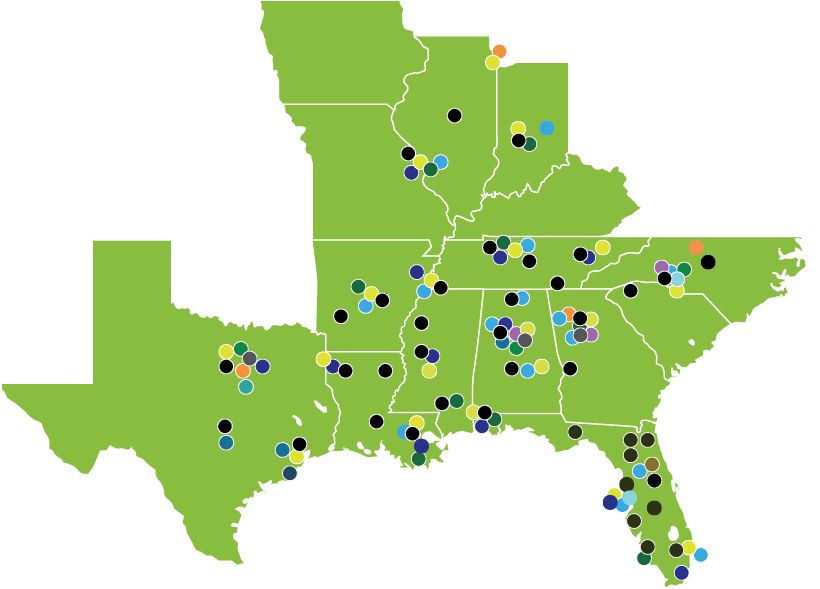
Our banking franchise

                                                                                                           Ranked 15th in the U.S. in total deposits(2)

                                                                                                                                                     Branch locations by state (1)

                                                                                                                                                  Alabama – 197      Louisiana – 95
                             Birmingham, Alabama                                   Line of business coverage                                      Arkansas – 72      Mississippi – 117

                                                                                                                                                  Florida – 305      Missouri – 62

                                                                                                                                                  Georgia – 117      North Carolina – 7

                                                                                                                                                  Illinois – 46      South Carolina – 23

                                                                                                                                                  Indiana – 50       Tennessee – 209

                                                                                                                                                  Iowa – 8           Texas – 81

                                                                                                                                                  Kentucky – 10

(1) Full Service branches as of 3/31/2019. (2) Source: SNL Financial as of 6/30/2018; pro-forma for announced M&A transactions as of 4/30/2019.

                                                                                                                                                                                         4
Business segments
1Q19 Pre-tax pre- Average loans(2) Average deposits(2)
provision income(1)
1%
3%
6% 8%
29%
40%
38%
$637M $84B $94B
59%
54%
62%
Consumer Corporate Wealth Management Other
(1) Excludes the pre-tax pre-provision income (loss) from the Other Segment totaling $(47) million. (2) Reflects 1Q19 average balances.
5Why Regions?
1 FOOTPRINT advantage
2 Valuable DEPOSIT FRANCHISE
Focus on risk adjusted returns and
3 PROFITABILITY
ENHANCED risk management and
4 governance infrastructure
Simplify and Grow underpins
5 LONG-TERM PERFORMANCE
6Top market share plays a valuable
role in the competitive landscape
Markets with top 5 market share(1) • Ranked 15th in the U.S. in total deposits(1)
• 86% of deposits in 7 states: Alabama,
Tennessee, Florida, Louisiana, Mississippi,
Georgia, Arkansas
• Top 5 or better market share in ~70% of
MSAs across 15-state footprint(1)
• ~70% of deposits in markets without a
significant money center bank presence(2)
• Investing in priority markets approaching a
top 5 market share
• St. Louis, Missouri
MSAs • Atlanta, Georgia
Non-MSA counties • Orlando, Florida
• Houston, Texas
(1) Based on MSA and non-MSA counties using FDIC deposit data as of 6/30/2018; pro-forma for announced M&A transactions as of 4/30/2019.
(2) Significant money center bank presence (JPM, BAC, C, WFC) defined as combined market share using 6/30/2018 FDIC deposit data of 20% or more.
7Presence in strong growth markets
Population Growth vs. Peers(1) (2019-2024) More than 60% of top(2) MSAs are projected to grow faster
than the U.S. national average
Peer #1 5.1%
Market
Top MSAs Deposits Rank(2) '19-'24 Population Growth
RF 3.6% Nashville,
Tennessee $7.6 3
Peer #2 3.6%
Tampa, Florida $4.2 4
Peer #3 2.7% Miami, Florida $4.1 14
Atlanta, Georgia $3.9 7
Peer #4 2.4%
Knoxville,
Tennessee $2.1 3
Peer #5 1.7%
Orlando, Florida $1.9 5
Peer #6 1.7% Huntsville,
Alabama $1.6 1
Indianapolis,
Peer #7 1.7% Indiana $1.4 12
Houston, Texas $1.3 21
Peer #8 1.5%
Peer median: 2.4% Chattanooga,
Tennessee $1.3 3
National average: 3.6%
(1) Large Regional Peers: BBT/STI (combined), CFG, FITB, HBAN, KEY, MTB, PNC, USB. Deposits weighted by MSA and non-MSA counties - FDIC 6/30/2018.
(2) Source: SNL. Top 30 markets as defined by deposit dollars - FDIC 6/30/2018. Pro-forma for M&A through 4/30/2019.
8Our footprint has significant economic advantages
Markets
Jobs Population Footprint Retirees
42% of all new jobs 51% of all U.S. 35% of the U.S. GDP 6 of the top 10 states
created in the US since population growth in generated in our where retirees are
2009 were in our last 10 years occurred footprint moving
footprint within our footprint
Alabama Tennessee Louisiana Florida Georgia
#1 state for #1 state for foreign job #1 state for workforce GDP ranks among the #1 state for doing
manufacturing investments training world’s largest business
economies
Note: See appendix for references.
9Regions receives top honors
Regions Bank Named 2018 Temkin Group Ranks
Regions Ranked Among Top Five Years Strong: Regions Javelin Trust in Banking Regions Bank Among Top
Banks in J.D. Power banking Bank Again Named Gallup Leader for Second Companies for Customer
Satisfaction Study Great Workplace Award Winner Consecutive Year Experience
10NET INTEREST
INCOME AND
ASSET SENSITIVITY
11Asset liability management philosophy
Strategies to protect net interest margin through the economic cycle
Net Interest Margin Has Outperformed Forward Strategies Reduce Market Risk
3.60% Asset sensitivity levels & asymmetric
risk will decline to be roughly neutral
by early 2020 as forward starting
3.40%
forward rate scenario
hedges begin
Change in NII vs
3.20%
3.00%
2.80%
1Q16 4Q16 3Q17 2Q18 1Q19 1Q19 1Q20
RF Peer Median (1)
Reducing asset sensitivity profile Focus on risk-adjusted returns
• Neutralizing sensitivity levels as • Core deposit funding key to Regions'
economic cycle matures franchise value and sensitivity profile
• Hedging protects profitability
advantage generated by deposit
outperformance
(1) Peers include: BBT, CFG, CMA, FHN, FITB, HBAN, HWC, KEY, MTB, PNC, SNV, STI, USB, ZION
12Balance sheet profile
(as of March 31, 2019)
Portfolio compositions
• Naturally asset sensitive balance sheet,
supported by a large, stable deposit base Assets Other Liabilities
14%
• A portion of asset sensitivity is driven by
Securities Borrowings
repricing over next 12 months of fixed rate 20% $129B Deposits
$113B 13%
84%
assets from core business activities Loans
◦ ~$9B fixed rate loans repricing 66% Other
3%
◦ ~$4B fixed rate securities
reinvested Loans(1)(2) Deposits Wholesale Borrowings(1)
Time
• Going forward, sensitivity levels are 9%
Fixed
Fixed 11%
expected to neutralize 49%
◦ Business mix and deposit repricing Non-Interest
$96B IB Checking,
$84B Bearing Money Market $15B
◦ Balance sheet hedging initiatives Checking & Savings
Floating 36% 55%
• Expect fixed loan mix to increase to low/ 51% Floating
89%
mid 60% range in falling rate environment
once balance sheet hedging concludes and
forward hedges begin
Contractual floating rate exposure(1)(2)(3)
$28.8B
• Deposit betas were roughly 54% through $17.8B
the last cycle and 25% so far this cycle(4),
both at the lower end of peers $11.2B $11.1B $11.2B
◦ Deposit beta through 2.50% Fed
$1.7B $1.9B
Funds in prior cycle was 32% for RF $0B $(0.2)B
and 38% for the peer set
FF/Prime 1M Libor 3M Libor FF/Prime 1M Libor 3M Libor FF/Prime 1M Libor 3M Libor
Assets Liabilities Net Exposure
(1) Including spot starting balance sheet hedges - receive fixed loan swaps & receive fixed debt swaps; deferred start loans swaps not reflected in current exposure.
(2) ARM mortgage loans are included as floating rate loans. (3) Excluding deposits, which are primarily management priced. (4) Last rising rate cycle measured from
2Q04 – 2Q07; current rising rate cycle measured from 3Q15 – 1Q19.
13Interest rate scenario assumptions
(as of March 31, 2019)
Interest rate risk assumptions Hedging program assumptions
Baseline scenario Standard shock scenarios • Forward hedges begin mostly in 1H 2020
• Combination of interest rate swap and floor contracts
+100/-100bps parallel, instant
Market interest rates Current implied forward rate shock applied to forward curve Notional
Swaps Floors Total
Full-year adjusted average
loans expected to grow in the
Loan balance growth low to mid-single digits(1) Same as baseline Legacy swaps $5.00B - $5.00B
Full-year average deposits ~$2.5B ending remixing from Forward starting executed prior
expected to remain relatively NIB to Time in rising scenario to 1Q19 end $4.75B $4.75B $9.50B
Deposit balance growth stable(2) (consistent with historical observations)
Forward starting executed after
1Q19 end $0.75B $1.00B $1.75B
New business loan spreads Stable at current levels Same as baseline $10.50B $5.75B $16.25B
50% - 70% beta incremental to • Anticipate approximately $3B - $4B additional forward hedges
(3)
Full rising rate cycle beta in the baseline, market forward
Deposit repricing (Betas) the low 30% range rate case
Sensitivity level outlook(4)
($ in millions) +$94M
$0 to +$25M
+100 bps
NII impact of Asset sensitivity levels &
standard shock asymmetric risk will decline to roughly
versus baseline
scenario
neutral by early 2020 as forward
-100 bps starting hedges begin $0 to -$25M
-$179M
1Q19 1Q20
(1) Growth expectations are on an adjusted basis; see non-GAAP reconciliation in appendix. (2) Growth expectations exclude the impact of brokered and Wealth
Institutional Services deposits. (3) Full-cycle deposit beta utilizes 3Q15 as a starting point. (4) Including spot starting and forward starting balance sheet hedges to the
extent impacts fall within 12 month measurement horizon. 14Positioned to support NIM profile
through 2021
Net Interest Margin Forecast(1) Assumptions - Upper Range
Upper End =3.70% • Modest GDP growth and stable credit environment
• Increases in market interest rates through 2021
3.55%
3.53% • Fed Funds between 2.75% and 3.00%
3.49%
Current Range • 10-year Treasury yields between 2.75% and 3.00%
3.37%
Lower End =3.40%
3.32% Assumptions - Current Range
• Modest GDP growth and stable credit environment
3.15% • Stable market interest rates and flat curve through 2021
3.16%
• Fed Funds ~2.50%
• 10-year Treasury yields between 2.40% and 2.70%
2Q16
4Q16
2Q17
4Q17
2Q18
4Q18
2Q19
4Q19
2Q20
4Q20
2Q21
4Q21
• Under current rates/flat curve, expect relatively stable to Assumptions - Lower Range
modestly lower full-year 2019 NIM compared to the prior year; • Typical recession similar in magnitude to post WWII recessions, excluding
near-term margin pressure mostly from deposit cost increases, 2008
partially offset over the course of 2019 through balance sheet • Significant declines in market interest rates
optimization
• Fed Funds revert to near zero policy range
• Forward starting hedges, core deposit growth, and continued
• Long-end rates decline to historic lows (i.e. 10-year Treasury yields
balance sheet optimization to support NIM stability over longer- below 1.50%)
term
(1) See appendix for scenario details supporting forecast assumptions.
15Deposit advantage
Expected to continue
Average deposits by customer type NIB deposits to total deposits(1) Deposit costs(1)
(Retail vs. Business)
1Q19, ($ in billions) Peer #14 Peer #14
Private Institutional Peer #13 Peer #13
Wealth(3) Services(3) RF 36% Peer #11
$7 $1 Peer #12 RF 47 bps
Peer #11 Peer #4
Peer #10 Peer #10
Consumer
Peer #9 Peer #3
Segment $27 Peer #8 Peer #5
$58 Corporate Peer #7 Peer #9
Segment Peer #6 Peer #8
Peer #5 Peer #12
Other Peer #4
Peer #6
Segment(3) Peer #3
Peer #1
Peer #2
$1 Peer #2
Peer #7
Peer #1
Deposit characteristics provide a funding advantage...
• 1Q19 average retail deposits represent 69% of total deposits • Favorable mix of low cost products - 36% non-interest bearing
• Over 60% of consumer deposits held by customers who have banked at • Continuous account and relationship growth through new client acquisition,
Regions for over 10 years rather than growth in existing account size
• Over 90% of consumer checking households include a high quality primary • Stronger market share in non-metropolitan markets
checking account(2)
...evidenced by 25% cumulative deposit beta versus peer
median of 30%; liability yield beta of 26% to date versus peer
median of 32%
(1) Source: SNL Financial; peers include BBT, CFG, CMA, FHN, FITB, HBAN, HWC, KEY, MTB, PNC, SNV, STI, USB and ZION. (2) High quality and primary account estimates are based on
multiple individual account behaviors and activities (e.g., balances and transaction levels). (3) Private Wealth Management and Institutional Services deposits are combined into the Wealth
Management Segment. Total Other segment deposits consist primarily of brokered deposits. A break-out of these components is provided in the Company's quarterly Earnings Supplement.
16FEE INCOME AND
EFFICIENCIES
17Growing total revenue
Adjusted total revenue(1) Non-interest income
($ in millions)
$1,412 $1,439 $1,449 Change vs
909 3.55%
3.53% 1Q19 4Q18 1Q18
3.46% 958 948 Service charges $ 175 (5.4)% 2.3 %
Card and ATM fees 109 (1.8)% 4.8 %
Wealth management income 76 (1.3)% 1.3 %
503 481 501
Capital markets income 42 (16.0)% (16.0)%
1Q18 4Q18 1Q19 Mortgage income 27 (10.0)% (28.9)%
Adjusted non-interest income (1)
Bank-owned life insurance 23 91.7 % 35.3 %
Market value adjustments (on
Net interest income (2) employee benefit assets - defined benefit) 5 (171.4)% NM
Market value adjustments (on
(3)
employee benefit assets - other) (1) (87.5)% NM
Net interest margin
• Interest rates equal to current yield curve and Other 46 48.4 % (13.2)%
moderate future balance sheet growth are expected Total non-interest income $ 502 4.4 % (1.0)%
to generate relatively stable to moderately lower full-
Adjusted non-interest income(1) $ 501 4.2 % (0.4)%
year NIM; moderate NIM compression rest of 2019
Expect full-year 2019 adjusted total revenue growth in the 2-4% range
(1) Non-GAAP; see appendix for reconciliation. (2) Net interest income and other financing income. (3) These market value adjustments relate to assets held for employee
benefits that are offset within salaries and employee benefits expense.
18Diversified non-interest revenue
1Q19 fee revenue by segment(1) Consumer
($ in millions) • Consumer fee income categories are an important and stable
component of fee revenue and are expected to contribute to
overall growth
• Service charges are expected to increase consistent with growth
in checking accounts and households
Corporate • Card and ATM fee growth is expected to continue consistent
$131 with growth in active cards and increased transactions
Wealth
• Continued growth in wealth management relationships, assets
Consumer under management and improvement in equity markets are
$281 expected to contribute to income growth
Wealth
$78 • 1Q19 wealth management relationships increased 6%
QoQ
• 1Q19 assets under management increased 6% QoQ
• 1Q19 investment services fee income is up 12% QoQ
Corporate
• Capital markets income decreased in 1Q19, but is expected to
increase in 2Q19
• Treasury management revenue is up 6% QoQ
(1) Excludes Other Segment fee revenue of $12 million in 1Q19.
19Disciplined expense management
QoQ highlights Non-interest expense
($ in millions)
• Non-interest expense increased 1% on a reported
and adjusted(1) basis QoQ; decreased 3% on a
reported basis and 1% on an adjusted(1) basis YoY $884
$853 $860
22 8
• Salaries and benefits increased 2% due to 10
seasonally higher payroll taxes 60.5% 58.1% 58.3%
• Occupancy expense decreased 5% primarily due to 862 843 852
4Q18 Hurricane Michael storm-related charges
• Furniture and equipment expense decreased 7%
primarily due to 1Q19 benefit in property taxes
1Q18 4Q18 1Q19
• Professional fees decreased 26% primarily due to a
reduction in consulting fees
Adjusted non-interest expense(1) Adjusted items(1)
• 1Q19 efficiency ratio 58.8%; adjusted efficiency Adjusted efficiency ratio(1)
ratio(1) 58.3%
Expect full-year 2019 adjusted non-interest expense to be relatively stable with 2018; expect full-year 2019
effective tax rate of 20%-22%
(1) Non-GAAP; see appendix for reconciliation.
20BALANCE SHEET
21Focus on risk-adjusted returns
Capital Optimization Investments
Mortgage Corporate/Commercial
Mortgage Servicing Rights
• Sold ~$1.3B of primarily under- • ~$86B of loan exposures
• Over the last three years ~$16B in MSR
performing loans in recent years have been reviewed in depth
bulk purchases
by Capital Commitments
Indirect Working Group since 2016 • Began flow-deal arrangement in 2016,
resulting in $1.7B in MSR purchases
• $4.4B of strategic run-off • Continuous improvements to
• Third-party originated auto runoff of risk ratings & capital
~$2.0B starting in 2016 allocation models Corporate Banking
• Dealer Financial Services auto • First Sterling, acquired in 2016, a leading
portfolio runoff of ~$2.4B starting in Regions Insurance Group national syndicator of investment funds
early 2019 • Sold in July 2018 resulting benefiting from Low Income Housing Tax
in ~$300M of capital Credits
redeployed to shareholders
Talent and Technology
Regions has made challenging decisions in order to • Corporate bankers, MLOs, Wealth
Advisors
optimize the balance sheet: improving capital • System enhancements and new
allocation by divesting low risk-adjusted return technology
• Data and analytics
businesses, all while making revenue enhancing
investments.
22Growing loans and deposits
Average loans and leases Average deposits by segment
($ in billions) ($ in billions)
$81.9 $83.7 $95.4 $93.2 $94.2
$79.9 2.9 1.7
1.5 1.4
2.9
3.3 8.9 8.0 7.9
28.3
28.4 Consumer
27.8 Adjusted 27.7 26.3 26.9
business Bank
loans (1)
Corporate
Adjusted Bank
consumer
loans (1) Wealth
Mgt (2)
Adjust-
52.5 ments (1) 58.0 Other (3)
48.8 50.6 57.1 57.4
1Q18 4Q18 1Q19 1Q18 4Q18 1Q19
Expect full-year 2019 adjusted average loan growth in the low to mid-single digits
(1) Non-GAAP; see appendix for reconciliation. (2) Wealth Management segment deposits include Private Wealth Management and Institutional Services deposits. A break-
out of these components is provided in the Company's quarterly Earnings Supplement. (3) Other deposits consist primarily of brokered deposits.
231Q19 average loan composition
Average consumer loans Average business loans
($ in billions)
($ in billions)
Mortgage $14.2
CRE Mortgage - OO
$5.6
Indirect-Vehicles CRE Construction -
$2.9
$31.2B Commercial and $52.5B OO $0.4
Industrial $40.0 IRE - Mortgage $4.7
Other $1.2
Indirect-Other $2.4
Credit Card $1.3 IRE - Construction
$1.8
Home Equity $9.1
24Securities portfolio
(as of March 31, 2019)
• Portfolio is managed within the construct of the
overall balance sheet and risk management process
Securities portfolio composition(1) • Expected to perform well in a variety of economic
environments
• Supports regulatory and market/liquidity objectives
Corporate Bonds 5% Agency/UST 1%
• Selective when purchasing MBS - choose loan
Non-agency CMBS 3% characteristics that offer prepayment protection
while preserving upside in rising rate scenario
• MBS selection and declining book prices
Agency CMBS 19%
mitigate excessive premium amortization,
which is expected to remain in the mid-to-
upper $20M per quarter range
$25.2B
• A decline of ~50 bps in primary mortgage
rates would prompt increased premium
amortization by ~$5-7M per quarter
Agency MBS 72% • Supplement MBS with bullet like assets such as
Agency & Non-Agency CMBS and Investment Grade
Corporate Bonds
• ~4.0yr duration with relatively modest extension risk
from current levels
(1) Includes both AFS and HTM securities.
25CREDIT
26Diversification through comprehensive
concentration framework
Industry Concentrations Geographic Concentrations
• Risk Appetite driven approach • Market scorecards are product
Concentration Risk Framework • Multi-tiered hierarchy
specific
e.g., Consumer vs. Investor Real Estate
9 sectors, 24 industries, 96 sub-industries
• Concentration limits at state and
• Dynamic limits tied to capital
metro levels
• Emerging risk research drives
• Market and product trends drive
origination strategy
origination strategies
Product Concentrations Single-Name Concentrations
• Examples: Investor Real Estate, • Risk-based limits define direct and
Technology, Defense, Utilities total exposure
Sub-limits constrain highest risk segments Limited hold limit exceptions
• Specialized bankers, underwriters • 1Q19 outstanding balances of top
and credit professionals 20 relationships < 12% of TCE
• Large exposures have strong credit
profile
27Significant expansion of portfolio
risk indicators
Portfolio Performance Metrics Early Warning Indicators
Material increase in monitoring Leading macroeconomic variables drive advanced early warning indicators
metrics; from 10 pre-crisis to over 100
today
Capital Market Loss / Default Macroeconomic
Stress Index Indicator Stress Indicator
28Asset quality performing in-line
with expectations
Criticized business loans NPLs and coverage ratio
($ in millions) ($ in millions)
$601
$2,223 $2,119 $496 $523
$1,922
925 1,063
939
169% 163%
1,298 53 140%
983 1,056
1Q18 4Q18 1Q19 1Q18 4Q18 1Q19
Classified Special mention NPLs - excluding LHFS Coverage ratio
Net charge-offs and ratio QoQ highlights
($ in millions) • Lower Corporate net charge-offs drove an 8 bps improvement
$95
$84 in total net charge-offs to 0.38% of average loans
5 30 $78
26 0.46% 20 • Allowance for loan losses represented 1.01% of total loans
0.40% 0.42% 0.38% and 163% of NPLs
65 58
53 • Total delinquencies(2) improved $102M; loans 30-89 days past
due decreased $106M; 90+ days past due increased modestly
1Q18 4Q18 1Q19
• Business services criticized and total TDR loans increased
Adjusted Consumer net charge-offs (1) Corporate net charge-offs $197M and $27M, respectively; NPLs increased to 0.62% of
Net charge-offs ratio Adjusted net charge-offs ratio (1)
total loans
Expect full-year 2019 net charge-offs of 40-50 bps
Adjustments (1)
(1) Non-GAAP; see appendix for reconciliation. (2) Delinquencies exclude government guaranteed mortgages.
29Select portfolios
(outstanding balances as of March 31, 2019)
Leveraged(1) balances by industry SNC balances by industry
Information 17%
Manufacturing
Manufacturing 10%
16%
Financial
Restaurant & Services 10%
Accommodations 10%
17%
22% 12%
10% Energy 9%
Professional
44% Retail 8%
6% $5.8B (2)(3) 16%
Services 10%
$21.2B 9%
Wholesale 7%
Wholesale 10%
7% 8%
Healthcare 6%
10% 12% Healthcare 7%
7%
10% 6% 6%
Information 6%
Administrative
6%
Other 44%
(Portfolios 3x senior debt or 4x total debt; purpose test secondary to leverage test; includes investment grade
& non-investment grade loans. (2) Approximately 80% of leveraged loans outstanding are also SNCs. (3) Using Moody's 2018 Regional Bank Survey definition for leveraged
lending, Regions' outstanding balance at 3/31/2019 would be approximately $3.1 billion. (4) Business services represents the combined total of commercial and investor real
estate loans. 30TECHNOLOGY &
CONTINUOUS
IMPROVEMENT
31Focused technology strategy
Innovation
Customer Experiences • Continue deployment of AI
• Mobile-first thinking • Strategic investments and
• Continued digitization of customer partnerships
experiences • Talent acquisition
• Making banking easier • Develop processes that enable
continuous agility
Core Capabilities and
Delivery Optimization Infrastructure
• Enhancing speed to market • Investing in core as well as new
• Utilizing Agile methodology technology investments
• Leveraging data and analytics • Harnessing the power of the Cloud
• Delivering robust cyber defenses
32Significant spending on new technology
initiatives
2019 technology investment Strong technology Investments
(11% of 2018 revenue) in place continue
Cybersecurity & risk
management • Single branch platform • AI and Robotics
• New SEI wealth platform • Voice
New technology • New nCino commercial • Mobile
10% investments platform • Core systems
42% • Strong online and mobile • Digital
$625M platforms • Data and analytics
• Hadoop data lake • Cyber
• WorkDay – HR • Personalization
48%
• SalesForce CRM
• Robust cyber defenses
System maintenance / infrastructure
• Data center
• Network Talented and innovative leadership team
• User hardware
• Broad range of industry experiences from banking,
telecommunication, FinTech and start-up companies
• 1,671 dedicated technology professionals - 8% of workforce at
year-end 2018
33Delivering AI solutions to better serve customers
and improve efficiency
REGGIE ROSIE
Regions Optimal Solutions Intelligence
our Contact Center Virtual Banker
Engine
ROSIE looks at more than
Handles select customer calls Providing bankers
350GBs of data to deliver a
Answers bankers' questions in real time personalized
personalized
Analyzes calls for customer pain points recommendations for
recommendation in less
customers
than a second
Enabling Technologies: Artificial Intelligence - Development Operations
(DevOps) - Robotic Process Automation (RPA) - Cognitive Engine Enabling Technologies: Big Data - Artificial Intelligence - Omni-Channel -
Application Programming Interface (API) - Cloud
1Q19 Performance Results
REGGIE ROSIE
Answered 500K customer calls 18M personalized recommendations
Handles: online banking FAQs, profile updates (phone, email, address), 12M recommendations were presented to the customer
and card maintenance (activate, reissue, close) ROSIE produces 7% more revenue versus control group,
700K banker questions answered on a per customer basis
Delivers consistent answers
Equal to ~50 full time contact center representatives
34Rapid digital adoption continues
Usage Growth Enhancements
2.7M Active Digital Users 49% increase YoY in checking Digital Application 63% of
5% Growth YoY accounts opened through digital • Pre-filled/personalized mortgage apps
• Minutes to apply entered online
• Increased adoption +112% YoY
of all customer 16% increase YoY increase in
58% transactions occur in in Digital Credit consumer
Online or Mobile Card Sales online apps
Application Status +25%
Digital Logins Mobile Deposits • Secure document upload increase in
• Status portal associate
(in millions) (in millions)
• Real-time updates & alerts productivity
754 4.2
566 e-Closing ~50% of
499 2.6
• Electronic signatures unsecured
226 1.4 1.3 loans use this
• 24/7 e-Closings
2016 2017 2018 2019 YTD 2016 2017 2018 2019 YTD feature
Top decile in Customer Top-rated bank in Customer Trust Top decile performer in Temkin
Satisfaction per Gallup's Retail in 2017 and 2018 Javelin Trust in Customer Experience ratings
Banking Database Banking Study
Note: Data points updated as of March 31, 2019. Enhancements highlight metrics associated with fully digital consumer loan experience.
35Simplify and Grow: a continuous
improvement journey
2018 - 2019 YTD successes
• Completed 12 of 46 Simplify and Grow
initiatives
Making Banking Easier
• Completed organizational simplification
Revenue Growth including spans and layers improvements
Efficiency Improvements
• 2.0M calls handled by AI virtual banker in the
contact center
• 14,451 loan applications submitted online in
1Q19 (112% increase YoY)
Key results • 63% of mortgage applications submitted
through Mortgage Portal in 1Q19
• Reduced staffing by ~1,700 (includes • Mortgage Portal has reduced final loan
Regions Insurance) since 2017 approval by approximately nine days
• Reduced ~1.1M square feet of occupied • 51% of Direct Loans closed through eSign
space since 2017 (rolled out December of 2018)
• Renegotiated 3rd-party contracts saving in • Average commercial loan production up 26%
excess of $32M since 2017 or $3.1M per Relationship Manager
36Continuous improvement
Full time equivalent employees(1) Declining square footage
21,714 13.7M 13.0M
19,969 20,056 11.6M
53
2017 2018 1Q19 2017 1Q19 2021E
Cumulative 3rd party spend reduction • Reduced management positions ~17% in 2018; additional
2018 2021E
staffing reductions expected 2019 - 2021
2019 YTD
• Key drivers of future staffing reductions:
◦ Technology deployment of AI, robotics and digitization
$11M ◦ Migration to digital channels
◦ Branch consolidations
• Consolidations of both back office and branch locations, agile
$32M
distribution, hoteling and remote work will further reduce
square footage
• Third-party spend helped by re-engineered procurement
process, better demand management, and targeted 10% -
$60-$65M 30% savings through strategic sourcing
(1) 2017 includes Regions Insurance staffing.
37Optimizing the branch network
Cumulative branch consolidations & Over the last five years
de novos • Between 2014 and 2018, consolidated 284
Consolidations branches while opening 33 branches
De Novos
53 Forward strategies
• Further reduce branch count ~25 by 2021 with
~100 closures(1) and ~75 de novos(1)
2014 2015 2016 2017 2018 2019E 2020E 2021E • Continue to optimize core market distribution
network with de novo infills and 2 for 1
Branch count consolidations
• Examples of analytics driven approach:
◦ St. Louis, Missouri-repositioned branches
-16% resulting in trade area population growth of
190%
◦ Houston, Texas-branch build out will result in
2.4M more population in trade area
◦ Atlanta, Georgia-optimizing branches will result
in 900K more people in trade area
◦ Orlando & Tampa, Florida-optimization will
2013 2014 2015 2016 2017 2018 2019E 2020E 2021E
reduce 30+ branches while growing trade area
population
(1) Not all locations have been identified
38CAPITAL, DEBT &
LIQUIDITY
39Prudently managing and optimizing
capital
Adjusted ROATCE(1) Capital priorities
16.5% 16.3%
9.0%
53
Organic growth
2015 2018 2019 YTD Dividends
Dividend per common share
Strategic investments
$0.46
$0.23
$0.14
Share repurchases
2015 2018 2019 YTD
(1) Non-GAAP; see appendix for return on average tangible common equity (ROATCE) reconciliation.
40Creating sustained value for shareholders
Total implied shareholder return 9-12%
Implied
Capital Shareholder
Generation Return
• Low-to-mid single digit organic loan growth
1. Growth & • Focus on disciplined underwriting and appropriate risk-
Strategic adjusted returns
Investments 10% - 20% 3% - 4% • Consider bolt-on strategic acquisitions
• Focused on through-the-cycle sustainability
• +26% CAGR over the last three years
2. Common
Dividends 35% - 45% 3% - 4%
• Provide flexibility necessary to effectively manage
capital
3. Share • Continue to contribute to EPS growth
Repurchases 35% - 55% 3% - 4% • Utilize capital in excess of target range
Total 9% - 12%
41Capital positioned for flexible
management in any environment
Strong capital position - CET1(1)
• Capital targets are calibrated using
9.8% 53
internal scenario planning to balance
9.5%
Management Buffer 0.5% stakeholder expectations across full range
Quantitative Buffer 2%
of potential environments
• Target CET1 ratio includes a Management
Post Stress Limit 7%
Buffer of 0.5%
◦ Provides balance between
compelling shareholder returns, and
◦ Flexibility to deploy capital
opportunistically in challenged
economic environments
1Q19 Target
(1) Current quarter common equity tier 1 (CET1) ratio is estimated.
42Balance sheet optimization
Historical debt profile(1) Unsecured debt as a % of assets(2)
($ in billions)
Peer median 7.3%
11.64% Peer #1 .8%
11.30%
Peer #2 1.9%
9.11% 11.20%
$14.50 $14.50 Peer #3 2.4%
$14.00
7.05% 6.97%
6.59% 6.22% 6.51% 8.95 8.50 Peer #4 3.3%
5.86% 6.16% 5.90% 8.50
5.44% $11.35
4.80% 4.82% RF 4.4%
4.36%
6.55
2.58% $8.90 $8.65 Peer #5 4.8%
$8.31 $8.00
$7.80 4.75 $7.75
$7.31 $7.35 4.15
5.25 $6.70 2.60 Peer #6 6.3%
4.25 $6.00 4.25 $6.00 3.85
4.25
$5.31 2.20
2.50 2.50 Peer #7 6.9%
3.00 5.40 5.55 5.50 6.00
$3.16 4.50 4.50 4.80
4.15 Peer #8 7.8%
3.16 3.55 3.50 3.50 3.50 3.50
3.06 3.06
2.31 Peer #9 9.4%
Peer #10 9.4%
1Q15 2Q15 3Q15 4Q15 1Q16 2Q16 3Q16 4Q16 1Q17 2Q17 3Q17 4Q17 1Q18 2Q18 3Q18 4Q18 1Q19
Peer #11 9.8%
Unsecured Secured (FHLB) Peer #12 10.1%
Peer #13 10.9%
Total Debt as a % of Assets
Peer #14 11.9%
(1) Balances exclude valuation adjustments on hedged long-term debt and capital lease obligations. (2) As of 4Q18. Source: S&P Global Market Intelligence. Peers
include BBT, CFG, CMA, FHN, FITB, HBAN, HWC, KEY, MTB, PNC, SNV, STI, USB and ZION. As of 1Q19, RF's unsecured debt as a percentage of assets was 4.7%.
43Regions unsecured debt and credit
ratings profile
Debt maturity profile(1) Select credit ratings
($ in millions)
$3,000
Moody's S&P Fitch
Regions Financial
1,900 Corporation
Senior Unsecured Debt Baa2 BBB+ BBB+
$1,000 $1,000 Subordinated Debt Baa2 BBB BBB
$800
500 Regions Bank
1,100 1,000 1,000
$100 $150
300 Senior Unsecured Debt Baa2 A- BBB+
2019 2020 2021 2022 2023 2024 2025 2037 Subordinated Debt Baa2 BBB+ BBB
HoldCo Senior Notes Bank Senior Notes Outlook Positive Stable Stable
HoldCo Subordinated Notes Bank Subordinated Notes
• Unsecured wholesale debt footprint represents just 4.7% of 3/31/2019 assets with Holding Company and Bank
unsecured debt making up 2.8% and 1.9% of 3/31/2019 assets, respectively
(1) As of 3/31/2019.
44Solid liquidity
Loan-to-deposit ratio(1)
• Strong, core funded balance sheet
• Future debt maturities are
88% 88% 88% manageable and allow for efficient re-
82% 84%
financing
• Liquidity policy requires the holding
company maintain at least 18 months
coverage of maturities, debt service
and other cash needs
• Management targets 24 months
coverage
• Bank wholesale funding requirements
will be largely dictated by the relative
1Q18 2Q18 3Q18 4Q18 1Q19 performance of loan and deposit
growth
(1) Based on ending balances
45NEAR-TERM AND
LONG-TERM
EXPECTATIONS
46Near-term and long-term expectations
2019 Expectations Three-Year Expectations (2019-2021)
FY 2019
Category Expectations Category Expectations
Adjusted average loan growth Low to mid-single 2021 adjusted return on average 18% - 20%
(from adjusted 2018 of $77,667 million)(1) digits tangible common equity(1)
Adjusted total revenue growth (1) 2% - 4% 2021 adjusted efficiency ratio(1)ENVIRONMENTAL,
SOCIAL &
CORPORATE
GOVERNANCE
48Corporate governance
Engagement
The Company understands that good governance is the • We take a long-term view of how we create value, and we
foundation of sustainable business and good decision making is take a similar approach to corporate governance
necessary for creating shareholder value over the long term. shareholder engagement.
• We consider proper shareholder engagement to be a
Board of Directors continuous relationship throughout the year through in-
Our Corporate Governance Principles affirm that the Board will person meetings, phone calls, and email updates with
seek members from diverse professional and demographic both Directors and management.
backgrounds, who combine a broad spectrum of experience and • Engaging with our shareholders and soliciting their points
expertise with a reputation for integrity, to ensure that the Board of view is critical to providing long-term value to all of the
maintains an appropriate mix of skills and characteristics to meet Company's stakeholders.
the needs of the Company. Corporate governance enhancements
Independence Diversity • Appointed an independent, non-executive Chair of the
Based on gender, ethnic, Board.
or sexual orientation
• Included a Board skills, diversity and composition matrix
in this year's proxy statement.
• Adopted a diverse Director candidate search policy.
92% 38% • 50% of the Board's committees are chaired by women.
• Strengthened the Board self-evaluation process.
• Brought more balance among our newer, mid-tenured
and seasoned Directors.
Compensation principles • Enhanced Board oversight for environmental and social
responsibility.
Create a balanced, performance-based compensation philosophy that
• Expanded oversight of the Compensation and Human
is properly aligned with strategic and financial objectives and supports
Resources Committee to include associate conduct,
the Company's risk appetite and tolerance.
corporate culture, human capital/talent management and
diversity and inclusion.
49(1)
Environmental & social highlights
ASSOCIATES
12 weeks 5% $15/hour
Continued to invest in the
Expanded parental leave plan to Increased the 401(k) Plan Raised the entry-level wage to development of our associates
provide 12 weeks of fully paid matching contribution from 4% $15 an hour, while also Created a Diversity and to prepare them for the rapidly
leave for birth mothers and 6 to 5%, in addition to the annual providing career paths and Inclusion Center of Expertise, changing work environment
weeks of fully paid leave for 2% contribution that all eligible professional growth led by the Head of Diversity and through re-skilling and up-
birth and adoptive parents(2) associates receive(2) opportunities for our associates Inclusion skilling programs
CUSTOMERS AND COMMUNITIES
Formed the Corporate Responsibility and Community
94,000 $100 million(3) Engagement team to address local community
development needs and promote inclusive economic
Contributed to the Regions Foundation to make growth through:
Financial education presentations delivered by the purpose-led, performance-driven community
Next Step®Elevate team investments Economic and Community Development
Ed Education and Workforce Readiness
56,000 $4.8 billion
Community service hours logged by our associates Invested in community development $ Financial Wellness
ENVIRONMENT AND SUSTAINABILITY
18% 145 megawatts
2023 Environmental Goals(4)
Reduced internal copy paper Provided capital in the form of sale-leasebacks to utility scale and
Reduce Emissions by: Reduce Energy Use by: use by 18% over the past commercial photovoltaic solar projects with overall generating capacity
year through process of 145 megawatts
improvements
30% 30%
Adopted an Environmental Sustainability Policy Statement and created
an Environmental Working Group to support the implementation of the
20% achieved 12% achieved policy and engage associates on sustainability
(1) Represents activity between January 1, 2018 and December 31, 2018, unless otherwise noted. (2) Parental leave plan and 401(k) Plan changes went into effect
January 1, 2019. (3) Regions contributed $40 million to the Regions Foundation in 2017 and $60 million in 2018. (4) 2015 baseline.
50APPENDIX
51Footprint economic advantages
source references
Fact Source
Bureau of Labor Statistics. "Employment, Hours, and Earnings from the Current Employment
Statistics Survey." Databases, Tables & Calculators by Subject, 18 Feb. 2019, data.bls.gov/
Job Growth timeseries/CES0000000001. Accessed 18 Feb. 2019.
Data Access and Dissemination Systems (DADS). "U.S. Census Bureau Population Estimates."
Census.gov, factfinder.census.gov/faces/nav/jsf/pages/searchresults.xhtml?refresh=t#.
Population Growth Accessed 18 Feb. 2019.
6 of top 10 states where retirees are Smartasset. "Where Are Retirees Moving - 2018 Edition." SmartAsset, 20 Sept. 2018, https://
www.smartasset.com/retirement/where-are-retirees-moving-2018-edition. Accessed 14 Feb.
moving in footprint 2019.
Global Trade Staff. "Http://www.globaltrademag.com/site-selection/state-spotlight/best-
Alabama - #1 state for states-for-manufacturingHttp://www.globaltrademag.com/site-selection/state-spotlight/
manufacturing in footprint best-states-for-manufacturing." Global Trade Magazine, 10 Aug. 2018, htl.li/LSQT30lo2Nd.
Tennessee - #1 state for foreign job Global Trade Staff. "Http://www.globaltrademag.com/site-selection/state-spotlight/best-
states-for-manufacturing." Global Trade Magazine, 10 Aug. 2018, htl.li/LSQT30lo2Nd.
investment in footprint Accessed 14 Feb. 2019.
Louisiana Economic Development. "LED Awards & Recognition | Louisiana Economic
Louisiana - #1 state for workforce Development." LED | Louisiana Economic Development, https://
training in footprint www.opportunitylouisiana.com/about-led/awards. Accessed 14 Feb. 2019.
Georgia - #1 state for doing business Geraldine Gambale, Editor, Area Development Magazine, and Steve Kaelble, Staff Editor, Area
Development. "2018 Top States for Doing Business: Georgia Ranks #1 Fifth Year in a Row."
in footprint Area Development, 28 Sept. 2018, www.areadevelopment.com/Top-States-for-Doing-
Footprint includes top 10 states for Geraldine Gambale, Editor, Area Development Magazine, and Steve Kaelble, Staff Editor, Area
Development. "2018 Top States for Doing Business: Georgia Ranks #1 Fifth Year in a Row."
doing business Area Development, 28 Sept. 2018, www.areadevelopment.com/Top-States-for-Doing-
Florida GDP ranks among the world’s Enterprise Florida. "Florida The Future is Here." Enterprise Florida,
www.enterpriseflorida.com/thefutureishere/. Accessed 14 Feb. 2019.
largest economies
Note: Source references to "Our footprint has significant economic advantages" slide included in the "Profile and Strategy" section of this presentation.
52Forecast model assumptions
(as of April 30, 2019)
Upper Range 2018 2019 2020 2021
Real GDP, annual % change 2.9% 2.6% 1%- 2% 2%- 3%
10-year U.S. Treasury Yield, average of daily figures 2.9% 2.8% 3.0% 3.0%
Fed Funds Target - Upper End, average of daily figures 1.9% 2.5% 2.8% 3.0%
Stable Yield Curve 2018 2019 2020 2021
Real GDP, annual % change 2.9% 2.3% 1.5%- 2.5% 1%- 2%
10-year U.S. Treasury Yield, average of daily figures 2.9% 2.6% 2.5% 2.5%
Fed Funds Target - Upper End, average of daily figures 1.9% 2.5% 2.5% 2.5%
Lower Range 2018 2019 2020 2021
Real GDP, annual % change 2.9% 2.0% (1)%- 1% (1)%- 1%
10-year U.S. Treasury Yield, average of daily figures 2.9% 2.9% 1.6% 2.1%
Fed Funds Target - Upper End, average of daily figures 1.9% 2.6% 0.8% 0.3%
Note: Forecast model assumption scenario details supporting the net interest margin forecast range through 2021 presented in the "Net Interest Income and Asset
Sensitivity" section of this presentation.
53Non-GAAP information
This document contains non-GAAP financial measures, which exclude certain items management does not consider indicative of the
Company’s on-going financial performance. Management believes that the exclusion of these items provides a meaningful base for period-
to-period comparisons, which management believes will assist investors in analyzing the operating results of the Company and predicting
future performance. These non-GAAP financial measures are also used by management to assess the performance of Regions’ business. It is
possible that the activities related to these adjustments may recur; however, management does not consider these activities to be
indications of ongoing operations. Management believes that presentation of these non-GAAP financial measures will permit investors to
assess the performance of the Company on the same basis as that applied by management.
Other companies may use similarly titled non-GAAP financial measures that are calculated differently from the way we calculate such
measures. Accordingly, our non-GAAP financial measures may not be comparable to similar measures used by other companies. We caution
investors not to place undue reliance on such non-GAAP financial measures, but to consider them with the most directly comparable GAAP
measures. Non-GAAP financial measures have limitations as analytical tools and should not be considered in isolation or as a substitute for
our results reported under GAAP.
The following tables present reconciliations of Regions' non-GAAP measures to the most directly comparable GAAP financial measures.
54Non-GAAP items impacting
earnings
Adjusted Items
Quarter Ended
• 1Q19 items include charges associated
(amounts in millions, except per share data) 3/31/2019 12/31/2018 3/31/2018
with the company's continued focus on
Non-GAAP adjusted items impacting earnings from continuing
increasing organizational efficiency and
operations: effectiveness, including refining its
Pre-tax adjusted items: branch network; incurred $2 million of
Branch consolidation, property and equipment charges $ (6) $ (3) $ (3) severance expense, and $6 million of
Salaries and benefits related to severance charges (2) (7) (15)
expenses associated with branch
consolidations, property and equipment
Gain on sale of affordable housing residential mortgage loans 8 — —
charges
Securities gains (losses), net (7) — —
Expenses associated with residential mortgage loan sale — — (4) • Recorded an $8 million gain associated
Net provision benefit from residential mortgage loan sale — — 16
with the sale of $167 million of
affordable housing residential mortgage
Leveraged lease termination gains — — 4
loans
Diluted EPS impact* $ — $ (0.01) $ —
• Incurred a $7 million net loss
attributable primarily to the sale of
certain lower yielding investment
securities
* Based on income taxes at an approximate 25% incremental rate beginning in 2018. Tax rates associated with leveraged lease terminations
are incrementally higher based on their structure.
55Adjusted net income and Return on
average tangible common equity
Quarter Ended Year Ended
($ amounts in millions) 3/31/2019 12/31/2018 12/31/2015
ADJUSTED RETURN ON AVERAGE TANGIBLE
COMMON STOCKHOLDERS' EQUITY
Net income from continuing operations available to
common shareholders (GAAP) A $ 378 $ 1,504 $ 1,007
Total net adjustments to non-interest income(1) (1) (9) (128)
(1)
Total net adjustments to non-interest expense 8 136 153
Provision related to troubled debt restructured loans moved
to held-for-sale — (16) —
Income tax adjustment(2) (2) (26) (27)
Adjusted net income from continuing operations available
to common shareholders (non-GAAP) B $ 383 $ 1,589 $ 1,005
Average stockholders' equity (GAAP) $ 15,192 $ 15,381 $ 16,916
Less: Average intangible assets (GAAP) 4,940 5,010 5,099
Average deferred tax liability related to intangibles (GAAP) (94) (97) (170)
Average preferred stock (GAAP) 820 820 848
Average tangible common stockholders' equity (non-
GAAP) C $ 9,526 $ 9,648 $ 11,139
Return on average tangible common stockholders' equity
(non-GAAP)(3) A/C 16.1% 15.6% 9.0%
Adjusted return on average tangible common stockholders'
equity (non-GAAP)(3) B/C 16.3% 16.5% 9.0%
(1) Refer to non-GAAP reconciliation in Regions' Annual Report on Form 10-K for the year ended December 31, 2018 and Current Report on Form 8-K dated April 18,
2019, as filed with the SEC. (2) Based on income taxes at an approximate 25% incremental rate beginning in 2018, and 38.5% for all prior periods. Tax rates
associated with leveraged lease terminations are incrementally higher based on their structure. (3) On a continuing operations basis.
56Non-GAAP reconciliation: NII, non-interest income/
expense, operating leverage and efficiency ratio
Quarter Ended
($ amounts in millions) 3/31/2019 12/31/2018 3/31/2018 1Q19 vs. 4Q18 1Q19 vs. 1Q18
Non-interest expense (GAAP) A $ 860 $ 853 $ 884 $ 7 0.8 % $ (24) (2.7)%
Adjustments:
Branch consolidation, property and equipment charges (6) (3) (3) (3) 100.0 % (3) 100.0 %
Expenses associated with residential mortgage loan sale — — (4) — NM 4 NM
Salary and employee benefits—severance charges (2) (7) (15) 5 (71.4)% 13 (86.7)%
Adjusted non-interest expense (non-GAAP) B $ 852 $ 843 $ 862 $ 9 1.1 % $ (10) (1.2)%
Net interest income and other financing income (GAAP) C $ 948 $ 958 $ 909 $ (10) (1.0)% $ 39 4.3 %
Taxable-equivalent adjustment 13 13 13 — —% — —%
Net interest income and other financing income, taxable-equivalent basis -
continuing operations D $ 961 $ 971 $ 922 $ (10) (1.0)% $ 39 4.2 %
Non-interest income (GAAP) E $ 502 $ 481 $ 507 $ 21 4.4 % $ (5) (1.0)%
Adjustments:
Securities (gains) losses, net 7 — — 7 NM 7 NM
Leveraged lease termination gains — — (4) — NM 4 NM
Gain on sale of affordable housing residential mortgage loans (8) — — (8) NM (8) NM
Adjusted non-interest income (non-GAAP) F $ 501 $ 481 $ 503 $ 20 4.2 % $ (2) (0.4)%
Total revenue C+E=G $ 1,450 $ 1,439 $ 1,416 $ 11 0.8 % $ 34 2.4 %
Adjusted total revenue (non-GAAP) C+F=H $ 1,449 $ 1,439 $ 1,412 $ 10 0.7 % $ 37 2.6 %
Total revenue, taxable-equivalent basis D+E=I $ 1,463 $ 1,452 $ 1,429 $ 11 0.8 % $ 34 2.4 %
Adjusted total revenue, taxable-equivalent basis (non-GAAP) D+F=J $ 1,462 $ 1,452 $ 1,425 $ 10 0.7 % $ 37 2.6 %
Operating leverage ratio (GAAP) I-A 5.1 %
Adjusted operating leverage ratio (non-GAAP) J-B 3.8 %
Efficiency ratio (GAAP) A/I 58.8% 58.7% 61.9%
Adjusted efficiency ratio (non-GAAP) B/J 58.3% 58.1% 60.5%
Fee income ratio (GAAP) E/I 34.3% 33.1% 35.5%
Adjusted fee income ratio (non-GAAP) F/J 34.3% 33.1% 35.3%
NM - Not Meaningful
57Non-GAAP reconciliation: adjusted
average loans
Average Balances
($ amounts in millions) 1Q19 4Q18 1Q18 1Q19 vs. 4Q18 1Q19 vs. 1Q18
Commercial and industrial $ 39,999 $ 38,111 $ 36,464 $ 1,888 5.0 % $ 3,535 9.7 %
Add: Purchasing card balances (1) — 252 208 (252) (100.0)% (208) (100.0)%
Adjusted commercial and industrial loans (non-GAAP) $ 39,999 $ 38,363 $ 36,672 $ 1,636 4.3 % $ 3,327 9.1 %
Total commercial loans $ 45,968 $ 44,307 $ 42,899 $ 1,661 3.7 % $ 3,069 7.2 %
Add: Purchasing card balances (1) — 252 208 (252) (100.0)% (208) (100.0)%
Adjusted total commercial loans (non-GAAP) $ 45,968 $ 44,559 $ 43,107 $ 1,409 3.2 % $ 2,861 6.6 %
Total business loans $ 52,518 $ 50,397 $ 48,619 $ 2,121 4.2 % $ 3,899 8.0 %
Add: Purchasing card balances (1) — 252 208 (252) (100.0)% (208) (100.0)%
Adjusted total business loans (non-GAAP) $ 52,518 $ 50,649 $ 48,827 $ 1,869 3.7 % $ 3,691 7.6 %
Total consumer loans $ 31,207 $ 31,476 $ 31,272 $ (269) (0.9)% $ (65) (0.2)%
(2)
Less: Balances of residential first mortgage loans sold — — 164 — NM (164) (100.0)%
Less: Indirect—vehicles 2,924 3,109 3,309 (185) (6.0)% (385) (11.6)%
Adjusted total consumer loans (non-GAAP) $ 28,283 $ 28,367 $ 27,799 $ (84) (0.3)% $ 484 1.7 %
Total loans $ 83,725 $ 81,873 $ 79,891 $ 1,852 2.3 % $ 3,834 4.8 %
(1)
Add: Purchasing card balances — 252 208 (252) (100.0)% (208) (100.0)%
(2)
Less: Balances of residential first mortgage loans sold — — 164 — NM (164) (100.0)%
Less: Indirect—vehicles 2,924 3,109 3,309 (185) (6.0)% (385) (11.6)%
Adjusted total loans (non-GAAP) $ 80,801 $ 79,016 $ 76,626 $ 1,785 2.3 % $ 4,175 5.4 %
(1) On December 31, 2018, purchasing cards were reclassified to commercial and industrial loans from other assets. (2) Adjustments to average residential mortgage
loan balances associated with loans sold in the first quarter of 2018 assume a simple day-weighted average impact. NM - Not Meaningful.
58Non-GAAP reconciliation: Adjusted
net charge-off ratio
Quarter Ended
($ amounts in millions) 3/31/2019 12/31/2018 3/31/2018
Residential first mortgage net charge-offs (GAAP) A $ — $ 1 $ 7
Less: Net charge-offs associated with TDR sale — — 5
Adjusted residential first mortgage net charge-offs (non-GAAP) B $ — $ 1 $ 2
Total consumer net charge-offs (GAAP) C $ 58 $ 65 $ 58
Less: Net charge-offs associated with TDR sale — — 5
Adjusted total consumer net charge-offs (non-GAAP) D $ 58 $ 65 $ 53
Total net charge-offs (GAAP) E $ 78 $ 95 $ 84
Less: Net charge-offs associated with TDR sale — — 5
Adjusted total net charge-offs (non-GAAP) F $ 78 $ 95 $ 79
Average residential first mortgage loans (GAAP) G $ 14,203 $ 14,230 $ 13,977
Add: Average balances of residential first mortgage loans sold — — 90
Average residential first mortgage loans adjusted for residential first mortgage loans sold (non-GAAP) H $ 14,203 $ 14,230 $ 14,067
Average total consumer loans (GAAP) I $ 31,207 $ 31,476 $ 31,272
Add: Average balances of residential first mortgage loans sold — — 90
Average total consumer loans adjusted for residential first mortgage loans sold (non-GAAP) J $ 31,207 $ 31,476 $ 31,362
Average total loans (GAAP) K $ 83,725 $ 81,873 $ 79,891
Add: Average balances of residential first mortgage loans sold — — 90
Average total loans adjusted for residential first mortgage loans sold (non-GAAP) L $ 83,725 $ 81,873 $ 79,981
Residential first mortgage net charge-off percentage (GAAP)* A/G 0.02% 0.04% 0.21%
Adjusted residential first mortgage net charge-off percentage (non-GAAP)* B/H 0.02% 0.04% 0.06%
Total consumer net charge-off percentage (GAAP)* C/I 0.75% 0.80% 0.75%
Adjusted total consumer net charge-off percentage (non-GAAP)* D/J 0.75% 0.80% 0.69%
Total net charge-off percentage (GAAP)* E/K 0.38% 0.46% 0.42%
Adjusted total net charge-off percentage (non-GAAP)* F/L 0.38% 0.46% 0.40%
* Annualized
59Forward-looking statements
Forward-Looking Statements
This release may include forward-looking statements as defined in the Private Securities Litigation Reform Act of 1995, which reflect Regions’ current views with respect to future events and financial performance. Forward-looking statements are not
based on historical information, but rather are related to future operations, strategies, financial results or other developments. Forward-looking statements are based on management’s expectations as well as certain assumptions and estimates made by,
and information available to, management at the time the statements are made. Those statements are based on general assumptions and are subject to various risks, uncertainties and other factors that may cause actual results to differ materially from
the views, beliefs and projections expressed in such statements. Therefore, we caution you against relying on any of these forward-looking statements. These risks, uncertainties and other factors include, but are not limited to, those described below:
• Current and future economic and market conditions in the United States generally or in the communities we serve, including the effects of possible declines in property values, increases in unemployment rates and potential reductions of
economic growth, which may adversely affect our lending and other businesses and our financial results and conditions.
• Possible changes in trade, monetary and fiscal policies of, and other activities undertaken by, governments, agencies, central banks and similar organizations, which could have a material adverse effect on our earnings.
• Possible changes in market interest rates or capital markets could adversely affect our revenue and expense, the value of assets and obligations, and the availability and cost of capital and liquidity.
• Any impairment of our goodwill or other intangibles, any repricing of assets, or any adjustment of valuation allowances on our deferred tax assets due to changes in law, adverse changes in the economic environment, declining operations of
the reporting unit or other factors.
• The effect of changes in tax laws, including the effect of any future interpretations of or amendments to Tax Reform, which may impact our earnings, capital ratios and our ability to return capital to stockholders.
• Possible changes in the creditworthiness of customers and the possible impairment of the collectability of loans and leases, including operating leases.
• Changes in the speed of loan prepayments, loan origination and sale volumes, charge-offs, loan loss provisions or actual loan losses where our allowance for loan losses may not be adequate to cover our eventual losses.
• Possible acceleration of prepayments on mortgage-backed securities due to low interest rates, and the related acceleration of premium amortization on those securities.
• Loss of customer checking and savings account deposits as customers pursue other, higher-yield investments, which could increase our funding costs.
• Possible changes in consumer and business spending and saving habits and the related effect on our ability to increase assets and to attract deposits, which could adversely affect our net income.
• Our ability to effectively compete with other traditional and non-traditional financial services companies, some of whom possess greater financial resources than we do or are subject to different regulatory standards than we are.
• Our inability to develop and gain acceptance from current and prospective customers for new products and services and the enhancement of existing products and services to meet customers’ needs and respond to emerging technological
trends in a timely manner could have a negative impact on our revenue.
• Our inability to keep pace with technological changes could result in losing business to competitors.
• Changes in laws and regulations affecting our businesses, including legislation and regulations relating to bank products and services, as well as changes in the enforcement and interpretation of such laws and regulations by applicable
governmental and self-regulatory agencies, which could require us to change certain business practices, increase compliance risk, reduce our revenue, impose additional costs on us, or otherwise negatively affect our businesses.
• Our ability to obtain a regulatory non-objection (as part of the CCAR process or otherwise) to take certain capital actions, including paying dividends and any plans to increase common stock dividends, repurchase common stock under current
or future programs, or redeem preferred stock or other regulatory capital instruments, may impact our ability to return capital to stockholders and market perceptions of us.
• Our ability to comply with stress testing and capital planning requirements (as part of the CCAR process or otherwise) may continue to require a significant investment of our managerial resources due to the importance and intensity of such
tests and requirements.
• Our ability to comply with applicable capital and liquidity requirements (including, among other things, the Basel III capital standards and the LCR rule), including our ability to generate capital internally or raise capital on favorable terms, and
if we fail to meet requirements, our financial condition could be negatively impacted.
• The effects of any developments, changes or actions relating to any litigation or regulatory proceedings brought against us or any of our subsidiaries.
• The costs, including possibly incurring fines, penalties, or other negative effects (including reputational harm) of any adverse judicial, administrative, or arbitral rulings or proceedings, regulatory enforcement actions, or other legal actions to
which we or any of our subsidiaries are a party, and which may adversely affect our results.
• Our ability to manage fluctuations in the value of assets and liabilities and off-balance sheet exposure so as to maintain sufficient capital and liquidity to support our business.
• Our ability to execute on our strategic and operational plans, including our ability to fully realize the financial and non-financial benefits relating to our strategic initiatives.
• The risks and uncertainties related to our acquisition or divestiture of businesses.
• The success of our marketing efforts in attracting and retaining customers.
60You can also read


