Jamaica Library Service (JLS) - Governance and Resource Management Performance Audit Report - Houses of Parliament
←
→
Page content transcription
If your browser does not render page correctly, please read the page content below
July 2018

                 Jamaica Library Service (JLS)
                 Governance and Resource Management

Performance Audit Report

                               “A Better Country Through Effective Audit Scrutiny”
The Auditor General is appointed by the
                       Governor General and is required by the
                          Constitution, Financial Administration
                            and Audit Act, other sundry acts and
                      letters of engagement, to conduct audits
                         at least once per year of the accounts,
                          financial transactions, operations and
                                  financial statements of central
                      government ministries and departments,
                           local government agencies, statutory
                             bodies and government companies.

                      The Department is headed by the Auditor
                            General, Pamela Monroe Ellis, who
                      submits her reports to the Speaker of the
                       House of Representatives in accordance
                         with Section 122 of the Constitution of
                        Jamaica and Section 29 of the Financial
                                  Administration and Audit Act.

                       This report was prepared by the Auditor
                          General’s Department of Jamaica for
                                   presentation to the House of
                                              Representatives.

                                       Auditor General of Jamaica
                                    Auditor General’s Department
                                          40 Knutsford Boulevard
                                         Kingston 5, Jamaica, W.I.
                                      www.auditorgeneral.gov.jm

                       ‘A better Country through effective audit scrutiny’

         Governance and Resource Management
Page 3             Jamaica Library Service (JLS)
                                  January 2020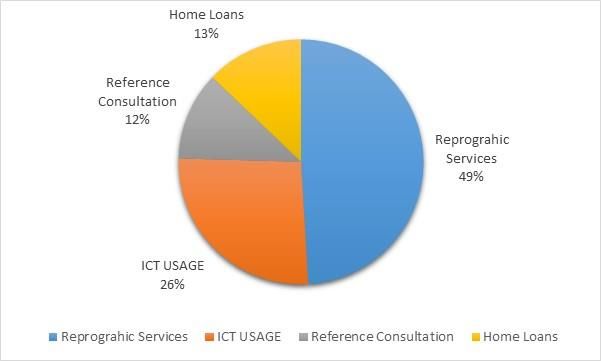
TABLE OF CONTENTS
OVERVIEW....................................................................................................................................... 6
SUMMARY....................................................................................................................................... 8
PART ONE ...................................................................................................................................... 14
INTRODUCTION ............................................................................................................................. 14
    INNOVATIONS CREATED A SHIFT IN TRADITIONAL LIBRARY USAGE .................................................................... 14
    RATIONALE FOR THE AUDIT .................................................................................................................... 14
    OBJECTIVES AND SCOPE OF THE AUDIT...................................................................................................... 14
    MANAGEMENT'S RESPONSIBILITY ............................................................................................................ 15
    AUDITOR'S RESPONSIBILITY .................................................................................................................... 15
    INDEPENDENCE .................................................................................................................................... 15
PART TWO ..................................................................................................................................... 16
STRATEGIC DIRECTION .................................................................................................................. 16
    JLS HAS NOT MEASURED THE IMPACT THAT TECHNOLOGICAL CHANGES HAVE ON LIBRARY SERVICE ........................ 17
    JLS SLOW IN CONDUCTING FULL REVIEW OF LIBRARY SERVICE TO RESPOND TO TECHNOLOGICAL CHANGES............... 19
    ABSENCE OF AN INFORMED COST-EFFECTIVE PLAN TO RESPOND WELL TO CHANGE ............................................. 21
    NO EVIDENCE THAT JLS’S BOARD OF DIRECTORS CONSIDERED ITS STRATEGIC DIRECTION ................................... 22
    NO EVIDENCE OF STRATEGIC SUPPORT FROM PARENT MINISTRY .................................................................... 23
PART THREE................................................................................................................................... 24
FINANCIAL AND HUMAN RESOURCE MANAGEMENT .................................................................... 24
    JLS GOVERNANCE IS IMPACTED BY ITS FAILURE TO PRESENT TIMELY FINANCIAL STATEMENTS ................................ 24
    JLS IS OPERATING WITHOUT AN APPROVED STAFF ESTABLISHMENT ................................................................. 24
    JLS PAID $20 MILLION FOR SECURITY SERVICES WITHOUT A SIGNED CONTRACT IN PLACE. ................................... 25
    JLS IGNORED PROCEDURES FOR DISPOSING ASSETS ...................................................................................... 26
    BOARD OF SURVEYED ITEMS REMAINED ON THE ASSET REGISTER AFTER THREE YEARS. ......................................... 26

                                                        Governance and Resource Management
 Page 4                                                           Jamaica Library Service (JLS)
                                                                                 January 2020
Governance and Resource Management
Page 5 Jamaica Library Service (JLS)
January 2020Overview
When the Jamaica Library Service (JLS) was established in 1948, there was a need for access
to free printed information. Since then, innovations and advancements in communication
technologies created easier and greater access to information by way of electronic means.
This worldwide phenomenon puts traditional libraries, like those managed by JLS, at a
turning point by presenting major challenges relating to their relevance and cost-
effectiveness. The Government of Jamaica (GOJ) allocated $4.7 billion, between 2014-15
and 2018-19, to provide library service through a network of 13 parish libraries and over 100
branch libraries, with more than 700 employees. The International Federation of Library
Associations (IFLA) indicated that public libraries play a role in contributing to the Sustainable
Development Goals (SDGs) by supporting digital inclusion through access to Information and
Communication Technology (ICT). This supports Vision 2030 Jamaica National Development
Plan (NDP) Goal 3, National Outcome #11 for the country to become a “Technology-Enabled
Society”. Ministry of Education, Youth and Information (MoEYI), the Parent Ministry of JLS,
is the agency responsible for increasing the use of technology as a tool for enhancing
teaching and learning, and to promote literacy and education in contributing to Jamaica
achieving “World-Class Education and Training”.
We conducted an audit of JLS to review aspects of its corporate governance processes to
determine the extent to which JLS was measuring and responding to the impact of
technological changes to remain relevant and cost-effective, while contributing to the Vision
2030 NDP and SDGs. We also assessed compliance standards in JLS financial and human
resource management.
The Audit revealed weaknesses in JLS governance systems, resulting from the Board of
Directors failing in its corporate governance responsibilities, while the Parent Ministry
appeared to offer little or no strategic support. Although JLS spent significant sums to
introduce and maintain ICT Infrastructure in libraries, the number of people using public
libraries has fallen, triggered by a shift in how people access and use information through
technology, and there was no evidence of effort to rationalize and reallocate resources to
minimize waste and create greater cost-effectiveness. The GoJ recently provided $128
million in the 2019-20 supplementary estimates to upgrade public libraries and purchase
books. JLS runs the risk of not spending this allocation wisely, if it undertakes upgrading
activities without an island wide review of the library service.
I thank the management and staff of JLS for the cooperation and assistance given to my staff,
during the audit and urge JLS and the MoEYI to take urgent actions to implement the
recommendations in this report.
Pamela Monroe Ellis, FCCA, FCA
Auditor General
Governance and Resource Management
Page 6 Jamaica Library Service (JLS)
January 2020Governance and Resource Management
Page 7 Jamaica Library Service (JLS)
January 2020Summary
The Jamaica Library Service (JLS) includes a network of 13 parish libraries and 103 branch
libraries, which provides access to information for educational, research and recreational
purposes at little or no cost to the users. This service is subsidized by the Government of
Jamaica (GOJ). Within the last five years, the approved budget for JLS increased to $1.05
billion in 2018-19 from $868 million in 2014-15. However, the way people access and use
information has changed dramatically in the 21st century. This worldwide phenomenon puts
public libraries, like those managed by JLS, at a turning point by presenting major challenges
relating to their relevance and cost-effectiveness1. As innovations and advancements in
communication technologies created easier and greater access to electronic information,
there is a ripple effect in the number of users and the frequency in which users visit libraries.
The International Federation of Library Associations (IFLA) alluded to the need for public
libraries to be equipped with the appropriate communication technologies and formulate
strategies that will support their relevance and cost-effectiveness.
Vision 2030 Jamaica National Development Plan (NDP) did not make any specific or obvious
reference to JLS. However, JLS is a member of the International Federation of Library
Associations (IFLA), which indicated that public libraries play a role in contributing to the
Sustainable Development Goals (SDGs) by supporting digital inclusion through access to
Information and Communication Technology (ICT) and dedicated staff to help people
develop new digital skills2. Vision 2030 Jamaica NDP Goal 3, National Outcome #11 is for
Jamaica to become a “Technology-Enabled Society”. Ministry of Education, Youth and
Information (MoEYI), the Parent Ministry of JLS, is the agency responsible for increasing the
use of technology as a tool for enhancing teaching and learning, and to promote literacy and
education in contributing to Jamaica achieving “World-Class Education and Training”3.
Vision 2030 Jamaica National Development Plan (NDP)
National Priority Sector Responsible
Outcome #2 Strategies (Years 1- 3) Agency
•World-Class •Increase the use of •Ministry of
Education and technology as a tool Education, Youth
Training for enhancing and Information
teaching and (MoEYI)
learning.
We conducted an audit of the library service to determine the extent to which JLS was
measuring and responding to the impact of technological changes, while contributing to
Jamaica’s Vision 2030 NDP and the SDGs. We also assessed whether aspects of JLS financial
and human resource management were consistent with good practices and accord with GoJ
regulations. The audit did not seek to prescribe the strategies, which should be considered
in responding to change.
1
Why do we still need public libraries in the digital age? 19 September 2014 britishcouncil.org/voices-magazine
2
SDG website: https://sustainabledevelopment.un.org/partnership/?p=10909
3
NDP Goal #1, National Outcome #2 – “World-Class Education and Training”
Governance and Resource Management
Page 8 Jamaica Library Service (JLS)
January 2020Summary
What we Found
Poor Low Usage Minimal No Measure
Governance Fall in the usage of Change of Cost
Outstanding public libraries Absence of full Effectiveness
Financial triggered by a impact assessment
major shift in how While GOJ
Statements impedes cost- Increased funding
impaired people access and effective response
use information to provide library
oversight and mechanisms, service, there is no
accountability through resulting in
technology and measure of the
process, narrow minimal changes . cost-effectiveness
focus of Board of little knowledge of
the real impact on of public libraries.
Directors and
inadequate the relevance and
Parent Ministry cost-effectiveness
strategic support. of public libraries.
Strategic Direction
1. Contrary to accountability and compliance standards, JLS Board of Directors did
not prepare annual reports and financial statements. JLS breached statutory
regulations by its failure to submit to the responsible Minister the required annual
reports since 2014-154. JLS received budgetary support of $4.7 billion, between
2014-15 and 2018-19, and collected revenue from income generating activities for
which there were no audited financial statements to explain how these monies were
spent. Its non-submission of the annual reports and audited financial statements for
five years diminished the level of oversight that Parliament could provide and the
process of holding management accountable for their performance. This was
exacerbated by a weak internal control function, given that there was no evidence
that JLS internal audit unit conducted any reviews of the operations of JLS Head
Office within the last seven years, 2012 to 2019.
4
Financial Administrative and Audit (FAA) Act and Jamaica Library Service (JLS) Act
JLS Act Section 7 (c) of the Jamaica Library Service Act of 1961which stipulates that; the duties of the Board shall
be to prepare and to submit to the Minister not later than the 31st day of July in each year, a report of the
activities of the Board and a financial statement of all receipts and expenditure by the Board during the preceding
year ending 31st day of March, and such report and financial statement shall be laid on the Tables of the Senate
and the House of Representatives. Section 13 also requires that the statements be audited annually in such
manners as maybe approved by the Auditor General.
Governance and Resource Management
Page 9 Jamaica Library Service (JLS)
January 2020Summary
JLS indicated that its inability to attract and keep competent accountants has
contributed to its failure to improve its financial reporting, including maintenance of
timely accounting records, to enable the preparation of financial statements for the
outstanding years.
2. JLS Board of Directors failed to convene regular meetings to review the
performance and set the strategic direction of JLS, which indicates a major
deficiency in its governance processes. After convening a meeting in November
2017, the Board did not meet again until July 2018. Another meeting of the Board
was held in March 2019, indicating a gap of eight months between meetings. We
reviewed the minutes of the seven meetings held by the Board within a two-year
period, June 2, 2016 to July 10, 2018, and noted that the Board paid little attention
to JLS’s long-term strategic priorities. We also noted that the tenure of the Board
expired April 2019 and the new Board, which was appointed in September 2019,
convened its first meeting in December 2019. In addition, JLS did not submit minutes
of its Board meetings to MoEYI. On the other hand, MoEYI did not seek to ensure
JLS compliance, which meant that, as Parent Ministry, its oversight function would
have been impaired. This lack of strategic direction and oversight represents a
breakdown in established monitoring arrangements for public bodies under the
Corporate Governance Framework5.
The International Federation of Library Associations (IFLA) and other sources
suggested that the internet adversely impacted traditional library services6. In
responding to this impact and supporting the achievement of Vision 2030 Jamaica
NDP and the SDGs, JLS implemented mitigating measures by installing Information
and Communication Technology (ICT) infrastructure in its library network. In 1999,
JLS began providing free computer and internet access at its parish and branch
libraries to improve opportunities for access to online information7. As at December
2019, all 13 parish libraries and 93 of the branch libraries offer computer and
internet services. JLS noted that over 30,000 users have been trained since the
introduction of a computer training programme in the year 2000 for senior citizens.
5Principle 15: Monitoring Arrangement by Ministries “The Permanent Secretaries as chief advisors to the
Ministers are required to monitor performance against expected results, manage risks and advise/inform the
Minister accordingly, on Public Bodies which operate within the portfolio responsibility of the Ministry. They also
ensure coordination among Public Bodies within the Ministry's portfolio which enhances policy coherence. They
should know what is happening in the Public Bodies in order to assess whether the strategic objectives of the
Ministry are being met through the Public Bodies.”
6
Why do we still need public libraries in the digital age? 19 September 2014 britishcouncil.org/voices-magazine, IFLA World
Library and Information Congress: 78th IFLA General Conference and Assembly; The Book Seller – England : Library usage falls
nearly 30% since 2005 Published February 2, 2017.
11-17 August 2012
7 Extracted from JLS Strategic Business Plan 2016-19: “The Jamaica library Service is positioning itself to remain
visible and relevant amidst the growing body of online resources and new technological facilities by acquiring a
number of computers and setting up internet service (including wireless) island-wide. This is being done through
the Global Libraries Project, which seeks to provide new and enhanced programmes and services responsive to
users/ non-users’ and stakeholders’ needs as well as promoting programmes and services to existing and
potential users to increase library usage and improving awareness of the value of public libraries in communities
in order to build local and national support.”
Governance and Resource Management
Page 10 Jamaica Library Service (JLS)
January 2020Summary
JLS indicated that it spent $95.6 million to purchase computers, in addition to $29.7
million to upgrade and maintain its information technology infrastructure, between
April 2014 and March 2019. The recurrent cost for the internet service amounted
to approximately $13.3 million. These ICT initiatives supported JLS’ effort to
contribute to the achievement of the Vision 2030 NDP and the SDGs. However, there
is no evidence that consideration was given to creating a balance between the cost
to operate the network of public libraries and their effectiveness, given the fall in
usage patterns despite the introduction of ICT infrastructure (Table 3).
3. Our review of library visits over the three-year period, 2016-17 to 2018-19, showed
that visits in nine of the 13 parishes fell by an overall 24 per cent, with the rates of
decline ranging from 13 per cent to as much as 73 per cent. JLS did not disaggregate
the information to show the number of visits at its branch libraries, where usage
trends would have been impacted significantly. Consequently, we were unable to
analyse labour efficiency and cost-effectiveness of parish and branch libraries. In
2019, as part of its recently initiated Strategic Review and Rationalization process,
JLS conducted a profile on 14 of the 103 branch libraries (13.6 per cent) that were
considered to be low performing. The reports showed that the daily average number
visits at 12 of the 14 branch libraries was below the daily threshold of 25 users
established by JLS, while only two of the libraries met the threshold. For example,
daily visits at three of the 14 libraries averaged between two to four users.
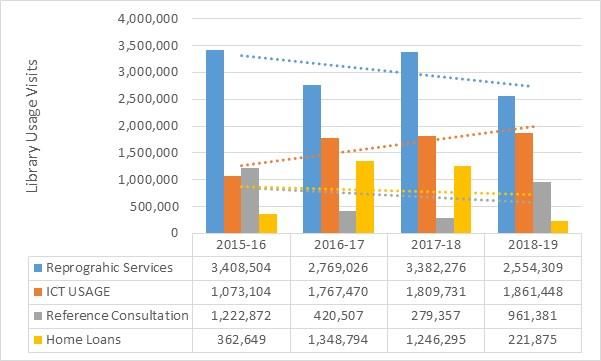
Our analysis of library usage data provided by JLS, for 2015-16 to 2018-19, revealed
that fewer persons are visiting public libraries for the traditional purposes; while
more visits are for ICT related services. Traditionally, people visited libraries to
borrow books and access reference materials. Lately, people visited libraries to
access reprographic and ICT services. Our analysis revealed that users mainly visited
libraries to access reprographic and ICT services8. Reprographic services accounted
for 49 per cent of visits, while ICT services accounted for 26 per cent, reference
consultation 12 per cent and only 13 per cent related to users borrowing books. In
addition, except for visits for ICT services that increased by 42 per cent, all other
services showed declines in usage. The number of visits to borrow books declined
by 63 per cent, followed by reprographic services and reference consultation, which
declined by 33 per cent and 27 per cent respectively.
4. While 12 of the libraries were underutilized, JLS continued to pay lease, utility,
maintenance and staff costs to operate them. JLS did not provide the actual
operating expenditure for the libraries, but indicated that it made recommendations
to MoEYI for the closure of the 14 libraries. However, MoEYI instructed that no
library should be closed pending further review for budgetary support or Cabinet
approval for closure. JLS indicated that public library usage has been significantly
impacted by inadequate resources, which resulted in compromised service
standards and delivery of other non-technology programmes. JLS pointed to the
high levels of attrition owing to low levels of remuneration as a factor affecting its
8
Reprographic services: Photocopying, Printing, Scanning, Laminating, Facsimile and Spiral Binding.
ICT services: Internet, Wi-Fi and Computer access,
Governance and Resource Management
Page 11 Jamaica Library Service (JLS)
January 2020Summary
human resource capabilities. However, JLS did not provide the relevant information
for us to assess the rate of attrition and resource utilization.
5. JLS is yet to conduct a review of usage patterns at all libraries to have full
knowledge of their cost-effectiveness. Therefore, JLS was not fully aware of all
underutilized branch libraries that would necessitate rationalization and reallocation
of resources to locations where there is greater usage. We noted minimal changes
to the structure of public libraries over the years. In its draft 2014-15 annual report,
JLS indicated it had 109 branch libraries and at November 2019 the library network
included 103 branch libraries, which suggests that JLS closed six branch libraries in
the last five years. Parish and branch libraries are cost centres that would have
affected JLS annual operating costs, which we were not able to analyse due to the
absence of financial statements and disaggregated expenditure and operational
information. In addition, JLS did not provide disaggregated financial information for
individual libraries across its network, which includes operational cost and revenue
from income generating activities for the last five years, 2014-15 to 2018-19. Having
full knowledge of the cost-effectiveness of individual libraries, JLS would be better
able to rationalize and reallocate its resources to minimize waste and create greater
value. JLS informed us that it conducted a Needs Assessment and Baseline Study in
2014 and two ICT impact assessments in 2016 and 2017. However, the Needs
Assessment, Baseline Study and ICT impact assessments were specific to the
introduction of ICT in libraries and not the usage, efficiency and relevance of public
libraries.
6. In addition, GOJ provided $128 million in the 2019-20 supplementary estimates for
the upgrading of public libraries and to purchase books. However, JLS has not
developed and implemented a structured plan, for this upgrading programme, which
would have provided a good opportunity for JLS to respond more effectively to
changes impacting the relevance of traditional library services. There is no evidence
that the Board of Directors articulated a medium to long-term plan to effectively
respond to new and emerging information technology changes. A library network is
a public good, but there is need for JLS to create a balance between the cost to
operate the network and efficiency and effectiveness.
Operational and Financial Functions
7. JLS employed and appointed individual employees in various posts upon the
approval of the Ministry of Finance and the Public Service (MoFPS). The MoFPS is
yet to finalize and approve a list of established posts for JLS, a necessary first-step in
maintaining recruitment and payroll control. JLS payroll summary for November
2019 indicated that 724 employees where paid salaries and travelling allowances
totalling $49 million. However, upon repeated requests for a current staff list, JLS
provided three lists, which were either inaccurate or incomplete. In December 2019,
JLS provided another list that indicated 844 employees, revealing a major disparity
with the payroll summary. In light of the decline in library usage, we expected JLS to
assess its workload utilization to determine staffing levels and performance for
efficient and cost-effective service delivery.
Governance and Resource Management
Page 12 Jamaica Library Service (JLS)
January 2020Summary
8. JLS did not have contracts in place to govern the provision of security services at
its head office and two other locations. JLS engaged three security companies
without written contracts and made payments totalling $20.6 million between April
2016 to August 2019. JLS action to engage the suppliers using the direct contracting
methodology was in breach of Section 1.1.4 of the Procurement Guidelines. This
arrangement prevented JLS from ensuring that it has obtained the best possible
prices on a competitive basis. Without formal contracts, which would establish
performance criteria, we could not determine how JLS satisfied itself that the
suppliers met expectations. The absence of formal contracts could have denied JLS
of surety of services and may leave JLS without recourse in the event of losses related
to unsatisfactory performance.
What should be done:
Better Strategic Adhere to
Oversight Review Procurement Rules
•The Board of Directors •There is an urgent •In the short-term, JLS
should improve the requirement for JLS and, needs to regularize
oversight of JLS and the by extension, MoEYI to contracts for security
MoEYI should ensure JLS conduct a thorough review services by adhereing to
compliance with its of the usage of public the procurement
reporting obligations. All libraries islandwide with a guidelines in the selection
outstanding annual reports view to explore and awarding of contracts.
including financial opportunities for
statements should be improved services through
prepared forthwith and technology and cost
presented for auditing. consolidation. This is
necessary to inform the
need for rationalization
and reallocation of
resources.
Governance and Resource Management
Page 13 Jamaica Library Service (JLS)
January 2020Part One
Introduction
Innovations created a shift in traditional library usage
1.1 The Jamaica Library Service (JLS) was established in 1948 when there was a need for
access to free printed information for educational, research and recreational purposes. JLS
cited that its mission is “to enable national development through the creation and support
of a knowledge-based society of culturally aware life-long learners by providing universal
access to information.” JLS, like other public libraries world-wide, is at a turning point and
the way people access and use information has changed dramatically in the 21st century9.
This world-wide phenomenon presents major challenges for public libraries as innovations
and advancements in communication technologies created easier and greater access to
electronic information. This heightens the need for public libraries to be equipped with the
appropriate communication technologies and formulate strategies that will support the
relevance and cost-effectiveness of library service10.
Rationale for the Audit
1.2 We considered public library service as still relevant; but, to survive in this digital age
and stay relevant, efficient and cost effective, public libraries need to be innovative and
embrace structural changes both physically and virtually. Since its inception, the network of
libraries has grown. There were 13 parish libraries and 103 branch libraries as at November
2019. There are opportunities for JLS to adapt to new trends that will create greater
efficiency and cost-effectiveness, while achieving it mission.
Objectives and Scope of the Audit
1.3 We conducted an audit of JLS to review its corporate governance, financial
transactions and accounting records to determine the extent to which JLS was measuring the
impact of technological changes on its operation. The audit also assessed whether JLS was
keeping pace with the changes in how people access and consume information so as to
remain relevant and cost effective. The audit did not seek to prescribe the strategies, which
should be considered in responding to change.
9
Why do we still need public libraries in the digital age? 19 September 2014 britishcouncil.org/voices-magazine
10
IFLA World Library and Information Congress: 78th IFLA General Conference and Assembly
11-17 August 2012
The Book Seller – England : Library usage falls nearly 30% since 2005 Published February 2, 2017
Governance and Resource Management
Page 14 Jamaica Library Service (JLS)
January 2020Part One Introduction
1.4 We examined the accounting records and financial transactions of JLS for the period
April 2016 to August 2019. In gaining an understanding of JLS, we assessed the financial,
operational and environmental risk and directed our audit focus to the riskier areas as
appropriate. The audit focused on JLS governance, internal controls and risk management
as well as aspects of JLS operational and financial management functions. The audit findings
and observations, therefore, should not be regarded as representing a comprehensive
statement of all the weaknesses and improvements that exist at JLS.
Management's Responsibility
1.5 Management is responsible for designing, implementing and maintaining internal
controls relevant to the activities of JLS and to formulate and implement effective strategies
for efficient and cost-effective use of resources. It is the responsibility of management to
ensure that the governance, internal control and risk management framework are designed
and managed in accordance with the FAA Act, Regulations and its Instructions, other
government guidelines and best practices.
Auditor's Responsibility
1.6 Our work was conducted in accordance with the International Organization of
Supreme Audit Institutions (INTOSAI) and Fundamental Auditing Principles and Guidelines.
Those principles require that we comply with ethical requirements and plan and perform the
audit to obtain reasonable assurance on whether the activities, financial transactions and
information reflected in the accounts are in all material respects, in compliance with the
Government of Jamaica Regulations and Guidelines. Our responsibility is to independently
express an opinion on the effectiveness of JLS governance, internal controls and risk
management framework based on our audit.
Independence
1.7 We consider that we comply with the Auditing Practices Board (APB) ethical
standards and that, in our professional judgment, we are independent and our objectivity is
not compromised. There are no relationships between the Auditor General’s Department
and the JLS that we consider to bear on our objectivity and independence.
Governance and Resource Management
Page 15 Jamaica Library Service (JLS)
January 2020Part Two
Strategic Direction
2.1 The way people access and use information has changed dramatically in the 21st
century. This world-wide phenomenon puts public libraries at a turning point by presenting
major challenges relating to their relevance and cost-effectiveness11. The increase in
information and communication technologies created easier and more efficient ways to
access information electronically. Globally, there is a reported fallout in the number of users
and the frequency in which people visit libraries. This heightens the need for public libraries
to be strategic and adapt to the new trends to survive in this digital age, in order to remain
relevant and cost effective.
2.2 JLS annual request for budgetary support averaged $1.9 billion, between 2014-15
and 2018-19. Over that period, GOJ annual approved budget for library service averaged
$938 million, reflecting an average budgetary shortfall of $973 million (Table 1). This
heightens the need for JLS to ensure that it better managed the distribution of its limited
resources in a cost-effective manner, given the declining trends in the usage patterns at
public libraries. JLS operates 13 parish libraries, 103 branch libraries. These are cost centres
that would have affected JLS annual operating costs.
Table 1 JLS Budget Request, Funding and Shortfall 2014-15 to 2018-19
Average 2014-15 2015-16 2016-17 2017-18 2018-19
Details 2014-19 $’000 $’000 $’000 $’000 $’000
School Library 78,401 75,471 76,425 72,296 83,906 83,906
Public Library 860,096 792,126 805,906 770,053 965,484 966,910
Total 938,497 867,597 882,331 842,349 1,049,390 1,050,816
Budget Request 1,911,359 1,811,779 1,572,940 2,025,188 2,004,605 2,142,283
Excess/(Deficit) (972,862) (944,182) (690,609) (1,182,769) (955,215) (1,091,467)
Source: JLS Financial Records
2.3 Despite requests, JLS did not provide information relating to revenue earned from
income generating activities and actual expenditure for that period (Table 2). This prevented
us from assessing the level of support the GOJ provided to offset JLS operating cost.
Notwithstanding, operational costs for library service is heavily subsidized by GOJ. Libraries
are public good, but there is need to create a balance between the cost to operate them and
their effectiveness.
11
Why do we still need public libraries in the digital age? 19 September 2014 britishcouncil.org/voices-magazine
Governance and Resource Management
Page 16 Jamaica Library Service (JLS)
January 2020Part Two Strategic Direction
Table 2 Analysis of JLS Revenue, GoJ Subsidy and Expenditure, 2014-15 to 2018-19
Details 2014-15 2015-16 2016-17 2017-18 2018-19
$’000 $’000 $’000 $’000 $’000
Revenue12 N/P N/P N/P N/P N/P
Expenditure N/P N/P N/P N/P N/P
Excess/(Deficit) N/P N/P N/P N/P N/P
GOJ Subsidy 867,597 882,331 842,349 1,049,390 1,050,816
Subsidy % CND CND CND CND CND
Note: N/P – Not Provided
CND – Could Not Determine
Source: JLS Financial Records
JLS has not measured the impact that technological changes have on library service
2.4 Part of the fiduciary responsibility of JLS Board of Directors is to set the strategic
direction. An important first-step in doing so is to get a good understanding of the
operational impact technological changes are having on library services and the cost
implication. However, JLS did not make use of financial and library usage data to optimize
its strategic decision making, to create greater cost saving and revenue generating
opportunities. While parish and branch libraries submitted monthly data on library visits to
JLS, there is no evidence that JLS analysed the data to use the information for cost-effective
decision-making.
2.5 Further, JLS did not provide relevant financial information for individual libraries
across its network, to include revenue from income generating activities and operational cost
for the last five years, 2014-15 to 2018-19. JLS recently formalized efforts to collate library
usage data. A review of library visits over the three-year period, 2016-17 to 2018-19, showed
that visits in nine of the 13 parishes fell by an overall 24 per cent, with the rates of decline
ranging from 13 per cent to as much as 73 per cent (Table 3). Our analysis was further limited
as JLS did not disaggregate the information to show the number of visits at its branch
libraries, where usage trends would have been impacted significantly by the changes in
information technology. Consequently, we were unable to analyse labour efficiency and
cost-effectiveness of parish and branch libraries.
12
Revenue from income generating activities
Governance and Resource Management
Page 17 Jamaica Library Service (JLS)
January 2020Part Two Strategic Direction
Table 3 Actual Library Visits 2014-15 to 2018-19
No. Parish [A] [B] [C] [C-A] %
2016-17 2017-18 2018-19 Variance
1 Clarendon 237,356 210,182 159,572 (77,784) (33)
2 Hanover 55,193 65,400 83,524 28,331 51
3 KSAPL 165,125 199,434 108,546 (56,579) (34)
4 Manchester 188,880 151,338 133,071 (55,809) (30)
5 Portland 256,503 331,490 444,669 188,166 73
6 St. Ann 154,607 168,392 161,448 6,841 4
7 St. Catherine 231,940 180,798 133,650 (98,290) (42)
8 St. Elizabeth 124,188 122,415 107,578 (16,610) (13)
9 St. James 164,465 164,291 136,620 (27,845) (17)
10 St. Mary 743,738 673,201 201,890 (541,848) (73)
11 St. Thomas 140,593 190,876 107,203 (33,390) (24)
12 Trelawny 33,273 34,814 94,469 61,196 184
13 Westmoreland 177,132 191,489 147,207 (29,925) (17)
Total 2,672,993 2,684,120 2,019,477 (653,546) (24)
Note: N/P – Not Provided
Source: Data provided by JLS
2.6 In addition, JLS would be unaware of underutilized branch libraries that would
necessitate rationalization and reallocation of resources to locations where there is greater
usage to improve cost-effectiveness. We noted minimal changes to the structure of public
libraries over the years and the unawareness of usage trends affected the adequacy of JLS
response. In its draft 2014-15 annual report, JLS indicated it had 109 branch libraries and at
November 2019 the library network included 103 branch libraries, which suggests that JLS
closed six branch libraries in the last five years. Traditionally, people visited libraries to
borrow books and access reference materials (reference consultation) and lately to access
reprographic and ICT services13. Individual libraries in JLS network record the purpose for
each user’s visit. JLS collated and provide library service usage data for four years, 2015-16
to 2018-19.
2.7 Our analysis of the data, as shown in Figure 1, revealed that users mainly visited
libraries to access reprographic and ICT services. Reprographic services accounted for 49 per
cent of visits, while ICT services accounted for 26 per cent, reference consultation 12 per
cent and only 13 per cent related users borrowing books (home loans). In addition, except
for visits for ICT related services that increased by 42 per cent, between 2015-16 and 2018-
19, all other services showed declines in usage. The number of visits to borrow books
declined by 63 per cent, followed by reprographic services, 33 per cent and reference
consultation, 27 per cent; indicating that fewer persons are visiting public libraries for the
traditional purposes.
13
Reprographic services: Photocopying, Printing, Scanning, Laminating, Facsimile and Spiral Binding.
ICT services: Internet, Wi-Fi and Computer access,
Governance and Resource Management
Page 18 Jamaica Library Service (JLS)
January 2020Part Two Strategic Direction
Figure 1 JLS Library Service Usage 2015-16 to 2018-19
Source: Data provided by JLS
JLS slow in conducting full review of library service to respond to technological changes
2.8 In 2018 JLS commenced a strategic review of its library service network to examine
the coverage and performance of all public libraries. However, JLS is yet to complete the
review to understand better, the usage patterns and the cost-effectiveness to deliver library
services at individual locations. Having full knowledge of the cost-effectiveness of libraries,
JLS would be able to manage its resources more efficiently.
2.9 In 2019, JLS conducted a profile of only 14 of its 103 branch libraries considered to
be low performing and provided the draft profile reports. As shown in Table 4, the daily
average number of visits at 12 of the 14 branch libraries was below daily threshold of 25
users established by JLS, while only two of the libraries met the threshold. For example, daily
visits at three of the 14 libraries averaged between two to four users. While 12 of the
libraries were underutilized, based on their profile results, JLS continued to pay lease, utility,
maintenance and staff costs to operate them. JLS indicated that it made recommendations
to the MoEYI for the closure of the 14 libraries; however, the MoEYI instructed that no library
should be closed pending further review for budgetary support or Cabinet approval for
closure.
Governance and Resource Management
Page 19 Jamaica Library Service (JLS)
January 2020Part Two Strategic Direction
Table 4 Actual Library Usage 2014-15 to 2018-19
No. Branch Library Type Estimated Wi-Fi Staffing Daily Daily
Population Availability Average Usage
Served Usage Threshold
1 Cross Keys, Manchester Leased 2000 No 2 5-7 Below
2 Lancaster, Manchester Leased N/I No 2 3-12 Below
3 Mount Pleasant, Leased N/I Yes 2 11-12 Below
Portland
4 Sturge Town, St. Ann Other N/I No 2 2-4 Below
5 Mount Zion, St. Ann Leased N/I No 2 6-9 Below
6 Runaway Bay, St. Ann Leased N/I Yes 2 8-10 Below
7 Beeston Spring, Owned N/I No 2 10-15 Below
Westmoreland
8 Springfield, St. James Leased N/I Yes 2 10-13 Below
9 Chatham, St. James Leased N/I Yes 2 20-25 Meet
10 Pondside District, Great Leased N/I Yes 2 2-4 Below
Valley, Hanover
11 Pennants, Clarendon Leased N/I Yes 3 20-25 Meet
12 James Hill, Clarendon Leased N/I No 3 10-14 Below
13 Points Hill, St. Catherine Owned N/I No 2 6-8 Below
14 Riversdale, St. Catherine Leased N/I No 2 2-4 Below
TOTAL 8-11
Note: N/I – Not Indicated
Other – Community Facility
Source: Data provided by JLS
2.10 JLS commissioned a review and rationalization committee to gather evidence based
data to determine continuation of service in some communities, inform program and service
delivery and to respond to the changes in information technology. The committee met four
times between May 2019 and November 2019. The terms of reference of the committee
and the minutes of the meetings did not indicate timelines for the completion of the review.
2.11 JLS informed us that it commissioned a Needs Assessment and a Baseline Study in
2014 to review Information and Communication Technology (ICT) services for user and non-
user needs. The results of the Needs Assessment and a Baseline Study informed actions taken
to introduce new and enhanced ICT programmes and services to library users. Subsequently,
two ICT impact assessments were completed in 2016 and 2017. The Needs Assessment,
Baseline Study and ICT impact assessments were specific to the introduction of ICT in branch
libraries and not the usage, efficiency and relevance of public libraries.
Governance and Resource Management
Page 20 Jamaica Library Service (JLS)
January 2020Part Two Strategic Direction
Absence of an informed cost-effective plan to respond well to change
2.12 JLS acknowledged in its Strategic Business Plan 2016-2019, that “the availability of
resources online may undermine the visibility and value of the library". However, JLS
indicated that the impact and relevance of public libraries globally is no longer confined to
statistics on traffic and usage of traditional resources, but rather the contribution of libraries
to personal and national development and the United Nations Sustainable Development
Goals (SDGs). The International Federation of Library Associations alluded that public
libraries play a role in contributing to the SDGs by supporting digital inclusion through access
to Information and Communication Technology (ICT) and dedicated staff to help people
develop new digital skills14.
2.13 In responding to the adverse impact of technological changes and supporting the
SDG, JLS implemented mitigating measures by installing ICT infrastructure, by installing
computers and Internet service at its parish and branch libraries to improve opportunities
for free access to online information15. As at December 2019, all 13 parish libraries and 93
of the branch libraries offered computer and internet services.
Extract from JLS Response: “The provision of computer and Internet access in parish libraries
began in 1999. This service expanded to branch libraries island wide in successive years
resulting in the provision of free access in 2008 to all citizens propelling the organization to
become the single largest provider of free computer and internet access in the island. The
library was lauded when the first computer training for senior citizens was introduced in
2000. The training programme which is offered free of cost has since expanded to include
training for all categories of users resulting in over 30,000 users trained since the inception
of this technology programme. These initiatives would have been developed over the years
through the organizational strategic review and response to changes in the information and
knowledge industry.”
2.14 However, there is no evidence that consideration was given to creating a balance
between the cost to operate the network of public libraries and their effectiveness, given the
fall in usage patterns despite the introduction of ICT infrastructure. JLS indicated that it spent
$95.6 million to purchase computers, in addition to $29.7 million to upgrade and maintain
its information technology infrastructure, between April 2014 and March 2019. The
recurrent cost for the internet service amounted to approximately $13.3 million. However,
JLS indicated that public library usage has been significantly impacted by inadequate
resources, which resulted in compromised service standards and delivery of other non-
14
SDG website: https://sustainabledevelopment.un.org/partnership/?p=10909
15
Extracted from JLS Strategic Business Plan 2016-19: “The Jamaica library Service is positioning itself
to remain visible and relevant amidst the growing body of online resources and new technological
facilities by acquiring a number of computers and setting up internet service (including wireless)
island-wide. This is being done through the Global Libraries Project, which seeks to provide new and
enhanced programmes and services responsive to users/ non-users’ and stakeholders’ needs as well
as promoting programmes and services to existing and potential users to increase library usage and
improving awareness of the value of public libraries in communities in order to build local and national
support.”
Governance and Resource Management
Page 21 Jamaica Library Service (JLS)
January 2020Part Two Strategic Direction
technology programmes. JLS pointed to the high levels of attrition owing to low level of
remuneration as a factor affecting its human resource capabilities. However, JLS did not
provide the relevant information for us to assess the rate of attrition and resource utilization.
2.15 GoJ provided $128 million in the 2019-20 supplementary estimates for the upgrading
of public libraries and to purchase books. However, JLS has not proved that initiatives for
upgrading public libraries were informed by proper impact assessment, considering the
paradigm shift from the use of traditional library services to more technological means of
accessing information. JLS has not demonstrated that it has developed and implemented a
structured plan, for this upgrading programme, which provides a good opportunity for JLS to
respond more effectively to changes impacting the relevance of traditional library services.
Part of the problem is that there is no evidence that the Board of Directors articulated a
medium to long-term plan to effectively respond to new and emerging information
technology changes.
2.16 JLS presented a risk register which, identified its key business processes, risk
category, risk description, risk matrix and response. Of note, the specific risks relating to
technological changes and the impact on library service were not included. We were
therefore unable to determine how current the risk profile was, and how frequently it was
updated, as the document was undated. However, JLS indicated that it submitted the risk
portfolio to the Parent Ministry in October 2019. Periodic risk assessment is necessary for
JLS to identify and manage key risks, in order to continuously rethink the delivery of public
library service to curtail waste that may be associated with the decline in library usage.
2.17 We noted that JLS operational plan for 2019-20 and risk management plan for 2019-
21 were still at the draft stage awaiting submission to MoEYI for approval. However, these
draft plans, in their current form, are narrowly focused as, for example, the risk management
plan did not include the substantive issue of the quantifiable operational and financial
challenges JLS faces and the strategies to address them.
No evidence that JLS’s Board of Directors Considered its Strategic Direction
2.18 After convening a meeting in November 2017, the Board did not meet again until
July 2018. At the time of the audit in October 2019, the last meeting of the Board was held
in March 2019, indicating a gap of eight months between meetings. We reviewed the
minutes of seven meetings held by Board of Directors within a two-year period, June 2, 2016
to July 10, 2018, and noted that the Board paid little attention to long-term strategic
priorities in relation to JLS operations. Instead, dialogue among Board members was limited
to making administrative decisions. We noted that the tenure of the Board expired April
2019 and the new Board, which was appointed in September 2019 convened its first meeting
in December 2019.
Governance and Resource Management
Page 22 Jamaica Library Service (JLS)
January 2020Part Two Strategic Direction
No evidence of strategic support from Parent Ministry
2.19 We found no evidence that MoEYI effectively monitored the operations of JLS and
provided strategic support to foster an innovative and cost effective environment. For
example, we found no evidence that JLS submitted minutes of its Board meetings to MoEYI.
MoEYI, on the other hand, did not seek to ensure JLS compliance, which means that its
oversight function would have been impaired. This lack of oversight and strategic direction
represents a breakdown in established monitoring arrangements for public bodies under the
Corporate Governance Framework16.
16Principle15: Monitoring Arrangement by Ministries “The Permanent Secretaries as chief advisors to the
Ministers are required to monitor performance against expected results, manage risks and advise/inform the
Minister accordingly, on Public Bodies which operate within the portfolio responsibility of the Ministry. They also
ensure coordination among Public Bodies within the Ministry's portfolio which enhances policy coherence. They
should know what is happening in the Public Bodies in order to assess whether the strategic objectives of the
Ministry are being met through the Public Bodies.”
Governance and Resource Management
Page 23 Jamaica Library Service (JLS)
January 2020Part Three
Financial and Human Resource Management
JLS governance is impacted by its failure to present timely financial statements
3.1 JLS governance practices were inconsistent with the Public Bodies Management and
Accountability (PBMA) Act, Corporate Governance and Accountability Frameworks, Ministry
of Finance and the Public Service Circulars and the Jamaica Library Service Act. JLS breached
these regulatory frameworks by not ensuring that it submits to the responsible Minister, the
required annual reports. The last annual report, including audited financial statement, was
for the financial year 2013-14. By its non-submission of the statutory annual reports and
audited financial statements for five years, JLS has deprived the portfolio Ministry and
Parliament of their oversight function regarding the financial and operational performance.
3.2 In breach of JLS Act Section 7 (c), JLS has not accounted for sums allocated by
Parliament over the period spanning 2014-15 to 2018-19. The annual estimates of
expenditure showed that, over the last five years, 2014-15 to 2018-19, GOJ provided
budgetary support of $4.7 billion, averaging $946 million each year. We also determined
that JLS received income from its activities. However, JLS failed to provide us with the
relevant information to allow for thorough analysis, despite requests. JLS’s failure to provide
financial statements over this period to account for its revenues and related expenditure was
exacerbated by a weak internal control function, given that there was no evidence that JLS
internal audit unit conducted any reviews of the operations of JLS Head Office within the last
seven years, 2012 to 2019. At the time of the audit, only one of four internal audit positions
was filled.
3.3 Based on these deficiencies, JLS Board of Directors failed in its corporate governance
responsibility to prepare and submit annual reports, including audited financial statements,
to adhere to accountability and compliance standards. JLS indicated that its inability to
attract and keep competent accounting officers has contributed to its failure to improve its
financial reporting, including maintenance of timely accounting records, to enable the
preparation of financial statements for the outstanding years.
JLS is operating without an approved staff establishment
3.4 GoJ funding to offset JLS operating cost has also increased. Within the last five years,
the approved budget for JLS increased to $1.05 billion in 2018-19 from $868 million in 2014-
15, with an average 82 per cent of the budget allocated for staff related expenses each year17
(Table 5). JLS employed and appointed individual employees in various posts upon MoFPS
approval. At the time of the audit, JLS did not provide a current staff list that should be
17
Salary and Travelling Allowance
Governance and Resource Management
Page 24 Jamaica Library Service (JLS)
January 2020Part Three Financial and Human Resource Management
readily available, detailing the names and positions of all its employees and where they are
located.
Table 5 Approved budget for public library services 2014-15 to 2018-19
Particulars 2014-15 2015-16 2016-17 2017-18 2018-19
$’000 $’000 $’000 $’000 $’000
Compensation 702,160 716,894 676,912 808,887 808,887
Travel Expenses 23,223 23,223 23,223 23,323 23,323
Rental 16,960 16,960 16,960 16,860 18,286
Utilities 31,416 31,416 31,416 31,416 31,416
Goods and Services 50,000 50,000 50,000 50,000 50,000
Retirement Benefits - - 43,838 116,860 116,860
Capital Goods 43,838 43,838 - 2,044 2,044
Total 867,597 882,331 842,349 1,049,390 1,050,816
Compensation % 84% 84% 83% 79% 79%
Source: GoJ Estimates of Expenditure
3.5 Further, MoFPS is yet to finalize and approve a list of established posts for JLS, a
necessary first-step in maintaining recruitment and payroll control. JLS payroll summary for
November 2019 indicated that 724 employees where paid salaries and travelling allowances
totalling $49 million. Upon repeated requests for a current staff list, JLS provided three lists,
which were either inaccurate or incomplete. In December 2019, JLS provided another list
that indicated 844 employees, demonstrating a major disparity with the payroll summary.
In light of the decline in library usage, we expected JLS to assess its workload utilization to
determine staffing levels and performance for efficient and cost-effective service delivery.
JLS paid $20 Million for security services without a signed contract in place.
3.6 JLS did not have contracts in place to govern the provision of security services at its
head office, one parish library and one branch library. JLS engaged the companies without
written contracts and made payments totalling $20.6 million between April 2016 and August
2019. JLS action to engage the suppliers using the direct contracting methodology was in
breach of Section 1.1.4 of the Procurement Guidelines. This arrangement prevented JLS from
ensuring that it has obtained the best possible prices on a competitive basis.
3.7 JLS’s failure to manage efficiently its contractual arrangements would have
prevented it from ensuring that it obtained value for money for the delivery of security
service. Without valid contracts, which would establish performance criteria, we could not
determine how JLS satisfied itself that the suppliers met expectations. The absence of formal
contracts could have robbed JLS of surety of services and may leave JLS without recourse in
the event of losses related to unsatisfactory performance.
Governance and Resource Management
Page 25 Jamaica Library Service (JLS)
January 2020Part Three Financial and Human Resource Management
JLS ignored procedures for disposing assets
3.8 JLS has not established a board of survey committee as stipulated by the MoFPS
guidelines to deal with the disposal of assets18. We noted that the head of each department
submitted a listing of all assets deemed irreparable to the Deputy Director of Administration,
who compiled and submitted a list to the Ministry of Finance requesting that the items be
board of surveyed. This contravenes the guideline, which stipulates that; A Board of Survey
committee consisting of not less than three persons (two of whom must be of senior rank)
shall be established by all public bodies to review and recommend the disposal or otherwise,
of the enterprise’s fixed assets, other than land. The lack of an existing Board of Survey
Committee at JLS may result in subjective judgement of item(s) to be board of surveyed
thereby resulting in misappropriation of Government’s assets.
Board of surveyed items remained on the asset register after three years.
3.9 We found that the asset manager failed to remove 37 items from the asset register
that were disposed of on June 21, 2016. The MoFPS Board of Survey guideline stipulates that
"Proper notation as to asset disposal should be made in the assets register and these should
be certified by someone other than the person with responsibility for maintaining the
register". JLS’ failure to remove disposed items from the register represents an
overstatement of the accounts thereby preventing Management from making accurate
assessments of the Library’s resources. Management must ensure that a Board of Survey
Committee is implemented and assets disposed of are promptly remove from the register in
accordance with stipulated guidelines.
18
Guideline 2.06 Asset Management" procedures for the disposal of Assets including motor vehicles (other than vehicles
assigned to eligible officers) No. 7 dated Oct 1, 1996.
Governance and Resource Management
Page 26 Jamaica Library Service (JLS)
January 2020You can also read


