Knowledge-based Service for African Traditional Herbal Medicine: A Hybrid Approach
←
→
Page content transcription
If your browser does not render page correctly, please read the page content below
Knowledge-based Service for African Traditional
                        Herbal Medicine: A Hybrid Approach

        Samuel Nii Odoi Devine1, Emmanuel Awuni Kolog2, Erkki Sutinen3 and Ilari Sääksjärvi4
    1Departmentof Information and Communication Technology, Presbyterian University College Ghana, Okwahu, Ghana
    2Departmentof Operations and Management Information Systems, University of Ghana Business School, Accra, Ghana
                        3Department of Future Technologies, University of Turku, Turku, Finland
                            4Department of Biodiversity, University of Turku, Turku, Finland

              samuel.nodevine@presbyuniversity.edu.gh, eakolog@ug.edu.gh, {erkki.sutinen, ileesa}@utu.fi

Keywords:         Knowledge-base, Information Retrieval, Ontology, Machine Learning, African Traditional Herbal Medicine.

Abstract:         Globally, the acceptance and use of herbal and traditional medicine is on the rise. Africa, especially Ghana,
                  has its populace resorting to African Traditional Herbal Medicine (ATHMed) for their healthcare needs due
                  to its potency and accessibility. However, the practice involving its preparation and administration has come
                  into question. Even more daunting is the poor and inadequate documentation covering the preservation and
                  retrieval of knowledge on ATHMed for long-term use, resulting in invaluable healthcare knowledge being
                  lost. Consequently, there is the need to adopt strategies to help curtail the loss of such healthcare knowledge,
                  for the benefit of ATHMed stakeholders in healthcare delivery, industry and academia. This paper proposes
                  a hybrid-based computational knowledge framework for the preservation and retrieval of traditional herbal
                  medicine. By the hybrid approach, the framework proposes the use of machine learning and ontology-based
                  techniques. While reviewing literature to reflect the existing challenges, this paper discusses current
                  technologies suited to approach them. This results in a framework that embodies an ontology driven
                  knowledge-based system operating on a semantically annotated corpus that delivers a contextual search
                  pattern, geared towards a formalized, explicit preservation and retrieval mechanism for safeguarding
                  ATHMed knowledge.

1     INTRODUCTION                                                       Predominantly and habitually, this knowledge, as
                                                                     classified by Nonaka and Takeuchi (1995), is tacit,
The idea of providing treatment to ailments or                       which does not suit the view of long-term use and
diseases has, over the years, seen various methods                   preservation of such valuable knowledge. Tacit
being applied, with each having to show its own                      knowledge comprises of the skills, ideas and
potency and often attributed to a specific region or                 experiences people possess, which are hard to access
country. The case of Ghana is not different as the use               and transfer (Chugh, 2018, p. 2), in this case the
of such methods is either orthodox or traditional.                   ATHMed practitioners in Ghana. There are many
Before the introduction of orthodox medicine, many                   cases where in an attempt to remain relevant, herbal
a Ghanaian took to the use of traditional herbal                     practitioners (traditional healers and herbalist) pass
treatments, of all sorts, to help cure all forms of                  on the knowledge to only their close allies or families.
diseases. Still, the use of African traditional herbal               This often leads to the likelihood of such knowledge
medicine (ATHMed) is widespread in Ghana, as an                      being either lost or failing to be developed over time
estimated 70% of the population obtain healthcare                    (Amoah et al., 2014). In the case where the
through traditional healers (Amoah et al., 2014),                    knowledge is not shared at all, the practitioner
especially with rural communities. Interestingly,                    eventually dies with the knowledge. Furthermore, due
preference for traditional medicine is on the rise                   to the absence of proper documentation on the choice
worldwide (Frass et al., 2012; Zhang, 2004). The                     selection of ingredients, methods of drug preparation
preparation of ATHMed is often in various forms                      and administration, some ATHMed patrons often
with ingredients (herbs) and methods which are                       doubt the efficacy of these medications. There have
usually in the keep of the practitioners.                            been reported instances of “misinformation and abuse
of traditional health knowledge” (Yeboah, 2000: p. or treatment of physical and mental illness" (WHO,
208) which poses negative consequences to the health 2018, p. 1). Herbal medicines also encompass "herbs,
of ATHMed patrons. With these concerns, this study herbal materials, herbal preparations and finished
seeks to develop a framework for preserving and herbal products that contain as active ingredients
retrieving knowledge in traditional herbal medicine. parts of plants, or other plant materials, or
Throughout history, attempts and varying combinations" (WHO, 2018, p. 1).
approaches have been developed and implemented in The Government of Ghana realising such a need
order to safeguard, as well as, disseminate has setup the Centre for Scientific Research into Plant
knowledge. This is to ensure posterity and present Medicine to lead the way in the preparation and
benefit from works, acts, processes, information and standardization of herbal medicine in Ghana (Amoah
all relevant data that will help improve or maintain et al., 2014). In recent times, attempts are being made
personal to organizational development needs. by Universities in Ghana to train pharmacists in the
Knowledge is regarded as key to any organization’s area of indigenous African herbal medicine treatment.
present and future growth, and competitive advantage Two universities, Kwame Nkrumah University of
especially in the 21st century (Xue, 2017; Davenport Science and Technology and University of Ghana, are
and Prusak, 1998), with its basis being often formed currently offering degree programmes at the
by, but not limited to, data and information. undergraduate level and training programs in an
To help salvage and standardize such practices in attempt to assist in formalizing the training of
the area of ATHMed, the United Nations Millennium professionals in herbal medicine. However, their
Development Goals and the World Health focus has mainly been to help curb the challenge
Organization (WHO) has recognise the need to related to the Ghanaian traditional herbal medicine
promote and support the development of traditional practitioner’s accurate measurement of ingredients
herbal medicine by launching the Traditional for drug preparation with issues on quality. The
Medicine Strategy 2014–2023 (WHA62.13) 1 . Key universities also strive to provide strategies for long-
amongst its strategic objectives is "to build the term preservation, appropriate forms of
knowledge base for active management of administration, and administering right dosage of
Traditional, complementary and integrative medicine such herbal drugs. For instance, the University of
through appropriate national policies". In view of this Ghana 2 in 2016 organized a 2-day face-to-face
advocacy, these researchers propose a novel model training programme for manufacturers of herbal
and knowledge-based framework using products/food supplements, focusing on the
computational ontologies and machine learning to improvement of safety and efficacy, evaluation of
help in the preservation and retrieval of traditional raw materials, toxicological assessment, quality and
herbal medicines. In this paper, we have suggested a standardization in Ghana. These interventions seek to
framework fit for use in Medical Institutions of harness the potential of herbal medicine, providing
Higher Education (IHE) and herbal businesses where orthodox and scientific approaches to standardizing
the knowledge of herbal medicine, sourced from and safeguarding the knowledge associated with it,
“deep smart” knowledge bearers, is imparted to and the practices in applying medication. This
students who are, potentially, future herbal doctors. attempt also assists in documenting and preserving
practices and medications associated with African
traditional herbal medicines (ATHMed) which
2 BACKGROUND hitherto was in the domain of the practitioner. Failure
to undertake such interventions would in the end lead
to loss of this indigenous yet efficient medicinal
2.1 Traditional Herbal Medicine approach (Boadu and Asase, 2017).
To address the problem, a computer-aided
According to the World Health Organization (WHO),
approach is suggested. The applications of
traditional medicine deals with "knowledge, skill, and
information technologies have been experienced in
practices based on the theories, beliefs, and
many fields of study and are described to be a viable,
experiences indigenous to different cultures, whether
sustainable mechanism for long-term storage
explicable or not, used in the maintenance of health
(preservation) and information sharing (retrieval)
as well as in the prevention, diagnosis, improvement
1 2
http://www.who.int/traditional-complementary-integrati https://www.ug.edu.gh/announcements/2-day-training-
ve-medicine/en/ programme-manufacturers-herbal-productsfood-
supplementsresident in the domain of knowledge management. To Ashkenas (2013) advocates that to sustain,
this end, a knowledge-based framework for adequately formalize, explicitly define and ensure
preserving and retrieving ATHMed in the service continuity of institutional knowledge, information
pharmaceutical sector and assistive of formal learning technology, thus computational approaches, should
in Medical Institutions of Higher Education is be adopted. In agreement, Panahi, Watson and
proposed. The framework provides a roadmap on Partridge (2012) espouse that using computational
describing some key elements such as choice of approaches are more effective and efficient than
medicinal plants, relationship between them and the verbal/oral or face-to-face approaches. As knowledge
associated diseases they seek to cure. This would sharing, which hinges on efficient knowledge
provide the base for preserving the knowledge of preservation (KP), particularly tacit knowledge, is
traditional herbal medicine practitioners (formal and paramount and unavoidable (Sarkiunaite and
informal), thus, the engineering of an African Kriksciuniene, 2005), this paper proposes a hybrid
Traditional Herbal Medicine ontology. This is geared approach to KB implementation for ATHMed, based
towards assisting in the efficient classification and on prior approaches adopted in other related fields.
annotation of the knowledge of treatment in Efficient and accurate retrieval of knowledge is
traditional herbal medicine, in order to build the heavily dependent on how it is stored, herein,
relevant contextual relationship between ATHMed preservation. The relevance and critical role of
remedies and their associated cures. The fulcrum of knowledge preservation cannot be downplayed as it
designing such a retrieval mechanism is to enable drives the very essence of continuous learning and
efficient access to the knowledge base (KB). A improvement for posterity (Faust, 2007).
software artefact developed based on the framework Knowledge preservation can be viewed as
is needed to test the adequacy and viability of the KB. “a process for maintaining knowledge important
By this approach, the knowledge preservation of to an organization’s mission that stores
ATHMed will aid in providing a formalized, explicit knowledge/information over time and provides the
repository for future pharmaceutical needs and formal possibility of recall for the future” (Mazour, 2006: p.
training. 2). Probst et al., (2006) also argue that the processes
of KP are covered in three stages: select, store,
2.2 Related Works in Knowledge-base actualize. In an extensive review undertaken by
Archival Antonova et al., (2006) on technology solutions for
KM, the researchers explored numerous approaches
Since the 1990s, with the advent of computers, employed within the domain. Antonova et al., (2006)
knowledge management (KM) has been implemented detail notable technological solutions in managing
through software solutions. This is especially in the knowledge by classifying them based on the key KM
employee training, based on well documented norms, processes encompassing: ‘generation’, ‘storing,
practices and personal know-how (tacit knowledge) codification and representation’, ‘transformation
of other internal employees, so that sharing and and use’ and ‘transfer, sharing, retrieval, access and
safeguarding knowledge can be efficiently done search’. This paper discusses KP and retrieval,
(Davenport and Völpel, 2001; El Morr, 2010). focusing on storage, codification and representation
Extant literature has revealed that, preservation of of knowledge (Antonova et al., 2006), considering
data and knowledge has been the focus of many KP as a purposeful, articulate, and explicit activity
organizations since the integration of procedures to that involves the safeguarding of knowledge,
manage and improve information assets has become especially tacit knowledge, for efficient storage,
critical for competitive growth in the 21st century retrieval, use and dissemination.
(Xue, 2017). However, the preservation of Over the years, there has been a study migration
knowledge, especially tacit, is hard to transfer and from merely employing information system strategies
difficult to preserve (Mazour, 2006). By implication, that mainly focused on transaction processing,
there is the need for a more robust, explicit and process controls and assisting in decision making, to
systematic approach to capturing, classifying and the efficient capturing and dissemination of
sharing such knowledge. The involvement of interrelated knowledge. This shift has become a vital
computerization and various electronic-based component to many an organization’s operations.
strategies also provide additional power to monitor This focus seeks to guarantee the future success and
and manage electronic information (Davidavičienė sustenance of organizations, using relevant,
and Raudeliūnienė, 2010). progressive and adaptive computational approaches.
Mazour (2006) emphasizes that documentation,hitherto preservation, is a “good means” to “articulate approaches have been explored and adopted over the
knowledge” and though knowledge (tacit) years.
preservation and retrieval involves extensive effort, In their study, Li, et al., (2003) investigated the
its benefit is undeniably vast. feasibility of adopting an ontology-based approach to
Based on the classification proposed by Probst et supporting KM activities in the metal industry in
al. (2006) for tacit knowledge preservation processes, Taiwan. The researchers argue that, though this
Davidaviciene and Raudeliuniene (2010), in an approach is an “adequate methodology” for domain
extended work, identified ICT tools that implement specific KM, it is rather involving and time-
the KP process. The implementation is carried out consuming. To this end, an ontology-based KMS was
through capturing systems (expert systems, chat modelled, using KAON for building the ontology and
groups, wikis, blogs, podcasting, best practices and Java 2 Enterprise Edition (J2EE) for the system in a
lessons learned databases, computer based web-based environment.
communication, computer based simulation) and Similarly, Tomai and Spanaki (2005) adopted the
sharing systems (team collaboration tools, wikis, use of ontologies to propose a framework for
blogs, podcasting, web-based access to data, modelling robust geographic concepts. However,
databases, best practice databases, lessons learned they utilized NLP approaches for linguistic semantic
systems and expertise locator systems) analysis of the knowledge in the KB. To enable data
(Davidaviciene and Raudeliuniene, 2010). be appropriately tagged, in context, the metadata
Antonova et al., (2006) catalogued technological handling and description language, Web Ontology
solutions for storage of knowledge assets into Language (OWL) full was used. This enabled the
databases, knowledge bases, data warehouses and application of W3C specification tools, thus
knowledge warehouses, data marts and data supporting Extensible Markup Language
repositories. With regards to knowledge codification (XML)/XML Schema and Resource Definition
and representation, case-based reasoning systems, Framework (RDF)/RDF Schema. A web-based
rule-based approaches, frame and semantic nets as environment for user interaction with the KB was also
well as formal logical, production and procedural adopted, built on the .ASP format, and tested in an
model approaches are engaged (Antonova et al., intranet.
2006). Antonova et al. (2006) further postulate that Lin, et al., (2013) also addressed the challenge of
for retrieval to be easily facilitated, knowledge tackling environmental protection concerns in the
organization technologies which include directories, product development process, through an eco-design
taxonomies and repository indexes must be adopted. approach, using a Life Cycle Assessment (LCA)
This suggests the adoption of ontology-based design strategy. The researchers presented an ontology-
specifications. In addition to these technologies for based process-oriented framework as the
knowledge storage and representation, topic and skill underpinning strategy to address the problem, with
maps, and controlled vocabularies, structured as data Protégé as the tool for building the ontology. A
dictionaries can be applied (Antonova et al., 2006). reasoning engine was formed to establish an
Presently, research leans towards contextual ontology-based knowledge decision support system
semantic preservation of knowledge assets using by transforming the knowledge acquired into a
semantic enabling technologies such as XML. The linguistic information, fit for OWL and Semantic
use of XML has aided the provision of interrelated Web Rule Language (SWRL), using the Java Expert
pattern search in a platform-independent System Shell (Jess).
environment, as evident in the web environment. In the aerospace industry domain, Sanya and
Other studies have indicated the integration of natural Shehab (2014) propose a novel approach towards the
language processing (NLP) techniques to provide development of a KB engineering framework for
linguistic semantic analysis and pattern related search implementing platform-independent knowledge-
and retrieval of knowledge (Tomai and Spanaki, enabled product design systems. With the aim of
2005). Additionally, machine learning techniques for achieving long-term preservation of knowledge on
intuitive extraction of knowledge is being adopted. engineering, their framework targeted a cost-
As earlier espoused, KB development related effective, reasonable, model-driven architecture, also
literature indicates focus towards intuitive, robust, using an ontology-based approach that renders a
platform-independent, metadata dependent, semantic and portable knowledge structuring system.
semantically driven, contextual domain-based OWL and SWRL were used to model the KB system,
knowledge modelling, reasoning, preservation and Java for the CAD interface and Jess was used for the
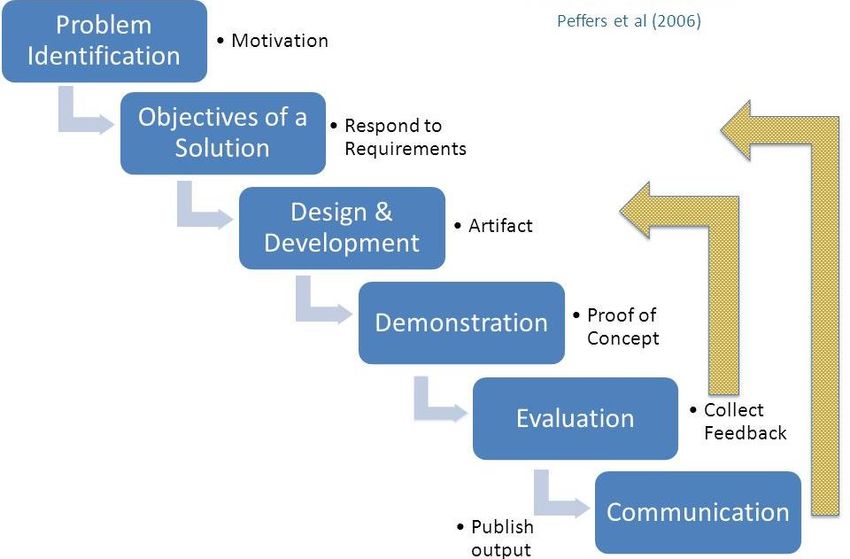
extraction systems. A number of these computational inference engine.Song et al., (2016) explored a 3-tier system For an Information Systems’ project such as this
architectural framework for KB systems’ study, Peffer et al., (2006) propose six common
management of manufacturing process knowledge. design process elements that cover DSR methodology
The researchers proposed an effective reusable in a nominal sequence: Problem Identification and
management approach to implementing their KB Motivation, Objectives of a Solution, Design and
system, via a systematic methodology for Development, Demonstration, Evaluation and
constructing the KB, indicating the key role of Communication. This study takes a problem-centered
ontology development through an iterative process. focus as its entry point. Consequently, the DSR
According to Shang et al., (2017), by employing a methodology is well suited for this research as our
vulnerability-centric ontology-based KB framework aim is to develop an artefact that provides a formal
strategy, cyber security knowledge existing in some computational solution for safeguarding ATHMed
independent KBs and on the internet, in text form, knowledge (Peffers et al., 2006). Subject to this
was efficiently integrated. This enabled the extraction approach, stakeholders for this project will be
of cyber security knowledge using both rule-based involved throughout the developmental stages as
and machine learning information extraction shown in Figure 1. The idea is to co-create the
techniques. intended system with the stakeholders’ involvement.
From the literature reviewed, in addressing KM This paper forms part of the initial phase of the
needs, a systematic approach is to be adopted. The DSR framework. Based on the DSR’s initial phase,
approach should be dynamic, contextual, ontology- this study identifies the gap in the knowledge
based, AI-oriented, platform independent and preservation and retrieval (KPR) practices within the
semantic in nature. This forms the basis of the design ATHMed domain. From literature, it is evident that
and development approach adopted for this research. the KPR practices are inadequate with its
repercussion having been discussed in earlier sections.
The motivation therefore is to propose a framework
3 METHODOLGY to assist in addressing the phenomenon. This will
require clearly defined requirements to help obtain
relevant information and guidelines needed for
This research is an ongoing study that adopts a design
identifying key concepts towards the KBS
science research process. In this section, we provide
the overview of the DSR process and the framework development.
for the implementation of the system. Of the requirements specified through active
stakeholders’ consultation, the artefact will be
designed and developed towards meeting the set
3.1 Design Science Research objectives. Four components of the artefact will be
materialized to provide a contextually fit and rigorous
As part of this project, the development of the
solution. The artefacts are interdependent covering an
knowledge-based system follows a design science
ATHMed Framework to guide the development
research (DSR) process. Peffers et al. (2006) DSR is
process, a formalized ontology, a corpus and a KBS.
adopted as shown in Figure 1. DSR is one of the two
The prototyping strategy shall be used to enable
major paradigms in Information System research
stepwise involvement of stakeholders. As a proof of
(Hevner et al., 2004; Mramba et al., 2016) and is a
concept, the KBS will undergo rigorous testing with
solution-oriented methodology that focuses on the
training data to demonstrate its ability and adequacy
design and investigation of IT artefacts (Peffer et al.,
to meet the objective for which the system was
2006; Hevner et al., 2004). DSR seeks the systematic
designed for.
and purposeful development of a solution (artefact)
Subsequently, the output, efficiency and overall
based on a rigorous scientific process. It provides a
performance of the artefact will be measured through
strategic mental model for empirical and theory
another stage of rigorous testing by stakeholders and
research building for contextual understanding,
patrons of ATHMed. This will help in assessing the
evaluation and reproducibility of a study. The artefact
veracity and efficacy of the KB and how usable the
may take the form of a construct, model, method, or
KBS is. The feedback obtained will affirm system
an instantiation such as hardware or software (Hevner
adequacy and viability, as well as usability and user
et al., 2004).
satisfaction.Figure 1: Design process with design science framework (Adopted from Peffers et al., 2006).
3.2 Knowledge-based Framework for Data Processing
Traditional Herbal Medicine
As earlier indicated, with the DSR, stakeholders in
To contribute to the building of a formally defined the medical fraternity are involve in the actual
body of knowledge in the domain of ATHMed implementation. Therefore, the initial data (ATHMed
practice and training in Medical IHE, a conceptual corpus) obtained from interacting with the
framework (model) is proposed. As such, defining a stakeholders (ATHMed practitioners and academia)
semantic-oriented, lexically functional, syntactic is to be pre-processed for easy annotation. This
structure in a machine-readable and machine- processing is based on the elements relevant for
understandable language is the focus of this proposed ingredient selection and processing, mode of
framework. The framework seeks to adopt and preparation and associated treatment (administration)
incorporate two major Artificial Intelligence (AI) method. Through expert (experts from academia,
techniques – machine learning (ML) and ontology– to research institutions and registered herbal clinics)
provide a progressively adaptive environment to annotation, a predefine annotation scheme for the
implement an intuitive KBS. Additionally, the ATHMed data shall be arrived at. This will enable the
retrieval mechanism for users’ interaction is attainment of a good agreement score on what
facilitated using web and mobile technologies. The element goes where, to obtain a concisely annotated
proposed knowledge-based framework has three data for training a ML classifier. This will lead to a
components as shown in Figure 2: data layer, logic gold standard being obtained, from the initial test
layer and application layer. The system will be data, via a supervised machine learning technique.
designed by following the Model-View-Control During storage, which implements the
(MVC) software architecture. The Data Layer preservation phase, the data after pre-processing, is
implements the Model component, the Logic Layer run through a classifier for categorization into
actualizes the Control component and the View specific non-static association and accurate
component is considered in the Application Layer. identification of the knowledge using a suitable ML
classifier. Throughout classification process, each
3.2.1 The Data Layer data value (or key words) will be tagged to enable
efficient association of term and concepts, via part-
The data layer is comprised of the data (knowledge) of-speech tagging through lemmatization.
acquisition sub-component, which captures the Literature in medical research involving the use
knowledge, and knowledge base, which stores the of ML suggests a diversity of techniques being
knowledge obtained from the domain experts. applied. Jiang et al., (2017) conducted a survey of AIapplication in healthcare. The researchers observed under the guide of a domain expert (in academia) and
that Support Vector Machine (SVM) and Artificial verified by experts (both academia and practitioners).
Neural Networks (ANNs) were often used. In a This shall require the use of knowledge and
related study on biomedical disease detection, metadata representation tools. An ontology authoring
Niharika and Kaushik (2018) concluded that different tool such as Protégé shall be used for building the
ML classifiers should be considered to build a unified ontology. XML and XML Schema is suitable for
hybrid framework. By this, to obtain optimal results, defining the metadata description, structure and
they recommend the use of SVM, extreme learning storage, with RDF for describing related knowledge
with variations of various swarm techniques. resources prevalent on the web for interrelation
Similarly, Bayesian Networks (BNs), ANNs and definition. OWL Descriptive Logic (DL) shall be
SVM were identified as methods most frequently used for defining the ontology structure and necessary
applied in the THMed domain (Arji et al., 2018). semantics, and SPARQL to querying the ontology-
Consequently, to determine which ML algorithm based knowledge-base. A classification of key
is most suited for the ATHMed classifier, an optimal elements and concepts, with their interrelationships
performance test shall be undertaken. This test shall shall be explored, defined and annotated. Appropriate
involve the use of notable machine learning software, axioms shall be used to implement the guidelines for
example WEKA. Based on the results, ML that building the ontology.
demonstrate superiority in classifying ATHMed data Through this approach, the proposed knowledge-
will be chosen for the implementation. based system is certain in providing knowledge users
Additionally, a robust algorithm to improve and ATHMed stakeholders with a computer-aided
classification of the ATHMed data shall be solution that supports semantic capabilities. This will
considered. This is to directly influence the facilitate relevant, contextual preservation and
performance of ontology model, through a novel retrieval of results from the knowledge base, through
indexing approach, to facilitate quick retrieval. a simplified search mechanism using a web portal or
mobile app.
The Ontology Model 3.2.2 The Logical Layer
The proposed knowledge base (KB) design is based This layer, as the middle layer, interacts with the data
on an ontology, for extensibility and reusability. As layer where the knowledge is preserved and the
such, at the ontology construction phase, the proposed application layer, where requests from users are
ontology model is to be defined through the process submitted via queries. Thus, the reasoning module is
of organizing the ATHMed knowledge in categories, executed via the logic layer, tagged as the Information
type classification into classes, hierarchical Extraction Component (IE). The IE is implemented
structuring of associated instances and properties, via two sub-components: Machine Learning
with appropriate axioms, rules, restrictions and Extractor and Semantic Reasoner.
interrelations. The ontology model is to be evaluated
to verify functional specifications thereby ensuring
consistency, reliability, accuracy and extensibility. A Machine Learning Extractor
further validation, involving verification and
evaluation tests for reliability (Preece, 1994) is The information extraction component shall be used
required to ascertain the performance capacity of the as the means to extract or retrieve information from
KBS. This is to measure the quality of the ontology the knowledge base. The IE constructed using two
by ensuring adequate coverage of the knowledge sub-approaches involving a machine learning based
within the ATHMed domain. The testing strategy for (ML-based) extraction algorithm and an inference
the KB is tailored to conform to software engine. The ML extractor will be designed to
development test approaches. complement the ontology, that possess features of the
The ontology-based approach is predominantly ATHMed knowledge-based ontology, taking critical
novel yet extensive for knowledge engineering. It considerations to class types, their relationships,
facilitates appropriate representation, maintenance instances, connotations and semantics. The ML
and dissemination of knowledge, and thus relevant in extractor interacts with the inference engine built to
applying this approach in the ATHMed domain. The deduce new knowledge, thus from the data and
proposed knowledge capturing/acquisition information present in the knowledge base (KB) to
component is targeted at being modelled based on a ensure accurate prediction and determination of
standard medicine preparation template design focus,appropriate treatment, association to ailment, This requires employing technologies that are
preparation methods and other relevant inferences. ubiquitous and support use, anywhere and at anytime
with ease. Web-based and mobile technologies have
shown potential to be adaptive to such an
Semantic Reasoner environment. The proposed KBS is targeted at
providing users with a graphical front-end: web-
The proposed knowledge-based system’s semantic
based interface designed with J2EE technology and a
reasoner acts as the inference engine. The inference
mobile interface using Android technology. Users
engine structure is expected to work on the Java-
will pass queries through simple to expressive
based framework, Apache Jena. ML techniques
statements which are treated as natural language
mainly to improve efficiency of predictability,
expressions. NLP techniques and tools are efficient to
deduction accuracy and an extensible deeper learning
support such manipulation. This requires that all
approach shall be considered. This shall support
queries be analysed lexically, and semantically
making of inferences whiles deducing new
compared against the KB through the information
knowledge in a contextual form. This requires that the
extraction (IE) component. This is to facilitate the
ML algorithm (classifier) chosen must be trained,
extraction of relevant knowledge in the form required
firstly on some rule-based approach before a well-
for adequate interpretation and understanding to the
structured corpus for ATHMed is defined and
user. To this end, representation of the extracted
extended with the algorithm.
knowledge must be textual and visual where required.
Same interface shall be used to provide new
3.2.3 The Application Layer
knowledge to the KB.
As earlier mentioned, the application layer is the view For optimal performance, thus reliability and
component, thus presentation layer for accessing the accuracy of the proposed KB, systematic engagement
KBS. In the wake of enhanced and fluid ways of of domain experts in designing and validating every
communication, there is the need to make access to stage of the KBS is required. Below is a conceptual
knowledge easy and quick, supported in an design of the proposed ATHMed KB framework.
interconnected, platform independent environment.
Figure 2: The Proposed knowledge-based framework for Achieving African traditional herbal medicine.4 DISCUSSION practitioners of THMed willingly share their
knowledge with their assistants, they choose to
Developing countries have about 80% of their purposefully, deliberately and prudently transfer such
populace depending on THMed, with reports of rising knowledge, comfortably with their own relations.
global demands, for their health needs (WHO, 2018; Notably, albeit some African countries are attempting
Frass et al., 2012; Zhang, 2004). This is due to to safeguard THMed knowledge, it is predominantly
THMed’s ease of use, natural form, often minimal oral and being leisurely done using some form of
side effects, availability, affordability and ease of recording (Maluleka and Ngulube, 2018; Adekannbi,
preparation. Poorna, Mymoon and Hariharan (2014) et al., 2014; Yeboah, 2000). Consequently, a
reported cases of countries pursuing knowledge knowledge bearer may teach in part resulting in half-
preservation and retrieval practices on traditional baked practitioners administering poor medical
knowledge, thus THMed. Their findings, indicate practices which are likely to cause more harm than
strategic, meticulous efforts to safeguard THMed good, as evidenced in some reports (Yeboah, 2000).
knowledge, have yielded distinctive yet To help salvage the situation, deliberate calls and
collaboratively immense benefits. This result was attempts have been made, by academia and research
attained through an all-inclusive effort spanning the institutions worldwide, to help formalize and train
health, academic and industry divide. Interestingly, THMed professionals. As custodians, these
all 6 countries that were observed to be making strives professionals will not only guide the processes and
by implementing THMed documentation initiatives procedures to the preparation, preservation and
were from developing nations. This reiterates the administration of THMed, but also ensure the
importance of THMed to developing nations, and knowledge is not lost (WHO, 2018; Boadu and Asase,
African countries in particular. 2017; Amoah et al., 2014; Poorna, et al., 2014).
In essence, the impact of pursuing such THMed Additionally, this effort is to assist in safeguarding
knowledge preservation and retrieval leads to key such vital knowledge which can be extracted and
benefits to countries especially in Africa. There are refined for further commercialization in the service
obvious implications of healthcare benefits. It provides industry. Key to benefiting from this are researchers
economic benefits whiles promoting preservation of and academia, in general, via extending studies into
indigenous cultural heritage (Boadu and Asase, 2017; the viability of such medicines and the development
van Andel et al., 2015). It provides avenues for of appropriate curricula in the training of qualified
securing patents to THMed knowledge (Zhang, 2004) herbal medicinal practitioners and healthcare
and protecting such knowledge against misuse professionals who will ensure continuity and
(Poorna, et al., 2014). These benefits were witnessed formalization of THMed practices in Higher Learning
amongst the 6 countries that were observed by Poorna, Institutions. The resulting output from academia will
Mymoon and Hariharan (2014). This was possible feed the pharmaceutical industry with the requisite
through proper codification and documentation knowledge on THMed. Causally, it will provide
(Poorna, Mymoon and Hariharan, 2014), a requisite opportunities for job creation while sustaining
strongly advocated for, to facilitate preservation economies of countries that depend predominantly on
(Faust, 2007; Mazour, 2006). This means that for THMed for providing healthcare to their indigenes.
THMed knowledge to be preserved, a consistent and Ultimately, the effort will assist in improving socio-
purposeful effort is required. In addition, it is necessary economic livelihoods and sustaining biological
that all such knowledge captured are interlinked or resources at the same time. The overall effect shall be
semantically correlated, to enable efficient search and to the advantage of the general populace with regards
retrieval, in order to promote new discoveries in related to the provision of relevant information on what
medicines and treatments. choice of THMed medication to resort to in servicing
Despite extant literature indicating growing their medical needs. The study conducted by Poorna,
interest in herbal medicine usage, especially in et al., (2014) supports these claims. In their study, it
developing countries, most of these practices are was revealed that countries that pursued preservation
either not well preserved nor documented. The of THMed knowledge benefited not only to safeguard
evidence and dangers of THMed knowledge not such knowledge, but also inherently promoted saving
being properly and adequately transferred from one and securing patent to these national assets.
bearer to another, to continue the medicinal practice The provision of improved, timely, accessible and
is well documented in literature. Instances of this affordable healthcare through the offering of
nature were observed by Adekannbi, et al., (2014). alternative healthcare practices based on a formalized
The researchers indicate that, though some THMed knowledge-based Framework is theunderlining motivation proposed in this paper. The contextual knowledge base shall be pursued. The
expected impact will not only be for developing research then culminates with an implementation of
countries like Ghana, but all regions that value and the framework proposed and validation of the
access healthcare through THMed. ATHMed KBS.
The proposed framework is geared towards
managing African traditional herbal medicine
(ATHMed) knowledge, focusing on its relevance in REFERENCES
the Ghanaian pharmaceutical service sector and the
medical institutions of higher education context, Adekannbi, J., Olatokun, W. M., Ajiferuke, I., 2014.
seeking to deepen research at the national and global Preserving traditional medical knowledge through
level, as advocated by Xu et al. (2008). The modes of transmission: A post-positivist enquiry. South
framework falls in the domain of KM processes African Journal of Inform Management, 16(1), pp.1-9.
covering technologies, related tools, appropriate Alavi, M., Leidner, D. E., 2001. Knowledge management
methods and general KM involving frameworks. and knowledge management systems: Conceptual
Furthermore, the proposed framework seeks to add to foundations and research issues. MIS quarterly, Vol. 25
the KM body of knowledge, by contributing to the (1), pp. 107-136.
Amoah, S. K., Sandjo, L. P., Bazzo, M. L., Leite, S. N.,
delivery and improvement of quality healthcare (El
Biavatti, M. W., 2014. Herbalists, traditional healers
Morr and Subercaze, 2010). This, we hope, will and pharmacists: a view of the tuberculosis in Ghana.
extend knowledge in ATHMed and contribute in Brazilian Journal of Pharmacognosy, 89-95.
answering the call for preserving such indigenous Antonova, A., Gourova, E. and Nikolov, R., 2006, July.
medicinal practices (WHO, 2018). Review of technology solutions for knowledge
management. In 2006 2nd IET International
Conference on Intelligent Environments-IE 06 (Vol. 2,
pp. 39-44). IET.
5 CONCLUSION AND FUTURE Arji, G., Safdari, R., Rezaeizadeh, H., Abbassian, A.,
WORK Mokhtaran, M., Ayati, M. H., 2019. A systematic
literature review and classification of knowledge
The premise and prospects of this work is based on discovery in traditional medicine. Computer methods
and programs in biomedicine, 168, pp.39-57.
the articulation of formalized processes that are Ashkenas, R., 2013. How to preserve institutional
expected to yield a structured computer science knowledge. Harvard Business Review.
approach to assist in preserving and retrieving Boadu, A. A., Asase, A., 2017. Documentation of herbal
relevant data and information on African Traditional medicines used for the treatment and management of
Herbal Medicine, progressively, efficiently and human diseases by some communities in southern
sustainably, using novel approaches. Ghana. Evidence-Based Complementary and
A hybrid approach of adopting machine learning Alternative Medicine, 2017.
techniques and an ontology framework is presented. Bolisani, E., Bratianu, C., 2018. The Elusive Definition of
This is geared towards addressing issues related to Knowledge. In Emergent Knowledge Strategies (pp. 1-
22). Springer, Cham. DOI: https://doi.org/10.1007/978-
developing an efficient knowledge-based system 3-319-60657-6_1
(KBS), that provides a formal, explicit preservation Carrillo, F. J., 2006. From transitional to radical
and retrieval mechanism of ATHMed leading to a knowledge-based development. Journal of Knowledge
well-defined body of ATHMed knowledge. Management, 10(5), 3-5. DOI: https://doi.org/
This paper is considerably a working paper, 10.1108/13673270610691125
requiring further empirical studies to concretize and Chugh, R., 2018. Tacit Knowledge Transfer in Australian
affirm the veracity and viability of the framework. In Universities: Exploring the Barriers and Enablers. In
this regard, further research will focus on the design MATEC Web of Conferences (Vol. 210, p. 04054).
of an ontology, based on ATHMed. Trailing this will EDP Sciences. DOI: https://doi.org/10.1051/matec
conf/201821004054
be the exploration of strategies to facilitate quick and Davenport, T. H., Prusak, L., 1998. Working knowledge:
adept cataloging of data through an innovative search How organizations manage what they know. Harvard
pattern that employs a novel indexing approach to Business Press.
storage and data retrieval, applicable to classifying Davenport, T. H., Völpel, S. C., 2001. The rise of
semantic data, thus an annotated corpus. Furthermore, knowledge towards attention management. Journal of
research into the adoption of machine learning knowledge management, 5(3), 212-222.
techniques tailored to suit annotated ATHMed Davidavičienė, V., Raudeliūnienė, J., 2010. ICT in tacit
knowledge to provide a semantically-aware, knowledge preservation. In Proceedings of the 6thInternational Scientific Conference “Business and documentation initiatives across the globe. Current
Management 2010”, Selected Papers (pp. 436–442). Science, 107(8):1240–1246.
El Morr, C., Subercaze, J., 2010. Knowledge management Preece, A., 1994. Validation of knowledge-based systems:
in healthcare. In Handbook of research on develop- The state-of-the-art in north america. Journal of
ments in e-health and telemedicine: Technological and communication and cognition-Artificial intelligence,
social perspectives (pp. 490-510). IGI Global. 11, 381-413.
Faust, B., 2007. Implementation of tacit knowledge Probst, G., Raub, S., Romhardt, K., 2006. Ziniu vadyba:
preservation and transfer methods. In International sekmes komponentai [Managing Knowledge: Building
Conference on Knowledge Management in Nuclear Blocks for Success]. Vilnius: Knygiai. 352 p. ISBN
Facilities (pp. 18-21). 9955-443-26-X
Frass, M., Strassl, R. P., Friehs, H., Müllner, M., Kundi, M., Sanya, I. O., Shehab, E. M., 2014. An ontology framework
Kaye, A. D., 2012. Use and acceptance of for developing platform-independent knowledge-based
complementary and alternative medicine among the engineering systems in the aerospace industry.
general population and medical personnel: a systematic International Journal of Production Research, 52(20),
review. The Ochsner Journal, 12(1), 45-56. 6192-6215.
Girard, J., Girard, J., 2015. Defining knowledge Sarkiunaite, I. D., Kriksciuniene. 2005. Impacts of
management: Toward an applied compendium. Online information technologies to tacit knowledge sharing:
Journal of Applied Knowledge Manag., 3(1), 1-20. Empirical approach. Informacijos mokslai, pp. 69-79.
Hevner, A. R., March, S. T., Park, J., Ram, S., 2004. Design Shang, H., Jiang, R., Li, A., Wang, W., 2017. A Framework
science in information systems research. MIS quarterly, to Construct Knowledge Base for Cyber Security.
28(1), 75-105. In Data Science in Cyberspace (DSC), 2017 IEEE
Jiang, F., Jiang, Y., Zhi, H., Dong, Y., Li, H., Ma, S., Wang, Second International Conference on (pp. 242-248).
Y., Dong, Q., Shen, H., Wang, Y., 2017. Artificial IEEE.
intelligence in healthcare: past, present and future. Tomai, E., Spanaki, M., 2005. From ontology design to
Stroke and vascular neurology, 2(4), pp.230-243. ontology implementation: A web tool for building
Li, S. T., Hsieh, H. C., Sun, I. W., 2003. An Ontology-based geographic ontologies.
Knowledge Management System for the Metal Song, H., Wang, H., Liu, T., Zhang, Q., Gao, B., 2016. The
Industry. In WWW (Alternate Paper Tracks). Design and Development of Manufacturing Process
Lin, J. S., Hsu, W. L., Chang, J. H., 2013. An ontology- Knowledge Base System Based on Ontology. In
based product development framework considering International Conference on Cooperative Design,
eco-design. In Proceedings of the International Multi Visualization and Eng. (pp. 9-16). Springer, Cham.
Conference of Engineers and Computer Scientists. Van Andel, T. R., Croft, S., van Loon, E. E., Quiroz, D.,
Maluleka, J. R., Ngulube, P., 2018. The preservation of Towns, A. M., Raes, N., 2015. Prioritizing West
knowledge of traditional healing in the Limpopo African medicinal plants for conservation and
province of South Africa. Inform. Dev, 34(5), 515-525. sustainable extraction studies based on market surveys
Mazour, T., 2006. Knowledge preservation and transfer: and species distribution models. Biological
issues and terminology. Proceedings of School of Conservation, 181, 173–181.
Nuclear Knowledge Management, pp.18-22. World Health Organization, 2018. Traditional,
Mramba, N., Apiola, M., Kolog, E.A. and Sutinen, E., 2016. complementary and integrative medicine. [online]
Technology for street traders in Tanzania: a design Available at: http://www.who.int/traditional-comple
science research approach. African Journal of Science, mentary-integrative-medicine/about/en/ [Accessed 18
Techn, Innovation and Development, 8(1), pp.121-133. Feb, 2018]
Nonaka, I., Takeuchi, H., 1995. The knowledge-creating Zhang, X., 2004. Traditional Medicine: Its Importance and
company: How Japanese companies create the Protection. Protecting and Promoting Traditional
dynamics of innovation. Oxford university press. Knowledge: Systems, National Experiences and
Niharika, Kaushik, B. N., 2018. Machine Learning in International Dimensions. Part, 1, 3-6. Available at:
Biomedical Mining for Disease Detection. Journal of https://unctad.org/en/docs/ditcted10_en.pdf#page=23.
Artificial Intelligence, 11: 39-47. Xu, J., Sankaran, G., Sankaran, S., Clarke, D., 2008.
Panahi, S., Watson, J., Partridge, H., 2012. Social media Knowledge management in twenty-first century:
and tacit knowledge sharing: Developing a conceptual Literature review and future research directions. The
model. World academy of science, engineering and Intern. Technology Management Review, 1(2), 16-24.
technology, (64), pp.1095-1102. Xue, C. T. S., 2017. A Literature Review on Knowledge
Peffers, K., Tuunanen, T., Rothenberger, M. A. Chatterjee, Management in Organizations. Research in Business
S., 2006. A Design Science Research Methodology for and Management, 4(1), pp.30-41.
Information Systems Research. Journal of Yeboah, T., 2000. Improving the provision of traditional
Management Information Systems, 24(3), Winter 2007- health knowledge for rural communities in Ghana.
8, 45-78. Health Information & Libraries Journal, 17(4), 203-
Poorna, R., Mymoon, M., Hariharan, A., 2014. Preserva- 208.
tion and protection of traditional knowledge – diverseYou can also read


