Online Multilingual Hate Speech Detection: Experimenting with Hindi and English Social Media - MDPI
←
→
Page content transcription
If your browser does not render page correctly, please read the page content below
information

Article
Online Multilingual Hate Speech Detection: Experimenting
with Hindi and English Social Media
Neeraj Vashistha ∗                 and Arkaitz Zubiaga

                                                School of Electronic Engineering and Computer Science, Queen Mary University of London, London E1 4NS, UK;
                                                a.zubiaga@qmul.ac.uk
                                                * Correspondence: ec19471@qmul.ac.uk

                                                Abstract: The last two decades have seen an exponential increase in the use of the Internet and
                                                social media, which has changed basic human interaction. This has led to many positive outcomes.
                                                At the same time, it has brought risks and harms. The volume of harmful content online, such as
                                                hate speech, is not manageable by humans. The interest in the academic community to investigate
                                                automated means for hate speech detection has increased. In this study, we analyse six publicly
                                                available datasets by combining them into a single homogeneous dataset. Having classified them into
                                                three classes, abusive, hateful or neither, we create a baseline model and improve model performance
                                                scores using various optimisation techniques. After attaining a competitive performance score,
                                                we create a tool that identifies and scores a page with an effective metric in near-real-time and uses
                                                the same feedback to re-train our model. We prove the competitive performance of our multilingual
                                                model in two languages, English and Hindi. This leads to comparable or superior performance to
                                                most monolingual models.

                                                Keywords: social media; hate speech; text classification


                                         1. Introduction
Citation: Vashistha, N.; Zubiaga, A.                  Hate speech is a characterisation of communication that is ‘hateful’, controversial,
Online Multilingual Hate Speech De-             generates intolerance and in some way is divisive and demeaning. There is no legal
tection: Experimenting with Hindi and           definition of hate speech, but on several accounts accepted meaning of the term deals
English Social Media. Information 2021,         with communication in speech, behaviour or writing, remarks which are pejorative or
12, 5.    https://dx.doi.org/10.3390/           discriminatory concerning a person or a group of persons, either directly or indirectly.
info12010005                                    Such remarks are based on their religion, ethnicity, nationality, descent, race, colour, gender
                                                or other identity factors [1].
Received: 23 November 2020
                                                      Many countries have adopted new laws and frameworks have been constituted.
Accepted: 18 December 2020
                                                However, due to the pervasive nature of online communications, only 3% of malicious
Published: 22 December 2020
                                                communication offenders are charged [2]. This is because of a lack of clarity and certainty
                                                in this area. Several of these frameworks prohibit the incitement to discrimination, hostility
Publisher’s Note: MDPI stays neu-
                                                and violence rather than prohibiting hate speech. There is a need for quick identification of
tral with regard to jurisdictional claims
                                                such remarks and an automatic system which can identify and take measures to prevent
in published maps and institutional
affiliations.
                                                the instigation and incitement.
                                                      There are several examples of hate speech (Figure 1) which either implicitly or ex-
                                                plicitly target an individual or a group of individuals and inflict mental pain that may
                                                eventually cause of social revolts or protests.
Copyright: © 2020 by the authors. Li-
censee MDPI, Basel, Switzerland. This
article is an open access article distributed
under the terms and conditions of the
Creative Commons Attribution (CC BY)
license (https://creativecommons.org/
                                                Figure 1. Examples of hate text sequences.
licenses/by/4.0/).

Information 2021, 12, 5. https://dx.doi.org/10.3390/info12010005                                             https://www.mdpi.com/journal/information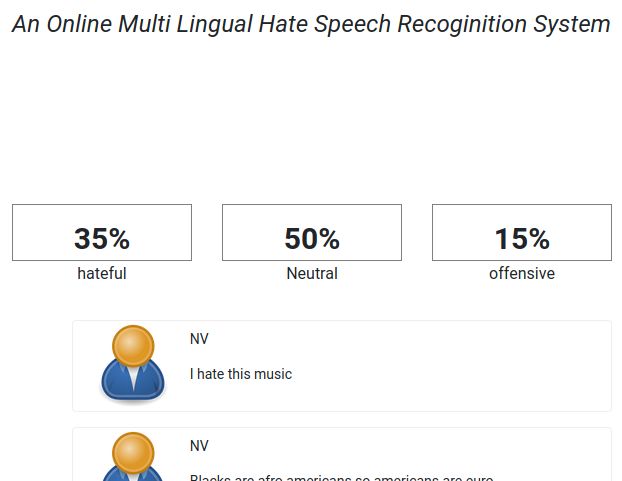
Information 2021, 12, 5                                                                                          2 of 16

                               In this work, we study the existing methods designed to tackle hate speech. We curated
                          the data from the most prominent social media platform, Twitter. We also combine the
                          existing datasets into one, as these are pre-annotated and previous researchers have used
                          these to target several cases of hate speeches. Individually, these are small datasets, but,
                          after we combine the existing datasets into one dataset, we obtain a large corpus of hate
                          speech sequences. This dataset is a combination of the hateful content of five different
                          categories: sexual orientation, religion, nationality, gender and ethnicity. We create models
                          which classify the content of a text as hateful, abusive or neither. The total size of the
                          dataset is around seventy-six thousand samples, and, due to the high variance and low
                          bias, we avoid sub-categorisation of hate classes.
                               We also study some state-of-the-art models which claim to give superior accuracy.
                          Since these models are built on specific languages (English or Hindi), we utilise the work
                          and propose our model which is multilingual. Finally, we use our optimised models
                          to create a simple tool which identifies and scores a page if hateful content is found
                          and uses the same as the feedback to re-train the model. While the vast majority of
                          previous works have investigated the development of hate speech detection models for
                          specific languages [3], here we propose a multilingual model which we experiment in two
                          languages, English and Hindi, leading to competitive performance and superior to most
                          monolingual models.
                               The main contributions of this work are as follows:
                          •    We create a system which is trained on a sufficiently large corpus of hate speech text.
                          •    A multilingual system that can work on different languages is proposed, and another
                               language be added and trained quickly using our transfer learning models.
                          •    We propose system which can learn a new form of hateful remark or Zipfian nature of
                               language by re-training in an online environment.
                          •    The resulting system has models which are simple, lightweight and optimised to be
                               used in a near-real-time online environment.
                               In this way, the system holds potential as a product for safer social media utilisation
                          as well as reduces the need for human annotators and moderators to tag disturbing
                          online messages.
                               The rest of the paper is organised as follows. An overview of hate speech datasets and
                          existing models is provided in the Related Work Section. In the Model Section, we critically
                          analyse the existing models and discuss their limitations. We also discuss our model and
                          several optimisations we performed to achieve a desirable performance score. Furthermore,
                          we talk about the feedback mechanism for the optimised model and its usage in an online
                          environment.

                          2. Related Work
                              Here, we discuss related work on hate speech datasets, hate speech detection models
                          and different approaches. This serves as a motivation for our work and helps us bridge our
                          study to the existing research available.

                          2.1. Related Datasets
                               As mentioned above, six publicly available datasets [4–9] are manually curated and of
                          modest size. In the following, we discuss the characteristics and the generation process of
                          each of these datasets. Using these annotated datasets, we create our own resource of hate
                          speech sequences.

                          2.1.1. Data Gathering Process
                               The data in the online diaspora can be curated from various technology companies
                          and social media platform providers such as Facebook, Google, Internet Service Provider
                          Association, Oath, Twitter, Snap Group Limited, etc. Twitter’s Public API, with its ease
                          of use, high availability and accessibility, it is one of the most sought and targeted online
                          social media platforms. We can set up a mechanism, and relevant data for hate speech can
Information 2021, 12, 5 3 of 16
be sourced. The dataset we use in this study comes from Twitter and is labelled by the
annotators into pre-specified categories and subcategories of hate speech.
The examples sourced from Twitter are based on keyword matching with terms
which have a strong connection with hate. These are annotated and tagged as abusive or
hateful. This task has to be done manually and is very time-consuming. The same process
has been adopted for code-mixed and pure Hindi language. Since the sample space of
P. Mathur et al. [9] and HASOC2019 [4] is small, we try to update these datasets with our
own curated samples.
To describe the multilingual aspect, the dataset consists of three different types of
target language: English, Hindi and code-mixed Hindi. Table 1 describes various attributes
of the dataset.
Table 1. Multilingual dataset attributes.
Attributes
Language
Total Records Vocab Size Max Seq. Len
English-EN 61,319 23,216 89
Hindi-HI 9330 6082 104
Hindi Code-Mix 3161 6094 48
Although there are some limitations such as small sample text size of 160 characters
or under-representation of all forms of hate speech sequences, this does not limit the use
of data. Other issues related to this kind of dataset is the filtering of unwanted details
such as email address, URL, date, phone number, username, etc. due to which textual and
contextual information is lost. We also aim to ensure that the collation of different datasets
does not impact the attributes. As these datasets are tagged by different authors as per
their own perception and with the daily evolution of slang and jargon, evaluation becomes
a tedious task.
2.1.2. Existing Datasets
HASOC2019: The dataset presented in [4] shares task on hate speech and offensive
content identification in Indo-European languages and contains around 7005 posts in
English and 9330 posts in the Hindi language, with 36% and 52% abusive content in the
respective languages. The task is focused on three sub-tasks:
• Whether the tweet text is either hate or offensive, or neither
• Whether tweet text is hate, offensive or profane
• Whether the tweet text is targeted towards an individual/group or is untargeted
For this study we only consider the data presented for the first sub-task.
TDavidson et al.: The dataset presented in [5] includes tweets labelled by human
annotators into three categories: hate speech, offensive or neither. There are 24,802 English
tweets with only 6% abusive content.
ElSherif et al.: The dataset presented in [6] is procured from Twitter and it is cate-
gorised into seven different categories of hate. The data are sought from [5,10] with their
own annotation from No Hate Speech Movement (www.nohatespeechmovement.org) and
Hatebase (hatebase.org). The total number of samples is 10,760 with abusive content
accounting for around 10%. This dataset is in the English language.
Ousidhoum et al.: Here, the author categorised Twitter data into 46 different senti-
ments of hateful, offensive, fearful, abusive, disrespectful, normal and different combina-
tions of each. The dataset presented [7] is in English, and it also captures the annotators’
sentiments, directness, intended targets and groups. These attributes are important, but,
to create a homogeneous dataset, they have been left out from this study. The total size of
this dataset is around 5647 instances which are reorganised for our purpose into the three
categories hateful, abusive or neither, with abusive content of around 26%.Information 2021, 12, 5 4 of 16
SemEval 2019 Task 5: The dataset presented [8] comprises 12,906 text instances,
of which 42% are abusive in nature. Again, the data are sourced from Twitter. This is a
shared task with three sub-tasks in it. The first task is a binary task to classify if the text
instance is hate or not, which is what we consider for our study. The other tasks are within
hate, whether the text is directed towards a group or individual and whether the text is
aggressive or not. This dataset is hate speech sequences against immigrants and women in
English language.
PMathur et al.: The dataset presented in [9] contains tweets of offensive nature along
with a profanity word list in code-mixed Hindi. Code-mixed Hindi is a phonetic translation
of Hindi words written in the English language. These tweets are annotated into three
different categories of normal, abusive and hate. The resulting size of the profanity word list
is around 226 words in code-mixed Hindi, with the meaning of each in English, profanity
score and Devanagari script Hindi word. The size of the dataset is around 3189 tweets with
55% of hateful nature.
For our study, these datasets (https://github.com/neerajvashistha/online-hate-speech-
recog/tree/master/data/) were curated according to the guidelines provided by the au-
thor [9]. Originally, the Hindi language dataset [4] contains only two classes, non-hate and
hate, so we added more data in accordance with the above-mentioned datasets. The sum-
mary of all the datasets used in this research is provided in Table 2.
Table 2. Datasets hate composition.
Dataset Name Total Records Hate % Abuse %
HASOC2019—EN 7005 36.38 —
HASOC2019 - HI 9330 52.92 -
TDavidson et al. 24,783 77.43 5.77
ElSherif et al. 10,760 90.94 -
Ousidhoum et al. 5647 65.66 22.63
SemEval 2019 Task 5 12,906 42.15 -
PMathur et al. 3189 55.34 9.5
Total 76,403 61.84 4.55
The data from all sources were collated and sorted into a homogeneous form, the de-
tails of which are illustrated in the Model Section.
2.2. Related Models
Davidson et al. [5] followed a simple approach and created a simplistic model.
They created simple feature vectors for each sample instance. The feature vector consisted
of Part of Speech (POS), term frequency–inverse document frequency (TFIDF) vectors, etc.
The final model was a logistic regression and linear support vector machine (SVM) which
claimed to achieve an overall precision of 0.99, recall of 0.90 and F1 score of 0.90.
As we expanded the dataset for our experiments, the 94% accuracy for English lan-
guage dataset claimed by the author was not applicable in this case, and therefore we had to
re-run it again. This is why in our case the accuracy of the model was close to 68%. Similar
to this work, Ref. [11] discussed the use of SVM, Random Forest and other simpler models
to achieve comparable performance score in classifying hate speech sequence. We could
not use Hindi or code-mixed Hindi because the embeddings used by the author, Babylon
multilingual word embeddings [12] and MUSE [13], were not compatible with our Hindi
or code-mixed Hindi dataset.Information 2021, 12, 5 5 of 16
Ref. [7] created two types of models: Bag-of-word (BOW), a feature-based logistic
regression model, and a deep learning-based model [14] containing Bi-directional Long
Short Term Memory (BiLSTM) layer with one hidden layer. They claimed that, due to the
small size of the dataset, deep learning-based models performed poorly. They suggested
using Sluice network [15], as it is suitable for loosely related tasks such as the annotated
aspects of the corpora. State-of-art performance scores are obtained using Sluice networks.
One of the initial research on hate speech detection from Hindi–English tweets was
done by [16]. The research was based on 4575 code-mixed Hindi tweets. They used features
such as character n-gram, emoticon count, word n-gram, punctuation count and applied
dimension reduction techniques. An accuracy of 71.7% on SVM and 66.7% on Random
Forest was obtained.
The most relevant research done for code-mixed Hindi dataset was done by [9]. They
claimed that term frequency, inverse document frequency (TF-IDF) and BoW features with
SVM model gave peak performance when compared with other configurations of baseline
supervised classifiers. The other features such as Linguistic Inquiry and word count
features (LIWC) [17], profanity vector [18] with the glove and Twitter embeddings gave
best results against the baseline model, as argued by the authors. In addition, a transfer
learning-based approach called Multi-Channel Transfer Learning-based Model (MTLM)
achieved on its best configuration a precision of 0.851, recall of 0.905 and F1 score of 0.893.
Similar scores have been obtained in our study as well.
Ref. [19] applied deep learning-based approaches. In the experiment, the author
created a sub-word level LSTM model and Hierarchical LSTM model with attention-based
phonemic sub-words. The architecture of these models is important to research in this
field as attention-based models perform highly in comparison to basic deep learning-based
models. Hierarchical LSTM with attention achieved an accuracy of 66.6% while sub-word
level LSTM model scored 69.8%.
In the work of [20], three deep learning models using domain-specific word em-
beddings were created. These word embeddings are available and comprise of 255,309
code-mixed Hindi text, which the author collected from Twitter. The word embeddings
are trained using gensim’s word2vec model and used in the three deep learning models.
For 1D-CNN, an accuracy of 82.62% was achieved, which was the highest, against BiL-
STM with 81.48% and LSTM with 80.21%. Similar to this work, Ref. [21] dedicated his
research to discovering the best embeddings to predict the occurrence of hate speech in the
English language.
In the above-mentioned research, we can see that all the models were created to process
only a single language at a time. In our project, we focused on creating a single model
that will inculcate multiple languages at the same time, leading to a more generalisable
approach. The only exception of a multilingual model found in the literature is that by [22],
who focused on English and Chinese. However, the authors used third party translation
APIs, such as Google translation API, to convert the raw text into English or Chinese.
In the following sections, we propose a Logistic regression model and two Deep
Learning-based models for both English and Hindi (code-mixed Hindi) languages. The
model architecture for all the languages is the same; however, the feature building process
is different for different languages.
3. Model
In this section, we discuss the model-building procedure. We are building a system
that learns from the feedback, is multilingual and is trained on large hate sequence text.
We also provide optimisation carried out and performance verification.
3.1. Data Preprocessing
Since the data in our use case are sourced from various datasets [4–9], it becomes
essential to organise them into a homogeneous form. To achieve this, we consider the
text and the class type of the existing datasets. In many datasets, as shown in Table 2,Information 2021, 12, 5 6 of 16
the data are classified as hate or not, and abuse class is not present. The original text is
taken without any formatting. The class types (if necessary) are converted from original to
hate, abusive or normal. To identify the source of the text, we labelled each record instance
with specific dataset identifiers.
Samples for Hindi and code-mixed Hindi are sourced from [4,9]. This dataset is
relatively small in comparison to the English language dataset. Thus, we updated these
data by adding new tweet samples to Hindi and code-mixed Hindi dataset by following
the below procedure.
1. We added and updated the profane word list provided by [9] with more words in
code-mixed Hindi language.
2. We used this profane word list and added corresponding Hindi Devnagari scripted
text against each code-mixed Hindi profane word.
3. To assign classes to newly curated text from Twitter Public API, we followed the
guideline below.
(a) Tweets involving sexist or racial slur to target a minority may contain abusive
word and are annotated as hate.
(b) Tweets which represent undignified stereotypes are marked as hate.
(c) Tweets which contain problematic hashtags are marked as hate.
(d) Tweets which contain only abusive words are tagged as abusive.
(e) Other tweets are marked as normal.
Some typical instances of our seventy-six thousand data are shown in Table 3.
Table 3. Example texts.
Dataset Type Example Class Type
I am literally too mad right now a ARAB won
English-EN Hateful
#MissAmerica
English-EN Black on the bus Hateful
I can not just sit up and HATE on another bitch. I got
English-EN Abusive
too much shit going on!
Hindi-HI Hateful
Main jutt Punjabi hoon aur paka N league.
Hindi Code-Mixed Hateful
Madarchod Imran ki Punjab say nafrat clear hai.
One of the major issues related to Twitter text and to which other studies have indi-
cated as the potential cause for degrading in performance is the small sequence of text
followed by ever-evolving use of unknown words such as slang and hashtags. In Table 1,
Max Seq. Len. denotes the maximum sequence length of the various language datasets;
the sequence length for all the languages is very small (less than 100), but the vocabulary
size (vocab. size) is way too high. Ref. [23] described the limitations of unusually large
vocabulary leading to poor performance.
In our research, when we performed exploratory data analysis (EDA), we concluded
that, due to the above-mentioned issues, the performance of our classifier was also being
affected. Thus, during prepossessing of text, we decided to use ekphrasis [24]. This
preprocessor performs the following:
• Normalise the url, email, percent, money, phone, user, time, date and number in
Twitter text.
• Annotate the hashtag, allcaps, elongated, repeated, emphasis, censored and words in
the text.
• Segment words.
• Convert Hashtags to unpacked word list (if possible).Information 2021, 12, 5 7 of 16
• Convert English contractions such as “can’t” and “we’ll” into “cannot” and “we will”,
respectively.
• Tokenise the sentences into words.
• Convert emoticons and slang into actual expressions/phrases.
The output from this preprocessing technique contains more information than previ-
ously studied research. Although ekphrasis works well for the English language, it does
not have a multilingual capability built into it. Therefore, we leveraged [25] Indic NLP
and [26] NLTK library support for Hindi Language. During the EDA, we observed some
issues related to unpacking of slang, emoticons and English contractions in ekphrasis and
tokenisation issues in Indic NLP [25]. These are now being rectified by raising an issue on
Github and by making an open-source contribution to the original work.
3.2. Model Building
In previous research [5,9], we found that BoW- or TFIDF-based feature vectors along
with other features tend to work best with logistic regression-based models, and they
generally give a fine baseline model performance. A similar approach was carried out in
this study.
We created a logistic regression model as the baseline model. We applied an L2 penalty
giving equal class weights to three classes. To comprehend the sheer volume of data and to
make the model converge, the model’s hyperparameter maximum iteration was set to 5000
iterations for English and 3000 for Hindi and code-mixed Hindi. Other hyperparameters
were obtained in a grid search, with five fold cross-validation, and the performance scores
are described in Table 4.
Table 4. Performance Comparison of F1 scores and accuracy between classes for Logistic regres-
sion model.
Dataset Type F1-Neither F1-Hate F1-Abuse Acc
EN 0.68 0.47 0.80 0.687
HI 0.95 0.96 - 0.956
HI-Code Mix 0.84 0.62 0.91 0.855
After building a baseline model, we explored the possibility of building a Hierarchical
Deep Neural Network by combining several Convolutional Neural Network (CNN) filters
into Bi-directional Long Short Term Memory network (BiLSTM). During the EDA, we
discovered valuable sequential information in Twitter text for each class. When we applied
a BiLSTM layer on top of a CNN layer, we could capture the sequential information as well
as the low lying textual representation. Thus, we improved the simple contextual BiLSTM
classification with use of CNN layers. This model has the following architecture:
1. Word Embedding—to capture and convert text into sequences
2. CNN—to capture low lying information using different filter size
3. BiLSTM—to capture contextual information of the sequence
4. Fully-connected output
This model was inspired by the works of [27–29]. In these studies, with the use of
CNN, the character level property of the text is explored.
Figure 2 describes the architecture and different layers. The word embedding layer con-
verts sparse representation of word sequences into dense vector representation. The three
CNN layers consist of three parallel convolutional; two-dimensional filters, of sizes 3, 4
and 5 with batch normalisation; and max pooling layer. This CNN layer is time distributed
over the LSTM layer, which captures the contextual information and finally the model is
fed forward to a dense layer, where sigmoid activation layer performs the classification.
This model is built to analyse the use of deep neural networks and find out whether there
is any improvement in the previous benchmarks with respect to models performance.Information 2021, 12, 5 8 of 16
Figure 2. CNN LSTM network.
The above network is trained on all three datasets. After optimisations, the results
obtained are relatively similar to the logistic regression model.
Table 5 describes the performance of three language datasets. This model was trained
on GPU. Thus, the model convergence time was much quicker in comparison to the logistic
regression model.
We used random search to find the parameters and hyperparameters. Table 6 describes
the parameters which resulted in the best performance.
Table 5. Performance comparison of F1 scores and accuracy between classes for CNN-LSTM model.
Dataset Type F1-Neither F1-Hate F1-Abuse Acc
EN 0.74 0.63 0.72 0.78
HI 0.86 0.86 - 0.85
HI-Code Mix 0.83 0.62 0.70 0.86
Table 6. Parameter optimisation for CNN LSTM model.
Dataset Type Epochs Batch Size Optimiser Learning Rate Dropout Hidden Size
EN 22 30 sgd 0.001 0.2 64
HI 20 30 sgd 0.001 0.1 32
HI-Code Mix 22 30 adam 0.01 0.2 64
In the previous model, the word embeddings are learned from data that have low
dimension and are denser than TFIDF features. However, the model seemed to be less
performant than the logistic regression model built previously. Therefore, in the next model,
we incorporate Bidirectional Encoder Representations from Transformers (BERT) [30]
to leverage contextual word embeddings in place of CNN layers we previously added to
the CNN LSTM model. This model has the following architecture:
1. Pre-trained BERT Embedding—to capture contextual word embeddings
2. Bidirectional LSTM—to capture contextual information of the sequence
3. Fully-connected output
Ref. [31] claimed to achieve a best in class F1 and GLUE score of above 90% for SQUAD
1.1 dataset classification. Using the transfer learning method, we leveraged the pre-trained
embeddings of this transformer model into our CNN LSTM model. There are multiple
pre-trained embeddings of various sizes (layers and hidden nodes) and languages. In our
study, for English and code-mixed Hindi dataset, we used BERT-Base, Uncased: 12-layer,
768-hidden, 12-heads and 110 M parameters. For Hindi dataset, we employed BERT-Base,
Multilingual Cased: 12-layer, 768-hidden, 12-heads and 110 M parameters.
Figure 3 describes the architecture and different layers. Instead of word embedding
and CNN layers, for English, we used 24-layer contextual aware BERT language embed-
dings. There are only 12 hidden layers in the pre-trained model for BERT to support
multilingual aspects which we implemented for our Hindi dataset. The BERT model results
in 768 hidden layers, which are then time distributed over the BiLSTM layers and finally
concatenated on a dense layer. For classification, the sigmoid activation layer is applied to
the dense layer [32] used transfer learning approach and built a BERT-based model, but
our model is architecturally different from the one proposed by them. In our study, weInformation 2021, 12, 5 9 of 16
split the BERT model’s dimensions and later concatenated the results of BERT-LSTM for
classification.
Figure 3. BERT-based network.
Table 7 describes the performance score for the BERT based model. The model was
trained on Google’s Tensor Processing Unit (TPU) and requires different mechanisms to
process the data and feed them into the network. The model’s performance is better than
the logistic regression model and CNN LSTM model.
Table 7. Performance comparison of F1 scores and accuracy between classes for BERT model.
Dataset Type F1-Neither F1-Hate F1-Abuse Acc
EN 0.75 0.55 0.90 0.80
HI 0.94 0.94 - 0.95
HI-Code Mix 0.83 0.65 0.92 0.86
In Table 8, we describe the best parameters obtained using the technique of random
search and evaluation.
Table 8. Parameter optimisation for BERT model.
Dataset Type Epochs Batch Size Optimiser Learning Rate Dropout Hidden Size
EN 13 121 sgd 0.01 0.2 3
HI 15 9 sgd 0.01 0.2 3
HI-Code Mix 8 11 sgd 0.01 0.2 3
The models developed in this study are oriented to be used in an online environment.
Therefore, it becomes important that we pursue a state-of-the-art model which can be
re-trained in a given frame of time within a resource-constrained environment. It is critical
to analyse the prediction time as well as the time taken by the model to train.
Table 9 summaries some of the important performance features of the models built
thus far.
• The logistic regression model takes an excessive amount of time for preprocessing
and training. The BERT and CNN LSTM models take much less time in comparison.
This is due to the fact that the logistic regression model requires TFIDF features on the
entire vocabulary size.
• The model size for logistic regression models are 1000 times less than the BERT model
and 100 times less than CNN LSTM model. Thus, the inference time for the logistic
model is the least as compared to other models.
• The logistic regression model is well suited for smaller datasets as it is trained on CPU.
For larger datasets, GPU- or TPU-based CNN LSTM- or BERT-based models could be
used to reduce the training and inference time.
• One of the reasons for high inference time for CNN LSTM models is the inability to
find the right set of hyperparameters, and thus we observed a higher performance for
BERT models as compared with other models.Information 2021, 12, 5 10 of 16
Table 9. Model evaluation and performance scores.
Model Preprocess Type Training Time Infer. Time System Req. Model Size Test Acc.
LR-EN 126 s 9287 s 0.7 s CPU 498.8 KB 68%
LR-HI 14,927 s 412 s 0.7 s CPU 161.2 KB 95%
LR-HI Code-Mix 435 s 210 s 0.7 s CPU 402.2 KB 85%
CNN-LSTM-EN 41 s 340 s 13 s GPU 19.9 MB 78%
CNN-LSTM-HI 1453 s 68 s 11 s GPU 5.7 MB 85%
CNN-LSTM HI-Code-Mix 0.6 s 27 s 13 s GPU 6.8 MB 83%
BERT-EN 28 s 726 s 0.9 s TPU 438.6 MB 80%
BERT-HI 0.8 s 1037 s 0.9 s TPU 712.2 MB 95%
BERT-HI Code-Mix 0.1 s 218 s 0.9 s TPU 438.6 MB 86%
4. Results and Discussion
We show that the logistic regression model supplemented with TFIDF and POS
features gave relatively good results in comparison to other models. However, the time
taken for the model to converge is very long. The results presented are in line with those of
previous research [5,9,33].
The deep learning model gave similar performance scores without much feature
engineering and the model converged quickly too. Such results can be attributed to the
use of embedding layers in the neural network. We also tried to use the glove and Twitter
embedding layers, but, due to the high number of unknown words, desirable results were
not obtained.
The logistic regression model has fewer system requirements, is very quick to infer a
single sample instance and has great performance scores. Due to its inability to scale on a
large dataset and the time taken to build the model is very high, it can only be used as a
benchmark for other models and cannot be used in an online environment, where models
are continuously re-trained on the feedback loop.
The CNN LSTM model is an average model which has a mediocre performance but
its performance can be perfected. The random search optimisation used in this study is a
test-driven approach. Other optimisation techniques such as Bayesian optimisation can
find better hyperparameters. However, the time taken to build the model will increase
considerably. The CNN LSTM model requires moderate GPU processing and infers a single
sample instance in near-real-time. Thus, we utilise this model in our online web application.
The BERT model is a high-performance state-of-the-art model. It has the highest
accuracy among all the models. If the system requirement (TPU) criteria are fulfilled, it can
be used in an online environment. This model has much less training time and is very
quick to infer a single sample instance. The only constraint is the use of the TPU. Although
the model size is 1000 times the size of a logistics regression model, memory and disk
space consumption is hardly a worry these days due to their easy availability. Unlike GPU,
the cost of a single TPU instance is very high. However, the scope of TPU usage as the
mainstream processing unit for machine learning in the future is high. Thus, the research
done in this study is futuristic and this novel state-of-the-art model is very much applicable
to be used in the real world.
To give a fair comparison of our models to existing ones, we apply our models to the
datasets in isolation. We find that our models outperform on most of the datasets. Table 10
shows these results. The dataset was segmented in the exact proportions of test and train
as it was done in the original research. Further, out of the many models described here,
we chose the best results (after optimising it to work on smaller datasets) of CNN LSTM
model as it works more quickly in loading the data as well as giving inference. The resultsInformation 2021, 12, 5 11 of 16
are consistent with the performance and the performance is consistent across the datasets
as well.
Table 10. Comparison of different dataset models with our model.
Existing Best Scores Our Model Best Scores
Datasets
Precision Recall F1 Precision Recall F1
HASOC 2019 EN n.a. n.a. 0.79 0.91 0.9 0.9
HASOC 2019 HI n.a. n.a. 0.81 0.87 0.82 0.81
Davidson et al., 2017 0.91 0.9 0.9 0.93 0.9 0.92
ElSherif et al. n.a. n.a. n.a. 0.85 0.86 0.83
Ousidhoum et al., 2019 n.a. n.a. 0.94 0.91 0.91 0.9
SemEval 2019 Task 5 0.69 0.68 0.65 0.83 0.8 0.8
Mathur et al., 2018. 0.85 0.9 0.89 0.88 0.9 0.87
We also undertook and extended our study to compare our models with the state-of-
the-art models RoBERTa [34] for English and code-mixed Hindi and XLM-R (cross-lingual
RoBERTa model) [35] for Hindi. We found that our model’s performance is comparable to
the existing pre-trained models. Our BERT-based model and CNN-LSTM model perfor-
mance match fairly against RoBERTa. Figure 4 describes the accuracy scores of different
models in different languages.
Figure 4. Our model comparison with other state-of-the-art models.
Ablation Study and Modes of Errors
Performance layer-by-layer, without fine-tuning. To understand which layers are
critical for classification performance, we analysed results on the English dataset for CNN-
LSTM- and BERT-based models. We checked the importance of CNNs and LSTM in
CNN-LSTM network and LSTM in the BERT-based model.
In Figure 2, we have three parallel convolution kernels that are convoluted with the
reshaped input layer to produce a tensor of outputs each are of shape 1 × 6, which are then
concatenated at m0 resulting into a 1 × 192 tensor. As explained above, the main reason
to employ three parallel CNNs is to learn textual information in each utterance, which is
then used for classification. The output of CNN is time distributed in t0 over Bidirectional
LSTMs (bl0,bl1). The outputs of both CNNs and LSTMs are passed through dense layer fc0
and fc1, respectively, and are finally concatenated at m1 before passing through another
dense layer fc2 and activation a0. We focus the usage of first CNN C1 (c0,b0,s0), second
CNN C2 (c1,b1,s1) and third CNN C3 (c2,b2,s2) along with the role of BiLSTM bl0 and bl1,
on the performance of the entire network. The first five rows of Table 11 give the details of
the performance of our network on a layer-by-layer basis. We understand that both CNN
and BiLSTM are important in the network to attain good performance score. If we removeInformation 2021, 12, 5 12 of 16
the CNN layers entirely, then we get an average model but there is a considerable increase
in performance when CNN layers are added.
Table 11. Performance of CNN-LSTM and BERT model layer-by-layer.
Layers Model F1-Neither F1-Hate F1-Abuse Acc
Without C1 and C2 and C3 CNN-LSTM 0.60 0.59 0.60 0.60
C1 only CNN-LSTM 0.64 0.63 0.62 0.62
C1 and C2 CNN-LSTM 0.70 0.73 0.73 0.72
Without bl0 and bl1 CNN-LSTM 0.54 0.56 0.53 0.53
bl0 only CNN-LSTM 0.70 0.69 0.70 0.71
Without bl0 and bl1 BERT 0.71 0.67 0.83 0.79
bl0 only BERT 0.75 0.62 0.80 0.80
Without FT CNN-LSTM 0.74 0.61 0.70 0.76
With FT CNN-LSTM 0.74 0.62 0.73 0.78
Without FT BERT 0.75 0.62 0.88 0.79
With FT BERT 0.75 0.55 0.91 0.80
In Figure 3, we use BERT + BiLSTM to capture both utterance level and sentence level
understanding of hate speech sequence. To understand how the performance is affected,
we removed bl1 and bl0, simultaneously. Rows 6–7 present the performance of the model
when both BiLSTM layers are removed and when only one is kept. The overall performance
of the model is unaffected with or without the presence BiLSTM as there are 109,584,881
parameters of which only 102,641 belong to BiLSTM part of the network, but, with the split
and BiLSTM layers, a slight improvement is added nonetheless.
Performance layer-by-layer, with fine-tuning. We now analyse the results from our
CNN-LSTM and BERT models after having fine-tuned their parameters on the English
dataset. The improvement is marginal in both the cases (Table 11, Rows 8–11): fine-tuning
increases the accuracy by 1–2%. The best hyperparameters to give this result are shown in
Tables 6 and 8.
Modes of Error Further, we discuss some categories of errors that were observed in
the deep learning and logistic regression models:
• The noisy and repetitive nature of the data present on social media creates a skewness
in the class distribution. Although it is taken care of by the hyperparameter tuning, it
still caused overfitting in both logistic regression models and CNN LSTM models.
• The code-mixed words tend to be biased as they appear at specific locations. [36]
showed that bilingual people favour code-mixing of specific words at specific locations.
• Almost all the class labels are hand-annotated. Since there are no defined criteria
of how one should classify, it can lead to the ambiguity between classes. This is the
reason for lower F1 scores between abusive and hate classes in both logistic regression
and CNN LSTM models for all the languages.
5. Online Feedback Mechanism
In this section, we discuss the use of created models in an online environment. Once
the model is created, it is essential to understand how the model will behave. Here, we also
discuss the complete execution of the machine learning pipeline, by adding an external
feedback loop to the model. This allows the model to learn the evolution of text and textual
context over time. We are aware that there are several disadvantages of doing this, as the
model may become biased towards one class if used over a stretch of time, but we can
overcome this by adding human-in-the-loop. In this way, the weight of tagging text by
moderator and annotators could be reduced significantly.Information 2021, 12, 5 13 of 16
To achieve this, we create a RESTful API which connects the machine learning model to
an online webchat system. The webchat we create here is a live application demonstrating
a chat room. The most important aspect is the API which scans the page and scores each
comment by the user. It summarises the total score of all classes, viz. normal, hateful or
offensive. In Figure 5, we see the metric which understands the page content concerning
its hateful or abusive nature.
Figure 5. Real time monitoring of content and scoring page based on percentage if hateful content
is present.
The above use case is a passive method showcasing the capability of our model in an
online application. An active use case would be if we can prevent the use of hateful/abusive
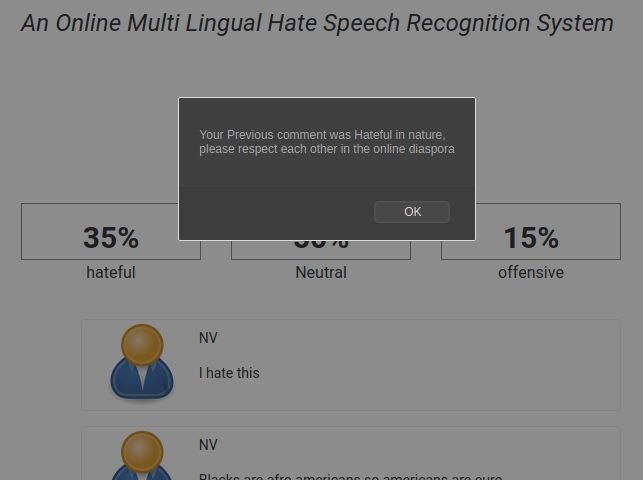
comments. To do so, we create a notifier on the submit button of the comments. If the
comment is hateful or abusive, the user gets notified and we can actively prevent users
from commenting derogatory remarks. Thus, users can be made self-aware and can be
advised to refrain from sending something incinerating to the social world. Figure 6 depicts
the mentioned use case.
Figure 6. Proactively notifying users that their comment is hateful in nature.
The above application has the ability to automatically switch between different ma-
chine learning models depending on the language of the user. If the user uses Hindi,
the model automatically switches to the Hindi model.
We capture these online comments into a database and use this database to update our
existing datasets. The database can be reviewed by an annotator for comments which have
lower confidence of belonging to a single class. Thus, a small portion of the comments has
to be reviewed. Such comments can be added to the training dataset for future addition.Information 2021, 12, 5 14 of 16
6. Conclusions
The objective of this study was to bring to light a model which was trained on a large
dataset of multiple languages. By experimenting on an aggregated dataset combining six
datasets in English, Hindi and Code-mixed Hindi, we demonstrate that our models achieve
comparable or superior performance to a wide range of baseline monolingual models.
The model leads to competitive performance on combined data and works in an online
environment in near-real-time.
Further work can be done in the space of improving the model architecture and
performance—we can apply and test other feature selection methods and extend the model
to other code-mixed languages. Other strategies can be incorporated such as using CNN
with BERT or other BERT-based model, e.g. RoBERTa or distilBERT, which support multi-
lingual aspect of language. In this process of fine-tuning the transfer-learning methods,
the model can be used to understand some types of biases to help in annotation. We can
also look at different embeddings. both co-occurrence and contextual. which can be used in
CNN-LSTM model to improve its performance. Besides fine-tuning deep learning models
and hyperparameter selection/optimisations, other advanced hierarchical models such as
Spinal, GRU and Bayesian optimisation are areas of future research. These models have
shown significant results in text classification and are quite robust.
Author Contributions: Conceptualisation, N.V. and A.Z.; methodology, N.V.; software, N.V.; val-
idation, N.V. and A.Z.; formal analysis, N.V. and A.Z.; investigation, N.V.; resources, N.V.; data
curation, N.V.; writing—original draft preparation, N.V.; writing—review and editing, N.V. and A.Z.;
visualisation, N.V.; supervision, A.Z.; project administration, N.V. and A.Z.; All authors have read
and agreed to the published version of the manuscript.
Funding: This research received no external funding.
Institutional Review Board Statement: Not applicable.
Informed Consent Statement: Not applicable.
Data Availability Statement: Not available.
Conflicts of Interest: The authors declare no conflict of interest.
References
1. Cortese, A.J.P. Opposing Hate Speech; Greenwood Publishing Group: Westport, CT, USA, 2006.
2. Abusive and Offensive Online Communications: A Scoping Report; The Law Commission: London, UK, 2018.
3. Vidgen, B.; Derczynski, L. Directions in Abusive Language Training Data: Garbage In, Garbage Out. arXiv 2020, arXiv:2004.01670.
4. Mandl, T.; Modha, S.; Majumder, P.; Patel, D.; Dave, M.; Mandlia, C.; Patel, A. Overview of the HASOC Track at FIRE 2019: Hate
Speech and Offensive Content Identification in Indo-European Languages. In Proceedings of the 11th Forum for Information
Retrieval Evaluation, Kolkata, India, 12–15 December 2019; Association for Computing Machinery: New York, NY, USA, 2019;
FIRE ’19; pp. 14–17. [CrossRef]
5. Davidson, T.; Warmsley, D.; Macy, M.W.; Weber, I. Automated Hate Speech Detection and the Problem of Offensive Language.
In Proceedings of the Eleventh International Conference on Web and Social Media, ICWSM 2017, Montréal, QC, Canada, 15–18
May 2017; AAAI Press: Palo Alto, CA, USA, 2017; pp. 512–515.
6. ElSherief, M.; Nilizadeh, S.; Nguyen, D.; Vigna, G.; Belding, E. Peer to Peer Hate: Hate Speech Instigators and Their Targets.
arXiv 2018, arXiv:cs.SI/1804.04649.
7. Ousidhoum, N.; Lin, Z.; Zhang, H.; Song, Y.; Yeung, D.Y. Multilingual and Multi-Aspect Hate Speech Analysis. In Proceedings of
the 2019 Conference on Empirical Methods in Natural Language Processing and the 9th International Joint Conference on Natural Language
Processing (EMNLP-IJCNLP); Association for Computational Linguistics: Hong Kong, China, 2019; pp. 4675–4684. [CrossRef]
8. Basile, V.; Bosco, C.; Fersini, E.; Nozza, D.; Patti, V.; Rangel Pardo, F.M.; Rosso, P.; Sanguinetti, M. SemEval-2019 Task 5:
Multilingual Detection of Hate Speech Against Immigrants and Women in Twitter. In Proceedings of the 13th International
Workshop on Semantic Evaluation; Association for Computational Linguistics: Minneapolis, MN, USA, 2019; pp. 54–63.
[CrossRef]
9. Mathur, P.; Sawhney, R.; Ayyar, M.; Shah, R. Did you offend me? Classification of Offensive Tweets in Hinglish Language.
In Proceedings of the 2nd Workshop on Abusive Language Online (ALW2); Association for Computational Linguistics: Brussels,
Belgium, 2018; pp. 138–148. [CrossRef]Information 2021, 12, 5 15 of 16
10. Waseem, Z.; Hovy, D. Hateful Symbols or Hateful People? Predictive Features for Hate Speech Detection on Twitter. In Proceedings
of the NAACL Student Research Workshop; Association for Computational Linguistics: San Diego, CA, USA, 2016; pp. 88–93.
11. Watanabe, H.; Bouazizi, M.; Ohtsuki, T. Hate Speech on Twitter: A Pragmatic Approach to Collect Hateful and Offensive
Expressions and Perform Hate Speech Detection. IEEE Access 2018, 6, 13825–13835. [CrossRef]
12. Smith, S.L.; Turban, D.H.P.; Hamblin, S.; Hammerla, N.Y. Offline bilingual word vectors, orthogonal transformations and the
inverted softmax. arXiv 2017, arXiv:cs.CL/1702.03859.
13. Lample, G.; Conneau, A.; Denoyer, L.; Ranzato, M. Unsupervised Machine Translation Using Monolingual Corpora Only. arXiv
2017, arXiv:cs.CL/1711.00043.
14. Minaee, S.; Kalchbrenner, N.; Cambria, E.; Nikzad, N.; Chenaghlu, M.; Gao, J. Deep Learning Based Text Classification:
A Comprehensive Review. arXiv 2020, arXiv:cs.CL/2004.03705.
15. Ruder, S.; Bingel, J.; Augenstein, I.; Søgaard, A. Sluice networks: Learning what to share between loosely related tasks. arXiv
2017, arXiv:abs/1705.08142.
16. Bohra, A.; Vijay, D.; Singh, V.; Akhtar, S.S.; Shrivastava, M. A Dataset of Hindi-English Code-Mixed Social Media Text for Hate
Speech Detection. In Proceedings of the Second Workshop on Computational Modeling of People’s Opinions, Personality, and Emotions in
Social Media; Association for Computational Linguistics: New Orleans, LA, USA, 2018; pp. 36–41. [CrossRef]
17. Sawhney, R.; Manchanda, P.; Singh, R.; Aggarwal, S. A Computational Approach to Feature Extraction for Identification of
Suicidal Ideation in Tweets. In Proceedings of ACL 2018, Student Research Workshop; Association for Computational Linguistics:
Melbourne, Australia, 2018; pp. 91–98. [CrossRef]
18. Jay, T.; Janschewitz, K. The pragmatics of swearing. J. Politeness Res. Lang. Behav. Cult. 2008, 4, 267–288. [CrossRef]
19. Santosh, T.; Aravind, K. Hate Speech Detection in Hindi-English Code-Mixed Social Media Text. In Proceedings of the ACM
India Joint International Conference on Data Science and Management of Data, Kolkata, India, 3–5 January 2019; pp. 310–313.
[CrossRef]
20. Kamble, S.; Joshi, A. Hate Speech Detection from Code-mixed Hindi-English Tweets Using Deep Learning Models. arXiv 2018,
arXiv:cs.CL/1811.05145.
21. Kshirsagar, R.; Cukuvac, T.; McKeown, K.; McGregor, S. Predictive Embeddings for Hate Speech Detection on Twitter. arXiv 2018,
arXiv:cs.CL/1809.10644.
22. Sohn, H.; Lee, H. MC-BERT4HATE: Hate Speech Detection using Multi-channel BERT for Different Languages and Translations.
In Proceedings of the 2019 International Conference on Data Mining Workshops (ICDMW), Beijing, China, 8–11 November 2019;
pp. 551–559.
23. Chen, W.; Su, Y.; Shen, Y.; Chen, Z.; Yan, X.; Wang, W.Y. How Large a Vocabulary Does Text Classification Need? A Variational
Approach to Vocabulary Selection. In Proceedings of the 2019 Conference of the North American Chapter of the Association for Compu-
tational Linguistics: Human Language Technologies, Volume 1 (Long and Short Papers); Association for Computational Linguistics:
Minneapolis, MN, USA, 2019; pp. 3487–3497. [CrossRef]
24. Baziotis, C.; Pelekis, N.; Doulkeridis, C. DataStories at SemEval-2017 Task 4: Deep LSTM with Attention for Message-level and
Topic-based Sentiment Analysis. In Proceedings of the 11th International Workshop on Semantic Evaluation (SemEval-2017),
Vancouver, QC, Canada, 3–4 August 2017; Association for Computational Linguistics: Vancouver, QC, Canada, 2017; pp. 747–754.
25. Kunchukuttan, A. The IndicNLP Library. Available online: https://github.com/anoopkunchukuttan/indic_nlp_library/blob/
master/docs/indicnlp.pdf (accessed on 20 December 2020).
26. Loper, E.; Bird, S. NLTK: The Natural Language Toolkit. In Proceedings of the ACL Workshop on Effective Tools and
Methodologies for Teaching Natural Language Processing and Computational Linguistics, Philadelphia, PA, USA, 7–12 July 2020;
Association for Computational Linguistics: Philadelphia, PA, USA, 2002.
27. Zhang, X.; LeCun, Y. Text Understanding from Scratch. arXiv 2015, arXiv:cs.LG/1502.01710.
28. Jozefowicz, R.; Vinyals, O.; Schuster, M.; Shazeer, N.; Wu, Y. Exploring the Limits of Language Modeling. arXiv 2016,
arXiv:cs.CL/1602.02410.
29. Kim, Y.; Jernite, Y.; Sontag, D.; Rush, A.M. Character-Aware Neural Language Models. arXiv 2015, arXiv:cs.CL/1508.06615
30. Devlin, J.; Chang, M.W.; Lee, K.; Toutanova, K. BERT: Pre-training of Deep Bidirectional Transformers for Language Under-
standing. In Proceedings of the 2019 Conference of the North American Chapter of the Association for Computational Linguistics: Human
Language Technologies, Volume 1 (Long and Short Papers); Association for Computational Linguistics: Minneapolis, MN, USA, 2019;
pp. 4171–4186. [CrossRef]
31. Devlin, J.; Chang, M.W.; Lee, K.; Toutanova, K. BERT: Pre-training of Deep Bidirectional Transformers for Language Understand-
ing. arXiv 2018, arXiv:1810.04805.
32. Mozafari, M.; Farahbakhsh, R.; Crespi, N. A BERT-Based Transfer Learning Approach for Hate Speech Detection in Online Social
Media. In Complex Networks and Their Applications VIII; Cherifi, H., Gaito, S., Mendes, J.F., Moro, E., Rocha, L.M., Eds.; Springer
International Publishing: Cham, Switzerland, 2020; pp. 928–940.
33. Badjatiya, P.; Gupta, S.; Gupta, M.; Varma, V. Deep Learning for Hate Speech Detection in Tweets. In Proceedings of the 26th
International Conference on World Wide Web Companion—WWW ’17 Companion, Perth, Australia, 3–7 April 2017. [CrossRef]
34. Liu, Y.; Ott, M.; Goyal, N.; Du, J.; Joshi, M.; Chen, D.; Levy, O.; Lewis, M.; Zettlemoyer, L.; Stoyanov, V. RoBERTa: A Robustly
Optimized BERT Pretraining Approach. arXiv 2019, arXiv:cs.CL/1907.11692.Information 2021, 12, 5 16 of 16
35. Conneau, A.; Khandelwal, K.; Goyal, N.; Chaudhary, V.; Wenzek, G.; Guzmán, F.; Grave, E.; Ott, M.; Zettlemoyer, L.; Stoyanov, V.
Unsupervised Cross-lingual Representation Learning at Scale. arXiv 2020, arXiv:cs.CL/1911.02116.
36. Singh, R. Grammatical Constraints on Code-Mixing: Evidence from Hindi-English. Can. J. Linguist. Rev. Can. Linguist. 1985,
30, 33–45. [CrossRef]You can also read


