Comfort air curtain Manual
←
→
Page content transcription
If your browser does not render page correctly, please read the page content below
Manual
Comfort air curtain
Model CA2

Version 7.0
Original Manual       English

a
en
                                                                        COMFORT AIR CURTAIN

      . . . Contents

     1      Introduction                                                                 4
             1.1   About this manual                                                     4
             1.2   How to read this manual                                               4
             1.3   About the unit                                                        5
             1.4   Safety instructions                                                  11

     2      Installation                                                               13
             2.1   Safety instructions                                                  13
             2.2   Delivery check                                                       13
             2.3   General working method                                               13
             2.4   Suspending the unit                                                  15
             2.5   Connecting the unit to the central heating system                    18
             2.6   Connecting the unit to the Daikin system                             20
             2.7   Connecting the unit to the power supply                              22
             2.8   Installing the control panel and external controls                   25
             2.9   Unit finishing                                                       33
            2.10   Powering up and testing                                              38

     3      Operation                                                                  40
             3.1   Introduction                                                         40
             3.2   Switching ON and OFF                                                 41
             3.3   The Home screen                                                      41
             3.4   CHIPS control                                                        41
             3.5   Adjusting the strength of the air curtain                            42
             3.6   Controlling the temperature                                          43
             3.7   Faults                                                               43
             3.8   Main menu                                                            43
             3.9   Preferences                                                          45
            3.10   Settings                                                             46
            3.11   Configuration                                                        47
            3.12   Maintenance                                                          51
            3.13   USB                                                                  53

     4      Maintenance                                                                55
             4.1   Replacing or cleaning the filter                                     55
             4.2   Cleaning the unit                                                    57
             4.3   Scheduled maintenance                                                57

     5      Faults                                                                     58
             5.1   Safety instructions                                                  58
             5.2   Resolving simple problems                                            58
             5.3   Fault messages on the control panel                                  60
             5.4   Remedying faults accompanied by an error message                     61
             5.5   Remedying faults without message                                     66

     en-2                                                                            B
en
CA2 MANUAL

6             Service                                                      68
               6.1    Safety instructions                                   68
               6.2    Access to the interior of the unit                    68
               6.3    Electronics module                                    70
               6.4    Daikin electronics                                    71
               6.5    Fuses                                                 71
               6.6    Removing the discharge section                        72
               6.7    Venting the heat exchanger                            72
               6.8    Bleeding the heat exchanger                           73
               6.9    Entering the unit code                                73
              6.10    Resetting the PIN code                                74
              6.11    Updating the software of the b-touch control panel    75
              6.12    Replacing the battery of the wireless sensors         76
              6.13    Biddle control cable composition                      77

7             Dismantling                                                  78

Manual version 7.0 (22-04-2013)                                            en-3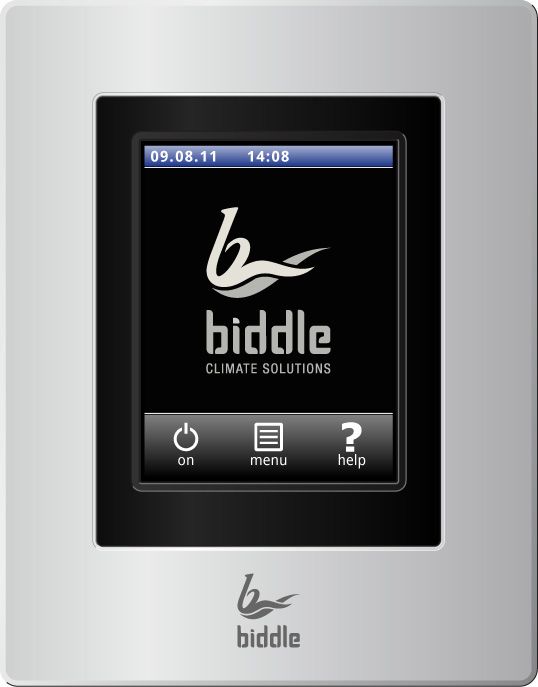
en

     1. .         Introduction

     1.1    About this manual
                                      This manual describes the installation, operation and mainte-
                                      nance of the Comfort air curtain model CA2 with b-touch con-
                                      trol panel and CHIPS control. The manual also provides
                                      instructions and information on service operations.

     1.2    How to read this manual

                                      1.2.1 Daikin manuals

                                      Only for CA2V and CA2Q:

                                      This manual makes cross-reference to the manuals of the Dai-
                                      kin components (outdoor unit, indoor unit, control panel,
                                      etc.).

                                      1.2.2 Marginal symbols used in the manual

                                      The following symbols are used in this manual:

                                               Note:
                                      n        Draws your attention to an important part of the
                                               text.

                                               Caution:
                                      c        If you do not perform this procedure or action
                                               correctly, you may damage the device.

                                               Follow the instructions strictly.

                                               Warning:
                                      w        If you do not perform this procedure or
                                               action correctly, you may cause damage and/
                                               or bodily injury.

                                               Follow the instructions strictly.

     en-4
en
CA2 MANUAL INTRODUCTION
Danger:
d This indicates actions which are not
permitted.
Ignoring this warning may lead to serious
damage or accidents which may involve bodily
injury.
1.2.3 Pictograms used on the unit and in the manual
The following pictograms indicate potential risks or hazards.
The same pictograms will also be found on the unit.
Pictograms
PICTOGRAM DESCRIPTION
w You are entering an area of the unit containing live components.
Accessible to qualified maintenance staff only.
Exercise caution.
w This surface or part can be hot. There is a risk of burns on contact.
1.2.4 Related documentation
Besides this manual, the following documents have been sup-
plied with the unit:
• Installation and servicing wiring diagram
1.3 About the unit
1.3.1 Applications
General
The purpose of the Comfort air curtain is to separate cli-
mates between two rooms and to heat and filter (filter class
EN779-G2) air. The unit is installed above the doorway, across
its full width.
Manual version 7.0 (15-05-2013) en-5en
INTRODUCTION COMFORT AIR CURTAIN
Mounting methods
The free-hanging model is designed for free, visible installation
above the door.
The recessed model is designed for installation into a false
ceiling or into an alcove where the air inlet may be at some
distance from the unit itself.
The cassette model is designed for installation above a false
ceiling where the air inlet is close to the unit and the unit is
easily accessible.
Comfort air curtain for Daikin system
On models CA2V and CA2Q:
The air connection is connected to a Daikin direct expansion
system. The air blown through the unit is heated by the cool-
ing medium. The air curtain is controlled and operated partly
by the Daikin system and partly by the Biddle system.
The system has a number of limitations:
• The unit is only suitable for use in Daikin direct expansion
systems.
• The unit is not suitable for cooling.
• The Daikin system has to be active at all times.
Other versions and intended usage.
On request, versions can be supplied for other applications.
en-6en
CA2 MANUAL INTRODUCTION
Warning:
w Applications other than those described
above are not considered to be an intended
use. Biddle assumes no responsibility for
damage or injury resulting from applications
other than the intended use. The intended
use also implies observance of and
compliance with the instructions in this
manual.
1.3.2 Mode of operation
The air curtain blows out a warm air stream straight down,
thus achieving the following:
• The exchange of air between two rooms due to tempera-
ture differences (convection) is stopped.
• The cold air entering across the floor due to draught is
heated.
Depending on the air curtain's setting, the unit can also blow
unheated air.
1.3.3 About the automatic CHIPS control
The CHIPS control matches the strength and heat of the air
curtain to changing weather conditions. This reduces energy
consumption and improves comfort through selection of the
optimum setting under all circumstances. CHIPS stands for
“Corrective Heat and Impulse Prediction System”.
The operation of the air curtain is based on the outside tem-
perature and the room temperature near the air curtain.
1.3.4 Type designation
The table below provides an overview of available models of
the Comfort Air Curtain and the corresponding type designa-
tions. In combination, the type designations constitute the
type code, for instance: CA S-100-W-F.
If some part of the manual applies to certain models only,
these will be indicated using the corresponding type designa-
tion, for example:
• S: Models with capacity S
• 100: Models with discharge width 100
• W: Water-heated models
Manual version 7.0 (15-05-2013) en-7en
INTRODUCTION COMFORT AIR CURTAIN
• E: Electrically-heated models
• F: Free-hanging models
Note:
n In the illustrations in this manual, the following unit
type is used as a general example: CA M-150-W-F.
The appearance of your unit may be different but its
function is the same, unless stated otherwise.
Explanation of the type code
PART TYPE CODE DESIGNATION MEANING
Product series CA2 General reference for the series
CA2V For connection to Daikin VRV system (‘multi’)
CA2Q For connection to Daikin ERQ system (‘pair’)
Capacity S short range
M medium range
L long range
XL extra-long range
Discharge width 100, 150, 200 or 250 Discharge width in cm
Heating W Water heating
E Electric heating
A Without heating
DK Heating with Daikin direct expansion system
Mounting method F Free-hanging model
R Recessed model
C Cassette model
Only models for Dai- B White
kin system: S Aluminium
Colour X Non-standard colour
Only models for Dai- C Biddle control panel included
kin system: N Not supplied
Control panel
en-8en
CA2 MANUAL INTRODUCTION
1.3.5 Type plate
Example of a type plate The type plate is located on the left at the front of the unit.
This manual refers to the following data on the type plate:
• Type: Complete type code of the unit;
• M: Weight of the unit
• Medium: Heating medium
• Capacity Index: Daikin capacity index
• Pmax: Maximum permissible working pressure in the hot
water circuit (at 110°C).
• U, Imax, Pmotor en Pheating: Maximum load on the electrical
system by the unit.
1.3.6 Field of application
The Comfort Air Curtain is predominantly used in commer-
cial premises at an ambient temperature of max. 40°C. The
following parameters must be observed:
Parameters of use for all models
Ambient temperature 5 °C to 40 °C
Connection voltage see type plate
Power see type plate
Maximum discharge temperature 50 °C
Parameters of use for water-heated models
Heating medium water with max. 20% glycol
Maximum working pressure and temperature 6 bar at 110 °C
Maximum valve pressure difference:
- type S/M 0.5 bar
- type L/XL 1.0 bar
Warning:
w The air curtain must not be employed in
potentially explosive atmospheres, wet
environments, outdoors or in very dusty or
aggressive air.
Biddle assumes no responsibility for damage
or injury resulting from use in these
situations.
Manual version 7.0 (15-05-2013) en-9en
INTRODUCTION COMFORT AIR CURTAIN
1.3.7 Modifications and changes
No changes or modifications may be made to the unit which
could influence its safety without the approval of Biddle. The
CE mark is no longer valid if the unit has been modified or
changed in any way.
1.3.8 Components and accessories
Note:
n The type code of components and accessories must
correspond to that of the unit with which they will
be employed.
Accessories for operation and control
The following components are delivered separately but always
required:
• b-touch control panel (able to control a maximum of 10
units)
• outdoor sensor
• Door contact switch
• Biddle control cable, available in various lengths
Accessories
The following accessories are available as options
• Wireless temperature sensor set instead of the standard
outdoor sensor
• Wireless indoor temperature sensor
• Tendency sensor instead of an outdoor temperature sen-
sor
• Filter sensor (pressure sensor) in the unit to measure fil-
ter contamination
• Infrared sensor in the unit to count passages instead of the
standard door contact switch
• BEM communication module for Modbus and RS232 com-
munication, instead of the b-touch control panel
en-10en
CA2 MANUAL INTRODUCTION
Accessories for attachment and finishing
The following components are delivered separately but always
required:
• For free-hanging models only:
set of end caps
The following accessories are available as options:
• Set of wall consoles, ‘Standard’ or ‘Design’
• Threaded rod lining
Daikin components
The following Daikin components are required for models that
are to be connected to a Daikin direct expansion system:
• Outdoor unit
• optional, only possible with a VRV system:
one or more indoor units
• Daikin control panel
• Connection materials, such as cooling lines, wiring, etc.:
see the Installation Manual for the outdoor unit
Caution:
c The control system and capacity index of the Daikin
outdoor unit must correspond to those of the
Biddle air curtain.
1.4 Safety instructions
1.4.1 Safety in use
Warning:
w Do not put any objects in the inlets and
outlets.
Warning:
w Do not obstruct the unit’s inlets or outlets.
Warning:
w The upper surface of the unit becomes hot
during operation.
Manual version 7.0 (15-05-2013) en-11en
INTRODUCTION COMFORT AIR CURTAIN
Caution:
c In exceptional situations, water may run out of the
unit. Therefore do not place anything under the unit
that could be damaged as a result.
1.4.2 Safety issues relating to installation, mainte-
nance and servicing
Danger:
d The unit may be opened by qualified technical
staff only.
Warning:
w Perform the following actions before opening
the unit:
1. Switch the unit off using the control panel.
2. Wait until the fans have stopped.
3. Allow the unit to cool down.
Caution:
c The heat exchanger and/or the heating elements can
get very hot. Moreover, the fans may continue to
rotate for a while.
4. For models to be connected to a Daikin direct
expansion system:
Turn the Daikin system off and disconnect its mains supply.
5. Disconnect the power supply (remove plug from power
point or move isolation switch to OFF).
6. For water-heated models:
Close the central heating supply (if possible).
Caution:
c For models to be connected to a Daikin direct
expansion system:
Water may be present in the inspection panel if the
system is running or was recently running in defrost
mode.
Warning:
w The fins of the heat exchanger are sharp.
en-12en
2 . . Installation
2.1 Safety instructions
Warning:
w Installation work on the unit may only be
performed by qualified technical staff.
Warning:
w Before you begin: read the safety instructions.
See also:
1.4 "Safety instructions" on page 11
2.2 Delivery check
• Check the unit and its packaging for correct delivery.
Immediately report to the driver and to the supplier any
damage caused in transit.
• Make sure that all components and accompanying parts
have been supplied. Immediately report any defects to the
supplier.
2.3 General working method
2.3.1 Sequence of operations
Biddle recommends working as follows when installing the
unit:
1. Mount the unit.
2. For water-heated models:
connect the unit to the central heating system.
3. For models to be connected with a Daikin direct
expansion system:
Install the Daikin components in accordance with the
releavant installation manuals.
- external unit;
Manual version 7.0 (22-04-2013) en-13en
INSTALLATION COMFORT AIR CURTAIN
- if applicable to your system:
indoor unit(s);
- control panel.
4. Connect the unit to the mains power supply.
5. Install the control panel and (any optional) connections to
external controls.
6. Complete appliance installation.
7. For models to be connected to a Daikin direct
expansion system:
Connect the unit to the Daikin system.
8. Turn the mains power supply on and check that the unit is
working properly.
General instructions
Some parts of this section only apply to certain models.
Where this is the case, it will be indicated. If no specific model
is referred to, the description applies to all models.
Note:
n Make sure you perform all installation operations
that are required for your unit.
Check the type plate and consult the manual if in
doubt about the unit model and type.
Note:
n Protect the unit from damage and ingress of dust,
cement, etc. throughout the installation. You can, for
instance, use the packaging for protection.
See also:
2.4 "Suspending the unit" on page 15
2.5 "Connecting the unit to the central heating system" on
page 18
2.6 "Connecting the unit to the Daikin system" on page 20
2.7 "Connecting the unit to the power supply" on page 22
2.8 "Installing the control panel and external controls" on
page 25
2.9 "Unit finishing" on page 33
2.10 "Powering up and testing" on page 38
en-14en
CA2 MANUAL INSTALLATION
2.4 Suspending the unit
2.4.1 Determining the location of the unit
Danger:
d Do not install the unit in a vertical position.
• Make sure that the structure from which the unit is about
to be suspended can bear the weight of the unit. The unit’s
weight is marked on its type plate.
• Note the following dimensions:
- The unit must be at least as wide as the door opening
(dimension b).
- Position the unit as near to the doorway as possible.
- The maximum mounting height of the unit (dimension
h, measured from the floor to the discharge grill)
depends on the unit type.
Warning:
w The minimum installation height (dimension
h) is 1.8 m.
Warning:
w The top of the unit may get hot. The unit
should be placed with at least 25 mm ceiling
clearance (dimension x).
See also:
1.3.5 "Type plate" on page 9
2.4.2 Fix the suspension brackets
1. Fix four threaded rods M8 according to the dimensions in
the table. Make sure the thread rods are perpendicular.
Note:
n Three suspension brackets are used with 250mm
long units. Fix six thread rods for that type.
2. Screw a lock nut 1 onto each threaded rod.
3. Place the suspension brackets 2 onto the threaded rods
and then put on the nuts 3.
4. Make sure the suspension brackets are suspended horizon-
tally and flush.
Manual version 7.0 (22-04-2013) en-15en
INSTALLATION COMFORT AIR CURTAIN
5. Secure each suspension bracket by tightening the lock
nuts 1.
Dimensions for suspending unit
SIZE TYPE DIMENSIONS
a all models as needed
b S 119 mm
M 119 mm
L 200 mm
XL 200 mm
c all models 200 mm
d 100 500 mm
150 1000 mm
200 1500 mm
250(six threaded 2 x 1000 mm
rods)
2.4.3 Suspending and securing the unit
1. Remove the components and packaging from the pallet
with the unit on it. Leave the unit on the pallet.
2. The unit is fixed to the pallet with two transportation
brackets 1. Remove the screws 2. But do not remove the
brackets from the unit.
en-16en
CA2 MANUAL INSTALLATION
3. Tilt the unit across the pallet and lay it down as shown
opposite.
4. Lift the pallet, with the unit on it, and hook the unit into
the suspension brackets.
Caution:
c Depending on the weight (specified on the type
plate), either use a lifting device or lift the unit with
at least 2 persons.
Note:
n Always use the pallet when lifting the unit to prevent
any damage.
5. The unit is now suspended from the suspension brackets:
remove the pallet.
6. Remove the transportation brackets 1 from the unit.
7. Fit a lock plate 3 to each suspension bracket.
Warning:
w The unit may fall down if you do not secure
the suspension.
8. Check whether the unit is suspended firmly:
- Try to push the unit from its suspension.
- Shake the unit for a few seconds.
Warning:
w Ensure you do not run any risk, should the
unit drop down.
Manual version 7.0 (22-04-2013) en-17en
INSTALLATION COMFORT AIR CURTAIN
2.5 Connecting the unit to the central heating system
2.5.1 Special notes on the water connection
Caution:
c The central heating system’s supply and return pipes
must be attached to the correct connectors 1. The
directions are indicated on the unit using arrows.
Caution:
c The unit has an integrated water control. The
central heating connection must NOT be fitted with
a control valve.
Caution:
c Biddle recommends the inclusion of a valve in each
pipe.
• The maximum permissible operating pressure of the hot
water circuit is specified on the type plate. It is based on a
water temperature of 110 ºC.
• The bleed valve 2 of the heat exchanger is located on the
left on the top of the unit.
• The water-side control valve is automatically closed as
standard if the air curtain and/or the heating is switched
off. This can be adjusted on the control panel via
menu > Configuration > 77. Valve position unit off
en-18en
CA2 MANUAL INSTALLATION
2.5.2 Units with side connection
Units with electrical 1 en 2 and water-side 3 connections
on the side can be supplied on request. The water-side con-
trol is then not built-in, but has to be connected outside the
unit during installation.
1. Connect the valve to the connections 3 as shown in the
diagram opposite.
2. Connect the valve drive to terminal 2.
2.5.3 Frost protection
The electronic control features integrated frost protection. It
works in two stages:
1. If the discharge air temperature falls to below 5ºC:
- the control panel will temporarily display fault message
E6;
- the valve of the integral water control will open fully;
- the output on the unit gives a signal for the central
heating installation if function 61a/b. Function of output
1/2 on the operating panel is set to Risk of freezing.
2. If the discharge air temperature falls to below 2ºC:
- fault message E6 will become final;
- the fans will be switched off, but the valve of the water
control will stay open.
The frost protection is automatically lifted when the incoming
or outgoing air temperature rises to above 8ºC.
Caution:
c The frost protection reduces the risk of freezing but
does not guarantee 100% protection.
Manual version 7.0 (22-04-2013) en-19en
INSTALLATION COMFORT AIR CURTAIN
Take the following precautions if you install the unit
in a room where frost may occur:
- Provide for constant circulation of the water at the
right temperature;
- Add up to 20% glycol to the water when the unit is
not in operation during the wintertime;
- Or bleed the system and the unit.
2.5.4 Connecting the unit
1. Connect the unit to the central heating system.
2. Vent the heat exchanger.
3. Check the connections for leaks.
2.6 Connecting the unit to the Daikin system
2.6.1 Preconditions for connection to a Daikin system
• The Daikin system must always be active when the Biddle
air curtain is active.
• A control system must be connected to the Daikin sys-
tem. This can also be A Daikin control panel that is con-
nected to the Biddle air curtain.
Warning:
w Units of type CA2V may only be connected to
a Daikin VRV system.
Units of type CA2Q may only be connected to
a Daikin ERQ system.
These units are NOT interchangeable.
2.6.2 Connecting the controls
For all models:
Caution:
c Use cable with a cross-section of at least 0.75mm².
en-20en
CA2 MANUAL INSTALLATION
On models with discharge width 150, 200 or 250:
1. Connect the system controls to terminal X84 on the
upper side of the air curtain:
- Connect the control cable of the outdoor unit to F1/
F2.
- If applicable on your unit:
Connect the Daikin control panel to P1/P2.
2. Install the cable sheath (supplied) on the terminal.
On models with discharge width 100:
1. Remove the cover of the box on the side of the unit.
2. Optional:
Remove the box from the unit:
- Remove the bracket from the unit and the box.
- Install the box on the wall at an appropriate point.
Note:
n Do not disconnect the wiring between the box and
the unit.
3. Lay the control cable(s) into the box, through the free
cable gland(s) 3.
4. Connect the controller of the system to the free terminal
block 4:
- Connect the control cable of the outdoor unit to F1/
F2.
- If applicable on your unit:
Connect the Daikin control panel to P1/P2.
5. Tighten the cable gland(s).
Manual version 7.0 (22-04-2013) en-21en
INSTALLATION COMFORT AIR CURTAIN
2.6.3 Connecting the cooling medium
• Install the lines according to the installation manual for the
Daikin outdoor unit.
• Solder the lines to the pipes protruding out of the upper
side of the unit.
2.6.4 Settings on the Daikin control panel
You can make local settings on the Daikin control panel as
described in the corresponding installation manual.
The units described in this manual have a few additional set-
ting possibilities:
MODE FIRST CODE DESCRIPTION OF SECOND CODE NUMBER
NUMBER NUMBER THE SETTING 01 02 03 04
(22) 3 Function of air unheated unheated at standstill --
curtain when not (default set- (if 23-8 is set
heating ting) to 01)
(23) 8 Function of air at standstill unheated unheated --
curtain in defrost (default set-
mode ting)
2.7 Connecting the unit to the power supply
2.7.1 Special notes about the mains supply
For all models
Warning:
w Do not turn on the unit from the power
supply. Use the control panel.
Warning:
w The unit must be earthed.
en-22en
CA2 MANUAL INSTALLATION
Warning:
w Connect the unit in accordance with the
applicable local requirements.
Warning:
w Each unit should be individually fused
according to the table below.
Fuse ratings
MAXIMUM AMPERAGE ON TYPE PLATE L1, L2 OR L3 MAXIMUM FUSE VALUE A
≤ 10A 16 A
≤ 15A 20A
≤ 20A 25A
≤ 25A 35A
≤ 35A 50A
≤ 50A 63A
≤ 65A 80A
≤ 80A 100A
≤ 102A 125A
Note:
n Multiple units may only be served by a common fuse
if their total current consumption is less than 10A.
For models with electric heating
Danger:
d Only connect the unit if you are qualified to
work on three-phase power systems.
• Connect the unit to the power supply with a 5-core cable
(not supplied). Maximum ratings are specified on the type
plate.
Manual version 7.0 (22-04-2013) en-23en
INSTALLATION COMFORT AIR CURTAIN
• An isolation switch (not supplied) must be fitted between
the unit and the power supply. This switch must:
- be all-pole;
- have a contact separation of at least 3 mm;
- be positioned at a maximum of 4 m from the left side
of the unit.
For other models
• Ensure that an (earthed) power point is available at a maxi-
mum of 1.5 m from the left side of the unit.
Note:
n The power point must remain accessible after
installation so that the unit can be disconnected for
service and maintenance.
2.7.2 Connecting the unit
Electrically-heated models only
Warning:
w Make sure that the mains power supply has
been turned off.
1. Fit the isolation switch and connect it to the power supply.
2. Remove the inspection panel 1:
- Remove the screws from the front of the inspection
panel.
- Pull the panel a little forward and take it away.
Caution:
c The entire panel comes free once pulled forward –
make sure it does not fall.
3. Fix the cable gland 2 to the unit.
4. Feed the power supply cable through the cable gland.
en-24en
CA2 MANUAL INSTALLATION
5. Connect the cable to the terminal 3 in the unit according
to the wiring diagram.
6. Put back and screw down the inspection panel.
Warning:
w When replacing the the inspection panel,
always attach it using flanged bolts with
milled edges; these are required for the earth
connection.
7. Connect the power supply cable to the isolation switch.
Caution:
c Do not yet switch the mains supply on.
2.8 Installing the control panel and external controls
2.8.1 Control panel details
Positioning
• You may fix the control panel either to the wall or to a
standard socket.
Cabling
Note:
n Take the following into account, otherwise faults may
occur:
- The control cable between the control panel and the
(first) connected unit must not be longer than 50m.
- Keep control cables away from electromagnetic fields
and interference sources such as high-voltage cables
and fluorescent-light starters.
- Stretch control cables out or roll them up neatly.
- Do not remove the dummy plug, unless otherwise
stated.
Note:
n Use Biddle control cables only. Standard modular
telephone cable is NOT suitable.
Multiple units operated from one control panel
• Up to 10 units can be connected to one single control
panel. To do so, the units must be interlinked.
Manual version 7.0 (22-04-2013) en-25en
INSTALLATION COMFORT AIR CURTAIN
Note:
n The RSR receiver module counts as one unit.
• The total length of the control cables is not to exceed
100m.
• Only units that have the same second digit in the unit code
(see “Code” on the type plate) can be controlled in combi-
nation with the same control panel.
2.8.2 External control details
Input on the control panel X426
The control panel has one input signal interface. This can be
used for an external ON/OFF signal or for an additional tem-
perature sensor.
Input on the unit I1-I1
The unit has one input signal interface. The door contact
switch (supplied as standard) can be connected to this. Other
possibilities include a timer switch, a room thermostat or a
signal from a building management system.
On units connected to a Daikin system:
The Daikin system already supplies a release signal to the
input. The units can be switched on and off via the Daikin con-
trol panel if function 60. Function of input is set to Switch all
units on.
This terminal can be disconnected in order to connect a sig-
nal with a different function.
Caution:
c Both inputs are designed for controls with potential-
free contacts, and are not to be loaded.
Caution:
c The inputs of multiple units must NOT be connected
to each other.
en-26en
CA2 MANUAL INSTALLATION
Warning:
w With units connected to a Daikin system,the
units must not be frequently switched ON
and OFF via the inputs. This can cause
damage to the unit or to the Daikin system.
With function 60. Function of input the
settings Unit off locally, Switch all units on/
off are not permitted.
With the setting Quick speed up, function 54.
Strength with door closed must not be set to
zero.
Note:
n With the setting Switch all units off and with the NC
(Normally Closed) settings of function 61a/b.
Function of output 1/2, a jumper must be laid to the
input for all the subsequent connected units.
Outputs on the unit O1-O1 and O2-O2
The unit has an interface for two output signals: These can be
used, for example, for controlling the central heating or cool-
ing system, or for transmitting status reports to a BMS.
Caution:
c The outputs are potential-free contacts (relays).
Their maximum load is 24 V / 1 A.
Options and operation
Options and operation depend on the inputs or output as well
as on the control panel settings.
Manual version 7.0 (22-04-2013) en-27en
INSTALLATION COMFORT AIR CURTAIN
2.8.3 Mounting and connecting control panel
1. Lay the control cable.
2. If the external-control input in the control panel is
used:
Lay the necessary cable for this. The cable core diameter is
not to exceed 0.75mm.
3. Push the operating panel out of the wall holder.
4. Connect the control cable to terminal X397 and (if
installed) the cable for the external control to terminal
X426 of the wall holder.
5. Screw the wall holder onto the plug socket or the wall.
Caution:
c The control panel should only be put back in the
wall holder when the power supply has been
switched on to all the connected units.
2.8.4 Connecting control panel to unit
The control panel connections G and D are located on the
connector plate on the upper side of the unit. The two sock-
ets are identical. One of the two sockets has a dummy plug.
1. Connect the control cable to the free terminal G or D.
Note:
n Do not remove the dummy plug from the other
socket, as this may lead to faults.
Note:
n Leave about 30cm of cable free; it will be needed to
take the electronics out when servicing the unit.
Multiple units operated from one control panel
1. For each unit to be linked, remove the dummy plug from
socket G or D.
2. Connect the units: connect the control cables to G and D.
Note:
n Do not remove the dummy plug from the last unit,
as this may lead to faults.
en-28en
CA2 MANUAL INSTALLATION
2.8.5 Connecting the RSR receiver module
The RSR receiver module is to be connected to the system. It
can be connected between the unit and the control panel,
between two units or connected separately to a unit (at the
end of the system).
1. Connect the control cable(s) to the terminals G.
2. If the RSR receiver module is connected at the end of the
system:
1. Remove the dummy plug from the terminal G or D.
2. Connect the RSR receiver module to the free terminal.
3. Place the dummy plug in the free terminal G on the RSR
receiver module.
Note:
n Leave about 30cm of cable free when connecting to
the unit; it will be needed to take the electronics out
when servicing the unit.
2.8.6 Installing the outdoor sensor
The CHIPS control requires an outdoor sensor in order to
operate correctly. There are three options for this:
1. A wired outdoor sensor (standard)
2. A wireless outdoor sensor (optional)
3. A pipe sensor (optional)
Caution:
c The automatic control is less efficient without an
outdoor sensor.
Position of the outdoor sensor
Install the outdoor sensor on the wall:
• At least 1 metre to the side of the door opening or at least
2 metres above the door opening;
• Out of the sun and protected against rain.
Installing the wired outdoor sensor
Caution:
c The automatic control is less efficient without an
outdoor sensor.
Manual version 7.0 (22-04-2013) en-29en
INSTALLATION COMFORT AIR CURTAIN
1. Install the outdoor sensor on the wall
2. Lay a cable (not supplied) between outdoor sensor 1 and
unit.
3. Connect the sensor to terminal X82 on the upper side of
the air curtain.
4. Install the cable sheath (supplied) on the terminal.
Note:
n Leave about 30cm of cable free; it will be needed to
take the electronics out when servicing the unit.
Installing the wireless outdoor sensor
The wireless outdoor sensor set consists of:
• TS2 wireless temperature sensor;
• RSR receiver module.
The TS2 wireless temperature sensor is to be installed out-
doors. The RSR receiver module is to be installed indoors.
Installing the wireless indoor sensor
The position for the optional indoor sensor depends on the
sensor that has been selected in function 51. Indoor sensor:
• If the air curtain has been selected:
Position the indoor sensor:
- about 3 metres from the doorway;
- at a height of 10 to 50 cm;
- away from direct sunlight.
• If the control panel has been selected:
Position the indoor sensor at an appropriate place in the
room:
- away from direct sunlight;
- away from heat sources;
- at a height of approx. 150 cm.
en-30en
CA2 MANUAL INSTALLATION
Linking the wireless sensors to the RSR receiver mod-
ule
1. Turn on the power supply to the unit.
2. When the unit is switched on for the first time, the Instal-
lation Guide will start up. This will guide you through the
most important settings. During this process, the wireless
sensors are also installed.
If the Installation Guide does not start:
- Go to the wireless sensor settings via
menu > Configuration > 87. Wireless sensors.
- Select the desired sensor.
3. Fit the battery 2 into the sensor 1.
4. Press the micro switch 3 on the sensor.
The sensor will now transmit regularly for 10 minutes.
5. Return the sensor’s printed circuit board to the housing
and place the sensor inside the protective cover.
6. Position the sensor and the RSR receiver module in such a
way as to optimize reception.
You can read the reception of the relevant sensor using
function 87. Wireless sensors under Signal strength.
The signal strength should be between -79 and zero dBm.
Note:
n Position the outdoor sensor and the RSR receiver
module:
- no further than 4 m apart
- preferably as close to each other as possible
Reception quality depends on the distance and on
the structural materials between the sensor and the
receiver.
Manual version 7.0 (22-04-2013) en-31en
INSTALLATION COMFORT AIR CURTAIN
2.8.7 Connecting the pipe sensor
The pipe sensor can be used instead of the outdoor sensor to
get weather-responsive control of the water temperature. The
6XSSO\WHPSHUDWXUH
7HPSHUDWXUH outdoor temperature is then deduced from the input temper-
ature of the water, based on the ‘heating line’. This heating line
ZDWHU>&@
must be entered in the b-touch control panel.
7HPSHUDWXUH 1. Fit the pipe sensor to the system’s input pipe.
7HPSHUDWXUH
2. Connect the pipe sensor’s wiring to terminal X82 on the
unit.
2XWGRRUWHPSHUDWXUH>&@ 3. Configure the pipe sensor via menu > Configuration > 59.
Sensor X82.
Note:
n If the unit is fitted with a two-way valve instead of
the standard three-way valve,the pipe sensor will not
function as well.
2.8.8 Connecting the door contact switch
1. Attach the door contact switch to the door and the frame.
2. Connect the door contact switch to terminal I1-I1 on the
unit.
3. When the unit is switched on for the first time, the Instal-
lation Guide will start up. This will guide you through the
most important settings. During this process, the door
contact switch will also be installed.
If the Installation Guide does not start:
- Go to the installation guide via
menu > Maintenance > Installation.
or:
- Configure the function of the door switch via
menu > Configuration > 60. Function of input.
2.8.9 Connecting external controls to the unit
Optional
The terminals are located in the connector plate on the top of
the unit. The corresponding connectors are located in the ter-
minals.
en-32en
CA2 MANUAL INSTALLATION
• Connect the cable for the output signals to terminal O1-
O1 or O2-O2.
• Connect the input signal cable to terminal I1-I1.
Note:
n Leave about 30cm of cable free; it will be needed to
take the electronics out when servicing the unit.
2.9 Unit finishing
2.9.1 Finishing free-hanging models
Position the side caps
1. Fit the end caps to either side of the unit:
- Hook the end panels 1 into the key holes in side 2.
- Push the caps down until you hear a click.
If linking two or more units to each other, fit the end caps to
the outer ends.
Position the inlet grates
1. Fit the inlet grates to the unit:
- Hook the grates onto the upper side of the unit.
- The back of each grate has a projection. Fit the grate
with the projection into the rectangular hole 3.
2.9.2 Finishing recessed models
General
Note:
n Ensure that the unit remains accessible for
maintenance and repair through, for instance, an
inspection hatch.
Manual version 7.0 (22-04-2013) en-33en
INSTALLATION COMFORT AIR CURTAIN
Adjusting the discharge duct
If linking two or more units to each other, you must adjust the
discharge duct so that the finishing edges will not be in each
other’s way.
1. Remove the end piece with finishing edge 1.
2. Mount the end piece without finishing edge 2.
Installing the discharge duct
1. Make a hole in the ceiling for the discharge (see table for
dimensions).
2. Fix the two angle sections 3 with sheet metal screws to
the unit, along the edges of the discharge opening.
3. Slide the discharge duct 4 into the discharge opening until
the desired height is reached.
4. Using sheet metal screws, fix the discharge duct to the
angle sections 3.
Discharge section hole dimensions
SIZE TYPE DIMENSIONS
a S-R 102 mm
M-R 102 mm
L-R 133.5 mm
B
C XL-R 133.5 mm
b 100-R 1008 mm
150-R 1508 mm
200-R 2008 mm
250-R 2508 mm
en-34en
CA2 MANUAL INSTALLATION
Installing the grill plenum of the inlet section
1. Make a hole in the false ceiling for the inlet section (see
table).
2. Take the inlet grill out of its frame:
- Push the two pins 1 in the grill towards one another
and tilt the grill outward.
- Push the two pins at 2 towards one another and take
the grill out.
3. Mount the grille plenum to the inlet grill frame.
4. Put the grill back into its frame.
Note:
n The grill plenum may come mounted to the inlet grill
on delivery.
5. Fix the edge finishing strips to the frame.
6. Suspend the inlet section. To do so, use the supplied screw
eyes or four thread rods, M6.
Inlet section hole dimensions
SIZE TYPE DIMENSIONS
a S-R 268 mm
M-R 268 mm
L-R 368 mm
B
C XL-R 368 mm
b 100-R 1008 mm
150-R 1508 mm
200-R 2008 mm
250-R 2508 mm
Manual version 7.0 (22-04-2013) en-35en
INSTALLATION COMFORT AIR CURTAIN
Connect the unit plenum and grill plenum
1. Connect the unit plenum to the grill plenum using flexible
ducts. Use hose clips to fix the ducts.
Plenum duct diameter
TYPE DUCT DIAMETER
S-R 160 mm
M-R 160 mm
L-R 250 mm
XL-R 250 mm
2.9.3 Finishing cassette models
Note:
n With units with discharge width types 200 and 250,
the components of the inlet section are supplied in
two sections.
Installing the inlet case
1. Mount the inlet case on the unit:
- Hook the inlet case onto the upper side of the unit.
- Screw flange 1 of the inlet case to the unit.
2. Fix the angle points 2 of the inlet case to the ceiling. To
do so, use the supplied screw eyes or four thread rods,
M6.
Warning:
w If you do not fix the inlet case to the ceiling,
the unit may tip over and fall out of the
suspension brackets.
en-36en
CA2 MANUAL INSTALLATION
Installing the inlet grill
1. Take the inlet grill out of its frame:
- Push the two pins 1 in the grill towards one another
and tilt the grill outward.
- Push the two pins at 2 towards one another and take
the grill out.
2. Screw the frame 3 onto the inlet case.
3. Put the grill back into its frame.
Finishing
1. Fix the edge finishing strips around the unit.
2. In the false ceiling, make a hole with dimensions according
to the table.
Unit hole dimensions
SIZE TYPE DIMENSIONS
a S-C 829 mm
M-C 829 mm
L-C 1113 mm
B
C XL-C 1113 mm
b 100-C 1008 mm
150-C 1508 mm
200-C 2008 mm
250-C 2508 mm
Manual version 7.0 (22-04-2013) en-37en
INSTALLATION COMFORT AIR CURTAIN
2.10 Powering up and testing
For all models:
1. Check the following connections:
- Power supply;
- Control cables between control panel and unit (or
units);
- If applicable:
external control components.
For models connected to a Daikin system:
1. Check the control cables between unit(s) and Daikin com-
ponents.
2. Switch on the Daikin indoor units and outdoor unit.
3. Test the Daikin system in accordance with the installation
manual for the outdoor unit.
For all models:
1. Switch the power supply on and/or plug in all connected
units.
2. Place the control panel back in the wall holder.
When you connect the control panel, the control panel
searches for connected units and then immediately dis-
plays the number of connected units
Note:
n In this respect, the RSR receiver module counts as
one unit.
Caution:
c If the number of units displayed does not match the
number connected, check the wiring and power
supply of the units and reconfigure the system via
menu > Maintenance > Reset control panel.
Optional:
Lock the control panel with the screw on the under-
side.
During the first start, the installation guide is started. Fol-
low this through to carry out the most frequently needed
settings.
en-38en
CA2 MANUAL INSTALLATION
If the installation guide is not displayed, it can be started via
menu > Maintenance > Installation.
For water-heated models:
1. Check that the heat exchanger is connected correctly.
2. Make sure that the central heating system has been turned
on.
3. Make sure heating is enabled in the control panel.
4. Feel if the discharged air stream gets warm. This may take
some time.
5. Vent the heat exchanger if necessary.
For models connected to a Daikin system (model
CA2 V):
1. Check that the heat exchanger is connected correctly.
2. Make sure the Daikin system is turned on.
3. Make sure heating is enabled in the control panel.
4. Feel if the discharged air stream gets warm. This may take
some time.
Electrically-heated models:
1. Make sure heating is enabled in the control panel.
2. Feel if the discharged air stream gets warm.
For models without heating:
1. Feel if the unit discharges air.
Manual version 7.0 (22-04-2013) en-39en
3. . Operation
3.1 Introduction
This section describes the functions of the b-touch control
panel required for the use of the comfort air curtain.
3.1.1 Control Panel
The b-touch control panel has a touchscreen with which all
the functions can be controlled:
• Switch the air curtain on and off;
• Set the strength of the air curtain;
• Switch the heating on and off;
• Carry out settings to adapt the function of the air curtain
to your situation.
3.1.2 Multiple units operated from one control panel
If multiple units are connected to the b-touch control panel,
the settings are the same for all units.
3.1.3 Settings
Select to save the settings and return to the previous
screen
Select to return to the previous screen without saving the
changes.
en-40en
CA2 MANUAL OPERATION
3.1.4 Help function
You can call up additional information on your momentary
point of operation at any time by touching Help.
3.2 Switching ON and OFF
3.2.1 Switching the air curtain on and off
You can switch the air curtain on and off manually. Indepen-
dently of this, the unit can be controlled by external controls
(see function 53. Control panel input and 60. Function of
input).
• Touch on/off to switch the air curtain on or off.
When the unit is switched on, the screen will go dark after a
short time to save energy. When the screen is touched, it
lights up again. This function cannot be deactivated.
When the unit is switched off, the screen will go dark after a
short time. Touch the screen to activate it again.
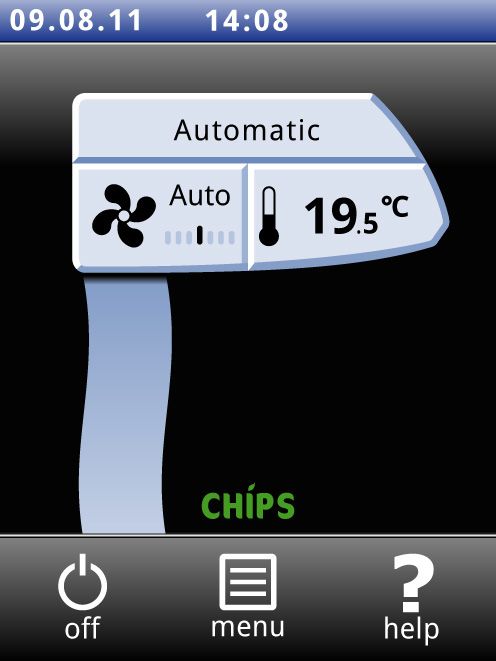
3.3 The Home screen
The settings of the air curtain and the room temperature can
be adjusted in the Home screen.
• Touch the parts of the air curtain icon to select manual or
automatic and to adjust the strength of the air curtain or
the room temperature.
• Touch the air flow icon to obtain brief information on the
operation of the unit.
• Touch menu to call up the main menu.
3.4 CHIPS control
The air curtain operates as standard with fully automatic con-
trol. Depending on the selected settings, the air curtain can
also be controlled manually.In automatic mode, the unit oper-
ates under CHIPS control. This control matches the strength
and heat of the air curtain to changing weather conditions.
This reduces energy consumption and improves comfort
Manual version 7.0 (22-04-2013) en-41en
OPERATION COMFORT AIR CURTAIN
through selection of the optimum setting under all circum-
stances. CHIPS stands for “Corrective Heat and Impulse Pre-
diction System”. The operation of the air curtain is based on
the outside temperature and the room temperature near the
air curtain.
3.4.1 Automatic or manual control
The air curtain has an automatic and a manual mode. These
can be selected by touching the uppermost part of the air cur-
tain icon.When the unit is switched on, it is always in automa-
tic mode. If you wish to operate the unit only in manual mode,
switch off the automatic mode via menu > Settings > 1. Select
modes.
3.4.2 Recommended setting of the air curtain
To obtain the maximum separation effect and the greatest
comfort possible with the least possible energy consumption,
Biddle recommends use of the fully automatic CHIPS control.
3.5 Adjusting the strength of the air curtain
3.5.1 Adjusting the automatic strength control
In automatic mode, the strength and temperature of the air
stream are controlled automatically. Due to weather condi-
tions, you might want to adjust the automatic setting. If you
feel a cold draught along the floor, you can increase the auto-
matic strength.
Note:
n The adjustment of the automatic strength is not
always directly translated into a different fan speed.
3.5.2 Manual setting of the strength
With the manual setting, you have 6 strengths to choose from.
To achieve maximum climate separation with minimum energy
consumption, Biddle recommends selecting the lowest
strength at which no draught occurs. This setting may need to
be changed during the day.
en-42en
CA2 MANUAL OPERATION
3.6 Controlling the temperature
You can set the temperature to a comfortable level. This is the
temperature at the air curtain.With units connected to a Dai-
kin system (CA2 V and CA2 Q), the temperature control is
less accurate than with water or electric heating.
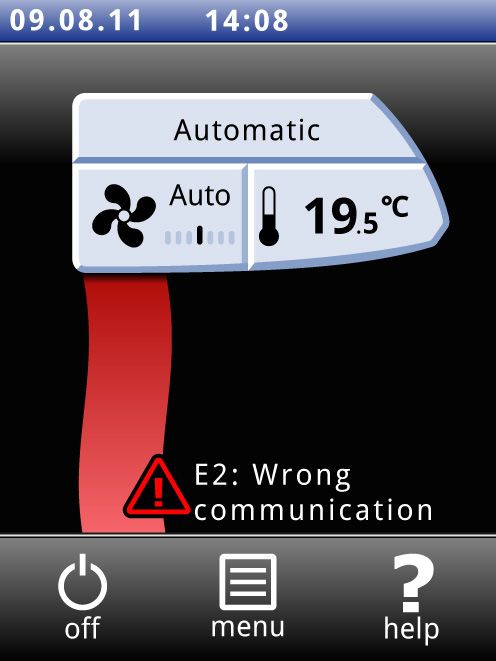
3.7 Faults
The symbol ä indicates that there is a fault. The fault mes-
sage is displayed alongside.
• Touch this message for further information on the fault and
for instructions as to how to react.
Warning:
w Some faults may cause damage or danger for
persons if they are disregarded. If ä is
displayed, follow the instructions as to how to
react shown on the operating panel.
Note:
n The symbol ä and the fault message remain
displayed as long as the fault has not been remedied.
If a fault has remedied itself, a corresponding message will be
displayed. Touch this message to display the and to read out
the last five faults and the times of their occurrence. This list
can also be read out by touching menu > Maintenance > Error
history.
3.8 Main menu
Touch menu to call up the main menu. Here you can set up a
number of frequently occurring functions and make settings in
sub-menus to adapt the function of the air curtain to your spe-
cific situation.
• Touch home to return to the Home screen again.
• v and x allow you to scroll through the list.
If the control panel is not operated for some time, it returns
automatically to the Home screen without saving the changes.
Lock the screen Select Lock screen to prevent unauthorised access. The # icon
appears on the screen.
Manual version 7.0 (22-04-2013) en-43en
OPERATION COMFORT AIR CURTAIN
Unlocking
Touch the screen for 5 seconds to unlock.
Switching the heating on and off The heating of the air curtain can be switched on and off man-
ually. This can be useful in summertime when no heating is
necessary.
Switching the heating off disables the room temperature con-
trol.
This function can be deactivated via setting 89 in the configu-
ration menu.
• Select Heating
When the heating is switched off, the air stream is displayed in
blue.
The heating can also be switched off by the control itself:
• by an external signal at the input of the unit, see
menu > Configuration > 60. Function of input, setting
Heating off;
• when the outdoor temperatuur is higher than the setting
of function 84. Heating off temperature.
Filter Dirty filters reduce the effectiveness of the air curtain. It is
therefore necessary to clean or replace the filters at regular
intervals. The filter contamination is either measured with the
optional filter sensor or calculated.
With the optional filter sensor, the unit measures the filter
contamination every 24 hours by running at the highest fan
speed for 40 seconds. You can set the check time for this in
the menu.
Warning:
w The default check time is 00:00 h (midnight).
Be aware that objects can be put into motion
by the airflow of the air curtain. This might
set off an alarm system in the building at
night time.
The cleaning interval can be adjusted to match the actual con-
tamination of the filters.
Without filter sensor the service life of the filter is calculated
in relation to the use of the air curtain. You can adjust this by
setting the maximum service life of the filter.
en-44en
CA2 MANUAL OPERATION
When the filters are contaminated or when the maximum ser-
vice life is reached, a message appears on the Home screen.
You may clean the filter with, for instance, a vacuum cleaner.
After some cleanings, however, the filter must be replaced.
New filters are available from Biddle.
Cleaning the display Using the touch screen may cause finger prints or smudges on
the display. The display can be cleaned using a soft, damp cloth.
Timer The b-touch control panel has a week timer. You can set two
start and stop times for every day of the week. The unit is on
between the start time and the stop time. The second start
and stop times are optional.When the button ON/OFF is dis-
played on the screen, the unit can also be switched ON or
OFF manually. From the next switching moment the unit then
follows the timer again.When the timer is switched on, the @
icon is displayed in the blue bar of the Home screen.
3.9 Preferences
Preferences The menu Preferences allows you to make settings for the use
of the control panel.
Set language The control panel offers a choice of languages. Choose your
preferred language from the list.
Set date and time The date and time are necessary for the timer function and in
order to track usage statistics of the unit.
Let op:
c A correct dateis also needed when there is no out-
door or contact sensor connected to the unit. In
this case the CHIPS control estimates the outdoor
temperature based on the month of the year and cli-
mate data for your country. Having a wrong date
causes a less optimal working of the air curtain.
The automatic summer time function switches the clock to
summer or winter time according to the applicable European
rules. If you do not use this function, you can switch to sum-
mer time manually. The clock is then set one hour forward.
Manual version 7.0 (22-04-2013) en-45en
OPERATION COMFORT AIR CURTAIN
Temperature unit Choose between temperature display in degrees Celsius and
degrees Fahrenheit.
Display brightness Set the brightness of the display to your personal preferences
or to the specific situation.
Show tips The control panel can show tips about the usage of the unit.
The display of these tips can be enabled or disabled.
3.10 Settings
The menu Settings allows you to make setting which influence
the day-to-day use of the unit.
1. Select modes The operating panel offers various operating modes. The func-
tion Select modes allows you to choose which of these modes
can be selected on the HOME screen.
5. Room temperature The default room temperature is the temperature setting at
every start-up of the unit.
This can be overruled manually.
6. Minimum air temperature Set the minimum difference between the room temperature
and the discharge temperature.
This difference can be increased for more comfort. A small dif-
ference saves energy.
8. Night temperature The night temperature is used when the unit is off. When the
room temperature drops below this setting, the unit will start
working to keep the room on the night temperature.
Warning:
w Be aware that objects can be put into motion
by the airflow of the air curtain. This might
set off an alarm system in the building at
night time.
9. Calibration An unfavourable position of the operating panel or using the
temperature sensor in the air curtain can be the reason why
the temperature displayed differs from the real temperature.
Use this function to adjust the temperature reading.
en-46en
CA2 MANUAL OPERATION
3.11 Configuration
The menu Configuration allows you to make settings to adjust
the operation of the unit to the room and the system. Usually,
this menu is used only for installation, maintenance and ser-
vice purposes.
50. Access control Access to the whole control panel or only to the menu can be
protected with a four-digit PIN code.
The default PIN code is 0000.
51. Indoor sensor Both the unit and the operating panel have a sensor which
measures the indoor temperature. Choose one that the sys-
tem is to use:
• Select the sensor on the unit for automatic control. This is
the standard setting.
• Select the sensor on the control panel if you also wish to
use the air curtain for heating the room. In this case com-
fort may be reduced by draughts along the floor.
52. Display on/off button The unit can be switched on and off manually. It can also be
switched on and off via the internal timer or via an external
release signal at the input of the operating panel or of the unit.
In this case you can disable the manual switching on and off.
The on/off button is then not displayed on the Home screen.
53. Control panel input The control panel has one input signal interface. This can be
used for an external of/offsignal or for an additional tempera-
ture sensor.
When the timer is in use, the on/off function of the input of
the control panel is deactivated, irrespective of this setting.
If an additional temperature sensor is connected, this takes
over the function of the sensor in the control panel.
Note:
n Selecting “Temperature“ without actually connecting
a sensor will lead to a fault message.
54. Strength with door closed Set the minimum fan speed when contact is made with the
input. Use a door switch here to reduce the fan speed when
the door is closed.This has an effect only when function 60.
Function of input is set to Quick speed up or Slow speed up.
Manual version 7.0 (22-04-2013) en-47en
OPERATION COMFORT AIR CURTAIN
If this function is set to zero (fans off), it can occur that the
fans start working with the doors closed. This is to maintain
the room temperature. If you don’t want this:
• decrease the set room temperature, or:
• change this function to a value other than zero.
55. Boost function If there is a large difference between the desired and the actual
room temperature, the fan speed can be increased to reach
the desired temperature quicker.
Use this function when the air curtain also is used for heating
the room.
If 61a/b. Function of output 1/2 is set to value Winter door
setting, a contact on that output is also made when the actual
difference is larger than this setting.
58. Maximum strength The maximum fan speed can be limited in order to limit the
noise level. This function has an effect only in Automatic
mode.
Use of this function can reduce the comfort.
59. Sensor X82 The sensor connected to terminal X82 on the unit can act as
either an outdoor sensor or as a pipe sensor on the supply
pipe of the central heating system. This sensor is used in the
automatic control of the air curtain.
Pipe sensor
The outdoor temperature is derived from the water tempera-
ture. For this you need a pipe sensor on the supply pipe of the
6XSSO\WHPSHUDWXUH
7HPSHUDWXUH central heating system and a weather depended control of the
central heating system.
ZDWHU>&@
The outdoor temperature is based on the heating curve of the
7HPSHUDWXUH supplied water. This curve is defined by three points of out-
door temperature and water temperature.
7HPSHUDWXUH
The first point is for the high outdoor temperature, the last
point for the low outdoor temperature. Make sure that the
2XWGRRUWHPSHUDWXUH>&@ limits of all temperatures correspond to the temperatures that
can occur.
As this is only an estimation, the working of the air curtain
might be less optimal.
en-48You can also read


