Knowledge Organiser 2020 2021 - Year 8 - Longfield Academy
←
→
Page content transcription
If your browser does not render page correctly, please read the page content below
Knowledge Organiser
      2020 - 2021

              Year 8
Name: _ _ _ _ _ _ _ _ _ _ _ _ _ _ _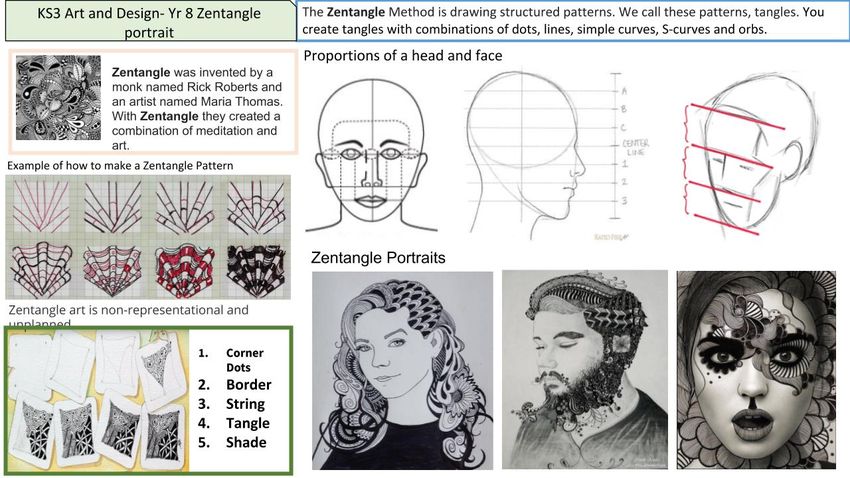
Knowledge Organisers
At Longfield Academy, we believe that a firm grounding in knowledge should be at the core of students
learning. With this in mind, we have created this ‘knowledge organiser’ booklet to give you an overview of
what your son or daughter will be studying over the next two modules. A knowledge organiser is a set of key
facts or information that pupils need to know and be able to recall in order to master a unit or topic. This will
help them to develop and deepen their learning across all of their lessons.
Each subject has created one or more knowledge organisers based upon the topics that are being studied in
the first two modules. Students should learn this information in their own time so that they can recall it easily.
This can be done following these simple steps:
Read – Spend 5 to 10 minutes reading through a knowledge organiser.
Cover – Either cover over key topics or simply turn your knowledge organiser over to ensure that
the information is well hidden.
Quiz – Ask a friend or relative to test your knowledge on what you have learnt.
Repeat - Repeat the steps until you have committed the material to memory and mastered the
topic.
If you are still struggling with a topic, then you might want to carry out further research and make
your own knowledge organiser.
Teachers will set this as homework which should be recorded in the student planners. Students will then be
tested in lessons via low stakes quizzing to ensure that they have revised their knowledge organisers. It is
important that students track their scores from their low stakes quizzes in the “Quiz Scores” section of this
booklet. Typically, these will be scored out of 5, however, departments may vary depending on the topic they
are delivering. Initially the scores will be recorded in the student’s books or online work book. However, it is
vitally important that they are transferred to this document.
You can support your child by:
Encouraging them to study their knowledge organiser booklet and learn the material set.
Testing them on their ability to recall the information learnt from the knowledge organisers.
A digital copy of the knowledge organiser booklet can be found on our school website under the ‘curriculum’
tab. The knowledge organiser is part of their stationary equipment and it is expected that the knowledge
organiser should be with the students at all times.
Quiz Scores
                           Design - Art
  1    2      3    4         5           6    7    8    9    10

 11   12      13   14       15       16       17   18   19   20

                        Design - Technology
  1    2      3    4         5           6    7    8    9    10

 11   12      13   14       15       16       17   18   19   20

                                 Drama
  1    2      3    4         5           6    7    8    9    10

 11   12      13   14       15       16       17   18   19   20

                              English
  1    2      3    4         5           6    7    8    9    10

 11   12      13   14       15       16       17   18   19   20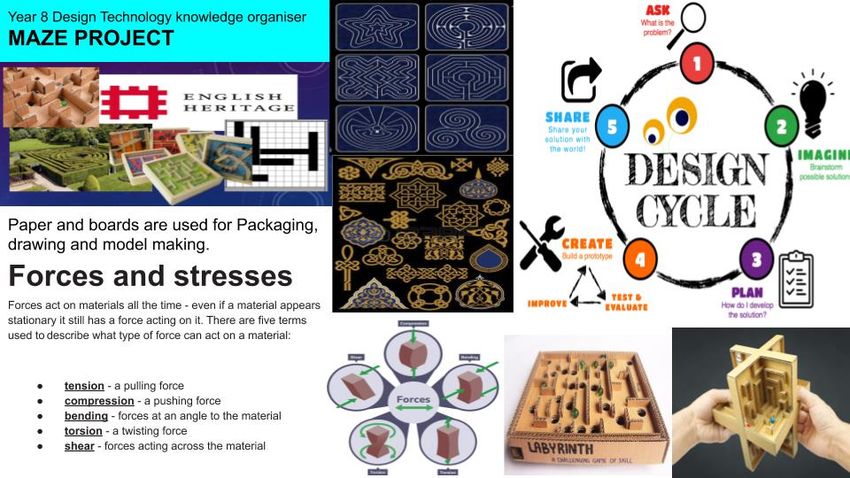
Quiz Scores
                   Food Preparation and Nutrition
  1    2      3       4        5           6     7    8    9    10

 11   12      13     14       15       16        17   18   19   20

                             Humanities
  1    2      3       4        5           6     7    8    9    10

 11   12      13     14       15       16        17   18   19   20

                          Digital Design - ICT
  1    2      3       4        5           6     7    8    9    10

 11   12      13     14       15       16        17   18   19   20

                                   Maths
  1    2      3       4        5           6     7    8    9    10

 11   12      13     14       15       16        17   18   19   20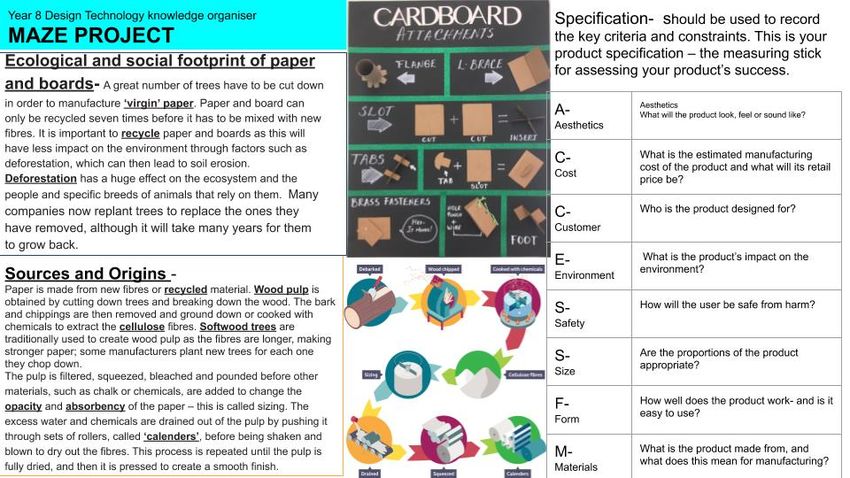
Quiz Scores
                            Music
  1    2      3    4    5           6   7    8    9    10

 11   12      13   14   15        16    17   18   19   20

                             PE
  1    2      3    4    5           6   7    8    9    10

 11   12      13   14   15        16    17   18   19   20

                         Science
  1    2      3    4    5           6   7    8    9    10

 11   12      13   14   15        16    17   18   19   20

                         Spanish
  1    2      3    4    5           6   7    8    9    10

 11   12      13   14   15        16    17   18   19   20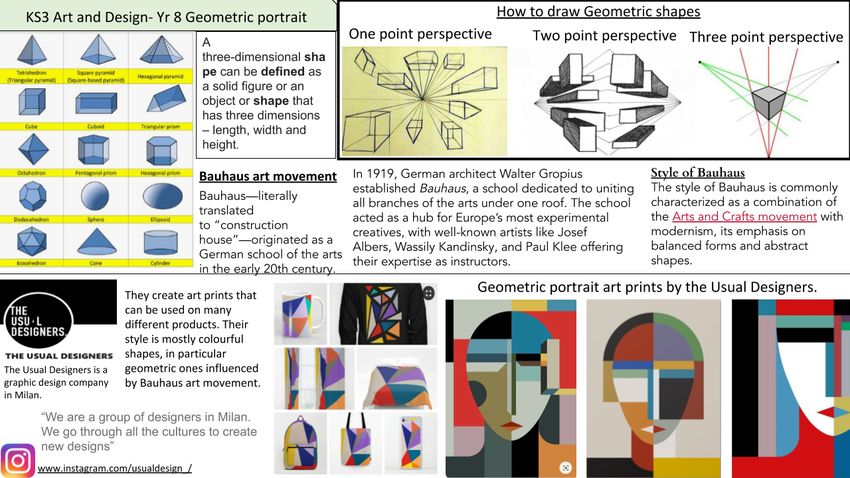
Contents
On the following pages are knowledge organisers for subjects in the following order:

Middle Years Programme Language
Design - Art
Design - Technology
Drama
English
Food Preparation and Nutrition
Humanities
Digital Design - ICT
Maths
Music
PE
Science
Spanish
Year 8 – Middle Years Programme Knowledge Organiser – All Terms
                                                                                      Approaches to Learning (ATL)
                    Communication                                              Collaboration                                       Organisation                                              Affective
Communication is the exchange or transfer of              Collaboration involves two or more people sharing       The action of organizing something effectively        This approach to learning is how you can
signals, facts, ideas and symbols.                        expertise and experience, working together to           like your coursework or pencil case.                  manage your state of mind whilst completing
                                                          solve a problem and realize shared goals.                                                                     your work.
                      Reflection                                           Information Literacy                                    Media Literacy                                       Critical Thinking
This is where you give a topic serious thought or         A set of abilities requiring individuals to recognize   Media literacy is the ability to identify different   Critical thinking is the ability to think clearly
consideration. An example might be when you are           when information is needed and have the ability to      types of media and understand the messages            and rationally, understanding the logical
evaluating your work.                                     locate, evaluate, and use effectively the needed        they're sending. It is also interacting with          connection between ideas. It is also the
                                                          information.                                            media to use and create ideas.                        ability to analyse and evaluate issues and
                                                                                                                                                                        ideas.
                   Creative Thinking                                              Transfer                                               MYP
Creative thinking means looking at something in a         When you learn a new skill you should be able to        This is the acronym for your programme of
new way. It is the very definition of thinking outside    transfer that skill into multiple contexts.             study. It stands for “Middle Years Programme”.
the box. It can also be described as generating news
ideas and considering new perspectives.
                                                                                                MYP Attributes
                                        We show empathy, compassion and respect. We have a                                                We act with integrity and honesty, with a strong sense of fairness and
                    Caring               commitment to service, and we act to make a positive                           Principled      justice, and with respect for the dignity and rights of people everywhere.
                                      difference in the lives of others and in the world around us.                                           We take responsibility for our actions and their consequences.

                                      We develop and use conceptual understanding, exploring                                           We thoughtfully consider the world and our own ideas and experience. We
                Knowledgeable       knowledge across a range of disciplines. We engage with issues                      Reflective     work to understand our strengths and weaknesses in order to support our
                                          and ideas that have local and global significance.                                                             learning and personal development.
                                    We approach uncertainty with forethought and determination;                                        We understand the importance of balancing different aspects of our lives—
                                    we work independently and cooperatively to explore new ideas                                        intellectual, physical, and emotional—to achieve well-being for ourselves
                  Risk-Taker                                                                                             Balanced
                                     and innovative strategies. We are resourceful and resilient in                                    and others. We recognize our interdependence with other people and with
                                                  the face of challenges and change.                                                                             the world in which we live.

                                     We express ourselves confidently and creatively in more than
                                                                                                                                         We nurture our curiosity, developing skills for inquiry and research. We
                                      one language and in many ways. We collaborate effectively,
               Communicators                                                                                             Inquirers         know how to learn independently and with others. We learn with
                                     listening carefully to the perspectives of other individuals and
                                                                                                                                             enthusiasm and sustain our love of learning throughout life.
                                                                  groups.

                                         We critically appreciate our own cultures and personal
                                                                                                                                        We use critical and creative thinking skills to analyse and take responsible
                                    histories, as well as the values and traditions of others. We seek
                Open-Minded:                                                                                            Thinkers:       action on complex problems. We exercise initiative in making reasoned,
                                      and evaluate a range of points of view, and we are willing to
                                                                                                                                                                     ethical decisions.
                                                        grow from the experience.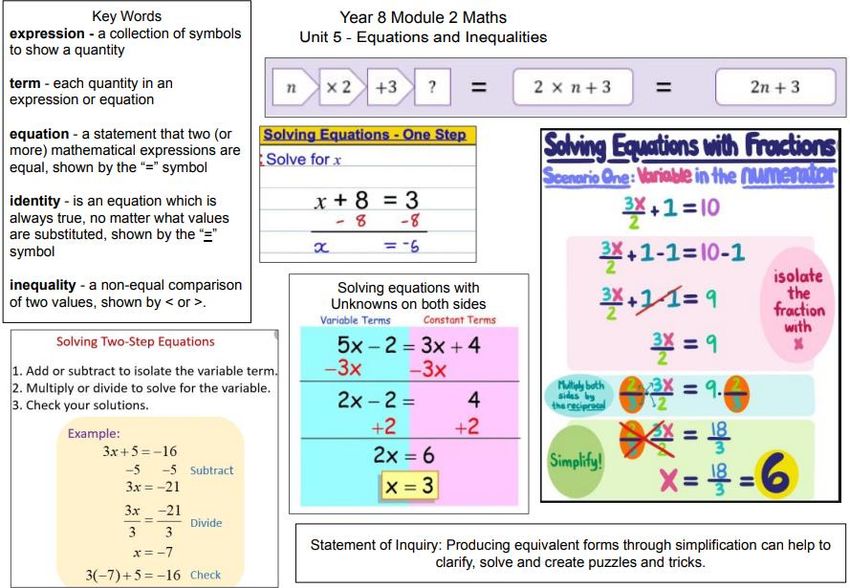
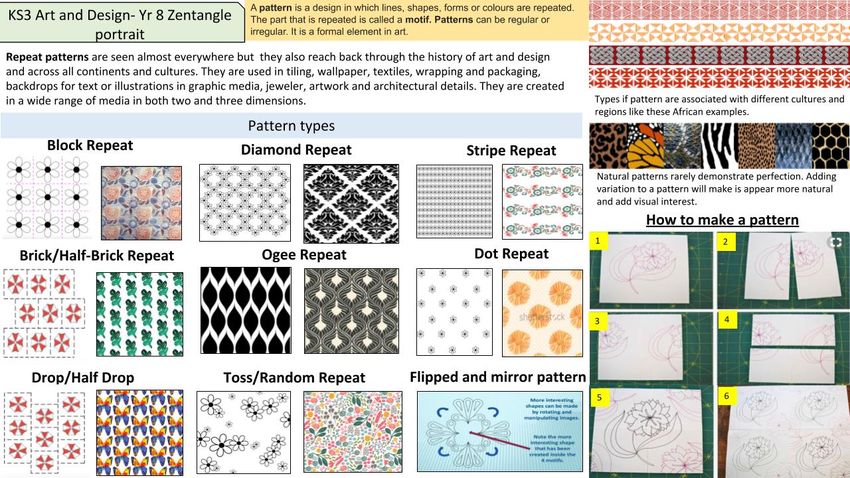
Art - Modules 1 and 2 – Part 1
Art - Modules 1 and 2 – Part 2
Art - Modules 1 and 2 – Part 3
Design Technology - Modules 1 and 2 – Part 1
Design Technology - Modules 1 and 2 – Part 2
Drama - Modules 1 and 2 – Too Much Punch for Judy
English - Module 1 – Merchant of Venice
English - Module 2 – Gothic Short Stories – Part 1
English - Module 2 – Gothic Short Stories – Part 2
English - Module 2 – Gothic Short Stories – Part 3
English - Module 2 – Gothic Short Stories – Part 4
Food Preparation and Nutrition - Modules 1 and 2 – Part 1
Food Preparation and Nutrition - Modules 1 and 2 – Part 2
Food Preparation and Nutrition - Modules 1 and 2 - Part 3
Food Preparation and Nutrition - Modules 1 and 2 – Part 4
French – Module 1

      Knowledge organiser - Please, learn your vocabulary regularly. Your teacher will test you at the start of every lesson.

               1. Likes, dislikes and reasons                                              2. TV programmes
J'aime                             I like                      Regarder                                To watch
J'adore                            I love                      Les comédies                            Comedies
Je n'aime pas                      I do not like               les dessins animés                      Cartoons
Je déteste                         I hate                      les feuilletons                         Soaps
Je préfère                         I prefer                    les infos                               The news
C'est relaxant                     It is relaxing              les jeux (télévisés)                    Gameshows
C'est divertissant                 It is entertaining          Les émissions musique                   Music programmes
C'est amusant/ drole/ rigolo       It is funny/amusing         Les émissions de sport                  Sports programmes
C'est ennuyeux                     It is boring                les émissions de science-fiction        Science fiction programmes
C'est interessant                  It is interesting           Les émissions de télé-réalité           Telereality programmes
C'est nul                          It is rubbish               Les émissions de cuisine                Cookery programmes
C'est passionnant                  It is fascinating           Les films d'action                      Action films
Parce que/ car                     Because                     Les films d'horreur                     Horror films
très                               Very                        Les films de super-heros                Superhero films
Assez                              Quite                       les films de sciences-fiction           Science fiction films
Plutôt                             Rather                      Mon émission préférée est               My favourite programme is
           3.The internet and new technologies                                                 4. Questions
J'ai un smartphone                 I have a smartphone         Qu'est-ce que tu aimes à la télé?       What do you like on TV?
 Je surfe                          I surf                      Quelle est ton émission préférée        What is your favourite
                                                                                                       programmes?
Je blogue                        I blog                        Quand est-ce que tu regardes la         When do you watch TV?
                                                               télé?
Je tchatte                       I chat                        Tu veux aller au cinéma?                Do you want to go to the cinema?
Je fais des achats en ligne      I do online shopping          Tu viens au cinéma avec moi?            Are you coming to the cinema
                                                                                                       with me?
Je ne joue jamais à des jeux     I never play video games      Rendez-vous à quelle heure?             When shall we meet?
vidéos
Elle écoute de la musique sur    She listens to music on her   Tu as un téléphone portable?          Do you hjave a moble phone?
sa tablette                      tablet
Je n'ai pas d'ordinateur         I do not have a computer      Tu as un ordinateur?                  Do you have a computer?
Il regarde son portable          He is looking at his phone    Tu fais des achats en ligne?          Do you do shopping on line?
Le matin                         In the morning                Tu aimes internet?                    Do you like the internet?
Le soir                          In the evening                Qu'est-ce que tu aimes voir au        What do you like to watch at the
                                                               cinéma?                               cinema?
À la maison                      At home                       Qu'est-ce que tu as regardé à         What did you watch on TV
                                                               la télé hier?                         yesterday?
Dans le bus                      On the bus                    Qu'est-ce que tu as fait le           What did you do last weekend?
                                                               week-end dernier?
Avec ma famille                  With my family                Tu joues à des jeux vidéos en ligne? Do you play video games on line?
Avec mes copains                 With my friends               Qu'est-ce que tu vas faire le week-   What are you going to do next
                                                               end prochain?                         weekend?
                       5. The past tense.                                    6. High frequency words and other structures.
Je suis allé au centre             I went to the shopping      Mon/ma/mes                            My favourite programme
commercial                         centre
J'ai fait les magasins             I went shopping             Ton/ta/tes                            Your
J'ai fait des achats               I went shopping/ I bought   Son/sa/ses                            His/her
                                   things
J'ai acheté un tee-shirt           I bought a tee shirt        Ne…pas                                Not
J'ai mangé un sandwich             I ate a sandwich            Ne...jamais                           Never
j'ai bu une limonade               I drank a lemonade          Ne…rien                               Nothing
J'ai fait une balade               I went for a walk           Aussi                                 Also
Je suis allé au cinéma             I went to the cinema        Mais                                  But
J'ai vu un film comique            I saw a funny film          Et                                    And
J'ai vu une comédie                I saw a comedy              Avec                                  With
J'ai regardé la télévision         I watched TV                Seul( e)                              Alone
J'ai joué au foot                  I played football           Le week-end                           At the weekend
J'ai surfé sur internet            I surfed on the internet    Cependant                             However
J'ai tchatté avec mes copains      I chatted with my friends   Surtout                               Mainly/especially
Je vais aller au cinéma            I am going to (go to)       Sauf                                  Except
                                   the cinema
French - Module 2
Knowledge organiser - Please, learn your vocabulary regularly. Your teacher will test you at the start of every lesson.
1. Location 2. Weather
Où habites-tu? Where do you live? Quel temps fait-il? What’s the weather like inthe photo?
J’habite dans un village. I live in a village. Il fait beau. The weather’s fine.
J’habite dans une ville. I live in a town. Il fait mauvais. The weather’s bad.
J’habite dans une grandeville. I live in a city. Il fait chaud. It’s hot.
J’habite à la campagne. I live in the country. Il fait froid. It’s cold.
J’habite à la montagne. I live in the mountains. Il y a du soleil. It’s sunny.
J’habite au bord de la mer. I live at the seaside. Il y a du vent. It’s windy.
J’habite en France. I live in France. Il neige. It’s snowing.
J’habite en Suisse. I live in Switzerland. Il pleut. It’s raining.
J’habite au Maroc. I live in Morocco.
3. Description of a place 4. Activities in town
C’est comment? Elle est What is it like? Qu’est-ce qu’on peut faire dans ta What can you do in your region?
comment, ta région? région?
C’est animé. It’s lively. Dans ma ville ... In my town ...
C’est calme. It’s peaceful / quiet. Dans ma région ... In my region ...
C’est tranquille. It’s peaceful / quiet. On peut manger des crêpes. You can eat pancakes.
C’est ennuyeux. It’s boring. On peut visiter des grottes. You can visit some caves.
C'est joli. It’s pretty. On peut visiter le marché. You can visit the market.
C’est nul. It’s awful On peut visiter des monuments You can visit historic monuments.
historiques.
Il y a des ... There are (some) ... On peut faire du canoë-kayak. You can go canoeing.
Il y a beaucoup de ... There are lots of ... On peut faire des randonnées. You can go for walks.
Il n’y a pas de ... There are no ... On peut faire du ski. You can go skiing.
bâtiments. buildings. On peut faire les magasins. You can go shopping.
champs fields. On peut aller au cinéma. You can go to the cinema.
lacs. lakes. Qu’est-ce que tu as fait le What did you do last weekend?
weekend dernier?
touristes. tourists. Je suis allé(e) à Ajaccio. I went to Ajaccio.
forêsts. forests. 5. Housework.
montagnes. mountains. Qu’est-ce que tu dois faire à la What must you do at home?
maison?
plages. beaches. Je dois laver la voiture. I must wash the car.
voitures. cars. Je dois rapporter l’eau. I must fetch the water.
6. Routine Je dois ranger ma chambre. I must tidy my bedroom.
À quelle heure est-ce que tu te What time do you get Je dois garder le bébé. I must look after the baby.
lèves? up?
Je me lève. I get up. Je dois nourrir le chien. I must feed the dog.
Je prends le petit déjeuner. I have breakfast. Je dois faire la cuisine. I must do the cooking.
Je me douche. I have a shower. Je dois faire la vaisselle. I must do the washing-up.
Je m’habille. I get dressed. Je ne fais rien. I do nothing./I don’t do anything.
Je me coiffe. I do my hair. Mon frère doit (laver la voiture). My brother must (wash the car)
Je me lave les dents. I brush my teeth. Ma soeur doit (ranger sa My sister must (tidy her room).
chambre).
Je me couche. I go to bed. Mon frère ne fait rien. My brother doesn't do anything.
à sept heures. at seven o’clock Ma soeur ne fait rien. My sister doesn't do anything.
à sept heures et quart at quarter past seven Je pense que c’est juste. I think it’s fair.
à sept heures moins le quart at quarter to seven Je pense que ce n’est pas juste. I think it’s unfair.
à sept heures et demie at half past seven 7. Moving places
à sept heures (vingt) at (20) past seven J’ai déménagé. I moved house.
à sept heures moins (dix) at (10) to seven J’ai déménagé en ville. I moved to the town.
8. Frequency words and phrases J’ai déménagé à la campagne. I moved to the countryside.
tous les jours Every day Voici mon nouveau collège. This is my new school.
souvent often Voici ma nouvelle maison. This is my new house.
quelquefois sometimes C’est un vieux village. It is an old village.
le weekend at weekends Il y a un beau jardin. There is a beautiful garden.
le lundi on Monday Il y a une belle cuisine. There is a beautiful kitchen.
vraiment really Il y a une vieille église. There is an old church.
très very
trop tooHumanities - Module 1 – Part 1
Humanities - Module 1 – Part 2
Humanities - Module 2 – Part 1
Humanities - Module 2 – Part 2
ICT - Modules 1 and 2 - Python Programming - Part 1

                                                                                         Python 3.4
                   Python 3.4                                  Variables                        High-level Programming Languages                               Integers
 Python is a high-level programming language.       A variable is a ‘container’ used      This is a programming language that resembles              A whole number, i.e. 1, 7, 188.
                                                             to store data.                           natural human language.
                    String                                       Constants                                   Identifiers                                           Shell
 A sequence of characters. They can be letters,     A ‘container’ that holds a value     A unique name given to a variable or a constant.          The Shell is a where the program is
numbers, symbols, punctuation marks or spaces.          that never changes. Like         Using descriptive names for variables makes code       executed as well as checking for errors in
                                                        variables, constants have                       much easier to read.                                   the program.
                                                            unique identifiers.
                       IDLE                                         Run                                     Syntax Error                                        Logic Errors
  IDLE stands for Integrated Development and           This is the process you will    A syntax error means that part of the code breaks the   This is an error which occurs when the logic
 Learning Environment which provides the user           need to take to see if the         rules of the language, which stops it running.       of a program does not produce the result
with a basic interface of where they can type the    program works as intended.                                                                                 you expect.
                    program up.
                  Runtime Errors                             Comments                                      Indentation                                           Interface
This is an error which occurs when the computer     Comments are used to explain      Indentation is where you move the text along to the      This is a device or a program which enables
      tries to run code that cannot execute.        what each part of the program      right, to make it easier to see where each block of      a user to communicate with a computer.
                                                               does.                                code starts and finishes.
                                                                                 IF and ELIF Conditions
                                       IDLE                                                                                          SHELL

                                                                                       Define Function
                                       IDLE                                                                                          SHELL
ICT - Modules 1 and 2 – Python Programming - Part 2
ICT - Modules 1 and 2 – Python Programming - Part 3
               Below are all of the key words associated with the Python programming language.

Method                  Description                   Method                     Description
 and                 A logical operator               import               To import a module
  as                 To create an alias                 in         To check if a value is present in a list,
                                                                                  tuple, etc.
 assert                  For debugging                   is          To test if two variables are equal
 break               To break out of a loop           lambda        To create an anonymous function
  class                 To define a class              None               Represents a null value
continue    To continue to the next iteration of a    nonlocal        To declare a non-local variable
                              loop
  def                 To define a function             not                    A logical operator
  del                  To delete an object              or                    A logical operator
  elif      Used in conditional statements, same       pass      A null statement, a statement that will do
                            as else if                                             nothing
 else          Used in conditional statements           raise               To raise an exception
except        Used with exceptions, what to do         return       To exit a function and return a value
                  when an exception occurs
 False       Boolean value, result of comparison       True        Boolean value, result of comparison
                           operations                                          operations
 finally    Used with exceptions, a block of code       try         To make a try...except statement
           that will be executed no matter if there
                     is an exception or not
   for                To create a for loop             while              To create a while loop
  from       To import specific parts of a module      with        Used to simplify exception handling
 global          To declare a global variable          yield      To end a function, returns a generator
    if        To make a conditional statement
Maths – Module 1 – Prime Factorisation
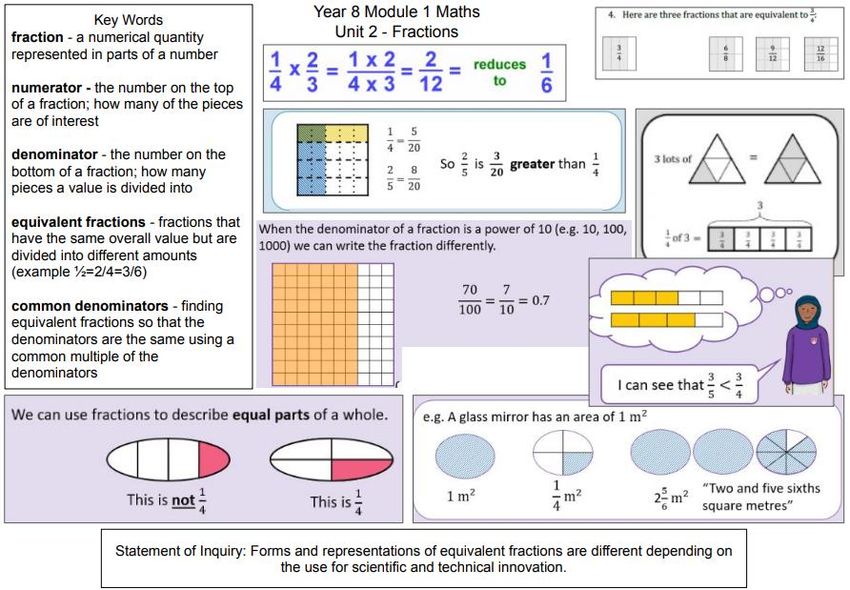
Maths – Module 1 – Fractions – Part 1
Maths – Module 1 – Fractions – Part 2
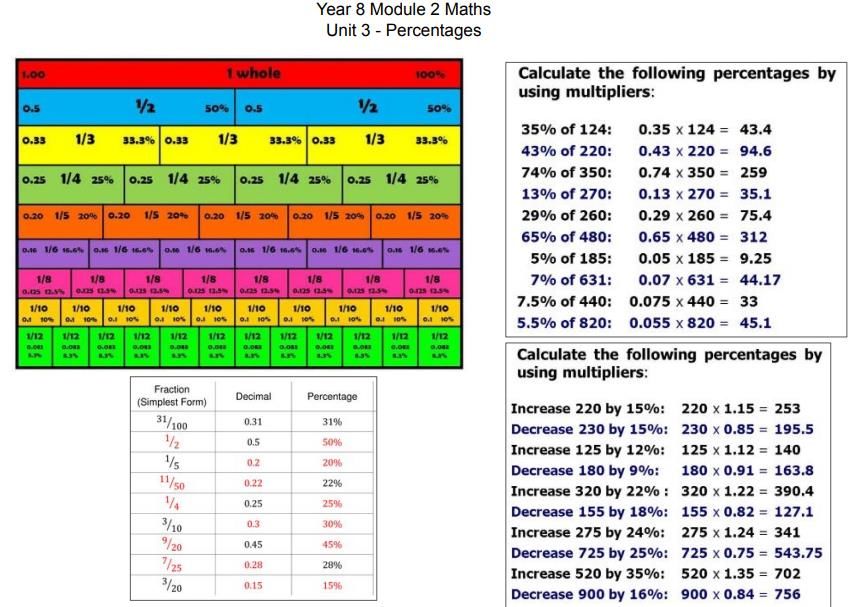
Maths – Module 2 – Percentages – Part 1
Maths – Module 2 – Percentages – Part 2
Maths – Module 2 – Sequences
Maths – Module 2 – Equations and Inequalities – Part 1
Maths – Module 2 – Equations and Inequalities – Part 2
Music - Modules 1 and 2 – Part 1
Music - Modules 1 and 2 – Part 2
PE - Modules 1 and 2 – Cardio
PE - Modules 1 and 2 – Types of Training
PE - Modules 1 and 2 – Planning a Training Programme
PE - Modules 1 and 2 – Sporting Etiquette and NGO’s
Science - Modules 1 and 2 – Electricity and Energy – Part 1
Science - Modules 1 and 2 – Electricity and Energy – Part 2
Science - Modules 1 and 2 – The Periodic Table, Metals and Acids – Part 1
Science - Modules 1 and 2 – The Periodic Table, Metals and Acids – Part 2
Spanish – Module 1

     Knowledge organiser - Please, learn your vocabulary regularly. Your teacher will test you at the start of every lesson.

              1. Likes, dislikes and reasons                                2. The internet and new technologies
¿Te gusta la música de One      Do you like One Direction's      Chateo con mis amigos.          I chat with my friends.
Direction?                      music?                           Comparto mis vídeos             I share my favourite
                                                                 favoritos.                      videos.
Me gusta...                       I like...                      Descargo melodías o             I download ringtones or
                                                                 aplicaciones.                   apps.
Me gusta mucho...                I like... very much             Hablo por Skype.                I talk on Skype.
Me encanta...                    I love...                       Juego.                          I play.
No me gusta...                   I don't like...                 Leo mis SMS.                    I read my texts.
No me gusta nada...              I don't like... at all          Mando SMS.                      I send texts.
porque es guay                   because it is cool              Saco fotos.                     I take photos.
triste                           sad                             Veo vídeos o películas.         I watch videos or films.
divertido                        funny
informativo, informativa         informative
Me gusta la música de Adele. I like Adele's music.
mi canción favorita              my favourite song
mi cantante favorito, favorita my favourite singer
mi grupo favorito                my favourite group
En mi opinión...                 In my opinion...
más... que...                    more... than...
                       3. Music Styles                                                 4. TV Programs
el rap                           rap                             ¿Qué te gusta ver en la         What do you like on TV?
                                                                 televisión?
el R'n'B                        R'n'B                            Me gustan las comedias          I like comedies
el rock                         rock                             un programa de música           a music programme
la música clásica               classical music                  un programa de deportes         a sports programme
la música electronica           electronic music                 un concurso                     a game show
la música pop                   pop music                        un documental                   a documentary
¿Qué tipo de música             What type of music do you        un reality                      a reality show
escuchas?                       listen to?
Escucho rap.                    I listen to rap.                 una comedia                         a comedy
Escucho la música de Adele.     I listen to Adele's music.       una serie policíaca                 a police series
Escucho de todo.                I listen to everything           una telenovela                      a soap opera
la letra                        the lyrics                       el telediario                       the news
la melodía                      the tune
el ritmo                        the rhythm
                     5. The past tense.                                6. High frequency words and other structures.
Bailé en mi cuarto.             I danced in my room.             así que                        so (that)
Fui al cine.                    I went to the cinema.            más... que...                  more... than...
Hablé por Skype.                I talked on Skype.               mi, mis                        my
Hice gimanasia.                 I did gymnastics.                su, sus                        his/her
Hice karate.                    I did karate.                    normalmente                    normally
Jugué en línea con mis          I played online with my          no                             no, not
amigos.                         friends.
Jugué tres horas.               I played for three hours.        nunca                               never
Monté en bici.                  I rode my bike.                  o                                   or
Vi una película.                I watched a film.                porque                              because
Salí con mis amigos.            I went out with my friends.      también                             also, too
No hice los deberes.            I didn't do my homework.         y                                   and
ayer                            yesterday                        todos los días                      every day
luego                           later, then                      dos o tres veces a la semana        two or three times a week
por la mañana                   in the morning                   a veces                             sometimes
por la tarde                    in the afternoon                 de vez en cuando                    from time to time
Spanish – Module 2
Knowledge organiser - Please, learn your vocabulary regularly. Your teacher will test you at the start of every lesson.
1. Places in town 2. Telling the time
¿Qué hay en tu ciudad? What is there in your town? ¿Qué hora es? What time is it?
Hay… There is… Es la una. It’s one o’clock.
un castillo a castle Son las dos. It’s two o’clock.
un centro comercial a shopping centre Es la una y cinco. It’s five past one.
un estadio a stadium Son las dos y diez. It’s ten past two.
un mercado a market Son las tres y cuarto. It’s quarter past three.
un museo a museum Son las cuatro y veinte. It’s twenty past four.
un parque a park Son las cinco y veinticinco. It’s twenty-five past five.
una piscina a swimming pool Son las seis y media. It’s half past six.
una plaza a square Son las siete menos It’s twenty-five to seven.
veinticinco.
un polideportivo a sports centre Son las ocho menos veinte. It’s twenty to eight.
un restaurante a restaurant Son las nueve menos cuarto. It’s quarter to nine.
una tienda a shop Son las diez menos diez. It’s ten to ten.
una universidad a university Son las once menos cinco. It’s five to eleven.
En… In… Son las doce. It’s twelve o’clock.
mi barrio my neighbourhood ¿A qué hora? At what time?
mi ciudad my town, my city a la una at one o’clock
No hay museo. There isn’t a museum. a las dos at two o’clock
No hay nada. There’s nothing. ¿Cuándo? When?
3. Activities in town 4. The future tense
¿Qué haces en la ciudad? What do you do in town? ¿Qué vas a hacer? What are you going to do?
Salgo con mis amigos. I go out with my friends. Voy a salir con mis amigos. I am going to go out with my
friends.
Voy… I go… Vas a ver la televisión. You are going to watch TV.
al cine to the cinema Va a ir de paseo. He/She is going to go for a walk.
al parque to the park Vamos a jugar al voleibol. We are going to play volleyball.
a la bolera to the bowling alley Vais a chatear. You are going to chat.
a la cafetería to the café Van a hacer los deberes. They are going to do their
homework.
a la playa to the beach No voy a hacer nada. I am not going to do anything.
de compras shopping
de paseo for a walk
No hago nada. I do nothing.
5. In the café. 6. High frequency words and other structures.
En la cafetería In the café unos museos/unas tiendas some museums/some shops
Yo quiero… I want… muchos museos/muchas a lot of museums/a lot of shops
tiendas
bebidas drinks ¿Te gusta vivir en…? Do you like living in…?
un batido de chocolate/de fresa a chocolate/strawberry Me gusta mucho vivir en… I like living in… a lot.
milkshake
un café a coffee No me gusta nada vivir en… I don’t like living in… at all.
una Coca-Cola a Coca-Cola porque hay/es… because there is/it is...
una Fanta limón a lemon Fanta este fin de semana this weekend
un granizado de limón an iced lemon drink el sábado por la mañana on Saturday morning
un té a tea el domingo por la tarde on Sunday afternoon/evening
raciones snacks primero first
calamares squid luego then
croquetas croquettes finalmente finally
gambas prawns a las tres de la tarde at three o’clock in the afternoon
jamón ham (un poco) más tarde (a little) later
pan con tomate tomato bread aquí here
patatas bravas spicy potatoes a ver let’s see
tortilla Spanish omlette con with
¿Algo más? Anything else? hasta until
No, nada más. No, nothing else. más more
¿Y de beber? And to drink?
¿Cuánto es, por favor? How much is it, please?
Son cinco euros setenta y cinco. That’s 5,75 €.You can also read


