Kony Cryptographic Library - FIPS 140-2 Level 1 Security Policy Version: 1.0c Last Updated: August 18, 2013
←
→
Page content transcription
If your browser does not render page correctly, please read the page content below

Kony Cryptographic Library

FIPS 140-2 Level 1 Security Policy
                Version: 1.0c
        Last Updated: August 18, 2013

                  Kony, Inc.
        7380 West Sand Lake Road #390
            Orlando, Florida 32819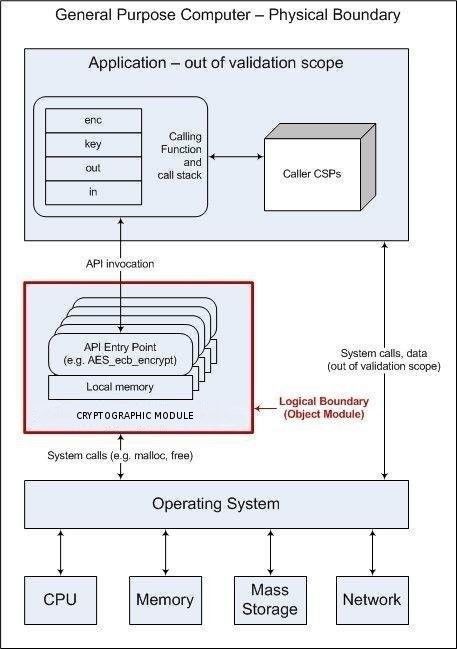
Kony Cryptographic Library Security Policy

Copyright © 2012-2013 Kony, Inc. All rights reserved. This document may be freely
reproduced and distributed whole and intact including this Copyright Notice.

Revision History
   Authors               Date              Version           Comment
       Kony, Inc.        2013-08-28        1.0c              Corporate name change
       Kony, Inc.        2013-08-16        1.0b              Added two iOS platforms
       Kony, Inc.        2013-05-29        1.0               Initial draft

                                              Page 2 of 13
Kony Cryptographic Library Security Policy
Table of Contents
Revision History.................................................................................................................... 2
1 Introduction.........................................................................................................................4
2 Tested Configurations.........................................................................................................5
3 Ports and Interfaces ............................................................................................................6
4 Modes of Operation and Cryptographic Functionality ...................................................... 6
4.1 Critical Security Parameters and Public Keys............................................................ 7
5 Roles, Authentication and Services ................................................................................... 9
6 Self-Test..............................................................................................................................11
7 Operational Environment....................................................................................................13
8 Mitigation of other attacks.................................................................................................. 13
Page 3 of 13Kony Cryptographic Library Security Policy
1 Introduction
This document comprises the non-proprietary FIPS 140-2 Security Policy for the Kony
Cryptographic Library, hereafter referred to as the Module.
Block Diagram
The Module is a software library providing a C-language application program interface (API) for
use by other processes that require cryptographic functionality. The Module is classified by FIPS
140-2 as a software module, multi-chip standalone module embodiment. The physical
cryptographic boundary is the general purpose computer on which the module is installed. The
logical cryptographic boundary of the Module is the fipscanister object module, a single object
Page 4 of 13Kony Cryptographic Library Security Policy
module file named fipscanister.o. The Module performs no communications other than with the
calling application (the process that invokes the Module services).
The FIPS 140-2 security levels for the Module are as follows:
Security Requirement Security Level
Cryptographic Module Specification 1
Cryptographic Module Ports and Interfaces 1
Roles, Services, and Authentication 2
Finite State Model 1
Physical Security NA
Operational Environment 1
Cryptographic Key Management 1
EMI/EMC 1
Self-Tests 1
Design Assurance 1
Mitigation of Other Attacks NA
Table 1 – Security Level of Security Requirements
The Module’s software version for this validation is 2.0.
2 Tested Configurations
Operating Processor Optimizations Hardware Device
System (Target)
1 Android 2.2 Qualcomm QSD 8250 none HTC Desire
(ARMv7)
2 Android 2.2 Qualcomm QSD 8250 NEON HTC Desire
(ARMv7)
3 Android 3.0 Ti OMAP 3621 (ARMv7) none Nook BNRV200
4 Android 3.0 Ti OMAP 3621 (ARMv7) NEON Nook BNRV200
5 Android 4.0 TI DM3730 (ARMv7) none Beagleboard-XM
6 Android 4.0 TI DM3730 (ARMv7) NEON Beagleboard-XM
7 Apple iOS 5.0 ARM Cortex-A8 (ARMv7) NEON iPhone 4
8 Apple iOS 6.0 ARM Cortex-A8 (ARMv7) NEON iPhone 4
9 Apple iOS 5.0 ARM Cortex-A8 (ARMv7) none iPhone 4
Page 5 of 13Kony Cryptographic Library Security Policy
10 Apple iOS 6.0 ARM Cortex-A8 (ARMv7) none iPhone 4
Table 2 - Supported Platforms
3 Ports and Interfaces
The physical ports of the Module are the same as the computer system on which it is executing.
The logical interface is a C-language application program interface (API).
Logical interface type Description
Control input API entry point and corresponding stack parameters
Data input API entry point data input stack parameters
Status output API entry point return values and status stack parameters
Data output API entry point data output stack parameters
Table 3 - Logical Interfaces
As a software module, control of the physical ports is outside module scope. However, when the
module is performing self-tests, or is in an error state, all output on the logical data output
interface is inhibited. The module is single-threaded and in error scenarios returns only an error
value (no data output is returned).
4 Modes of Operation and Cryptographic Functionality
The Module supports only a FIPS 140-2 Approved mode. Tables 4a and 4b list the Approved and
Non-approved but Allowed algorithms, respectively.
Function Algorithm Options Cert #
Random Number [ANS X9.31] RNG AES 128/192/256 1164
Generation; [SP 800-90] DRBG1 Hash DRBG 290
Symmetric key Prediction resistance HMAC DRBG, no reseed
generation supported for all variations CTR DRBG (AES), no derivation function
Dual EC DRBG: P-256, P-384, P-521
[SP 800-67] 3-Key TDES TECB, TCBC, TCFB, TOFB; 1464
CMAC generate and verify
Encryption, [FIPS 197] AES 128/ 192/256 ECB, CBC, OFB, CFB 1, CFB 8, 2338
Decryption and CFB 128, CTR, XTS; CCM; GCM; CMAC
[SP 800-38B] CMAC generate and verify
CMAC [SP 800-38C] CCM
[SP 800-38D] GCM
[SP 800-38E] XTS
Message Digests [FIPS 180-3] SHA-1, SHA-2 (224, 256, 384, 512) 2016
1 For all DRBGs the "supported security strengths" is just the highest supported security strength per [SP800-90]
and [SP800-57].
Page 6 of 13Kony Cryptographic Library Security Policy
Function Algorithm Options Cert #
Keyed Hash [FIPS 198] HMAC SHA-1, SHA-2 (224, 256, 384, 512) 1448
Digital Signature and [FIPS 186-2] RSA GenKey9.31, SigGen9.31, SigGenPKCS1.5, 1204
Asymmetric Key SigGenPSS, SigVer9.31, SigVerPKCS1.5,
Generation SigVerPSS (1024/1536/2048/3072/4096 with all
SHA sizes)
[FIPS 186-2] DSA PQG Gen, PQG Ver, Key Pair Gen, Sig Gen, Sig 732
Ver (1024 with SHA-1 only)
[FIPS 186-3] DSA PQG Gen, PQG Ver, Key Pair Gen, Sig Gen, Sig 732
Ver (1024/2048/3072 with all SHA sizes)
[FIPS 186-2] ECDSA Key Pair, PKV, SigGen, SigVer (all NIST 382
defined B, K, and P curves with SHA-1 only)
[FIPS 186-3] ECDSA Key Pair, PKV, SigGen, SigVer (all NIST 382
defined B, K and P curves with all SHA sizes)
ECC CDH (CVL) [SP 800-56A] (§5.7.1.2) All NIST defined B, K and P curves 51
Table 4a – FIPS Approved Cryptographic Functions
The Module supports only NIST defined curves for use with ECDSA and ECC CDH.
Category Algorithm Description
Key Agreement EC DH Non-compliant (untested) DH scheme using elliptic curve, supporting all
NIST defined B, K and P curves. Key agreement is a service provided
for calling process use, but is not used to establish keys into the Module.
Key Encryption, RSA The RSA algorithm may be used by the calling application for
Decryption encryption or decryption of keys. No claim is made for SP 800-56B
compliance, and no CSPs are established into or exported out of the
module using these services.
Table 4b – Non-FIPS Approved But Allowed Cryptographic Functions
EC DH Key Agreement provides 80 to 256 bits of security strength. RSA Key Wrapping
provides 80 to 256 bits of security strength.
The Module supports only a FIPS 140-2 Approved mode. The Module requires an initialization
sequence (see IG 9.5): the calling application invokes FIPS_mode_set()2, which returns a “1”
for success and “0” for failure. If FIPS_mode_set() fails then all cryptographic services fail
from then on. The application can test to see if FIPS mode has been successfully performed.
The Module is a cryptographic engine library, which can be used only in conjunction with
additional software. Aside from the use of the NIST defined elliptic curves as trusted third party
domain parameters, all other FIPS 186-3 assurances are outside the scope of the Module, and are
the responsibility of the calling process.
4.1 Critical Security Parameters and Public Keys
All CSPs used by the Module are described in this section. All access to these CSPs by Module
2 The function call in the Module is FIPS_module_mode_set() which is typically used by an application via the
FIPS_mode_set() wrapper function.
Page 7 of 13Kony Cryptographic Library Security Policy
services are described in Section 4. The CSP names are generic, corresponding to API parameter
data structures.
CSP Name Description
RSA SGK RSA (1024 to 16384 bits) signature generation key
RSA KDK RSA (1024 to 16384 bits) key decryption (private key transport) key
DSA SGK [FIPS 186-3] DSA (1024/2048/3072) signature generation key or [FIPS 186-2] DSA
(1024) signature generation key
ECDSA SGK ECDSA (All NIST defined B, K, and P curves) signature generation key
EC DH Private EC DH (All NIST defined B, K, and P curves) private key agreement key.
AES EDK AES (128/192/256) encrypt / decrypt key
AES CMAC AES (128/192/256) CMAC generate / verify key
AES XTS AES (256/512) XTS cipher key
TDES EDK TDES (3-Key) encrypt / decrypt key
TDES CMAC TDES (3-Key) CMAC generate / verify key
HMAC Key Keyed hash key (160/224/256/384/512)
RNG CSPs Seed (128 bit), AES 128/192/256 seed key and associated state variables for ANS
X9.31 AES based RNG3
Hash_DRBG CSPs V (440/880 bits) and C (440/880 bits), entropy input (length dependent on security
strength)
HMAC_DRBG CSPs V (160/224/256/384/512 bits) and Key (160/224/256/384/512 bits), entropy input
(length dependent on security strength)
CTR_DRBG CSPs V (128 bits) and Key (AES 128/192/256), entropy input (length dependent on security
strength)
Dual_EC_DRBG CSPs S (P-256, P-384, P-521), entropy input (length dependent on security strength)
CO-AD-Digest Pre-calculated HMAC-SHA-1 digest used for Crypto Officer role authentication
User-AD-Digest Pre-calculated HMAC-SHA-1 digest used for User role authentication
Table 4.1a – Critical Security Parameters
Authentication data is loaded into the module during the module build process, performed by an
authorized operator (Crypto Officer), and otherwise cannot be accessed.
The module does not output intermediate key generation values.
CSP Name Description
RSA SVK RSA (1024 to 16384 bits) signature verification public key
RSA KEK RSA (1024 to 16384 bits) key encryption (public key transport) key
DSA SVK [FIPS 186-3] DSA (1024/2048/3072) signature verification key or [FIPS 186-2] DSA
(1024) signature verification key
ECDSA SVK ECDSA (All NIST defined B, K and P curves) signature verification key
3 There is an explicit test for equality of the seed and seed key inputs
Page 8 of 13Kony Cryptographic Library Security Policy
EC DH Public EC DH (All NIST defined B, K and P curves) public key agreement key.
Table 4.1b – Public Keys
For all CSPs and Public Keys:
Storage: RAM, associated to entities by memory location. The Module stores RNG and
DRBG state values for the lifetime of the RNG or DRBG instance. The module uses CSPs
passed in by the calling application on the stack. The Module does not store any CSP
persistently (beyond the lifetime of an API call), with the exception of RNG and DRBG state
values used for the Modules' default key generation service.
Generation: The Module implements ANSI X9.31 compliant RNG and SP 800-90 compliant
DRBG services for creation of symmetric keys, and for generation of DSA, elliptic curve, and
RSA keys as shown in Table 4a. The calling application is responsible for storage of
generated keys returned by the module.
Entry: All CSPs enter the Module’s logical boundary in plaintext as API parameters,
associated by memory location. However, none cross the physical boundary.
Output: The Module does not output CSPs, other than as explicit results of key generation
services. However, none cross the physical boundary.
Destruction: Zeroization of sensitive data is performed automatically by API function calls
for temporarily stored CSPs. In addition, the module provides functions to explicitly destroy
CSPs related to random number generation services. The calling application is responsible
for parameters passed in and out of the module.
Private and secret keys as well as seeds and entropy input are provided to the Module by the
calling application, and are destroyed when released by the appropriate API function calls. Keys
residing in internally allocated data structures (during the lifetime of an API call) can only be
accessed using the Module defined API. The operating system protects memory and process
space from unauthorized access. Only the calling application that creates or imports keys can use
or export such keys. All API functions are executed by the invoking calling application in a non-
overlapping sequence such that no two API functions will execute concurrently. An authorized
application as user (Crypto-Officer and User) has access to all key data generated during the
operation of the Module.
In the event Module power is lost and restored the calling application must ensure that any
AES-GCM keys used for encryption or decryption are re-distributed.
Module users (the calling applications) shall use entropy sources that meet the security strength
required for the random number generation mechanism: 128 bits for the [ANS X9.31] RNG
mechanism, and as shown in [SP 800-90] Table 2 (Hash_DRBG, HMAC_DRBG), Table 3
(CTR_DRBG) and Table 4 (Dual_EC_DRBG). This entropy is supplied by means of callback
functions. Those functions must return an error if the minimum entropy strength cannot be met.
Page 9 of 13Kony Cryptographic Library Security Policy
5 Roles, Authentication and Services
The Module implements the required User and Crypto Officer roles and requires authentication
for those roles. Only one role may be active at a time and the Module does not allow concurrent
operators. The User or Crypto Officer role is assumed by passing the appropriate password to
the FIPS_module_mode_set() function. The password values may be specified at build time
and must have a minimum length of 16 characters. Any attempt to authenticate with an invalid
password will result in an immediate and permanent failure condition rendering the Module
unable to enter the FIPS mode of operation, even with subsequent use of a correct password.
Authentication data is loaded into the Module during the Module build process, performed by the
Crypto Officer, and otherwise cannot be accessed.
Since minimum password length is 16 characters, the probability of a random successful
authentication attempt in one try is a maximum of 1/25616, or less than 1/1038. The Module
permanently disables further authentication attempts after a single failure, so this probability is
independent of time.
Both roles have access to all of the services provided by the Module.
• User Role (User): Loading the Module and calling any of the API functions.
• Crypto Officer Role (CO): Installation of the Module on the host computer system and
calling of any API functions.
All services implemented by the Module are listed below, along with a description of service
CSP access.
Service Role Description
Module initialization, inclusive of all Table 9 tests (FIPS_module_mode_set). Does
Initialize User, CO
not access CSPs.
Self-test User, CO Perform all Table 9 tests (FIPS_selftest). Does not access CSPs.
Functions that provide module status information:
• Version (as unsigned long or const char *)
Show status User, CO
• FIPS Mode (Boolean)
Does not access CSPs.
Functions that destroy CSPs:
• fips_rand_prng_reset: destroys RNG CSPs.
• fips_drbg_uninstantiate: for a given DRBG context, overwrites DRBG CSPs
Zeroize User, CO (Hash_DRBG CSPs, HMAC_DRBG CSPs, CTR_DRBG CSPs,
Dual_EC_DRBG CSPs.)
All other services automatically overwrite CSPs stored in allocated memory. Stack
cleanup is the responsibility of the calling application.
Page 10 of 13Kony Cryptographic Library Security Policy
Service Role Description
Used for random number and symmetric key generation.
• Seed or reseed an RNG or DRBG instance
Random
• Determine security strength of an RNG or DRBG instance
number User, CO
generation • Obtain random data
Uses and updates RNG CSPs, Hash_DRBG CSPs, HMAC_DRBG CSPs,
CTR_DRBG CSPs, Dual_EC_DRBG CSPs.
Used to generate DSA, ECDSA and RSA keys:
Asymmetric RSA SGK, RSA SVK; DSA SGK, DSA SVK; ECDSA SGK, ECDSA SVK
User, CO
key generation There is one supported entropy strength for each mechanism and algorithm type, the
maximum specified in SP800-90
Symmetric Used to encrypt or decrypt data.
User, CO
encrypt/decrypt Executes using AES EDK, TDES EDK (passed in by the calling process).
Symmetric Used to generate or verify data integrity with CMAC.
User, CO
digest Executes using AES CMAC, TDES, CMAC (passed in by the calling process).
Used to generate a SHA-1 or SHA-2 message digest.
Message digest User, CO
Does not access CSPs.
Used to generate or verify data integrity with HMAC.
Keyed Hash User, CO
Executes using HMAC Key (passed in by the calling process).
Used to encrypt or decrypt a key value on behalf of the calling process (does not
Key transport4 User, CO establish keys into the module).
Executes using RSA KDK, RSA KEK (passed in by the calling process).
Used to perform key agreement primitives on behalf of the calling process (does not
Key agreement User, CO establish keys into the module).
Executes using EC DH Private, EC DH Public (passed in by the calling process).
Used to generate or verify RSA, DSA or ECDSA digital signatures.
Digital
User, CO Executes using RSA SGK, RSA SVK; DSA SGK, DSA SVK; ECDSA SGK,
signature
ECDSA SVK (passed in by the calling process).
Utility User, CO Miscellaneous helper functions. Does not access CSPs.
Table 5 - Services and CSP Access
6 Self-Test
The Module performs the self-tests listed below on invocation of Initialize or Self-test.
Algorithm Type Test Attributes
Software integrity KAT HMAC-SHA1
HMAC KAT One KAT per SHA1, SHA224, SHA256, SHA384 and SHA512
Per IG 9.3, this testing covers SHA POST requirements.
AES KAT Separate encrypt and decrypt, ECB mode, 128 bit key length
4 "Key transport" can refer to a) moving keys in and out of the module or b) the use of keys by an external
application. The latter definition is the one that applies to this Module.
Page 11 of 13Kony Cryptographic Library Security Policy
Algorithm Type Test Attributes
AES CCM KAT Separate encrypt and decrypt, 192 key length
AES GCM KAT Separate encrypt and decrypt, 256 key length
XTS-AES KAT 128, 256 bit key sizes to support either the 256-bit key size (for XTS-AES-128) or
the 512-bit key size (for XTS-AES-256)
AES CMAC KAT Sign and verify CBC mode, 128, 192, 256 key lengths
TDES KAT Separate encrypt and decrypt, ECB mode, 3-Key
TDES CMAC KAT CMAC generate and verify, CBC mode, 3-Key
RSA KAT Sign and verify using 2048 bit key, SHA-256, PKCS#1
DSA PCT Sign and verify using 2048 bit key, SHA-384
DRBG KAT CTR_DRBG: AES, 256 bit with and without derivation function
HASH_DRBG: SHA256
HMAC_DRBG: SHA256
Dual_EC_DRBG: P-256 and SHA256
ECDSA PCT Keygen, sign, verify using P-224, K-233 and SHA512. The K-233 self-test is not
performed for operational environments that support prime curve only (see Table
2).
ECC CDH KAT Shared secret calculation per SP 800-56A §5.7.1.2, IG 9.6
X9.31 RNG KAT 128, 192, 256 bit AES keys
Table 6a - Power On Self Tests (KAT = Known answer test; PCT = Pairwise consistency test)
The FIPS_mode_set()5 function performs all power-up self-tests listed above with no operator
intervention required, returning a “1” if all power-up self-tests succeed, and a “0” otherwise. If
any component of the power-up self-test fails an internal flag is set to prevent subsequent
invocation of any cryptographic function calls. The module will only enter the FIPS Approved
mode if the module is reloaded and the call to FIPS_mode_set()5 succeeds.
The power-up self-tests may also be performed on-demand by calling FIPS_selftest(), which
returns a “1” for success and “0” for failure. Interpretation of this return code is the responsibility
of the calling application.
The Module also implements the following conditional tests:
Algorithm Test
DRBG Tested as required by [SP800-90] Section 11
DRBG FIPS 140-2 continuous test for stuck fault
DSA Pairwise consistency test on each generation of a key pair
ECDSA Pairwise consistency test on each generation of a key pair
RSA Pairwise consistency test on each generation of a key pair
5 FIPS_mode_set() calls Module function FIPS_module_mode_set()
Page 12 of 13Kony Cryptographic Library Security Policy
Algorithm Test
ANSI X9.31 RNG Continuous test for stuck fault
Table 6b - Conditional Tests
In the event of a DRBG self-test failure the calling application must uninstantiate and re-
instantiate the DRBG per the requirements of [SP 800-90]; this is not something the Module can
do itself.
Pairwise consistency tests are performed for both possible modes of use, e.g. Sign/Verify and
Encrypt/Decrypt.
7 Operational Environment
The tested operating systems segregate user processes into separate process spaces. Each
process space is logically separated from all other processes by the operating system software
and hardware. The Module functions entirely within the process space of the calling application,
and implicitly satisfies the FIPS 140-2 requirement for a single user mode of operation.
8 Mitigation of other attacks
The Module does not claim any attack mitigation beyond FIPS 140-2 Level 1 requirements.
Page 13 of 13You can also read


