Land and Water Conservation Fund
2021 Application for Local Governments
←
→
Page content transcription
If your browser does not render page correctly, please read the page content below
Land and Water Conservation Fund 2021 Application for Local Governments
Environmental Sustainability: To assist the N.C. Department of Natural and Cultural
   Resources in being good stewards of the environment, please print your application
          documentation double-sided on 30% post-consumer recycled paper.

 The Division of Parks and Recreation does not discriminate against anyone on basis of race,
sex, color, national origin, age, or disability and is an equal opportunity employer. If anyone
feels that he/she has been discriminated against, a complaint may be filed with either DNCR
  or the Equal Opportunity Office, U.S. Department of the Interior, Washington, D.C. 20240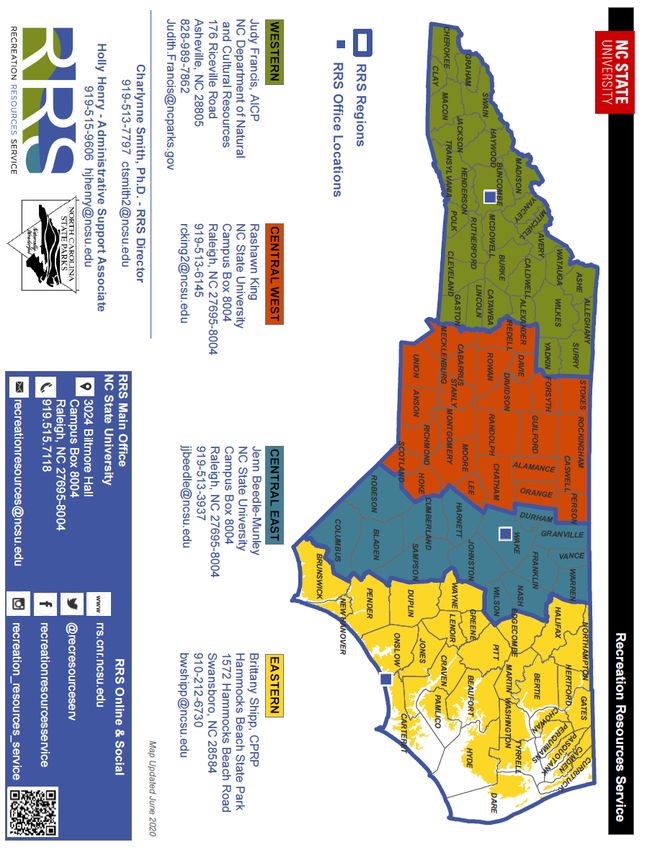
Table of Contents
                                                                                                                                            Page
2021-22 Local Government Grant Program Schedule .................................................................... 1
Requirements and Resources .......................................................................................................... 2
Assistance for Completing the Application ..................................................................................... 3
Advice for Grant Recipients ............................................................................................................. 4
Components of the Application
           Checklist to Submit a Complete Application ....................................................................... 5
           Basic Facts and Assurances ................................................................................................. 7
           Source of Matching Funds ................................................................................................... 8
           Project Timeline……………………………………………………………………………………………………………10
           Budget Narrative…………………………………………………………………………………………… ............... 12
           Federal Construction / Acquisition Programs Form (SF-424C) …………………………………….14
           Application and Revision (A&R Form) 2.0 Public Benefit……………….………………………………15
           Project Location Map ........................................................................................................ 16
           Site Plan / LWCF Map ........................................................................................................ 17
           Approval from the State Historical Preservation Office .................................................... 18
           Proof of Ownership / Site Control…………………………………………………………………………… ..... 19
           Application and Revision (A&R Form) 2.2 Development and Combination Grants…….….20
           Application and Revision (A&R Form) 3.0 Site Information……………………………………………21
           Land Acquisition Requirements......................................................................................... 26
                 Property Values and Requirements for Appraisals ..................................................... 26
                 List of Properties to be Acquired ................................................................................ 27
                 Legal Description of the Land ...................................................................................... 28
                 Application and Revision (A&R Form) 2.1 (Acquisition and Combination grants)...... 29
Scoring System............................................................................................................................... 31
Definitions ..................................................................................................................................... 38

Recreation Resources Service: Offices and Staff……………………………………………………………………….45

                                                                       i
Land and Water Conservation Fund
                      2021 Local Government Grant Program Schedule
Federal Land and Water Conservation Fund (LWCF) grants will be available in North Carolina in 2021 for local
park and recreation projects. Cities, towns, and counties as well as federally recognized Native American
tribes are eligible to apply for the matching grants. LWCF supports the protection of public lands and waters
– including local, state, and national parks and recreation areas. A key feature of the program is that all LWCF
assisted areas must be maintained and open, in perpetuity, as public outdoor recreation areas. The program
is administered through the Division of Parks and Recreation (DPR) within the Department of Natural and
Cultural Resources (DNCR) in North Carolina.

The matching grants can be used to acquire new park properties or renovate/replace outdoor recreation
facilities and other amenities at existing parks. Local governments can request a maximum of $500,000 with
each application and must match the grant dollar for dollar or greater.
                                                    Schedule
                                                          Announcement
     March 2021         DPR informs local governments about the availability of LWCF matching grants and
                        how to apply. Electronic copies of the application are available at the DPR website.

                                                     Application Workshop
    Wednesday,
  March 31, 2021        DPR staff conducts a workshop for local governments to explain the application
 (9:30 a.m. – 12:30     process and requirements. The workshop will be streamed live and recorded via
        p.m.)           WebEx.
                        To attend: Join here. Attendance is strongly recommended but not required.
                                                       Application Deadline
       Friday
                        Applications must be delivered by 5 p.m. or postmarked before midnight. Late
     Oct 1, 2021
                        submissions will not be accepted.

                                                  Funding Recommendations
   December 2021
                        DPR will recommend grant recipients to the National Park Service.

     Spring 2022        Grant recipients are announced.

                                    Where to submit the application
                         Via Mail:                                          In person drop-off:
                  Attn: Grants and Outreach                             Attn: Grants and Outreach
              NC Division of Parks and Recreation                   NC Division of Parks and Recreation
                   1615 Mail Service Center                               Administrative Offices
                   Raleigh, NC 27699-1615                                Nature Research Center
                                                                                 2nd Floor
      Must be postmarked with tracking before midnight                      121 West Jones St.,
                     October 1, 2021.                                        Raleigh, NC 27603
                                                                       Office Hours: 9 a.m. – 5 p.m.

                                                       1
Requirements and Resources
Program Summary
When a new LWCF grant is used to renovate or
● Eligible Projects: LWCF grants can be used to replace recreation facilities at an existing LWCF
acquire land for a public park or renovate/replace site, all the land within the current park
outdoor recreational or support facilities at boundaries will be included in the updated LWCF
existing park sites. A project must be located on boundaries.
a single park site.
● Indoor Recreation Facilities: LWCF does not
● Eligible Applicants: North Carolina counties and permit indoor recreation facilities to be
incorporated municipalities are eligible to apply developed on the project site unless they will
for LWCF assistance. Federally recognized Native enhance public outdoor recreation. Gymnasiums,
American tribes are eligible as local governments. community centers or similar buildings are not
Co-sponsored applications are not eligible. permitted without NPS approval.
● LWCF Requirements: All LWCF regulations, like
If an applicant is out of compliance with LWCF
the ones noted above, will apply to the project
requirements, the National Park Service (NPS)
sites selected for an LWCF grant. For a complete
may allow a local government to apply if it has
summary, please refer to the LWCF manual.
made substantial progress toward an approved
remedy. ● Incomplete and ineligible applications will not be
considered for funding. Only information
● Maximum Request: Applicants can request a received or postmarked by October 1, 2021 will be
maximum of $500,000 with each application. accepted. Mailed applications must include a
tracking number. In cases where all financial
● Local Match: An applicant must match the grant calculations submitted in the application do not
at least dollar for dollar. correctly total, the National Park Service may
declare the application ineligible.
● Public Use: Park areas and facilities must be open
and accessible to the public with no restrictions ● Application Checklist: The documents required
such as membership. Property acquired with for a complete application are listed on page 5.
LWCF assistance must be restricted forever for ● Selecting Recipients: All applications will be
public outdoor recreational use only. evaluated and ranked according to the Local Open
Project Selection Process (OPSP). The ranked list
Facilities renovated/replaced with an LWCF grant, will be submitted to the NPS for review and
as well as the park site where they are located, are approval. No partially funded projects will be
to be used for public recreation forever. awarded.
Properties acquired with LWCF funds must be
developed for public recreation within three ● Future Road Improvements: Review the N.C.
years of the project closing. Department of Transportation planned road
improvements to determine if any planned
● LWCF Boundaries: All parks that are acquired or construction projects might impact proposed
renovated with LWCF assistance are subject to LWCF boundaries for the park.
LWCF restrictions. For a local park, all the land
• A local government may submit multiple
within the park boundaries is included. These
applications.
boundaries are known as LWCF boundaries.
● LWCF Website: This application, a list of existing
● New LWCF Grants Update LWCF Boundaries: LWCF-assisted local parks, and other resources
Many existing LWCF grants were awarded for local governments are available on the DPR
decades ago. These parks may have been website.
subsequently enlarged with additional property.
2Application Assistance Planning Facilities for Public Recreation
● Your proposed LWCF project should be the result of ● Making Facilities Accessible: All facilities funded by
a planning process that reflects the public’s LWCF must comply with the Americans with
preferences. Read the entire application and Disabilities Act Accessibility Guidelines (ADAAG).
understand how each application is evaluated. Applicants are encouraged to include the costs of
Start early to assemble all items on the checklist for access routes to the accessible facilities in the grant
submitting a complete application. application. For design guidelines, go to:
● DPR provides technical assistance to local ADA Standards - index
governments through a contract with Recreation
About ADA Standards
Resources Service (RRS) at N.C. State University.
Guidelines for Recreation Facilities
Contact your regional consultant to discuss the
LWCF project you are proposing.
● Universal Design: can further enhance the
usefulness to all park users. Please refer to
● Attend the workshop to learn about the LWCF
application. The workshop will be held via webinar guidance provided in Universal Design in Public
at 9:30 a.m. on Wednesday, March 31, 2021 To Park Settings.
attend, join here. ● Playground Safety Guidelines: All applicants are
encouraged to adhere to the guidelines established
● Complete the application by September 1, 2021 by the U.S. Consumer Product Safety Commission’s
and contact your RRS regional consultant for a (CPSC) Handbook for Public Playground Safety
technical review to ensure that your application is (publication #325).
complete.
• Place Utility Lines Underground: All utility lines
• Ratio of Grant Funds to Total Project Cost: DPR funded with a grant from LWCF must be placed
recommends local governments request LWCF underground.
funds to be 50 percent of the total cost of the
project. For example, if the total cost of the project • Wetlands: The Regulatory Division of the U.S. Army
is $430,500, the LWCF grant request would be Corps of Engineers can assist in identifying wetlands.
$215,250. Local matching funds would also be Contact them as early as possible.
$215,250.
● Floodplains: The Federal Emergency Management
Please refer to the federal form SF-424C (page 14) Agency (FEMA) floodplain map contains current
to see how the percentage of federal funds is information for North Carolina. The permitting
indicated. The federal share of the total project process before construction of facilities will
costs is entered on line 17 of the form. determine the applicable storm water
requirements for the project.
● Appraisals: All land acquisition projects, including
donations, must be appraised using the Uniform ● Cultural Resources: The State Historic Preservation
Appraisal Standards for Federal Land Acquisition Office can assist in identifying historical and
(Yellow Book). The completed appraisal must archaeological resources.
accompany the application. Acquisition projects
submitted without a Yellow Book appraisal will be ● School properties: Projects involving school
declared ineligible by the National Park Service. systems are not eligible.
● Co-sponsored Applications are not eligible.
3DOT, FERC & FEMA Permitting for Facilities
● If your project includes a bridge or other facility that • When to Start: To receive LWCF grant funds, a
requires a Department of Transportation (DOT), grantee must sign a contract before beginning. There
Federal Energy Regulatory Commission (FERC), or are two exceptions. DPR can request a waiver of
Federal Emergency Management Agency (FEMA) retroactivity from the NPS for land acquisition. If the
permit, it is strongly recommended that the local waiver is approved, a local government can acquire
government obtain the approved permit before the land before a grant is approved (page 26). Some
applying for an LWCF grant. The permit process can planning costs can be incurred before applying (page
be lengthy and cause delays that prevent a grant 10).
recipient from completing a park project on time.
● Budget Narrative submitted in the application will
be part of the contract, serve as the budget for the
Submitting Your Application project and the basis for reimbursement (page 12).
• To submit your LWCF application, please send one ● Reimbursements: LWCF grants are paid as
complete paper copy of the application and reimbursements of documented expenses.
accompanying digital PDF copies on a flash drive. Grantees may submit requests for reimbursement
(checklist on page 5). on a quarterly basis. The LWCF program will
reimburse grantees for up to 50 percent of their
• Only complete application packets postmarked or expenditures for the project.
received by October 1, 2021 will be accepted.
● Audits and Inspections: LWCF staff will conduct
Advice for Grant Recipients periodic site inspections of each project to inspect
the progress as well as the financial records. All
● Signing the Contract: Grant recipients are grantees must maintain accounting records for the
announced according to the schedule shown on project that are supported by documentation such
page 1. A grantee signs a contract that describes as invoices and contracts.
the project and the conditions for receiving a LWCF
grant. This is a legally binding agreement between ● Completing the LWCF Project: A local government
the local government and the State of North has three years to complete a LWCF project, as
Carolina. specified in the contract.
4Use this checklist to ensure that all required documents are included with your application. Your application must include
a paper copy and a digital copy. Keep a copy of the application for your files. Digital files will be accepted only on a flash
drive and must be in PDF format. The flash drive must accompany the paper copy per the table below. Create a digital
file for each item on the checklist that you are submitting using the file name shown.
Applicant: ___________________________ Project’s Title: _________________________
Checklist to Submit a Complete Application
Number of Copies
Page Included
Required for All Applications (File Name)
Reference Paper Digital ✓
1. Checklist for Submitting a Complete Application (Checklist) 5 1
2. Applicant’s Basic Facts and Assurances (Basic Facts) 7 1
Submit one flash drive including each file as a separate PDF. Use the (file name) denoted on the checklist.
Risk Assessment and Financial Information
3. Source of Matching Funds (Matching funds) 8 1
4. Project Timeline (Timeline) 10 1
5. Budget Narrative (Budget Narrative) 12 1
6. Federal Information for Construction and Acquisition Programs (SF424C) 14 1
Project Description
7. Application & Revision Form – Public Benefit (A&R 2.0) 15 1
8. Project Location Map (Project Location) 16 1
9. Project Site Plan and LWCF Boundary Map (LWCF Boundary) 17 1
10. Review Letter from State Historical Preservation Office (SHPO Letter) 18 1
11. Proof of Ownership/Site Control (Ownership) 19 1
12. A & R Form - Development and Combination Grants (A&R 2.2) 20 1
13. A & R Form - Site Information (A&R 3.0) 21 1
14. Scoring System (Scoring System) 31 1
Required for Projects to Acquire Property (including acquisition with a waiver)
15. Acquisition Form (Acquisition Form) 27 1
16. Appraisal conforming to the Uniform Appraisal Standard for Federal
26 1
Land Acquisition (Yellow Book Appraisal)
17. Legal Description of the Land (Land Description) 28 1
18. History of Conveyance (Conveyance) 26 If applicable, 1
19. A & R Form - Acquisition Grants (A&R 2.1) 29 1
Checklist continues next page
5(Checklist continued)
Documents for the Scoring System
20. Master Plan for the Park (Master Plan) 32 & 39 If available, 1
21. Parks and Recreation Systemwide Plan for the Jurisdiction (Comp Plan) 32 & 40 If available, 1
22. Capital Improvement Plan for Parks and Recreation (CIP) 33 & 40 If available, 1
23. Documentation of Surveys or Public Involvement
33 & 41 If available, 1
(Public Meeting), (Survey), (Civic Groups), (Advisory Board)
24. Local Board Minutes or Resolution Adopting of Planning Documents 32-33 If available, 1
6Basic Facts and Assurances
Local Government Name:
Federal Employer Tax I.D. Number:
Mailing Address
Street or PO Box:
City: State: NC Zip Code: County:
Local Government Contact Person for the Grant Local Government Manager (required)
Name: Name:
Phone: Phone:
E-mail: E-mail:
(must be an employee of the sponsoring local government)
Project Name:
Physical Address of Project County:
Street:
City: State: NC U.S. Congressional District:
Lat / Long Coordinates:
Type of project: Check all that apply
Acquisition Renovation of an existing park site
Project number(s) of existing LWCF site (if applicable):
Acres to be acquired _______________ _______________________________
Grant Request: $ Local Match: $ Total Cost: $
Federal share (percentage): _____________% Please note: Local expenditures will be reimbursed
Grant request divided by total cost up to this percentage.
Certification and Approval by Local Governing Board
I hereby certify the information contained in the attached application is true and correct and the required dollar-for-dollar (or greater)
matching funds will be available during the project period. This application has been approved by the local governing board.
Chief Elected Official
(Print or Type Name and Title) (Signature)
7Source of Matching Funds
Use the format below to show the sources of your matching funds. Please indicate if these funds are
currently available or are the funds yet to be approved. If funds are yet to be approved, list the date for
approval. Full land donations are eligible as matching funds. Partial donations (bargain sale) are not eligible as match.
Example Source of Matching Funds
Amount of
State match Description of funding source Description of funding availability
match
An application for this project was
North Carolina Parks This is a state grant that funds local
submitted in May of this year. The
and Recreation Trust park capital and land development $100,000
grant was awarded in August of
Fund (PARTF) projects
this year and is available now.
This is a state grant that funds land
acquisition and water improvement A land acquisition project was
North Carolina Land
projects. The NCLWF permits a very submitted for this site last year and
and Water Fund $25,000
limited number of types of outdoor was awarded. Money is available
(NCLWF)
recreation, which aligns with our now.
future needs
Local match
The town plans for land acquisition Half of these funds are available
Town’s CIP and development needs in 5-year now. The other half will be $200,000
periods. available next fiscal year.
Other
A private citizen bequeathed funds
The funds will be available as soon
Private donation or property to develop a park to $100,000
as needed.
the town.
The group has raised funds over
Local park support group has raised
the past three years. They will
Local fundraising $50,000
funds for local parks. transfer the funds to the town
when the grant is awarded.
Total match $475,000
Most federal funds cannot be used to match LWCF grant funds.
Exceptions: Recreational Trails Program (https://www.fhwa.dot.gov/safetealu/factsheets.htm) and Community
Development Block Grants (https://www.hud.gov/program_offices/comm_planning/cdbg)
In the case that an anticipated funding source does not materialize, the local government will be expected to cover
this portion of the match.
8Source of Matching Funds (this form and format must be used)
Use the format below to show the sources of your matching funds. Please indicate if these funds are currently
available or are the funds yet to be approved. If funds are yet to be approved, list the date for approval. The
value of the donated property is not eligible as local matching funds.
State match Description of Funding Source Description of funding availability Amount of match
Local match
Other
Total match
Most federal funds cannot be used to match LWCF grant funds.
Exceptions: Recreational Trails Program (https://www.fhwa.dot.gov/safetealu/factsheets.htm) and Community
Development Block Grants (https://www.hud.gov/program_offices/comm_planning/cdbg)
If an anticipated funding source does not materialize, the local government will be expected to cover this portion of the
match.
9Project Timeline - Example
Please provide your projected timeline
All elements noted in budget narrative must be addressed in the timeline.
Completed Completed Completed
6 months after 1 year after 2 years after Completed during
Already in progress* contract start date contract start date contract start date 3rd year of contract
Project planning began Award bid All demolition Bocce court Parking lot
February 2020 Land Acquisition - Site prep Picnic shelter w/ Lighting
(list the start date of all parcels Retaining wall restroom
pre-award expenses) Playground
*Only planning can take place prior to the project contract start date, without additional approval from NPS.
These costs are eligible if they are incurred after October 1, 2019 (two years before the application deadline) and before
the end date for the LWCF contract. Include these costs in the Budget Narrative and keep copies of the invoices to
submit for reimbursement. The following costs are eligible: architectural and engineering fees, site plans, design and
construction drawings, construction management, and preparing project costs.
Provide notes as needed:
If project contracting is delayed, a land acquisition waiver may be needed as owner of parcel 075385893, as part of
the land acquisition contract has required that the land transaction be closed before (insert date).
Previous experience with federal grants
Do you have recent experience completing similar projects with federal grant funding (LWCF or other)? If so, please
describe.
No recent LWCF funding, but in 2019 we successfully completed a project funded through the Recreation Trails
Program (U.S. Department of Transportation’s Federal Highway Administration) 8-months prior to grant end date.
No recent LWCF funding, but in 2019 we did successfully complete a project funded through months prior to grant
end date.
10Project Timeline
Please provide your projected timeline
All elements noted in budget narrative must be addressed in the timeline.
Completed
Completed Completed 2 years after
Already in 6 months after 1 year after contract contract start Completed within 3rd year
progress* contract start date start date date of contract
*Only planning can take place prior to the project contract start date, without additional approval from NPS.
These costs are eligible if they are incurred after October 1, 2019 (two years before the application deadline) and
before the end date for the LWCF contract. Include these costs in the Budget Narrative and keep copies of the
invoices to submit for reimbursement. The following costs are eligible: architectural and engineering fees, site plans,
design and construction drawings, construction management, and preparing project costs.
Provide notes as needed:
Experience with previous federal grants
Do you have recent experience completing similar projects with federal grant funding (LWCF or other)? If so, please
describe.
11Budget Narrative - Example
Administrative costs (Incidental land costs are not eligible for land acquisitions)
Element Unit Cost per unit Federal share Match share Total
Landscape General N/A $17,000 $17,000 $34,000
Architect
Land acquisition
Parcel #/PIN Acres Cost per acre Federal share Match share Total
075385893 12 $10,000 $60,000 $60,000 $120,000
075365425 1 $1,000 $500 $500 $1,000
Site preparation
Element Unit Cost per unit Federal share Match share Total
Grading 5,000 cubic feet $10 $25,000 $25,000 $50,000
Retaining wall 100 linear feet $200 $10,000 $10,000 $20,000
Demolition
Element Unit Cost per unit Federal share Match share Total
Playground Bulk $3,000 $1,500 $1,500 $3,000
removal
Basketball Bulk $2,000 $1,000 $1,000 $2,000
court
Renovation/replacement
Element Unit Cost per unit Federal share Match share Total
Playground 3 elements $30,000 $45,000 $45,000 $90,000
Bocce Court 2 courts $1,000 $1,000 $1,000 $2,000
Picnic shelter 400 square feet $150 $30,000 $30,000 $60,000
w/ restroom
Pave parking 20 spaces Bulk $10,000 $10,000 $20,000
lot
Miscellaneous
Element Unit Cost per unit Federal share Match share Total
Shelter lighting 4 $2,000 $4,000 $4,000 $8,000
Parking General N/A $10,250 $10,250 $20,500
lighting
Federal share Match share
total total Grand total
Totals
$215,250 $215,250 $430,500
Contingency not an eligible LWCF cost. Explain how the budget was developed:
A licensed engineer was used to provide the estimates on all development costs.
A federal Yellow Book appraisal was provided to determine the value of the property.
Total anticipated pre-award expenses: $34,000 (Landscape Architect Designs)
Describe project elements/costs that will improve site resiliency (i.e., response to threat of flood or climate change)
and facility longevity, if any:
12Budget Narrative
(This form and format must be used; lines can be inserted or added as needed)
Administrative Costs/ Pre-Award Costs (Incidental land costs are not eligible for land acquisitions)
Element Unit Cost per unit Federal share Match share Total
Land Acquisition
Parcel # Acres Cost per acre Federal share Match share Total
Site preparation
Element Unit Cost per unit Federal share Match share Total
New Facilities
Element Unit Cost per unit Federal share Match share Total
Demolition
Element Unit Cost per unit Federal share Match share Total
Renovation/replacement
Element Unit Cost per unit Federal share Match share Total
Miscellaneous
Element Unit Cost per unit Federal share Match share Total
Federal share total Match share total Grand total
Totals
Contingency not an eligible LWCF cost. Explain how the budget was developed:
Total anticipated pre-award expenses:
Describe project elements/costs that will improve site resiliency (i.e., response to threat of flood or climate change)
and facility longevity, if any:
13Federal Information for Construction/Acquisition Programs (SF-424C)
Please download, complete, and submit the federal “Budget information for construction programs” form
(SF-424C) using the following link: Grants.gov 424 Family. For the calculations to work correctly, the PDF
version of the form must be downloaded to a computer, then opened from the list of downloaded files. The
downloaded file name should appear as “SF424C_2_0-2.0.pdf”. This pdf file can be edited and saved.
Example: The sample SF-424C form presents how to correctly complete the form using the sample
Budget Narrative on page 12.
14Application and Revision Form 2.0 – Public Benefit
1. Describe both short- and long-term outdoor recreation benefits that will be achieved
because of this project.
2. Explain how this project fits as part of any other projects planned for this same site in
the next three years.
3. Describe the process that led to the development of this proposal and how the public
was involved.
15Project Location Map
Please provide one copy of an 8½" x 11" map showing the location of the proposed project. Include the
following items on the map:
• Title of the project
• The name of the road a visitor uses to get to the park entrance.
• The closest major road
• Legible street names
• North arrow
• Physical address (such as a street address)
• Latitude/longitude coordinates of the central point in the site
Sample: Project location map
Lineburger Park
632 Garrison Blvd.
Gastonia, NC
Latitude / Longitude:35°15'16.8"N / 81°10'19.7"W
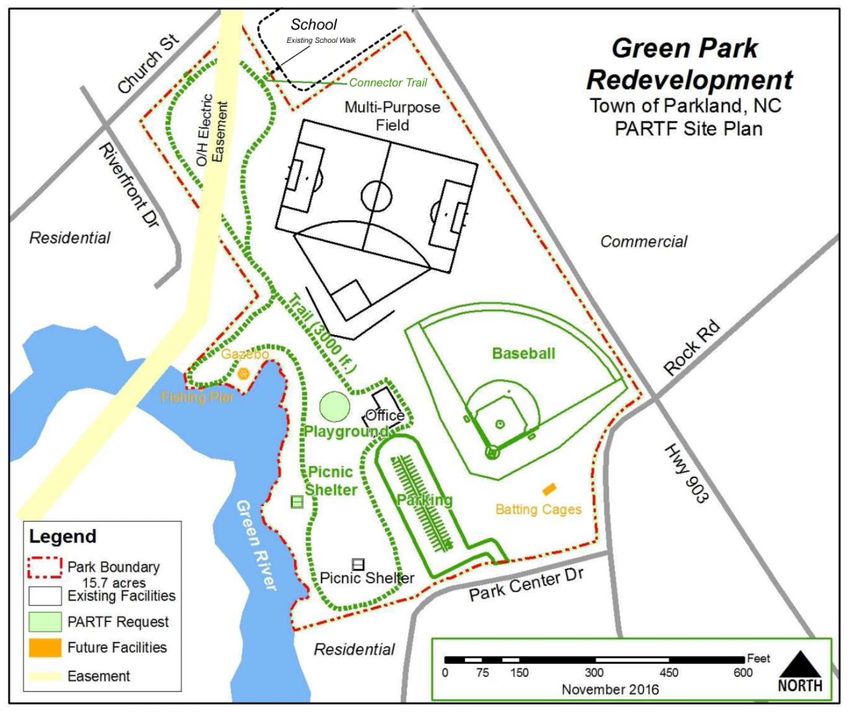
16Project Site Plan / LWCF Map (Example)
Use the example below as a guide for the site plan, including the listed items and color coding. A site plan is required
for every project. Development projects should denote in green the elements to be renovated/replaced. For land
acquisition only projects, a conceptual plan displaying proposed future development must be displayed in orange.
Include the following items and color codes on the site plan:
LWCF boundary:
15.7 acres
Renovation items
• Title: Name of project and applicant • Utility easements (power, sewer, and
• Acreage water lines): yellow
• Elements of the proposed LWCF project: light green. Include • Names of adjacent roads
land to be acquired, recreational & support facilities. • Ownership of adjacent property
• Known streams, lakes, and wetlands: blue • Deed reference
• Park boundaries: red for existing/ green for new land to be • Metes and bounds (not required)
acquired • Length of lease & expiration date (if
• Existing facilities: black and white applicable)
• On new property being acquired, denote in black and annotate, • Legend showing color coding
planned future indoor recreation facilities. • North arrow
• Number of acres that are/will be in the LWCF boundaries. • Date the map was prepared
LWCF boundary restrictions are presented below. • Scale
• Entrance and access roads to the site
• Future facilities: orange
LWCF Restrictions: Properties acquired, improved, or developed with LWCF assistance must be retained in perpetuity
for public outdoor recreation use. Grant recipients are required to place a restrictive clause in the deed of the park
which stipulates that the property is protected in perpetuity for public recreation use only. A LWCF boundary defines
the area being protected. If the land is used for other purposes, it must be replaced with property of equal value and
usefulness. LWCF refers to the section of the relevant section of the LWCF Act of 1965.
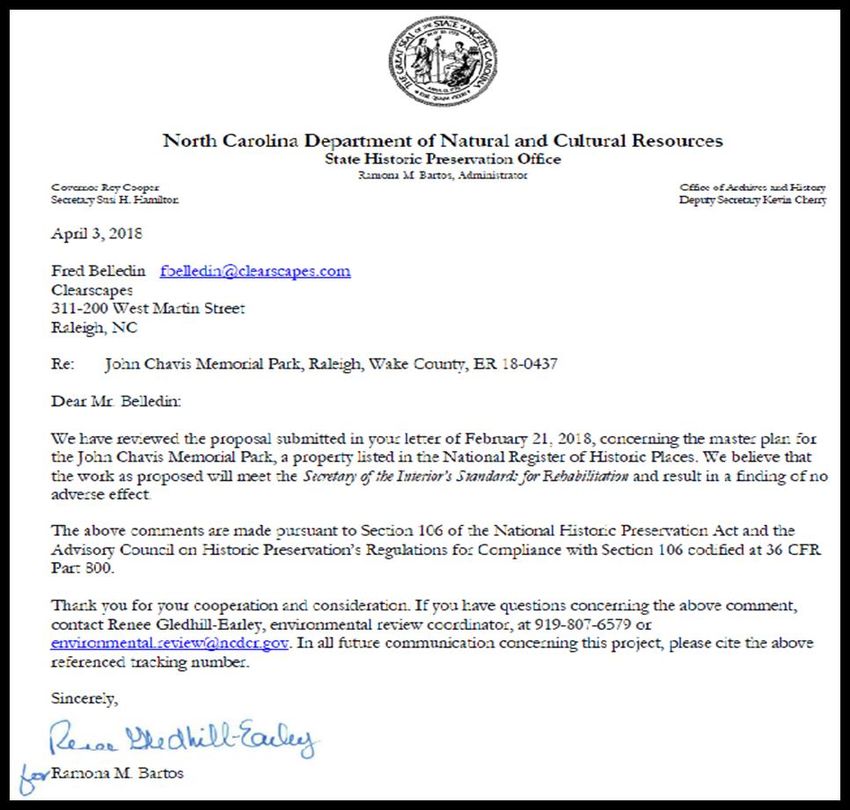
17Section: Approval from the State Historical Preservation Office (SHPO)
Please provide a letter of approval from the North Carolina State Historical Preservation Office declaring
that the site has been reviewed for adverse impacts.
Example:
18Proof of Ownership / Site Control
Local Government: ___________________ Project Name: ________________________________
Instructions: The local government must show that it has control of the entire site of a proposed
development project for providing public recreation by October 1, 2021. The project must be located on
a single contiguous site. Please contact your regional consultant about linear parks and greenways.
Important: The application can be declared ineligible without this certification.
Exception: This certification is not required for applications only proposing land acquisition or
applications proposing to acquire the site of a proposed development project.
1. TYPE OF SITE CONTROL: Indicate the type(s) of control the applicant has for the project site.
TYPE OF CONTROL Check all that apply Provide copies of deed(s), lease(s), or easement(s)
Entire Site.
Fee Simple Title All deeds are provided (PDF and hardcopy)
Portion of site
Entire Site.
Lease All leases are provided (PDF and hardcopy)
(25 years or longer) Portion of site
Entire Site.
Easement All easements are provided (PDF and hardcopy)
Portion of site
2. LIMITATIONS, CONDITIONS OR ENCUMBRANCES:
No limitations, conditions, or encumbrances
a) For property owned or to be owned by the local government, describe all easements or encumbrances.
b) Describe any conditions or limitations in current or proposed leases, easements or use agreements.
Include restrictions on the local government’s use of the site or the rights to be reserved by the
landowner that may impact the local government’s ability to complete the project in a timely
manner and/ or provide for public recreational use for at least 25 years.
Attach additional pages if needed.
19Application and Revision Form 2.2 - Development and Combination Grants
All elements noted in budget narrative must be addressed on A&R Form 2.2. Attach additional pages as needed.
A. Grant elements
1. What new facilities will be constructed as part of this project?
2. What existing facilities will be renovated or replaced (specify which) as part of this project?
3. What general site improvements (e.g., demolition, site preparation, landscaping, habitat
improvements, etc.) will be completed as part of this project?
4. What is the anticipated life span of the facilities that will be funded as part of this project?
5. Does the project scope include facilities that also eligible for Dingell-Johnson or Wallop-Breaux
Act funding (i.e., boat/fish access)?
a. ☐ No
b. ☐ Yes – Ensure necessary SLO certification is included (see manual)
6. Does this project involve the new development of a sheltered/enclosed swimming pool or ice-
skating rink or the sheltering/enclosure of an existing outdoor pool or rink?
a. ☐ No
b. ☐ Yes
i. Explain how it was determined that the site meets the cold climatic criteria
described in the LWCF manual. Provide a copy of the cold climatic data used to
make the eligibility determination with the application (see manual).
ii. Explain the nature of the project – is this a new sheltered facility, or
construction of the shelter only? If the pool or ice rink already exists, was it
LWCF-funded? If yes, what year was it built and how much LWCF assistance was
provided?
iii. What is the total cost of the sheltered facility and what amount of grant funding
will be spent on the actual shelter/enclosure structure itself (if any)?
iv. Explain the significantly increased public use that will be made possible by the
shelter/enclosure to justify the construction of such a facility.
B. Design elements
1. How are access requirements under the Americans with Disabilities Act (ADA) and Architectural
Barriers Act (ABA) being addressed in this project?
2. What design elements are included that contribute to preserving environmental resources as
part of ensuring a quality outdoor recreation experience for present and future generations?
20Application and Revision Form 3.0 – Site Information
Attach additional pages as needed.
A. Basic information
1. Will this proposal create a new public park/recreation area where none previously existed?
a. ☐ No
b. ☐ Yes – Explain:
2. If this is an existing LWCF site, has the park name changed since the last grant?
a. ☐ No
b. ☐ Yes – Explain:
3. Is this project located in a floodplain?
a. ☐ No
b. ☐ Yes – Explain and confirm that you have met applicable federal insurance requirements.
4. Is your site contiguous with or connected to any federally owned recreation area?
a. ☐ No
b. ☐ Yes – Explain:
5. Is your site part of a larger management area, such as a greenway or regional recreation area?
a. ☐ No
b. ☐ Yes – Explain:
6. Describe the existing site conditions.
7. Explain why the site is suitable for the type of outdoor recreation proposal being submitted.
8. Does the site include any elements that visually detract from the outdoor recreation experience or that
represent a potential public safety hazard?
a. ☐ No
b. ☐ Yes – Explain and describe whether this project will help to address those concerns.
9. What is/will be the applicant’s type of ownership and control of the property?
a. ☐ Fee simple ownership.
b. ☐ Less than fee simple. Explain what rights the applicant has and what agency holds the
underlying fee simple ownership.
c. ☐ Lease. Include a copy of the lease with the application.
21B. Stewardship considerations
1. Is this a multi-use site (i.e. school, reservoir, state forest, etc.)?
a. ☐ No
b. ☐ Yes – Explain:
i. How often will the public have recreation access to the site?
ii. What kinds of restrictions to public outdoor recreation will occur?
2. Who will manage and operate the site(s)?
3. Describe the nature of any rights-of-way, easements, reversionary interests, etc. within the proposed
LWCF boundary area:
4. Are there any pre-existing or planned indoor facilities on site that would not themselves be eligible for
LWCF grant funding?
a. ☐ No
b. ☐ Yes – Describe and explain how/if the structure(s) support public outdoor recreation.
5. Is the proposed LWCF boundary the same as the boundary of the park/recreation area as it exists in its
totality?
a. ☐ Yes
b. ☐ No – Explain any area proposed for exclusion and why, and ensure it is clearly depicted on the
proposed LWCF boundary map.
6. Are there any pre-existing or planned resource management practices (i.e., timber management, grazing,
etc.)?
a. ☐ No
b. ☐ Yes – Describe the nature of the practice, the anticipated duration, and how the practice
supports outdoor recreation.
7. Are there any pre-existing or planned uses on site that are incompatible with LWCF requirements that
should be excluded from the LWCF boundary?
a. ☐ No
b. ☐ Yes – Describe the nature of the use and ensure it is clearly depicted on the proposed LWCF
boundary map. Clarify whether the future intent is for the area to become subject to LWCF once
the use is terminated, or if the intent is for the use to continue within the park in perpetuity.
22C. Environmental Resources Survey
Consultation with NPS regarding the NEPA pathway for a proposal should occur prior to the completion of this
section. If you have already determined that the proposal will require an EA or EIS, you may go directly to the
questions following Tables 1 and 2.
The tables below serve as a record of the environmental resources present at the site, whether the proposed action
is likely to have a significantly negative impact those resources, and whether further information is needed to
determine the potential impact. Review the listed resources and identify any resources that may be significantly
impacted by the action. The Environmental Resources Survey should be completed with professional input from
resource experts and in consultation with relevant local, state, tribal, and federal governments, as appropriate.
Table 1 – For each resource, use the check boxes to indicate if positive impacts or negative impacts are anticipated to
result from the action or if further information is needed to determine the potential impact.
+ indicates positive impacts are anticipated to result from the action
- indicates negative impacts are anticipated to result from the action
? indicates further information is needed to determine the potential impact
Site Name:
How will the project affect the following resources? + - ?
1 Air quality ☐ ☐ ☐
2 Circulation and transportation ☐ ☐ ☐
3 Climate ☐ ☐ ☐
4 Contamination or hazardous materials even if remediated ☐ ☐ ☐
Endangered species: (listed or proposed threatened or endangered)
5 ☐ ☐ ☐
including associated habitat
6 Environmental justice: minority and low-income populations ☐ ☐ ☐
7 Geological resources: soils, bedrock, slopes, streambeds, landforms, etc. ☐ ☐ ☐
8 Historic or cultural resources ☐ ☐ ☐
9 Invasive species ☐ ☐ ☐
10 Land use plans or policies from other agencies including tribes ☐ ☐ ☐
11 Lightscapes, especially night sky ☐ ☐ ☐
12 Migratory birds ☐ ☐ ☐
13 Recreation resources ☐ ☐ ☐
14 Socioeconomics: changes to tax base or competition with private sector ☐ ☐ ☐
15 Sound (noise impacts) ☐ ☐ ☐
Unique ecosystems, such as biosphere reserves, World Heritage sites, old
16 ☐ ☐ ☐
growth forests, etc.
17 Water quality and/or quantity ☐ ☐ ☐
18 Water: coastal barrier resources or coastal zones ☐ ☐ ☐
19 Water: marine and/or estuarine ☐ ☐ ☐
20 Water: stream flow characteristics ☐ ☐ ☐
21 Water: wetlands and floodplains ☐ ☐ ☐
22
Other important resources ☐ ☐ ☐
Explain:
23Table 2 – This is a list of mandatory impact criteria that preclude the use of a categorical exclusion. If you answer “yes” or
“?” for any of the mandatory criteria, you must develop an EA or EIS regardless of your answers in table 1.
Site Name:
Will your proposal: Y N ?
1 Have significant negative impacts on public health or safety? ☐ ☐ ☐
Have significant negative impacts on unique natural resource or geographic
characteristics such as historic or cultural resources; park, recreation, or refuge
lands; wilderness areas; wild or scenic rivers; national natural landmarks; sole or
2 principal drinking water aquifers; prime farmlands; wetlands; floodplains; ☐ ☐ ☐
national monuments; migratory birds; and other ecologically significant or
critical areas?
Have highly controversial environmental effects or involve unresolved conflicts
3 concerning alternative uses of available resources? ☐ ☐ ☐
Have highly uncertain and potentially significant environmental effects or
4 involve unique or unknown environmental risks? ☐ ☐ ☐
Establish a precedent for future action or represent a decision in principle about
5 future actions with potentially significant environmental effects? ☐ ☐ ☐
Have a direct relationship to other actions with individually insignificant but
6 ☐ ☐ ☐
cumulatively significant environmental effects?
Have significant adverse effects on properties listed or eligible for listing in the
7 National Register of Historic Places as determined by NPS? ☐ ☐ ☐
Have significant negative impacts to species listed, or proposed to be listed, on
8 the List of Endangered or Threatened Species or have significant impacts on ☐ ☐ ☐
designated critical habitat for these species?
Violate a federal law, or a state, local, or tribal law or requirement imposed for
9 ☐ ☐ ☐
the protection of the environment?
Have a disproportionately high and adverse effect on low income or minority
10 ☐ ☐ ☐
populations (EO 12898)?
Limit access to and ceremonial use of Indian sacred sites on federal lands by
11 Indian religious practitioners or significantly adversely affect the physical ☐ ☐ ☐
integrity of such sacred sites?
Contribute to the introduction, continued existence, or spread of noxious
weeds or nonnative invasive species known to occur in the area or actions that
12 ☐ ☐ ☐
may promote the introduction, growth, or expansion of the range of such
species?
1. Have there been any previous NEPA/SEPA documents that are relevant to this project or this
specific site?
a. ☐ No
b. ☐ Yes – Attach and summarize findings and include page number references below.
2. Explain any negative or unknown impacts identified in Table 1 of the Environmental Resources
Survey, or any boxes marked “yes” in Table 2 (mandatory criteria).
3. How was the information identified in the tables derived and what sources of data were used to
justify the impact selection?
244. Who contributed to filling out the Environmental Resources Survey (include name, title, agency)
and what qualifications do they have that provide the necessary resource expertise to determine
impact significance?
5. List all required federal, state, and local permits/approvals needed for the proposal and explain
their purpose and status.
Environmental Reviewers – Include name, title, agency, and field of expertise.
1.
2.
3.
Signature of LWCF applicant here: Date:
NEPA Pathway Recommendation
Attach documentation of NPS concurrence with the recommended NEPA Pathway.
☐ This proposal qualifies for a Categorical Exclusion (CE). List: __________
☐ This proposal requires an Environmental Assessment (EA), which is attached and has
been produced in accordance with the LWCF Manual.
☐ This proposal may require an Environmental Impact Statement (EIS).
D. Cultural and historic resources review
Have there been any previous cultural and/or historic resource surveys completed that included this
site within the area of potential effect that was assessed?
☐ No – Describe any construction planned because of this project that will extend beyond the
pre-existing disturbance area (including surface area and depth).
☐ Yes – Attach survey and summarize findings and include page number references below.
25Land Acquisition Requirements
Restricted for Public Recreation Use Only: Property acquired must be restricted for public outdoor
recreation in perpetuity. DPR staff will provide a copy of this restrictive language for projects that are
selected to receive a grant.
Items to Submit with the Application: Land Acquisition Only Projects
• List of properties to be acquired A local government proposing a land acquisition
only project must build recreational facilities
• The value of the property according to a
Uniform Appraisal Standards for Federal within three years at the site.
Land Acquisition (Yellow Book) appraisal.
• Legal description of the land such as a survey
or plat map Property Values and Appraisals
• History of conveyance for donated land. • All land acquisition projects must have an
(copies of deeds from last five years) appraisal conducted to the Uniform Appraisal
Standards for Federal Land Acquisition,
All the requirements for acquiring land by fee commonly called a Yellow Book appraisal.
simple title also apply to acquiring land by
• The completed appraisal(s) must be submitted
donation.
with the LWCF application.
When to Take Title of Land • The N.C. State Property Office will review the
appraisals and accept or decline the appraisal as
Grant recipients must sign a contract with the consistent with Yellow Book appraisal standards.
state before accepting title to land that will be
acquired as part of a LWCF grant, either by • Full land donations are eligible as matching
purchase or donation. funds. Partial donations (bargain sales) are not
eligible as match.
Is it Urgent? Request a Waiver
If necessary, a local government can request • Incidental costs of acquisition such as appraisals,
surveys, closing costs, and taxes are not eligible
permission to acquire land before receiving a
expenses for reimbursement.
grant. This request must be submitted and
approved prior to acquiring land. DPR staff will Conceptual Plans
consider a written request that identifies the
proposed site and explains why the property A local government proposing land acquisition
must be acquired early. If the request provides only must provide a conceptual site plan
this information, DPR will submit it to NPS for showing the proposed development using the
consideration. instructions listed under “Site Plan”.
If approved, a waiver is in effect for 12 months.
The local government must submit a LWCF
application to acquire the land before the waiver
expires (prior to application deadline if
necessary).
26List of Properties to be Acquired
Acquisition Form
Applicant
Title of Project
Parcel Estimated Value
Will the property be:
- Purchased Improvements
Proposed
- Donated1 Current for Public Park
Purchase
Owner Number Acreage Land Purposes2
Price
Totals:
Notes:
1. Full property donations, not bargain sales, can be used as matching funds..
2. Identify the value of each existing improvement that will be used or renovated/replaced for public
park purposes.
3. Describe how an existing facility(s) will be used for public recreation as part of the project in this
application in the space below the table.
(Example: Existing boat ramp on the property to be acquired will be used for a public boat ramp)
27Legal Description of Property to be Acquired
Applicants proposing to acquire property with a LWCF grant are required to submit a legal description of
the property. Legal descriptions include surveys, plat maps, tax maps or other maps that include metes
and bounds. A legal description is needed for all parcels included on the “List of Properties to be Acquired”
(page 27).
The legal description should be submitted on a single 8½" x 11" page or an 11" x 17" page. Include the
following items as shown on the sample below:
• Project title, acreage, north arrow, scale, date prepared
• Metes and bounds of the property
• Any easements or restrictions on the public use of the property
• Owner and/or uses of adjacent property
• Significant reference points such as state plane coordinates, benchmarks, iron stakes, major streets,
highway, or other landmarks
• Deed book number, page number, and date recorded
In addition to the legal description, applicants with acquisition only projects must submit a copy of a
conceptual plan showing the property to be acquired and future development for public recreation.
Instructions for the conceptual plan are combined with the “Site Plan” instructions on page 17.
Oak Leaf Park - Legal Description
28Application and Revision Form 2.1 – Acquisition and Combination Grants
A. Need
1. Why is this acquisition (whether attained via purchase or donation) needed?
2. Describe the existing resources and features of the site that make it desirable for public outdoor
recreation.
3. Explain how you envision this acquisition contributing to outdoor recreation in the long term.
B. Acquisition schedule & appraisal/waiver valuation certification
Reproduce table as needed for multiple parcels.
Parcel Name
Parcel Size
Parcel Value
Anticipated Acquisition Date
☐ A State-certified Review Appraiser has reviewed the appraisal and has determined that it
was prepared in conformity with the Uniform Appraisal Standards for Federal Land
Acquisitions
OR
☐ The State has prepared a waiver valuation for this property in conformity with 49 CFR
24.102(c)(2)(ii)
C. Property information
1. From whom is this property being purchased?
2. Are any buildings or structures being purchased along with the property?
a. ☐ No
b. ☐ Yes – Describe what is planned for those structures and whether the grant funded
project includes the value of those structures.
3. How will the site be made open and accessible for public outdoor recreation use (signage,
entries, parking, site improvements, allowable activities, etc.)?
294. When will access to the site for public outdoor recreation become available?
5. Describe development planned for the site(s) for the three (3) years following acquisition. As this
will impact NHPA and NEPA compliance, focus on what you reasonably expect to accomplish.
6. If development will be delayed by more than three years from grant close, explain why this
acquisition is still a priority for grant funding at this time and what ability the public will have to
use the site in the interim.
7. Is this acquisition an addition to an existing park or other recreation area?
a. ☐ No
b. ☐ Yes – How will it support and enhance that existing park?
D. Acquisition approach
1. Is this property being acquired under threat of condemnation?
b. ☐ No
c. ☐ Yes – Explain:
2. Was the property listed for public sale?
a. ☐ No
b. ☐ Yes – Explain how the property owner was made aware of the grant sponsor interest
in the property.
3. Does this project involve donated property?
a. ☐ No
b. ☐ Yes – Include evidence that the seller was offered the fair market value of the
property as just compensation and willingly chose to donate the property instead. (If the
donation is subject to a waiver of retroactivity the evidence must pre-date the
donation.)
30Scoring system
Points Awarded by Type of Project
Acquisition and
Renovating
Renovation of
Acquiring Land Recreation
Recreation
Facilities
Category Facilities
Planning 10 20 20
Public Involvement 15 15 15
Recreation Facilities 0 30 30
Land Acquisition 30 0 30
Operation and Maintenance 15 15 15
Clientele Served 0 5 5
Past LWCF per Capita Funding 10 10 10
Consistency with the
20 20 20
NC Outdoor Recreation Plan
Total Possible Points 100 115 145
Projects are rated on the percentage of points achieved out of the total possible by project type.
31LWCF Scoring System for Local Grants
Please provide all information requested for each item. Attach a separate page if more space is needed
to address any item. Before beginning, please refer to the Definitions Section (page 38 - 41). A team of
LWCF staff will evaluate each application based on the scoring system and make the final decision about
the applicant’s score.
Applicant:
Project:
A. Planning: (20 possible points)
1. Master Plan for the park and/or greenway system (10 points)
(Not applicable for projects proposing land acquisition only)
a. The applicant has a master plan created or revised within the past five years for the project site and
the project conforms to the plan.
Date the plan was produced: _______ (9 points)
or
b. The applicant has a master plan created or revised within the past six years to ten years for the project
site and the project conforms to the plan.
Date the plan was produced: _______ (4 points)
c. The local governing board has adopted the master plan.
Date the plan was adopted: __________ (1 point)
Documentation Required:
• One copy of the park master plan or greenway system plan.
• One copy of the local governing board’s meeting minutes or resolution as documentation of the
adoption or acceptance.
• List the page number(s) and tab or highlight where the project is referenced in the plan.
2. Comprehensive systemwide parks and recreation plan for the local government’s jurisdiction (7 points)
a. The applicant has a Comprehensive Systemwide Parks and Recreation Plan produced or revised in the
past 10 years and the project conforms to the plan.
Date the plan was produced: _________ (6 points)
b. The local governing board has adopted the systemwide plan.
Date the plan was adopted: __________ (1 point)
Documentation Required:
• One copy of the comprehensive systemwide parks and recreation plan.
• One copy of the local governing board’s meeting minutes or resolution as documentation of the
official adoption or acceptance.
• List the page number(s) and tab or highlight where the project is referenced in the plan.
323. Three-to-five-year capital improvement plan for parks and recreation (3 points)
The applicant has a three-to-five-year capital improvements plan for parks and recreation and the
project is identified in the plan.
Date the plan was adopted: ________ (3 points)
Documentation Required:
• One copy of the capital improvement plan.
• One copy of the local governing board’s meeting minutes or resolution documenting adoption of the
plan as a part of the local government’s budget process.
• List the page number(s) and tab or highlight where the project is referenced in the plan.
B. Level of public involvement in developing and supporting the project: (15 possible points)
1. Public meetings (5 points):
The applicant conducted a public meeting(s) exclusively for discussing the project and obtaining
comments. The public supported the project.
Date of the meeting(s): _________
Documentation Required:
• Provide a title page that gives the name of applicant, the name of the project and identifies the
document as “Public Meetings.”
• One copy of the newspaper advertisement or a document describing the other means used to widely
advertise the meeting.
• One copy of the minutes including the discussion of the project, who was present, and public
comments.
2. Recreational needs survey (5 points):
The results of a survey to determine the recreational needs in the applicant’s jurisdiction show that
the citizens support the project.
• The survey must have been conducted during the past ten years
• Please refer to page 41 for the required components of the survey
Documentation Required:
1. The following information about the survey
• Copy of the questionnaire
• Results of the survey
• Describe how the survey was distributed.
• Give the date(s) of distribution and the number of surveys distributed.
• Provide the number of respondents and demographic information that they are representative
of the local government’s jurisdiction.
• Describe how the results of the survey show that the citizens support the project.
2. Include a title page that gives the name of applicant, the name of the project and identifies the document
as “Survey of Recreational Needs.””
33You can also read


