Lifecycle Management Methodology - Version 2.2 3/9/2021 Final - Federal Student Aid
←
→
Page content transcription
If your browser does not render page correctly, please read the page content below
Lifecycle Management Methodology
         Version 2.2 ● 3/9/2021
                 Final
Lifecycle Management Methodology Revision History
Revision History
VERSION DATE AUTHOR DESCRIPTION
2.2 3/9/2021 LMM Operations Document reviewed for current content and minor
Team reference updates.
2.1 7/17/2019 LMM Operations Minor updates based on feedback from subject matter
Team experts and experience after first year under the 2.0
LMM.
• Changed acquisition term “re-compete” to
“competition.”
• Changed term “Operating Committee” to
“Executive Committee” throughout document.
• Added “FSA Investment, Program, and Project
Management Artifact Guidance” as a reference
document.
• Updated Governing Standards references to
current versions.
2.0 5/22/2018 LMM Tailoring Major re-write of methodology document based on FSA
Plan and enterprise-wide workgroup collaboration. Approach to
Process many components of the LMM were revised as a result of
Workgroup / this update.
LMM
Improvement
Initiative
1.4 9/30/2016 LMM Team Minor update which included the following items:
• Added guidance on incremental development
(FITARA requirement) to Initiative Vision and
Definition Stages;
• Added guidance on value engineering (OMB
Circular A-131 requirement) to Definition Stage;
• Removed “Lifecycle Management Methodology
Stage Gate Review Process Description”
document, LMM now relies on the individual
process description documents maintained for
each stage gate.
• Updated Subject Matter Expert (SME)
assignments on WBS Dictionary and Tailoring
Plan and other applicable LMM SME references.
Conforming changes were also made throughout the
LMM documentation set to address the items above.
1.3 6/30/2015 LMM Team Incremental release reflecting changes to update WBS
and WBS Dictionary and Tailoring Plan, for version 1.3.
1.2 6/15/2012 LMM Team Incremental release reflecting changes needed to be
consistent with version 1.2 including the updated WBS
and WBS Dictionary and Tailoring Plan, the LMM
Artifacts Summary and updated Library. Document was
also updated to reflect the new updated Master
Template. Includes minor 508 corrections.
1.1 10/28/2011 LMM Team Update release to include minor corrections,
synchronization with other documents, and 508
compliance (e.g., Alt Text).
Version: 2.2 2 3/9/2021Lifecycle Management Methodology Revision History
VERSION DATE AUTHOR DESCRIPTION
1.0 7/29/2011 LMM Team Initial version for publication to Intranet
Version: 2.2 3 3/9/2021Lifecycle Management Methodology Table of Contents
Table of Contents
SECTION 1. DOCUMENT INFORMATION ...................................................................................................................5
1.1. PURPOSE AND SCOPE ............................................................................................................................................5
1.2. INTENDED AUDIENCE .............................................................................................................................................6
1.3. REFERENCE DOCUMENTS ......................................................................................................................................7
1.4. GOVERNING STANDARDS .......................................................................................................................................7
SECTION 2. LIFECYCLE MANAGEMENT METHODOLOGY ......................................................................................9
2.1. ROLES AND RESPONSIBILITIES ................................................................................................................................9
2.2. METHODOLOGY APPROACH .................................................................................................................................. 11
2.2.1. Cross-Lifecycle Support Processes .......................................................................................................... 12
2.2.2. Initiative Vision Stage ............................................................................................................................... 13
2.2.3. Requirements Stage ................................................................................................................................. 14
2.2.4. Design Stage ............................................................................................................................................ 14
2.2.5. Development Stage .................................................................................................................................. 15
2.2.6. Testing Stage............................................................................................................................................ 15
2.2.7. Implementation Stage ............................................................................................................................... 15
2.2.8. Operations and Maintenance Stage ......................................................................................................... 15
2.2.9. Retirement Stage ...................................................................................................................................... 15
2.2.10. LMM SDLC Examples ............................................................................................................................ 15
SECTION 3. PROGRAM AND PROJECT MANAGEMENT ........................................................................................ 19
3.1. PROGRAM (IT INVESTMENT/SYSTEM) GUIDANCE .................................................................................................... 19
3.2. PROGRAM (COMPLEX PROJECTS) GUIDANCE ......................................................................................................... 20
3.3. PROJECT GUIDANCE ............................................................................................................................................ 20
3.4. MANAGEMENT STAGE GATE GUIDANCE ................................................................................................................. 20
SECTION 4. LMM TAILORING ................................................................................................................................... 22
4.1. LMM TAILORING PLAN GUIDANCE......................................................................................................................... 23
4.2. LMM TAILORING PLAN APPROVAL ........................................................................................................................ 24
APPENDIX A - ACRONYMS AND ABBREVIATIONS ................................................................................................ 25
APPENDIX B - GLOSSARY ........................................................................................................................................ 27
APPENDIX C - LMM TAILORING PLAN TEMPLATE ................................................................................................ 29
List of Tables
Table 1. Types of Work .................................................................................................................................................. 5
Table 2. Intended Audience ........................................................................................................................................... 6
Table 3. Reference Documents ..................................................................................................................................... 7
Table 4. Governing Standards ....................................................................................................................................... 7
Table 5. Roles and Responsibilities ............................................................................................................................... 9
Table 6. Cross-Lifecycle Support Processes ............................................................................................................... 13
Table 7. Acronyms and Abbreviations.......................................................................................................................... 25
Table 8. Glossary ......................................................................................................................................................... 27
List of Figures
Figure 1 LMM - Waterfall SDLC View .......................................................................................................................... 16
Figure 2 LMM - Agile SDLC View................................................................................................................................. 17
Figure 3 Program Diagram ........................................................................................................................................... 19
Figure 4 Complex Project Diagram .............................................................................................................................. 20
Figure 5 LMM in the Acqusition Process (Major/FISMA Reportable Information Systems).......................................... 23
Version: 2.2 4 3/9/2021Lifecycle Management Methodology Document Information
Section 1. Document Information
1.1. Purpose and Scope
The Lifecycle Management Methodology (LMM) is Federal Student Aid’s (FSA) Information Technology
(IT) project delivery and governance methodology. While the LMM is not a System Development Lifecycle
(SDLC), it does call for certain governance requirements regardless of which SDLC is applied. System
integrators and developers are expected to provide traceability of their unique SDLCs to the LMM and to
supplement this guidance with their own processes where appropriate. Refer to Section 4 LMM Tailoring
for additional information on which information systems are required to complete an LMM Tailoring Plan.
LMM’s approach to solution delivery consists of eight stages and may include stage gate reviews when
appropriate. The LMM stages include: Initiative Vision, Requirements, Design, Development, Testing,
Implementation, Operations and Maintenance, and Retirement. Depending on the size, scope and
complexity of the project, some stages may be conducted iteratively, conducted in parallel, and/or
combined for efficiency. The LMM allows for the development and delivery of solutions in smaller portions
within shorter periods of time. By involving appropriate stakeholders throughout the lifecycle, feedback is
incorporated early and often, which allows the development team to take advantage of lessons learned.
LMM Stage Gate Reviews are IT Governance processes to review risk associated with moving to the next
lifecycle stage, identify any corrective actions needed, and provide management with insight into areas
where changes to resources may be needed.
The LMM encourages solutions with evolving functionality/features and documentation, rather than a
large up-front investment of time and resources. LMM Guidance and Templates are available on a
SharePoint Site and are monitored by a librarian to keep information current and up-to-date. The LMM
Templates are used for many components of the SDLC; this minimizes the overall time and expense
spent on developing new documents from scratch and correcting out-of-date documentation. The LMM
does not reengineer existing processes, but rather provides FSA a methodology to align system
development, program/project management, and acquisition functions.
LMM SharePoint Site: https://fsa.share.ed.gov/lmm
The LMM applies to all IT projects, acquisitions, development, implementation, maintenance and disposal
of information systems within FSA regardless of cost, complexity and time constraints. It applies to all
FSA employees and contractors engaged in activities associated with an information system. Nothing in
this methodology excuses or exempts contractors from satisfying all requirements of their contracts.
There are a number of flexibilities built into the LMM, including which systems are required to complete a
system-specific LMM Tailoring Plan (see Section 4).
FSA defines an IT project as “A temporary IT endeavor undertaken to accomplish a unique set of
outcomes with a defined start and end point that, when attained, signify completion. Projects are
composed of activities undertaken for development, modernization, enhancement, disposal, or
maintenance of a new or existing IT system, program, or investment asset.”
Types of work may include:
Table 1. Types of Work
TYPE OF WORK DESCRIPTION
New Software / The first release or version of a system built from any combination of COTS,
Application GOTS and custom developed code. (e.g., This should be a v1.0 release)
Development
Software / Application A software release of an existing system consisting of new functionality,
Development interface changes, product changes, or any combination thereof. These
Upgrade changes are typically denoted by an increase to the version number to the left
or right of the decimal point (example: v1.3 to v1.4 or v2.0 to v3.0 )
Version: 2.2 5 3/9/2021Lifecycle Management Methodology Document Information
TYPE OF WORK DESCRIPTION
Software Bug A release of an existing system consisting of bug fixes, changes to static
Fix/Patch content, COTS component patches or any combination thereof. These
changes are typically denoted by an increase to the version number of the
rightmost decimal point (example: v1.3.1 to v1.3.2)
New COTS/non-ED The first introduction of a Commercial off the Shelf or Government off the Shelf
GOTS Installation product not developed by ED and not requiring custom developed code or
modifications beyond infrastructure integration and configuration tasks.
Products falling into this category include: Operating systems, applications,
and desktop or server tools. (e.g., Microsoft Windows XP, Microsoft
Exchange, Adobe Photoshop, etc.) The complexity level of the product will
determine the level of "Case Specific" items required.
COTS/ non-ED A COTS/GOTS product release consisting of new functionality, interface
GOTS Upgrade changes, product changes, or any combination thereof. These changes are
typically denoted by an increase to the version number to the left of the
decimal point (e.g., v1.3 to v2.0) for major releases, and to the right for minor
releases (example v1.4 to v1.5).
Infrastructure A change to core infrastructure, major system component configurations;
Change/Upgrade network, server, or storage topology; enterprise routing or switching; major
application or server operating systems; or facility location/configuration. This
includes any decommissioning and/or transitioning of data center assets, and
disaster recovery.
New Hardware New hardware unrelated to major system fielding or development. Examples
include: new storage, IDS equipment, voice over IP, audio/visual systems, and
peripheral devices beyond printers, scanners, and multi-function devices.
1.2. Intended Audience
The table below lists the intended users and the purpose for which they may utilize the information in this
document:
Table 2. Intended Audience
USERS USES
Business Owners Communicate the LMM expectations to the FSA organization.
Contracting Officer / To understand document expectations of the FSA organization as applied
Contracting Specialist to a particular information system acquisition.
Enterprise Change Control To understand document expectations for system and releases of the
Board (ECCB) system.
External Review/Audit To understand FSA’s plan for organizational level oversight of an
Entities information system.
Information System Communicate the LMM expectations to the FSA organization.
Owners
Information System To understand document expectations for system and releases of the
Security Officers (ISSO) system as it relates to information security.
and other Security
Personnel
LMM Operations Team To understand how the system will address various federal requirements
and documentation needs.
LMM Stage Gate Owners To understand how the system will address the LMM Management and
Technical Stage Gates.
Version: 2.2 6 3/9/2021Lifecycle Management Methodology Document Information
USERS USES
Organizational Review To understand document expectations for system and releases of the
Board (ORB) system.
Program and Project To understand documentation and governance requirements for
Managers programs and projects undertaken that will impact a system or systems.
System Support Personnel To understand document expectations for system and releases of the
system.
Technical Review Board To understand document expectations for system and releases of the
(TRB) system.
Business Owners Communicate the LMM expectations to the FSA organization.
1.3. Reference Documents
The following documents provide either governance or guidance for this document.
Table 3. Reference Documents
DOCUMENT TITLE
Requirements Review Stage Gate Process Guide
Design Stage Gate Review Process Description
Enterprise Test Management Standards (Test Readiness Review Stage Gate)
Production Readiness Review (PRR) Process Description
System Retirement and Disposal Guide
Management Stage Gate 1: Investment Review, Standard Operating Procedure
Management Stage Gate 2: Project Execution, Standard Operating Procedure
Management Stage Gate 3: Project Closeout, Standard Operating Procedure
FSA Enterprise Change Management Plan
Information Resource Program Elements (IRPE)
FSA Investment, Program, and Project Management Artifact Guidance
1.4. Governing Standards
The LMM supports the implementation of the following federal government requirements and standards.
Table 4. Governing Standards
DOCUMENT TITLE DOCUMENT
VERSION
Clinger-Cohen Act of 1996 (Public Law 104-106) 1996
E-Government Act of 2002 (Public Law 107-347) 2002
[FITARA] Title VIII of the National Defense Authorization Act for FY 2015 - 2014
Subtitle D "Federal Information Technology Acquisition Reform" (Public Law
113-291)
Government Performance and Results Act of 1993 (Public Law 103-62) 1993
GPRA Modernization Act of 2010 (Public Law 111-352) 2010
Privacy Act of 1974 (Public Law 93-579) 1974
Circular A-11 – Preparation, Submission and Execution of the Budget , OMB December 2020
Version: 2.2 7 3/9/2021Lifecycle Management Methodology Document Information
DOCUMENT TITLE DOCUMENT
VERSION
(Section 55 addresses Information Technology Investments)
Circular A-123 – Management’s Responsibility for Enterprise Risk Management July 15, 2016
and Internal Control, OMB
Circular A-130 – Managing Federal Information as a Strategic Resource, OMB July 28, 2016
Circular A-131 – Value Engineering, OMB December 26, 2013
M-15-14 - FITARA Implementation Guidance, OMB June 10, 2015
Federal Information Processing Standards (FIPS) 199 – Standards for Security February 2004
Categorization of Federal Information and Information Systems, NIST
Special Publication 800-18 Revision 1, Guide for Guide for Developing Security February 2006
Plans for Federal Information Systems, NIST
Special Publication 800-60, Guide for Mapping Types of Information and August 2008
Information Systems to Security Categories, NIST
Special Publication 800-37, Revision 2, Risk Management Framework for December 2018
Information Systems and Organizations: A System Life Cycle Approach for
Security and Privacy, NIST
Special Publication 800-53 Revision 5, Security and Privacy Controls for September 2020
Information Systems and Organizations, NIST
Special Publication 800-160 Volume 1, Systems Security Engineering: November 2016
Considerations for a Multidisciplinary Approach in the Engineering of (updated 3/21/2018)
Trustworthy Secure Systems, NIST
Lifecycle Management (LCM) Framework, ED OCIO, ACS OCIO: 1-016 May 26, 2017
Procuring Electronic and Information Technology (EIT) in Conformance with September 28, 2016
Section 508 of the Rehabilitation Act of 1973, ED OCIO, ACS Directive OCIO:3-
105
Software Asset Management Acquisition Policy, ACS Directive OCIO: 3-110 October 16, 2018
Version: 2.2 8 3/9/2021Lifecycle Management Methodology Lifecycle Management Methodology
Section 2. Lifecycle Management Methodology
2.1. Roles and Responsibilities
The table below describes the roles in the LMM and provides a summary-level description of how that
role participates in supporting the LMM.
Table 5. Roles and Responsibilities
ROLE LMM PARTICIPATION / RESPONSIBILITIES
Business Owner FSA Official charged with management responsibility for the business
functions and processes that are supported by an information system.
The Business Owner is responsible for defining business needs and
business requirements.
Contracting Officer (CO) FSA Official that creates or manages the contract for an information
system or other IT Project. The CO is responsible to ensure that correct
contract clauses relating to the LMM and IRPE are included in contracts.
Contracting Officer’s Individual that supports the Contracting Officer and Program/Project
Representative (COR) Manager in developing and managing the contract. The COR monitors
deliverables and assists both government staff and contractors in
ensuring that correct templates and standards from the LMM are applied
as specified by the contract.
Department of Education, ED agency official (office) charged with management responsibility for
Office of the Chief information systems. ED OCIO participates as part of FSA’s Investment
Information Officer (ED Review Board and performs oversight of FSA’s information systems.
OCIO)
FSA Chief Information FSA Official charged with management responsibility for FSA’s
Officer (FSA CIO) information systems and leadership of FSA’s Technology Office. This
includes responsibilities for security authorization, investment
management, architectural oversight, and other delegated authority from
ED OCIO.
Enterprise Quality Technology Office Team charged with the management and
Assurance Team, coordination of support to the technology components of the LMM. This
Technology Office (QA) team is also responsible for maintenance of the LMM SharePoint site
available to the FSA organization.
Information System Owner FSA Official responsible for the day-to-day operations of an information
system and ensures implementation of LMM processes, practices, and
procedures within the work-activities of the staff supporting the system.
Information System Individual(s) assigned formal responsibility for supporting and advising
Security Officer (ISSO) the Information System Owner in regards to security aspects of an
information system. Also supports implementation of LMM processes,
practices, and procedures within the work-activities related to
information security.
Integrated Project Team Team that is charged with delivery of a project or release of an
(IPT) information system. Typically an IPT includes the Information System
Owner, Business Owner, Business Analyst, ISSO, System Support
Personnel, Project Manager, COR, and contractor staff. In some
situations, FSA may refer to the IPT as a “cross functional team.” The
IPT does not include LMM SMEs, Stage Gate Owners, the LMM
Operations Team and other oversight functions.
LMM Operations Team Provides overall coordination and management for the LMM across the
organization. Responsible for maintaining LMM documentation set
(Methodology Document, Tailoring Plan Template, etc.).
Version: 2.2 9 3/9/2021Lifecycle Management Methodology Lifecycle Management Methodology
ROLE LMM PARTICIPATION / RESPONSIBILITIES
Other Related Boards Standing boards within the FSA organization support the LMM and
associated processes. Section 1.4 Reference Documents includes
references to documents that provide more information on the roles and
responsibilities of these boards. The boards that either directly or
indirectly support the LMM include but are not limited to:
• Contract Review Board (CRB)
• Enterprise Change Control Board (ECCB)
• Investment Management Board (IMB)
• Investment Review Board (IRB)
• Organizational Review Board (ORB)
• Organizational Unit Change Management Boards
• Risk Management Council (RMC)
• System Change Control Boards (CCB)
Technical Review Board (TRB)
Program Manager Responsible for managing the business case for an information system
and the planning/sequencing of projects for an information system. A
program manager may be put in place temporarily to manage a complex
project comprised of multiple smaller projects.
Project Manager Responsible for managing all aspects of the project, reporting on project
progress, and overall project objectives.
Project Management and Performance Management Office group that is charged with the overall
Oversight Group, PMO, management of the LMM as well as the coordination of the investment
Performance Management management, program management, and project management
components of the LMM.
Stage Gate Owner Individual or team responsible for managing an LMM stage gate;
including maintenance of a process document for the stage gate and
oversight of stage gate activities (may include conducting stage gate
themselves or oversight of delegated stage gate duties).
Subject Matter Expert Individual or team responsible for maintenance of an LMM process or
(SME) document template.
System Support Personnel Provide support activities for the information system and utilize various
aspects of LMM processes, practices, and procedures in their work-
activities. Typical roles include, but are not limited to, business analysts,
requirements subject matter experts, software developers, and testers.
Version: 2.2 10 3/9/2021Lifecycle Management Methodology Lifecycle Management Methodology
2.2. Methodology Approach
The Lifecycle Management Methodology (LMM) is composed of eight stages, a set of cross-lifecycle
support processes, three management stage gates, and five technical stage gates. The following bullets
describe the LMM Stages and the LMM Stage Gates at a high level; the sequencing of these activities will
differ depending on the system development life cycle (SDLC) used by each information system and the
actual phase of life the system is in (for example, initial startup and deployment versus operation and
maintenance). The approach used by an information system in steady-state operations may differ
substantially from the approach used to develop a new information system.
FSA maintains a number of support processes that occur throughout the lifecycle and are adjusted to
work with each type of SDLC (waterfall, iterative, agile/Scrum, etc.). Both system personnel and FSA
Enterprise-level groups support these processes. The system personnel perform actions to implement
releases (or projects) while Enterprise-level groups provide templates, process development and ongoing
coaching activities, and a level of oversight. These processes include:
• Investment Management
• Program Management
• Project Management
• Quality Assurance
• Information Security
• Contracts/Acquisitions
• Enterprise Change Management
• System Configuration Management
The following LMM Stages and LMM Stage Gates are not listed in a strict sequence but provide an
outline of activities to be considered and accounted for during the life of an information system.
1. Initiative Vision – Activities needed to plan for an information system program/project, including
high-level evaluation of business needs and processes to align with major technology choices.
a. Management Stage Gate 1: Investment Review
b. Management Stage Gate 2: Project Execution
2. Requirements – Activities needed to create and manage detailed system requirements. This may
include a complete requirements definition for a system, management/grooming of a requirements
backlog, or other requirements management approach.
a. Technical Stage Gate: Requirements Review
3. Design – Activities needed to create and manage the design and architecture of an information
system.
a. Technical Stage Gate: Design Review
4. Development – Activities to create or update the technical components of an information system.
This includes software development, system configuration, and in some cases build-out of
infrastructure items.
5. Testing - Activities to test an information system, both technically and functionally.
a. Technical Stage Gate: Test Readiness Review (TRR)
6. Implementation - Activities to implement and “go-live” with the technical components of an
information system in a production environment to conduct the business of the organization.
a. Technical Stage Gate: Production Readiness Review (PRR)
b. Management Stage Gate 3: Project Closeout (typical occurrence)
7. Operations & Maintenance – Activities needed for the ongoing operations of the information
system to carry out the business mission of the information system.
Version: 2.2 11 3/9/2021Lifecycle Management Methodology Lifecycle Management Methodology
8. Retirement – Activities needed to closeout and dispose of an information system when the
business mission has ended, substantially changed, or when the information system is being
replaced by another information system.
a. Technical Stage Gate: System Retirement and Disposal Review
b. Management Stage Gate 3: Project Closeout (possible occurrence)
For each of the Management and Technical Stage Gates, there is a supporting Standard Operating
Procedure (SOP) or Process Description Document that describes the specific criteria and activities
associated with that stage gate; refer to those documents for additional information on stage gates. As a
general practice, risks and issues identified by the Technical Stage Gates are resolved at the working
level in the FSA organization. Technical Stage Gate Owners work with the Information System Owner and
Business Owner to resolve or mitigate risks and issues identified by the Technical Stage Gates. Issues
that cannot be resolved will be carried forward on appropriate risk and issue logs and are reported to
management at the PRR if appropriate.
Regardless of the SDLC, LMM Artifacts (documents and other deliverables) are adjusted to the specific
needs of a system. Some artifacts may be combined or consolidated; others are expected as stand-alone
documents. Guidance on specific artifact requirements is available in the LMM Tailoring Plan Template
and in the Management Stage Gate Standard Operating Procedures (SOPs). IPTs may create other
documents (beyond those identified by the LMM) based on the needs of the particular information
system, release, project, or program. A listing of LMM Artifacts, Templates, Guidance, Exemplars, and the
name of the assigned SME for each artifact is maintained on FSA’s LMM SharePoint site.
2.2.1.Cross-Lifecycle Support Processes
FSA maintains a number of support processes at both the organizational and system level. These
processes span across the entire lifecycle and are collectively referred to as “Cross-Lifecycle Support
Processes”. These include Investment Management, Program Management, Quality Assurance,
Information Security, Contracts/Acquisitions, Enterprise Change Management, and System Configuration
Management. These Cross-Lifecycle support processes generally have a functional group supporting
them at the FSA-Enterprise level and also have specific system support personnel that support the
process for each system.
For example, Information Security activities are supported by the Technology Office IT Risk Management
Group at the FSA-Enterprise level and also by Information System Owners and Information System
Security Officers for each information system. These groups work together to meet the collective
information security needs of FSA and the specific system.
The various components of the LMM are implemented in FSA’s contracts by utilizing the Information
Resource Program Elements (IRPE) document and checklist as solicitations are developed and move
through the acquisition process. The IRPE document includes proposed contractual requirements that
support various lifecycle components, these proposed contract requirements are reviewed and utilized as
appropriate by each acquisition team in contract planning and developing the solicitation. The IRPE
Checklist is a key document that is used to track which IRPE requirements are utilized and this checklist
is reviewed and approved by subject matter experts covering the disciplines addressed by each proposed
contract requirement. The IRPE and LMM Tailoring Plan are both completed prior to release of
solicitations covering new solutions or for solicitations covering operations and maintenance for an
existing system (refer to Section 4 of this document for additional information).
Each of these Cross-Lifecycle Support Processes has supporting documentation, which is maintained at
the system level and the FSA Enterprise Level in varying capacities. This documentation typically
includes templates and guidance documentation that the enterprise level support group makes available
to system support personnel.
Version: 2.2 12 3/9/2021Lifecycle Management Methodology Lifecycle Management Methodology
Table 6. Cross-Lifecycle Support Processes
CROSS-LIFECYCLE SUPPORT ENTERPRISE SUPPORT SYSTEM LEVEL
PROCESS GROUP P E R S O N N E L /A C T I V I T Y
PERFORMED
Investment Management Investment Management Group Investment Managers
(Performance Management)
Enterprise Architecture
(Technology Office)
Program Management Project Management and Program Managers (when
Oversight Group, PMO assigned)
(Performance Management)
Project Management Project Management and Project Managers (when
Oversight Group, PMO assigned)
(Performance Management)
Quality Assurance Enterprise Quality Assurance Information System Owners,
Team (Technology Office) System Support Personnel,
Contracting Officer
Representatives, any team
members performing quality
control or quality assurance
activities such as testing or
document reviews.
Information Security IT Risk Management Information System Owners and
(Technology Office) Information System Security
Officers (ISSOs)
Contracts/Acquisitions FSA Acquisitions Contracting Officer
Representatives
Senior Advisor (Technology
Office – IRPE Maintenance)
Enterprise Change Management Enterprise Change Management Information System Owners,
Team (Technology Office) Business Owners, System
Technical Leads, other system
support personnel
System Configuration Systems Configuration Information System Owners and
Management Management Team (Technology system support personnel that
Office) perform configuration
management activities (may be
support contractors)
2.2.2.Initiative Vision Stage
The Initiative Vision Stage establishes objectives, purpose, scope and high-level requirements of an
initiative. Components of the Initiative Vision Stage may need to be revisited and updated several times
during the life of an information system.
An integrated project team (IPT) charged with planning and executing the initiative is established at the
beginning of this stage. Each member of the IPT should have a clear understanding of project objectives,
purpose, scope and their responsibilities for achieving them throughout the lifecycle. The general
capabilities that stakeholders need and want from the ultimate solution are elicited during visioning and
captured in the form of prioritized high-level requirements. The Initiative Vision stage is typically complete
when a contract is awarded and a transition occurs from planning and contracting activities to a focus on
detailing requirements and delivering a solution.
Version: 2.2 13 3/9/2021Lifecycle Management Methodology Lifecycle Management Methodology The Initiative Vision considers incremental development and delivery approaches, including agile methodologies. Incremental development is defined as: “For development of software or services, planned and actual delivery of new or modified technical functionality to users occurs at least every six months” (OMB M-15-14, definition of Adequate Incremental Development). IPTs may approach incremental development differently (there is no single required SDLC by LMM); however all FSA projects must consider and incorporate incremental development approaches to achieve the goal of delivery of useful functionality to users at least every six months. Approaches that plan a single large delivery after multiple years of design, development, and testing typically do not meet FSA’s rapidly changing needs. The IPT makes an informed judgement in selecting the approach that will most effectively and efficiently meet FSA’s mission needs; often this judgement will be influenced by the approaches proposed by support contractors during a contract competition and negotiation. Value Engineering principles are also considered during the Initiative Vision Stage, as part of acquisition planning and execution. OMB Circular A-131 (revised, December 26, 2013) provides an overview of these principles. Key value engineering principles for FSA projects include consideration of total lifecycle costs of systems and services, cost avoidance, best value trade-offs regarding quality and performance versus cost, and functional analysis of requirements versus the cost of meeting the requirements. Applying value engineering prior to acquisition activities is critical to achieving savings and for FSA to make informed cost-benefit trade-off choices. FSA does not require a specific value-engineering document or analysis; however, the IPT must be able to demonstrate that value engineering has been incorporated throughout the project’s planning and acquisition activities. At the conclusion of the Initiative Vision Stage, a program or project is chartered, staffed by a complete Integrated Project Team (IPT), initial project planning has been completed, the LMM Tailoring Plan has been completed, and the project is under contract (if appropriate). All planning has been completed and necessary resources have been obtained to begin the future stages of the lifecycle. FSA Management may determine that a project is no longer needed, is not feasible, or is cost prohibitive; at which point the project may be cancelled during the Initiative Vision Stage rather than moving on to future stages. 2.2.3.Requirements Stage In the Requirements Stage, the IPT elicits and documents the detailed business, functional, and technical requirements for the system (or release). Statutory and regulatory requirements for government information systems, including but not limited to information security requirements, privacy requirements, accessibility requirements, cloud computing requirements, and other requirements from the IRPE/resulting contract are also considered as part of the Requirements Stage. As part of agile SDLC activities, the requirements backlog (or set of outstanding requirements) is managed as described in a Requirements Management Plan. Each requirement is assigned to a release and adjustments to the scope of the release package are made where appropriate. For programs and projects managing many increments of development/delivery over an extended time, it is expected that the IPT will be planning ahead and packaging releases for the next several delivery cycles. 2.2.4.Design Stage In the Design Stage, the IPT determines the design for both functional and technical aspects of the system. There are several different components to system design, including application architecture, architectural design, logical design, physical design, and design of security controls. As part of an agile SDLC, it is anticipated that parts of the system design may be updated many times throughout the lifecycle. Version: 2.2 14 3/9/2021
Lifecycle Management Methodology                                               Lifecycle Management Methodology

2.2.5.Development Stage
In the Development Stage, the IPT carries out the work to build or modify the information system. The
scope and scale of the build-out or modifications (changes) have been considered in the requirements
and design stages; the Development stage consists of making the changes to the system and/or software
code. Developer-testing activities, including unit testing, are conducted during the Development Stage.
As part of an agile SDLC, it is anticipated that an IPT will iterate through multiple development cycles at a
rapid pace.

2.2.6.Testing Stage
The Testing Stage includes the testing needed to have a reasonable level of confidence that the solution
developed by the IPT works correctly. Typical types of testing include functional testing, integration
testing, system testing, inter-system testing, user acceptance testing, accessibility testing, and
performance testing. For complete information on testing, refer to FSA’s Enterprise Test Management
Standards.
As part of an agile SDLC, it is anticipated that an IPT will iterate through multiple test cycles at a rapid
pace. Often the requirements, design, development, and testing phases will be streamlined for efficiency
and focus on delivery of quality software. A key consideration in any agile or rapid-delivery SDLC is the
level of test automation that has been set up for the system. While test automation requires up-front
investment and setup, a more automated test approach also allows for less labor to execute test cases
and more frequent delivery of software.

2.2.7.Implementation Stage
The Implementation Stage includes the activities that are carried out to install, upgrade, and/or configure
the system in a production environment to carry out the business mission. Depending on the system, the
implementation stage may be very short (a matter of hours) or may occur over an extended period as a
system is initially built-out and configured in the production environment. Typically, a key part of the
implementation stage is the hour-by-hour schedule of activities so that each IPT member understands
their step-by-step responsibilities to accomplish the implementation.
Regardless of the SDLC approach chosen by the system IPT, testing and security activities (e.g. security
scans) must be completed prior to the Implementation Stage. A Production Readiness Review (PRR) to
assess risk and quality of the release may also be required prior to starting the implementation stage.

2.2.8.Operations and Maintenance Stage
The Operations and Maintenance Stage includes the activities that are carried out to operate the system
in a steady state to meet the business mission. During Operations and Maintenance, small routine
changes to the information system may occur to keep the system operating as specified by the business
and system requirements. These small routine changes are typically referred to as a “maintenance
release” within FSA.

2.2.9.Retirement Stage
The Retirement Stage includes the activities that are needed to retire, de-commission, and dispose of an
information system. Retirement occurs at the end of the lifecycle when the business mission of a system
is no longer needed, has drastically changed, or when the system is being replaced by another system.

2.2.10.LMM SDLC Examples
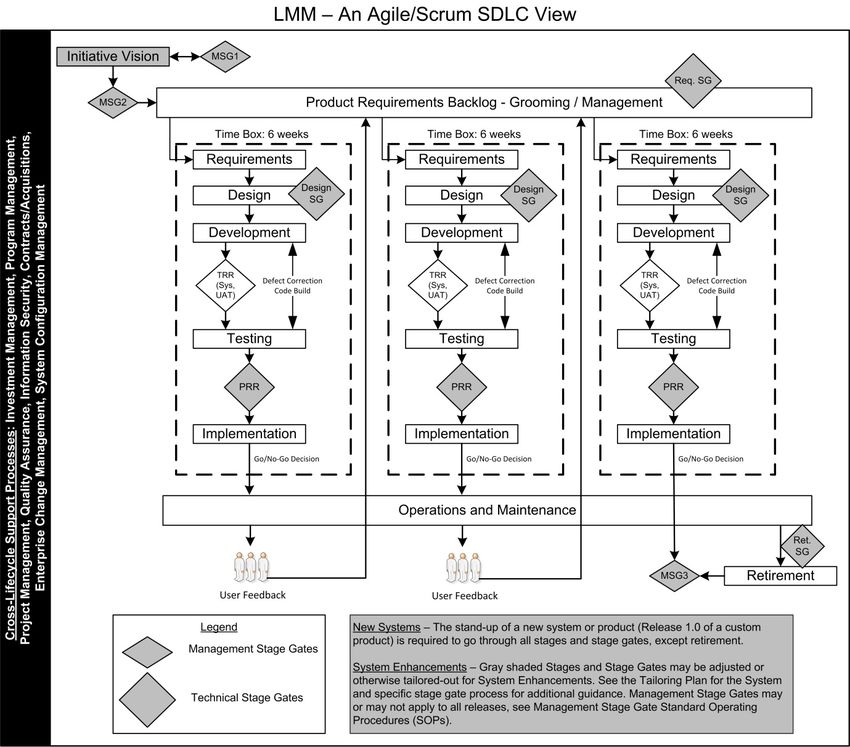
The following diagrams represent two views of the LMM, one following a notional waterfall SDLC and one
following a notional agile-Scrum SDLC. These diagrams are included for reference and understanding
only. The LMM may be applied to any SDLC. There are many other possible SDLCs that could be used,
including but not limited to iterative development, spiral development, rapid-application-development

Version: 2.2                                     15                                                    3/9/2021
Lifecycle Management Methodology                                              Lifecycle Management Methodology

(RAD), and hybrid SDLCs. It is expected that an IPT will tailor the components of the LMM to fit the SDLC
that has been selected to support each information system.
The first release of an information system is expected to go through all stages and stage gates, except
retirement. Subsequent enhancement releases will go through some stages and stage gates, but not
others based on the guidance provided by each stage gate process document (or SOP) and the LMM
Tailoring Plan for the Information System. Enhancement releases typically leverage system
documentation that has already been put in place for many of the LMM components.

                                     Figure 1 LMM - Waterfall SDLC View

Figure 1 depicts the LMM Stages and Stage Gates applied to a notional Waterfall SDLC. The LMM
Stages and Stage Gates flow in a straight-forward progression, starting with the Initiative Vision Stage,
Management Stage Gate 1, and Management Stage Gate 2. Within the Vision Stage, between
Management Stage Gate 1 and Management Stage Gate 2, a planning effort occurs.
The flow continues to subsequent LMM Stages and Stage Gates, including Requirements Stage,
Requirements Stage Gate, Design Stage, the Design Stage Gate, the Development Stage, the Test
Readiness Review Stage Gate(s), and then the Testing Stage. While this diagram shows the System Test
Readiness Review and the User Acceptance Test Readiness Review directly next to each other, there
are typically multiple code builds, test environment deployments, and re-test activities that occur between
the Development Stage, the Test Readiness Review Stage Gate(s), and the Testing Stage.
After the Testing Stage, the flow continues on to the Production Readiness Review Stage Gate, the
Implementation Stage, the Go/No-Go decision by the System Owner and technical team implementing
the release, the Operations & Maintenance Stage, and lastly Management Stage Gate 3. For systems

Version: 2.2                                     16                                                   3/9/2021
Lifecycle Management Methodology Lifecycle Management Methodology
that are being retired, the Retirement Stage Gate and Retirement Stage are added prior to Management
Stage Gate 3.
Figure 2 LMM - Agile SDLC View
Figure 2 depicts the LMM Stages and Stage Gates applied to a notional Agile/Scrum SDLC. The LMM
Stages and Stage Gates flow in a typical Scrum progression, starting with the Initiative Vision Stage,
Management Stage Gate 1, and Management Stage Gate 2.
After planning activities and Management Stage Gate 2, the flow depicts a Requirements Backlog,
containing user stories or other types of requirements, that is managed and groomed as part of Scrum
SDLC processes. The Requirements Stage Gate occurs at the system level, examining the requirements
management practices with a sampling of specific releases such that management practices of the
backlog can be reviewed.
The flow continues into a time-boxed set of activities which include the Requirements Stage (for detailed
requirements definition), the Design Stage (possibly an incremental update to a document that starts as a
high level architecture in the Scrum context), Design Stage Gate, the Development Stage, the Test
Readiness Review Stage Gate(s), and then the Testing Stage. While this diagram shows the System Test
Readiness Review and the User Acceptance Test Readiness Review directly next to each other, there
are typically multiple code builds, test environment deployments, and re-test activities that occur between
the Development Stage, the Test Readiness Review Stage Gate(s), and the Testing Stage.
Version: 2.2 17 3/9/2021Lifecycle Management Methodology Lifecycle Management Methodology After the Testing Stage, the flow continues on to the Production Readiness Review Stage Gate, the Implementation Stage, the Go/No-Go decision by the System Owner and technical team implementing the release. The time-boxed activities end after implementation. Next, the flow shows the Operations & Maintenance Stage, and lastly Management Stage Gate 3. For systems that are being retired, the Retirement Stage Gate and Retirement Stage are added prior to Management Stage Gate 3. Version: 2.2 18 3/9/2021
Lifecycle Management Methodology                                                  Program and Project Management

Section 3. Program and Project Management
Information system owners, program managers, and project managers must address how oversight and
governance will be applied to all aspects of programs and projects that involve changes to a system or
systems. This section explains the relationships between systems (investment), programs, and projects.
Program and project managers must review the LMM tailoring plans of any information systems involved
in their programs or projects.
FSA Business Units customize the investment, program, and project management approaches to meet
their needs; the approach for each investment is reviewed as part of the three Management Stage Gates
(Investment Review, Project Execution, and Project Closeout). Management and monitoring activities are
discussed from three levels of oversight:
     1. Program (IT Investment/system)
     2. Complex project (potentially involving multiple systems) also known as a program at FSA
     3. Standard project (typically projects done within the system boundaries)
The artifacts addressing all three levels of oversight are required. A full list of artifacts for each level of
oversight is available in the PM Toolkit and LMM home page. Although these artifacts are not addressed
in the LMM Tailoring Plan, they can be modified or combined to leverage existing business unit
processes. More detailed guidance on investment, program, and project management artifacts is
available from FSA’s Performance Management Organization.

3.1. Program (IT Investment/System) Guidance
The term “program” at FSA has several different meanings depending on the context in which it is used.
In section 3.1, the term “program” is used to mean an IT investment or information system. Each IT
investment or system must follow both FSA and Capital Planning and Investment Control (CPIC)
standards. Each IT investment may have multiple FSA investment requests (IR) to fund all aspects of the
program as noted in the diagram below.

                                           Figure 3 Program Diagram

The artifacts required for a Program as defined in this section focus on justification for the investment and
monitoring to determine if the program (IT investment/System) is still meeting the needs of FSA and our
customers as well as validating it is still the best method of meeting those needs.

Version: 2.2                                      19                                                    3/9/2021
Lifecycle Management Methodology Program and Project Management
3.2. Program (Complex Projects) Guidance
The term “program,” as applied in this section, is used to reference a complex project that may have
multiple sub-projects that need to be managed together to obtain a specific benefit or value. Each
complex project must follow both FSA and OMB standards. Although a complex project may leverage
funds identified in the IT investment IR, it is best practice to create a single IR devoted to the complex
project funding all aspects of the program as noted in the diagram below.
Figure 4 Complex Project Diagram
It is important to note that a complex project may impact multiple systems to meet a single goal. A
complex project may impact one system, but have a large impact of FSA’s strategic goals or have high
visibility outside of FSA.
The artifacts required for a Program (Complex Project) as defined in section 3.2 focus not only
justification of the program, but also on planning and coordination across the program to ensure proper
communication and collaboration between sponsors, system users, and the program team.
3.3. Project Guidance
Similar to the artifacts required for a Program as defined in section 3.2, project artifacts focus on
justification of the project, planning and coordination with the sponsors, system users, and project team.
Projects may be a component of a program as described in sections 3.1 or 3.2 or may be stand-alone.
When a project is a component of a program, it may leverage program management plans as
appropriate. However, there may be aspects of the project that are not addressed in the program
management plans or that require a different approach. In these instances, it is recommended that the
project team create the appropriate management plan or an addendum to the program management plan.
3.4. Management Stage Gate Guidance
The following stage gates in the LMM framework address investment and project selection through
closeout. Investment Review requires an IR for each category of funds an IT investment/system uses. An
IR may also be used to request funding for a complex project (program) that spans multiple systems.
Management stage gates 2 and 3 may be done for a single project or a group of associated projects. The
process for management stages gates 2 and 3 should be documented in your program/IT investment
management planning documents and align with FSA’s Management Stage Gate Standard Operating
Procedures.
Version: 2.2 20 3/9/2021Lifecycle Management Methodology Program and Project Management
• Management Stage Gate 1: Investment Review - The Investment Review Stage Gate determines
whether the proposed investment meets the agency’s need(s). The investment team provides
information on aspects of the investment such as organizational goal alignment, anticipated
benefits, proposed project structure, and estimated total projected costs through the IR. During
the Investment Review process, an assessment is performed and recommendation provided
regarding the investment’s ability to address FSA’s goals. Once an investment has passed
Management Stage Gate 1, it appears on the Investment Prioritization List, as approved by the
IRB. The Investment Review applies anytime an Investment Request or change is needed (for
an IT investment, complex project, or standard project).
• Management Stage Gate 2: Project Execution - The Project Execution Stage Gate determines
(for DME efforts) that the Business Unit Executive, Project Steering Committee or designee
agree: to the documented scope, budget, and schedule of the project; to the documented goals
and objectives of the project and any high level product requirements resulting from the project;
that the scope, budget, and schedule are within the scope, budget, and schedule of the
associated IR which is funding the project; that critical and high risks are appropriately identified
and responses appropriately planned; that stakeholders and project team members are
appropriately identified. DRMs for complex projects must be signed by the business unit
Executive Council Member or steering committee. DRMs for all other projects require sponsor
approval at the director level. Passing Management Stage Gate 2 will be documented in an
official Decision Record Memo (DRM) or equivalent document and provided to the Investment
Management Board (IMB). Passing Management Stage Gate 2 allows the team to execute
against approved funding to begin the project or group of associated projects.
• Management Stage Gate 3: Project Closeout - The Project Closeout Stage Gate is conducted for
an individual project or group of associated projects to officially close a project once it ends (for
DME efforts). A project may end due to project completion or when all work has stopped on a
project prior to completion. When a project ends due to project completion Management Stage
Gate 3 accepts the project results. It determines if the project accomplished the stated objectives
and validates that plans are in place for continuing management of the resulting project. When a
project ends prior to project completion, Management Stage Gate 3 reviews any project results.
Any outstanding scope is reviewed to determine if there is still a need for that scope and how that
need will be met. Completion of Management Stage Gate 3 results in a Decision Record Memo
(DRM) or equivalent document provided to the IMB. DRMs for complex projects must be signed
by the business unit Executive Council Member or steering committee. DRMs for all other
projects require sponsor approval at the director level.
Version: 2.2 21 3/9/2021Lifecycle Management Methodology LMM Tailoring Section 4. LMM Tailoring LMM Tailoring is the formal process of identifying how the LMM Artifacts (documents) and Technical Stage Gates apply to an FSA information system. In some situations, an LMM Artifact or Technical Stage Gate will not apply to an information system and an explanation is provided in the LMM Tailoring Plan. In other situations, LMM Artifacts may be combined or Technical Stage Gates may need to be arranged in a certain sequence to best support the SDLC for an information system. Program and Project Managers have some limited flexibilities in how different Program/Project Management Artifacts are completed. An LMM Tailoring Plan is required for information systems that are considered a Major IT Investment (3 year cost of greater than $10 Million or determined as major by FSA’s IRB or the Secretary) or if the system is considered a Major Application/General Support System (GSS) for reporting purposes under the Federal Information Security Management Act (FISMA). For applicable information systems, the LMM Tailoring Plan must be created (or updated) prior to contract competition. The Information System Owner for each applicable FSA Information System tailors the LMM and documents these decisions in a system specific tailored plan. The system specific tailored plan supports the IPT’s approach to how the system will be managed and development activities will occur. This tailoring process allows artifacts to be included, consolidated, streamlined, or excluded (tailored out) based on the development lifecycle activities that apply to the system. The LMM Tailoring Plan document is used to describe how each information system uses LMM artifacts and technical stage gates. Refer to the LMM Tailoring Plan Template for further guidance. The LMM Tailoring Plan for each applicable information system is used in contract planning to identify deliverables that FSA may want to include in the contract. The Tailoring Plan and underlying LMM Artifacts are also used to ensure that planned contracts will fit into existing information system management processes and to identify where FSA intends to change those processes for a particular information system. The following diagram shows the typical flow of an LMM Tailoring Plan, IRPE Checklist, and Business Requirements being used in the Acquisition Process to support a contract competition. Minor Applications for FISMA reporting purposes are not required to complete an LMM Tailoring Plan. Minor Applications do require a minimum set of documentation that includes appropriate security documentation, system requirements, system architecture, and an operations & maintenance plan. These documents/artifacts may be stored in a variety of repositories maintained by FSA including EEBC, EPPM, FSA Rational, CSAM, shared network folders on the EDUCATE Network, and other locations under control of support contractors (contractor-hosted SharePoint sites, contractor hosted Rational Implementation, and other contractor-hosted tools). Version: 2.2 22 3/9/2021
You can also read


