MANAGEMENT'S DISCUSSION AND ANALYSIS - VA.gov
←
→
Page content transcription
If your browser does not render page correctly, please read the page content below
MANAGEMENT’S
DISCUSSION AND
     ANALYSIS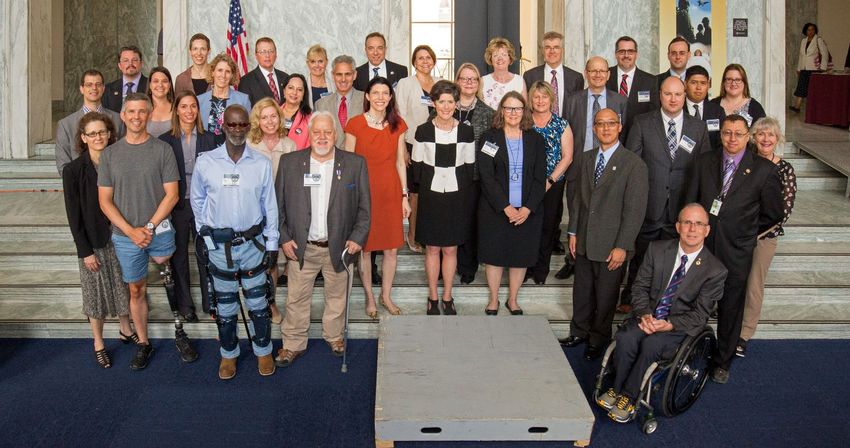
Researchers strive to make 3D-printed artificial lung to
help Vets with respiratory disease

VA scientists are working to create a 3D-printed artificial lung that they tout as having the po-
tential to revolutionize the treatment of Veterans affected by lung disease.

One such lung disorder—chronic obstructive pulmonary disease (COPD)—is one of the most
prevalent and costliest ailments in the Veteran population.

Dr. Joseph Potkay, a biomedical engineer at the VA Ann Arbor Health Care System in Michi-
gan, is leading the VA-funded research. It calls for making a prototype of the 3D-printed artifi-
cial lung. Potkay and his team hope to build what they call the first wearable artificial lung
that is compatible with living tissue and is capable of short- and long-term respiratory sup-
port.

The lung is seen initially as a temporary measure, a bridge to help patients awaiting a lung
transplant or an aid for those whose lungs are healing. Future versions could have longer-
term applications, the researchers say.

Potkay says this is the first time high-resolution 3D polymer printing is being used to create
microfluidic lungs with three-dimensional blood flow networks.

Microfluidic artificial lungs, a new class of artificial lungs, mimic the structure of the natural
lung better than conventional artificial lungs. Tiny blood channels, some thinner than a hu-
man hair, are closer in shape and dimension to those in a person, allowing for blood flow
similar to that in the human body.

The biocompatible coatings on the lung’s surface are equally important. Anytime blood
comes in contact with an artificial surface, an immune response leads to hardening of the
blood and clotting. Biocompatible coatings will help curtail that immune reaction.

“We hope that these microfluidic flow paths and biocompatible coatings will be more com-
patible with living tissue, thereby reducing the body’s immune response and increasing the
lifetime of the device,” says Potkay, who is also a researcher at the University of Michigan.
“The flexibility in design afforded by 3D printing gives us more freedom and thus the ease to
build artificial lungs with a small size and pressure drops that are compatible for operation
with the body’s natural pressures.”

Picture previous page: Biomedical engineer Dr. Joseph Potkay, with the VA Ann Arbor Health
Care System, displays a 2D prototype of an artificial lung. A 3D version is in production.

Department of Veterans Affairs – FY 2018 Agency Financial Report
       SECTION I: MANAGEMENT’S DISCUSSION AND ANALYSIS

                  MISSION AND ORGANIZATIONAL STRUCTURE

MISSION
President Lincoln’s immortal words,                             VA fulfills these words by providing world-
delivered in his Second Inaugural Address                       class benefits, medical, and burial services
more than 140 years ago, best describe                          to the millions of men and women who have
VA’s mission. “To care for him who shall                        served this country with honor. President
have borne the battle and for his widow,                        Lincoln’s words guide all VA employees in
and his orphan.” We care for Veterans,                          their commitment to providing the best
their families, and survivors – men and                         medical care, benefits, social support, and
women who have responded when their                             lasting memorials that Veterans and their
Nation needed help. VA’s mission is clear-                      dependents deserve in recognition of
cut, direct, and historically significant. It is a              Veterans’ service to this Nation.
mission that every employee is proud to
fulfill.

ORGANIZATION
VA is comprised of three Administrations, Veterans Benefits Administration (VBA), Veterans
Health Administration (VHA), and the National Cemetery Administration (NCA) that deliver
services to Veterans and Staff Offices that support the Department:
 VBA provides a variety of benefits to Veterans and           VHA provides a broad range of primary care,
 their families. These benefits include transition            specialized care, and related medical and social
 assistance services, disability compensation, pension,       support services that are uniquely related to Veterans’
 fiduciary services, educational opportunities,               health or special needs. VHA advances medical
 vocational rehabilitation and employment (VR&E)              research and development in ways that support
 services, home ownership promotion, and life                 Veterans’ needs by pursuing medical research in
 insurance benefits.                                          areas that most directly address the diseases and
                                                              conditions that affect Veterans.

  VBA representatives taking questions from
                                                               Veterans at the John D. Dingell VA Medical
  Servicemembers and Veterans at an Association
                                                               Center, Detroit, Michigan had a blast at this
  of the U.S. Army event.
                                                               year’s annual Ride for Hospitalized Veterans.

                                                          5
Department of Veterans Affairs – FY 2018 Agency Financial Report
       SECTION I: MANAGEMENT’S DISCUSSION AND ANALYSIS

NCA provides burial and memorial benefits to                  VA Staff Offices provide a variety of services to the
Veterans and their eligible family members. These             Department, including information technology (IT),
benefits include burial at national cemeteries,               human resources management, strategic planning,
cemetery grants for state and tribal cemeteries,              Veteran outreach and education, financial
headstones and markers, presidential memorial                 management, acquisition, and facilities management.
certificates, outer burial receptacles, and medallions.

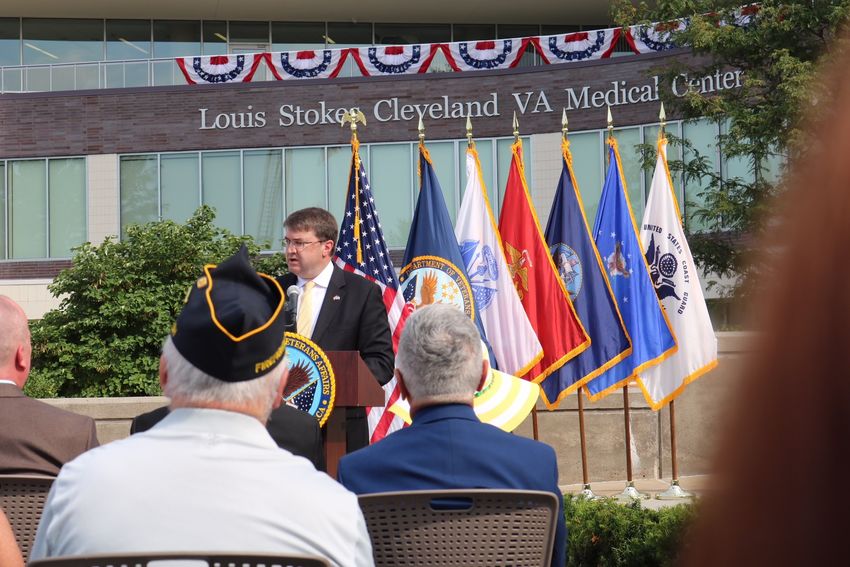
 Fort Gibson National Cemetery hosted the burial
 service of Seaman 1st Class Eugene W. Wicker                  Harry Ivy was the first customer service agent to
 Saturday, August 4, 2018. Wicker was killed in                receive a call at the White House VA Hotline,
                                                               which began taking callers on October 15, 2017.
 action onboard the USS Oklahoma during the
                                                               Veterans can reach the hotline at (855) 948-
 Japanese attack on Pearl Harbor on
                                                               2311.
 December 7, 1941. Wicker’s remains were
 identified by the Defense POW/MIA Accounting
 Agency. After more than 76 years, Wicker’s
 remains returned to Oklahoma.

                                               DID YOU KNOW?
VA DoD Veteran Link is a new social networking app just for Veterans and current
Servicemembers. The app creates a secure, closed community where users can connect and feel
comfortable talking about common interests and life circumstances, including any health concerns
they may have.
VA DoD Veteran Link is available through VA’s App Store. Veterans can access it from Internet-
connected desktops, laptops, and mobile devices.

                                                          6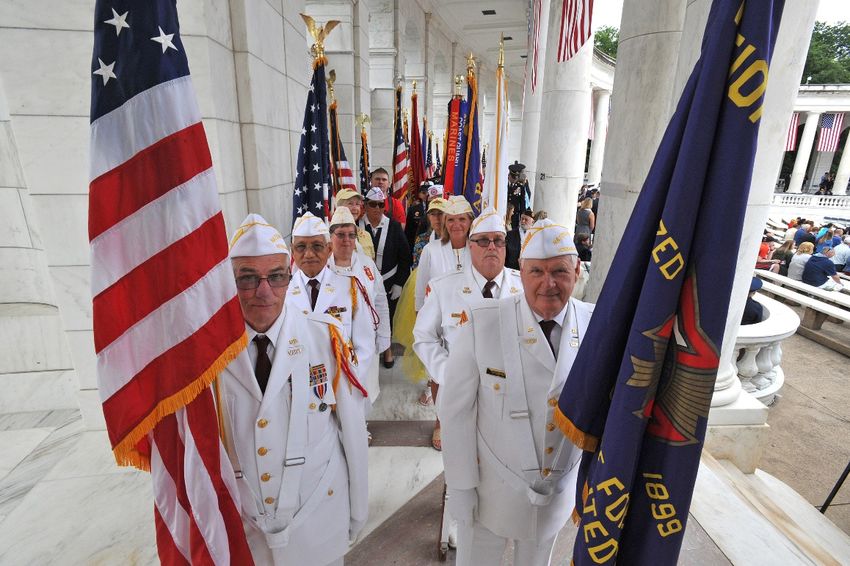
Department of Veterans Affairs – FY 2018 Agency Financial Report
      SECTION I: MANAGEMENT’S DISCUSSION AND ANALYSIS

DEPARTMENT OF VETERANS AFFAIRS ORGANIZATIONAL
STRUCTURE

Robert L. Wilkie was sworn in as Secretary of the U.S. Department of Veterans Affairs on July 30, 2018.

                                                      7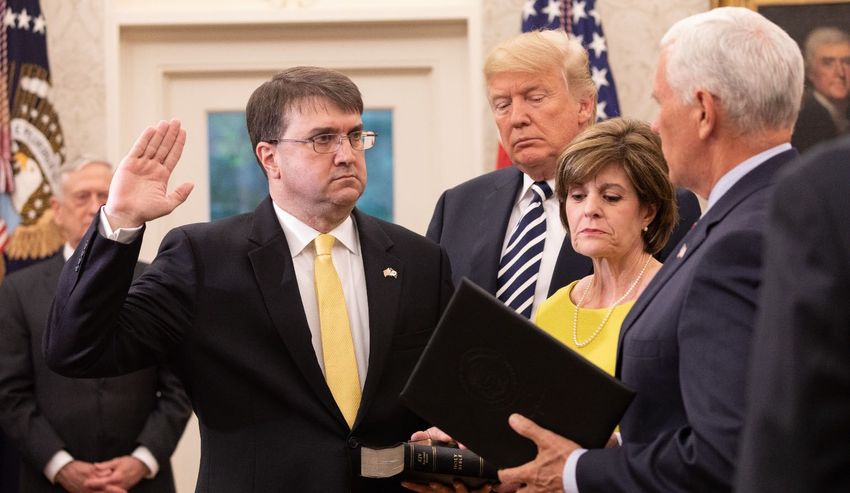
Department of Veterans Affairs – FY 2018 Agency Financial Report
      SECTION I: MANAGEMENT’S DISCUSSION AND ANALYSIS

          PERFORMANCE GOALS, OBJECTIVES, AND RESULTS

VA performance goals and objectives are captured in the new VA Strategic Plan, published in
February 2018. This Strategic Plan presents the Department’s five to seven year objectives it
will achieve for Veterans and emphasizes performance based on Veteran outcomes. Each
Secretary articulates the focus issues they want the Department to prioritize in support of
strategic plan outcomes. The previous Secretary’s priorities are incorporated into this
Strategic Plan. The plan will be refreshed in 2019 to reflect the current Secretary’s priorities.
As shown in the 2018 VA Strategic Plan poster below, the VA Strategic Plan goals align
directly with the previous Secretarial Priorities: Greater Choice for Veterans, Improve
Timeliness of Service, Suicide Prevention, Focus Resources More Efficiently, and Modernize
Our Systems. For ease of tracking VA’s performance progress, in the discussion and analysis
sections that follow, we will explicitly demonstrate that connection and provide partial year
performance results where available, along with some examples of performance measures we
will adopt in FY 2019.

                                                                           Memorial Day 2018 was
                                                                           commemorated at
                                                                           Arlington National
                                                                           Cemetery with the 150th
                                                                           Presidential Armed
                                                                           Forces Full Honor
                                                                           Wreath-laying
                                                                           Ceremony and DoD
                                                                           National Memorial Day
                                                                           Observance.

                                                                           VA Photo by Robert
                                                                           Turtil

                                                8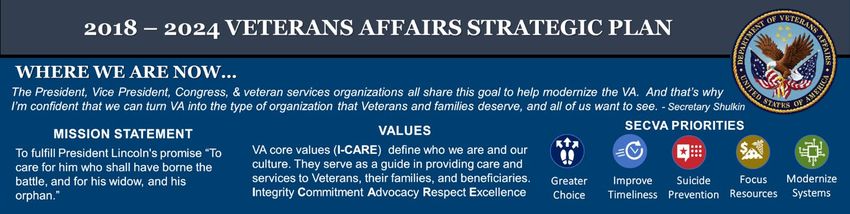
Department of Veterans Affairs – FY 2018 Agency Financial Report
       SECTION I: MANAGEMENT’S DISCUSSION AND ANALYSIS

2018 VA STRATEGIC PLAN GOALS

 GOAL 1               VETERANS CHOOSE VA FOR EASY ACCESS, GREATER
                      CHOICES, AND CLEAR INFORMATION TO MAKE INFORMED
                      DECISIONS

 Crosswalk to 2017            Greater Choice for Veterans
 Priority Goal

To provide Veterans with better choices and better access to the benefits, care, and services
they need, we have to enhance our understanding of what they are experiencing in their lives.
VA will combine understanding of the Veteran with continuous market analyses of availability
and quality of provider options to provide a better range of choices for our Veterans. This is
what we mean by greater choice. Further, VA must compete for our Veteran customers or risk
losing them. We welcome the challenge; we believe competing with the private sector to serve
our Veterans will make us stronger. In this goal, we also expand easy access beyond making
an appointment. It also applies to Veterans being able to use any benefit, care, or service they
need no matter where they are. VA, in its quest to better serve Veterans in the manner they
wish to be served, has identified three major elements pertaining to enhanced access for
Veterans:
   •   VA understands the benefits, care, and services the Veteran needs because they have
       communicated with the Veteran, and VA knows what exists in the Veteran’s community.
   •   Veterans are informed of benefits, care, and services available to them that are offered
       by VA and/or other providers.
   •   Veterans can avail themselves of the benefits, care, and services they need in the
       manner they desire.
In last year’s MD&A, VA highlighted three aspects of greater choice and access for Veterans:
reducing wait times, same-day services, and integrated network for care. These issues remain
important.

                                         DID YOU KNOW?
 The Veterans Legacy Program is NCA's educational initiative. The mission is to memorialize our
 Nation's Veterans through sharing their stories. We partner with schools, teachers, professors, and
 students to research Veterans interred in our cemeteries. https://www.cem.va.gov/legacy/

                                                  9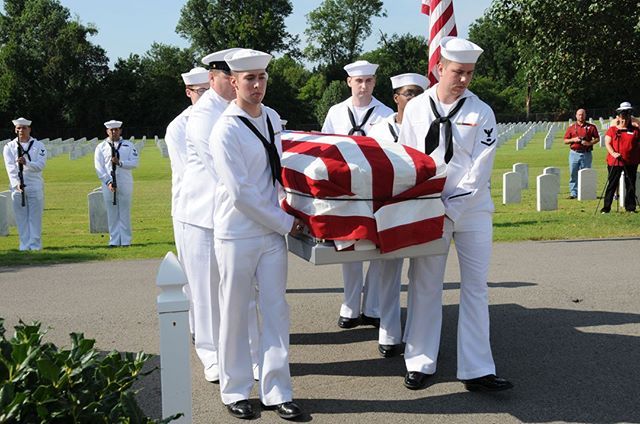
Department of Veterans Affairs – FY 2018 Agency Financial Report
      SECTION I: MANAGEMENT’S DISCUSSION AND ANALYSIS

                       Reducing Wait Times          Same-Day Services         Integrated Network for
                                                                                       Care
 Reported in FY       At just over 1 percent of   We are committed to         We are working with
 2017                 our locations across the    providing, by year’s end,   Congress on new
                      country, Veterans are       same-day services at all    Choice legislation that
                      waiting more than 60        our Community-Based         will streamline our
                      days for new                Outpatient Clinics.         processes, focus our
                      appointments.                                           resources, and provide
                                                                              Veterans a high-
                                                                              performing, integrated
                                                                              network for care.
 FY 2018 Update       93.99 percent of new        On January 12, 2018,        Congress passed the
                      primary care patients       VA announced that 100       MISSION Act, which will
                      completed an                percent of its more than    streamline VA’s
                      appointment within 30       1,000 medical facilities    community care
                      days or less from their     across the country offer    programs and
                      preferred date.             same-day services for       strengthen health care
                                                  urgent primary and          options for Veterans,
                                                  mental health care          whether in VA or in the
                                                  needs.                      community.

VETERAN CUSTOMER EXPERIENCE
Goal: VA will increase Veteran trust in VA. By September 30, 2019, Veterans’ positive
responses to the statement “I trust VA to fulfill our country’s commitment to Veterans” will
increase from 67 percent at the end of FY 2017 to 90 percent.
Update as of 3rd Quarter, 4th Quarter Results Will Be Published in the Annual Performance
Plan and Report:
VA’s initial focus is on Veterans’ experiences of outpatient care. There are three primary
drivers of customer experience: ease (measured by the statement: “It was easy to get the
care I needed”), effectiveness (“I got the care I needed”), and emotion (“I felt like a valued
customer”). In a VA-wide survey at the end of June 2018, results for each of the three drivers
had increased 1 percent from the previous quarter. Together, the increases have resulted in
an overall trust score of 69 percent.

                                                  10
Department of Veterans Affairs – FY 2018 Agency Financial Report
      SECTION I: MANAGEMENT’S DISCUSSION AND ANALYSIS

Reporting on             VA will manage performance against this goal by monitoring how Veterans
Results                  report access to health care, specifically the average percentage of
                         respondents saying they “Always” and “Usually” were able to get an
                         appointment for care when they needed it.

                         Second quarter FY 2018 results: 81 percent

Plan for                 •   Veterans surveyed are satisfied (or better) with the available choices for
Performance                  Veteran care, benefits, and services.
Measurement              •   Eligible Veterans choose VA as their provider of choice for their care.
                         •   Veterans agree that they received timely, relevant, and easy-to-understand
                             information from VA that empowered them to make informed choices about
                             their benefits, services, and care.
                         •   Veterans agree that the statement “I felt like a valued customer” is true.

VA scientists descended on the Nation’s capital to showcase their medical research advances that are aimed
at improving the lives of Veterans. More than 20 scientists attended the VA research fair on Tuesday,
June 19, 2018, exhibiting a myriad of innovations in the foyer of the Rayburn House Office Building in
Washington, DC. The exhibitions touched on topics that are critical to Veterans: the chronic effects of
neurotrauma; VA’s Million Veteran Program (genomics); pain and opioid research; posttraumatic stress
disorder (PTSD); prosthetics; rehabilitation engineering; spinal cord injury; suicide prevention; technology
transfer for VA discoveries; translating research into practice; traumatic brain injury (TBI); VA clinical trials;
Vietnam Veterans’ research; and female Veterans’ research.

                                                        11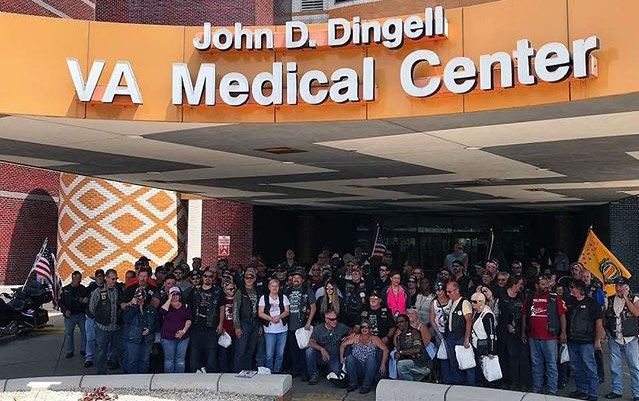
Department of Veterans Affairs – FY 2018 Agency Financial Report
      SECTION I: MANAGEMENT’S DISCUSSION AND ANALYSIS

 GOAL 2                VETERANS RECEIVE TIMELY AND INTEGRATED CARE AND
                       SUPPORT THAT EMPHASIZES THEIR WELL-BEING AND
                       INDEPENDENCE THROUGHOUT THEIR LIFE JOURNEY

 Crosswalk to 2017            Improve Timeliness of Service                   Suicide Prevention
 Priority Goal

VA will deliver integrated and seamless benefits, care, and support resulting in increased
quality of life for Veterans and their families, caregivers, and supporters. Improved quality of
life means Veterans are independent, economically secure, and socially engaged however
they choose and enjoy enhanced well-being.
Preventing suicide among Veterans and improving the timeliness of the services we provide
remain priorities from year to year. The following information demonstrates some of the
progress that has been made on those issues in the past year.

 Every week, volunteers gather at the Vietnam Veterans Memorial in Washington, DC and spend time cleaning
 the monument. In June, senior VA leaders joined with Vietnam Veterans of America Chapter 641 members to
 take part in this tradition.

                                                   12
Department of Veterans Affairs – FY 2018 Agency Financial Report
SECTION I: MANAGEMENT’S DISCUSSION AND ANALYSIS
Suicide Prevention Improving the Creating Transparency
Disability Claim in Claim Status
Timeline
Reported in FY We are now offering The average time a There is little information
2017 former Servicemembers disability claim is available to Veterans on
with other-than- awaiting a decision is the status of their
honorable discharges – just over 90 days. VA’s disability claim appeals.
a high-risk population – goal is to cut this time to This lack of
access to emergent 60 days over the next 2 transparency is a major
mental health services years. hindrance to providing
in our medical centers. timely decisions.
FY 2018 Update VA and the Department The average time a VA is implementing the
of Health and Human disability claim is Veterans Appeals
Services (HHS) are awaiting a decision is Improvement and
working directly with just over 90 days. We Modernization Act of
states and communities are providing faster 2017, which streamlines
to address suicide decisions to Veterans the appeals process
among those Veterans through process significantly. Third
not receiving health care enhancements and quarter FY 2018 results
through VA. The national workload of a test program
initiative is called the distribution and will showed that VBA
Mayor’s Challenge. As continue to focus on provided decisions to
of third quarter FY 2018, policy changes and Veterans within an
seven cities have been automation to make average of 66 days.
recruited to this project additional The new processes will
and will begin improvements. be fully implemented by
developing local action September 30, 2019
plans focused on ending (specifically,
Veteran suicide. VA implementation will
and HHS are in occur in February 2019).
discussions with 17
additional communities
to recruit them to this
effort.
Three of VA’s four Agency Priority Goals (APG) support “Goal 2” and are discussed below.
APGs are focused, 2-year initiatives aimed at producing outcomes that reflect the agency’s top
priorities.
APPEALS IMPROVEMENT AND MODERNIZATION ACT IMPLEMENTATION
Goal: VA will improve the claims and appeals process for benefits by implementing the new,
streamlined framework authorized by the Veterans Appeals Improvement and Modernization
Act of 2017 (the Act). The Act transforms VA’s appeals process from a complex, frustrating
process into one that is simple, timely, and transparent.
13Department of Veterans Affairs – FY 2018 Agency Financial Report
SECTION I: MANAGEMENT’S DISCUSSION AND ANALYSIS
Update as of 3rd Quarter, 4th Quarter Results Will Be Published in the Annual Performance
Plan and Report:
In addition to implementing the Act, VA has launched the Rapid Appeals Modernization
Program (RAMP), which provides eligible Veterans the opportunity to enter the new, more
efficient appeals process outlined in the Act prior to February 2019. In the third quarter of FY
2018, over 30,129 appellants with more than 36,729 unique appeals had opted into RAMP. In
the third quarter, VBA was able to provide decisions on RAMP cases within an average of 66
days.
VETERAN SUICIDE PREVENTION
VHA will proactively identify and provide interventions for at-risk Veterans, both those using
VHA care and those using other care systems, to prevent suicide and overdose death. VHA
will increase the use of interventions for Veterans at risk for suicide using predictive modeling
and enhanced engagement strategies.
Goals: By September 30, 2019, the percent of Veterans targeted through predictive modeling
algorithms within the VHA system that receive core recommended interventions will increase
to 90 percent from the baseline of 57 percent. By September 30, 2019, VA will partner with
HHS/Substance Abuse and Mental Health Services Administration and 17 cities in a “Mayor’s
Challenge” to develop community plans to end Veteran suicide outside the VHA system.
Update as of 3rd Quarter, 4th Quarter Results Will Be Published in the Annual Performance
Plan and Report:
• VA continues to expand suicide prevention programming to benefit all Veterans.
• The Mayor’s Challenge has been launched in seven initial cities, and recruiting is in
progress for a second wave of cities.
• VA is hiring additional mental health clinicians to serve Veterans in need.
COMMUNITY CARE
Goal: Improve Veterans’ health experiences by consolidating all VA-purchased care programs
into one modernized community care program. By September 30, 2019, the percent of
Veterans who are satisfied with the community care they received will increase from 73
percent at the end of FY 2017 to 79 percent.
Update as of 3rd Quarter, 4th Quarter Results Will Be Published in the Annual Performance
Plan and Report:
Congress passed legislation for community care reform. The VA MISSION Act was signed
into law on June 6, 2018. VA has started to develop and implement Title I MISSION provisions
related to the community care program.
As of March 31, 2018, 78.2 percent of surveyed Veterans were either “satisfied” or “very
satisfied” with their VA community care.
14Department of Veterans Affairs – FY 2018 Agency Financial Report
SECTION I: MANAGEMENT’S DISCUSSION AND ANALYSIS
Reporting on Dependency Claims Processing: Timeliness (month-to-date average days to
Results complete as of last month of the year).
Results as of August FY 2018: 80.2 days
Other measures supporting Goal 2:
• Average improvement in mental health symptoms in the 3-4 months after
the start of mental health treatment as measured by the mental health
component of the Short Form-12 (Under development for the FY 2020
Annual Performance Plan).
• Percentage of Veterans flagged as high risk for suicide who have received
recommended interventions and follow-up (Under development for the FY
2020 Annual Performance Plan).
Plan for • Veterans are satisfied with the results of the Veteran benefits, care, and
Performance services they received.
Measurement • VA’s organizational performance matches or exceeds industry standards
for excellence in all its lines of business.
• Veterans have good quality of life (presence of positive emotions in daily
activities, participation in society, satisfying relationships, and overall life
satisfaction).
• Zero Veteran suicides.
• Zero Veterans are homeless.
• Veterans achieve independence and economic security.
Around the Nation, VA employees are taking the opportunity to thank and honor Vietnam War era Veterans
and their families for their incredible service and sacrifices 50 years ago. March 29, 2018, marked the second
celebration of National Vietnam War Veterans Day. This special day was added to our list of national
observances when the President signed into law the Vietnam War Veterans Recognition Act of 2017. Led by
DoD, VA sustains more than 465 commemorative partnerships in recognizing the 50th anniversary of the
Vietnam War.
15Department of Veterans Affairs – FY 2018 Agency Financial Report
SECTION I: MANAGEMENT’S DISCUSSION AND ANALYSIS
GOAL 3 VETERANS TRUST VA TO BE CONSISTENTLY ACCOUNTABLE
AND TRANSPARENT
Crosswalk to 2017 This is a new area of focus for the Department; as such, it does not align
Priority Goal to a previous Secretarial priority.
VA’s pledge to build lifelong, trusted relationships with our Veterans is the basis for delivering
relevant and excellent benefits, care, and services to our Veterans that enhance their lives.
VA understands that earning our Veterans’ trust is the gold standard we aspire to achieve and
is critical to our long-term success. How VA delivers on its promises is just as important as
what it delivers. VA will earn trust and be the natural choice for Veterans by holding itself
accountable, being transparent about how we are performing, and showing how we adhere to
our core values with every single interaction. Specifically, VA will focus on accountability,
transparency, and value.
Reporting on In addition to tracking measures related to work conducted by the Office of the
Results Inspector General (OIG) to address fraud, waste, and abuse, VA will measure
Veterans’ trust in VA.
VA has measured Veterans’ overall trust in the Department since FY 2016,
when we found that only 60 percent of Veterans could answer affirmatively a
survey question regarding their level of trust. In FY 2017, that figure rose to 69
percent. Our goal is to reach 90 percent. We realized, however, that VA must
incorporate Veteran experience data in all business processes to drive
performance improvements in health care and benefits and thereby increase
Veterans’ overall trust in VA. We began by tracking our customers’
experiences with outpatient services. We found Veterans’ trust in outpatient
services in the third quarter of FY 2018 was 86 percent. We plan to begin
collecting data on customer experience for three additional service lines:
Board of Veterans’ Appeals, telehealth services, and the White House VA
Hotline.
Plan for • Veterans say, “I trust VA to fulfill our country’s commitment to Veterans.”
Performance • VA publishes health care benchmarks aligned with the private sector.
Measurement • VA publishes benefits and service delivery performance data.
• VA eliminates fraud, waste, and abuse.
• Performance based action will be initiated against all proven poor
performers within 90 days of substantiation of poor performance.
• Appropriate disciplinary or adverse action will be initiated against all
employees within 90 days of substantiation of misconduct.
16Department of Veterans Affairs – FY 2018 Agency Financial Report
SECTION I: MANAGEMENT’S DISCUSSION AND ANALYSIS
GOAL 4 VA WILL MODERNIZE SYSTEMS AND FOCUS RESOURCES MORE
EFFICIENTLY TO BE COMPETITIVE AND TO PROVIDE WORLD
CLASS CAPABILITIES TO VETERANS AND ITS EMPLOYEES
Crosswalk to 2017 Modernize Our Systems Focus Resources More
Priority Goal Efficiently
Two major forces are driving VA’s continuing transformation:
• The emphasis on using the Veterans’ perspective to shape its program delivery and
business operations.
• The need to modernize our systems and focus resources to ensure VA is here for
generations to come.
The cross-cutting objectives and strategies in this goal adapt the organization’s behavior in
four critical categories that will enable it to perform in an ever-changing business environment.
It also addresses two critical functions, Human Resources (HR) and IT, that must be optimized
for the Department to realize its modernization aim. The strategies will help the Department
make future choices about its strategic footprint (capital assets and construction); rapidly
deploy the right human capital capabilities as mission requirements evolve; put in place an IT
infrastructure that supports its Veteran engagement and delivery goals; and emphasize value
analytics so VA makes smart, implementable, and relevant business decisions every day. VA
will either develop or avail itself of shared services to dramatically improve hiring, procurement,
and IT to drive better service and delivery.
Modernizing our systems is critical to delivering the kind of service and the level of
accountability that we strive to provide to Veterans. There are multiple modernization efforts
underway in the Department, but the following provides an update to two areas referenced in
last year’s AFR.
DID YOU KNOW?
VA scientists at the VA Ann Arbor Healthcare System in Michigan recently announced that they are
working to create a 3D-printed artificial lung that could potentially revolutionize treatment of
Veterans affected by lung disease. Though still in its infancy, VA researchers hope to build what
they call the first artificial lung that closely replicates the natural lung, resulting in compatibility with
living cells and a very small size for portable or wearable short- and long-term respiratory support.
https://t.co/SYxS76yn4e
17Department of Veterans Affairs – FY 2018 Agency Financial Report
SECTION I: MANAGEMENT’S DISCUSSION AND ANALYSIS
IT Budget Outdated Systems
Reported in FY Over 75 percent of our IT budget is VA’s scheduling systems and our
2017 spent on legacy systems that are at financial systems are outdated,
risk of failing or need major preventing us from performing critical
enhancements. functions in a streamlined and efficient
manner.
• The Secretary of Veterans Affairs
(SECVA) recently announced that • Both systems are in the process of
VA will use the same contractor being replaced, but it will take
and system for electronic health several years to complete.
records (EHR) as DoD. This is a
major step forward in creating a
seamless transition for Veterans.
FY 2018 Update VA established an Office of Electronic VA has embarked on a
Health Record Modernization and Departmentwide initiative, called the
began developing detailed plans to Financial Management Business
deploy the new system across the VA Transformation (FMBT), to replace the
health care system, beginning with aging financial and acquisition system
health care facilities in the Pacific infrastructures. One of the first steps
Northwest. is the development of the integrated
Financial and Acquisition
Management System, which will
transform our business processes and
capabilities.
Reporting on The following measures will come on-line in FY 2019 to help VA track its
Results efforts to modernize its systems:
• Percentage of agency spending on cloud computing; and
• Number of data center closures.
The following measures will come on-line in FY 2019 to demonstrate the steps
VA is taking to focus its resources:
• The percentage of facility customers who are satisfied with services being
provided;
• Percentage of lease projects accepted by VA as substantially complete in
the quarter identified; and
• Percentage of construction projects accepted by VA as substantially
complete in the quarter identified.
Plan for • Veterans say, “I trust VA to fulfill our country’s commitment to Veterans.”
Performance • VA publishes health care benchmarks aligned with the private sector.
Measurement • VA publishes benefits and service delivery performance data.
• VA eliminates fraud, waste, and abuse.
18Department of Veterans Affairs – FY 2018 Agency Financial Report
SECTION I: MANAGEMENT’S DISCUSSION AND ANALYSIS
ANALYSIS OF FINANCIAL STATEMENTS AND STEWARDSHIP
INFORMATION
BALANCE SHEET
The Balance Sheet provides a snapshot of Department’s total liabilities significantly
the Department’s financial position. It exceed total assets. Chart 2 shows the
reports the balances of the Department’s components of the Department’s liabilities,
assets, liabilities and net position, at a fixed with the largest being Unfunded Federal
point in time. As shown in Chart 1, the Employee and Veterans Benefits.
Chart 1: Comparative Total Assets and Liabilities FY 2014 - FY 2018
19Department of Veterans Affairs – FY 2018 Agency Financial Report
SECTION I: MANAGEMENT’S DISCUSSION AND ANALYSIS
Chart 2: FY 2018 Breakdown of Funded and Unfunded Liabilities
The scale in Chart 2 increases in incremental dollar value due to the wide range of liability component balances from $679.4
million to $3.01 trillion.
Unfunded Federal Employee and Veterans Benefit Programs
Compensation Benefits /Education Benefits
$2.95 Trillion $65.7 Billion
Compensation benefits are the most significant VA delivers benefits through numerous education
component of Federal Employee and Veterans Benefit programs to eligible:
liabilities. VA delivers compensation benefits to:
• Veterans;
• Veterans with military service-related • Veteran dependents;
disabilities; and • Beneficiaries of deceased Veterans; and
• Beneficiaries of deceased Veterans. • Active duty Servicemembers.
Burial Benefits Federal Employee Compensation
$7.2 Billion $2.4 Billion
VA provides burial-related benefits to recognize The Federal Employee’s Compensation Act (FECA)
Veterans’ sacrifices in service of the Nation. Benefits provides compensation benefits to Federal Employees
include: for disability due to personal injury sustained while in
performance of duty.
• Burials;
• Burial flags, headstones, markers, and
medallions;
• Presidential Memorial Certificates;
• Outer burial receptacles; and
• Other internment needs.
20Department of Veterans Affairs – FY 2018 Agency Financial Report
SECTION I: MANAGEMENT’S DISCUSSION AND ANALYSIS
Chart 3: FY 2018 Significant Changes in Assets
Fund Balance with Investments, Other Assets,
Treasury Intragovernmental Intragovernmental
This increase is primarily due to A decrease in investment reserve A significant increase in other
additional appropriations received funds is a result of having certain assets is directly attributable to
for an extension of the Veterans insurance programs no longer advances provided to the US Army
Choice program, implementation of open to new issues. Also Corps of Engineers for major
the VA Mission Act of 2018, contributing are payouts for construction projects throughout
expansion of the Community Care policyholders, many of which are at the country.
program, medical facility an advanced age.
improvements, and Veterans
compensation benefits for new
beneficiaries.
21Department of Veterans Affairs – FY 2018 Agency Financial Report
SECTION I: MANAGEMENT’S DISCUSSION AND ANALYSIS
Chart 4: FY 2018 Significant Changes in Liabilities
Federal Employee and Accounts Payable, Public Other Liabilities,
Veteran Benefits Intragovernmental
This benefit liability increase is due The accounts payable liability The increase in other liabilities is
to actuarial computations for increase is primarily due to the due to the overall improvement in
compensation benefits, relating timing of payments for monthly the housing market, resulting in
better loan performance and fewer
primarily to an increase in the compensation and pension
claims on guaranteed housing
estimated interest on the liability, benefits. FY 2018 payments were loans than previously projected.
along with a change in the discount made on Monday, October 1st; This factor has resulted in
rate assumption. whereas, FY 2017 payments were substantial amounts due back to
made on Friday, September 29th. Treasury.
Also contributing to this increase
are liabilities due to the VA Mission
Act, along with expansion of the
Veterans Choice and Community
Care programs.
22Department of Veterans Affairs – FY 2018 Agency Financial Report
SECTION I: MANAGEMENT’S DISCUSSION AND ANALYSIS
NET COST OF OPERATIONS AND CHANGES IN NET POSITION
Chart 5: Comparative Statement of Net Cost, FY 2018 – FY 2017
Net (Gain)/Loss From Changes in VBA Program
Actuarial Assumptions
The majority of the decrease relates to changes in Veterans benefit payments continue to increase due
other assumptions for compensation and burial, which to efficiency gains from transformational process
include revisions to new case rates for Veterans; new changes and IT advances, resulting in a higher
survivor assumptions; revised spot and cost of living number of beneficiaries accessing and receiving these
adjustment (COLA) rates; and updated mortality benefits. Further, yearly cost of living increases
assumptions. In addition, the remaining decrease resulted in higher Veterans benefit expenses.
was the result of changes in the discount rate.
VBA Actuarial Cost, Excluding Changes VHA Program
in Actuarial Assumptions
Increase in Compensation and Burial is a result of the The increase is primarily the result of expanding the
new legislation and administrative changes for Camp VA Community Care program which increased costs
Lejeune water contamination and Mental Health for outpatient visits, amounts paid to hospitals and
initiatives, which represent prior service costs. This service providers, and contracts for education and
was offset by a decrease in costs from experience research. The increase is also attributed to an
changes resulting from population increases and increase in the number of full time equivalent
benefit size. employees needed to service the growing Veteran
population and ensure Veterans receive quality
healthcare in a timely manner.
23Department of Veterans Affairs – FY 2018 Agency Financial Report
SECTION I: MANAGEMENT’S DISCUSSION AND ANALYSIS
Chart 6: FY 2018 Gross Program Costs
The Statement of Changes in Net Position at a net position. Net position changed 5%
combines the net cost of operations with from a deficit of $2.81 trillion in FY 2017 to
non-exchange sources of financing to arrive a deficit of $2.95 trillion in FY 2018.
24Department of Veterans Affairs – FY 2018 Agency Financial Report
SECTION I: MANAGEMENT’S DISCUSSION AND ANALYSIS
BUDGETARY RESOURCES
VA expends a substantial amount of its sources of VA funding are appropriations
budgetary resources on medical care for from Congress and unobligated balances
Veterans and Veteran’s compensation and from prior year budget authority.
education benefit programs. The primary
Chart 7: Comparative Budgetary Resources, FY 2014 – FY 2018
Budgetary Resources
The increase in overall budgetary resources is the result of increased appropriations for:
• Veterans Choice Program, which aims to improve Veterans access to healthcare outside the VA system.
• Medical Community Care, which furnishes hospital care and medical services to eligible Veterans through
third party entities, as well as pay for care for eligible beneficiaries.
• Medical Facilities, which includes improvements and additions to medical facilities.
• Compensation and Pension Benefits, which provides compensation benefits to or on behalf of Veterans.
The increase in overall budgetary resources and FY 2018. Additionally, there was a
received in FY 2018 resulted in a $12.7 $3.1 billion (or 1.8%) increase in net
billion (or 6.5%) increase in new obligations outlays.
and upward adjustments between FY 2017
25Department of Veterans Affairs – FY 2018 Agency Financial Report
SECTION I: MANAGEMENT’S DISCUSSION AND ANALYSIS
STEWARDSHIP INVESTMENTS
Stewardship investments are substantial are treated as expenses in determining the
investments made by the Federal net cost of operations. The following chart
Government for the benefit of the Nation presents a trend comparison of VA’s
that are not physical assets owned by the stewardship investments.
Federal Government. When incurred, they
Chart 8: Comparative Stewardship Investments, FY 2014 – FY 2018
Human Capital Research and Non-Federal Physical
Development (R&D) Property
Investment in human capital is Investment in R&D is comprised of VA provides funding for the
comprised of education and expenses that are intended to purchase, construction, or major
training expenses for eligible: increase or maintain national renovation of:
economic production capacity or to
• Servicemembers; • State extended care
yield other benefits. VA R&D
• Reservists; facilities; and
investment components include:
• Veterans; • State and tribal Veterans
• Family members; and • Medical research service; cemeteries.
• Healthcare professionals. • Rehabilitative R&D;
• Health services R&D;
• Cooperative studies research
service; and
• Medical research support.
26Department of Veterans Affairs – FY 2018 Agency Financial Report
SECTION I: MANAGEMENT’S DISCUSSION AND ANALYSIS
ANALYSIS OF SYSTEMS, CONTROLS, AND LEGAL COMPLIANCE
MANAGEMENT ASSURANCES
November 26, 2018
The Department of Veterans Affairs (VA) management is responsible for managing risks
and maintaining effective internal controls to meet the objectives of Sections 2 and 4 of the
Federal Managers’ Financial Integrity Act of 1982 (FMFIA). VA conducted its assessment of
risks and internal controls in accordance with Office of Management and Budget (OMB) Circular
No. A-123, Management’s Responsibility for Enterprise Risk Management and Internal Control.
Based on the results of the assessment, the Department can provide reasonable assurance that
internal controls over operations, reporting, and compliance were operating effectively as of
September 30, 2018, except for the following reported material weaknesses:
Financial Reporting Material Weaknesses:
(1) Financial Reporting: VA’s legacy financial management systems are outdated and
driving a myriad of financial reporting deficiencies, including overuse of journal vouchers,
an increased need for analytics, issues with inter- and intragovernmental activities, lack
of reconciliation and timely clearing of deposit/clearing account activities, absence of
Financial Management System reconciliations with subsidiary systems, insufficient
budgetary to proprietary analysis, and deficient fluctuation analysis. VA is developing the
Integrated Financial and Acquisition Management System (iFAMS), a modernized
financial management system that will significantly reduce the need to input journal
vouchers. The target year for full implementation is fiscal year (FY) 2025. All VA legacy
system users have taken action to implement compensating controls until the new
system is fully developed and deployed, including (a) implementing detailed guidance
and instructions to assist with developing detailed flux analysis reviews and explanations;
(b) working to research, explain, and resolve abnormal balances monthly; (c) working to
implement additional Suspense account monitoring procedures; (d) initiating data
cleansing efforts around Interagency Agreements; and (e) providing reports to the
Veterans Integrated Service Networks (VISN)/Stations on potential late capitalization of
assets to proactively remediate late-capitalization findings.
(2) Veterans Benefit and Education Actuarial Liability: VA’s financial statement auditor
identified internal control deficiencies in the control environment related to the
Compensation, Pension, Burial, and Education (CP&E) actuarial estimates, along with
quality control issues and errors in the analysis of the models. The Veterans Benefits
Administration (VBA) lacks a permanent team to manage and take full responsibility for
VA’s CP&E modeling. VBA is recruiting additional actuarial staff, developing and
implementing policies and procedures, identifying assumptions and performing Look-
Back analyses, and engaging upper management by requiring sign off at key points in
the process. The targeted correction year is FY 2019.
27Department of Veterans Affairs – FY 2018 Agency Financial Report
SECTION I: MANAGEMENT’S DISCUSSION AND ANALYSIS
(3) Loan Guaranty Liability: VA uses financial models to prepare accounting estimates for
its mortgage guaranty liability for financial reporting purposes. A VA-initiated
independent review and VA’s financial statement auditor identified structural deficiencies,
deficient internal controls, and a governance environment that have led to several years
of misstatements of the mortgage guaranty liability. VBA is updating the portfolio-level
model, developing and implementing formal policies and procedures, engaging upper
management by requiring sign off at key points in the process, and pursuing the
development of a loan-level model in FY 2019. The targeted correction year is FY 2020.
Operations Material Weaknesses:
(4) Government Accountability Office (GAO) High-Risk List Areas: Every 2 years, at the
start of a new Congress, GAO calls attention to agencies and program areas that are
high risk due to their vulnerabilities to fraud, waste, abuse, and mismanagement, or are
most in need of transformation. GAO's 2017 High-Risk List added “Managing Risks and
Improving VA Health Care.” GAO highlighted five primary risk issues: (1) ambiguous
policies and inconsistent processes; (2) inadequate oversight and accountability; (3)
information technology (IT) challenges; (4) inadequate training of VA staff; and (5)
unclear resources and allocation priorities. VA submitted its management strategy to
GAO to address the five high-risk issues, including overarching goals and the desired
outcomes for each GAO high-risk area. VA also responds to GAO recommendations on
VA operations throughout the year. VA senior leadership is overseeing implementation
of the strategy. The target correction date is to be determined.
(5) Budget Constraints for Updates to VBA Critical IT Systems: VBA is working to
mitigate the impact of budget constraints that restrict updates to critical systems such as
VBA’s Payment System Benefit Delivery Network (BDN). No new development will be
funded in the future, except to replace mission-critical legacy systems, which will reduce
costs as systems that are no longer needed are phased out. VBA, the Office of
Information and Technology, and the Office of Finance are working collaboratively to
determine capabilities that will migrate into iFAMS. To ensure benefit payments are not
impacted, the VBA Executive Governance Board continues to seek consensus on
modifications to the IT infrastructure during VA’s transition to IT modernization.
Correction of this material weakness is ongoing.
(6) Community Care: The Veterans Health Administration (VHA) has weaknesses in its
design and implementation of controls over the Community Care program, specifically
regarding transaction authorization and obligation; cost estimation; payment processing;
internal control monitoring; and timely liquidation of unfulfilled authorizations,
reconciliations, and related accrued expenses. The VHA Office of Community Care
(OCC) has taken corrective actions including (1) publishing the OCC Guidebook –
Financial Standard Operating Procedures, (2) enhancing its quarterly Look-Back
analyses to compare data estimates to actuals, (3) expanding the nationwide
reconciliation dashboard, (4) publishing cost estimation procedures, and (5) developing a
service organization control matrix to capture relevant and expected internal controls and
support information covered in agreements with service organizations. The targeted
correction year is FY 2019.
28Department of Veterans Affairs – FY 2018 Agency Financial Report
SECTION I: MANAGEMENT’S DISCUSSION AND ANALYSIS
(7) Information Technology Security Controls: VA continues to have an IT material
weakness in (1) Agency-Wide Security Management Program, (2) Identity Management
and Access Controls, (3) Configuration Management Controls, (4) System
Development/Change Management Controls, (5) Contingency Planning, (6) Incident
Response and Monitoring, (7) Continuous Monitoring, and (8) Contractor Systems
Oversight. The Enterprise Cyber Security Team (ECST) implementation plans refer to
the detailed actions required to fully address the material weakness findings. These
actions are contained within 35 individual Plans of Action tailored to meet each of the
specific Office of Inspector General findings. All plans are part of the larger VA ECST
implementation plan designed to address the five distinct goals critical to evolving and
maturing the overall VA cyber environment to achieve Federal Chief Information Officer
priorities. The targeted correction year is FY 2019.
(8) Chief Financial Officer (CFO) Organizational Structure: VA’s financial statement
auditor reported a material weakness for the CFO organizational structure, noting that VA
operates under a decentralized environment with a fragmented financial management
and reporting structure. The auditor stated the organizational structure does not operate
in a fully-integrated manner to enable effective financial reporting for internal and external
purposes. In response to this material weakness, the Office of Management (OM) has
established a formal CFO council to facilitate communication and control over
Departmentwide CFO functions and is utilizing the CFO meeting to discuss remediation
activity for the Financial Statement audit. The targeted correction year is FY 2020.
The Department noted noncompliance with:
(1) FMFIA Sections 2 and 4: OM developed a robust internal control assessment process
to implement the new requirements for full compliance with FMFIA. Financial statement
testing as required by Appendix A of OMB Circular A-123 is suspended pending full
implementation of a new VA accounting system, which is projected for VA-wide
deployment in FY 2025. OM continues to make significant progress integrating internal
control functions with Enterprise Risk Management in the Office of Enterprise Integration.
VA conducted its evaluation of financial management systems for compliance with the
Federal Financial Management Improvement Act of 1996 in accordance with OMB
Circular A-123, Appendix D. Based on the results, the VA financial management system
does not substantially comply with Federal financial management systems requirements
and application of the United States Standard General Ledger at the transaction level.
(2) Anti-Deficiency Act (ADA): VHA received legal authority to increase the Minor
Construction project threshold up to $20 million. VHA is also working to implement the
following corrective actions: (a) Hire appropriate financial management support for Non-
recurring Maintenance (NRM), Clinical Specific Initiative (CSI), and Minor Construction
projects; (b) Provide and document annual, mandatory training for any employee involved
in project management; (c) Ensure VISN capital asset managers and CFOs have a role
in overseeing project management at VA medical centers, and ensure they have
authority to make decisions; (d) Ensure handbooks and guidebooks are updated and that
language is included to emphasize the consequences of violating Antideficiency Act and
Purpose Statutes by exceeding the Major Construction threshold; and (e) Increase
oversight and support for NRMs and CSIs. The target completion year has not been
determined.
29Department of Veterans Affairs – FY 2018 Agency Financial Report
SECTION I: MANAGEMENT’S DISCUSSION AND ANALYSIS
(3) Human Resources Procurement Process — Federal Acquisition Regulation and VA
Acquisition Regulation: VA has implemented policy that provides the Human
Resources and Administration (HR&A) Program Management Office (PMO) with an
oversight role for all procurements within HR&A. Also, the PMO has continuously worked
with the HR&A program offices to ensure that the project managers and Contracting
Officer Representatives within these offices are trained and maintain current
certifications. The targeted correction year is FY 2019.
(4) Improper Payments Information Act of 2002 (as amended by Improper Payments
Elimination and Recovery Act of 2010 and the Improper Payments Elimination and
Recovery Improvement Act of 2012): VBA, VHA, and OM have taken proactive
measures to help reduce improper payments. These measures include introducing
legislation that redefines improper payments, continuously monitoring payments,
developing innovative data analytics and improper payment risk assessment tools, and
engaging VA Senior Leadership to prevent occurrences of improper payments in VA.
Furthermore, the Improper Payments Remediation and Oversight Office was established
in FY 2016 to oversee all improper payment remediation efforts in VA. The targeted
correction year is FY 2020.
(5) Title 38 United States Code (U.S.C.) Section 5315, Interest and Administrative Cost
Charges on Delinquent Payments of Certain Amounts Due the United States; and
31 U.S.C. Section 3717, Interest and Penalty on Claims: VA leadership is pursuing a
legislative solution to assess interest and administrative costs at the Secretary’s
discretion. To facilitate this effort, VA inserted the following language into the annual
budget submission to Congress starting in FY 2017. “Clarify
the Secretary’s Authority on Interest and Administrative Costs Charged on Delinquent
Debts: Amend Title 38 by changing the words “shall be charged, under regulations which
the Secretary shall prescribe” to “may be charged, under regulations which the Secretary
shall prescribe.” To date, no Congressional action has been taken, and no correction
year can be stated for Congressional action.
(6) 38 U.S.C. Section 3733, Property Management: The Loan Guaranty Service (LGY)
published Vendee final rule in the Federal Register and approved Vendee Product Plan
guidelines with the service provider. LGY has been working with the service provider on
the logistics of underwriting, financing, and servicing of Vendee loans to make Vendee
loan financing available to purchasers of real estate-owned properties. The targeted
correction year is FY 2019.
VA has internal controls in place to provide reasonable assurance of the quality of data
used for DATA Act reporting and is in the process of reviewing and strengthening the data
quality assessment to increase trust and transparency in the data used.
30Department of Veterans Affairs – FY 2018 Agency Financial Report
SECTION I: MANAGEMENT’S DISCUSSION AND ANALYSIS
VA is responsible for providing an annual certification that management has appropriate
policies, controls, and corrective actions to mitigate the risk of fraud and inappropriate use of
charge cards as required by OMB Memorandum M-13-21, Implementation of the Government
Charge Card Abuse Prevention Act of 2012. The Department can provide reasonable
assurance that controls over charge cards are in place and effective with no material
weaknesses.
Sincerely,
31Department of Veterans Affairs – FY 2018 Agency Financial Report
SECTION I: MANAGEMENT’S DISCUSSION AND ANALYSIS
SUMMARY OF INTERNAL CONTROL ASSESSMENT
Each Administration and Staff Office signed
SUMMARY OF PROCESS FOR a statement of assurance (SOA) based on
ASSESSING INTERNAL CONTROLS the results of its ELICA. The SOA provides
The Office of Management’s (OM) Office of an informed judgment of the overall
Internal Controls (OIC) oversees the adequacy and effectiveness of internal
internal control program and assists VA’s control. OIC analyzed ELICA submissions
major organizations in completing an and statements of assurance to ensure the
internal controls assessment to support statements appropriately captured material
their statements of assurance. OIC weaknesses identified during the internal
developed an entity-level internal controls controls assessment.
assessment (ELICA) tool for evaluation of
each of the 17 principles in the GAO Due to ongoing financial system
Standards for Internal Control in the modernization, VA did not perform a
Federal Government (Green Book). The 17 comprehensive assessment over its internal
principles fall into 5 components of internal controls over financial reporting as
control: control environment, risk prescribed by OMB Circular A-123,
assessment, control activities, information Appendix A, in FY 2018. VA focused its
and communication, and monitoring. In efforts on developing business process
2018, VA assessed the three distinct but narratives at an enterprise level,
overlapping objectives of internal control: documenting actual operations, and
operations, compliance, and reporting. identifying key financial controls or gaps in
the design of controls for the target state.
In FY 2018, the Department required all Through system modernization, VA will
Administrations and major Staff Offices to continue to mature its evaluation of internal
complete an ELICA, identifying how the control over reporting. Through FMBT, VA
entity met the control objectives of each focuses on designing financial internal
Green Book principle and concluding on the controls and creating an evaluation
overall effectiveness of the principle, the framework, which establishes timely testing
control component, and the system of of key controls and aligns evaluation results
internal controls. If deficiencies were to key risks.
identified, management of the
Administration or Staff Office, in VA’s internal controls governing body, the
accordance with OMB Circular No. A-123, Chief Financial Officers (CFO) Council,
exercised judgment in determining the reviewed the material weaknesses
severity of the deficiency. identified by the Administrations and major
Staff Offices as well as those identified as
part of the financial statement audit.
32Department of Veterans Affairs – FY 2018 Agency Financial Report
SECTION I: MANAGEMENT’S DISCUSSION AND ANALYSIS
FINANCIAL SYSTEMS FRAMEWORK
VA’S FINANCIAL MANAGEMENT
SYSTEMS STRATEGY
VA’s FMBT program will increase the
transparency, accuracy, timeliness, and
reliability of financial information, resulting
in improved fiscal accountability to
American taxpayers and offering a
significant opportunity to improve care and
VA’s FMBT program: migrating VA’s financial and acquisition
services to our Veterans. The FMBT management systems to a modern, cloud-based solution.
program goals capitalize on the
acquisition system (eCMS), along with a
opportunities for business process
number of interfacing systems:
improvements to resolve systemic and
procedural issues, including: • Integrated Funds Distribution, Control
Point Activity, Accounting, and
• Standardizing, integrating, and
Procurement System (IFCAP);
streamlining financial processes
including budgeting, procurement, • Veterans Health Information Systems
accounting, resource management, and and Technology Architecture (VistA);
financial reporting; • Management Information Exchange
• Facilitating more effective management (MinX); and
by providing stronger analytics and • Centralized Automated Accounting
projections for planning purposes; Transaction System (CAATS).
• Integrating finance and acquisition Auditors have repeatedly identified a need
solutions; for VA to fully integrate these applications
• Improving customer service and support and the detailed transactions they contain
of goods, supplies, and services for into the core financial and acquisition
Veterans; and management systems.
• Improving the speed and reliability of FUTURE FINANCIAL MANAGEMENT
communicating financial information SYSTEMS FRAMEWORK
throughout the VA and providing timely, The scope of the FMBT program is focused
robust, and accurate financial reporting. on migrating VA from its legacy core FMS
to the Momentum commercial cloud
CURRENT FINANCIAL MANAGEMENT
solution, configured for VA as iFAMS,
SYSTEM FRAMEWORK
allowing VA to leverage the Software-as-a-
VA’s existing financial and acquisition
Service (SaaS) model. This involves:
management systems consist of the core
financial system, known as FMS, and the
33You can also read


