Marine Hull & Machinery and War Risks Market Update - OCTOBER 2019 - Gallagher
←
→
Page content transcription
If your browser does not render page correctly, please read the page content below
Marine Hull &
Machinery and
War Risks
Market Update
OCTOBER 2019

                1
ABO U T GAL LAG HE R
    Founded by Arthur Gallagher in Chicago in 1927, Gallagher
    (NYSE: AJG) has grown to become one of the largest
    insurance brokerage, risk management, and human capital
    consultant companies in the world. With significant reach
    internationally, the group employs over 30,000 people
    and its global network provides services in more than 150
    countries.

    Gallagher’s London divisions offer specialist insurance and
    risk management services. We provide bespoke policy
    wordings, programme design and risk placement solutions,
    and consulting support across a range of specialisms.
    We manage complex, large, global risks on a direct and
    wholesale basis and serve as primary access point to Lloyd’s
    of London, London company markets, and international
    insurance markets.

    W E H E L P B U S I N E SS E S G O B E YO N D T H E I R G OA L S .

2
CONTENTS
                                                                       03 .
                                                                       CAS UA LTY R E PORTS

01.                               02 .
IN T RODUCTION:                   M A RKET UPDATE
S P EC IAL EDITIO N
OF TH E GALLAGHE R
MARINE H ULL &
MAC H INERY AND WA R
R I S KS MARK ET RE PO RT 04                                  05                              06

04.                               0 5.
P ERSIAN GULF                      E RS I A N G UL F: ME R E LY THE
                                  P
S ECURITY UPDAT E                 TI P O F THE IC E B E R G FOR THE
BY NICK BUSVINE, HERMINIUS        LO NDO N WA R R IS K MA R KET
                                  BY RICHARD YOUNG, BEAZLEY GROUP

                             10                                                               12

06.
WA R AN D
P IRACY NEWS

                                                              18

                                                                                               3
01. INTRODUCTION

Welcome to the October           the Straits of Hormuz. Taken                   Whilst the Persian Gulf is very much in
                                                                                the spotlight, we should not forget the
2019 edition of the Gallagher    alongside the recent drone
                                                                                war and piracy threats to shipping in
Marine Hull & Machinery and      attacks on Saudi Arabian oil                   other parts of the world. The situation in
War Risks Market Report.         infrastructure, this is now                    Nigeria and the Gulf of Guinea continues

                                 considered to be the most                      to be difficult, conflicts are ongoing in
This special edition focuses                                                    Yemen, Syria and Libya, and the risk
primarily on War Risks           volatile environment for
                                                                                of detainment, arrest and confiscation
in view of the recent            shipowners and War Risks                       remains high in a number of places, most

dangerous escalation of          underwriters since the                         especially Venezuela.

tensions in the Arabian          Iran-Iraq war of the 1980s.                    In this special edition, we are delighted
                                                                                to present a report from Nick Busvine
Gulf. A series of attacks on     Rather like the piracy situation in the Gulf
                                                                                OBE, Partner at London-based strategic
                                 of Aden / Indian Ocean which was at its
tankers in the Persian Gulf                                                     advisory firm Herminius on the latest
                                 height ten years ago, this is an issue which
and Straits of Hormuz has        affects a huge number of vessels due to
                                                                                security situation in the Persian Gulf,
                                                                                with particular reference to the political
been the main focus with         the sheer volume of maritime traffic in the
                                                                                landscape. Then Richard Young, Head
                                 region. Whilst clearly the tankers loading
claims arising from these                                                       of Hull & Machinery and War at Beazley
                                 in the region are the most high profile
incidents believed to be in      risks, there are many vessels carrying
                                                                                explores the history of the War Risks

the region of USD70m in          other commodities as well as the vast
                                                                                Market, its present challenges, and how its
                                                                                future may look.
total. Following on from         number of vessels permanently trading
                                 in the region assisting with infrastructure
these incidents were the
                                 and providing vital support services.
high profile seizures of         Theoretically any vessel could be targeted
firstly the Iranian owned        based on who they are owned by or

tanker ‘Grace I’ in Gibraltar,   working for, not to mention the possibility
                                 of being in the wrong place at the wrong
followed by the retaliatory
                                 time, if more conventional conflict were to
seizure of the British           break out.
flagged ‘Stena Impero’ in
4
02. M
     A R K E T U P D AT E
The recent losses and new challenges in the War Risks market                    In terms of new capacity, Fidelis are looking to start a marine hull
sit alongside a continued hardening in the Hull & Machinery                     portfolio and have recently hired Bob Clarkson, formerly head of
market. The significant reduction in market capacity reported                   Hull and War Risks at Brit Syndicate1. Furthermore, John Potter
in our February issue has continued throughout 2019. Argo and                   (Head of Marine and Energy) at Antares Syndicate will be joining
Axis syndicates have both recently announced their withdrawal                   Convex2. It remains to be seen what appetite either of these new
from Hull & Machinery. Swiss Re have announced they will no                     entrants will have in the marine hull sphere.
longer write marine hull from the London office, however, they will
                                                                                These are challenging times in both shipping and insurance. As
continue to do so from Genoa, albeit with a reduction in the size of
                                                                                always, the team at Gallagher is on hand to help our clients and
their overall book.
                                                                                partners navigate through the unpredictable waters ahead.
2019 has been characterised by a reduction in the number of
                                                                                All references to changes to syndicate activities or risk appetite
participants, a consolidation at major market players such as Axa
                                                                                confirmed by market-wide, formal correspondence from these
XL, and many other underwriters downsizing their portfolios.
                                                                                underwriting syndicates, to our broking teams.
Put quite simply, many underwriters are prepared to walk away
from business if they cannot get the rate rises they are looking
for. Whilst it is too early to say what 2020 will bring, it seems
a fair assessment that following so many years of reductions,
underwriters are still a long way from the technical rating they
are looking for. Without much in the way of new capacity on
the horizon, existing capital providers will be applying plenty of
pressure to their underwriters to keep prices moving upwards.

1. insurancemarinenews.com/insurance-marine-news/fidelis-recruits-bob-clarkson-to-develop-marine-account/
2. w ww.insuranceinsider.com/articles/126985/antares-marine-head-potter-jumps-ship-for-convex                                                         5
0 3 . C A S U A LT Y
REPORTS
APL Le Havre
the fire was reported but the stormy conditions hampered the
effectiveness of the spray. The crew were given instructions by the
Coast Guard on how to fight the fire more directly, which involved
drilling holes in the containers and flooding them with water.
The fire was brought under control after some four hours. The
vessel was then escorted to the Gulf of Kutch, near the Mundra
anchorage, arriving in the morning of 10 August 2019. The vessel
was then berthed at the Adani CMA Mundra Container Terminal
where investigations into the fire and the damage continued. She
has since proceeded to Jawaharlal Nehru. None of the vessel’s 26
Surveys have been undertaken over recent days to assess the strong crew were injured during the blaze.
extent of the damage to the APL Le Havre and her cargo after a
This year has already seen a number of notable containership
fire was found in containers whilst the containership was off the
fires and whilst, at least on the basis of initial reports, the damage
coast of Gujarat, India in the evening of 9 August 2019. The fully
on the APL Le Havre has been limited, it will again raise concerns
cellular containership, with a carrying capacity of 10,106 teus,
particularly regarding the shipment of dangerous goods and the
reported to the Indian Coast Guard that a fire had started in six
issues relating to misdeclaration of cargo. Many carriers have said
containers stowed in the aft section of the vessel close to the
they will apply large fines on shippers who do not properly declare
accommodation block at 1915 hours whilst the vessel was about
the contents of containers, with Evergreen imposing penalties of
40 nm from Porbandar, Gujarat. Assistance from the Coast Guard
up to USD35,000. Hapag-Lloyd, Hyundai Merchant Marine and
was requested and the cutter ICGS Sangram diverted to the area.
OOCL have all announced similar measures.
On arrival her crew used a water cannon to cool the area where
Roose & Partners Casualty Newsletter – 14 August 2019
6
Golden Ray
to clamber down to the various attending craft. The remaining
crew were thought to be trapped in the vessel. Rescue teams
were alerted to their location when they heard tapping noises on
the hull. Coast Guard teams initially determined that it was too
dangerous to go on board the vehicle carrier. The remaining crew
members have since been rescued after being trapped for over
35 hours. Rescuers had to drill holes in the hull to access the crew
and initially provided them with food and water. The final crew
member, who had been trapped behind a glass panel in the ship’s
engineering control room without any access to food or water and
in sweltering conditions, was taken off the vessel at 1800 hours
local time. All four were sent to hospital for evaluation.
Roose & Partners Casualty Newsletter – 11 September 2019
Major Car Carrier Incidents
The capsize of the 7,700-ceu car carrier Golden Ray (built 2017) off
the US port of Brunswick is the sixth major incident to hit the car
carrier sector this year, making it arguably the shipping industry’s
second most pressing safety issue after boxship fires.
Insurers are now facing related claims running into the hundreds
of millions of dollars. The growing list of cases is certain to be a
In the early hours of 8 September 2019 the vehicle carrier Golden hot topic of discussion among marine underwriters as they gather
Ray suffered a loss of stability and capsized as she was departing in Toronto next week for the annual meeting of the International
the port of Brunswick, Georgia, USA. The two year old vessel had Union of Marine Insurance.
arrived from Jacksonville, Florida in the evening of 7 September
Expensive loss
2019 and completed cargo operations at 2300 hours. She left
her berth shortly after midnight on 8 September 2019 under The likely loss of the Golden Ray could cost its Far Eastern hull
the control of a local pilot and was bound to Baltimore. She was insurers between USD70m and USD80m.
loaded with some 4,000 Hyundai vehicles. After being underway
The cargo is also almost certain to be a write-off. Even if the 4,000
for 23 minutes, and as she was proceeding in St. Simon Sound she
cars onboard are modestly priced on average at USD20,000 per
is reported to have suddenly stopped. She developed a severe
unit, that adds up to an USD80m claim.
almost 90º list to port, eventually ending up on her side. Smoke
and flames were later seen coming from the vessel. The weather Experts also expect a prolonged salvage job. It is understood the
at the time was clear with calm seas. The Coast Guard and local initial emergency response and pollution control will be handled
agencies immediately deployed rescue craft to the area. Tugs were by owner Hyundai Glovis’ Oil Pollution Act 1990 designated
tasked with towing the vessel close to the shore to prevent her salvage company Donjon Marine and its partner Smit.
from sinking. The Golden Ray had a crew of 23 on board as well However, if a wreck removal is required the costs could potentially
as the local pilot. Twenty people, including the pilot, were initially run into the tens of millions of dollars for its protection and
rescued from the vessel after climbing out of various openings. indemnity insurer, the North P&I Club.
Some were then airlifted off by helicopter and others were able
7
Major car carrier incidents this year
Sincerity Ace Grande Europa
The Shoei Kisen 6,400-ceu car carrier Sincerity Ace (built 2009) The Grimaldi-controlled, 3,320-lane-meter Grande Europa (built
was evacuated in January after it caught fire in the Pacific while 1998) caught fire off Spain in May and was evacuated. It was
transporting cars from Japan to the US. The vessel remains out loaded with 1,843 vehicles.
of service.
Diamond Highway
Grande America
In June, the K Line 6,400-ceu car carrier Diamond Highway
The Grimaldi-controlled, 50,000-gt ro-ro vessel Grande America (built 2004) was abandoned in the West Philippine Sea after
(built 2007) sank off the Bay of Biscay in March with Porsche catching fire. The vessel has since returned to service.
and Audi cars onboard. It sank from a combination of free
surface effect caused by firefighting water and cargo shift. www.tradewinds.com
However, the fire is thought to have started from a container
cargo on the deck. 11 September 2019
Platinum Ray
The Ray Shipping-controlled, 6,200-ceu car carrier Platinum Ray
(built 2000) caught fire in Ulsan, South Korea, in May with 2,163
vehicles onboard.
MV Nur Allya
Rescue efforts currently being undertaken by the Indonesian SAR
Agency BASARNAS.
“Although the cause of the potential casualty is not known and
must be established by prompt investigation by the Indonesian
Authorities, INTERCARGO urges all Ship Owners, Operators
and Seafarers to exercise extreme caution when accepting, for
carriage, Nickel Ore and other cargoes that have the potential to
liquefy. We would like to stress the importance of adhering to the
provisions in the International Maritime Solid Bulk Cargoes Code
The International Association of Dry Cargo Shipowners
(IMSBC Code) to ensure the safety of lives at sea and the safe
(INTERCARGO) is once again urging shipowners, operators and
transportation of dry bulk cargoes,” the statement said.
crews to exercise extreme caution when loading nickel ore and
other cargoes known to liquefy following the loss of the Nur Allya According to INTERCARGO statistics, cargo failure and shifting
in Indonesia. (i.e. liquefaction) was to blame for nine dry bulk vessel casualties
from 2012 to 2018 resulting in the loss 101 lives. Among those, six
INTERCARGO this week said it was deep concerned over the fate
involved bulk carriers carrying nickel ore from Indonesia.
of the 25 crew members reported missing aboard the Nur Allya
and express thoughts and prayers to the families and loved ones “INTERCARGO expresses its utmost concern and dismay for any
of the missing. responsible parties that might have contributed to this potential
tragic loss of 25 lives. Moisture related cargo shifting and incidents
The 52,000 dwt, Panama-flagged Nur Allya has been missing
on voyage, widely known as liquefaction, continue to be a major
since 20 August while underway northern coast of Buru Island. A
concern for dry bulk shipping, as our Association has highlighted
major search operation involving air and sea assets has found no
in earlier notes this year. It is indeed frustrating to see a lack
sign of the missing or crew.
of consolidated efforts and commitment from all stakeholders
“INTERCARGO is in communication with various stakeholders to including Shippers, Receivers and Port State authorities at load
gather further information on the possible casualty,” INTERCARGO and discharge ports to eliminate the problem and safeguard the
said in a statement. “According to our sources, the ship was lives of innocent seafarers, despite a heightened awareness of the
carrying nickel ore and was on voyage in Indonesian waters en problem by the industry through various publications produced by
route from Sagea (Gebe island) to Morosi (southeast Sulawesi). the P&I Clubs and Industry associations.”
Our appreciation and encouragement goes to the Search and INTERCARGO Expresses ‘Deep Concern’ Over Missing
Nur Allya Loaded with Nickel Ore
8
Grand Bahama Shipyard
Cruise ship Oasis of the Seas (IMO 9383936) has been involved Oasis of the Seas was scheduled to leave Port Canaveral, Florida
in a major accident at the Grand Bahama Shipyard, Freeport. The on a 14-night cruise to Barcelona, Spain on 21 April. From there,
6,300 passenger vessel was in Dry Dock No 2 when something the ship was scheduled to spend the summer cruising season in
caused cranes to collapse onto the vessel and saw her tilt toward the Western Mediterranean before returning to her home port of
starboard. The local police reported several injuries – none of them Miami in November 2019.
thought to be life-threatening. A short video of the aftermath,
Royal Caribbean said on Monday 1 April that “as of 13:45 hrs EDT,
filmed by a shipyard worker who was working on the vessel,
we are accounting for the whereabouts of all site personnel and
Said that the ship collapsed, the dock collapsed, and the crane
working with local authorities to determine if there have been any
collapsed. “Dock two is gone, dock two is finished. All the cranes
injuries. We are aware of damage to the dock structure and to
collapsed”, said another worker on social media.
construction cranes. We are assessing damage to the ship”.
Oasis of the Seas arrived in Freeport on 31 March.
Grand Bahama Shipyard’s Dry Dock No 2 is 300 metres long and
One contact told the Grand Bahamas Tribune that the Oasis of the 58.5 metres wide. It is the largest of three floating dry docks at
Seas was in dry dock, but was too heavy or large for it. “As they the yard and is equipped with four large dock cranes. Built in
were lifting it the dry dock collapsed, along with the cranes and 2009, the 1,200-foot Oasis of the Seas is the lead ship in Royal
the ship”, the source claimed. Social media postings of the Oasis of Caribbean’s Oasis-class, which ranks as one of the world’s biggest
Sea clearly showed water still present in the dry dock. cruise ships1.
Insurance Marine News – 3 April 2019
Pinar Del Rio
The passenger vessel Pinar Del Rio allided with the breakwater the poor weather. The operation continues. This is the vessel’s
and ran aground approaching the entrance to Denia port, Spain on third entry in the Casualty Newsletter. The first entry (edition 214)
16 August 2019. The Maltese flagged catamaran ferry was arriving followed an allision in Malaga in May 2017 with the second being a
from Palma and Ibiza shortly before midnight on 16 August 2019 grounding in Ibiza in June 2018.
when she struck the concrete blocks of the northern breakwater Roose & Partners Casualty Newsletter – 21 August 2019
of Dénia (Alicante) and grounded. She is reported to have had
70 vehicles and 393 passengers on board. Emergency services,
including the Civil Guard and local Police, with the assistance of
a local tug, took immediate steps to evacuate all the passengers
and by 0200 hours on 17 August 2019 the rescue operation was
successfully concluded. No passenger injuries were reported.
During 17 August 2019, oil booms were placed around the vessel
as a precaution and divers carried out a survey of the hull to
determine the extent of any damage and to assist with salvage
plans. The owners of the Pinar Del Rio, Balearia Eurolineas
Maritimas S.A., immediately sought tenders for the salvage
operation. Ardentia Marine has since been contracted. Whilst the
risk of pollution from the vessel’s bunkers was considered small,
work was been undertaken to drain the fuel tanks. This work was
completed on 19 August 2019. Passengers have been reunited
with their belongings but those with vehicles will have to remain
patient. The plan is to remove the vessels by a crane mounted on
the jetty before steps are taken to refloat the vessel. Salvors were
forced to suspend work due to a passing storm which caused
a significant increase in wave heights. The two attending tugs
Boluda Fos and Boluda Tramontana held the vessel steady during
1. Source: themusterstation.com/largest-cruise-ships/
9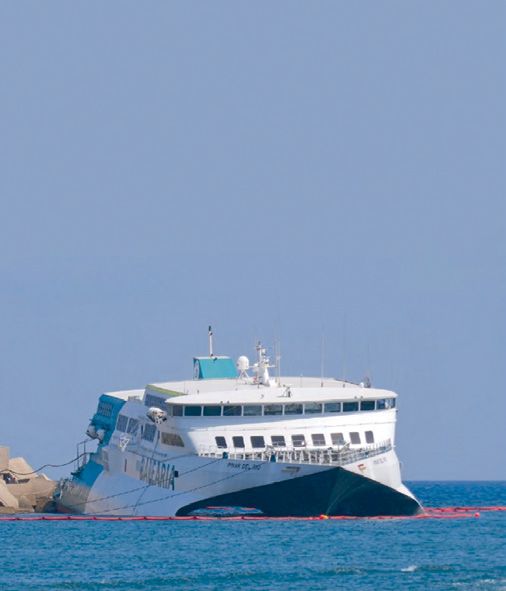
04. P
     ERSIAN GULF
    SECURITY
    U P D AT E
The gravity of the present situation in          under 500,000 bpd), and divestment by           Iran, for its part, sees its campaign
the Persian Gulf was highlighted by the          foreign firms threatened with US sanctions,     working. It was prepared to up the ante
recent drone attacks on strategic Saudi          means that its economy is expected to           recently, when President Hassan Rouhani
oil production architecture. Herminius,          shrink by 4-6% this year; inflation and         warned that Tehran would begin research
specialist advisers to the Joint War Risk        unemployment are sharply up. The weapon         on developing centrifuges to speed up
Committee at Lloyd’s, analysed the crisis        it has chosen to relieve this pressure          Uranium enrichment. Its attacks off Fujairah
and explain the context, informed by their       is a campaign of coercion against the           appear to have driven a wedge between
regular engagement with their contacts in        commercial interests of the US and its          the UAE and Saudi Arabia (the UAE has
the diplomatic and related fields.               allies in the Persian Gulf; the idea appears    drawn down its level of commitment to the
                                                 to be that threatening regional economic        Saudi-led coalition in Yemen since July, and
The departure of John Bolton as US
                                                 and political stability will persuade the US    opened discussions with Tehran to improve
National Security Adviser on 10 September
                                                 to back off, and European signatories of        commercial and diplomatic ties). Its seizure
2019 had prompted speculation of a more
                                                 JCPOA to provide the financial relief that      of the UK-flagged STENA IMPERO tanker
dovish tone from Washington on Iran,
                                                 sanctions have inhibited. This campaign         as a bargaining chip to swap for the
but both President Donald Trump and
                                                 has seen deniable sabotage attacks on           GRACE 1 – detained in Gibraltar in June
Secretary of State Mike Pompeo were
                                                 six merchant vessels in the waters on           – has (in Tehran’s eyes) led to the latter
quick to indicate that there would be no
                                                 either side of the Strait of Hormuz, plus       being freed to resume its transit to Syria
softening of the Administration’s stance
                                                 the seizure of four more, two (Tehran           with sanctions-busting Iranian oil. Fears
on sanctions. This was confirmed by the
                                                 claimed) for oil smuggling. It has also         of the possibility of war in the Gulf have
robust US response to the latest drone
                                                 seen increasingly ambitious attacks on          undoubtedly prompted French President
attacks on Saudi oil infrastructure four
                                                 airports and oil-related infrastructure in      Emanuel Macron’s initiative to launch
days later: the US is ‘locked and loaded’,
                                                 Saudi Arabia by the drones and missiles of      a USD 15 billion credit line for Iran until
President Trump swiftly asserted. The
                                                 Iran’s Yemeni allies, the Houthi movement,      year end. Macron is hoping in return for
situation is both tense and dangerous.
                                                 culminating in the most recent attack on        an end to attacks on merchant shipping,
Conversations with our own contacts              the Abqaiq facility in Saudi Arabia, the        compliance with JCPOA, and a return to
prior to the latest attacks underline the        world’s largest petroleum processing plant,     the negotiating table. Our contacts concur
view that the US remains committed to            which had a direct impact on global oil         that the US remains opposed to this
pushing Tehran into agreeing a new treaty        supplies – and prices. Any rise on oil prices   proposal – and will continue to enforce its
to replace the JCPOA nuclear deal, which         is a plus for Iran’s Islamic Revolutionary      sanctions against any party purchasing
it feels did not do enough to curb Iran’s        Guards Corps (IRGC), which dominates            Iranian oil). What makes the present
nuclear ambitions, and did not address           the smuggling of Iranian oil, and wants         situation particularly dangerous is that the
Tehran’s sponsorship of anti-US and anti-        to achieve higher prices for their product      IRGC is signalling that it is prepared to play
Israeli terrorist and militia groups overseas.   (particularly given it has to be sold at a      hardball. The IRGC has a track record of
The US’s tool has been the application           substantial discount                            success in the region going back years and
of ‘maximum pressure’ short of war. This                                                         is, as yet, unintimidated by the US. In other
                                                 In theory, both sides have an incentive to
has involved pulling out of JCPOA, and                                                           words, the IRGC is prepared to call the US’s
                                                 change course – after all, on 21 June 2019
imposing sanctions on Iran and entities                                                          bluff, while also seeking to drive a wedge
                                                 they came perilously close to head-on
doing business with it, to undermine the                                                         between the US and the EU.
                                                 confrontation, when President Trump chose
deal further. These moves have forced
                                                 at the last minute (and against Bolton’s        So what will the next few months hold
Iran into non-compliance with the deal,
                                                 advice) to cancel a wave of airstrikes meant    for the Gulf? All-out war remains unlikely,
thus reinforcing the US’s position that Iran
                                                 as retaliation for the destruction of a US      if only because neither side wants one;
cannot be trusted.
                                                 drone. Yet the Trump administration sees        President Trump has been a consistent
Iran, for its part, still needs to escape from   Iran under pressure – and thinks that this      opponent of foreign wars throughout
the pressure the US is applying. The 80%+        will bring Tehran to the negotiating table.     his public life, while Iran’s regime knows
cut in its oil exports (from 2.8m bpd to                                                         that hostilities with the US might

10
conceivably lead to the collapse of the sent, and Iranian capabilities degraded, further prejudices the chances of the
Islamic revolution. Of course, this does without war resulting. This has been the release of STENA IMPERO. Furthermore
not rule out an accidental war, provoked reality of past US-Iran confrontations – and the Iranians may see seamen from US
by misjudgement or over-reaction to a the Trump administration is even more and allied states, not just vessels flying
perceived threat. However, both sides have likely to try to contain hostilities than its their respective flags, as bargaining chips;
shown themselves ready to pause on the predecessors. IRGC radio traffic shortly after the STENA
escalation ladder, or even climb down the IMPERO seizure indicated the Iranians’
Where does all of this leave commercial
odd rung, when the situation has seemed disappointment at the lack of any British
shipping in the Gulf? It faces more of the
close to getting out of hand. For as long crew on board, and included orders for
same. We predicted in early September
as it is in the interest of both sides to avoid IRGC naval vessels to be on the lookout for
to our contacts in the insurance sector
war, we expect them to continue to try to British nationals. If the picture surrounding
that further sabotage attacks on tanker
exercise restraint. vessel seizures is still unclear, it is probably
vessels were likely – though not, perhaps,
fair to say that for the moment at least,
But restraint may still mean bloodshed. off Fujairah – as were rocket or drone
Iran will feel the tactic is working. In that
The reality is that the Iranians are playing attacks on Saudi oil infrastructure (- which
light, it would be foolish to assume that
a dangerous game with dangerous duly materialised). The IRGC appears to
Tehran won’t try the tactic again. Evidence
tools, for instance repeatedly testing US be seizing tanker vessels which it believes
that the Iranians may be prepared to up
and allied naval vessels on escort duty are compromising its dominance of the
the ante came on 11 September, when
(escorting British merchant ships through smuggling of Iranian oil; this, too, is likely
news broke that two British-Australian
the Gulf, HMS Montrose has averaged to continue. As for seizures of other
women and one Australian man may have
two confrontations a day with the IRGC vessels as bargaining chips, we do not
been detained in Iran. The situation in the
Navy over the past two months). The yet know how the drama of the GRACE 1
Gulf is set to continue to be extremely
destruction of the US drone in June was (now renamed ADRIAN DARYA 1) will play
tense. Enormous European diplomatic
particularly dangerous, given it was the out. It seems increasingly clear that she
efforts are underway to try to de-escalate
size of a conventional spy plane and the has indeed off-loaded her cargo to the
the situation, but the risk remains – as
Iranians may not have been aware it was Syrians – in breach of written assurances
former UK Foreign Secretary Jeremy Hunt
unmanned; the US has consistently said to the contrary to the UK government.
suggested earlier this year – that we may
it will use force against Iran if US citizens On 10 September 2019, the Iranian
end up with a military confrontation ‘by
are killed. However, US combat power Ambassador was summoned to the FCO
accident’.
is so great that it gives commanders to explain Iranian actions. Given there is a
plentiful alternatives as to how to respond US detention warrant against the vessel,
to Iranian provocation. Signals can be she may well be seized. This turn of events
Educated at Cambridge, Nick is a former diplomat. He has worked in the business advisory
sector since 2011. During his twenty-nine year career with the UK Foreign Office, he
served in South East Asia, the Middle East, Africa and Latin America. His posts at home
and overseas covered a range of thematic issues, including conflict resolution, counter-
terrorism and multi-agency collaboration in the fight against serious crime. At Herminius,
Nick specialises in leading projects to support and advise clients on issues with an
emerging market focus.
Herminius is a London-based strategic advisory firm. Our extensive global network of
NICK BUSVINE OBE, political, economic, security and sector experts and partners provides local, national and
PARTNER AT HERMINIUS international insight, intelligence and in-depth advice. Our clients draw on this advice to
make well-informed and risk-managed decisions, based on in-depth understanding of the
+44 (0) 20 3439 1139
info@herminius.com hidden factors that could support or undermine a key business decision. Herminius have
herminius.com been advisors to JWC since 2004. Key figures at the company include chairman
Jack Gressier, former CEO of Axis Insurance.
1105. P
E R S I A N G U L F : M E R E LY T H E T I P
O F T H E I C E B E R G FO R T H E LO N D O N
WA R R I S K M A R K E T
Marine War: Centuries old and thrust back into focus with events in the Persian Gulf.
Richard Young, Head of Hull & Machinery and War at Lloyd’s Insurer Beazley explores
the history of the War Risks Market, its present challenges and how its future may look.
History
At a time of heightened tension in the Persian Gulf it is claims. This means that Assureds will have certainty that in the
perhaps worth pausing for a moment to look at the history and event of a claim they will receive the best possible service, and,
development of the London war risks insurance market in order more importantly, obtain indemnity for their loss. Certainty in the
to contextualise what is currently going on. Whilst the events in insurance products that a shipowner buys is paramount and war
the Persian Gulf over the last few months may seem shocking, is one of the least certain of all perils. War is difficult to predict
they are entirely consistent with the type of event that the London (although these days there are plenty of security analysts who do
war risks market has been paying claims for over a number of a pretty good job of predicting it) but the uncertainty means it is
centuries. very difficult to price. War risks are by their nature low frequency
but high severity. It is difficult, if not impossible, to build a model
The London War risks market is the largest marine war risks
or algorithm to price for war risks. There will be long periods
market in the world. It is large and viable, willing and able to take
of limited activity and low losses followed by usually shorter
the risks of war and associated perils onto the balance sheets
periods of sustained activity and large losses. Market war rates are
of its respective companies and syndicates. Most insurance
therefore highly volatile. The ability for underwriters to re-price the
companies, war risks mutual and war risks associations writing
risk mid-term via the Notice of Cancellation mechanism is the only
marine war risks worldwide tend to reinsure some, or all, of their
way that war may be written viably and without enormous loss to
war exposures back into Lloyd’s and therefore most war risks
underwriters.
ultimately end up with the Lloyd’s market in London. Lloyd’s has
long been recognised as a market for marine war risks. There The London market is extremely competitive, and the forces of
is a historical reason for this development. In 1720 the British competition serve our Assureds very well. London market war
Government created two Royal Charters which saw the creation risks underwriters are not in a position to enforce a monopoly
of The Royal Exchange Assurance and The London Assurance and to control pricing because if rates are too high new capacity
Company. These companies were given a duopoly in which to will come into the market to take advantage of the perceived
operate and “all other companies or partnerships were legally profits. Or existing underwriters will seek to grow their war books
excluded from underwriting maritime risks”1. The structure of at the expense of others by under-cutting them. Whenever
Lloyd’s, in which private individuals underwrote risks for their there is a new global hotspot there is usually a period of price
own personal account, meant that they could continue to operate discovery when there will be as many different rates as there
outside of this State approved duopoly as they were neither are underwriters. However, over time the invisible hand of the
companies nor partnerships. And this scheme “resulted in the market pricing mechanism works and something resembling a
creation of a two-tier maritime insurance system in which the “market price” is established. There will always be outliers, some
chartered companies assumed a rather conservative attitude to underwriters will charge more and others less, depending on their
risks and enterprise, and the merchants/underwriters at Lloyd’s own loss experience and understanding of the risk. In order to
engaged in underwriting large and at times highly speculative complete the larger and more complex risks, a certain consensus is
risks” .
2
usually required.
Many ship-owners choose to buy their war risks from Lloyd’s and There was a time when war risks formed a greater risk and a larger
the London company markets. The London insurance market has part of an underwriter’s account than non-war risks. In these
a huge amount of experience in the underwriting of war risks times of heightened tension it may be that we see this balance
and the English legal system has an extensive volume of case law shift again. Until 1983 Lloyd’s underwriters wrote on the SG Policy
and precedent going back hundreds of years relating to war risks form and would underwrite both war and non-war risks on the
1. Lobo-Guerrero, Insuring War (2013)
2/3. Ibid.
12same policy. War risks could be excluded by means of the “Free that by insuring fleets at time of war in the 1700s and 1800s and
of capture and seizure” clause. It is interesting to note that benefiting from the Royal Navy’s efforts to keep sea lanes open
“capture” and “seizure” represented the earliest embodiment for trade that London underwriters interacted with Government
of war risks in the historical development of the market. The to the extent that insurance was used as an “instrument of
war risks market as we currently know it has its origins in the war”. By acting in partnership with the Government and the
American War of Independence (1775-1783), the various Anglo- Royal Navy a system of “reciprocity and responsibility” could
Dutch wars and the Napoleonic Wars (1803-1815). Large numbers exist. “The cash flow derived from the collection of insurance
of merchant vessels and their cargoes were lost during these premiums would constitute investment capital with which to
wars and, by way of example, in 1779 alone 656 ships were lost buy Government debt, which was badly required for supporting
to war perils. military efforts…”3
Luis Lobo-Guerrero in his 2013 book “Insuring War” looks at
the marine underwriter’s “consciousness as a stakeholder in
the security and economic success of the state”. He points out
13Present Challenges
War market figures could be used as a at the time of writing, there are as many as consequences of the freight market
crude barometer to gauge global tensions. nine cases of potential restraint or seizure turning against him. This would be a form
It is reasonable to expect at times of global of vessels ongoing around the world of financial guarantee. It is not the business
calm that the war market will return lower with cases in Venezuela, Egypt, Bulgaria, of war risks underwriters to guarantee the
loss ratios, but on a smaller premium Indonesia, Nigeria, Philippines, Ukraine, success of a speculative venture. A fortuity
base. The recent gross over capacity in Russia, as well as the high profile cases in is required to trigger an insurance policy
the Lloyd’s, London and global insurance Iran. Many of these cases appear to turn of indemnity. Most vessels that are entered
market coincided with a period of wider on charter party disputes, title disputes with IGA Clubs should be able to avail
global calm. As hull and machinery or alleged customs infringements. Very themselves of a Club Letter of Undertaking
rates tumbled underwriters have been few are really war losses as defined in the in the event of an arrest in the ordinary
increasingly drawn to the perceived profits Institute War Clauses, six of the nine above course of trading. Such a Club Letter
contained within the ‘W’ and ‘WB’ risk locations are not within the Joint War should secure the release of the vessel and
codes causing a bloody battle for market Committee listed areas so underwriters has long played an essential role in world
share resulting in a slide of rates and would not be able collect additional trade, keeping ships and their cargoes
potentially more dangerously a widening premium for this exposure having to moving whilst disputes are settled later.
of wordings. I would argue that war risks therefore fall back on the annual premium
So if the war policy doesn’t cover arrest
underwriters are still charging far too to cover these potential losses should they
from infringement of customs regulations
little for the exposures they are taking on. come home to roost. Are annual premiums
or the operation of ordinary judicial
Pricing of annual war is at all-time lows. currently sufficient to cover these?
process or other financial cause then
Our records suggest that annual war rates Certainly not.
what does it cover? The answer is it
have reduced by approximately 90%
The War Market does have standard covers the warlike actions of States or
since 2002. The annual war rate covers
exclusionary language within the Institute their representatives. Confiscation and
worldwide navigation and the additional
War Clauses which excludes losses from: Expropriation are covered and these
premium mechanism in theory covers the
are extremely important perils to have
increased risk arising from trade to a Listed
arrest restraint detainment
confiscation or expropriation insured. It would be hard to argue that the
Area. Given that the marine war policy
under quarantine regulations or by seizure of the “Stena Impero” is anything
covers terrorism and malicious damage,
reason of infringement of any other than a war loss of the sort that
which could happen anywhere at any
customs or trading regulations underwriters have in mind when they are
time, it seems as though the annual rate is
providing cover. Where things are not
extraordinarily low in many cases. and from
black and white tends to be when a vessel
the operation of ordinary judicial
The stand-alone war market developed to seizure is as a result of a rogue local court
process, failure to provide security
write the Free of Capture & Seizure risks acting outside of its remit or corruptly.
or to pay any fine or penalty
and in the fullness of time further perils
or any financial cause. Confiscation and Expropriation were not
were added into this coverage Michael
The marine war market has been insured perils under the old SG policy and
Miller’s brilliant “Marine War Risks” is
presented with claims arising from only appeared from the early 1980s in the
extremely helpful in understanding these
these events. Most are not covered. The Institute War Clauses.
perils, how they migrated over time into
exclusionary language above makes that The little used Institute War & Strikes
the war policy and for comparing and
clear. It would be against public policy Clauses – Limited Conditions (Cls 300) do
contrasting the subtle difference between,
to provide insurance for illegal acts or to not contain the perils of Confiscation and
say, capture and seizure. Miller writes:
insure companies that willingly infringe Expropriation. It may be argued that these
“when there are no widespread hostilities,
customs regulations. It is not possible “political risks” perils are not really priced
such as world war, “restraint” and “seizure”
to insure the consequences of an owner adequately by the market. They appear
are the commonest form of war risk
entering into a bad charter or for the as standard in Cls 281. It may be that if
losses”4. This has never been truer. Indeed,
14the war market finds itself paying a large number of confiscation wisely on infrastructure and education. Guyana is at a crossroad. It
and expropriation losses then the appetite to give this cover may could become the new Norway or the next Nigeria. What impact
evaporate and we might see Cls 300 in greater use. Or, more would that have for War Risks if it were to become the later?
likely, underwriters will begin to price each peril within the clauses
We are living in a time of heightened international tension. In
adequately.
“The Improbable War” (2015) Christopher Coker looks at the
The world is a dangerous place and increasingly unpredictable. possibility and potential inevitability of Great Power conflict.
It is not clear where the next war hotspot will be. It may well be This is the Thucydides Trap. He writes that Great Powers need to
that the South China Sea becomes the crucible of the next major “weave strategic narratives that are believable”. He points out that
marine war event. It may equally be somewhere that is currently “in the absence of a compelling grand strategy, nations can find
peaceful and calm. themselves sleepwalking to disaster as happened in 1914”6. A large
number of commenters have suggested that the current retreat
Whether it is the South China Sea, the Black Sea, the Gulf of Aden
from globalisation bears ominous parallels to the period leading up
or the Straits of Hormuz, there are a number of Maritime flash
to World War I. As Gideon Rachman wrote in the Financial Times
points at the moment and we should not be too surprised to see
on 9th August 2019 the world is an increasingly confused place.
further provocations and even further vessel confiscations. This
American credibility has been undermined. For the United States
is something that has happened for hundreds of years and will
“to maintain its status as a superpower and a world policeman
continue to happen. War rates will probably need to rise further to
then its international commitments must be clear and believable”.
make good the losses sustained to date in 2019 as well as pricing
However, at present US foreign policy is often unpredictable. The
in the current enhanced risk in many international hot spots.
current situation in the Persian Gulf seems intrinsically linked to
In “The Coming Anarchy” (Robert D Kaplan, 2000) the author American foreign policy in an increasingly confused and changing
talks about “distinctions between war and crime breaking down.” global system.
We already see this in some countries that exhibit a constant level
of low intensity conflict. In West Africa in general and Nigeria in
particular criminal gangs for hire might be blowing up a pipeline
one week or attacking a vessel another week. These gangs
increasingly see the business model of kidnap for ransom as
more lucrative than the dwindling amnesty payments they may
have received from the Government for giving up their politically
motivated actions. Whether or not they were in receipt of amnesty
payments the military factions in Nigeria are still looking for
sources of revenue and attacks on shipping can be expected to
continue for the foreseeable future, in the first half of 2019 75
seafarers were taken hostage globally of which 62 were captured
in the waters of the Gulf of Guinea5. Until the massive structural
challenges are addressed and the crucial truly independent
institutions are established in corrupt countries such as Nigeria
there is no suggestion that these attacks will abate. Transparency
International defines corruption as “the abuse of entrusted power
for private gain”. Sadly, one sees this all over the world, and in
the developed world as well as the developing world. Many large
western multinationals have been fined for corruption in recent
years. One fears for Guyana. The discovery of huge oil reserves
which are now moving into the production phase will lead to
billions of dollars in new oil wealth flowing into the country. Unless
corruption can be managed we can expect to see the all too
familiar sight of politicians enriching themselves at the expense of
their impoverished populations. The massive disparity in wealth
between those who enrich themselves and the general population
will, in such circumstances, create anger. This will eventually lead
to unrest. One hopes that Guyana will follow the Norwegian model 4. Michael D Miller, Marine War Risks (2005)
5. IMB Half Year Piracy Report (2019)
of building up a sovereign wealth fund and spending the money 6. Christopher Coker, The Improbable War (2015)
15The Future
The events of the last couple of months in the Persian Gulf power conflict; the opening skirmishes of which would almost
highlight several different issues which are worth touching on. certainly take place in cyber space. It is certain that the maritime
industry would be drawn into such a war. “The policy of attacking
The first of these is sanctions. Vessels calling to Iran need to
the sea-borne trade of an enemy is no new thing. It has always
be very mindful of the US sanctions regime. Most Lloyd’s and
played an important role in maritime warfare” (Hill, State War
London market insurers are now unable to provide cover for any
Insurance against War Risks at Sea, 1927).
vessels calling to Iran. This is due to a combination of factors
including, internal risk appetite, reputational risk, inability to rely There has been suggestion that the “Stena Impero” may have been
on reinsurance, inability to process premiums/claims funds and led off course by GPS spoofing. If this turns out to be the case it
the very real risk of being shut out of the US dollar trading system. will be very interesting to see whether this is deemed to be a cyber
Increasingly P&I clubs and banks are also taking action to protect attack. Would the Institute Cyber Attack Exclusion Clause come
their own positions too. The recent Kunlun Nord/LB case appears into play here? Various forms of cyber cover are starting to appear
to show that shipowners in apparent breach of sanctions run the and it does appear that a vigilant owner should avail themselves
risk of having their cover pulled and therefore being in breach of this coverage. The shipping world has been seen to be relatively
of mortgage agreements with their banks. Potentially leading to unprepared for cyber attacks. The IMO recommendations coming
arrest and judicial sale. into force in January 2021 make cyber preparedness a key part of
the vessel’s ISM.
It appears that the sanctions regime is ratcheting up and the
penalties for breaching sanctions are severe for shipowners and At the time of writing the “Stena Impero” is still being held.
potentially their banking and insurance partners. It does seem One hopes that the Stena crew are in good health and not too
remarkable that in 2019 we still do not always know where the tormented by their time in captivity. It is worth remembering that
ships we insure are currently trading. It is too easy for an owner most marine hull war will include war P&I up to the H&M value.
to instruct their masters to turn off their AIS and go dark. Not This is of huge value and is another example of the market selling
knowing where a vessel is leads to a situation of asymmetric its products incredibly competitively. If any of the six tankers that
information. This is nothing new. Insurers are always asked to make were attacked by mines in May and June had been a total loss then
decisions in the absence of complete information. But we need to the marine hull war policy might also have had a very expensive
be able to do this in Good Faith. Way back in 1663 Samuel Pepys war P&I claim. It would not be too difficult to imagine a situation
noted in his diary “what an opportunity had I to have concealed in which the hull war policy pays out for a total loss of the vessel,
this (news about the safety of a ship) and seemed to have made removal of wreck and pollution. Shipowners should keep in mind
an insurance and got £100 with the least trouble and danger in how much cover they are buying for a modest additional premium
the whole world”. He was talking about the potential for trading each time they call into a Listed Area.
on inside information, knowing the whereabouts and safety of a
The issue of detainment is an interesting one. Detainment is a
vessel which was not yet widely known. With the advent of the
peril within 1.2 of Cls 281 but the Detainment Clause itself
internet and the extraordinary speed of global communications
(Clause 3) is a clause that acts on all of the perils listed to define
we can look up vessels on various systems that are commonly
when a constructive total loss would be payable:
available. However, these are still reliant on the vessels transmitting
their position via AIS, itself a relatively recent development. Only In the event that the Vessel shall have been the subject of capture
twenty or so years ago Lloyd’s underwriters were reliant on news seizure arrest restraint detainment confiscation or expropriation,
of vessel casualties coming in from the Lloyd’s Agency network and the Assured shall thereby have lost the free use and disposal
around the world and being posted on the Loss Boards in Lloyd’s. of the Vessel for a continuous period of 12 months then for the
A weekly “pink sheet” would be circulated to marine underwriters purpose of ascertaining whether the Vessel is a constructive total
which detailed vessel casualties. These days the internet provides loss the Assured shall be deemed to have been deprived of the
instant updates on vessel positions and most underwriters can possession of the Vessel without any likelihood of recovery.
look up the vessels they are covering to see where they are, While the market was soft the 12 months contained in the clause
where they have been and where they are going next. There are was often amended to 6 months. These days most underwriters
now providers of software services to track vessels by satellite are leaving this unchanged at 12 months. 6 months is much too
when they go dark. I would expect to see this become more short, so much can change in the early days of a vessel seizure,
widespread as this service is useful to banks and insurers as well as and the key is “without any likelihood of recovery”. After 6 months
government agencies. there is still every likelihood of getting the vessel back and the
Wars have started for minor reasons in the past and it is not hard shipowner would be in the best position to do so. In the event of
to imagine a situation in which a miscalculation sets rival states on further vessel seizures it may be that underwriters seek to toughen
pathways to escalation from which they cannot come back. It may their stance still further on this clause, and amend it to 24 months
be that a misstep by the USA or China leads us into a new great for example.
16RICHARD YOUNG
HEAD OF MARINE HULL & WAR –
BEAZLEY GROUP
+44 (0)20 7674 7588
richard.young@beazley.com
Conclusion
The events for the past few months have thrust the Marine Ship-owners need to consider the security of their war risks
War Insurance market back to the forefront of global shipping. providers carefully. Their brokers can advise on this. London
The ”Stena Impero” remains captive in Iran and six vessels are market war risks underwriters can assemble well in excess of
suspected to have had limpet mines attached and detonated on USD 1 billion of capacity for war risks but they need to be
their hulls. The threat of further vessels seizures remains high and remunerated for this. With fewer and fewer Lloyd’s syndicates
the threat of further attacks on shipping by mines or other means the market’s capacity is diminishing. This is a natural result of the
is also high. The war risks market will respond to these losses as it appalling losses that have been sustained in Hull & Machinery and
always has done. All valid claims will be paid. However, for the war other lines of business. As capacity and choice diminishes prices
risks market to take on the billions of dollars of global shipping will go up and potentially quite a lot.
exposures it needs to take adequate consideration for the risks.
“In finance, everything that is agreeable is unsound and everything
The mechanism of charging additional premiums is the primary that is sound is disagreeable.”
way underwriters can hope to achieve anything approaching
Winston Churchill can usually be relied upon to say the wisest
adequate consideration for the risks they take on. Even here the
words and his comments on finance hold for marine war insurance,
war market remains hopelessly soft. Of every additional premium
it probably feels disagreeable to be paying more premiums,
that is paid less than half will make it to the underwriters by the
however in today’s world that is because it is sound to do so.
time NCBs, PCs and brokerage are taken into account. But what
of the potential losses far away from the Arabian Gulf in countries Beazley is a specialist insurer with three decades of experience
outside of the listed areas where no additional premium can in providing clients with the highest standards of underwriting
be charged? Is the market currently charging enough annual and claims service worldwide. All our insurance businesses are
premiums to cover potential losses? Terrorism can occur rated A (Excellent) by A.M. Best. Beazley is a proud participant
anywhere, corruption sadly exists across the globe. The value in the Lloyd’s market, the largest and oldest insurance market in
of the top ten shipping nation’s fleets is thought to be in excess the world. Through the Lloyd’s broker network and the market’s
of USD 500 billion. It is likely that their combined total annual trading licenses, we are able to access a wide range of insurance
war premiums in are significantly less than USD 100 million. This and reinsurance businesses from around the world.
is barely enough to pay for one large value total loss, let alone
pollution and wreck removal or injuries or death to crew members.
1706. W
AR AND
P I RACY N E WS
Seized MT Badr Sets Sail not have corporate legal status that allows GNMTC claims the letter of award was
from Burgas, them to be a valid party in any court forged and that the order did not enter
Re-Flagged and Renamed procedures, being a consortium of three into valid legal force.
companies Moran West Ltd, Moran Trade
“The basic starting activities of the auction
The Libyan-flagged crude oil tanker and Tectona Ltd.
as well as some of the formalities and
MT Badr, that was seized by Bulgarian
Separately, press office of Bulgargeomin documents concerned were finally revoked
authorities in 2017, has been renamed and
said in a statement that all the documents by the District Court of Bourgas on
taken over by Bulgarian-based oil and
seeking damages and MT Badr as 21 December 2018 which makes the whole
gas contractor Bulgargeomin, the General
collateral were legitimate, in line with auction invalid and the vessel need to be
National Maritime Transport Company of
the contract from 2013 signed by considered as not sold at all. Unfortunately,
Libya (GNMTC) said in an update, stressing
Hristina Ivanova Stamova, liquidator of the judgment is dated on 21 but it was
the transfer of ownership was illegal.
the state owned Bulgargeoin EAD and visible as text on 27 December,”
As informed, the ship left Burgas Bulgargeomin. The company added that GNMTC further stressed.
anchorage on 28 December 2018, with it was the only bidder in the subsequent
On the other hand, GNMTC claims that
a new crew on board, with the sailing official public auction for the sale of MT
the reflagging was based on “misleading
permission issued by the Bulgarian Marine Badr, which was awarded to Bulgargeomin
documents” as Bulfarfeomin claimed
Administration and provisional Panama- LTD in the presence of both sides of
it was the new owner, which GNMTC
flag certificate. GNMTC said that the the case. “As a legitimate owner of MT
denies to be true. The company noted
provisional flag was revoked by Panama’s Badr by virtue of award of ownership
that the process is underway of returning
Maritime Authority a day before the ship certificate (Write of Ownership) on
the ship to Libyan flag registry.“From 21
left the port, slamming the actions as movable property (MT Badr) dated at 30
to 27 December, all relevant authorities
illegal. August 2018, entered into full legal force
were informed of all the details and were
The sequence of events followed Badr’s on 15 September 2018, and not subject to
officially informed about these illegal
seizure by Bulgarian border police on 21 appeal, Bulgargeomin changed the flag
actions – the Prosecution, the Ministry of
December, while at Burgas anchorage, and register as the new owner of the ship.
Justice, the Ministry of Internal Affairs, the
and subsequent removal of the ship’s On 13 December 2018, the Panamanian
Border Police, the Marine Administration
crew from the vessel.The ship had been Maritime Authority issued a provisional
and the Ministry of Foreign Affairs,”
detained by the Port Authority of Burgas registration certificate for MT Badr with
GNMTC said, adding that the transfer of
since November 2017 over an alleged a registered new owner “Bulgargeomin
the vessel possession is being appealed.
unpaid mortgage to Bulgargeomin. The Ltd” DZZD, and a new name Bdin,” the
company denied the claims that it owed a statement reads.
USD 9.23m mortgage on the crude oil
carrier, saying the mortgage was falsified.
In January 2018, the Bulgarian Supreme
Court ordered the vessel’s release,
however, the vessel remained in detention
ever since.
Furthermore, according to the court
documents, dated November 2018, the
translation of which was provided by
GNMTC to World Maritime News, the
Supreme court cancelled the order for
the seizure of the ship, and ordered
Maritime Administration to compensate
GNMTC damages for legal proceedings.As
disclosed, the court decided that BGM did
18You can also read


