Mark Scheme (Results) January 2021 - Pearson Edexcel International Advanced Level In Biology (WBI14) Paper 01 Energy, Environment, Microbiology ...
←
→
Page content transcription
If your browser does not render page correctly, please read the page content below
Mark Scheme (Results)

January 2021

Pearson Edexcel International Advanced Level
In Biology (WBI14)
Paper 01 Energy, Environment, Microbiology
and Immunity
Edexcel and BTEC Qualifications

Edexcel and BTEC qualifications are awarded by Pearson, the UK’s largest awarding
body. We provide a wide range of qualifications including academic, vocational,
occupational and specific programmes for employers. For further information visit
our qualifications websites at www.edexcel.com or www.btec.co.uk. Alternatively,
you can get in touch with us using the details on our contact us page at
www.edexcel.com/contactus.

Pearson: helping people progress, everywhere

Pearson aspires to be the world’s leading learning company. Our aim is to help everyone
progress in their lives through education. We believe in every kind of learning, for all kinds of
people, wherever they are in the world. We’ve been involved in education for over 150 years,
and by working across 70 countries, in 100 languages, we have built an international
reputation for our commitment to high standards and raising achievement through
innovation in education. Find out more about how we can help you and your students at:
www.pearson.com/uk

January 2021
Publications Code WBI14_01_2101_MS
All the material in this publication is copyright
© Pearson Education Ltd 2021
General Marking Guidance

           •   All candidates must receive the same treatment. Examiners
               must mark the first candidate in exactly the same way as
               they mark the last.
           •   Mark schemes should be applied positively. Candidates must
               be rewarded for what they have shown they can do rather
               than penalised for omissions.
           •   Examiners should mark according to the mark scheme not
               according to their perception of where the grade boundaries
               may lie.
           •   There is no ceiling on achievement. All marks on the mark
               scheme should be used appropriately.
           •   All the marks on the mark scheme are designed to be
               awarded. Examiners should always award full marks if
               deserved, i.e. if the answer matches the mark
               scheme. Examiners should also be prepared to award zero
               marks if the candidate’s response is not worthy of credit
               according to the mark scheme.
           •   Where some judgement is required, mark schemes will
               provide the principles by which marks will be awarded and
               exemplification may be limited.
           •   When examiners are in doubt regarding the application of
               the mark scheme to a candidate’s response, the team leader
               must be consulted.
           •   Crossed out work should be marked UNLESS the candidate
               has   replaced   it  with   an   alternative  response
Question Answer Additional guidance Mark
number
1(a)(i) An answer that includes two of the following points: All 3 correct = 2 marks
1 or 2 correct = 1 mark
• pain / hurts / tender / aches / throbbing / dolor IGNORE itching
• redness / red / rubor IGNORE rash
• warmth / heat / hot / increased temperature / calor IGNORE fever
• loss of function (2)
Question Answer Additional guidance Mark
number
1(a)(ii) An answer that includes two of the following points: NB CE from (i)
• pain alerts the person that there is an injury (1) ACCEPT to avoid {contact with area /
using the injured part}
• warmth speeds up {chemical reactions / skin cell division ACCEPT reduce activity of bacterial
/ phagocytosis / increases rate of enzyme activity (of enzymes / reduce growth of bacteria
person) / defence mechanisms} (1)
• swelling results in more {blood / white blood cells /
platelets / phagocytes / antibodies/ tissue fluid} (to the
wound) (1) * two different ideas must be
given to award 2 marks
• redness results in more {blood / white blood cells / (2)
platelets / phagocytes / antibodies} (to the wound) (1)Question Answer Additional guidance Mark
number
1(b)(i) An answer that includes the similarity and two of the three differences: DO NOT PIECE TOGETHER but accept
in adjacent sentences
Similarities: ACCEPT converse where appropriate
turmeric for curcumin
• (overall) both treatments decrease inflammation (1)
Differences:
• curcumin is more effective than drug A (throughout) (1) IGNORE references to rate
• maximum decrease for drug A is less than that for curcumin
(1)
e.g. inflammation increases {2 / 4}
• credit a comparison at specific days (1) days after operation with drug A but
increases after day 3 with curcumin
extract (1) (3)
Question Answer Additional guidance Mark
number
1(b)(ii) The correct answer is C 33.3 (g)
A is incorrect because 0.03g contains 0.009g curcumin
B is incorrect because 3.33g contains 0.1g of curcumin (1)
D is incorrect because 33.3 recurring has been rounded incorrectlyQuestion Answer Additional guidance Mark
number
2(a) An explanation that includes two of the following points: NB Do not accept if clear confusion
with antibodies
• antibiotics used to treat impetigo and whooping cough
because they are caused by bacteria (1)
• antibiotics not always used to treat middle ear infections ACCEPT because some of the bacteria
or sinus infections as they {can be caused by viruses / as are resistant to antibiotics
they are not always caused by bacteria} (1)
• antibiotics not used to treat multiple sclerosis or IGNORE any ref to cause
rheumatoid arthritis as they are not caused by bacteria
(1)
ACCEPT antibiotics used for bacterial (2)
infections if no other marks awarded
Question Answer Mark
number
2(b)
The only correct answer is B.
A is incorrect because bactericidal antibiotics decrease the number of bacteria
C is incorrect because antibiotics do not increase the number of bacteria (1)
D is incorrect because antibiotics do not increase the number of bacteriaQuestion Answer Additional guidance Mark
number
2(c)(i) An explanation that includes the following points:
• to compete with (pathogenic) bacteria for {nutrients / IGNORE food
named nutrient / space} (1) ACCEPT produce {toxins / chemicals}
• so they {reduce / destroy / prevent the growth of} ACCEPT so that they do not increase in (2)
(pathogenic) bacteria (1) number and cause disease
Question Answer Additional guidance Mark
number
2(c)(ii) An explanation that includes the following points:
• (because gut flora contain) bacteria (1)
• and antibiotics are not (generally) specific to one type of ACCEPT antibiotics {can affect different
bacteria (1) types of bacteria / can be broad (2)
spectrum}
Question Answer Additional guidance Mark
number
2(c)(iii) (1)
6 7
• accept a value between 9 × 10 and 1.2 × 10Question Answer Additional guidance Mark
number
2(c)(iv) An answer that includes the following points: ACCEPT descriptions in terms of
resistance and susceptibility but not
immunity throughout
ACCEPT correct references to
bactericidal and bacteriostatic
• antibiotic P kills all but three types (1) ACCEPT kills 4 types / kills type A but
has limited effect on type B
• antibiotic Q only kills two types (1) ACCEPT results in the presence of a
new type / reduces the number of type
A and type B
• antibiotic R has no effect (on gut flora / types A and B) (1) (3)Question Answer Additional guidance Mark
number
3(a) A description that includes four of the following points:
• vaccine contains an {inactive / attenuated} form of the ACCEPT antigen (found on the
{pathogen / virus / bacteria / microorganism} (1) pathogen) / weakened pathogen
DO NOT ACCEPT dead {virus /
• macrophages engulf and display antigen on cell surface antigen}
(1)
• macrophages will present the antigen to T helper cells ACCEPT macrophages become
(1) antigen-presenting cells + description
to T helper cells
ACCEPT description e.g. T helper cells
• T helper cells will activate {B / T killer} cells (1) release cytokines that cause B cell
proliferation (4)
• (T / B) memory cells produced (1)Question Answer Additional guidance Mark
number
3(b)(i) A description that includes the following points:
• conclusion relating trust in scientists to income (1) e.g. trust goes down (slightly) with increase in
income
• conclusion relating trust in scientists to vaccine safety e.g. people who agree that vaccines are safe
(1) trust the scientists the most
e.g. at all incomes, there are people who
• conclusion relating income to vaccine safety (1) agree, neither agree nor disagree and
disagree that vaccines are safe (3)Question Answer Additional guidance Mark
number
3(b)(ii)
education / (influence of) {media / family / friends / previous experiences with {vaccines /
internet} / religious beliefs medications}
ethical beliefs
fear of needles
lack of trust in testing process
allergies
side effects
more money for {treatment / healthcare} (1)
medical insurance
Question Answer Additional guidance Mark
number
3(c) An answer that includes two of the following points:
• vaccinated people will {not / be less likely to} develop the IGNORE less likely to be infected
disease / vaccinated people will be immune (1)
• fewer infected people to infect people who are not immune ACCEPT herd immunity
(1)
e.g. allergic to vaccines,
• protect people who cannot become immune (1) immunodeficient, (2)
immunosuppressedQuestion Answer Mark
number
4(a)(i)
The only correct answer is B.
A is incorrect because oxygen is not a greenhouse gas
C is incorrect because oxygen is not a greenhouse gas (1)
D is incorrect because oxygen is not a greenhouse gas
Question Answer Additional guidance Mark
number
4(a)(ii) An answer that includes the following points:
• (anthropogenic) caused by the effects of humans (1) IGNORE named activities
• (climate change) changes to (mean) {temperature / rain fall} (1) ACCEPT long-term (mean) change in
weather patterns
IGNORE weather unqualified / global
warming / results of global warming /
climate (2)Question Answer Additional guidance Mark
number
4(b) An explanation that includes the following points:
• species distributed more towards the North (1) ACCEPT move away from the equator (northwards) /
move towards the (North) pole
IGNORE upwards
• this distribution related to a described change in e.g. because the temperatures have become too hot,
climate (1) move to a cooler area, areas have become drier,
areas have become wetter, drought
• the effect of this change explained (1) e.g. so the enzymes do not work effectively enough
(to sustain that species), their prey have migrated
(North), they would become dehydrated, plants they
feed on die, lack of food (3)
Question Answer Additional guidance Mark
number
4(c)(i) A description that includes the following points:
• temperature (that a beetle was kept at) affects males more than ACCEPT temperatures higher than
females (1) 35°C causes a greater decrease in
offspring in males than females
• the optimum temperature (for keeping both beetles) is 35°C (1) ACCEPT males at 35°C and females at
38°C / optimum is between 35°C and
38°C (2)Question Answer Additional guidance Mark
number
4(c)(ii) An explanation that includes three of the following points:
• there are fewer (successful) fertilisations by males / (successful) ACCEPT offspring for fertilisation
fertilisations are not (as) affected in females (1)
• the sperm are damaged by higher temperatures / egg cells are
not (so) affected by higher temperature (1)
• higher temperatures decrease sperm {viability / motility} (1) ACCEPT higher temperatures make the
egg cell easier to penetrate
• (higher) temperatures could affect {the acrosome reaction / ACCEPT enzymes of females have a
sperm enzymes / male enzymes} / (higher) temperatures do not higher optimum temperature than the
(really) affect {egg cell / female} enzymes (1) enzymes of {sperm / males}
NB If no other marks awarded, credit a
correct description of the effect of
temperature on enzyme activity (3)Question Answer Additional guidance Mark
number
5(a)(i) An explanation that includes three of the following points:
• because ATP is the source of energy for {plants / all living organisms} ACCEPT ATP is the {usable source
(1) of energy / energy currency}
• because light energy cannot be used (directly) (1)
• ATP is needed in the {light-independent reactions/ Calvin cycle} to (2)
convert GP into GALP (1)
Question Answer Additional guidance Mark
number
5(a)(ii) An answer that includes the following points:
• (ADP / adenosine diphosphate) and (inorganic) {Pi / phosphate / ACCEPT adp
PO4 3- (ion)} (1) DO NOT ACCEPT P / phosphorus
• hydrolysis (1) ACCEPT dephosphorylation (2)Question Answer Additional guidance Mark
number
5(a)(iii) An explanation that includes three of the following points:
• to {release / excite} electrons (from chlorophyll) (1)
• so that electrons can be used in {chemiosmosis /
(photo)phosphorylation} (1)
• photolysis to {replace electrons lost by chlorophyll /
provide protons for formation of reduced NADP (1)
• to produce ATP and reduced NADP for the {light-
independent reactions / Calvin Cycle} (1) (3)
Question Answer Mark
number
5(b)(i)
The only correct answer is D.
A is incorrect because ATP is not available to light-dependent reactions in cyclic photophosphorylation
B is incorrect because ATP is not available to light-dependent reactions in cyclic photophosphorylation (1)
C is incorrect because oxidised NADP is not producedQuestion Answer Additional guidance Mark
number
5(b)(ii) An answer that includes the following points:
• C and O from carbon dioxide (1) ACCEPT CO2
• H from water (1) ACCEPT H2O
DO NOT ACCEPT O from water (2)
Question Answer Mark
number
5(b)(iii)
Neither
New biological Both nitrates
Nitrates Phosphates phosphates nor
molecule and phosphates
nitrates
protein X
RNA X
triglyceride X
(3)Question Answer Additional guidance Mark
number
6(a)(i) An explanation that includes the following points:
• mutation (in the DNA) causing allele for resistance to the new ACCEPT forming a (new) gene for
chemical (1) resistance
DO NOT ACCEPT immune for resistant
selection pressure
causes mutation
• (new) chemical acts as a selection pressure (1)
• resistant flies survive and pass this {(new) gene / allele} onto their DO NOT ACCEPT immune for resistant
offspring (1) (3)
Question Answer Additional guidance Mark
number
6(a)(ii)
flies have a short life cycle / high mutation rate in flies / flies produce DO NOT ACCEPT selection pressure
many offspring / chemical is a strong selection pressure causes mutation (1)Question Answer Additional guidance Mark
number
*6(b) Indicative content:
Graph:
• black stripes reduce number of biting flies on body and legs (D)
• 128 down to 111 / by 17 / by 13% (D)
• this may not be significant as error bars overlap (D)
• black and white stripes reduce number of biting flies on body and legs (D)
• 128 down to {57/58} / by {70/71} / by 55% (D)
• probably significant as error bars do not overlap (D)
• black and white stripes reduce the number of biting flies on body and legs more
than just black stripes (C)
• 111 down to {57/58} / by {53/54} / by {48/49}% (C)
• probably significant as error bars do not overlap between the two groups of
painted cattle (C)
• error bar for black stripes is 17% and 17% for black and white stripes (C)
Table 1:
• black stripes reduce number of biting flies on legs but not on body (D)
• 1309 down to 1030 / by 279 / by 21% (D)
• black and white stripes reduce number of biting flies on body and legs (D)
(body) 662 down to 231 / by 431 / by 65% (D)
(legs) 1309 down to 710 / by 599 / by 46% (D)
• black and white stripes reduce the number of biting flies on body and legs more
than just black stripes (C)
• (body) 677 down to 231 / by 446 / by 66% (C)
• (legs) 1030 down to 710 / by 320 / by 31% (C)
Table 2:
• black stripes have no effect on {flicking tail / stamping feet / twitching} (D)
• black and white stripes have very little effect on {flicking tail / stamping feet} (D)
• black and white stripes have small increase on skin twitching (D)
• 5 up to 8 / by 3 / by 60% (D)Level 1 1 mark : description of data from one source 2 marks : description of data from two sources Level 2 3 marks : comparison made between black stripes only and black and white stripes, from one source of data 4 marks : two comparisons made between black stripes only and black and white stripes, from two sources of data Level 3 5 marks : two comparisons made between black stripes only and black and white stripes, from two sources of data + level 2 maths calculation OR a comparison of the error bars between black stripes only and black and white stripes 6 marks : two comparisons made between black stripes only and black and white stripes, from two sources of data + level 2 maths calculation AND a comparison of the error bars between black stripes only and black and white stripes (6)
Question          Answer                                                                                                                Mark
number
7(a)(i)
                    The only correct answer is C.

                  A is incorrect because DNA polymerase is used to synthesis DNA
                  B is incorrect because integrase inserts DNA into other DNA                                                           (1)
                  D is incorrect because reverse transcriptase synthesises DNA using a RNA template

Question   Answer                                                                       Additional guidance                             Mark
number
7(a)(ii)   An explanation that includes three the following points:                     IGNORE incorrectly named enzyme from part
                                                                                        (i)
              •   because restriction enzymes recognise specific (base) sequences
                  (1)                                                                   ACCEPT different enzymes cut at different
                                                                                        sites
              •   because these recognition sites are not equally spaced along the
                  DNA (1)                                                               ACCEPT different cutting sites will result in
                                                                                        different length fragments
              •   the enzyme hydrolyses the phosphodiester bonds (1)
                                                                                        ACCEPT breaks
              •   therefore different sized fragments move different distances                                                          (3)
                  through the gel (1)                                                   ACCEPT different speeds
Question Answer Additional guidance Mark
number
7(b)(i)
• 0.2 (1)
• 794 / 871 / 873 / 1000 (1) (2)
Question Answer Additional guidance Mark
number
7(b)(ii)
indication of spot positioned between the origin and the 10 000 DO NOT ACCEPT if clearly
spot overlapping
CE from 7(b)(i) i.e. if answer in 7(b)(i)
is greater than 0.25, the spot would
be below the 10 000 spot (1)
Question Answer Additional guidance Mark
number
7(c)
{more molecules / more bonds / smaller spaces / fewer spaces} so ACCEPT harder to move for higher
higher {resistance / friction} resistance (1)Question Answer Additional guidance Mark
number
7(d)(i) An answer that includes two of the following points:
• bacterial {genome / chromosome} / (bacterial) nucleoid (1) IGNORE loops of DNA in bacteria
• plasmid (1)
• in mitochondria / mitochondrial DNA / mtDNA (1) IGNORE mitochondria / chloroplasts
unqualified
• in chloroplasts / chloroplast DNA / cpDNA (1) ACCEPT cccDNA (formed by some
viruses inside cell nuclei)
viral DNA inserted into cell
{ecc / extrachromosomal circular}
DNA
DO NOT ACCEPT ribosomes / in
cytoplasm / in viruses (2)Question Answer Additional guidance Mark
number
7(d)(ii) An answer that includes two of the following points:
• linear DNA has (3’ and 5’) ends but circular DNA does not (1)
• linear DNA is associated with (more) {proteins / histones} than
ACCEPT converse
circular DNA (1)
ACCEPT circular DNA is supercoiled
but linear DNA is not
• linear DNA will have (unbound) {phosphate / deoxyribose} but
circular DNA will not (1)
• linear DNA will have (one) fewer phosphodiester bond than
ACCEPT converse
circular DNA (with the same number of mononucleotides) (1)
(2)Question Answer Additional guidance Mark
number
8(a)(i) An answer that includes the following points:
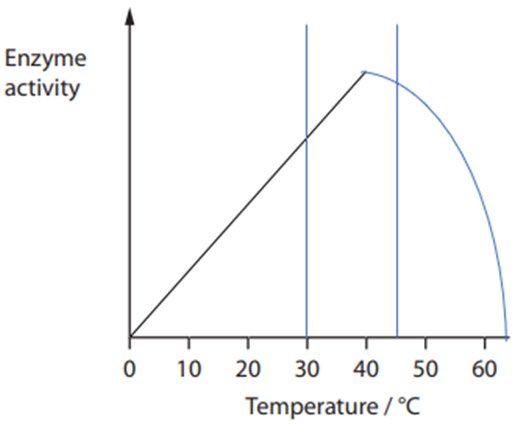
• linear line that increases with temperature and then ACCEPT carefully hand-drawn line
decreases (1) sloping up to optimum
NB line does not have to start at the
origin
• optimum temperature shown at (about) 40 °C (1) NB optimum must be above 30°C
and below 45°C
(2)Question Answer Additional guidance Mark
number
8(a)(ii) • values at 30 °C and 40 °C chosen (1) 50 and 32.5 and 50 and 22.5
• rate calculated per minute for each (1) (50-32.5) ÷ 5 / 17.5 ÷ 5 / 3.5
and
(50-22.5) ÷ 5 / 27.5 ÷ 5 / 5.5
CE from reasonable values read from graph
• numbers substituted into equation (1) 5.5 ÷ 3.5 / 1.5714
CE if added 10 to a correct rate from mp 2
• correct answer to 2 / 3 sig figs with no units 1.6 / 1.57
(1) ACCEPT correctly rounded value for mp 3
OR
OR
50 and 22.5 and 50 and 47.5
• values at 40 °C and 50 °C chosen
(50-22.5) ÷ 5 / 27.5 ÷ 5 / 5.5
• rate calculated per minute for each (1) and
(50-47.5) ÷ 2.5 / 2.5 ÷ 5 / 0.5
CE from reasonable values read from graph
0.5 ÷5.5 / 0.090909
• numbers substituted into equation (1) CE if added 10 to a correct rate from mp 2
• correct answer to 2 / 3 sig figs with no units 0.091 / 0.0909 (4)
(1) ACCEPT correctly rounded value for mp 3Question Answer Additional guidance Mark
number
8(b)(i)
• mass of monosaccharides calculated to be 1361.3 / NB check working out in space and first
correct ratios expressed with more than one dp (1) table for values
eg 164.012, 6.868, 1, 1.145
• ratios shown correctly as either (all) whole numbers or disaccharide 6.9 and tetrasaccharide 1.1
both disaccharide and tetrasaccharide values correctly
rounded to one dp (1)
Type of Ratio
carbohydrate
monosaccharide 164
disaccharide 7
trisaccharide 1
tetrasaccharide 1
(2)
Question Answer Mark
number
8(b)(ii)
The only correct answer is D.
A is incorrect because inositol and raffinose have the modal concentration
B is incorrect because inositol and raffinose have the modal concentration
C is incorrect because inositol and raffinose have the modal concentration (1)Question Answer Additional guidance Mark
number
*8(b)(iii) General description
• bacteria and fungi are decomposers
• decomposers release enzymes for decomposition
• digested molecules are absorbed into the decomposer
• release carbon dioxide
Details of decomposition of carbohydrates
• carbohydrases are needed to breakdown carbohydrates
• hydrolysis of glycosidic bonds
• to form monosaccharides
• monosaccharides taken up by diffusion
• glucose used in respiration
• carbon dioxide produced by respiration of glucose
Specific detail relating to carbohydrates in the table
IGNORE references to starch and amylase
• one glycosidic bond broken in disaccharides, two in
trisaccharides, three in tetrasaccharides• using one / two / three water molecules • e.g. sucrose broken down into glucose and fructose • monosaccharides do not need breaking down Level 1 : general description of decomposition 1 mark : one point made 2 marks : three points made Level 2 : details about decomposition of carbohydrates 3 marks : two points made 4 marks : three points made Level 3 : specific details relating to carbohydrates in the table + mention of respiration releasing carbon dioxide 5 marks : specific detail given for either di / tri / tetra saccharides 6 marks : specific detail given for two of the three types of saccharides (6)
Pearson Education Limited. Registered company number 872828
with its registered office at 80 Strand, London, WC2R 0RL, United Kingdom
You can also read


