GOVERNMENT OF PAKISTAN BENAZIR INCOME SUPPORT PROGRAM - Management Information System Targeting Process Terms of Reference - TOR Social Protection ...
←
→
Page content transcription
If your browser does not render page correctly, please read the page content below
GOVERNMENT OF PAKISTAN

BENAZIR INCOME SUPPORT
       PROGRAM

Management Information System
      Targeting Process
  Terms of Reference - TOR

     Social Protection Team – World Bank
               February 18, 2009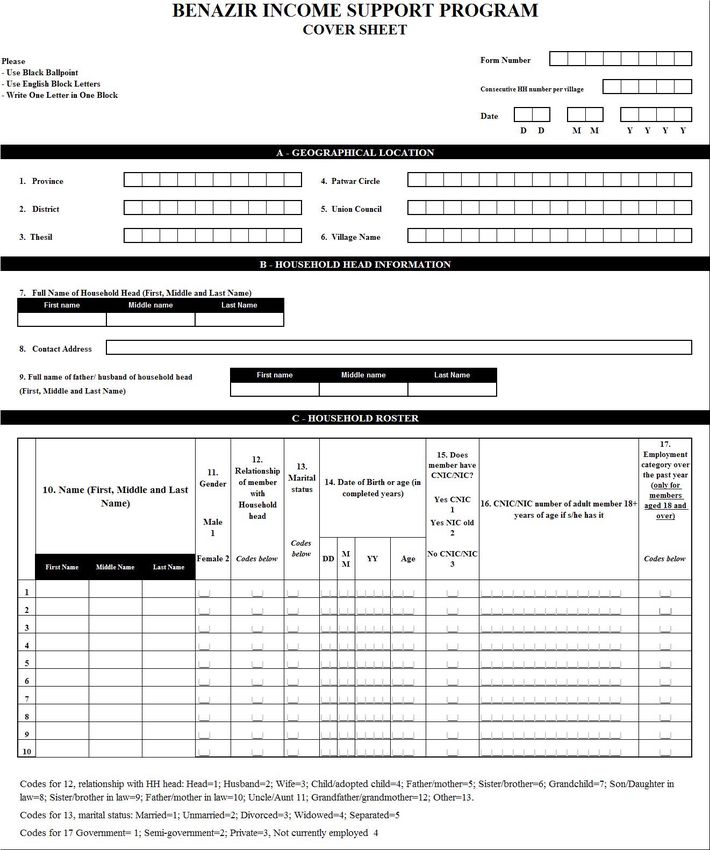
BISP MIS - Targeting Process
Terms of Reference (TOR)

                                                       Contents

A. INTRODUCTION ........................................................................................................ 3

B. THE BISP MIS ............................................................................................................ 3

C. MIS PROCESSES AND USER GROUPS ................................................................ 4

D. TARGETING MODULE ............................................................................................ 5

E. TARGETING MODULE IMPLEMENTATION – TERMS OF REFERENCE .. 6

Attachment 1 –BISP MIS Process Flow........................................................................ 11

Attachment 2 - Form-1: Cover Sheet and Scorecard................................................... 12

Attachment 3 - Form-1 Data Validation Rules............................................................. 14

Attachment 4 - Form-1 Field Descriptions ................................................................... 17

2/18/2009                                                                                                           Page 2
BISP MIS - Targeting Process
Terms of Reference (TOR)
BENAZIR INCOME SUPPORT PROGRAM
Targeting Module – Terms of Reference
A. INTRODUCTION
The Government of Pakistan has initiated the Benazir Income Support Program (BISP) as
its new social safety net program. The Program provides for cash transfers of Rs.1000 per
month to the eligible families. The program in the current fiscal year is intended to cover
about 3.4 million families or 13.6 million people and GoP intends to expand it in the
coming fiscal year to cover around 5 million families with the ultimate goal over the
medium term to expand coverage to 7 million. BISP is a national program that covers all
provinces of the country, AJK and Northern Areas.
B. THE BISP MIS
The BISP Management Information System (MIS) is a comprehensive information
management system designed to support the BISP in all its program functions at the
national level. The diagram below presents a functional view depicting the system main
processes and data flows that accomplish the required BISP operations. A complementary
physical distribution of this functionality is shown below in the system architecture view,
which shows access to system functions from the central operations segment as well as
from BISP Management and Operations and Provincial and Regional offices.
BENAZIR INCOME SUPPORT PROGRAM - MANAGEMENT INFORMATION SYSTEM
BENEFICIARI
NADRA BISP PBM ES BY ADMIN
DATABASE DATABASE DATABASE UNIT
BENEFICIARY
ELIGIBILITY STATUS
COMPLAINTS
7.0 PAYMNTS BY
GRIEVANCE BENEFICIARY
REDRESSAL
GRIEVANCE
10.0
MONITORING RESULTS
PAYMENT BISP MIS
COMPLAINTS AND
REPORTING ADDTL
REPORTS
4.0 6.0 8.0
1.0 2.0 3.0 5.0 9.0
VALIDATE HH APPLY PMT TO GENERATE
FORM-1 DOUBLE FORM-1 DATA VERIFY UPDATE BISP
AND FAMILY DETERMINE LIST OF
SCANNING DATA ENTRY VALIDATION OTHER SPPs DATABASE
MEMBERS ELIGIBILITY PAYMENTS
RECORD OF
DATA APPLICANT LIST OF BYMONTHLY PAYMENT/
FORM-1 INVALID
ENTRY IN OTHER INELIGIBLE PAYMENT
WITH CNICs RECONCILIATI
REPORTS SSPs APPLICANTS SCHEDULE ON REPORT
ERRORS
PROVIDE LIST
NOTIFY OF PAYMENTS
APPLICANTS TO PAKISTAN
POST
BISP MIS Functional View
2/18/2009 Page 3BISP MIS - Targeting Process
Terms of Reference (TOR)
Province A
Form-1 Scanning
and Data Entry
BISP Program
District ! Management
District 2
NADRA
BISP Servers
BISP Program
Operations
Province B
NADRA BISP OTHER
Database Database Databases
BISP MIS Architecture View
ƒ MIS and Database Servers - Hosting at NADRA headquarters in Islamabad
during the initial year of operation. Hosting will be transferred to BISP
headquarters office on the second year.
ƒ Form-1 Data scanning and data entry – Centralized operation at NADRA in
Islamabad. This operation will continue to be performed at NADRA to utilize the
installed data scanning infrastructure.
ƒ BISP Management and Operations Departments - Online secure Web access to
BISP MIS.
ƒ Provincial and Regional BISP Offices – Online secure Web access to BISP MIS
C. MIS PROCESSES AND USER GROUPS
With respect to the services provided by the MIS there are four main processes and user
groups, namely:
1. Targeting and Eligibility – Modules 1.0 through 6.0 support the data entry
process, validation, verification and the application of the Proxi Means Test
(PMT) to determine BISP eligibility. The data entry process performed at the
central (headquarters) NADRA office, managed by the MIS Data Entry Team.
2/18/2009 Page 4BISP MIS - Targeting Process
Terms of Reference (TOR)
Inherent to this activity is the handling of a very large volume (millions) of
applicant forms, a continuous attention to quality, organization and performance
to ensure an efficient operation.
2. Grievance Redressal – Module 7.0 provides a system function to enable BISP
Officers, located in provincial and/or regional/district offices, to obtain online
applicant or beneficiary information and have the necessary elements to evaluate
and resolve complaints. Complaints may be of different types, including those
related to an applicant not being eligible (i.e., missing information, invalid CNIC,
invalid name, etc.) or related to payments (i.e., not receiving it, wrong address,
etc.). The MIS will provide a function for the Officer to interact with the database
and update it as needed in solving the applicant’s or beneficiary’s issues.
3. Payment Process – Modules 8.0 and 9.0 provide system functions to manage the
payment process. The MIS may be prompted to generate a bi-monthly list of
eligible beneficiaries who will receive a BISP payment. This list will be produced
by BISP Central Operations Department, and once it is verified to be complete
and correct, will be delivered to the Pakistan Post BISP Program Manager for
payment production. After payments have been distributed to recipients and the
respective reports and payment reconciliation process is completed, these will be
provided to BISP Operations for updating and final reconciliation on the BISP
database.
4. Monitoring and Reporting – Module 10.0 consists of a business intelligence
capability to provide BISP Management the facility to generate activity
information on any program activity, from targeting to payment and monitoring.
Reports can be produced by geographical levels or by any attributes with respect
to demographics or other data available data descriptors. Additionally, statistics
and even more sophisticated tools may be used, such as data mining and graphic
tools to analyze program operations and performance.
D. TARGETING MODULE
The Targeting Module (TM) provides the software functions to capture incoming
information on the data collection Form-1 (Attachment 2). The process involves several
steps, which includes forms scanning, validating the data on the forms and applying the
PMT to determine program eligibility. The outcome of this process is obtaining complete
and correct information to create a beneficiary record on the BISP Database. Those forms
containing incomplete or erroneous information are noted and a notification is issued to
the applicant through the data collection Partner Organization, so that applicants can
provide the missing/incorrect data for further processing.
2/18/2009 Page 5BISP MIS - Targeting Process
Terms of Reference (TOR)
BISP MIS
TARGETING PROCESS
Determine BISP
Form-1 Data Capture Form-1 Data Validation Validation HH Identities Grievance Redressal
Eligibility
FORM-1
from POs
Data Validation Beneficiary in other Applicant Online
Form-1 Scanning Validation HH Identities
social programmes Update
Apply PMT to
Assign ID Nos.
Info. determine eligibility
Validation
notification Generate BISP
Double data entry Beneficiary Lists
Identity
Info
Data notification
Scanning
Reports
BISP
Applicants
BISP
Management
BISP Beneficiary
Database
NADRA Servers
Targeting Module Architecture
E. TARGETING MODULE IMPLEMENTATION – TERMS OF REFERENCE
This Section defines the services to be provided by the Consultant (NADRA), the entity
that will be responsible for development and implementation of the BISP Targeting
Module, followed by implementation of the complete MIS system, on behalf of the Client
(BISP). This Section can be taken in its entirety to be added to the Agreement document
to be signed by NADRA. This Section only addresses the Targeting Module as needed to
carry out the data entry and reporting processes for Phase 1 of the BISP. A second
complete TOR will be issued by BISP for implementation of the full MIS to support the
nationwide roll out of the program during Phase 2.
1 In lieu of the compensation to be paid by the Client and performance of its
corresponding obligations as agreed herein after, the Consultant shall provide the
following services to the Client:
1.1 Collection of Applicant Forms: Applicant Forms arranged by the Client (through
a Partner Organization (PO) assigned by the Client) in the agreed format will be
delivered to the Consultant from designated points specified by the Client. All
POs Area Coordinators at Union Councils shall at their cost and arrangement send
2/18/2009 Page 6BISP MIS - Targeting Process
Terms of Reference (TOR)
forms to the Consultant after ensuring that all mandatory fields in the form are
properly filled by the Client. The Consultant will not be responsible for any
mistake or missing fields. A manual manifest of the accepted forms will be
prepared by the Consultant at the time of receipt of forms and a counter-slip will
be provided to the Client containing number of forms and other particulars. The
collection will be effected on a weekly basis and the cost of transportation and
logistics will be borne by the Client. The data will be processed at the Consultant
Headquarters, Islamabad.
1.2 Estimated Number of Forms: BISP is intended to cover about 3.5 million families
as beneficiaries of the program during the first fiscal year of operation. This
number yields an average of approximately 27,000 beneficiaries per District. On
the basis of selecting one beneficiary out of 3-5 applicants, as an example, the
number of Forms to process could amount to as many as 17.5 million. However,
the actual number of applicants will be determined once the operation begins
implementation. The Consultant shall provide the computer processing and
storage capability to process a number of applicants within the range above in an
efficient and controlled manner.
1.3 Scanning & Data Acquisition: At the pre-scanning stage, forms will be manually
checked for any discrepancies in the data. The data will be entered in the
computers through double data entry method after scanning of forms. The data so
entered will be examined and checked in three stages by different individuals
before posting in the central database. The Consultant will generate an electronic
manifest of scanned forms, entered forms, complete forms and incomplete forms.
1.4 Form-1 Data Validation: The Consultant will validate the data on Form-1 through
a software function according to the rules on Attachment 3. The result of the
validation will be posted on the applicant record on the BISP database as
applicant status:
E - There are errors on Form-1, including values outside of the valid
codes as defined on the Targeting Manual.
I – There are missing data elements, which are deemed mandatory.
C – Form-1 is complete.
1.5 Generate and Maintain Household Member Identification: All members of the
household will be individually identified for database processing. The ID number
is normally the CNIC or NIC and for persons under 18 years of age, it is the
Certificate number assigned by NADRA. In case the ID is missing, the Consultant
will assign a temporary number for tracking purposes until a CNIC is permanently
assigned.
1.6 Validation of all Household and Family Members: The Consultant will validate
all members of the household based on the CNIC and the data in the Consultant’s
National Data Warehouse (NDWH), including names, date of birth and address.
The validation process shall determine a complete family unit and in some cases
2/18/2009 Page 7BISP MIS - Targeting Process
Terms of Reference (TOR)
the existence of more than one family unit in the household, based on the
biological or marriage properties maintained in the Consultant’s database.
Further, the Consultant will identify the individual assigned as the beneficiary in
each family based on the characteristic of being the oldest female with a valid
CNIC. If the Consultant finds inconsistencies while determining the family
composition, the applicant record status will be posted as “E” for error, to be
corrected through the Grievance Redressal process.
1.7 Verification of Other Social Safety Net Programs: The Consultant will access
other safety net programs databases to verify whether the applicant to the BISP is
already a beneficiary of those programs, such as Pakistan Bait ul Mal (PBM)
Food Support Program (FSP) or the Punjab Food Support Scheme (PFSS).
Following the policy designed by GOP, families that are beneficiaries of FSP and
apply to BISP, will be eligible to become beneficiaries in the BISP with an
intimation to PBM on the new status so that they are taken out of FSP. Likewise,
families that are beneficiaries of the PFSS would be ineligible for the BISP. The
Consultant will generate the necessary reports on a periodic basis to inform the
Client of the events described above.
1.8 Application of Proxi Means Test (PMT) to Determine Eligibility: The Consultant
will implement a software function to apply the PMT to applicant records deemed
complete (i.e., correct and complete data, contain all required CNICs; and no
members are beneficiaries of other social protection programs). The Consultant
will assign a Beneficiary status to those records with a score below or equal to the
designated cutoff mark.
1.9 Data Retrieval and Reporting: The Consultant will implement a software function
to enable the Client to enquire the BISP Database with the option to select
applicant and beneficiary records using different selection parameters, including
applicant status, data errors, missing CNICs, etc. The Consultant will provide the
Client the ability to select records based on geographical locations, by name, by
form number, by CNIC number and other demographic variables. The Consultant
will include the software function to generate printed reports with the above
information. These functions will be made available for use by the Client through
a Web interface which will be accessed by the Client from the headquarters office
in Islamabad as well as regional offices throughout the country. The Consultant
will provide the necessary secure and controlled access so that only authorized
BISP personnel will be allowed access to these functions.
1.10 Notification of BISP Application Outcomes: The Consultant will provide
a software function to generate online as well as printed reports to notify
applicants of incomplete applications and the specific errors or missing items.
Similarly, these reports will provide notification to applicants that have been
designated as beneficiaries of BISP. Online and hardcopy reports will be provided
by geographical breakdown by Village, Union Council, Patwar Circle, Tehsil,
2/18/2009 Page 8BISP MIS - Targeting Process
Terms of Reference (TOR)
District and Province, so that they may be distributed to Partner Organizations to
notify applicants.
1.11 Software Development: the Consultant will develop the following
software/ modules:
• Electronic Manifest Preparation Module
• Scanning Module
• Data Acquisition Module
• Form-1 Data Validation Module
• Household Member Identification Module
• Validation of Household and Family Members Module
• Verification of Other Social Safety Net Programs Module
• Application of Proxi Means Test Module
• Data Retrieval and Reporting Module
• Notification of BISP Application Outcomes Module
1.12 Implementation: The Consultant will implement the software solution with
centralized database maintenance and distributed processing at Provincial and
Regional BISP offices accessed through a Web interface with secure and
controlled access, and ensuring that the system architecture will provide optimal
performance to access data considering a very large database with up to 3.5
million records to be accessed from geographically dispersed access points
including districts, NWFP and AJK.
1.13 The hardware will be procured by the Consultant and that its cost would
be met from the Client budget as per provision.
2/18/2009 Page 9BISP MIS - Targeting Process
Terms of Reference (TOR)
1.14 The Consultant will assist the Client in order to procure software licenses,
whereas their cost would be met from the Client budget as per provision.
2/18/2009 Page 10BISP MIS - Targeting Process
Terms of Reference (TOR)
Attachment 1 –BISP MIS Process Flow
BENAZIR INCOME SUPPORT PROGRAMME (BISP)
MANAGEMENT INFORMATION SYSTEM (MIS) PROCESS FLOW
Form-1 Data Payment Monitoring/
Data Validation Eligibility Process
Capture Process Reporting
BISP
BISP Form-1 NADRA Data Other SSN Operations
submitted by POs Warehouse Programs BISP Database
Management
(PBuM, PFSS, Beneficiaries
Reporting
other) DBs System
Form-1 Data BISP Database Generate
Scanning Applicants
Bimonthly
Determine Beneficiaries in
Payment
beneficiarie in each
Schedule
other SSPs Administrative
Double Data Assign BISP Unit: Union
Entry from Identification Council, Tehsil,
Form-1 Number Bimonthly District, Province
Payment
HH members in
Schedule
other SSPs,
Validate HH Ineligible
Form-1 Data
members Detailed
Image Generate
identities information about
BISP Database Eligibility Lists each household
HH members for Payment and Beneficiary
Form-1 Scanning apt for applying Status
Reports BISP Database PMT
Validated HH Eligibility Lists for
members Payment
identities Detailed Records
Apply PMT to
and Numbers of
Form-1 Data determine
Financial
Validation, Invalid HH Eligibility
Transactions by
Create member Provide Lists for
Unit and
Applicant DB identities Payment to
Beneficiary
record Pakistan Post
BISP Database
Eligible HH
Members Reporting on
Form-1 Data PP Delivers
Notify Applicant of Grievance
Errors and Payments and
Action Taken Provides Record Redressal, No. of
missing data
of Payment and compalints and
BISP Ineligible
Reconciliation No. resolved
HH Members
Form-1 Missing Notify Applicant to Report
CNICs obtain CNIC
Other Operations
Record of Reports requested
Payment and by BISP
Applicants/ Reconciliation
BISP Database POs -Data Management
Form-1 Report from PP
corrections
Complete
Grievance
Redressal Update BISP
New
Errors, new DB with
assigned
CNICs, payment
CNICs
Eligibility delivery data
Status
Applicants/
BISP Database
POs -
Beneficiaries
Complaints
2/18/2009 Page 11BISP MIS - Targeting Process
Terms of Reference (TOR)
Attachment 2 - Form-1: Cover Sheet and Scorecard
2/18/2009 Page 12BISP MIS - Targeting Process
Terms of Reference (TOR)
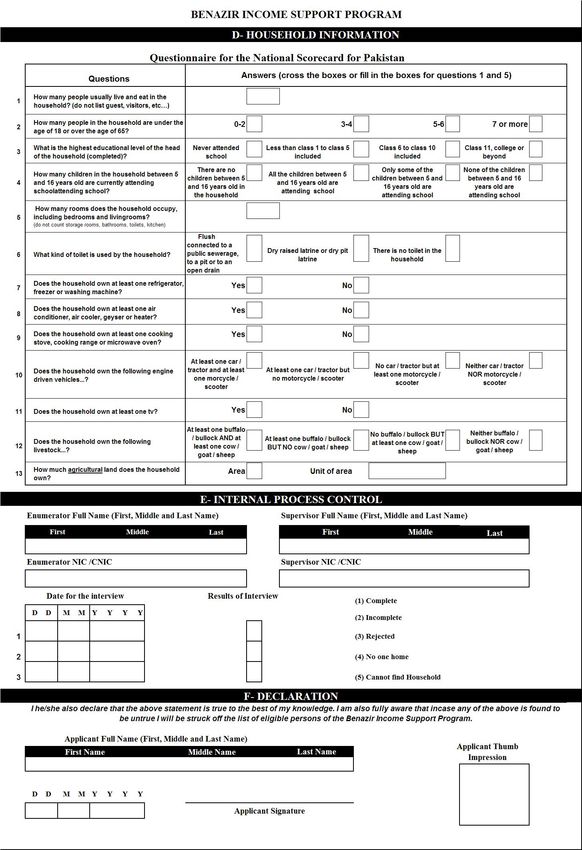
Form-1: Scorecard (Side Two)
2/18/2009 Page 13BISP MIS - Targeting Process
Terms of Reference (TOR)
Attachment 3 - Form-1 Data Validation Rules
Field No. Field Name Validation Rule Error Message Disposition
Form-1 Status
M-mandatory
U-unique M-Missing Blank=n/a,
N-numeric D-Duplicate E-Error
V-specified values N-Non-numeric I-Incomplete
I-Invalid,outside C-Complete
specified
values
Form Number M, U, N M,D,N
Consecutive N M,D,N
HH Number
per Village
Date M, N M,N E-date error, non-
numeric
I=missing date
1 Province M, List of Provinces M E-not on list
I-missing
2 District M, List of Districts M E-not on list
I-missing
3 Thesil M, List of Thesils M E-not on list
I-missing
4 Patwar Circle n/a, not always known
5 Union Council M, List of Union Councils M E-not on list
I-missing
6 Village n/a, not always known
7 Full Name of M M I-missing
Household
Head
8 Contact M M I-missing
Address
9 Full Name of n/a, may not exist
father/spouse
of Household
Head
10 Name of M M I-missing
Household
head
11 Gender M-Male; M, I E-outside valid codes
F-Female
12 Relationship to M; M,N,I E-outside valid codes
Household V-(valid codes are 01-13)
head
13 Marital Status M; M,N,I E-outside valid codes
V-(valid codes are 1-5)
14(a) Date of Birth M, if Age is missing M-if missing E-non numeric
and also if Age I- missing
is missing (i.e.
DoB or Age are
required); or N
14(b) Age M, if DoB is missing M-if missing E-non numeric
and also if DoB I-missing
2/18/2009 Page 14BISP MIS - Targeting Process
Terms of Reference (TOR)
Field No. Field Name Validation Rule Error Message Disposition
Form-1 Status
M-mandatory
U-unique M-Missing Blank=n/a,
N-numeric D-Duplicate E-Error
V-specified values N-Non-numeric I-Incomplete
I-Invalid,outside C-Complete
specified
values
is missing
15 Member has M, V: M, I E-outside valid codes
CNIC 1- has CNIC I-missing CNIC/NIC
2- has NIC, no CNIC
3- does not have CNIC or NIC
16 CNIC/NIC M-for persons older than 18 M, I-incomplete, missing
years old CNIC/NIC
17 Employment M-for persons older than 18 M, I I-incomplete, missing
Category years old value
V-Valid codes are 1-4 E-code error
18 (D1) No. of people M, N M, N I-incomplete
in the HH
19 (D2) People in the M-must check one of the four M I
HH less than possible answers
18 or over 65 V-non-blank character
20 (D3) Highest M-must check one of the four M I
educational possible answers
level of HH V-non-blank character
head
21 (D4) No. of children M-must check one of the four M I
age 5-16 possible answers
attending V-non-blank character
school
22 (D5) No. of rooms in M, N M, N I-missing value
HH E-non-numeric value
23 (D6) Type of toilet in M-must check one of the three M I
HH possible answers
V-non-blank character
24 (D7) Does HH own M-must check one of the two M I
appliances possible answers
V-non-blank character
25 (D8) Does HH own M-must check one of the two M I
Air possible answers
Conditioner, V-non-blank character
Cooler
26 (D9) Does HH own M-must check one of the two M I
cooking stove possible answers
V-non-blank character
27 (D10) Does HH own M-must check one of the four M I
engine possible answers
vehicles V-non-blank character
28 (D11) Does HH own M-must check one of the two M I
TV possible answers
V-non-blank character
29 (D12) Does HH own M-must check one of the four M I
livestock possible answers
2/18/2009 Page 15BISP MIS - Targeting Process
Terms of Reference (TOR)
Field No. Field Name Validation Rule Error Message Disposition
Form-1 Status
M-mandatory
U-unique M-Missing Blank=n/a,
N-numeric D-Duplicate E-Error
V-specified values N-Non-numeric I-Incomplete
I-Invalid,outside C-Complete
specified
values
V-non-blank character
30(a) Agricultural N N E
(D13) land area
owned by HH
30(b) Unit of Area M, if value is provided for 30(a) M I
31 Enumerator M M I
Full Name
32 Enumerator M M I
CNIC/NIC
33 Supervisor Full M M I
Name
34 Supervisor M M I
CNIC/NIC
35 Date of N M, N I
Interview
36 Results of M M, I I
Interview V-valid codes are 1-5
37 Applicant M, N M, N I
Declaration
Date
2/18/2009 Page 16BISP MIS - Targeting Process
Terms of Reference (TOR)
Attachment 4 - Form-1 Field Descriptions
(as defined on the Targeting Manual, Draft version)
Form Number
The Form Number corresponds to a serial and unique number; it must be printed along
the boxes provided. Each box corresponds to one letter.
Consecutive HH Number per Village
The Household Number per village must be printed along the boxes provided.
Date of Interview
The date of the interview must be specified by day, month, and year as shown in the
example:
1 5 1 0 2 0 0 9
d d / m m / y y y y
Form 1 is divided into the following 6 sections:
A- GEOGRAPHICAL LOCATION
1. Province
Enumerator must write down the name and the code of the province in the boxes
provided. Each box corresponds to one letter.
2. District
Enumerator must write down the name and the code of the district in the boxes provided.
Each box corresponds to one letter.
3. Thesil
Enumerator must write down the name and the code of the tehsil in the boxes provided.
Each box corresponds to one letter.
4. Patwar Circle
Enumerator must write down the name of the nearest Patwar Circle in the boxes
provided. Each box corresponds to one letter.
5. Union Council
Enumerator must write down the name of the Union Council in the boxes provided. Each
box corresponds to one letter.
6. Village Name
2/18/2009 Page 17BISP MIS - Targeting Process
Terms of Reference (TOR)
Enumerator must write down the name of the village in the boxes provided. Each box
corresponds to one letter.
B- HOUSEHOLD HEAD INFORMATION
7. Full Name of Household Head (first, middle, last)
A complete name of the Household head must be written down in the space provided. It
must include the First, Middle and Last Name. It must be written in capital letters.
The name must be written in the original language (e.g.. Bilal Ali Khan).
Example:
First name Middle name Last Name
Bilal Ali Khan
8. Contact Address
Enumerator must write down the name and number of the address where the Household
can be contacted. It should be written in capital letters.
9. Full Name of Father/ Spouse of Household Head
A complete name of the father or spouse of the Household head must be written down in
the space provided. It must include the first, middle and last name.
C- HOUSEHOLD ROSTER
10. Full Name
Enumerator must write down, in the space provided, the complete name of the Household
head or family member of the Household head. It must include the first, middle and last
name.
11. Gender
Enumerator must specify the gender of the member of the Household following the code
indicated. If the member of the Household is a male, Enumerator must write down the
number 1. If the member of the Household is a female, Enumerator must write down
number 2.
12. Relationship of members with the HH Head
Enumerator must describe the relationship of each member of the Household with the
Household head using the codes found at the end of table.
If a person is:
The Household head, number 1
The husband, number 2
The wife, number 3
2/18/2009 Page 18BISP MIS - Targeting Process
Terms of Reference (TOR)
The child or adopted child, number 4
The father or mother, number 5
The sister or brother, number 6
The grandchild, number 7
The son or daughter in law, number 8
The sister or brother in law, number 9
The father or mother in law, number 10
The uncle or aunt, number 11
The grandfather or grandmother, number 12
Another person who lives in the house, number 13
13. Marital Status
Enumerator must describe the marital status of each of the members of the Household
using the codes found at the end of the table.
If the person is:
Married, number 1
Unmarried, number 2
Divorced, number 3
Widowed, number 4
Separated, number 5
14. Date of Birth or Age
The birth date of the Household must be specified by day, month, and year as shown in
the example. The age must be written in completed years.
Example:
DD MM YYYY Age
15 05 1963 46
15. Does member have a CNIC/ NIC?
Enumerator must specify whether the member of the Household has a Computerized
National Identity Card (CNIC) or a National Identity Card (NIC) using the code given.
If the person:
Has a CNIC, number 1
Has a NIC (old), number 2
Has NO CNIC/ NIC, number 3
16. CNIC/NIC number of adult member 18+ years of age if he/she has it.
Enumerator must write down, in the space provided, the NIC/ CNIC number of the
member of the Household if he/she is 18 years old or older.
17. Employment category over the past year (only for members aged 18 and over)
Enumerator must indicate where the member of the Household, if he/she is 18 and older,
has been employed over the past year using the code provided.
2/18/2009 Page 19BISP MIS - Targeting Process
Terms of Reference (TOR)
If he/she has been employed in:
A government entity, number 1
A Semi – government entity, number 2
A Private entity, number 3
Not currently employed, number 4
D- SCORECARD
1. How many people usually live and eat in the Household?
Enumerator must write down, in the space provided, the number of people who live and
eat in the Household. Guests and visitors shall NOT be included.
2. How many people in the Household are under the age of 18 or over the age of 65?
Enumerator must specify how many people in the Household are under the age of 18 or
over the age of 65. There are four different options; the Enumerator must mark an X in
the appropriate box.
3. What is the highest educational level of the head of the Household (completed)?
Enumerator must specify the highest educational level the head of the Household has
completed. There are four different options; the Enumerator must mark an X in the
appropriate box.
4. How many children in the Household between 5 and 16 years old are currently
attending school?
Enumerator must specify how many people in the Household between the ages 5 and 16
years old are currently attending school. There are four different options; the Enumerator
must mark an X in the appropriate box.
5. How many rooms does the Household occupy, including bedrooms and living
rooms?
Enumerator must write down, in the space provided, the number of rooms that are
occupied in the Household. This number must include bedrooms and living rooms but
NOT storage rooms, bathrooms, toilets, kitchen or rooms for business
6. What kind of toilet is used by the Household?
Enumerator must specify what kind of toilet does the Household use. There are three
different options; the Enumerator must mark an X in the appropriate box.
Flush connected to a
Dry raised latrine There is no toilet in
public sewerage, to a pit
or dry pit latrine X the Household
or to an open drain
2/18/2009 Page 20BISP MIS - Targeting Process
Terms of Reference (TOR)
7. Does the Household own at least one refrigerator, a freezer or a washing
machine?
Enumerator must specify whether the Household owns at least one refrigerator, a freezer
or a washing machine. The Enumerator must mark an X in the appropriate box.
8. Does the Household own at least one air conditioner, an air cooler, a geyser or a
heater?
Enumerator must specify whether the Household owns at least one air conditioner, an air
cooler, a geyser or a heater. The Enumerator must mark an X in the appropriate box.
9. Does the Household own at least one cooking stove, a cooking range or a
microwave oven?
Enumerator must specify whether the Household owns at least one cooking stove, a
cooking range or a microwave oven. The Enumerator must mark an X in the appropriate
box.
10. Does the Household own the following engine driven vehicles...?
Enumerator must specify what kind of engine driven vehicles does the Household own.
There are four different options; the Enumerator must mark an X in the appropriate box.
Example: Household has no car/ tractor but at least one motorcycle / scooter.
At least No car /
At least one car one car / tractor
Neither car /
/ tractor and at tractor but at
tractor NOR
least one but no least one X
motorcycle /
motorcycle / motorcy motorcy
scooter
scooter cle / cle /
scooter scooter
11. Does the Household own at least one TV?
Enumerator must specify whether the Household owns at least one TV. The Enumerator
must mark an X in the appropriate box.
12. Does the Household own the following livestock...?
Enumerator must specify what kind of livestock does the Household own. There are four
different options; the Enumerator must mark an X in the appropriate box.
13. How much agricultural land does the Household own?
Enumerator must specify how much land does the Household own by filling in the
appropriate box.
E- INTERNAL PROCESS CONTROL
Enumerator Full Name
2/18/2009 Page 21BISP MIS - Targeting Process
Terms of Reference (TOR)
In this part, the full name of the Enumerator in charge of filling out the Form must be
written down in the space provided, including first, middle and last name.
Enumerator NIC/CNIC
In this part, the National Identity Card (NIC) or the Computerized National Identity Card
of the Enumerator must be written down in the space provided.
Supervisor Full Name
In this part, the full name of the Supervisor in charge of filling out the Form must be
written down in the space provided, including first, middle and last name.
Supervisor NIC/CNIC
In this part, the National Identity Card (NIC) or the Computerized National Identity Card
of the Supervisor must be written down in the space provided.
Date for the Interview / Results of Interview:
Enumerator must write down the date in which the interview was made in the boxes
provided. Next to the date, the result of the interview should be specified.
The following options will be admitted:
• Complete: When all the questions have been answered in Form 1.
• Incomplete: When, for some reason, one or various questions have not been
answered and have been left as pending.
• Declined: When the Household head has declined to answer and finish the
interview.
• No one home: When the Enumerator could not find anyone of the Household at
the time of the interview.
• Cannot find Household: When the Enumerator could not geographically locate the
house.
An extra box is provided to indicate that adults in this Household do not have a National
Identity Card (NIC) or the Computerized National Identity Card (CNIC).
If option is: incomplete, no one home or cannot find Household, the Enumerator should
report to the Supervisor. The Supervisor will decide if a new interview is possible or not.
In case the Supervisor authorizes a new visit to this house, the Enumerator should write
down the second date of the visit and its result.
For example: On December 1st of 2008, an Enumerator, when visiting a house could not
find anyone at home, he/ she should write 4. When reported this fact to the Supervisor,
he/she authorized a new visit after two days. On December 3, a new visit was made to the
house; but this time, the Household head was at home and gave all the information
required by Form 1. The Survey Control Section will be:
2/18/2009 Page 22BISP MIS - Targeting Process
Terms of Reference (TOR)
Date for the interview Results of Interview
D D M M Y Y Y Y (1) Comple te Number of
1 0 1 1 2 2 0 0 8 4 (2) Incomplete adults without
2 0 3 1 2 2 0 0 8 1 CIN/CNIC
(3) De cline d
3 (4) No one home
(5) Cannot find House hold
• Number of adults without NIC/ CNIC: the number of adults living in the
Household and who did not have a NIC/ CNIC.
F- DECLARATION
Applicant Name:
The full name of the applicant, including first, middle and last name, should be printed in
the space provided.
Date:
The date of the interview must be specified by day, month, and year in the boxes
provided. It is needed so as to have record that the Form was signed the same day the
interview was made.
Applicant Signature:
The signature of the applicant should be printed in the line provided in the form.
Applicant Thumb Impression:
The impression of the Household applicant’s thumb is needed in the box provided.
This is also valid when the Household head has declined the interview.
2/18/2009 Page 23You can also read


