Mission Review Self-Study - Conference for Mercy Higher Education January 2021 - Salve Regina University
←
→
Page content transcription
If your browser does not render page correctly, please read the page content below
Conference for Mercy
Higher Education

Mission Review
Self-Study
January 2021
Introduction
Inspired by the enduring vision of the founding Sisters of Mercy, Salve
Regina’s mission is a living commitment to the Catholic tradition
and Mercy values that the University endeavors to integrate into all
dimensions of its institutional life, including teaching, research, service
and leadership. With its focus on seeking wisdom and promoting
universal justice, the mission is the cornerstone of strategic planning and
academic programming, fostering the development of lifelong Mercy
leaders who understand the importance
of turning empathy into action.                “...to those imbued with
                                                                     the
The University’s mission statement has       charism of Mercy, need was the
inspired thousands of students, faculty,     touchstone, ministry the response,
staff, trustees and alumni to work for       and courage the vitalizing force.”
a world that is harmonious, just and
merciful; it was approved by the Board       Excerpted from “With Courage and Compassion”
of Trustees in its present form in 1997,     by MARY ELOISE TOBIN, RSM, and
                                             MARY JEAN TOBIN, RSM
reaffirmed in 2009, and again in 2020.

The University established the role of vice president for mission
integration in 2001 and welcomed its first layperson into this position
in 2018. The Office of Mission Integration oversees three areas: the
Mercy Center for Spiritual Life, the Center for Community Engagement
and Service, and the recently established McAuley Institute for Mercy
Education. Tasked with providing the campus community opportunities
to incorporate the mission into the Salve Regina experience, the
Office sponsors initiatives to promote understanding and engagement
with the living tradition of Mercy.

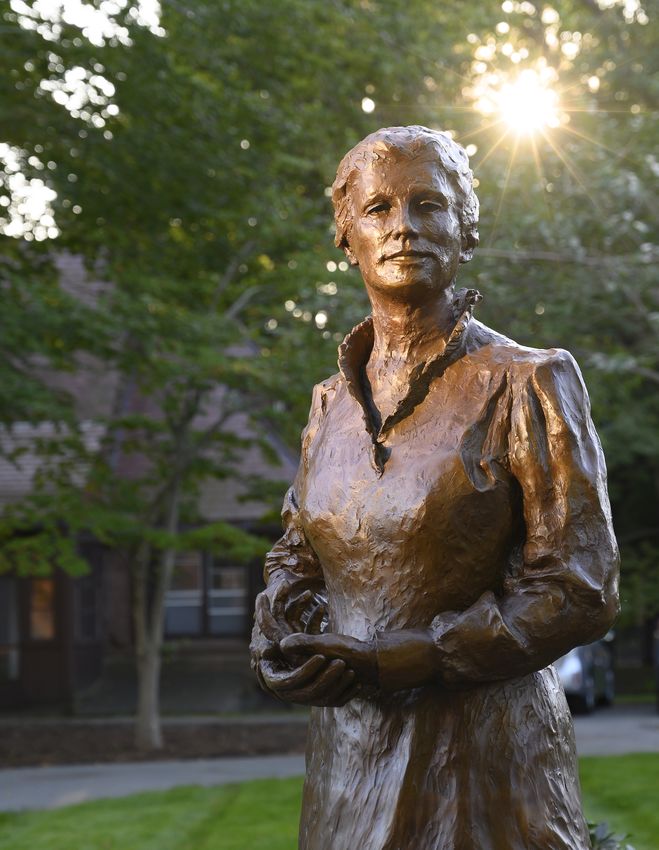
The 2019 installation of Catherine McAuley’s statue in the center
of campus serves as a visual manifestation of the spirit of Mercy that
continues to inspire the life and work of the University. Without
hesitation and undaunted by obstacles, Catherine and the first Sisters
of Mercy went where the need was greatest to tend to the sick, educate
the poor, and to offer compassionate outreach. Nearly 200 years after
Catherine’s profession of vows, her legacy continues to live on through
Salve’s mission and our commitment to the transformative work of
Mercy, Catholic higher education.

                                                                          Mission Review Self-Study   1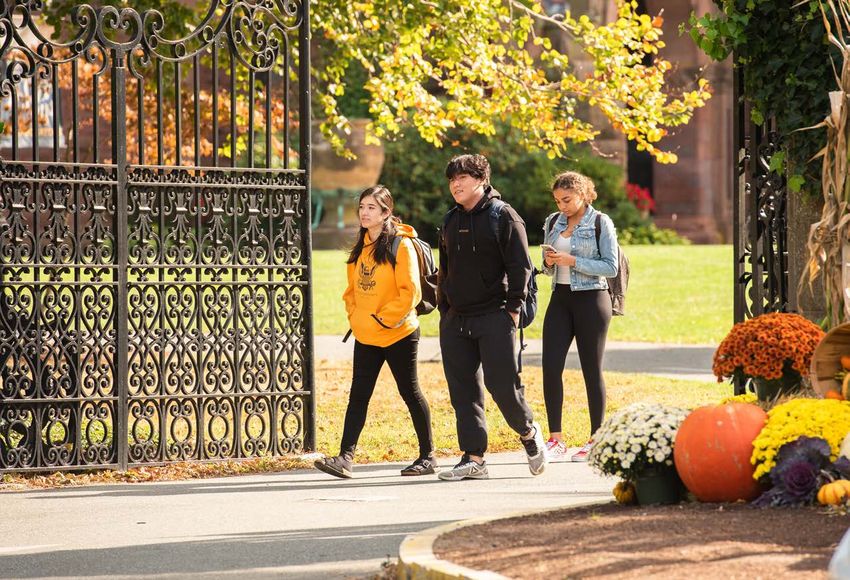
SALVE REGINA UNIVERSIT Y ADMINISTRATION

                                Dr. Kelli J. Armstrong            Dr. M. Therese Antone, RSM
                                President                         Chancellor

                                Dr Nancy G Schreiber              J. Malcolm Smith
                                Provost/Vice President for        Vice President for
                                Academic Affairs                  Student Affairs

                                                                  William Hall
                                Dr. Theresa Ladrigan-Whelpley
                                                                  Vice President for
                                Vice President for
                                                                  Administration/
                                Mission Integration
                                                                  Chief Financial Officer

                                                                  Michael Semenza
                                Dr. James Ludes
                                                                  Vice President for
                                Vice President for
                                                                  University Relations and
                                Public Research and Initiatives
                                                                  Advancement

                                                                  Kristine Hendrickson
                                James Fowler, Jr.                 Associate Vice President
                                Vice President for                for University Relations/
                                Enrollment Management             Chief Communications Officer

                                MaeLynn Patten
                                Chief Advancement Officer

2   Mission Review Self-Study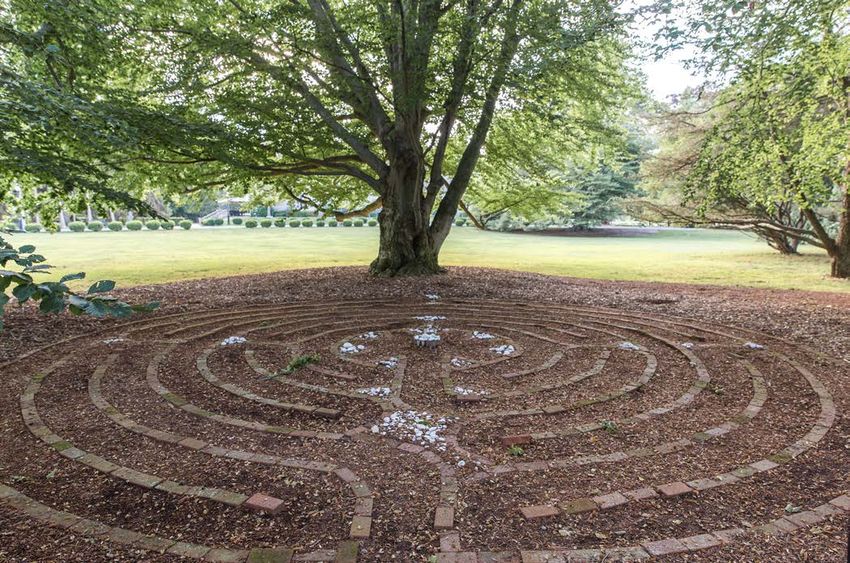
MISSION REVIEW COMMITTEE

In preparation for the CMHE mission review peer visit, an
ad hoc Mission Review Committee was convened with the
following members of the campus community:

Dr. Theresa Ladrigan-Whelpley
Vice President for Mission Integration, Committee Chair

Annemarie Bartlett
Director of Institutional Research and Effectiveness

Amy Cady
Assistant Director, Mercy Center for Spiritual Life

Dr. Daniel Cowdin
Professor of Religious and Theological Studies

Stephanie Dupuis
Associate Dean of Admission

Dr. Myra Edelstein
Associate Professor of Business and Economics

Mary Edwards
Director of Constituent Communications and Design

Christine Kavanagh, RSM
Chair, Mission Committee, Board of Trustees and
Executive Director, ReFocus, Inc.

Kelly Powers
Director, Center for Community Engagement and Service

Dr. Steven Rodenborn
Dean of Undergraduate Studies

Dr. Miguel Romero
Assistant Professor of Religious and Theological Studies

Together, the committee worked over the course of
the fall 2020 semester to build upon information gathered
by the NECHE self-study mission review committee and
develop a framework by which the CMHE mission review
would answer the five queries across eight core areas of
mission integration.

                                Mission Review Self-Study   3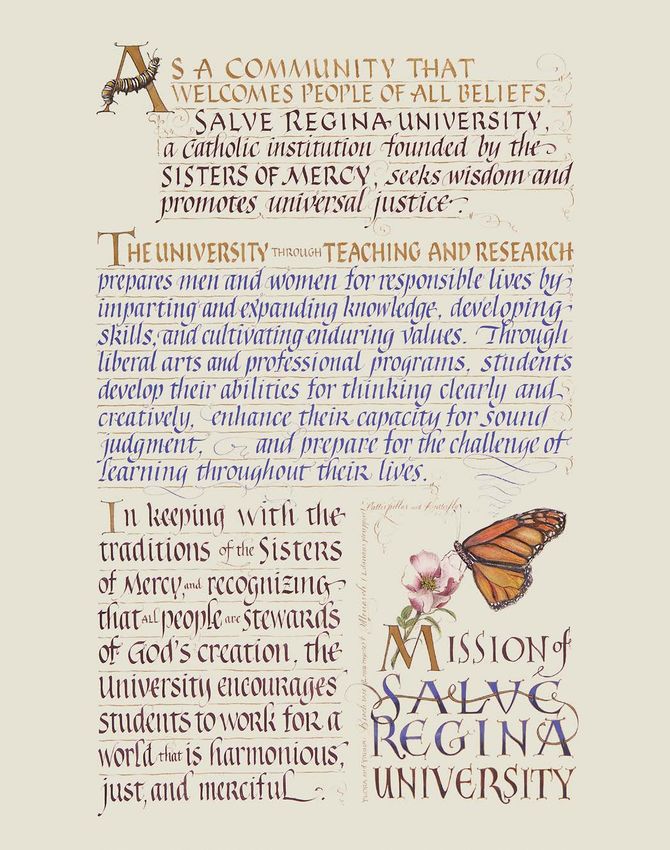
Mission Statement
                                 As a community that welcomes people of all beliefs,
                                 Salve Regina University, a Catholic institution founded by the
                                 Sisters of Mercy, seeks wisdom and promotes universal justice.

                                 The University, through teaching and research, prepares men
                                 and women for responsible lives by imparting and expanding
                                 knowledge, developing skills and cultivating enduring values.
                                 Through liberal arts and professional programs, students develop
                                 their abilities for thinking clearly and creatively, enhance their
                                 capacity for sound judgment, and prepare for the challenge of
                                 learning throughout their lives.

                                 In keeping with the traditions of the Sisters of Mercy,
                                 and recognizing that all people are stewards of God’s creation,
                                 the University encourages students to work for a world that
                                 is harmonious, just, and merciful.

“Let the Mission Statement
 serve as your guiding
 marker as you encounter
 life’s future cross roads.
 May you travel the path
 of life in peace with faith
 as your compass and
 love as your lodestar.”
 SISTER THERESE ANTONE, CHANCELLOR
 from her blessing to graduating students
 at Commencement.

 4   Mission Review Self-Study
Mission Review Self-Study 5
The Mercy Promise
Query 1: What Does the Mercy, Catholic Mission
mean for Salve Regina University?

                                The enduring vision of Salve Regina’s founding Sisters of Mercy
                                has guided the institution since its conception and subsequent
                                charter, which was granted after approval by the Rhode Island
                                Governor and General Assembly in 1934. Following Catherine
                                McAuley’s example of resolute persistence, the Sisters were “imbued
                                with the charism of Mercy,” in which “need was the touchstone,
                                ministry the response and courage the vitalizing force.”
                                (“With Courage and Compassion,” p. 9).

Where it all began
                                                                  1843         Led by Mother Frances Warde,
                                                                               the Sisters of Mercy came
                                                                               to America and first settled in
                                                                               Pittsburgh, Penn.

1827         Catherine McAuley
             opened the first
                                                                  1851          The Sisters of Mercy arrive
House of Mercy on Baggot Street in                                              in Providence and live at
Dublin, where she worked to shelter,                              St. Xavier’s Convent, a Mercy community.
educate and care for the poor in                                  From there, the Sisters branch out to other
her community, particularly women.                                cities in New England.

                                            1831
                                            Catherine McAuley
                                            and two companions
                                            profess their vows,
                                            founding the
                                            Sisters of Mercy.

6   Mission Review Self-Study
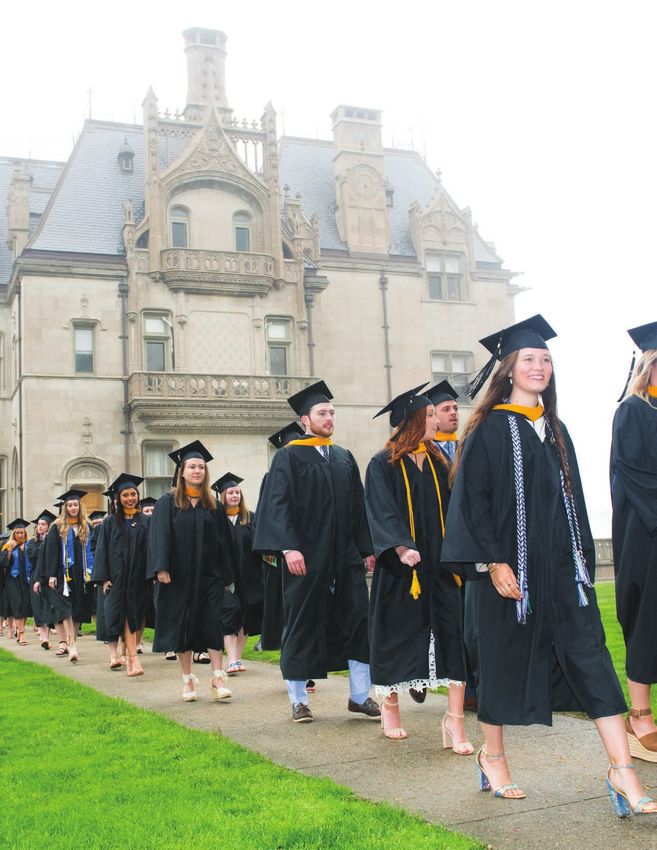
Thirteen years later, Robert Goelet gifted Ochre Court, his
   family’s spectacular Gilded Age “cottage” that sits oceanside
   along Newport’s famed Cliff Walk, to Salve Regina College.
   Made in memory of his father Ogden, the gift enabled
   the founding Sisters to open the gates of Salve Regina in
   welcome to the first 58 students on September 24, 1947
   – Mercy Day – as the Class of 1951.

   “Salve Regina, Mater misericordiae” is the beginning of an
   ancient Latin hymn that translates today to “Hail Holy               Mary Eloise Tobin, RSM (dec.), and
   Queen, Mother of Mercy, our life, our sweetness and our              Mary Jean Tobin, RSM (dec.), authors
   hope.” It was under the protection of Mary, Queen of                 of “With Courage and Compassion:
                                                                        A Reflection on the History of
   Heaven and Mother of Mercy, that the Religious Sisters of            Salve Regina University in the Light
   Mercy founded the University and it is Mercy that informs            of the Spirit Which Engendered
                                                                        and Sustains It”
   and pervades all facets of the Salve Regina experience.

                                                                                  1973
1934           100 years after
               the formation of
                                                                                   Salve Regina College
                                                                                   becomes coeducational.
the Sisters of Mercy, the State                                                    Sister Lucille McKillop,
of Rhode Island granted a                                                          Salve’s fifth president,
charter to the Sisters of Mercy                                                    states that “for all practical
of Providence for a corporation
named Salve Regina College.
                                              1947                                 purposes, Salve has been
                                                                                   coeducational all along in
                                              Robert Goelet gifts
                                                                                   as much as 440 men were
                                              Ochre Court in Newport,
                                                                                   enrolled in the school’s
                                              R.I., to the Sisters of Mercy
                                                                                   law enforcement courses
                                              to open Salve Regina
                                                                                   although not for a degree.”
                                              College “to promote virtue
                                              and piety in learning.”
                                              Mother Matthew Doyle,
                                              RSM, becomes Salve’s
                                              first president and
                                              welcomed 58 students
                                              of the Class of 1951.

                                                                                   Mission Review Self-Study   7
Today, nearly 75 years after the gates of
                                                  Ochre Court were open to Salve Regina’s
                                                  first students, the University is poised
“The mission statement is a                      to celebrate its jubilee anniversary in
 reasonable, lovely piece to live by. 2022, having built a strong foundation
 It is my inspiration to get involved             of Mercy-driven education upon which
                                                  its next chapters may unfold. While
 and be the brightest light I can
                                                  the mission is anchored in the traditions
 be on campus.”                                   of the Sisters of Mercy, it is also visionary
  CARLY CHERVENAK ’23                             in purpose for Salve Regina’s students
                      and graduates. The University continues to assess programming
                      through a mission lens, carefully considering the ways in which a
                      Mercy education is oriented to the needs and critical concerns of our
                      students, community, and the world.

                                                                             2005
                                                                             The Sisters of Mercy
                                                                             declare a commitment
                                                                             to five Critical Concerns
                                                                             of Mercy — Earth,
                                                                             immigration, nonviolence,
                                                                             anti-racism and women.
 1991                                                                        These are addressed
                                                                             through personal and
 Salve Regina achieves
 University status in formal
 recognition of its graduate
                                  1996           The University
                                                 strengthens its
                                                                             institutional choices,
                                                                             advocacy with
                                  longstanding commitment to community       legislators and other
 studies programs and the         service by establishing the Feinstein      government leaders and
 substantial development of       Enriching America Program, which           corporate and community
 its curriculum.                  supports students as they complete         engagement.
                                  a minimum of 10 hours of community
                                  service before they graduate.

 8   Mission Review Self-Study
Salve Regina University offers an education that is built on the power
of Mercy to change the world. We challenge students to achieve
academic excellence through disciplined development of skills and
knowledge, and to cultivate the spirit of Mercy within themselves –
to see, to care, and to act for the good of others. Salve Regina currently
serves over 2,100 undergraduates and 600 graduate and doctoral
students coming from 40 states and 20 countries. The University has
46 undergraduate majors, 14 master’s degree programs with options
for concentrations and certificates. Salve Regina offers Ph.D. programs
in Humanities and International Relations and a Doctor of Nursing
Practice (DNP). In keeping with the traditions of the Sisters of
Mercy and recognizing that all people are stewards of God’s creation,
the University encourages students to work for a world that is
harmonious, just and merciful.
2020
2019 The McAuley Institute for
Education is established
Dr. Kelli J.
to advance the vocation
Armstrong is
of Salve Regina University
2010 inaugurated
as Salve
through leadership
formation initiatives and
Our Lady of Mercy Chapel Regina’s
interdisciplinary faculty
opens, complete with stained eighth, and
collaboratives centered
glass windows created by local first lay,
on the tradition and
Victorian artist John LaFarge. president. Dr. Armstrong
Critical Concerns of Mercy.
Catholic Masses, multi-faith focuses on improving the
celebrations, sabbath time and educational experience for McAuley Institute
more are observed. The chapel students through research, for Mercy Education
houses the Mercy Center for planning and strategy and
Spiritual Life where students is particularly passionate
deepen their faith, engage in about serving disadvantaged
service, seek justice and become students and supporting “We should be shining lamps, giving light to all around us.” ~ Catherine McAuley
leaders formed by Mercy. the advancement of women
in underrepresented areas.
Mission Review Self-Study 9NEW AND VISIONARY LEADERSHIP
In her inaugural address in September 2019, President Kelli J. Armstrong, Ph.D.,
shared her vision for Salve Regina’s future, with emphasis on upholding the Mercy promise:
“We can no longer be quiet We will bolster those areas
about who we are. This is our in our institution that best
time to show the world what represent our mission. We will
a Mercy education means seek where we can have the
because the world needs us greatest impact. And we will
more than ever. In the words of enhance Salve’s ability to
Catherine McAuley: ‘We should shine a light on the world.
be shining lamps, giving light We will work to strengthen and
to all around us.’ The world is protect our University so that
tumultuous, but Salve Regina the Mercy mission is secure,
has what the world needs. and so that many future
In the coming years, we will generations can benefit from
expand our geographic reach... our transformative education.”
10 Mission Review Self-StudyTH E S T R AT E G I C C O M PAS S
Salve Regina regularly undergoes mission-driven strategic planning
and evaluation, as is evidenced by the 2020 Strategic Compass
process. This initiative has articulated anew the institution’s core
values and value proposition as a Mercy, Catholic university.
What does
Salve Regina University has been animated by its Catholic and
Mercy values since its inception. However, through listening deeply
every Salve
to the voices of students, faculty, staff, alumni, community members student
and other stakeholders, the Strategic Compass Steering Committee need when
articulated six distinct University values and four strategic principles they graduate?
that both have strong ties to the mission and history of Salve
and point the way forward. These articulated values and strategic
principles, alongside the mission statement, will guide the decisions,
actions, and developments of Salve Regina into the future.
Given new leadership in key positions, including the University’s
first lay president in its 73-year history, the Strategic Compass
process also prompted the review and renewal of the institutional
mission statement that is at the heart of the Salve Regina experience.
At its October 2020 meeting, the Board of Trustees adopted the
Covenant of Mercy Higher Education and reaffirmed the mission,
demonstrating that the connection between the past and the future is
linked through the University’s Mercy, Catholic mission and values.
Throughout the Strategic Compass project, a central question guided
the work: “What does every Salve student need when they graduate?”
Salve Regina University strives to integrate academic excellence
in the Catholic Intellectual Tradition with our core Mercy values and
mission to deliver a transformative educational experience for each
student. All Salve students need to leave the University with an
appreciation for their unique God-given talents and how to cultivate
these gifts to make a positive difference in the world.
Mission Review Self-Study 11Strategic Compass Foundational Values
Purpose-Driven Education
Through a values-based education rooted in liberal arts, academic
rigor and experiential learning, Salve students gain deep knowledge
that prepares them for career success and a journey of life-long
learning. Students gain the unique ability to enrich any workplace
and pursue a life of meaning and impact.
Respect and Dignity for All
We regard all humanity as being worthy of respect and honor
the uniqueness and dignity of each individual as God’s creation,
embracing differences in the feelings, beliefs, wishes, experiences,
cultures and traditions of others, with kindness and curiosity.
Mercy Community
We recognize the sacredness of community and pride ourselves
on being a welcoming, inclusive and collaborative environment,
with a sense of companionship and belonging for all, as we help
each other on life’s journey and in service of the common good,
in hopes of making the world a better place.
Integrity
We seek to develop leaders with a strong moral compass,
committed to making a positive difference in their communities
and in a diverse and changing world. We hold ourselves to high
ethical standards as stewards of the resources of Salve Regina
University and the responsibilities entrusted to us.
Faith and Spirituality
We promote the intellectual and spiritual exploration of faith for
people of all beliefs, guided by our Catholic heritage, and seek to
support all members of our community on their spiritual journey.
Compassionate Service and Solidarity
We are sensitive and attentive to the needs and experiences of others,
accompanying them with Mercy, acceptance and understanding.
We seek to alleviate suffering, sensing what will truly be of service,
and proactively anticipate and respond to these needs.
12 Mission Review Self-StudyS T R AT E G I C C O M PA S S
Guiding Principles
RIG ORO U S TR ANSFO R M ATI VE E DU CATI O N
grounded in liberal arts and professional programs,
personalized to support each student’s needs in
pursuit and development of their unique best self
INCLU SI VE CO M M U NI TY
that values diversity, welcoming every individual with
kindness, dignity and respect
ADA PTI VE R E SI L I E NCE
nurtured by faith, hope and optimism and supporting
each individual’s ability to adapt and thrive in
the midst of adversity and changing circumstances
COM PASSI O NATE M E RCY L E ADE R SHI P
cultivated through the lived experience of our
Mercy mission and core values in all we do at Salve
Mission Review Self-Study 13Strategic Compass Guiding Principles
Rigorous transformative education
Salve Regina is a caring and supportive community that strives to
optimize each student’s outcomes, offering a welcoming, “high-touch”
experience from recruitment to graduation and beyond. Salve Regina’s
approach to education is rooted in the Catholic Intellectual Tradition
and recognizes the importance of both faith and reason in the pursuit of
the continual human quest for knowledge and truth. This “whole person”
approach to education challenges students to develop intellectually,
emotionally and spiritually, in order to become the best version of
themselves. In pursuit of this goal, the Salve Regina faculty strive to truly
know the student and meet them where they are and to provide them
with a challenging and tailored academic experience that broadens their
perspectives and fosters intellectual curiosity, critical thinking, self-reflection
and personal growth. Salve faculty are given the academic freedom to
do this, which results in students learning to listen to and engage with
one another with an open mind, develop the skills necessary to excel in
their chosen field, live a life of meaning, and pursue lifelong learning.
Inclusive community
We believe that every voice is valuable and should be heard. We are
committed to addressing inequities and creating opportunities for
marginalized individuals and groups by learning from one another,
respecting differences in life experience, recognizing the dignity of
others, and welcoming all with hospitality, kindness and respect.
We celebrate the uniqueness of our students, faculty and staff, and
recognize the value each person brings to our community. Embracing
Salve’s Mercy mission, we place a high priority on addressing the
critical concerns of our local and global communities through the
transformative work of a Mercy education. We seek to advance
teaching, research and institutional action on the Critical Concerns
of the Sisters of Mercy: anti-racism, Earth, immigration, women and
nonviolence. We welcome diverse views of thought, making positive
assumptions about others and being open to change and new ideas.
We believe this broadens our perspectives, leads to a more inclusive
community, expands our worldview and affirms our common humanity.
14 Mission Review Self-StudyAdaptive resilience
Adaptive resilience is the ability to remain responsive versus reactive
to changing circumstances and adversity, staying true to core values,
mission and identity, and adapting with integrity. In an increasingly
complex, uncertain and changing world, Salve Regina understands
the need to instill resilience and cultivate a growth mindset among
our students, faculty, staff and administrators. We strive to create a
supportive, positive community where people listen to one another,
learn together from failures, and seek feedback in the spirit of
continual improvement. We view challenges as something that should
be embraced, celebrating hard work, effort and resourcefulness.
Each voice is valued as we reflect, engage with one another, explore
options and choose wisely from them. We adapt to our ever-changing
environment strategically while staying true to our mission so
that we may make a meaningful impact within our community
and beyond.
Mission Review Self-Study 15Compassionate Mercy leadership
Our mission is to develop and cultivate compassionate Mercy leadership
in our students and across the University by embodying the enduring
values of the Sisters of Mercy: to seek wisdom, promote universal justice
and work for a world that is harmonious, just, and merciful. Now, more
than ever, the world needs leaders who are attuned to the needs of the most
vulnerable, who can engage across differences respectfully, and who lead
with humility, integrity, fairness, grace and courage. Compassionate
leaders turn their attention outwards and are motivated to serve and
accompany, understanding that we are all connected. Salve Regina faculty
and staff strive to practice and demonstrate compassionate leadership.
We ensure that the Mercy mission is included in our teaching, research,
and institutional commitments, advancing work on the Critical Concerns
of the Sisters of Mercy: anti-racism, Earth, immigration, women and
nonviolence. Through community engaged learning, research and service,
we provide students with the opportunity to understand and practice
Mercy leadership in action.
16 Mission Review Self-StudyMission Integration Core Areas
Query 2: How does the University apply its meaning of mission
through programs, policies, practices?
SPONSORSHIP, CMHE AND ECCLESIAL RELATIONS
Membership in the Conference for Mercy Higher Education (CMHE)
is an essential component of Salve Regina’s realization of its Mercy,
Catholic identity and mission. CMHE seeks to preserve and develop
the core Catholic identity and mission of Mercy higher education in
accord with the spirit, mission and heritage of the Sisters of Mercy.
Salve’s president, vice president for mission integration, and director
of the Mercy Center for Spiritual Life have all been active members of
the CMHE network, regularly participating in annual meetings and
conferences. Dr. Theresa Ladrigan-Whelpley, vice president for mission
integration, has served as vice-chair of the CMHE Mission Officers’
Council from 2018-2019 and as chair from 2019-2020. Dr. Ladrigan-
Whelpley has also served on the CMHE planning committee developing
a mission formation program for Boards of Trustees at Mercy colleges
and universities. Salve has sent delegates, including the president,
board chair, RSM board members, and the vice president for mission
integration, to CMHE’s biennial leadership retreat, “Mercy the Principal
Path.” The University actively participates in CMHE-sponsored student
programs including the Pilgrimage for Young Mercy Leaders (sending
three students and one staff delegate biennially), U.N. Mercy Global
Action program (sending four students biennially), and D.C. Mercy
Advocacy program (sending four students biennially). Salve has also
participated in CMHE-sponsored collaboratives, including: D.C. Mercy
Roundtable where Dr. Anthony LoPresti, associate professor of religious
and theological studies, presented on “Mercy and Power”; and Carlow
Roundtable at Mercy International Center where Dr. Ladrigan-Whelpley
presented on “Living the Charism: Traditioning Mercy, Catholic
Higher Education in the 21st Century” (2018) and Dr. Leona Misto,
RSM, presented on “Salve Regina University: Charting Its Course by
Mission Integration and Planning” (2007).
Mission Review Self-Study 17Under the leadership of the University chancellor, Dr. M. Therese
Antone, RSM, and the Board of Trustees’ Mission Committee, the
University adopted the Covenant of Mercy Higher Education in October
2020, updating its bylaws and charter accordingly, and affirming
the mission statement. The Covenant describes the intentions and
assurances that inform the relationship between the Institute of the
Sisters of Mercy of the Americas and Mercy colleges and universities.
The Board of Trustees’ Mission Committee, instituted in 2005 and
chaired by Sister Christine Kavanagh, seeks to advance the Catholic
identity and Mercy mission of the University across institutional
priorities and programs and within board discussions and decision-
making. Five vowed members of the Sisters of Mercy serve as
Trustees, a number that remains a requirement of Salve’s bylaws to
assure the integral sponsorship of the Institute of the Sisters of Mercy
in the governance of the University. In a recent (2020) self-evaluation
by Board members, 96% strongly agreed and the remaining members
(4%) agreed that “The Board makes decisions that support the
philosophy, mission, values, and traditions of the Sisters of Mercy
and Salve Regina University.”
Salve Regina is also a member
“We need leaders today who possess institution and active participant in
not just competence, but compassion; the Association of Catholic Colleges
not just intelligence, but empathy. and Universities (ACCU). President
Like Catherine McAuley almost 200 years Kelli J. Armstrong, Ph.D., and the
vice president for mission integration
ago, we open our doors of Mercy to all.”
regularly participate in annual
DR. THERESA LADRIGAN-WHELPLEY meetings, and Dr. Ladrigan-Whelpley
Vice President for Mission Integration has also served on the planning
committee for the ACCU Mission
Officer’s Conference in 2018 and 2019
and currently serves on the Catholic Identity Mission Assessment
(CIMA) Advisory Board. A shared study of Ex Corde Ecclesiae and the
unique commitments and educational paradigm of a Mercy, Catholic
university is hosted for new faculty through the Mercy Faculty
Forum, with a session focused on Salve’s Catholic identity and Mercy
charism. A similar session for staff and administrators is included
annually in the Mercy Leadership Colloquium.
18 Mission Review Self-StudySalve Regina is a member of
the Catholic Campus Ministry
Association (CCMA) and two
Roman Catholic clergy of the
Diocese of Providence currently
serve as University Chaplains
through the Mercy Center for
Spiritual Life. Salve’s full-time
(.75 FTE) University Chaplain,
Rev. Scott J. Pontes, is formally
appointed to this position by
Bishop Thomas Tobin to support
the religious life of Salve’s
students, faculty and staff, and Fr. Ray Malm, who is retired from
the diocese, actively supports the ministry of the Mercy Center in
a part-time role (.25 FTE). Catholic Mass is celebrated on Sundays at
5 p.m. and 7 p.m. and during the week on Tuesdays and Wednesdays
at 12:15 p.m. in Our Lady of Mercy Chapel. A liturgical intern in
the Mercy Center supports the formation and leadership of student
liturgical ministers at Sunday Masses and a student liturgy committee
convened by Fr. Malm plans liturgical celebrations and designs the
artscape in the Chapel in accord with the liturgical seasons.
Spiritual programming for Catholic and non-Catholic students,
faculty and staff, such as the rosary, bible study, RCIA, a faith and
food speaker series, Taizé prayer, retreats and service outreach are also
regularly offered through the Mercy Center, which welcomed a new
director, MaryAnne Davey, in 2021 and developed a new strategic
plan in 2020. Bishop Thomas Tobin of the Diocese of Providence is
invited to preside at key University celebrations each year such as the
Baccalaureate Mass (and the recent Inauguration Mass of Salve’s eighth
president), and the president keeps the bishop informed of significant
events in the institution’s academic and spiritual life. The University
Chaplains and Mercy Center staff also have initiated outreach across
a network of local communities of worship (from multiple Christian
and other faith traditions), hosted multifaith services on campus, and
worked to connect students with local faith communities to support
their religious and spiritual life and development.
Mission Review Self-Study 19S PAC E , ART, SY MB OL ISM AND E NVIRONME NT
The calligraphic artwork depicting Salve Regina’s mission statement
is one of the most recognizable on campus; it hangs in offices, is
distributed at new student, faculty and employee orientations, and
appears in a variety of publications as well as on the University
website. The illustration of a caterpillar’s metamorphosis
into a butterfly symbolizes the transformative power
of a Salve Regina education, in which Mercy plays a
central and vital role.
The institution’s Mercy, Catholic heritage is evident across
the campus landscape, with statues of Mary and Joseph
and the Sacred Heart of Jesus located at the University’s
administration and academic buildings. Perhaps the
most poignant example is the statue of Catherine McAuley,
foundress of the Sisters of Mercy, which stands at the
center of campus beside Our Lady of Mercy Chapel.
A recent addition in 2019, Catherine’s statue has become
a familiar and favorite figure to students, faculty and
staff who take the time to pose with her for photos,
present her with flowers, and wrap her in a scarf during
the winter months or a mask during a pandemic. Her presence is
a powerful symbol encompassing the past, present and future calls
to action for a world that is harmonious, just, and merciful.
Catherine’s words are also
displayed around campus on
a number of stones, located at
busy intersections, that share
her most famous quotes, such as
“We should be shining lamps,
giving light to those around us.” Her wisdom and vision empower
the campus community to embrace the Mercy mission and her
portrait presides over the staircase in McAuley Hall, one of several
University buildings named for a Sister of Mercy. Other buildings
include Miley Hall, O’Hare Academic Building, McKillop Library,
Antone Academic Center, and Gerety Hall – all named after Sisters
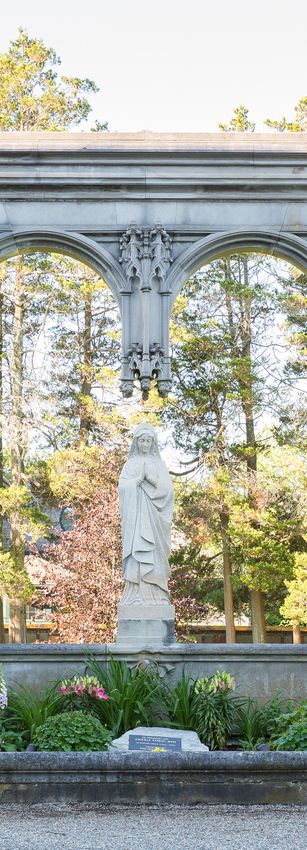
20 Mission Review Self-StudyOur Lady of Mercy Chapel
(above) and Catherine
of Mercy who served as University presidents, each playing an McAuley’s statue (opposite)
stand at the heart of
important role in the institution’s history. Salve Regina’s campus.
Our Lady of Mercy Chapel stands at the heart of campus as a tribute
to the Sisters of Mercy who have served Salve Regina. Consecrated
in 2010, the chapel offers Sunday and weekday Masses and other
religious services and allows graduates and community members to
celebrate their weddings on campus in a sacred space. The main floor
houses both the chapel and a space designated as a multifaith prayer
room, offering quiet space for prayer and meditation for people of all
faiths. However, because this designated space also features stained
glass windows of Mary and Jesus, the multifaith use of this space has
not yet been realized. The Mercy Center’s current strategic plan
includes the priority of developing a multifaith sanctuary for campus.
The Mercy Center for Spiritual Life, located on the lower level,
provides ample space for student activities, fellowship and offices
for campus ministers. Throughout the day, the chapel bells resonate
Mission Review Self-Study 21throughout campus and serve as an audible reminder of Salve Regina’s
connection to its Catholic roots.
Other visual representations include the Mercy shield prominently
displayed in McKillop Library’s circulation area, crosses in classrooms,
Mercy Center banners hung on the wrought-iron fence along Ochre
Point Avenue (focusing on one of the Critical Concerns of the
Sisters of Mercy), Salve Seeks light pole banners, a variety of posters
promoting events or reminders to “Have Mercy, Wear a Mask,”
and the Gerety Lawn labyrinth that invites passers-by to pause
and reflect as they wander its circular path. In addition, the Critical
Concerns of the Sisters of Mercy, along with the spiritual and corporal
works of Mercy, are displayed in a number of campus spaces
including Marian Hall, which houses the Department of Religious
and Theological Studies.
22 Mission Review Self-StudyThe Department of Art and Art History
frequently features student work and visiting
exhibitions that reflect the mission and
Critical Concerns. Recent exhibits held in
the Dorrance H. Hamilton Gallery in the
Antone Academic Center include:
• “Suffrage and Struggle: Feminist Art and
the 19th Amendment Centennial,” which
paid tribute to 2020’s milestone as the
centennial anniversary of women gaining
the right to vote in the United States.
• The development of the Nature Cabinet, a laboratory and study
center of the natural world, which points to the Department of Art’s
concern for the earth and environment. An upcoming show will
be dedicated to the achievements of Salve Regina students related
to the natural world and a website
was created for this resource.
• A photography exhibition called
“Traces,” which explored race and
identity as well as a photography
exhibit titled “What I Keep,”
which examined homelessness
in America, asking the question:
“What would you keep if you lost
everything?”
A redeveloped website presence for the Office of Mission Integration
features engaging content highlighting the three areas that fall
under its purview: The Mercy Center for Spiritual Life, the Center
for Community Engagement and Service and the McAuley Institute
for Mercy Education. A dynamic History and Tradition timeline tells
the story of Salve Regina and a link to Salvetoday brings readers to
“Mercy Monday” stories that appear regularly online. In addition,
Mission Integration’s robust social media presence includes regular
posts and reflections that engage and empower the campus community
Mission Review Self-Study 23across platforms such as Instagram and Facebook.
Salve Regina
REPORT FROM NEWPORT
University Magazine
The University magazine Report from Newport
Fall 2019
also features stories highlighting students, faculty
and alumni who incorporate the mission into their
personal and professional lives.
Central to Salve Regina’s mission is the recognition
that all people are stewards of God’s creation,
firmly affirming sustainability of resources as
Welcoming a campus priority. The University community
Dr. Kelli J. Armstrong
Salve Regina University’s
strives to conduct activities in a socially just,
eighth president
Page 16
economically viable and environmentally sound
manner, valuing the interdependence of people, prosperity and the
planet, now and into future generations. The unique campus landscape,
which includes 21 historically significant buildings purposefully
adapted with close attention to cultural and historic preservation,
serves as a living laboratory for sustainable development. The Critical
Concern regarding the Earth is also promoted through responsible
water consumption, waste reduction, sustainable and socially just
food production, material reuse and recycling, renewable energy
investments, ecological land use, green building practices, sustainable
campus transportation options and campus conservation efficiencies.
Students work
in Salve’s
hydroponics lab.
24 Mission Review Self-StudyMISSION
The Arbor
etum at Sa PARTNE
established lve R S
to preser ve Regina was
and histor the natura
ic resource
s of the ca
l S A LV E
landscape
and to prov mpus R EGI N
learning en ide a livin UNIVE A
rboretum
vironmen g R S IT Y
educationa t that enha
lm nces
and demon ission of the Unive the
strates a re rsity
“
commitm sp
ent to stew onsible
The New
por t Tre
e Con ser
ardship.
van cy
ACCRED
We value th ITATION
is
we feel a st land surrounding ou
rong sense
of responsi r campus, and
Interdisciplinary teaching and research addresses pressing local and
for future
generation bility to pr
communit s of eserve
y and visito students, members of it WAK EH
global environmental, economic, and social challenges and fosters
rs to Newpo
rt.”
the
UR S
TREE TO T
T
– Chancello
aforuvisible,
e to the vi
unding Si
educated,
sion of Sa
lve Regina’s
and active
r M. Ther
ese Anton commitment to integral ecology and
e, R SM UR
sters of M
of stewards er cy, the prac tree invent
the Uniclimate hi
versity miss p rem justice
ains in among
tice
our students,
or y and m
anagemen faculty, staff and graduates. POCK ET
ion. In reco tegral to in 2012
Univers ity’s ongoin gn
as part of
and Landsc Sa
t plan. Laun
lve Regina’s ched GUIDE
protect its g efforts to ition of the ap Hist
1,200 tree pres maintenan e Program, this mon oric Tree
Salve Reg s of 100 di er ve and ce plan is
designed to ito rin g and
ina’s campu fferent spec and replen
ArbNet A
Accredited by the Morton Arboretum as Level II, the Arboretum
Level II ar
rboretum
s ha
boretum by s been recognized
the Morto
n Arboret
ies,
as a
and walki
ish
t of a deta
pres
includes de campus trees. The pr er ve, protect
velopmen og ram also
Accredita um’s ng tour. iled digita
The Unive
mature an
at Salve Regina University is yet another testament to the
rsity’s 88-a
cre campu
tion Progra
m.
Committ
ed to mon
l catalog
salve.edu/
arboretum
d exotic tr s features its breathta itorin
mos king natura g and maintaining
by notable
Olmsted br mission’s recognition that all people are stewards of God’s creation.
landscape
others. Th
ees, origin
architects
ally designe tly
such as th
d supports in
University
itiatives th
l canopy, th
e
at invite m University
care and co e ongoing e communit embers of
y an the
distinguish
nser vation
es
of this hist
institutions Salve Regina amon
professiona
With more than 80 acres situated alongside the Cliff Walk in
oric landsc
l
ap
to interact
physically
with the co d the general publ
lle
and/or virt ction of specimen
ic
. g liberal ar e ually. trees
ts
Newport’s historic district, the University is committed to the
“
Arboreal w
ork on cam
recommen pu For more
dations from s is based on informatio
preservation of more than
digital wal
the compr
ehensiveking tour, 100
n, and to ac
vi species
ce ss our of mature
I think thand exotic trees
salve.edu/ sit us online at: at I shall n
ever see
arboretum a poem as
that adorn the grounds. Arboreal work on campusloveis ly asbased
a tree” on arboretum
salve.edu/
- Joyce Kilm
recommendations from the comprehensive tree inventory and er
management plan launched in 2012 as part of Salve Regina’s
historic tree and landscape program. This monitoring and
maintenance plan is designed to preserve, protect and replenish
campus trees so that the campus community, along with the
many visitors exploring the area, may experience the diversity
of species that comprise the University’s living laboratory.
Mission Review Self-Study 25S E LE C T I O N , ORIE NTATION , ONB OARDING
AN D M I S S ION DE VE LOPME NT
The introduction of Salve Regina’s Mercy, Catholic mission begins
during the prospective student recruitment process. Whether students
connect with Salve by attending an on-campus information session
or event, a virtual program or meet an admissions staff member
“on the road,” discussions about the University begin with mission.
Communications, view books and recruitment materials distributed
to students, schools and guidance counselors include both the mission
and examples of how it is woven into the Salve Regina experience.
The Office of Undergraduate Admissions works to ensure access
to an affordable education for all and strives to increase access for
underserved populations and those committed to the Mercy mission.
During the application review process, a focus on leadership and
service correlates with the awarding of merit scholarships. In addition,
Salve Regina has continued to increase the number of full-tuition
scholarships offered each year in the OCHRE Scholars program
(Opportunity and Community Helping to Reach Equity Scholars,
previously named the Martin Luther King Jr. Scholarship).
Applicants must have financial need and be committed to diversity,
multiculturalism and inclusion, and show evidence of service and
leadership in their school and community.
A selection of workshops including sessions on the Common
Application, financial aid, college essay writing and interviewing
skills, as well as translating publications and tours in multiple
languages are part of ongoing efforts to provide equitable access to
26 Mission Review Self-Studycollege for a broader range of students and families,
especially first-generation students. Invitations to
prospective students and their families to campus
presentations focused on issues of social justice
and the Critical Concerns of Mercy provide
opportunities to connect with the mission early in
the search process. An example is the collaboration
between Salve Regina’s Pell Center for International
Relations and Public Policy and the Rhode Island
Center for the Book in which high school students
read a chosen book each year and the Pell Center
hosts a conversation with the author. Students
attend the session but have the option to come early for an Admissions
presentation, campus tour and dinner in the dining hall. The two
most recent books were “What Their Eyes Don’t See” and “Rising,”
which featured themes around racism, social justice, earth, poverty,
access to health care and more. Given the ease with which the world
now moves virtually, more opportunities also continue to be offered
to a wider range of prospective students, such as the virtual teach-in
for Mercy and justice during MLK Week 2021.
An appreciation of, and attunement with, the University’s mission
and purposes are effectively demonstrated by the hiring and orientation
processes for members of the administration, faculty and staff. The
vice president for mission integration takes part in the interview
process for all tenure-track faculty and senior administration searches,
ensuring that prospective candidates have the opportunity for
conversation around the history and significance of Salve Regina’s Mercy,
Catholic mission and may ask questions and reflect on how they might
meaningfully contribute to this mission. Prior to the consideration
of candidates, the vice president meets with search committee chairs
to discuss the priorities for each search and the significance of
the mission within the department. Following the interviews with
finalists, the vice president shares reflections and insights from
candidate conversations with the search committee chairs. Once
selected, all new faculty and employees attend University orientation
sessions, which introduce the work of various offices across campus,
including a presentation by the Office of Mission Integration on the
Mission Review Self-Study 27University’s Mercy heritage and mission and the ways in which faculty
and staff can engage with, and contribute to the mission through
their work and leadership in the Salve Regina community.
Prospective and admitted student days and new student orientations
also feature an introduction to the University’s Catholic heritage and
Mercy charism through presentations by the Office of Mission
Integration, the Mercy Center for Spiritual Life, and the Center for
Community Engagement and Service. All are gifted with print copies
of the Mission statement and The Heritage and the Promise booklet,
as well as information on the Mercy Center and the Center for
Community Engagement and Service.
New members of Salve’s Board of Trustees are interviewed by the
president and board chair, and an informal orientation program
consisting of a series of overview and welcome meetings with new
Trustees and division vice presidents has been instituted. The vice
president for mission integration conducts one of these orientation
sessions. However, a more robust orientation process for new Trustees
is needed, particularly in relation to the role and responsibilities of
Trustees to uphold and steward the mission. The president has asked
the vice president of mission integration to develop a more robust
Trustee orientation program to launch in the coming year and she
is working together with the chair of the Mission Committee of the
Board of Trustees to develop the shape and scope of this program.
Opportunities to thoughtfully consider and assess the ways in
which the Mercy mission is lived out at Salve is currently available
for all constituents. Trustees complete an annual self-evaluation that
includes a prompt on personal mission effectiveness, supervisors
annually assess team members on ways in which they incorporate
the mission, and course evaluations across disciplines ask students
to discuss the ways in which a course enhanced their understanding
of, or fulfilled, the mission. Reflection is also part of departmental
self-evaluation across disciplines, occurring not just in the program
review stage but also in annual end-of-year reports. These habits
of mind and heart will continue and evolve as the Strategic Compass
is articulated and institutional values are more deeply embedded
into the campus culture and curriculum.
28 Mission Review Self-Study“The mission challenges you to analyze
your own perceptions and think critically
about unjust systems and how you
will seek answers, act and respond.”
COLLEEN CLOONAN SWAIN ’16, ’17 (M)
“We only come to know of
God’s love through God’s Mercy.
Thus, created in the image of God
and called to grow in that likeness,
Mercy is how we most perfectly
reflect the love of our Creator.”
DR. MIGUEL J. ROMERO
ASSISTANT PROFESSOR, RELIGIOUS
AND THEOLOGICAL STUDIES
Voices of Mercy
“Show that compassion
each and every day. Through
those little acts that make
someone happy. You never
know what kind of day
people are having or the
situation that they’re in.”
MARIA HENDRICKSON ’19, ’20 (M )
Mission Review Self-Study 29ONGOING FORMATION FOR MISSION
The mission of Salve Regina University is ordered around the
search for wisdom and the promotion of universal justice. These
fundamental community commitments entail responsibilities related
to the work of welcoming and formation. As a community that welcomes
people of all beliefs, Salve Regina aims to engage each member
of the community in the University mission and recognize their
unique part in its advancement. The work
“Mercy calls for action. of formation is oriented toward growth in
Mercy is compassion in action.” wisdom (i.e., “theoretical wisdom”) and
universal justice (i.e., the enactment
SISTER LEONA MISTO (DEC.) of “practical wisdom”). This two-fold
Former Vice President for Mission Integration enterprise of imparting theoretical
wisdom and practical wisdom pertains
to the first two spiritual works of Mercy: to instruct those who do not
understand and to guide those who are learning what it means to be
morally virtuous.
Therefore, at Salve Regina, formation is best understood as a work of
Mercy. Rooted in our Catholic identity, guided by our Mercy heritage,
and nourished by the Catholic intellectual tradition, the instruction
and formation of students is the heart of our mission. The immediate
and long-term goal is to form individuals and a community
committed to building a harmonious, just and merciful world.
Mission formation offerings for faculty and staff include two new
initiatives launched through the McAuley Institute for Mercy Education.
First, the Mercy Leadership Colloquium is a four-part mission
integration series for administrators and staff to engage with readings
and resources from the Mercy, Catholic tradition, vocationally reflect
on their lived experiences, and cultivate practices of Mercy leadership
across the campus community. Cohorts are comprised of 10 staff
and administrators each year and are nominated for participation by
their respective vice presidents. The Mercy Leadership Colloquium
is hosting its third cohort of staff participants in 2021. In a survey
of the first two cohorts, 100% agree or strongly agree that they made
significant gains in their understanding of, and connection with,
Salve’s Mercy Catholic mission and grew as Mercy leaders through the
30 Mission Review Self-StudyColloquium. A second new offering through the McAuley Institute,
the Mercy Faculty Forum, is a four-part mission integration series for
full-time faculty to engage resources from the Mercy, Catholic tradition
and reflect together on their vocations as teaching scholars within the
landscape of Mercy, Catholic higher education. Funded by a grant from
the Lilly Fellows Program, the Forum is facilitated by senior faculty
colleagues and the vice president for mission integration. New faculty
are invited to discuss shared readings, including Ex Corde Ecclesiae,
and consider the ways in which their own research, teaching, service
and leadership contribute to and advance the University’s mission.
Building upon the momentum of these mission formation initiatives,
the McAuley Institute plans to establish an annual symposium for
University faculty, staff and students exploring themes from the Mercy,
Catholic tradition in the coming year. Past symposiums sponsored
by the Office of Mission Integration have produced a series of
mission-related publications including “Mercy Illuminates” (2008),
“The Catholic Intellectual Life” (2014), “Mercy and the Catholic
Intellectual Life” (2015), and “Echoes of Mercy” (2015). For many
years the University Mission
Committee, comprised of
the vice president for mission
integration and a team
of faculty and staff, offered
regular programs for ongoing
mission formation including
“lunch and learn” sessions
on a variety of topics related
to the Mercy mission (e.g.
Catholic Social Teaching,
Mercy Hospitality, Servant
Leadership), mission-focused
art contests, and an annual
Collegium. Collegium was
an annual retreat engaging faculty in shared dialogue and reflection
around the ways in which the Mercy, Catholic mission is manifest
through their teaching, research and service. Through a recent
grant from the Network for Vocation in Undergraduate Education
(NetVUE), “Fostering the Transformative Work of Mercy, Catholic
Mission Review Self-Study 31Higher Education through Vocational Reflection and Action,”
resources to renew several of these offerings, including a faculty-staff
retreat, have been secured. Though deferred due to COVID, the
faculty-staff retreat has been designed to invite faculty and staff into
deeper community and shared vocational reflection and engagement
with the Mercy, Catholic mission. The Mercy Center for Spiritual Life
also offers regular opportunities for faculty and staff to reflect together
on their lives and vocations through lunchtime discussions, an annual
“busy person’s retreat,” and Advent and Lenten days of recollection.
Salve Regina is one of the few CMHE schools to host a continuous
chapter of Sigma Phi Sigma. Established as the National Mercy
Honor Society in 1951, Sigma Phi Sigma promotes the values of
scholarship, fidelity and service to the community. Sigma students
promise to uphold these values and carry forward the tradition and
practices of Mercy in their studies, profession and vocation. Moderated
by staff from the Office of Mission Integration, Salve’s chapter is
quite active, engaging members in ongoing formation opportunities
related to the meaning of Mercy leadership and the significance of
the Critical Concerns, as well as providing leadership opportunities
at signature University events (e.g. Convocation, the Governor’s Ball)
and shared community service and advocacy.
32 Mission Review Self-StudyMission leadership workshops are offered for student leaders annually
by the vice president for mission integration and the Mercy Center,
including sessions for Resident Advisors, Orientation Leaders, Peer
Mentors, Service Advocates, and the Mercy in Motion Leadership Team.
However, these deeper opportunities for vocational reflection and
leadership development in the Mercy tradition
are not provided to all Salve students universally.
The 2020 Strategic Compass has identified the
need to develop a “Signature Salve Experience”
for all students that include curricular and
co-curricular opportunities to grow and develop
as compassionate, Mercy leaders seeking to
advance our mission to build a more harmonious,
just, and merciful world. As we map the future
of this signature experience, particular attention
will be necessary to ensure that opportunities for Representatives of
mission formation are offered to all Salve students. To advance the the 2020-21 Student
Government Association
mission among the student population, the Student Government Executive Board
Association (SGA) has designated Mission/Traditions, Diversity and
Environmental committees.
Following a campus Vigil and Forum for Racial Justice in summer
2020, President Armstrong committed to renewed University action
addressing issues of systemic racism and promoting deeper education
and engagement around the Critical Concerns of the Sisters of Mercy,
particularly anti-racism. In fall 2020 Dr. Armstrong established the
Presidential Commission for Equity and Inclusion to advance this critical
work. Duties of the Commission include: 1) review Salve’s policies
and procedures to ensure that they promote University values and
the Mercy mission and advance an institutional commitment to
equity and inclusion; 2) review and recommend ongoing training
and development for students, faculty and staff to foster a culture
of equity, inclusion and support for all members of our community;
3) sponsor University-wide events and programs to promote deeper
understanding of the systemic issues of social inequity and injustice
and the ways in which a Mercy education calls us to respond; and
4) conduct regular, ongoing data collection to monitor University
progress on institutional commitments to equity and inclusion.
Mission Review Self-Study 33The Office of Mission Integration has also developed Mission
Effectiveness Statements for board members, faculty, staff and
students, highlighting the ways in which each constituency may
promote the vision and values of Mercy through their lives and
leadership. These statements appear in the Trustee, Staff and Student
Handbooks as well as the Faculty Manual and can be found on the
Mission Integration website. They highlight the value of ongoing
engagement, reflection and action across University constituents in
living the mission. The Office of Human Resources has developed
an employee evaluation, in use since 2004, that includes employees’
self-assessment and supervisors’ assessment of their employees’
advancement of the mission. In addressing the question, “How does
the employee effectively incorporate the University’s mission in his/
her day-to-day work role?” supervisors are encouraged to initiate
mission-driven discussion as part of the annual performance review
process. Furthermore, every course evaluation includes an open
response question related to the University’s mission, “In what ways
did this course enhance your understanding of or fulfill the mission?,”
inviting students and faculty to consider how the mission is
integrated in the material of the course and advanced in the teaching
and learning priorities of the University.
A standing Mission Committee of the Board of Trustees is charged
with ensuring that members of the Board actively support and further
the mission in deliberations and governance. The Mission Committee
recently shepherded the adoption of the new Covenant of Mercy
Higher Education by the Board of Trustees, amending bylaws and the
original charter to more explicitly integrate a commitment to Salve’s
Mercy, Catholic mission across the University’s governance and
priorities. However, the ongoing formation for mission of the Board
of Trustees is an identified area of growth for Salve. The vice president
for mission integration served on a CMHE committee developing
a new formation program for Mercy Boards of Trustees and plans are
currently under way (deferred by COVID) to develop a board
retreat at Salve that will deepen each member’s connection to, and
application of, the mission within their board leadership.
34 Mission Review Self-StudyYou can also read


