NAPIER BOYS' HIGH SCHOOL CHARTER 2021
←
→
Page content transcription
If your browser does not render page correctly, please read the page content below
NAPIER BOYS’ HIGH SCHOOL
CHARTER 2021
OUR VISION: Students at Napier Boys’ High School will develop into
confident, innovative young men who will learn, strive and achieve in a
traditional environment, having a strong sense of respect for themselves
and others.

Justum perficito nihil timeto
               Do right and fear nothing
                                                 Me tika te mahi, kia mataara
The Napier Boys’ High School Community: Napier Boys’ High School is a single sex state school
catering for young men from Year 9 to Year 13 with a substantial boarding hostel - Scinde House. The
Napier Boys’ High School community has a wide range of socio-economic and ethnic groups
contributing to a positive social diversity which enhances the character of the school. Students are
drawn from all parts of Napier city and outlying areas. The school is inclusive and fosters a caring and
safe learning environment for all those who are enrolled according to the school’s enrolment scheme.
All boys will have a strong sense of attachment to the school, they are proud members of the wider
school community, and experience success in a variety of settings.

Apart from the students, other important members of the school community include:

    •   Staff and their families (present and past)
    •   The Old Boys of the school
    •   Parents of students (past and present)
    •   Friends of the school

All these groups have strong feelings for the school based on the common belief in the qualities and
values that contribute to the special character of Napier Boys’ High School.

The community expects that the school maintains high standards and emphasises the pursuit of
excellence in academic/vocational study, cultural, social and sporting activities. The school is
responsive to change, yet delivers teaching and learning in a disciplined environment that develops
inquiry, personal reflection, a sense of occasion and respect amongst its students.

OUR VALUES:
•   Honesty – trustworthy and decent in all actions
•   Integrity – reliable and credible, “doing right and fearing nothing”
                                                      1
•   Discipline – self-control in formal and informal settings
•   Excellence – striving to exceed one’s personal potential in all things
•   Self-respect – pride and dignity
•   Well-rounded – actively involved in a range of pursuits which encourage personal
    development
•   Innovative – experiments and takes risks within a supportive environment
•   Diligent – persistent, timely, organised work habits
•   Confident - knowing one’s strengths and limitations while pursuing goals

                                          2
INTRODUCTORY SECTION
2021 Roll CHANGES
1/3/2021 Year 9 Year 10 Year 11 Year 12 Year 13 Total
Ethnicity NZ Int NZ Int NZ Int NZ Int NZ Int NZ % Int
Asian 6 5 3 6 2 8 2 1 2 26 2.2 9
European 160 149 1 149 3 153 1 111 722 62 2
Maori 96 79 77 48 53 353 30
MELAA* 0 1 3 1 2 7 0.6
Pasifika 6 7 2 11 11 37 3.2
Other 1 0 1 1 1 4 0.3
Totals 269 245 240 225 181 1160 11
Totals 2020 255 3 246 3 229 6 225 12 163 - 1118 100 29
Cultural Diversity Napier Boys’ High School has a diverse student population, with an increasing
Māori roll of 30%, a small Pasifika roll, usually around 40 students, and a small number of foreign fee
paying students in non COVID years (approx 25 - 35, predominantly German and Asian). The school
attracts students from both urban and rural sectors many of whom travel considerable distances to
enjoy the school’s structured learning environment.
Recognition of these groups is an important aspect of preparing NBHS students to live and work in a
global society. NBHS reflects this cultural diversity and the unique position of Māori within the school
in the following ways:
• Maintaining a well-resourced Māori Studies Department
• The school maintains a focus on Culturally responsive and relational pedagogy
• The implementation of M.A.N.A (Māori Achievement Night Awards); 2020 was the best attended
event in three years
• Association with the Pukemokimoki Marae
• Compulsory Tikanga at year 9 and the offering of Te Reo from year 9 – 13 and Tikanga in years
11 - 13
• Provision of a dedicated Māori Studies facility
• Recognition of the contribution of Māori heritage and associated Tikanga to the school.
• Involvement of International students in a range of activities
• Support for and from the local Pasifika Community (eg: Polyfest)
• The establishment of senior leadership groups for Māori and Pasifika students.
General Description of the School
The school was established on the Napier Hill in 1872 and moved to its current site in 1926 in order
that the students enjoy more spacious surroundings. The school site, now owned by the Board of
Trustees, measures 14.7 ha with an adjacent farm block of 13 ha. The palms planted after the 1931
earthquake, punctuate the school’s landscape and create a unique setting for the large fields and
facilities. Since the fire in October 1991, the school has been significantly upgraded and the modern
learning environment is enhanced with a unique Art-Deco style architecture that is a template for future
building developments.
Napier Boys’ High School is a well-established and respected school, promoting traditional values and
enhances these by adapting to changing needs and circumstances. It is a modern secondary school
with a rich past that caters for the all-round educational needs of approximately 1200 boys from a
diverse range of contributing schools.
3The school has a well-established boarding facility - Scinde House that provides for 185 students.
Students attend primarily from the East Coast North Island hinterland, with others from further afield
(Taupo – Taihape). During holiday periods the facility is a sought after event/conference venue.
The well qualified staff members have a serious commitment to academic excellence, as well as to
extra-curricular activities. Their input in the areas of sport, drama, outdoor education, music and art is
strength of the school and a genuine point of difference. The school enjoys the services of a
dedicated and capable administration, catering, ancillary and grounds staff.
A comprehensive range of academic and vocational subjects are offered at all year levels to satisfy
the career expectations of all students. The school also offers experience in a range of national and
international examinations and academic competitions.
The school involves groups and individuals from outside agencies through the Health, Gateway,
STAR, Careers, Sport and Cultural programmes, and the guidance network.
The school farm (13 ha) adjacent to the school provides a learning environment for a range of
educational activities. Horticulture, Viticulture, Forestry, Agriculture and Farm Technology are based on
this facility (and its history). In addition the school also owns an Outdoor Education Centre ‘Camp
Simmons’ at Pakaututu on the upper reaches of the Mohaka River, which is used in the summer months
as an outdoor base for classes involved in Outdoor Education.
Napier Boys’ High School is currently responsible (on behalf of the Napier high schools) for the
governance of the Napier Community High School. The school has a maximum roll of 20
students who are referred on a needs basis for varying lengths of time.
Napier Boys’ High School is an active member of the New Zealand Super Eight
Schools which links prominent North Island boys’ state secondary schools, expanding
opportunities to include contact for sporting and cultural events and staff professional
development.
International Students: International students have been an integral part of the schools
culture for many years. The Board of Trustees have developed a position that the roll should remain at
approximately 25 – 35 students. This allows for efficient use of current resources while providing a
genuine New Zealand school experience for the students themselves. Fundamental to this experience
is the need to balance the origins of the International student roll to ensure a healthy spread of
nationalities.
Camp Simmons: ‘Camp Simmons’ at Pakaututu is the school’s own outdoor facility kindly donated to
the school by the Simmons family in 1995. The site sits above the Mohaka River and provides a base
for EOTC activities.
The Hawke’s Bay Holt Planetarium is sited on the school grounds and provides an additional unique
learning facility for the school’s students as well as students from other schools, visitors and the greater
community.
4STRATEGIC PLANNING: The current Napier Boys’ High School Strategic Plan was developed in 2019
for implementation in 2020. Facilitated strategic planning meetings included surveys and gatherings
with: board, parents, whanau, staff, and students.
The school is a relatively constant operational entity. Resourcing, roll size, staffing and outputs do not
fluctuate markedly year on year. Governance via the Board changes every three years. The primary
drivers in considering the strategic direction of the school are:
• The demographic setting (age, socio economic mix and ethnicity) of Napier and Hawkes Bay.
• The expectations (and the successes) of the school’s wider community i.e. People’s perception of
all aspects of the school.
• Political decisions with respect to economic and educational priorities.
• Ever changing technologies.
• The local (East Coast) rural economy (and related industries).
• Legislative requirements and the Ministry of Education Educational expectations and initiatives
Given the above, the strategic plan for the school will place the school in a position to continue to be
able to enhance opportunities for young men of the region with respect to:
• The educational experiences and programmes that they participate in.
• The place where they learn,
• The people that they interact with during their learning experiences at the school.
The Board will review annually, the strategic plan that sets out goals to raise levels of student
achievement in all areas of the curriculum (Nag 2). The goals will reflect the ongoing learning needs of
the students and the means to address them.
It is the Board’s view that a roll of approximately 1200 students provides the school with the resources
that allow it to deliver programmes that addresses the needs of its students/community. Each year
targets will be set, based on the identified needs of NBHS students. These targets will be evaluated
and help inform future goals and targets. The Board will report annually to the Ministry of Education on
success in meeting these targets.
The School’s Leadership and Board Committees will compile for the Board’s approval, an Annual Plan
which details priorities and activities the school will undertake in order to effectively meet its targets.
This plan will reflect Ministry of Education requirements, Legislative requirements and the expectations
of staff and the wider community.
The School’s Strategic Plan and Annual Plan will take into account the broader demands of:
1. The academic needs and aspirations of students and the wider Napier community
2. The Ministry of Education and the Tertiary Education Commission (Gateway; Trades Academy)
3. School Development Plan (and ICT Strategic Plan)
4. Links with other Educational providers in the region particularly the Eastern Institute of
Technology.
The Board and Senior Leadership will consult with relevant stakeholders when:
1. Reviewing the Strategic Plan
2. Compiling Annual Plan
3. Examining the current situation
4. Setting future goals and objectives
5. Assisting the implementation of plans
6. Monitoring and reporting
In addition, the school’s involvement in the Napier City (Mataruahou Kahui Ako) Community of Learning
(COL) is also a key strategic component. The Napier City COL is operational now with all staff appointed
and working towards the approved challenges.
5Property:
The school now focusses on the rebuild of 20 ILE classrooms, including the probable alignment of all
science teaching facilities. Stage 1 was delivered on 15 February 2021. Stage 2 (four English rooms
and a resource area) should be complete by the end of this year.
Scinde House: Scinde House is a key component of the school’s identity and associated success.
Outside of Wellington, it is the only state boys’ boarding school on the East coast of the North Island.
The closure of a boarding facility in Gisborne reinforces the need to ensure that Scinde House is able
to provide for a growing hinterland. Hostel property developments are funded solely from Scinde House
fees and letting income. The M.F.Greenwood Educational Trust has been a major benefactor in
supporting the developments at Scinde House. The on-going refurbishment and redevelopment of
Scinde House is vital for the future viability of the facility. This development must be carefully planned
to allow continued occupation (for students and letting), as well as being ‘best for boys boarding’.
The Greenwood Block has set the standard for other property projects in the hostel and further
developments having been progressed, including:
• Completion of the new Ormond Block at $1.72 million
• Staff housing refurbishments (8/8 residences completed)
Current projects in planning include:
• Upgrade of Glendining Block over four years to the standard of Ormond Block; two wings are
partially complete as at 1 February 2021
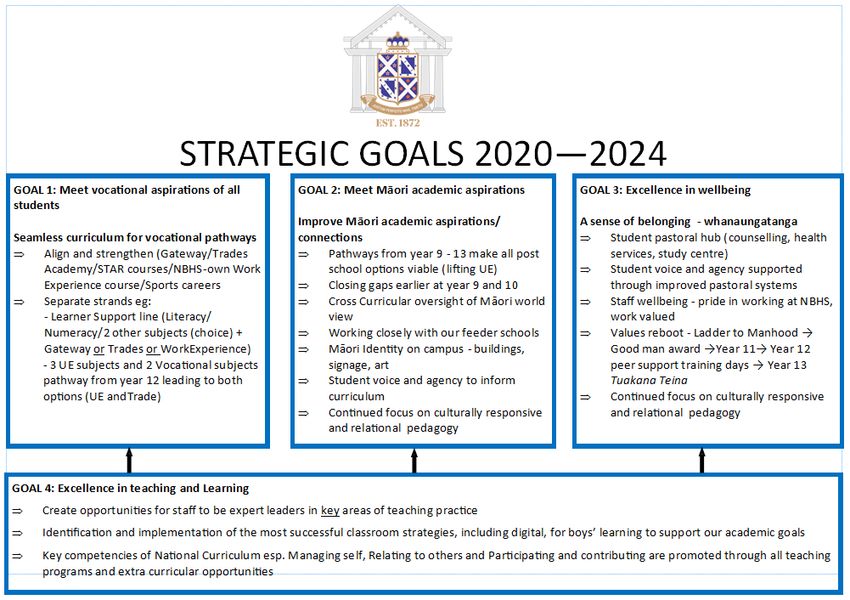
6Appendix 1 – Strategic plan 2020 - 2024
7Appendix 2– Annual plan and Charter targets 2021
1. Meet vocational aspirations of all students
Specific Measurable Achievable Relevant Timeframe Who
1.1 Review of pathways • Alignment of Trades Academy with Yes Yes Term 1 Senior
School courses Leadership
• Scope of Gateway and school’s own Senior
work experience program Leadership/BAR
1.2 Careers review • Funding Yes Yes Term 3 BER
• Programs Senior
Leadership/LAU
2. Meet Māori academic aspirations
Specific Measurable Achievable Relevant Timeframe Who
2.1 Culturally responsive and relational • Culturally response and relational Yes Yes Whole year RUS
pedagogy pedagogical training with first group
(Rongohia Te Hau model)
• Kia tū rangatira ai project with Dr. Yes Yes Whole year BER
Melinda Webber
• Compulsory tikanga year 9 Yes Yes Whole year PAK
• Basic tikanga and te reo courses Yes Yes Whole year PAK
(provided in-house)
2.2 Supporting Māori and Pasifika • Relationship with Pukemokimoki Yes Yes All year BER
student aspirations Marae continues; embedded as part
of “Ladder to Manhood”
• Establishment of Māori transition Yes Yes Ongoing TAM
Dean
2.3 Māori identity on campus – refer
Operational quality
2.4 Cross curricular oversight of Māori Investigate best practice models in NZ Yes Yes Term 3 Senior
world view schools Leadership
2.5 Closing gaps earlier at y9 and y10 • Data sharing with Kahui Ako and Yes Yes Whole year Kahui Ako
other feeder schools from y7 team
• Identify needs prior to y9 entry
• Identify strategies to accelerate
learning
83. Excellence in wellbeing
Specific Measurable Achievable Relevant Timeframe Who
3.1 School values • “Ladder to Manhood” (year 9) Yes Yes Term 1 RUS/TAY
• “Good man” award (year 10) with Pastoral
changes to booklet and community team
service
• Year 11 option to develop
• Year 12 peer support training days
• Year 13 Tuakana/Teina
3.2 Student wellbeing • Continued focus on mental health Yes Yes Whole year SIL/RUS
and resilience with specialist support with Pastoral
• Student voice re: program care team
• Build into level assemblies
3.3 Staff wellbeing and Interpersonal • Staff committee to establish principles Yes Yes Whole year SIL
relationships are an ongoing goal of for Wellbeing Committee and place of
the school Staff Association
• Administer wellbeing budget and
consult with staff
• Develop coherent program of support
3.4 Monitor and improve NBHS Safe – • Embed changes to H and S Yes Yes Ongoing NEW/Dr.
school’s Health and Safety committee under Board’s Freudenberg
procedures leadership
• Continue to Train/upskill all staff in
H and S
3.5 Ensure boarding practice is culturally • Monitoring student physical and Yes Yes All year JOH
responsive and inclusive of diversity emotional health and safety
• Implement Student Welfare
Committee
• Review Hostel Dean pastoral care
program to ensure we cater for at risk
students
93.6 Encourage the development of “Good • Phone restrictions applied to year Yes Yes All year JOH
Men” in boarding 11
• Provide education to students and
parents on current issues such as
vaping, relationships etc
• Improve leadership opportunities
for hostel students
4. Excellence in teaching and learning
Specific Measurable Achievable Relevant Timeframe Who
4.1 School achievement targets are Names, numbers and needs identified, Yes Yes Annual Senior
monitored Tracked and monitored Leadership
4.2 Continue process for monitoring, Align with CoL Transition team’s At risk Yes Yes Ongoing TAY (with
Tracking and mentoring of students spreadsheet SIL/STA)
to ensure those at risk of under- TAM
achieving are supported Specific tracking and monitoring by Māori ASH
and Pasifika transition deans
4.3 Imbed the use of academic data to HoD’s to identify key data Yes Yes Ongoing Senior
differentiate teaching and learning School to set up summary markbooks for all Leadership
teaches and departments with this key data and HoD’s
PLD provided re: using this
Use of the data a focus of all lesson
observations
4.4 Writing for literacy Write that Essay part of PLD Yes Yes Whole year SWE
Literacy module y9 continues (BUX/APP)
4.5 Digital fluency Professional learning time (30 Hours) Yes Yes Whole year RUS/STA
continues 2021 with differentiated staff PLD
opportunities
4.6 Gifted and Talented education • Identify register of GAT students Yes Yes Term 1 ASH
• Establish program of opportunities (a Term 2
second “curriculum”) for these
students
• Promotion of GATE All year
104.7 Identification and implementation of • Inquiry project Yes Yes Term 2 – 4 Senior
most successful classroom strategies • Review Room 101 project Leadership
for boys’ learning • Lead to Strategic Goal 4.1 in
2021
4.8 Gap analysis of Key competencies of • Curricular and extra curricular Yes Yes Term 3 - 4 SMT and
National Curriculum and action plan programs ELA
• Esp. managing self, Relating to
others, Participating and
contributing
4.9 Learning Support Identify learners who qualify for learning Yes Yes Term 1 and 2 DOB (with
support/SAC’s by year 11 NCEA, particularly APP, TAM)
Maori learners
5.0 Ensure quality of extra-curricular • Review extra-curricular programs Yes Yes Term 2/3 Senior
programs – leadership, delivery and funding Leadership
• Develop high performance Possibly Yes Term 3/4 WES
mcc
support for Gifted and Talented
students eg: S and C programs Yes Yes Term 3/4
• Ensure staffing provides both BER
appropriate leadership and
management of the extra-
curricular life of the school
5.1 Foster a culture of academic focus • Peer tutoring in senior subjects Yes Yes Term 2 – 4 Asst. HoB
and excellence amongst Scinde • Celebrate academic success and Yes Yes All year JOH
House students. community service
115. Operational quality
Specific Measurable Achievable Relevant Timeframe Who
5.1 Ensuring high quality staff in all Attendance at Boarding conference. Yes Yes Term 2 JOH/ha
aspects of Hostel life Term 2 JOH
First Aid Courses to be completed by all new
Boarding staff/renewals
5.2 Progress Armour Block Demolition Stage 2 completed Yes Yes February SMT/pi
replacement
Construction Stage 2 underway Yes Yes March
Stage 2 completed Probably Yes December
5.3 10YPP SIP projects ($400K) • Upgrade library (heat/cool/water/light) Yes Yes 2021 BER/pi
- Library • Add archival space
5.4 Ensuring high quality facilities in all • Upgrade third wing of Glendining Yes Yes Term 3 BER/pi
aspects of Hostel life Block (annual until 2023)
5.5 Progress Board long-term property • Farm Yes Yes Ongoing Board
objectives • Parking and road safety Te Awa Avenue
with NCC
5.6 Progress weathertightness Blocks B, AC, PA, MS, P1-3, FF, PL, T, G, H1 No Yes 2020 – 2023 BER/pi
remediation across school and PAV
5.7 Replace pool filter shed Urgent 5YA project under Health and Safety Yes Yes Term 1 BER/pi
5.8 Māori identity on campus Art – planning for the use of totara in storage Yes Yes Whole year NBHS
Whanau
Bilingual signage – design, commission and Yes Yes Whole year NBHS
begin rollout across campus Whanau with
PY
Buildings – concepts for wharenui or marae ātea Possibly Yes Whole year NBHS
Whanau and
Board
125.9 Professional development of • Tiaki Tioahi program via NZBSA – online Yes Yes All year JOH
Housemasters course; trialled by Head of Boarding
6. Finance
Specific Measurable Achievable Relevant Timeframe Who
6.1 Finance Review Independent review by Crowe Yes Yes Term 1 and 2 BER, SMT, jo
Implement recommendations
6.2 New Financial reporting Implement Xero Yes Yes Term 4 BER, jo
6.3 Ensuring the continued financial • Maintain strong promotions of the Yes Yes Term 1 JOH/BER
viability of Scinde House Hostel to prospective parents via
annual visits around the region.
Use of Social Media and Austin
Media to support promotions term
1
• All new enrolments to asked to Term 2 Finance
use Direct Debit for fees
• Review fees and maintain Term 3 Finance/Board
appropriate levels of fees and
funding sources for on-going
developments
• Maintain a high rate of Boarder Ongoing JOH
occupancy. Goal to exceed
budgeted occupancy level (175
boarders) Term 3 BER/Board
• Maintain promotion of hostel
holiday lets.
• Consider implementation of fees
insurance for all boarding families
(school to self insure)
7.1 Charter targets 2021: Students at risk of not achieving qualification/level
13Actual Pakeha Pakeha at Maori Maori at Pasifika Pasifika at
Qualification At risk
pass actual risk actual risk actual risk
Year 9 Read/Write (NZC L4) 30%/25% 17%/20% 25%/30% 33%/33%
Year 9 Numeracy (NZC L4) 24% 21% 26% 33%
Year 10 Read/Write (NZC
25%/20% 20%/17% 28%/22% 50%/50%
L5)
Year 10 Numeracy (NZC L5) 15% 13% 20% 50%
Year 11 Level 1 20% 15% 30% 40%
Year 11 Level 1
45% 40% 55% 60%
Endorsements
Year 11 Level 1 Literacy 10% 12% 15% 25%
Year 11 Level 1 Numeracy 12% 8% 20% 25%
Year 12 Level 2 15% 12% 20% 30%
Year 12 Level 2
60% 55% 75% 90%
Endorsements
Year 13 Level 3 25% 30% 30% 30%
Year 13 Level 3
65% 60% 80% 100%
Endorsements
Year 13 University Entrance 40% 40% 55% 50%
NZ Scholarship1 30 n/a n/a n/a
1 Target number only, not percentage
1415
Appendix 4 STATEMENT OF DEFINITION - To be a traditional boys’ school means for us a
focus on:

      •   Having a formal learning environment where learning occurs in an organised engaging
          manner.

      •   Providing a wide choice of academic and vocational options.

      •   Developing relationships that are welcoming to all and respectful.

      •   Providing strong role models for males and preparing boys to be ‘good young men’.

      •   Core values of: respect, self discipline, service, integrity, honesty and excellence.

      •   Acknowledging the ‘Good Man Ethos’ - Good men are positive and productive, they make

          sound decisions for themselves and others’, as well as the need for service to our

          community.

      •   Having staff that have empathy for young men, are inclusive and are prepared to help them

          be safe and succeed.

      •   Providing a clear and consistent behaviour management structure to protect the right of all

          students to learn, thereby developing self-management and discipline.

      •   Using a range of information to place junior students (Year 9 -10) in classes of a similar

          ability/attitude, and making sure that each student is challenged to learn.

      •   The promotion and recognition of excellence in performance across all subjects and in all

          activities outside the classroom.

      •   Using examinations (school-based and NZQA) as an important component of assessing

          student progress, and sharing the outcomes with students and their parents.

      •   Maintaining high standards of school uniform, grooming and behaviour.

      •   Providing each student with the opportunity for involvement in activities outside the

          classroom.

      •   Regular assemblies that recognise important school traditions, values, and the success of

          students.

      •   Providing leadership opportunities for students e.g. prefects, house prefects, tutor leaders,

          peer support leaders, sports and cultural captains.

                                                  16
• Recognising the history of the school through student studies, displays, services and
ceremonies.
• Being personally accountable, meeting commitments and completing tasks.
• Preparing students for the changing face of career opportunities.
17Appendix 5
SELF REVIEW – OVERVIEW – FOUR YEAR PROGRAMME: 2021 - 2024
Term Programme for Year 1 - Programme for Year 2 - 2022 Programme for Year 3 - 2023 Programme for Year 4 - 2024
2021
Adopt Budget Adopt Budget Adopt Budget Adopt Budget
Evaluate 2020 Achievement Evaluate 2021 Achievement Evaluate 2022 Achievement Evaluate 2023 Achievement
Information Information Information Information
Lodge 2020 Variance Report Lodge 2021 Variance Report with Lodge 2022 Variance Report with Lodge 2023 Variance Report with
with MOE. MOE. MOE. MOE.
Lodge 2021 Charter with Lodge 2022 Charter with MOE. Lodge 2023 Charter with MOE. Lodge 2024 Charter with MOE.
MOE. Implement & Monitor 2022 Targets. Implement & Monitor 2023 Targets. Implement & Monitor 2024 Targets.
Implement & Monitor 2021
Targets Adopt
ONE • Charter due 1 March
• Annual Report to Auditors by 31 March
• Adopt Headmaster’s Performance Agreement.
• 1 March return tabled.
• Teacher Registration Audit – reported to Board after 1 March
• Set Board annual work plan
• Management Reports to Board
• Curriculum reviews to Board
• Schedule of all Board reporting timeline in the Board Annual Work Plan
Elect Board Chair, Deputy, Elect Board Chair, Deputy, Elect Board Chair, Deputy, Elect Board Chair, Deputy,
Committees Committees Committees Committees
Confirm Annual Delegations Confirm Annual Delegations Confirm Annual Delegations Confirm Annual Delegations
Privacy Officer Privacy Officer Privacy Officer Privacy Officer
Fees Fees Fees Fees
2 yearly Review of Health 2 yearly Review of Health
Education Programme Education Programme
(See Curriculum Policy) (See Curriculum Policy)
18NAG 1 NBHS INTERNAL NBHS INTERNAL CURRICULUM NBHS INTERNAL CURRICULUM NBHS INTERNAL CURRICULUM
(4 yr CURRICULUM REVIEW: REVIEW: REVIEW: REVIEW:
Cycle) Mathematics, Languages, English, Physical Education, Social Physics, Chemistry, Music, Art, Music, ICT, Art, English, Physics,
Agriculture / Horticulture and Sciences, Pastoral and Guidance Computing, Culture, Hostel, Home Chemistry, Culture, Hostel
Commerce, Uniform, Home Economics.
Economics
TERM Review includes New Curriculum
TWO reporting.
• AUDITED ANNUAL FINANCIAL STATEMENTS to MOE 31 May
• ENROLMENT SCHEME Review Report to MOE 1 May
• June 1st Return
• July 1st Return
• Management Reports to Board
• Curriculum reviews to Board
Schedule of all Board reporting timeline in the Board Annual Work Plan
BOARD ELECTION
(Complete elections, new board
orientation; elect chair, deputy,
committees and confirm annual
delegations)
STUDENT REP ELECTION STUDENT REP ELECTION STUDENT REP ELECTION STUDENT REP ELECTION
(Plan and complete) (Plan and complete) (Plan and complete) (Plan and complete)
Complete Student Rep Complete Student Rep Orientation Complete Student Rep Orientation Complete Student Rep Orientation
Orientation and professional and professional development and professional development and professional development
development
• International Student Policy / NZQA annual attestation (formerly MOE Processes Review) [Filed
with NZQA]
• Provide Professional Development for Student Representative
• September 1st Return
• Management Reports to Board
• Curriculum reviews to Board
• NZQA Moderation report previous year
• Schedule of all Board reporting timeline in the Board Annual Work Plan
19Board Performance Annual Board Performance Annual Review Board Performance Annual Review Board Performance Annual Review
Review 2022 CHARTER TARGETS 2023 CHARTER TARGETS 2024 CHARTER TARGETS
TERM 2021 CHARTER TARGETS
FOUR Review STRATEGIC GOALS Review STRATEGIC GOALS Review STRATEGIC GOALS
Review STRATEGIC GOALS
Annual review / adopt school rules
Annual review / adopt school for ensuing year Annual review / adopt school rules Annual review / adopt school rules
rules for ensuing year for ensuing year for ensuing year
Draft 2022 Charter and Draft 2023 Charter and approve Draft 2024 Charter and approve Draft 2025 Charter and approve
approve Budget Budget Budget Budget
Plan 2022 Board elections
POLICY REVIEW CYCLE
The school is now using School Docs and will adopt their review recommendations
Yearly Every Three Years
Term 1
• School Wide Achievement Review • Reporting to parents
• Charter • Strategic Plan
• ELA Review • Board organisation (after election)
• EEO • Staff Induction
• Attendance rates whole previous year • Provisionally Certified Teachers
• Annual Plan • Appraisal, attestation, registration
• Retention Rates • Guidance/Support systems (including attendance)
• Performance Management Report previous year – • Sports Organisation
appraisal/Attestation • Library and Information systems
• Professional development • Cultural Organisation
• Teacher Registration • Curriculum Structure
• Stand downs and suspensions • Professional Development Structure
• Triple R – In committee
20• 1st March Return • Uniform
• Leadership
• Job Descriptions
• Health Consultation (every 2 years)
• Emergency procedures
Term 2
• Curriculum Plan (for following year)
• Annual report
• Property Plan 5YA
• Final Budget
• Annual Budget
• Faculty Review
• NZQA Moderation Report – previous year
• Curriculum Plan
• Prospectus
• Fees for following year
• 1st June Return
Term 3
• Property Plan
• Mid-year report stand downs and suspensions
• 1st July Return
Term 4
• Property Plan
• Professional Development Plan
• Board Annual Plan for following year
• Draft Annual Plan
• Draft budgets
• Draft PD Plan
Board Board
• Fees
21• Timetable All policies
• Delegations
22You can also read


