NASA LUNAR PROGRAMS Moon Landing Plans Are Advancing but Challenges Remain
←
→
Page content transcription
If your browser does not render page correctly, please read the page content below
United States Government Accountability Office

                          Testimony before the Subcommittee on
                          Space and Aeronautics, Committee on
                          Science, Space, and Technology, House
                          of Representatives

                          NASA LUNAR
For Release on Delivery
Expected at 11 a.m. ET
Tuesday, March 1, 2022

                          PROGRAMS
                          Moon Landing Plans Are
                          Advancing but Challenges
                          Remain
                          Statement of W. William Russell, Director, Contracting
                          and National Security Acquisitions

GAO-22-105533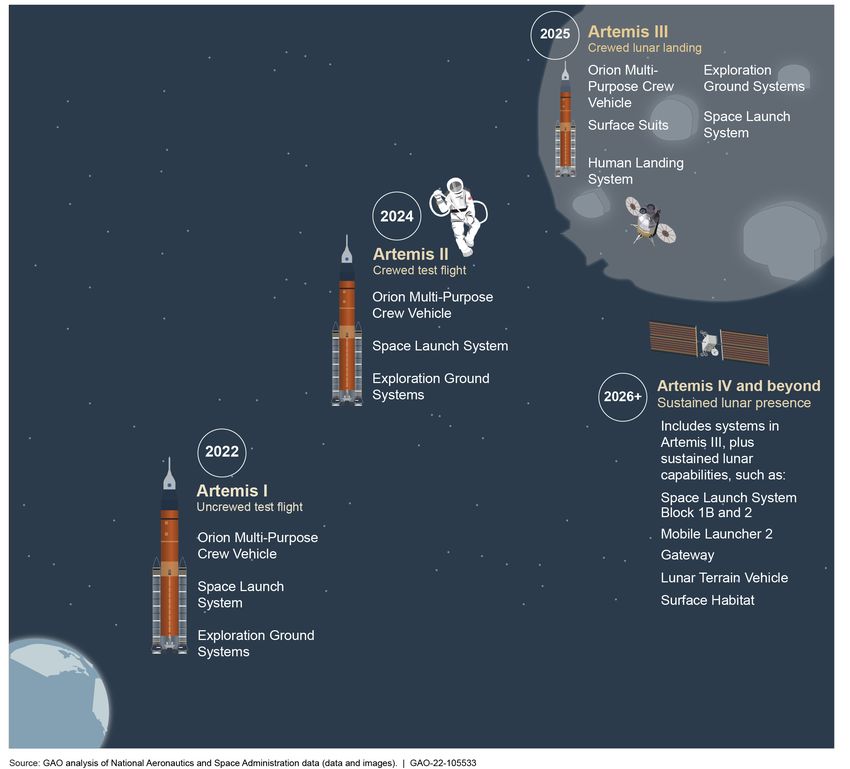
March 1, 2022

                                               NASA LUNAR PROGRAMS
                                               Moon Landing Plans Are Advancing but Challenges
                                               Remain
Highlights of GAO-22-105533, a testimony
before the Subcommittee on Space and
Aeronautics, Committee on Science, Space,
and Technology, House of Representatives

Why GAO Did This Study                         What GAO Found
NASA is developing multiple highly             The National Aeronautics and Space Administration (NASA) effort to return U.S.
complex and interdependent programs            astronauts to the Moon and then travel to Mars—known as Artemis—has made
to achieve the lunar landing mission,          progress. Since GAO’s May 2021 report, NASA conducted integration and test
known as Artemis III, as well as longer-       events for the Artemis I mission (an uncrewed test flight) and manufactured some
term goals to create a sustained lunar         hardware for the Artemis II mission (a test flight that will carry crew). NASA also
presence. In the fiscal year 2022              made progress on completing planning activities for the Artemis III moon landing
president’s budget request, NASA               mission, such as reviewing integration efforts across lunar programs.
requested at least $32 billion over the
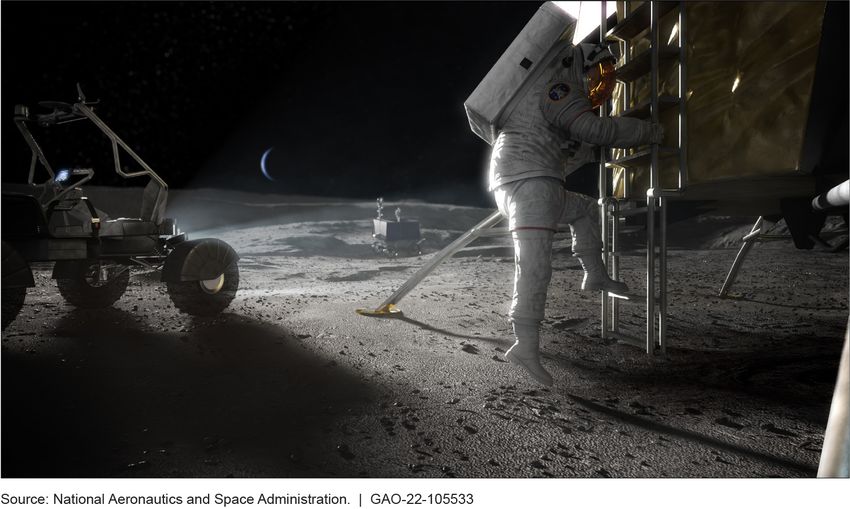
next 5 years to support these efforts.         Artist’s Rendition of Artemis Lunar Landing Mission

To land astronauts on the Moon, NASA
will need to develop a lunar lander and
new space suits. It will also need to
execute uncrewed and crewed test
flights, planned for spring 2022 and
2024, respectively, of the Orion Multi-
Purpose Crew Vehicle and the Space
Launch System. NASA has delayed
the first test flight multiple times, which
places pressure on the schedule for
subsequent missions. In prior reports,
GAO highlighted progress NASA has
made toward these missions, as well
challenges the agency faces in
managing and integrating these
systems and missions. This statement
updates NASA’s progress and
challenges in working towards the first
three Artemis missions.
This statement is primarily based on           NASA now plans to conduct the Artemis III moon landing mission no earlier than
GAO’s previously issued work on                2025, a year later than originally planned. While this delay will allow more time for
NASA’s lunar programs, as well as its          NASA to acquire a lunar lander and new space suit (shown above), Artemis III
ongoing annual assessment of NASA              schedule and costs remain challenging for several reasons, including:
major projects. GAO updated some
areas by following up with NASA                Delays to the lunar lander contract. NASA officials stated they estimated a 7-
through other ongoing work.                    month delay in working on the lander, subsequent to a bid protest and federal court
                                               complaint regarding the award of the lander’s contract. The schedule to develop the
What GAO Recommends                            landing system is ambitious; the program plans to develop and launch the system
                                               months faster than other spaceflight programs and needs to mature critical
Since 2019, GAO has made 10                    technologies.
recommendations related to improving
NASA’s management of its Artemis               Change to spacesuit acquisition strategy. In July 2021, NASA approved a change
efforts and related programs. NASA             from developing its new spacesuits in-house to using a contractor, which may affect
generally agreed with these                    planned development time frames. Under this strategy, NASA officials stated they will
recommendations and plans to take              not have the contract awardee’s proposed schedule until after the contract is
steps to implement them.                       awarded. Officials told GAO the award is planned for spring 2022.

View GAO-22-105533. For more information,      Increasing costs. Key Artemis III programs have experienced cost growth. For
contact W. William Russell at (202) 512-4841   example, costs for the Space Launch System and ground systems grew by more
or Russellw@gao.gov.                           than $1 billion in 2020.

                                                                                            United States Government Accountability Office
Letter Letter
March 1, 2022
Chairman Beyer, Ranking Member Babin, and Members of the
Subcommittee:
Thank you for the opportunity to discuss the National Aeronautics and
Space Administration’s (NASA) efforts to return astronauts to the surface
of the Moon and ultimately human exploration of Mars through its Artemis
missions. In the fiscal year 2022 president’s budget request, NASA
requested at least $32 billion over the next 5 years to support this
ambitious undertaking. NASA is developing multiple highly complex and
interdependent programs to achieve the lunar landing mission, known as
Artemis III, as well as longer-term goals to create a sustained lunar
presence. NASA now plans to conduct the lunar landing mission in 2025
or later. This is a delay of at least a year from earlier plans. NASA has
initiated eight lunar programs since 2017 to support lunar landing
missions and develop a sustained lunar presence. These new programs
include a human landing system to transport crew to the lunar surface
and space suits for lunar surface operations. In addition, NASA plans to
rely on existing programs, including the Orion Multi-Purpose Crew Vehicle
(Orion) and the Space Launch System (SLS) to launch and transport
crew from Earth to lunar orbit for the mission.
We have highlighted progress NASA has made toward the lunar landing
mission, such as completing some early lunar program development
activities, as well as challenges NASA faces in managing and integrating
these systems and missions. 1 For example, in December 2019, we
reported that NASA had begun making decisions related to requirements,
cost, and schedule for individual lunar programs but was behind in taking
these steps across the programs to support the overall Artemis III
mission. As a result, NASA risked the discovery of integration challenges
and needed changes late in the development process. Successfully
executing the Artemis III mission will require extensive coordination
across lunar programs and with a wide range of contractors to ensure
systems operate together seamlessly and safely.
You asked us to testify today on GAO’s work examining NASA’s lunar
programs. My statement focuses on (1) progress NASA has made toward
1GAO, NASA Lunar Programs: Significant Work Remains, Underscoring Challenges to
Achieving Moon Landing in 2024, GAO-21-330 (Washington, D.C: May 26, 2021); and
NASA Lunar Programs: Opportunities Exist to Strengthen Analyses and Plans for Moon
Landing, GAO-20-68 (Washington, D.C.: Dec. 19, 2019).
Page 1 GAO-22-105533its first three Artemis missions and (2) challenges the agency faces in
conducting Artemis missions.
This statement is based primarily on our previously issued reports on
NASA’s Artemis efforts, including reports that focus on the lunar
programs necessary to support Artemis missions, and our annual
assessment of NASA major projects. 2 In addition, we updated some
information from our ongoing work. 3 To provide updates, we assessed
NASA program acquisition and key decision point documentation,
briefings to senior leaders, and information provided for recommendation
follow up. The reports cited throughout this statement include detailed
information on their scope and methodology.
We are conducting the work on which this statement is based in
accordance with generally accepted government auditing standards.
Those standards require that we plan and perform the audit to obtain
sufficient, appropriate evidence to provide a reasonable basis for our
findings and conclusions based on our audit objectives. We believe that
the evidence obtained provides a reasonable basis for our findings and
conclusions based on our audit objectives.
Background
Key Elements of NASA’s NASA is developing multiple programs to achieve its Artemis III mission
Planned Return to the and longer-term goals including a sustained lunar presence and ultimately
human exploration of Mars. 4 These programs include an outpost orbiting
Moon
the Moon, a landing system to put humans on the surface of the Moon,
and a new launch vehicle and crew capsule. See figure 1 for programs
needed to accomplish the Artemis missions.
2GAO-21-330; NASA: Assessments of Major Projects, GAO-21-306 (Washington, D.C.:
May 20, 2021); NASA Human Space Exploration: Significant Investments in Future
Capabilities Require Strengthened Management Oversight, GAO-21-105 (Washington,
D.C.: Dec. 15, 2020); and GAO-20-68.
3Our ongoing work includes our annual review of all of NASA’s major projects and a
review NASA’s lunar focused programs.
4NASA distinguishes between programs and projects in its policies and guidance. A NASA
program has a dedicated funding profile and defined management structure, and may
include several projects. Projects are specific investments under a program that have
defined requirements, life-cycle costs, schedules, and their own management structure.
For the purpose of this statement, we refer to both programs and projects as programs.
Page 2 GAO-22-105533Figure 1: Artemis Missions and the Programs Needed to Accomplish Each Mission
Note: NASA also plans to launch the Volatiles Investigating Polar Exploration Rover in 2023. The
rover is being designed to investigate volatiles—including water, carbon dioxide, and other chemicals
that boil at low temperatures—at the lunar South Pole. NASA could potentially use these volatiles to
Page 3 GAO-22-105533support sustained human presence on the lunar surface. Scientific results from the rover that map
volatiles on the lunar surface will help to inform the landing site selection for the Artemis III mission.
Prior to the Artemis III lunar landing mission, NASA plans to execute
uncrewed and crewed test flights of the Orion crew capsule and the SLS,
known as the Artemis I and II missions, respectively. We have previously
reported that NASA has experienced delays on the uncrewed test flight,
which places pressure on the schedule for future missions. 5
NASA Acquisition Life NASA initiates space flight programs to accomplish its scientific or
Cycle exploration goals. NASA policy states that programs shall follow their
appropriate life cycle. The life cycle for programs consists of two phases:
1. formulation, which takes a program from concept to preliminary
design, and
2. implementation, which includes building, launching, and operating the
system, among other activities.
Senior NASA officials must approve programs at milestone reviews,
known as key decision points (KDP), before they can enter each new
phase. The formulation phase culminates in a review at KDP C. This
decision point is also known as a confirmation review, at which cost and
schedule baselines are established. NASA measures its cost and
schedule performance for the program against these baselines.
Throughout the acquisition life cycle, programs also hold reviews to
assess the maturity of their systems or evaluate the readiness to move to
the next phase of the life cycle. For example:
• Near the end of the formulation phase, programs hold a preliminary
design review to assess the maturity of the program’s technologies
and to determine if the design is mature enough to proceed with the
detailed design phase.
• During the implementation phase, programs hold a critical design
review to determine if the design is stable enough to support
proceeding with the final design and fabrication.
5GAO-21-105.
Page 4 GAO-22-105533NASA Acquisition Acquisition management has been a long-standing challenge at NASA,
Management High Risk although we have reported on improvements the agency has made in
recent years. 6 We first designated NASA’s acquisition management as a
Area and Priority
high-risk area in 1990 in view of NASA’s history of persistent cost growth
Recommendations and schedule slippage in the majority of its major systems. We have
identified management weaknesses that have exacerbated the inherent
technical and engineering risks faced by NASA’s largest projects,
including the Orion, SLS, and Exploration Ground Systems programs.
NASA has taken steps to improve its management of major projects, such
as embracing tools to support better cost and scheduling practices, but
has continued to struggle with major project cost and schedule
performance. In our March 2021 High Risk Update, we found that NASA
needs to do more to reduce acquisition risk and demonstrate progress,
especially with regard to demonstrating sustained improvement in cost
and schedule performance for new, large, complex programs, such as
NASA’s lunar programs. 7
We have made multiple recommendations to NASA focused on improving
transparency into long-term costs and affordability of human spaceflight
programs and improving the reliability of data used to inform acquisition
decisions. We determined that these recommendations warranted priority
attention, and therefore included them in our annual letter to the NASA
administrator. 8 This letter provided the overall status of the agency’s
implementation of our recommendations and identifies open
recommendations that should be a priority for implementation. As of
December 2021, we identified seven recommendations related to
monitoring Artemis program and mission costs and execution as being a
priority for implementation.
6GAO, High-Risk Series: Dedicated Leadership Needed to Address Limited Progress in
Most High-Risk Areas, GAO-21-119SP (Washington, D.C.: Mar. 2, 2021).
7GAO-21-119SP.
8GAO,Priority Open Recommendations: National Aeronautics and Space Administration,
GAO-21-574PR (Washington, D.C.: Jun. 21, 2021).
Page 5 GAO-22-105533NASA has made progress toward its first three Artemis missions since we
NASA Has Made last reported on the status of these missions and programs in May 2021. 9
Progress Toward Its This progress includes conducting integration and test events for the
Artemis I mission and manufacturing some hardware for the Artemis II
Artemis Test Flights mission. NASA also has made progress completing documents and
and Planning for First activities for Artemis III mission planning, including holding an integration
review.
Lunar Landing
Mission • Artemis I. NASA has made progress in final integration and test
activities for its Artemis I mission, scheduled for spring 2022. NASA
will need to complete important testing for integrated operations and
launch. For example, NASA will need to complete the wet dress
rehearsal in early 2022. During this test, NASA fills the core stage and
interim cryogenic propulsion stage with fuel at the launch pad,
conducts a countdown and testing, and then drains the tanks. If any
issues occur during the test prior to fueling, NASA officials said they
can potentially retest the next day. If issues occur after the propulsion
stage is loaded with fuel, it could result in longer delays to completing
the test. Officials said the minimum time to retest after fueling
depends on their ability to replenish the fuel, the issue, and the
corrective action.
• Artemis II. NASA is making progress receiving and manufacturing the
hardware needed for the Artemis II mission. For example, the
European Space Agency delivered the service module, which
provides the propulsion and life support systems for crew, to the
Kennedy Space Center in October 2021. In addition, in 2021, the SLS
program delivered the interim cryogenic propulsion stage to contractor
facilities near the Kennedy Space Center, completed the integration of
the top part of the core stage, and installed key components of the
engine section of the core stage.
NASA has a number of key activities remaining for Artemis II. These
include hardware deliveries, such as the Orion launch abort system
and SLS core stage to the Exploration Ground Systems program. Key
integration and test events include core stage functional testing,
installing avionics on the Orion crew module—which are being reused
from the Artemis I crew module—and mating the crew module with
the service module, and integrating the entire SLS stack, which
includes the engines, boosters, stages, and adapters.
9GAO-21-330 and GAO-21-306.
Page 6 GAO-22-105533• Artemis III. NASA has also made progress completing initial Artemis
III planning activities since our May 2021 report. The human
exploration mission directorate and the Advanced Exploration
Systems (AES) division, which is responsible for managing the
Artemis III and later missions, have made progress in baselining
several key lunar architecture and requirements documents. For
example, the human exploration mission directorate updated its top-
level Artemis requirements in March 2021 to better match current
planned missions and the AES division baselined its corresponding
requirements in June 2021. The division also finalized documents to
govern control boards and defined mission concept of operations and
risk management processes. 10
In December 2019, we recommended that the division define and
determine a schedule for synchronization or integration reviews to
help ensure that requirements between mission and program levels
are reconciled. We found that, without reconciling these requirements,
NASA risked discovery of needed design changes late in the
acquisition process, which could result in cost or schedule delays.
NASA concurred with this recommendation and took steps to
implement it. The AES division held its first integration review, which
focused on the Artemis III mission, in September 2021, and plans to
hold these reviews approximately annually. For the first review, the
division convened relevant stakeholders, including the programs
included in the missions, to confirm that Artemis products, processes,
and organizational responsibilities were defined and that systems
were properly integrated as part of the architecture, among other
things. During the review, NASA officials also reviewed requirements
alignment among the mission directorate, division, and programs.
AES officials said the next review would include more definition of the
lunar lander and how its design affects the overall mission design.
10Division and joint-division control boards review and approve cost, schedule, technical,
and risk baselines for their portfolio of programs and assigned Artemis missions and any
changes to these baselines.
Page 7 GAO-22-105533While NASA continues to make progress on its Artemis efforts, the
NASA Faces agency still faces a number of challenges. We will continue to follow up
Challenges Related on NASA’s efforts to address these challenges in our ongoing work.
to Artemis Schedule
and Cost, Technology
Development, and
Management
Artemis III Schedule In November 2021, NASA announced that it was no longer working to its
Remains Challenging goal of an Artemis III mission for the first lunar landing in 2024 and that
the mission would be no earlier than 2025. We previously found that the
2024 lunar landing goal was aggressive, and in announcing the delay,
senior NASA officials acknowledged that the prior 2024 goal was
unrealistic. This delay will allow NASA more time to acquire a new lunar
lander and space suits, both of which are required to return humans to
the lunar surface.
NASA has also delayed Artemis mission time frames and key program
milestones since our May 2021 lunar programs report. The first three
Artemis missions are sequentially linked, so a delay to any mission has a
ripple effect on the subsequent missions. Figure 2 depicts the changes to
key events for the missions.
Page 8 GAO-22-105533Figure 2: Artemis Missions I through III and New Program Delays since GAO’s May 2021 Lunar Programs Report
a
Space suit program officials said the schedule for the space suits is uncertain until after NASA
awards a contract for the demonstration and production of the suits. The contractor will be required to
provide a schedule for all subsequent milestone dates.
Page 9 GAO-22-105533While NASA has delayed the Artemis III mission by at least a year, the
schedule remains challenging for the following reasons:
• Further delays to the Artemis I and II missions. Delays to the
Artemis I mission have a cascading effect on the Artemis II and III
mission schedules because of the minimum time needed between
missions. NASA announced another delay for the Artemis I mission
from November 2021 to spring 2022. This is more than 3 years past
the original November 2018 launch date.
Further Artemis I mission delays may occur. The Exploration Ground
System program estimated that NASA had an 80 percent likelihood of
launching in April 2022. However, as of November 2021, the program
was tracking risks that, if realized, could delay the launch past April
2022. These include the risk of potential delays (1) related to
Coronavirus Disease 2019 affecting worker availability, and (2)
technical challenges related to an anomaly on one of core stage
engine controllers, which contains the electronics that operate the
engine and communicate with the SLS vehicle. Exploration System
Development division officials stated that they resolved the anomaly
by removing and replacing the controller in late December 2021, but it
resulted in some delays.
NASA also delayed the Artemis II mission to May 2024, which is a
delay of 13 months past the original April 2023 launch date. The new
Artemis II date assumes that the Artemis I mission launches no later
than April 2022, and delays past this date may result in additional
Artemis II mission delays. The Exploration System Development
division estimates that NASA needs about 27 months between the
Artemis I and II missions. However, division officials said the minimum
time needed between the two missions varies on the amount of risk
assumed. This timeframe is for the Orion program to refurbish and
install some avionics from the Artemis I crew module on the Artemis II
crew module, complete the crew and service module, and complete
the ground systems prelaunch processing activities.
Delays to the Artemis II mission could also result in further delays to
the Artemis III mission. The Artemis II mission is a crewed test flight to
demonstrate the Orion crew capsule’s ability to support crew in lunar
orbit. The test flight will specifically test out the key life support
systems like environmental control, communication systems, and
flight software that will be necessary for crew and piloting support.
NASA may find issues during the test flight that it would need to
address between the Artemis II and III missions. Exploration System
Development division officials said that they will need at least 6
Page 10 GAO-22-105533months between the Artemis II and III missions for the ground
systems to prepare for another SLS launch. However, NASA officials
said that more time may be needed for modifications to Orion’s life
support or docking systems or to implement changes to the launch
and processing flow. In addition, officials said that the minimum of 6
months does not include additional schedule risks that may be carried
by the Human Landing System (HLS) or space suits programs.
• Delays to the Human Landing System contract. In April 2021,
NASA announced the selection of SpaceX for the award of the
contract to develop the Artemis III lunar lander. After the award, Blue
Origin and Dynetics filed bid protests with GAO, which GAO denied in
July 2021. 11 Subsequently, in August 2021, Blue Origin filed a
complaint with the U.S. Federal Court of Claims, which the court
dismissed in November 2021. 12 NASA officials reported that a 7-
month delay for the HLS program contributed to delaying the Artemis
III mission.
Moving the Artemis III mission to no earlier than 2025 provides the
program with additional time to work on the lunar lander, but the
timeframe is still aggressive. Prior to the estimated 7-month delay, in
May 2021, we had already found that NASA’s planned pace to
develop a human landing system was months faster than other
spaceflight programs, and a lander is inherently more complex than
those programs because it supports human spaceflight. 13
• Change to NASA’s space suit acquisition strategy. In July 2021,
NASA approved a change in acquisition strategy for the space suits
for lunar surface operations, which may affect planned time frames.
The new acquisition strategy includes a full and open competition
among commercial vendors to, among other things, demonstrate and
produce the space suits and associated systems. Officials stated that
this commercial approach allows the agency to enable innovative
solutions among would-be competitors, drive down cost through
competition, and enable a commercial market for space suits. NASA
plans to award a contract in spring 2022. While the stated goal in the
request for proposals was to have demonstrated the suits’ capability
11GAO, Blue Origin Federation, LLC; Dynetics, Inc.-A Leidos Company, B-419783; B-
419783.2; B-419783.3; B-419783.4, July 30, 2021, 2021 ¶ CPD 265 (Washington, D.C.:
July 30, 2021).
12Blue Origin Fed. LLC v. United States, Fed. Cl., No. 21-1695C (Nov. 4, 2021).
13GAO-21-330.
Page 11 GAO-22-105533as early as 2024, NASA will not have the contract awardee’s
proposed schedule until after the contract award.
NASA Has Not Yet Taking steps to improve cost performance will also be important for NASA
Established an Artemis III to contain cost growth in its human spaceflight programs. Orion, SLS, and
the ground systems development efforts are critical for the Artemis
Mission Cost Estimate
missions. In May 2021, we reported that those three programs had
cumulatively experienced $4.3 billion in development cost growth since
baselines were established, with more than $1 billion of the cost growth
occurring in 2020. Since May 2014, we have found that transparency in
the long-term costs of these human spaceflight programs could be
improved. 14 Specifically, the ground systems and SLS do not have a cost
and schedule baseline that covers activities beyond Artemis I. In addition,
the Orion program does not have a baseline beyond Artemis II. As a
result, NASA is planning to spend billions of dollars for missions that do
not yet have cost and schedule baselines against which to assess
progress. 15
In December 2019, we recommended that NASA create an Artemis III
mission cost estimate to help NASA effectively monitor total mission costs
and to provide Congress with insight into mission or program affordability
when making decisions about each year’s budget request. 16 NASA
concurred with the recommendation and said the agency would create
this estimate after establishing cost and schedule baselines for the HLS
program, among other things. NASA plans to establish a baseline for the
HLS program in August 2022.
NASA Faces Technology In May 2021, we found that NASA lunar programs face additional risk due
Development Knowledge to the use of immature technologies and the ambitious schedule required
to develop such technologies. 17 Our best practices work has shown that
Gaps
maturing technologies to a technology readiness level 6—which includes
demonstrating a representative prototype of the technology in a relevant
environment that simulates the harsh conditions of space—by preliminary
14GAO, NASA: Actions Needed to Improve Transparency and Assess Long-Term
Affordability of Human Exploration Programs, GAO-14-385 (Washington, D.C.: May 8,
2014).
15GAO-21-105.
16GAO-20-68.
17GAO-21-330 and GAO-21-306.
Page 12 GAO-22-105533design review can minimize risks for the systems entering product
development. 18 In our prior reports, we identified potential challenges
maturing technologies for two lunar programs needed for the Artemis III
mission.
• Human Landing System. At the time of our May 2021 review, we
found that while NASA planned to avoid extensive technology
development for its lunar landers by asking the HLS contractors to
include mature technologies in their proposed designs, the initial HLS
contractor proposals included technologies with relatively low maturity
levels. 19 Our analysis of HLS critical technologies data for all three
contractors showed that the contractors proposed only four mature
technologies out of a total of 11 critical technologies at the time of the
base contract award. In addition, NASA noted in its April 2021 source
selection statement for the Option A contract, which NASA awarded to
SpaceX, that SpaceX had several propulsion sub-systems that would
require substantial maturation. 20 The source selection statement also
stated that SpaceX’s proposal acknowledged the risks introduced due
to the complexity of its system, coupled with the level of development
and testing activities that must occur with relatively little schedule
margin available, and proposed an approach to help mitigate this risk.
Maturing these technologies may require either (1) additional time to
develop or (2) for NASA and the contractor to make trade-offs to use
more mature technologies.
• Space suits. Also in May 2021, we found that NASA had not planned
to mature two of its three critical technologies for its lunar surface
suits for the Artemis III mission by preliminary design review. 21
However, since then, the project changed its acquisition strategy, as
noted above. Program officials said that after award they will provide
data on the government’s design and technology development efforts
to date, and that the contractor can use these data if it chooses. If the
contractor plans to use immature technologies, it may require more
18GAO, Technology Readiness Assessment Guide: Best Practices for Evaluating the
Readiness of Technology for Use in Acquisition Programs and Projects, GAO-20-48G
(Washington, D.C; Jan. 2020).
19GAO-21-330.
20We have not yet reviewed the HLS program contract with SpaceX for technology
maturity of critical technologies after the resolution of the GAO bid protest and U.S. Court
of Federal Claims complaint.
21GAO-21-306.
Page 13 GAO-22-105533time to mature the technologies. We plan to determine the status of
critical technologies and their corresponding levels of maturity in
ongoing work.
NASA may face mission delays if it does not mature critical technologies
for these two programs in time to develop, integrate, and test the various
systems needed for the mission. Our technology best practices have
found that if a program’s design does not have a solid technical basis, the
program is at risk for having a design that is less likely to remain stable. 22
NASA Continues to The human exploration mission directorate and the AES division needs to
Develop its Artemis complete the process of establishing a solid foundation for mission
management and integration. For example:
Management and
Integration Functions for • In May 2021, we found that NASA had assigned Artemis mission roles
the First Lunar Landing and responsibilities to specific divisions, but had not yet finalized the
Mission documentation of roles, responsibilities, and authorities. In September
2021, NASA announced a reorganization of its human exploration
mission directorate. The reorganization splits the directorate into two,
with one directorate focused on space operations and the second on
systems development. NASA is still in the process of implementing
the reorganization, and it is too soon to know how these changes will
affect NASA’s governance of Artemis missions or programs.
• In May 2021, we also found that the agency had not clearly
documented how it determined what key programmatic and technical
tools it plans to use to guide mission decision-making. 23 For example,
the agency plans to apply some program and technical management
practices and tools found in program management and systems
engineering policy and guidance to the Artemis III mission, such as
creating a mission integrated master schedule, but not other practices
and tools, such as holding mission-level key decision point reviews.
Without documenting this decision-making process, NASA cannot
ensure that it has the appropriate processes in place to track how the
missions will achieve objectives and address risks at the mission
level. We recommended that the AES division document the process
used to determine the program and technical management practices
and tools that it will apply to the Artemis III and later missions.
NASA concurred with this recommendation. NASA officials said that
officials reviewed the set of products the AES division plans to use to
22GAO-20-48G.
23GAO-21-330.
Page 14 GAO-22-105533govern the Artemis III mission at its September 2021 integration
review. The agency continues to evaluate the structure within its two
new mission directorates, including the execution and operation of the
Artemis missions. We plan to continue to assess NASA’s
implementation of the recommendation.
In summary, NASA has made important progress on its Artemis efforts,
but completing the lunar landing mission remains challenging. NASA is
undertaking a complex series of missions that rely on the success of each
individual program and on the agency to effectively manage and integrate
the programs. NASA has experienced significant cost growth and
schedule delays on the programs needed for the Artemis I and II
missions. If these test flights are further delayed, or if major system
updates are needed, the planned schedule for Artemis III will be delayed.
NASA and SpaceX will also need to develop the human landing system at
an unprecedented pace, and NASA will need to select a space suits
contractor to mature, develop, and produce lunar surface suits. Lastly, to
improve oversight of the Artemis missions, NASA needs to continue to
take steps to implement our prior recommendations to determine mission
and program costs, and to further mature its integration and management
functions for the Artemis III and later missions.
Chairman Beyer, Ranking Member Babin, and Members of the
Subcommittee, this completes my prepared statement. I would be
pleased to respond to any questions that you may have at this time.
If you or your staff have any questions about this testimony, please
GAO Contact contact W. William Russell, Director, Contracting and National Security
and Staff Acquisitions at (202) 512-4841 or russellw@gao.gov. Contact points for
our Offices of Congressional Relations and Public Affairs may be found
Acknowledgments on the last page of this statement. GAO staff who made key contributions
to this statement include Kristin Van Wychen, Assistant Director; Erin
Kennedy, Analyst-in-Charge; Erin Cohen; Laura Greifner; Natalie Logan;
Sylvia Schatz; Alyssa Weir; and Robin Wilson.
(105533)
Page 15 GAO-22-105533This is a work of the U.S. government and is not subject to copyright protection in the United States. The published product may be reproduced and distributed in its entirety without further permission from GAO. However, because this work may contain copyrighted images or other material, permission from the copyright holder may be necessary if you wish to reproduce this material separately.
The Government Accountability Office, the audit, evaluation, and investigative
GAO’s Mission            arm of Congress, exists to support Congress in meeting its constitutional
                         responsibilities and to help improve the performance and accountability of the
                         federal government for the American people. GAO examines the use of public
                         funds; evaluates federal programs and policies; and provides analyses,
                         recommendations, and other assistance to help Congress make informed
                         oversight, policy, and funding decisions. GAO’s commitment to good government
                         is reflected in its core values of accountability, integrity, and reliability.

                         The fastest and easiest way to obtain copies of GAO documents at no cost is
Obtaining Copies of      through our website. Each weekday afternoon, GAO posts on its website newly
GAO Reports and          released reports, testimony, and correspondence. You can also subscribe to
                         GAO’s email updates to receive notification of newly posted products.
Testimony
Order by Phone           The price of each GAO publication reflects GAO’s actual cost of production and
                         distribution and depends on the number of pages in the publication and whether
                         the publication is printed in color or black and white. Pricing and ordering
                         information is posted on GAO’s website, https://www.gao.gov/ordering.htm.
                         Place orders by calling (202) 512-6000, toll free (866) 801-7077, or
                         TDD (202) 512-2537.
                         Orders may be paid for using American Express, Discover Card, MasterCard,
                         Visa, check, or money order. Call for additional information.

                         Connect with GAO on Facebook, Flickr, Twitter, and YouTube.
Connect with GAO         Subscribe to our RSS Feeds or Email Updates. Listen to our Podcasts.
                         Visit GAO on the web at https://www.gao.gov.

                         Contact FraudNet:
To Report Fraud,
                         Website: https://www.gao.gov/about/what-gao-does/fraudnet
Waste, and Abuse in
                         Automated answering system: (800) 424-5454 or (202) 512-7700
Federal Programs
                         A. Nicole Clowers, Managing Director, ClowersA@gao.gov, (202) 512-4400, U.S.
Congressional            Government Accountability Office, 441 G Street NW, Room 7125, Washington,
Relations                DC 20548

                         Chuck Young, Managing Director, youngc1@gao.gov, (202) 512-4800
Public Affairs           U.S. Government Accountability Office, 441 G Street NW, Room 7149
                         Washington, DC 20548

                         Stephen J. Sanford, Managing Director, spel@gao.gov, (202) 512-4707
Strategic Planning and   U.S. Government Accountability Office, 441 G Street NW, Room 7814,
External Liaison         Washington, DC 20548

                            Please Print on Recycled Paper.
You can also read


