Distance Learning Plan Template for School Districts - ASU ...
←
→
Page content transcription
If your browser does not render page correctly, please read the page content below
Distance Learning Plan Template for School Districts
On June 24, 2020, Governor Ducey issued Executive Order 2020-41 Prioritizing Kids and Schools During COVID-19 regarding the reopening of
schools for school year 2020-2021. As part of the Executive Order, all public schools may submit a Distance Learning Plan (DLP) to receive the
flexibility to offer distance learning options for students without an approved Arizona Online Instruction (AOI) program for the 2020-2021 school
year. School districts are required to submit a DLP to the Arizona Department of Education (ADE) prior to implementing distance learning. School
districts may begin operating their DLP upon submission of the plan to ADE. Charter schools are required to use the template provided by the
Arizona State Board for Charter Schools (ASBCS) and must submit their DLP as specified in communications from ASBCS and each charter
holder’s assigned Education Program Manager.

School Districts may make revisions to improve their DLP at any time, but must submit those changes to the ADE within 10 business days of any
substantive revision. School districts should contact the ADE at EmergencyDL@azed.gov to revise their DLP.

A school district that has been approved to operate an AOI but plans to operate distance learning for students enrolled in a brick and mortar
school must submit a DLP prior to beginning operations. School districts are required to submit a DLP to be eligible for the Governor’s
Enrollment Stability Grant Program.

Instructions
A school district that wishes to provide distance learning under Executive Order 2020-41 must create a DLP using this template, provided by the
ADE. School districts not utilizing the appropriate template will be required to revise and resubmit their plans. Plans not submitted in the
template must wait to begin DL instruction until the plan is submitted in the approved template. The template is a Word document that must be
completed in its entirety and submitted via email to EmergencyDL@azed.gov, as specified in communications from ADE.

In the sections found on pages 3-5, a school district will populate background information regarding school district and school information,
including basic information about each school district’s overall plan and intended number of instructional days.

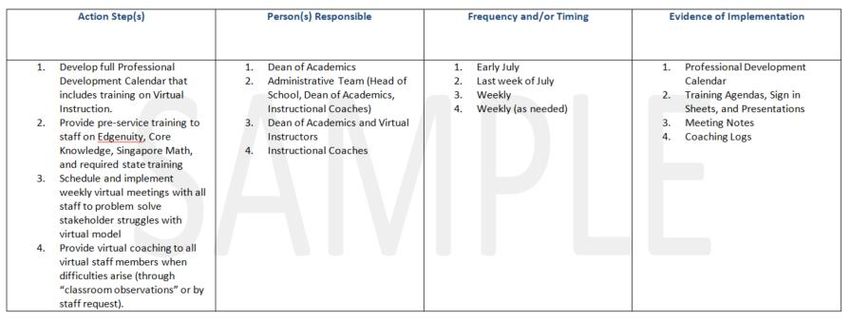
Most areas of the DLP will be completed by breaking processes into discreet, sequential action steps that answer the questions of what, who,
when, and how. The action steps require the school district to name the action, indicate who is responsible for the action, provide the frequency
and/or timing of the action, and identify what evidence will exist to show that the step has been/is being completed. Areas should include
multiple action steps in order to demonstrate that the school district has a “detailed plan” to “provide substantive distance learning”, as
required by the Executive Order. An example of a set of action steps for an area is below:

                                                                                                                                                1
Distance Learning Plan Template 2020-2021
The example above is not intended to demonstrate that these are specific action steps a school district should use, nor that this is the best or
most appropriate number of action steps. Rather, it is provided as guidance to show the manner in which the template is to be completed.
Other areas of the template will require the school district to check boxes to indicate specific tasks, strategies, or resources to be used for
different stakeholders included in the distance learning process.
2Distance Learning Plan Template 2020-2021
School District Information
*School districts are only required to submit one DLP. If individual schools within a district are providing unique instructional programs, we encourage school
districts to incorporate that information into one DLP, as opposed to completing additional templates. Please contact EmergencyDL@azed.gov with any
questions.
School District Name ASU Preparatory Academy School District Entity ID
Representative authorized to submit the plan (This is the individual who will
be contacted with questions about the plan)
Representative Telephone Number
Representative E-Mail Address
School Information
*In the chart, list the schools this plan applies to. Add rows as needed to account for all schools.
School Name Entity ID CTDS
ASU Preparatory Academy - Casa Grande High School
ASU Preparatory Academy - Polytechnic Elementary School
ASU Preparatory Academy - Polytechnic Middle School
ASU Preparatory Academy - Polytechnic High School
ASU Preparatory Academy - Phoenix Elementary School
ASU Preparatory Academy - Phoenix Middle School
ASU Preparatory Academy - Phoenix High School
ASU Preparatory Academy - South Phoenix Primary
ASU Preparatory Academy - South Phoenix Intermediate
ASU Preparatory Academy - South Phoenix High School
3Distance Learning Plan Template 2020-2021
Distance Learning Background Information
a. Number of Instructional Days (3.b)
Each school district shall operate for the required 180 days of instruction pursuant to Executive Order 2020-41 (3.b). An exception to this
requirement may be granted by the ADE, if the school intended to switch to a different schedule for the 2020-2021 school year. If ADE previously
approved the school to operate on a calendar that was not 180 days, but met the number of hours equal to 180 days of instruction, this provision
is still met, and no action is required.
Please note, pursuant to Executive Order 2020-44 the Arizona Department of Education (ADE) shall conduct an analysis of the need to waive the
number of school days that schools are required to provide schooling and the impact of such a waiver by August 31, 2020.
How many instructional days will the school district operate for School Year 2020-2021? 180 (except CG who
will have 144 days)
How many instructional days did the school district operate for School Year 2019-2020? 180
b. Distance Learning Option (3.b)
Estimated Enrollment for FY 2021 3,341 Start Date for Distance Learning 08/17/2020
Estimated Number of Students
Estimated Number of Students Participating Participating in Distance
1,063 3,341
in Distance Learning for the Full Year Learning for a Portion of the
year
☐1. We intend to operate distance learning for the full year for all students.
☐2. We intend to operate distance learning until ________________ for all students.
Please choose the option that indicates
your proposed duration/plan for distance ☐3. We intend to operate distance learning only until the Governor allows schools to fully
learning: reopen.
☐4. We intend to operate distance learning and use a hybrid approach once the Governor
allows schools to fully reopen. Hybrid includes distance learning with students learning in the
4Distance Learning Plan Template 2020-2021
classroom on some days, and from home on other days (i.e. half of the students attend
Mon/Wed and half of the students Tues/Thurs, half of the students come each week, etc.).
☒5. Other (Please explain below)
If you chose option 4 or 5 above, please provide a brief narrative explaining the details of the plan you will use:
Students will begin their learning virtually from the beginning of the school year (August 17) through quarter one (Mid-October). We will continue to reassess if this date
needs to be extended given the guidance from the Governor’s Office, ADE, CDC, and our Mitigation Plan using public health benchmarks. Once we resume in-person teaching
and learning we will offer students the opportunity to participate in-person, hybrid, or continue in the virtual environment.
Is the school district requiring students to do distance learning? Yes
If students are required to do distance learning, is the school district providing a physical location for students to go Yes
during the same hours of the day AND the same days throughout the week as it did in the FY2020 school year prior to
the school closure?
*In the case of a statewide closure or delay of in-person instruction, the requirement to provide a physical location available for students is waived under the
Executive Order 2020-41 until the State permits in-person instruction. If due to a COVID-19 outbreak and pursuant to A.R.S. § 36-787, the Arizona Department of
Health Services directs a school to close temporarily in order to appropriately sanitize the facility, the requirement to provide a physical location available for
students is waived.
Attendance Tracking (1.a.i, 1.i)
• Describe how the school district will track attendance for students attending remotely, whether full time or intermittently.
The description must include the specific measures that will be used to determine whether a student participating in DL will be reported
as present or absent on days when instruction does not take place in person. Attendance tracking may include methods such as:
▪ Communication with their teachers via telephone, ZOOM, MS Teams, or other digital meeting software.
▪ Student participation in a virtual meeting or classroom session (ZOOM, MS TEAMS, Google Meets, etc.)
▪ Daily assignments completed and submitted by the student.
▪ A parent attestation or documentation of time spent on educational activities.
5Distance Learning Plan Template 2020-2021
The school district is advised that the ADE will continue to issue guidance on the topic of attendance, and should closely monitor updated
information related to these expectations. Current guidance can be found here: https://www.azed.gov/finance/school-finance-guidance-for-
covid-19/
Action Step(s) Person(s) Responsible Frequency and/or Timing Evidence of Implementation
1. Students will participate in both 1. Teacher 1. Daily 1. Attendance Records
synchronous and asynchronous
instruction each day. Track attendance 2. Parents and Students 2. Daily 2. Attendance Records
through many methods, including,
a. Log attendance through our
student information system,
Infinite Campus
b. Learning Management
System, Canvas, Assignment
Completion through the
following activities:
i. Canvas Assignment
Completion
ii. Canvas Discussion
Board
iii. Canvas Assessment
iv. Canvas Lesson
c. Teacher Communication
i. Zoom Meetings
ii. Voice calls through
Cisco Jabber and
Google Voice
iii. Email Conversations
iv. Google Suite - chat
features through
google slides, docs,
and sheets
d. Live Lessons
6Distance Learning Plan Template 2020-2021
i. Participation in live
lesson opportunities
through Zoom
e. Blended Learning Applications
i. Completion of
assignments and
activities through web-
based applications,
such as but not limited
to: Nearpod, Google
Classroom, Canvas,
DreamBox, ALEKS,
etc.)
2. Parent Attestation: Parent and Student
attestation through the class period
check-in feature in our Student
Information System, Infinite Campus
a. Describe the efforts the school district will make to ensure all enrolled students are contacted and in communication on a regular basis.
Action Step(s) Person(s) Responsible Frequency and/or Timing Evidence of Implementation
All reports and strategies are a daily All communication for absences will be
1. All virtual students must check- 1. Students/Parents (trained with occurrence to ensure students are logged in our student information
in through Infinite Campus procedure on how to use or SIS present for both in-person and virtual system. For students that miss three or
Portal by 8:25am each day Check-in feature) instruction more consecutive absences, the extra
communication from site administration
2. All teachers must take 2. All teachers trained on how to
will be logged in our student
attendance for first period by take attendance for students information. The Home Visits from
8:35am each day physically in-school and administration on the sixth and ninth
3. Office Staff/Administration virtually in school consecutive absence will also be logged
ensure all teachers have 3. Office Staff/Administration in our student information system.
marked attendance ensure all teachers have taken
4. Office Staff sends blast email attendance
and robo call for students not 4. Site Admin and Attendance
present by 8:25 in the morning Clerk/Receptionist
5. Office staff and Site admin
7Distance Learning Plan Template 2020-2021
5. Beginning at 9:30am, office 6. Site Admin and Office Staff
staff and administration begin 7. Additional call/email from
calling each individual family Admin to each student that
that has not checked-in misses more than three
virtually and showed physically consecutive days of in-person
on campus or virtual instruction
6. Office Staff/Site Administration 8. Site Admin will conduct a
run consecutive absent report home visit on the 6th
each day consecutive and 9th
7. Home Visit on 6th and 9th consecutive absence
Consecutive Absence
8. Students will be dropped on
their 10th consecutive
unexcused absence
Teacher and Staff Expectations and Support (1.a.ii)
a. Describe expectations of teachers and other staff working virtually.
Action Step(s) Person(s) Responsible Frequency and/or Timing Evidence of Implementation
1. ASU Prep developed and approved a 1. Executive Director of Human Capital 1. March 2020 1. Electronic delivery to employees.
comprehensive ‘Telecommuting for 2. Executive Director of Human Capital 2. August 2020 2. Electronic delivery of the Employee
Immersion Employees Policy’ in March Resource Guide to all employees
2020 that was issued electronically to all
employees.
2. ASU Prep’s ‘Telecommuting for
Immersion Employees Policy’ was
approved by ASU Prep’s Executive
Cabinet for formal inclusion in our
Employee Resource Guide of policies for
the 2020-2021 academic year.
b. Describe commitments on delivery of employee support services including but not limited to:
o Human resource policies and support for employees; and
o Regular communication from the administration.
8Distance Learning Plan Template 2020-2021
Action Step(s) Person(s) Responsible Frequency and/or Timing Evidence of Implementation
1. Human Capital and Business Services 1. Executive Director of Human Capital 1. Daily 1. Continued execution on all of our day-
continue to provide all normal services to-day responsibilities including benefits,
to employees across ASU Prep, albeit in a 2. Managing Director, Head of 2. As needed when information is payroll, purchasing and HR support.
remote fashion. Immersion Schools, and Executive provided relative to COVID-19 exposure
Director of Human Capital on campus. 2. A COVID questionnaire has been
2. Human Capital consults with our created for use by any employee who
Executive Leadership Team regarding has potentially been exposed to COVID
any potential COVID exposures to our and may be eligible for Emergency Sick
sites, in conjunction with Maricopa Leave.
County Public Health Disease Reporting.
c. Describe how professional development will be provided to employees.
Action Step(s) Person(s) Responsible Frequency and/or Timing Evidence of Implementation
Plan and execute Professional Executive Director of School New Teacher Training: Full Days from Teacher Professional Development
Development Sessions for New and Improvement & Innovation and Site July 22nd - July 24th Calendar – All Staff and New Staff
Returning Teachers (Note: Professional Principals
Development will be 100% virtual and All Teacher Training: Full Days from July
will be offered both synchronously and 27th to August 14th
asynchronously. Teachers have access to
a Canvas course where they can find all
PD resources)
List Specific Professional Development Topics That Will Be Covered
● Safety/Return to Work Presentation
● Asynchronous vs. Synchronous Instruction 2.0
● Virtual Collaboration Strategies
● Assessment Tool (Exact Path) Training
● SEL PD Sessions: Student and Family Check Ins, Building Classroom Culture Virtually, RULER Framework for SEL
● Optional: Achieve3000 Follow Up Session
● English Language Learner Session (Offered by Grade Bands)
● Digital Curriculum Trainings
● Slack Training
● Zoom Training
● Basic Canvas Training
● Optional Canvas Home Page Design
● Using Digital Agendas to Structure Weekly and Daily Learning
● Health/Safety/Model Overview
● Using Clever and Lightspeed Orchestrator
9Distance Learning Plan Template 2020-2021
● Behavior Management
● Norms, Routines, Procedures
● Buncee App Training
● Intro to Twitter/FB
● Optional: Open Teacher Support Room (Offered for 6 hours a week)
● The First 6 weeks: Strategies to Make you Successful from the Start
● Achieve 3000 Training
● Applications and Technology Exploration
● Intro to PBL
● Intro to Blended Personalized Learning
● Choice Session (G-Suite, Screencasting, Why BPL, Article Discussion, Stories from the Field)
● Edcamp (Teacher Led Choice Session)
Connectivity (1.a.iii)
Check the boxes below to indicate which was/will be used to ensure each student, teacher, and staff member has access to a device and internet
connectivity if the plan relies on online learning.
Students Teachers Staff
What was Used to Establish Need?
Questionnaire
Personal Contact and Discussion
Needs Assessment-Available data
Other: All staff were provided loaner devices. All
students were provided the opportunity for a
loaner device.
What will be Used to Respond to Need?
Loaner Device (laptop/tablet)
WIFI Hot Spot
Supplemental Utility Support (Internet)
Other: All staff were provided loaner devices. All
students were provided the opportunity for a
loaner device. We will assess access to the internet
on a case by case basis.
When will stakeholders have access to IT Support Availability?
10Distance Learning Plan Template 2020-2021
Traditional School Hours
Extended Weekday Hours
24/7 Support
Other:
Instructional Methods and Monitoring Learning (1.a.iii)
a. In the tables below, list the methods that will be used to deliver instruction (i.e. Direct Instruction via Zoom, Independent Study, Project
Based Learning via a menu of options), the content provider or program to be used (i.e. Edgenuity, Journeys, Saxon Math), and the
Formative and Summative Assessment Strategies to be used, as well as the frequency of those assessments.
Instructional Methods, Content Delivery, and Monitoring Student Learning (Math)
Educational Delivery Content Provider/Program Formative Assessment Summative Assessment
Methodologies Used Strategies and Frequency Strategies and Frequency
Kindergarten • Synchronous Instruction: • Curriculum Programs: • Teacher created • Teacher created
Zoom HMH Into Math, assessments (as needed assessments, HMH Into
• Asynchronous Instruction: EngageNY usually multiple times a Math/EngageNY
Canvas • Adaptive Programs: Exact week) Unit/Module
• Methodologies: Direct Path, Dreambox • Exact Path knowledge Assessments,(At the end
Whole Group Instruction, checks (as students of each unit/module -
Direct Small Group complete 4 topics - every 4-6 weeks)
Instruction, Playlists, Pre- usually weekly) • Exact Path comprehensive
recorded videos (Flipped • Dreambox (at the end of knowledge checks (every
Classroom), Thematic each topic - usually semester)
Projects, Online content multiple times a week)
assigned through adaptive
programs.
1-3 • Synchronous Instruction: • Curriculum Programs: • Teacher created • Teacher created
Zoom HMH Into Math, assessments (as needed assessments, HMH Into
• Asynchronous Instruction: EngageNY usually multiple times a Math/EngageNY
Canvas • Adaptive Programs: Exact week) Unit/Module
• Methodologies: Direct Path, Dreambox • Exact Path knowledge Assessments, (At the end
Whole Group Instruction, checks (as students of each unit/module -
Direct Small Group complete 4 topics - every 4-6 weeks)
Instruction, Playlists, Pre- usually weekly) • Exact Path comprehensive
recorded videos (Flipped • Dreambox (at the end of knowledge checks (every
Classroom), Thematic each topic - usually semester)
Projects, Online content multiple times a week)
11Distance Learning Plan Template 2020-2021
assigned through adaptive
programs.
4-6 • Synchronous Instruction: • Curriculum Programs 4- • Teacher created • Teacher created
Zoom 5th: HMH Into Math, assessments (as needed assessments, HMH Into
• Asynchronous Instruction: EngageNY usually multiple times a Math/Open Up
Canvas • Curriculum Programs 6th: week) Resources/EngageNY
• Methodologies: Direct Open Up Resources, • Exact Path knowledge Unit/Module
Whole Group Instruction, EngageNY checks (as students Assessments, (At the end
Direct Small Group • Adaptive Programs: Exact complete 4 topics - of each unit/module -
Instruction, Playlists, Pre- Path, Dreambox usually weekly) every 4-6 weeks)
recorded videos (Flipped • Dreambox (at the end of • Exact Path comprehensive
Classroom), Station each topic - usually knowledge checks (every
Rotation, Choice Boards, multiple times a week) semester)
Project-Based Learning,
Online content assigned
through adaptive
programs.
7-8 • Synchronous Instruction: • Curriculum Programs: • Teacher created • Teacher created
Zoom Open Up Resources, assessments (as needed assessments, Open Up
• Asynchronous Instruction: EngageNY usually multiple times a Resources/EngageNY
Canvas • Adaptive Programs: Exact week) Unit/Module
• Methodologies: Direct Path, Dreambox • Exact Path knowledge Assessments, (At the end
Whole Group Instruction, checks (as students of each unit/module -
Direct Small Group complete 4 topics - every 4-6 weeks)
Instruction, Playlists, Pre- usually weekly) • Exact Path comprehensive
recorded videos (Flipped • Dreambox (at the end of knowledge checks (every
Classroom), Station each topic - usually semester)
Rotation, Choice Boards, multiple times a week)
Project-Based Learning,
Online content assigned
through adaptive
programs.
9-12 • Synchronous Instruction: • Curriculum Programs: ASU • Teacher created • Teacher created
Zoom Prep Digital Math assessments (as needed assessments, ASUP Digital
• Asynchronous Instruction: Content, Cambridge Math usually multiple times a Unit/Module Assessments
Canvas • Adaptive Programs: Exact week) (At the end of each
• Methodologies: Direct Path, ALEKS • Exact Path knowledge unit/module - every 4-6
Whole Group Instruction, checks (varies based on weeks)
Direct Small Group student level) • Exact Path and ALEKS
Instruction, Playlists, Pre- comprehensive
recorded videos (Flipped knowledge checks (every
semester)
12Distance Learning Plan Template 2020-2021
Classroom), Station • ALEKS (at the end of each
Rotation, Choice Boards, topic - usually multiple
Project-Based Learning, times a week)
Online content assigned
through adaptive
programs.
Instructional Methods, Content Delivery, and Monitoring Student Learning (ELA)
Educational Delivery Content Provider/Program Formative Assessment Summative Assessment
Methodologies Used Strategies and Frequency Strategies and Frequency
Kindergarten • Synchronous Instruction: • Curriculum Programs: • Benchmark Advance • Teacher created
Zoom Benchmark Advance formative assessments assessments, Benchmark
• Asynchronous Instruction: • Adaptive Programs: Exact and Teacher created Advance Unit/Module
Canvas Path assessments (as needed Assessments, (At the end
• Methodologies: Direct usually multiple times a of each unit/module -
Whole Group Instruction, week) every 4-6 weeks)
Direct Small Group • Exact Path knowledge • Exact Path comprehensive
Instruction, Playlists, Pre- checks (as students knowledge checks (every
recorded videos (Flipped complete 4 topics - semester)
Classroom), Daily 5, usually weekly)
Thematic Projects, Online
content assigned through
adaptive programs.
1-3 • Synchronous Instruction: • Curriculum Programs: • Benchmark Advance • Teacher created
Zoom Benchmark Advance formative assessments assessments, Benchmark
• Asynchronous Instruction: • Adaptive Programs: Exact and Teacher created Advance Unit/Module
Canvas Path assessments (as needed Assessments, (At the end
• Methodologies: Direct usually multiple times a of each unit/module -
Whole Group Instruction, week) every 4-6 weeks)
Direct Small Group • Exact Path knowledge • Exact Path comprehensive
Instruction, Playlists, Pre- checks (as students knowledge checks (every
recorded videos (Flipped complete 4 topics - semester)
Classroom), Daily 5, usually weekly)
Thematic Projects, Online
content assigned through
adaptive programs.
4-6 • Synchronous Instruction: • Curriculum Programs: • Benchmark Advance • Teacher created
Zoom Benchmark Advance formative assessments assessments, Benchmark
• Asynchronous Instruction: • Adaptive Programs: Exact and Teacher created Advance Unit/Module
Canvas Path assessments (as needed Assessments, (At the end
13Distance Learning Plan Template 2020-2021
• Methodologies: Direct usually multiple times a of each unit/module -
Whole Group Instruction, week) every 4-6 weeks)
Direct Small Group • Exact Path knowledge • Exact Path comprehensive
Instruction, Playlists, Pre- checks (as students knowledge checks (every
recorded videos (Flipped complete 4 topics - semester)
Classroom), Station usually weekly)
Rotation, Choice Boards,
Project-Based Learning,
Online content assigned
through adaptive
programs.
7-8 • Synchronous Instruction: • Curriculum Programs: ASU • Teacher created • Teacher created
Zoom Prep Digital Content, and assessments (as needed assessments, Open Up
• Asynchronous Instruction: Teacher Created usually multiple times a Resources/EngageNY
Canvas • Adaptive Programs: Exact week) Unit/Module
• Methodologies: Direct Path, Achieve3000 • Exact Path knowledge Assessments, (At the end
Whole Group Instruction, checks (as students of each unit/module -
Direct Small Group complete 4 topics - every 4-6 weeks)
Instruction, Socratic usually weekly) • Exact Path comprehensive
Seminars, Playlists, Pre- • Achieve3000 (at the end knowledge checks (every
recorded videos (Flipped of each lesson - usually 1- semester)
Classroom), Station 2 times a week)
Rotation, Choice Boards,
Project-Based Learning,
Online content assigned
through adaptive
programs.
9-12 • Synchronous Instruction: • Curriculum Programs: ASU • Teacher created • Teacher created
Zoom Prep Digital Content, assessments (as needed assessments, ASUP Digital
• Asynchronous Instruction: Teacher Created, and usually multiple times a Unit/Module Assessments
Canvas Cambridge week) (At the end of each
• Methodologies: Direct • Adaptive Programs: Exact • Exact Path knowledge unit/module - every 4-6
Whole Group Instruction, Path, Achieve3000 checks (varies based on weeks)
Direct Small Group student level) • Exact Path and
Instruction, Socratic • Achieve3000 (at the end Achieve3000
Seminars, Playlists, Pre- of each lesson - usually 1- comprehensive
recorded videos (Flipped 2 times a week) knowledge checks (every
Classroom), Station semester)
Rotation, Choice Boards,
Project-Based Learning,
Online content assigned
14Distance Learning Plan Template 2020-2021
through adaptive
programs.
Instructional Methods, Content Delivery, and Monitoring Student Learning (Science)
Educational Delivery Content Provider/Program Formative Assessment Summative Assessment
Methodologies Used Strategies and Frequency Strategies and Frequency
Kindergarten • Synchronous Instruction: • Curriculum Programs: • Teacher created • Teacher created
Zoom Teacher Created and assessments (as needed assessments, (At the end
• Asynchronous Instruction: Discovery Science usually multiple times a of each unit/module -
Canvas week) every 4-6 weeks)
• Methodologies: Direct
Whole Group Instruction,
Direct Small Group
Instruction, Playlists, Pre-
recorded videos (Flipped
Classroom), Thematic
Projects, Online content
assigned through adaptive
programs.
1-3 • Synchronous Instruction: • Curriculum Programs: • Teacher created • Teacher created
Zoom Teacher Created and assessments (as needed assessments, (At the end
• Asynchronous Instruction: Discovery Science usually multiple times a of each unit/module -
Canvas week) every 4-6 weeks)
• Methodologies: Direct
Whole Group Instruction,
Direct Small Group
Instruction, Playlists, Pre-
recorded videos (Flipped
Classroom), Lab
Investigations, Thematic
Projects, Online content
assigned through adaptive
programs.
4-6 • Synchronous Instruction: • Curriculum Programs: • Teacher created • Teacher created
Zoom Teacher Created and assessments (as needed assessments, (At the end
• Asynchronous Instruction: Discovery Science usually multiple times a of each unit/module -
Canvas week) every 4-6 weeks)
• Methodologies: Direct
Whole Group Instruction,
Direct Small Group
15Distance Learning Plan Template 2020-2021
Instruction, Playlists, Pre-
recorded videos (Flipped
Classroom), Lab
Investigations, Station
Rotation, Choice Boards,
Project-Based Learning,
Online content assigned
through adaptive
programs.
7-8 • Synchronous Instruction: • Curriculum Programs: • ASUP Digital Program • Teacher created
Zoom Discovery Science, ASU formatives and Teacher assessments, ASUP Digital
• Asynchronous Instruction: Prep Digital Content, and created assessments (as Unit/Module Assessments
Canvas Teacher Created needed usually multiple (At the end of each
• Methodologies: Direct • Adaptive Programs: times a week) unit/module - every 4-6
Whole Group Instruction, Achieve3000 weeks)
Direct Small Group
Instruction, Lab
Investigations, Playlists,
Pre-recorded videos
(Flipped Classroom),
Station Rotation, Choice
Boards, Project-Based
Learning, Online content
assigned through adaptive
programs.
9-12 • Synchronous Instruction: • Curriculum Programs: ASU • ASUP Digital Program • Teacher created
Zoom Prep Digital Content, formatives and Teacher assessments, ASUP Digital
• Asynchronous Instruction: Teacher Created, and created assessments (as Unit/Module Assessments
Canvas Cambridge needed usually multiple (At the end of each
• Methodologies: Direct • Adaptive Programs: times a week) unit/module - every 4-6
Whole Group Instruction, Achieve3000 weeks)
Direct Small Group
Instruction, Lab
Investigations, Playlists,
Pre-recorded videos
(Flipped Classroom),
Station Rotation, Choice
Boards, Project-Based
Learning, Online content
assigned through adaptive
programs.
16Distance Learning Plan Template 2020-2021
Instructional Methods, Content Delivery, and Monitoring Student Learning (Other Content Areas)
Educational Delivery Content Provider/Program Formative Assessment Summative Assessment
Methodologies Used Strategies and Frequency Strategies and Frequency
Kindergarten • Synchronous Instruction: • Curriculum Programs: • Teacher created • Teacher created
Zoom Teacher Created assessments (as needed assessments, (At the end
• Asynchronous Instruction: usually multiple times a of each unit/module -
Canvas week) every 4-6 weeks)
• Methodologies: Direct
Whole Group Instruction,
Direct Small Group
Instruction, Playlists, Pre-
recorded videos (Flipped
Classroom), Thematic
Projects, Online content
assigned through adaptive
programs.
1-3 • Synchronous Instruction: • Curriculum Programs: • Teacher created • Teacher created
Zoom Teacher Created assessments (as needed assessments, (At the end
• Asynchronous Instruction: usually multiple times a of each unit/module -
Canvas week) every 4-6 weeks)
• Methodologies: Direct
Whole Group Instruction,
Direct Small Group
Instruction, Playlists, Pre-
recorded videos (Flipped
Classroom), Thematic
Projects, Online content
assigned through adaptive
programs.
4-6 • Synchronous Instruction: • Curriculum Programs: • Teacher created • Teacher created
Zoom Teacher Created assessments (as needed assessments, (At the end
• Asynchronous Instruction: usually multiple times a of each unit/module -
Canvas week) every 4-6 weeks)
• Methodologies: Direct
Whole Group Instruction,
Direct Small Group
Instruction, Playlists, Pre-
recorded videos (Flipped
Classroom), Station
17Distance Learning Plan Template 2020-2021
Rotation, Choice Boards,
Project-Based Learning,
Online content assigned
through adaptive
programs.
7-8 • Synchronous Instruction: • Curriculum Programs: ASU • ASUP Digital Program • Teacher created
Zoom Prep Digital Content, formatives and Teacher assessments, ASUP Digital
• Asynchronous Instruction: Teacher Created created assessments (as Unit/Module Assessments
Canvas • Adaptive Programs: needed usually multiple (At the end of each
• Methodologies: Direct Achieve3000 (for Social times a week) unit/module - every 4-6
Whole Group Instruction, Studies) weeks)
Direct Small Group
Instruction, Socratic
Seminars, Playlists, Pre-
recorded videos (Flipped
Classroom), Station
Rotation, Choice Boards,
Project-Based Learning,
Online content assigned
through adaptive
programs.
9-12 • Synchronous Instruction: • Curriculum Programs: ASU • ASUP Digital Program • Teacher created
Zoom Prep Digital Content, formatives and Teacher assessments, ASUP Digital
• Asynchronous Instruction: Teacher Created created assessments (as Unit/Module Assessments
Canvas • Adaptive Programs: needed usually multiple (At the end of each
• Methodologies: Direct Achieve3000 (for Social times a week) unit/module - every 4-6
Whole Group Instruction, Studies) weeks)
Direct Small Group
Instruction, Socratic
Seminars, Playlists, Pre-
recorded videos (Flipped
Classroom), Station
Rotation, Choice Boards,
Project-Based Learning,
Online content assigned
through adaptive
programs.
Instructional Methods, Remote Training and Monitoring Student Learning (CTEDs, in lieu of requirements outlined in
A.R.S. § 15-391(4)(d) )
18Distance Learning Plan Template 2020-2021
Educational Delivery Content Provider/Program Formative Assessment Summative Assessment
Methodologies Used Strategies and Frequency Strategies and Frequency
9-12 N/A N/A N/A N/A
Optional: Describe how the school will provide substantive distance learning (use if the school wishes to provide information in addition to the tables above)
We are making sure we build a lot of structure, but also allow for flexibility. We have created extensive teacher training to support teachers to understand these systems and
how to use them. We have built a Canvas course for all of our teachers that allows for asynchronous work in the summer, but also gives them easy access to all training and
guidance documents in one place at any time. In addition, to ensure distance learning is meaningful and interactive, we have chosen to focus on training and technical
support for these web applications: Buncee, Benchmark Universe (aligned to our K-6 ELA Curriculum), Lightspeed Orchestrator, Google Read and Write, Flipgrid, SeeSaw,
EdPuzzle, Nearpod, Classcraft, Screencastify, Padlet, Pear Deck, NewsELA, Khan Academy and Kahoot. In addition, our teachers have access to the ASU Library Resources and
ASUforYou resources.
Meeting the Needs of Students with Disabilities and English Learners.
a. Describe how the school district will ensure access and meet the needs of students with disabilities.
In addition to action steps articulated in this document, all state/federal laws and IDEA assurances provided annually to the Department remain applicable
and in effect.
Action Step Person(s) Responsible Frequency and/or Timing Evidence of Implementation
1. Review guidance from local, 1. Director of Special Education 1. Periodic 1. Training of staff on latest
state and federal agencies to 2. Special Education Service Providers 2. According to the minutes guidance and provision of
guide the provision of special 3. Special education teachers and identified in each students IEP resources to special education
education service in distance general education teachers 3. Based on work assigned that staff.
learning. 4. Network staff and special requires collaboration 2. IEP progress reporting and
2. Telepractice service delivery education teachers 4. As needed or requested by data collection
for special education services 5. Special education teacher and parents 3. Data collection and work
to include related services paraeducator 5. Weekly or biweekly samples that show
3. Use of online tools and 6. MET or IEP team 6. According to annual MET/IEP collaborative work
programs that facilitate due dates 4. Phone logs and service minute
collaborative work. documentation
4. Phone and Zoom support for 5. Attendance in office hours
students and parents to access 6. Meeting attendance forms
curriculum and materials
5. Special Education teachers and
paraeducators hold office
hours to provide help, pre-
teach and re-teach strategies
19Distance Learning Plan Template 2020-2021
6. Meetings are held on Zoom for
IEP, MET, Progress or
requested
Process for Implementing Action Step
Special Education services and adaptations are provided across all classes. Support and service will transition to the virtual environment with training, collaboration among
staff, and tenacity. Teachers will adjust their schedule to offer office hours and technical support for parents. Digital tools that are introduced in the traditional school setting
will transition to the digital environment. Meetings will stay on schedule with a transition to Zoom.
b. Describe how the school district will ensure access and meet the needs of English learners.
Action Step Person(s) Responsible Frequency and/or Timing Evidence of Implementation
1. During distance learning, 1. Network Student Data Analyst, 1. During the first 30 days of 1. Tracker for provisional EL
identification of new, School Assistant Principal and school for provisional screener results. Students will
provisional EL Students will Support Staff identification. Within 30 days be added to the school's EL
be completed using OELAS 2. Classroom Teacher of return to in-person classes student list. Results of AZELLA
guidance. We will follow-up 3. Classroom Teacher or Reading for AZELLA Placement. Placement after return to in-
with an AZELLA Placement Specialist 2. Daily/Weekly person classes.
exam upon return to in- 4. Classroom Teachers, Reading 3. Daily/Weekly 2. Lesson plans in Canvas.
person classes. Specialists, Assistant Principal, 4. Quarterly Student work in Canvas. CCRS
2. Integrated ELD instruction Network Academic Team 5. As needed or requested by & ELP Standards identified in
provided during full-class 5. Network staff and School Support parents Canvas.
meetings and activities (via teams 3. Documentation by
Zoom and Canvas). teacher/specialist responsible
3. Targeted ELD instruction for Targeted ELD instruction.
provided during small-group 4. Data Analysis Form and
meetings and activities (via Meeting Minutes
Zoom and Canvas). 5. Communication logs in
4. Planning and Data Meetings Infinite Campus.
for teachers of EL students to
review student progress and
adjust implementation of EL
programs in a virtual
environment.
5. Phone and Zoom support for
students and parents to
access curriculum and
materials
Process for Implementing Action Step
20Distance Learning Plan Template 2020-2021
EL student services are provided across all classes, with a focus on those identified for integrated and targeted ELD. Support will be provided in the virtual environment
with teacher and student training, collaboration among staff, and flexibility. Digital tools that are used in the traditional school setting will transition to the digital
environment.
Social and Emotional Learning Support for Students (1.a.v)
Check the boxes below to indicate which will be provided to students to support social emotional learning and how counseling services will be
provided for each grade band.
Kinder 1-3 4-5 6-8 9-12
Teacher Check-in
Packet of Social and Emotional Topics
Social Emotional
Online Social Emotional videos
Learning
Parent Training
Other: Support to teachers
Kinder 1-3 4-5 6-8 9-12
In-Person
Phone
Counseling Services Webcast
Email/IM
Other:
Provide a description of how the school district will provide social and emotional learning support to students using the methods identified in the
above charts.
Action Step Person(s) Responsible Frequency and/or Timing Evidence of Implementation
1. Home Visits 1. (At least 2 staff) Counselor/SW, 1. As needed 1. Steps taken by Person(s)
2. Phone and Zoom support to Principal, Dean 2. Ongoing responsible to determine when
students and families 2. Counselor/SW 3. Once a month a home visit is needed,
3. Social-Emotional information 3. Counselor/SW 4. Updated once a month typically a decision made after
through email 4. Counselor/SW a student has not participated
4. Shared Google Drive - in assignments and live Zoom
resources and material for sessions for a period of time.
students/families and staff to 2. Documentation of
access for SEL learning conversation
3. Newsletter or personal email
21Distance Learning Plan Template 2020-2021
4. New material uploaded
throughout distance learning
experience
Demonstrating Mastery of Academic Content (1.a.vi)
Describe how the school district will require students to demonstrate ongoing competency or mastery in grade level or advanced grade level
content.
Action Step(s) Person(s) Responsible Frequency and/or Timing Evidence of Implementation
K-12 Math and ELA: Mastery Executive Director of School Weekly Usage Exact Path Dashboard
assessments through Exact Path Testing Improvement and Innovation:
in Math and ELA give information about Implementation and Training
student progress on content assigned to Teachers: Program Implementation
them in their learning path, based on Principal: Accountability
gaps identified during
baseline/benchmark testing.
K-8 Math: Dreambox implementation Executive Director of Immersion Used weekly (3 lessons per week) Dreambox Dashboard
allows us to track personalized mastery Academics Implementation and Training
for students as they work through the Teachers: Program Implementation
adaptive math program. Principal: Accountability
6-12 ELA: Achieve3000 implementation Executive Director of School Used weekly (1 lesson per week) Achieve3000 Dashboard
allows us to track personalized mastery Improvement and Innovation:
for students as they work through the Implementation and Training
adaptive ELA program. Teachers: Program Implementation
Principal: Accountability
9-12 Math: ALEKS implementation allows Executive Director of Immersion Used weekly (3 lessons per week) ALEKS Dashboard
us to track personalized mastery for Academics: Implementation and Training
students as they work through the Teachers: Program Implementation
adaptive math program. Principal: Accountability
K-4 ELA: DIBELS implementation allows Executive Director of Immersion Usage depends on student level (~1 time DIBELS Dashboard
us to track personalized mastery for Academics: Implementation and Training a month progress monitoring)
students as a part of the progress Teachers: Program Implementation
monitoring piece of the program. Principal: Accountability
22Distance Learning Plan Template 2020-2021
K-12 ALL SUBJECT AREAS: Teachers use Teachers: Assessment Implementation Varies depending on current content, but Teacher Canvas Courses
standards-aligned formative and Principal: Accountability formative assessments occur weekly and Teacher Gradebooks in Infinite Campus
summative assessments that are summative occur every 4-6 weeks.
provided by the adopted curricula or
created by the teacher themselves to
regularly monitor student progress on
standards mastery.
Benchmark Assessments (1.a.vii)
In the tables below, list the assessments that will be used for benchmarking in grades K-12 in English language arts and mathematics (i.e. NWEA
MAP, Galileo, Fountas and Pinnell BAS, etc.), the manner in which the assessment will be given, and the proposed date(s) the assessment(s) will
be given. Career and Technical Education Districts should submit N/A.
Benchmark Assessments (Math)
Assessment(s) to be used (Name of Plan for Assessment (online, in person, Proposed date(s) of assessments
Assessment and/or Assessment at testing center, etc.)
Provider/Creator)
Kindergarten Exact Path (from Edmentum) Online August-September, December-Jan, May
Dreambox Online August-September (only baseline)
1-3 Exact Path (from Edmentum) Online August-September, December-Jan, May
Dreambox Online August-September (only baseline)
3rd Only: Sample AzM2 In Person or Online January - February
4-6 Exact Path (from Edmentum) Online August-September, December-Jan, May
Dreambox Online August-September (only baseline)
Sample AzM2 In Person or Online January - February
7-8 Exact Path (from Edmentum) Online August-September, December-Jan, May
Dreambox Online August-September (only baseline)
3rd Only: Sample AzM2 In Person or Online January - February
9-12 Exact Path (from Edmentum) Online August-September, December-Jan, May
ALEKS Online August-September, December-Jan, May
3rd Only: Sample AzM2 In Person or Online January - February
Benchmark Assessments (ELA)
Assessment(s) to be used (Name of Plan for Assessment (online, in person, Proposed date(s) of assessments
Assessment and/or Assessment at testing center, etc.)
Provider/Creator)
23Distance Learning Plan Template 2020-2021
Kindergarten Exact Path (from Edmentum) Online August-September, December-Jan, May
DIBELS Online or In Person August-September, December-Jan, May
1-3 Exact Path (from Edmentum) Online August-September, December-Jan, May
DIBELS Online or In Person August-September, December-Jan, May
3rd Only: Sample AzM2 In Person or Online January - February
4-6 Exact Path (from Edmentum) Online August-September, December-Jan, May
4th Only: DIBELS Online or In Person August-September, December-Jan, May
6th Only: Achieve3000 Online August-September, December-Jan
Sample AzM2 In Person or Online January - February
7-8 Exact Path (from Edmentum) Online August-September, December-Jan, May
Achieve3000 Online August-September, December-Jan
Sample AzM2 In Person or Online January - February
9-12 Exact Path (from Edmentum) Online August-September, December-Jan, May
Achieve3000 Online August-September, December-Jan
Sample AzM2 In Person or Online January - February
Optional: Describe how the school district will administer benchmark assessments (use if the school district wishes to provide information in addition to
the table above).
ASU Prep Benchmark Policy:
Narrative:
Our schools will administer the network-wide diagnostic benchmark assessments this August and September. The network will provide written instructions for teachers to post
in their Canvas shell to navigate students to the benchmarks in Exact Path (and separately directions for DIBELS, Achieve3000, ALEKS and Dreambox). In order to increase test
security, teachers may utilize Lightspeed Orchestrator or may require students to open Zoom and take the benchmark with their camera on.
The purpose of this assessment is to collect data that will give us an overarching view of what students learned and retained from the previous year, in addition to identifying
any gaps in knowledge. The story of the data will be much deeper than mastery levels on standards. We will be able to quickly identify our highest need students and dive into
the circumstances surrounding why the student has not demonstrated success. It is our duty as a school community to continue to strive to find solutions to make this form of
learning accessible to every single student in our network.
Purpose & Intentions
● Collect data to use in planning high quality, personalized instruction for students
● Identify needs of struggling students to better prepare for intervention needs:
○ Challenges with content
○ Challenges with learning remotely
● We must do a deep dive into the data analysis of this benchmark and develop intentional action steps to improve the outcomes for all students.
Timeline:
● August 17 - September 4th: Benchmark Window
● September 8-11: Make up Window
24Distance Learning Plan Template 2020-2021
Testing Location
Administer within Canvas (using network-provided text and link out to Exact Path)
● Student will automatically be generated a user account when they click on the Exact Path link)
● Academic Integrity Concerns
○ Students sign in to take the benchmark at a designated time
○ Utilize Lightspeed Orchestrator
Students turn video on Zoom to take assessment
Additional Information (Optional)
The school district may use this space to add any additional information it believes is key to the plan it has laid out in this document, or to highlight its
efforts to provide a quality Distance Learning Plan to its students.
In order to create a quality Distance Learning Plan, our team worked in close consultation with the ASUP Digital Leadership to construct an overall plan, and then divide into a
series of committees to be sure we were considering all factors. Our Leadership Team initially held a series of meetings to discuss high level modeling including conversations
around the best practices established by ASUP Digital, ADE Guidance, the models/options, and communication plan ideas.
In May, we surveyed parents about their initial preference, and our June family newsletter included a short overview of next year’s options. The initial feedback from the
parents mirrors the May survey results - strong desire for in-person options for next school year.
We then split into 3 teams (Health and Safety, Logistics and Academics) and Team Leads from each team met weekly to discuss progress and then created a document to
capture cross-collaborative items to ensure cohesion between teams. Additional cross-team items included creation of an initial timeline and stakeholder communication
plan.
Health and Safety Team: Met daily to review and implement ADE Guidance. Team created recommendations for schools including recess, screening, food/nutrition,
maintenance, transportation to name a few.
Logistics Team: Team created a master scheduling plan built around the guidance on the balance of synchronous and asynchronous instruction from the ASUP Digital
Academic Team to create a schedule that has a best practice balance of synchronous and asynchronous.
Academic Team: This team, led by a member of the ASUP Digital Academic Team, built out a training plan for implementation of our Synchronous and Asynchronous Virtual
instruction model.
25You can also read


