NGS-SA SARS-COV-2 SEQUENCING UPDATE 19 JULY 2021
←
→
Page content transcription
If your browser does not render page correctly, please read the page content below
NGS-SA SARS-CoV-2 Sequencing Update

                                                                         19 July 2021

                             Network for Genomic Surveillance South Africa (NGS-SA)

Prepared by the National Institute for Communicable Diseases (NICD) of the National Health Laboratory (NHLS) on behalf of the Network for Genomics Surveillance in South Africa (NGS-SA)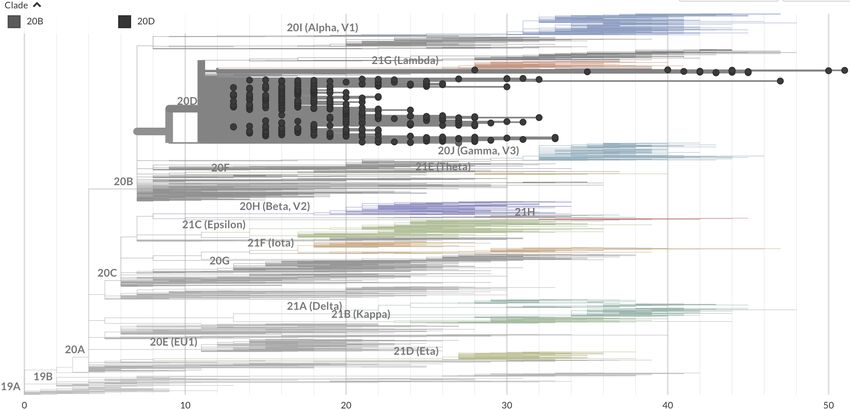
Network for Genomic Surveillance in South Africa (NGS-SA)
                                 UNIV PRETORIA (UP)                              UNIV WITWATERSRAND
                                 & NHLS-TAD                                      (WITS) & NHLS

         NATIONAL INSTITUTE
         FOR COMMUNICABLE
         DISEASES (NICD)

                                                                                     KRISP,UKZN
                                                                                     & IALCH NHLS

STELLENBOSCH
UNIVERSITY & NHLS

                                                                      UNIV OF THE FREE
                                                                      STATE (UFS) & NHLS
   UNIVERSITY OF CAPE
   TOWN (UCT) & NHLS

                                 Supported by the DSI and the SA MRC
                              Msomi N, Mlisana K, et al. Lancet Microbe 2020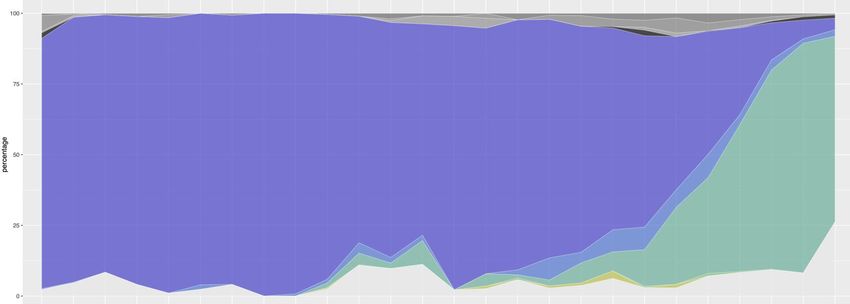
The genomic data presented here are based on South African
       SARS-CoV-2 sequence data downloaded from GISAID
              (www.gisaid.org) on 19 July at 09h00

         Data license: https://www.gisaid.org/registration/terms-of-use/

Elbe, S., and Buckland-Merrett, G. (2017) Data, disease and diplomacy: GISAID’s innovative
contribution to global health. Global Challenges, 1:33-46. DOI: 10.1002/gch2.1018 PMCID: 31565258
Shu, Y., McCauley, J. (2017) GISAID: Global initiative on sharing all influenza data – from vision to
reality. EuroSurveillance, 22(13) DOI: 10.2807/1560-7917.ES.2017.22.13.30494 PMCID: PMC5388101
Variants of Concern (VOC)
                Pango                Nextstrain                   Additional amino acid            Earliest documented
WHO label               GISAID clade                                                                                      Date of designation
               lineages                clade                      changes monitored*                      samples

  Alpha                                                                   +S:484K                    United Kingdom,
                B.1.1.7          GRY           20I (V1)                                                                      18-Dec-2020
                                                                          +S:452R                        Sep-2020

              B.1.351
  Beta                                                                     +S:L18F                      South Africa,
              B.1.351.2 GH/501Y.V2             20H (V2)                                                                      18-Dec-2020
                                                                                                         May-2020
              B.1.351.3
                  P.1
 Gamma           P.1.1                                                                                     Brazil,
                            GR/501Y.V3          20J (V3)                  +S:681H                                            11-Jan-2021
                 P.1.2                                                                                    Nov-2020

              B.1.617.2
  Delta          AY.1                                                     +S:417N                          India,          VOI: 4-Apr-2021
                        G/478K.V1                 21A
                 AY.2                                                                                     Oct-2020        VOC: 11-May-2021

https://www.who.int/en/activities/tracking-SARS-CoV-2-variants/

*Notable spike (S) amino acid changes under monitoring, which are currently reported in a minority of sequenced samples
Currently designated Variants of Interest (VOI)
                                Pango                    Nextstrain     Earliest documented         Date of
                  WHO label               GISAID clade
                               lineages                    clade               samples            designation

                                                                         Multiple countries,
                      Eta      B.1.525    G/484K.V3         21D                                   17-Mar-2021
                                                                             Dec-2020

                                                                      United States of America,
                     Iota      B.1.526    GH/253G.V1        21F                                   24-Mar-2021
                                                                              Nov-2020

                                                                              India,
                                                            21B                                   4-Apr-2021
                    Kappa     B.1.617.1   G/452R.V3                          Oct-2020

                    Lambda       C.37     GR/452Q.V1        21G            Peru, Dec-2020         14-Jun-2021

https://www.who.int/en/activities/tracking-SARS-CoV-2-variants/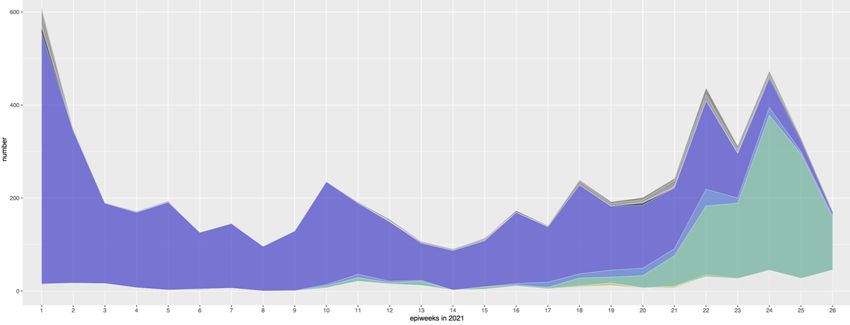
Number of South African genomes deposited on GISAID, by specimen collection week, 2020 and 2021
                       600
                                                                (N=11 677*, downloaded 19 July)
                                  Total genomes: 11 677
                                  2020 genomes: 5 790                                                                              Sequencing data ending epi-
                                  2021 genomes: 5 887                                                                              week 26 (ending 3 July 2021)

                                                                                                                                   Currently in epi-week 29
                                                                                                                                   (ending 24 July 2021)
                       400
       Number of sequences

                       200

                             10               20                      30                          40                          50          10              20
                                                          2020                                               epiweek               2021
*This represents the cleaned, de-duplicated set containing unique sequences. This dataset will be used for all further figures.
GISAID genomes vs total cases, 2020 and 2021 (N=11 677)

    All provinces, apart from Limpopo (less), Gauteng (less) and KZN (more), have a similar percentage of cases as sequenced
                                                             genomes.

Case data from https://www.nicd.ac.za/wp-content/uploads/2021/07/COVID-19-Weekly-Epidemiology-Brief-week-27-2021.pdf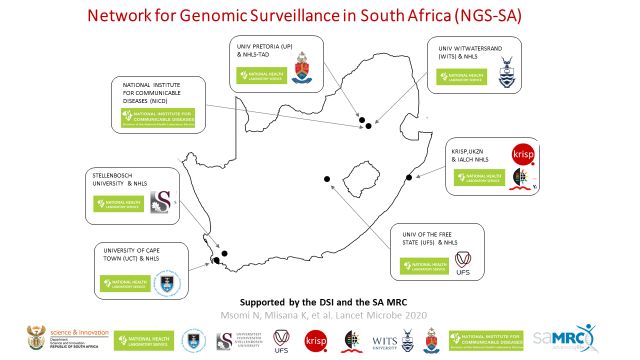
South African genomes submitted per sequencing lab, 2020
                  and 2021 (N=11 677)

                          *      *     *        *    *                            *NGS-SA laboratories

           Multiple labs from NGS-SA are contributing to the sequencing effort.
                       Sequencing is increasing with the third wave.
Distribution and number of clades in South Africa, 2021 (N=5 887)

                                                                                                      Sequencing data ending epi-
                                                                                                      week 26 (ending 3 July 2021)

                                                                                                      Currently in epi-week 29
                                                                                                      (ending 24 July 2021)

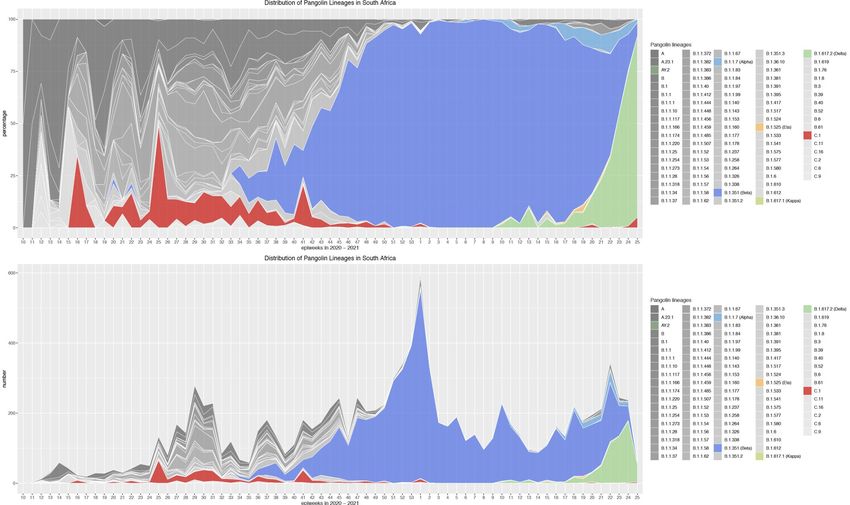
Alpha, Delta and Eta variant frequency increasing as of the beginning of May (epi-week 18, 2 May). Delta becoming dominant by
                   end of June (333/473, 70% in week 24; 268/330, 81% in week 25; 75/100, 75% in week 26)
Prevalence of Variants of Concern (VOC) and Variants of Interest
                   (VOI) in May 2021 sequences, South Africa (N=965)

• 90% of sequences are from a VOC
  (Alpha, Beta, Delta) or VOI (Eta).

• Greater than 10%
   ― Beta variant (66%) dominated
   ― Delta (16%)

• Less than 10%
    ― Alpha (6%).
    ― Eta (VOI, 1%)
    ― Kappa is present in only one
       sample (0.001%).

                                       Beta variant dominated in May in South Africa
Prevalence of Variants of Concern (VOC) and Variants of Interest (VOI)
in June 2021 sequences, South Africa (N=1 580)
• 87% of sequences are from a VOC
(Alpha, Beta, Delta) or VOI (Eta).
• Greater than 10%
― Delta variant now dominates
(60%)
― Beta variant (22%)
• Less than 10%
― Alpha (4%).
― Kappa is present in six samples
(0.004%).
― Eta not yet detected in June
Delta variant dominated in June in South AfricaPrevalence of Variants of Concern (VOC) and Variants of Interest (VOI)
in July 2021 sequences, South Africa (N=73)
• 69% of sequences are from a VOC
(Beta, Delta)
• Greater than 10%
― Delta variant now dominates
(52%)
• Less than 10%
― Beta (4%).
• More high quality data is required to
establish variant dominance and
diversity
Delta variant appears to dominate in July in South Africa so far, but
more high quality sequence data is required to confirm thisGenomes sequenced from specimens collected in May and June 2021 from
KwaZulu-Natal, Gauteng, Western Cape Provinces
Gauteng
• Delta is present in early weeks (May) and increases in proportion in later weeks (June)
• Eta detected in May but is not present in June. Kappa detected in May and early June
KwaZulu-Natal
• Delta is present in early weeks (May) and increases in proportion later weeks (June)
• Eta was not detected
Western Cape
• Beta dominates until week 22, when Delta increases and rapidly dominates (early June)
• Eta is detected in higher numbers than in GP and KZN, but not detected in most recent weeks
Beta dominates in all provinces in May, however following its detection in week 18, Delta rapidly begins to dominate in all three provinces by mid-JuneGenomes sequenced from specimens collected in May and June 2021 from
Eastern Cape, Limpopo and North-West Provinces
Eastern Cape
• Delta detected in early May and rapidly increases to predominate by end of May
• Alpha detected at low frequency in May and only once in June
Limpopo
• Delta detected at the end of May and predominates by early June
• Kappa detected at low frequency in May and early June
North-West
• Delta detected at high proportion in June, but additional earlier time points required for sequencing
Delta variant dominating in Eastern Cape, Limpopo and North-West ProvincesGenomes sequenced from specimens collected in May and June 2021 from Free
State, Mpumalanga and Northern Cape Provinces
Free State
• Delta has been detected at low frequency in June
• Recent sequences are required to determine whether Delta has begun to dominate
Mpumalanga
• Delta detected throughout May and June, however increased specimen numbers required to estimate predominance of a particular variant
Northern Cape
• Delta was detected in March (not shown, see later slides) in Northern Cape, but the Beta variant continued to cause a significant number of
infections
• Delta again detected at most recent time point, but more sequences are required to establish prevalence levels
Recent data is required from these provinces to estimate the dominance of DeltaSARS-CoV-2 clade distribution per province South Africa 2021
Gauteng Province, 2021, n = 1 874
KwaZulu-Natal Province, 2021, n = 1 100
Western Cape Province, 2021, n = 828
Eastern Cape Province, 2021, n = 645
Limpopo Province, 2021, n = 164
Mpumalanga Province, 2021, n = 296
Northern Cape Province, 2021, n = 355
North West Province, 2021, n = 256
Free State Province, 2021, n = 298
Monitoring mutations in SARS-
CoV-2 lineages
South Africa 2021
Monitoring VOCs and VOIs in South Africa
                 (N=7 692, 66% of all sequences)
                                        (2020 – 2021)

                               VOC                                 VOI
Variant monitoring has detected a number of VOCs and VOIs. Within these, no unusual mutations have
                                       yet been detected.
Monitoring VOCs and VOIs in South Africa
(excluding 20H, Beta; 2020 – 2021)
VOC VOI
Variant monitoring has detected a number of VOCs and VOIs. Within these, no unusual mutations have yet
been detected. Lambda variant not yet detected.C.1 evolution in South Africa
C.1 global distribution
                                                    Globally, N=422 (according to GISAID as
                                                    of 12pm, 8 July).

                                                    Of these, 391 (93%) sequences are from
                                                    South Africa (C1 was first detected in
                                                    South Africa – Tegally 2021 Nat Med).

                                                    The majority of SA sequences were
                                                    collected in 2020. In 2021, 18 C.1
                                                    sequences have been detected. 8 in
                                                    January, 4 in May, 6 in June.

KEY                                                 The 10 sequences detected since May
   C.1 detected
                                                    2021 (6 in GP, 3 in LP, 1 in MP) possess a
   Not detected
                                                    number of unusual mutations, some of
https://outbreak.info/situation-reports?pango=c.1
                                                    which are found in the three VOCs
                                                    present in SA (Alpha, Beta, Delta)
C.1 frequency in South Africa C.1 seen before
in SA during the
first wave and
part of the
second
But this C.1 is
not that same
as the previous
lineage!C.1 spike mutation prevalence: 2020 vs May and June 2021
Mutation profile of C.1 in 2020 and January 2021
Frequency of
Frequency of spike SNVs for
spike SNVs for lineage
lineage:C.1
C.1(n=381)
(n = 375)
100
90 SP
NTD
80 RBD
70 RBM
• Significant increase in the S1
percentage
60 S2
number of spike 50 HR1
HR2
40
mutations in the C.1 30
CP
lineage 20
10
0
• Many of these are
G75R
D80N
D138H
K558N
T676I
T912I
M1237I
L5F
V70F
S98F
F157L
D178T
Y473stop
V826L
L938F
Q957L
P26S
G219S
A243S
S349P
E484K
Y144del
G181del
G496C
A570S
D614G
F643Y
A688V
A706V
M740K
G769V
P809S
A845S
S689I
G885R
A942S
N1074D
D1084Y
D1139N
K1191N
G1219V
present in other variants
of concern or variants of
interest (grey shading) Mutation profile of C.1 in May and June 2021
Frequency of spike SNVs for lineage: C.1 (n = 10)
100
• Functional studies are 90 SP
NTD
80 RBM
currently underway 70 RBD
S1
percentage
60 S2
50
40
30
20
10
0
T95I
Y449H
P681H
T716I
T859N
P9L
P25L
C136F
L585F
T19K
R190S
T478K
E484K
N501Y
Y144del
W152R
D215G
L242del
A243del
L244del
D614G
H655Y
N679K
H1101QGlobal set of C.1 samples (N=387 as of 19 July) within nextclade global tree https://clades.nextstrain.org/tree
Divergence between older and recent C.1 sequences

                                           17 May 2021, MP   n=18 samples from
                                           18 May 2021, MP   SA (MP, LP & GP)
                                                             England
                                     16 May 2021, GP         Portugal
                                                             Switzerland
                                                             China

https://clades.nextstrain.org/tree
Total number of C.1 for each
C.1 in May and June 2021 by epiweek epiweek indicated above bar
1 2
1
2
1
2
1Summary • In June, Delta increases significantly and dominates in most provinces where recent data available. • Delta remains dominant in July, but additional sequencing data required to confirm these estimates. • Variant diversity appears to have decreased with the dominance of Delta. • C.1 lineage, which was a dominant lineage prior to Beta dominance, has developed some concerning mutations (n=15 sequences). • Functional testing in progress (neutralization sensitivity and competition experiments) • Alerts to the WHO VEWG
NICD Acknowledgements
•   Thabo Mohale                                                                    NICD COVID-19 response team
                          •    Thandeka Moyo            •   Stanford Kwenda
•   Daniel Amoako         •    Tandile Hermanus         •   Phillip Senzo Mtshali   COVID Incident Management Team
•   Cathrine Scheepers    •    Frances Ayres            •   Ranmini Kularatne
•   Josie Everatt         •    Zanele Molaudzi          •   Arshad Ismail
•   Boitshoko Mahlangu    •    Bronwen Lambson          •   Penny Moore
•   Noxolo Ntuli          •    Tandile Hermanus         •   Anne von Gottberg
•   Anele Mnguni          •    Sibongile Walaza         •   Cheryl Cohen
•   Amelia Buys           •    Mignon du Plessis        •   Lynn Morris
•   Cardia Fourie         •    Stefano Tempia           •   Jinal Bhiman
•   Noluthando Duma       •    CRDM lab and epi staff
•   Linda de Gouveia      •    Mvuyo Makhasi            •   Erica Anderson-Nissen
•   Jackie Kleynhans      •    Brent Oosthuysen         •   Anneta Naidoo
•   Nicole Wolter         •    Susan Meiring            •   Raymond Rott
•   Zamantungwa Khumalo   •    Mashudu Madzivhandila    •   Simon Travers (Hyrax
•   Annie Chan            •    Prudence Kgagudi             Biosciences)
•   Morne du Plessis      •    Mushal Allam
•   Constantinos Kurt     •    NICD SARS-CoV-2
    Wibmer                     Sequencing Group
Multi-institute, multi-disciplinary NGS team
Contributors of samples to NICD:
Adriano Mendes Greta Hoyland Simnikiwe Mayaphi
Allison J. Glass Howard Newman Terry Marshall
Amy Strydom Jeannette Wadula Warren Lowman
Andries Dreyer Kathleen Subramoney Zinhle Makatini
Christa Viljoen Lia Rotherham
Eddie Silberbauer Marianne Wolfaardt
Elias Bereda Marietjie Venter
Eugene Elliot Michaela Davis
Florah Mnyameni Oluwakemi Laguda-Akingba
Florette K. Treurnicht Riaan Writes
Gloria Selabe Shareef AbrahamsSubmission of routine specimens for sequencing
• representative of multiple geographic regions (provinces/districts/health
facilities) from individuals of
• all ages
• over as many time periods during the SARS-CoV-2 epidemic in South Africa
• requested that testing laboratories in both the private and public sectors,
submit respiratory samples to the NICD (or their closest NGS-SA
sequencing laboratory*) on a routine basis (ideally every week) as follows,
depending on the capacity of the testing laboratory:
• All positives samples should be sent every week (NICD will perform random sampling
as described below) OR
• A weekly selection of approximately 10%-20% of randomly selected positive samples
should be sent every week. Number of selected samples will depend on the size of
laboratory and how many other laboratories are drained by the submitting
laboratory.Submission of special interest specimens for sequencing In addition to routine samples mentioned above, please send specimens separately to above and clearly marked if: • Suspected vaccine breakthrough (≥14 days after vaccine), especially if hospitalised and clinically severe • Suspected re-infection (≥90 days after previous episode), especially if hospitalised and clinically severe • Prolonged shedding with high SARS-CoV-2 viral loads (i.e. Ct values less than 30 for more than 1 month post-primary diagnosis) in immunocompromised individuals • Possible animal-to-human transmission • Suspected cases of importation from another country, especially countries known to harbour SARS-CoV-2 variants of concern or countries with little available information • Clusters of “unusual” cases (e.g., in terms of disease presentation, patient groups affected, etc.)
You can also read


