NHS Health Check implementation review and action plan - Supported by: GOV.UK
←
→
Page content transcription
If your browser does not render page correctly, please read the page content below
Supported by:

NHS Health Check
implementation review
and action plan

July 2013
Executive summary
    Context
    Findings – issues and actions
    Next steps

2    NHS Health Check Implementation Review
Executive summary
    The NHS Health Check programme offers a fantastic opportunity to tackle avoidable deaths, disability and reduce
    health inequalities in England. Public Health England (PHE), the Local Government Association (LGA) and NHS
    England are working closely together to provide consistent, strong support for this important programme.
    Key to the review has been talking to people involved in commissioning and delivering local programmes. Qualitative
    research to understand how the NHS Health Check programme has been implemented since 2009, was combined
    with a series of stakeholder and expert meetings to explore, in detail, best practice, barriers to implementation,
    emergent issues and possible actions.
    Through the review process and in discussion with our partners in the Local Government Association, NHS England
    and others, we have identified ten key areas which will be the focus of PHE support.
    The review has been an opportunity to take stock of what we have achieved, share what we have learned and start to
    understand what makes a successful programme. We stand united in our shared ambition to work together for
    successful implementation and scale-up of the NHS Health Check programme. Colleagues working across health and
    social care all play a critical role in now making this programme happen. This will help achieve the reductions in
    avoidable deaths and ill-health across our communities: the people we serve, our neighbours, friends and within our
    own families.

    Professor Kevin Fenton                 Councillor Zoe Patrick                 Professor Sir Mike Richards
    Director, Health and Wellbeing         Chair, Community Wellbeing Board       Director for Reducing Premature Mortality
    Public Health England                  Local Government Association           NHS England

3        NHS Health Check implementation review and action plan
1
         Issues

     Leadership
                             Overview of Issues and Actions                                  Actions

                    PHE fully supports the NHS Health Check programme at all levels. It will lead the development of collaborative national leadership through a clear
                    programme governance structure including an advisory committee, comprising the key stakeholders (NHS England, NHS Improving Quality (NHS

                                                                                                                                             [Insert text here]
                    IQ), Department of Health (DH), LGA and others) and an expert clinical and scientific advisory panel. PHE will provide timely and authoritative advice
                    on emerging issues and will empower public health leaders locally with the evidence and rationale for the programme.

                    PHE will work with local authority NHS Health Check teams to test the potential impact of behavioural insight and marketing interventions on
     Improving
2                   uptake. This will include developing options for improving the NHS Health Check brand, establishing the effectiveness of different approaches to
     uptake         recruitment and testing marketing campaigns to support uptake locally and nationally.

     Providing      A.   PHE will thoroughly review and collate previous approaches to commissioning and delivering the NHS Health Check programme and so learn
                         from and share promising practice and experience.
3    the Health     B.   PHE will collaborate with the Centre for Public Scrutiny to work with several test bed sites to explore approaches to effective commissioning the
     Check               programme.

                    PHE will explore long term solutions to free up the system to enable the flow of data, including to and from GP practices, for the best possible
     Information    delivery of the NHS Health Check programme. It will explore the use of innovation and IT technologies to allow the seamless flow of NHS Health
4
     governance     Check data across the health and social care system. This will create an environment that supports local teams to commission and evaluate
                    programmes which aspire for excellence and improved outcomes.

     Supporting     PHE will build upon and give continued support to established national, regional and local implementation support networks, ensuring equitable
5
     delivery       access to all organisations across England. PHE will work with the LGA to advance NHS Health Checks through the sector led improvement agenda.

     Programme      PHE will set up clear programme governance arrangements, including an Expert Clinical and Scientific advisory panel to assure that any additional
6
     governance     elements of the programme are evidence based. It will keep the programme under review and advise the DH and Ministers accordingly.

                    A.   PHE will work with Health Education England (HEE) to build upon existing competency frameworks for use by providers and commissioners to
     Provider            ensure high quality training for those delivering the NHS Health Check.
7
     competency     B.   PHE will work with local commissioners, training providers and professional bodies to develop a professional development programme of work
                         on NHS Health Checks to enhance the focus on behaviour change for better health outcomes.

                    PHE will release and review on a regular basis best practice guidance describing all the elements and standards it would expect of a quality
8    Consistency    programme such as quality of delivery and robustness of data capture and reporting. It will raise awareness, promote adoption and explore
                    opportunities for quality assurance programmes in local authorities.

     Proving the    PHE will work with system partners to facilitate future research and evaluation of the NHS Health Check programme at a national and local level.
9
     case           This will provide the implementation evidence required to ensure effective roll-out and improvement.

                    PHE will support those LAs taking on challenging programmes. It will work with local authorities to achieve offers to 20% of the target population
     Expected
10                  annually with a vision to realise at least 75% uptake per year. This will support local authorities to achieve offers to 100% of their eligible population
     roll-out       over five years.

     4      NHS Health Check implementation review and action plan
Executive summary
    Context
    Findings – issues and actions
    Next steps

5    NHS Health Check implementation review and action plan
Purpose and scope of the implementation review
                                            This review has determined how PHE will support local
                                  authorities in commissioning the NHS Health Check programme

  The Secretary of State for Health has prioritised reducing           • Living well for longer: a call to action on avoiding premature
  premature mortality and has a focus on improving prevention            mortality – the Government’s ambition is for England to have the
  and early diagnosis; the NHS Health Check programme will be            lowest rates of premature mortality amongst European peers
  a key deliverable in supporting this ambition.                       • CVD outcomes strategy – provides advice to local authority and
                                                                         NHS commissioners and providers about actions to improve
  The Department of Health published Living well for longer: a
                                                                         cardiovascular disease outcomes. It sets out outcomes for people
  call to action on avoiding premature mortality and the
                                                                         with or at risk of cardiovascular disease (CVD)                [Ref 2, 3]
  Cardiovascular disease (CVD) outcomes strategy on 5 March
  2013. Both identify the NHS Health Check programme as a
                                                                       In winter 2012/2013, PHE led an implementation review with a range of
  vehicle for delivering ambitions.
                                                                       stakeholders to determine how they can best support local authorities to
  The Global burden of disease report (2013) highlighted the           commission the NHS Health Check programme successfully.
  need to reverse the growing trend in the number of people
                                                                       The implementation review:
  dying prematurely from non-communicable diseases. Since
  1990, the number of people dying from ischemic heart disease         1.    reviewed the public health leadership position in support of
  and diabetes has risen by 30% and a high body-mass has                     the implementation of the programme
  been attributed as the most important cause of premature             2.    reviewed implementation and uptake across England
  mortality and disability.
                                                                       3.    identified examples of effective practice and lessons learned
  Therefore it is imperative that PHE supports local authorities to    4.    considered national and local support mechanisms
  commission successful NHS Health Check programmes.                   5.    identified awareness and attitudes in key clinical communities
                                                                       6.    considered how local engagement could be strengthened to
                                                                             support future local authority commissioning and DH policy
• The Global burden of disease: Generating evidence, guiding
  policy – The Global Burden of Disease (GBD) approach is a            7.    considered NHS Health Check delivery expectations for
  systematic, scientific effort to quantify the comparative                  2013/14 – 2014/15
  magnitude of health loss due to diseases, injuries, and risk         8.    considered the support PHE will provide
  factors by age, sex and geography for specific points in time        9.    identified any difficult issues which require further work
                                                             [Ref 1]                                                    Link to Methodology – Annex A

 6       NHS Health Check implementation review and action plan
NHS Health Check: explained
                                 The NHS Health Check programme is a national risk assessment
                                       and management programme for those aged 40-74 years

NHS Health Check is a national risk assessment and management programme for those aged 40 to 74 living in England,
who do not have an existing vascular disease, and who are not currently being treated for certain risk factors. It is aimed at
preventing heart disease, stroke, diabetes and kidney disease and raising awareness of dementia for those aged 65-74 and
includes an alcohol risk assessment. An NHS Health Check should be offered every five years.

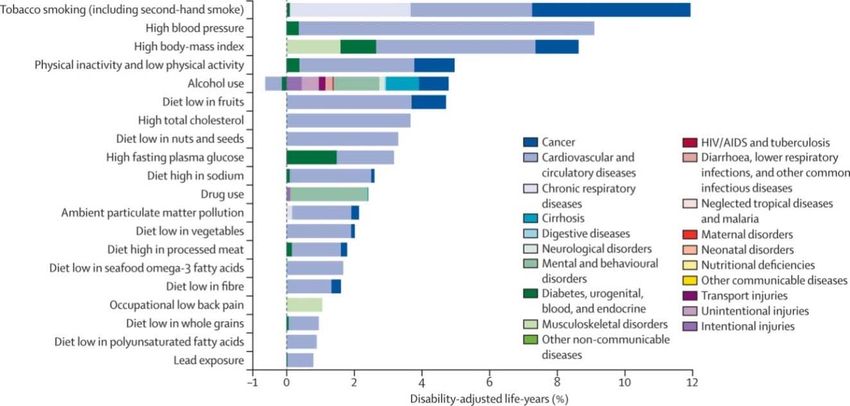
The programme systematically targets the top seven causes of premature mortality. It incorporates current NICE
recommended public health guidance, ensuring it has a robust evidence base. Economic modelling suggests the
programme is clinically and cost effective.                                                                                                          [Ref 4]

Top seven causes of preventable                  Burden of disease attributable to 20 leading risk factors for both sexes in 2010, expressed as a
mortality: high blood pressure,                                          percentage of UK disability-adjusted life-years
smoking, cholesterol, obesity, poor diet,
physical inactivity and alcohol
consumption.                                                                                                          *The negative percentage for alcohol is the
                                                                  *                                                   protective effect of mild alcohol use on
                                                                                                                      ischaemic heart disease and diabetes.

Each year NHS Health Check can on
average:
•       prevent 1,600 heart attacks and
        save 650 lives
•       prevent 4,000 people from
        developing diabetes
•       detect at least 20,000 cases of
        diabetes or kidney disease earlier
                                       [Ref 5]                                                                                                         [Ref 1]

    7       NHS Health Check implementation review and action plan
NHS Health Check: benefits to health
                                         Reducing and managing risk factors will reduce prevalence
                                                                            and effects of disease

Vascular disease: over four million                  The NHS Health Check programme helps to prevent the onset
people in England are estimated to have              of vascular disease and vascular dementia by supporting
vascular disease, which is recognised as             changes to and management of behavioural and physiological
the largest single cause of long term ill-           risk factors.
health, disability and death. Vascular
diseases are responsible for over a third                  Behavioural and
of deaths and a fifth of hospital                         Physiological Risk                       Vascular Disease
admissions in England each year.                                Factors        Managing risk     Coronary Heart Disease
                                                               Smoking          factors can              Stroke
Dementia: more common in people as                                              reduce risk     Transient Ischemic Attack
                                                           Physical inactivity and/or delay
they get older, it is estimated that 670,000                                                     Chronic Kidney Disease
                                                               Poor diet          onset of
people are living with dementia in                                                              Type 2 Diabetes Mellitus
                                                           Too much alcohol       disease
England. Over half have Alzheimer's
                                                          Raised cholesterol                           Dementia
disease and up to a third vascular
                                                          High blood pressure
dementia. In many cases however these
                                                                Obesity
conditions coexist and are thus likely to
be subject to delay in symptoms if we
manage the common risk factors that                  •   it is estimated that around 850,000 people are unaware that
predispose to them.                                      they have type 2 diabetes; half of all people diagnosed have
                                                         serious complications                                    [Ref 8]
Alcohol consumption: over 10 million
                                                     •   in more than 90% of cases the first heart attack is related to
people in England are drinking at levels
which increase their risk of ill-health. [Ref 5-7]       preventable risk factors                                  [Ref 9]

 8      NHS Health Check implementation review and action plan
NHS Health Check: the economic case
                                       Economic modelling suggests the programme is clinically and
                                                                                   cost effective

                         The economic case                          [Ref 4]   Quality Adjusted Life Years (QALYs) – gives an idea of
                                                                              how many extra months or years of life of a reasonable
DH established that the NHS Health Check policy was likely to be
                                                                              quality a person might gain as a result of treatment.
cost effective, before implementation began.
The cost calculations include two components:                                                       The ready reckoner                     [Ref 10]
• the cost of the actual assessments plus any follow-on tests or
                                                                              An interactive ready-reckoner on the NHS Health Check
  monitoring that are required in terms of staff time and lab costs
                                                                              website identifies the potential service implications, health
• the cost impact of the interventions that are provided as a result of
                                                                              benefits and cost savings resulting from implementing health
  the NHS Health Checks
                                                                              checks at council level. It is likely that there will be significant
The estimated savings to the NHS budget nationally are around                 additional social care savings as a result of ill-health
£57 million over four years, rising to £176 million over a fifteen-year       prevention, with a reduction in people accessing social care
period. It is estimated that the programme will pay for itself after 20       with conditions such as dementia, stroke and heart failures.
years as well as having delivered substantial health benefits.
The programme is underpinned by cost benefit modelling which                         Example area results from ready reckoner
considers cost in relation to quality adjusted life year (QALY) and                          local authority: Macclesfield
shows that it is extremely cost effective.                                    • Total cost of providing NHS health check for one year
                                                                                based on national estimates - £216,842
Further analysis showed that of all the options considered, the
optimal is a starting age of 40 with an NHS Health Check offered              • Workforce requirements to undertake NHS health check
every five years.                                                               in this year - 2,234 hours of time to invite people to Health
                                                                                Check and arrange appointments, 2,688 hours of contact
Further work will be undertaken to:                                             time for the health check and 1,862 hours of contact time
• refresh the economic modelling for this programme, given the                  for feedback of results
  addition of the two new components: alcohol and dementia
  awareness                                                                   • Total lifetime gains for the cohort of people invited for an
• establish the potential savings for local local authority services,           NHS Health Check this year 879 QALYs at a cost of
  including social care and benefits                                            £1,941 per QALY

  9      Health Check implementation review and action plan
NHS Health Check: responsibilities
                              Local authorities are mandated to commission the NHS Health Check and
                               are encouraged to work with the HWBs to commission local interventions

From April 2013 local authorities
are mandated to provide the NHS                                  NHS Health Check
Health Check programme. Money
has been allocated as part of the
public health ring fence to provide
NHS Health Checks for 20% of the
eligible population per year.
For benefits to be secured, local
authorities will need to ensure the
programme is seen as part of a
strategic approach to tackling
morbidity and mortality from
vascular disease and have a
clear sense of how it impacts on
local priorities.
They will need to provide:
• strong leadership at the health
  and wellbeing boards (HWBs)
  and work closely with the clinical
  commissioning groups (CCGs)
  to ensure a co-ordinated
  response
• risk assessment and follow-up
  interventions, with clear links to
  commissioned staying healthy
  initiatives and community
  development programmes [Ref 11]                                                               [Ref 12]

10      NHS Health Check implementation review and action plan
NHS Health Check: varying implementation
Local authorities will be taking on programmes at varying stages of
implementation and performance
Before April 2013, primary care trusts (PCTs) had responsibility for commissioning the programme. Phased implementation began in
2009. The number of NHS Health Checks offered and received has varied significantly across England. Therefore local authorities will be
taking on programmes in varying stages of implementation and with widely varying performance.
Learning from similar programmes has demonstrated that it takes time to increase uptake rates and with the programme still in its early
stages, it is encouraging that the national take-up rate in 2011/2012 was 52% and that during transition, in 2012/13 it was 49%.
A comparison of offered and received NHS Health Checks by PCT Variation in NHS Health Check offers and take-up rates across
(2012/2013) SHAs (covers all 2012/2013; each year 20% of eligible
population should be offered an NHS Health Check)
45%
NHS Health Check offered
(Percentage of eligible population offered and
40
40%
NHS Health Check received NHS Health Check offered
35
35% NHS Health Check received
NHS Health Check 2012-13
30
30%
25
received)
25%
%
20
20%
15
15%
10
10% 5
5% 0
East Midlands
West Midlands
Yorkshire and The
North East
South West
London
East of England
South East Coast
South Central
North West
0%
Humber
PCT
(from lowest to highest percentage offered)
Source: NHS Health Checks performance data, 2013 DH Source: NHS Health Checks performance data, 2013 DH
11 NHS Health Check implementation review and action planMaking the case: the rising costs of social care
Current trends suggests that the cost of social care and
continuing healthcare will continue to rise
Personal social services net and continuing health expenditure on
As the number of older people living in England increases and
over-65s in England under base case (BC) and continued trends
public expenditure becomes more constrained, meeting the
assumption (CTA), 2012-2022 [Ref 13]
need for social care will become more challenging.
The Office for National Statistics (ONS) 2010-based principal Scenario BC CTA
population projections for England project that between 2010
and 2022 the number of people aged 65 or over will rise by Rise in number ≥ 65 years with
27% and the number aged 85 or over will rise by 44%. a moderate or severe disability 32% 54%
by 2022
Eighty percent of those aged 65 and over will need care in their
later years of their life.
Cost of social and continuing £12.7 £14.4
Current trends suggest that the cost of social care and healthcare by 2022 billion billion
continuing healthcare will continue to rise; reasons include:
• 2% yearly increase in obesity, increasing prevalence of £15,000
Constant prevalence of diability by age and gender
arthritis, stroke, CHD and vascular dementia
Rising prevalence of disability by age and gender*
• emergence of minority ethnic groups in significant numbers £14,000
within the older population adds to prevalence of stroke and
Expenditure (£ million)
CHD £13,000
• 2% bi-yearly increase in prevalence of arthritis, stroke, CHD
and mild dementia from 2012 (moderate/severe dementia £12,000
from 2016)
• 10% increase in disabling effects of arthritis, stroke and £11,000
CHD from 2012 and a reduction in mortality of 5% from mild
dementia, stroke and CHD from 2016 £10,000
The NHS Health Check programme offers us an
opportunity to stall some of these trends, and reduce £9,000
current cost predictions. 2010 2011 2012 2013 2014 2015 2016 2017 2018 2019 2020 2021 2022
[Ref 13] *The rising prevalence of rates of disability reflects continuation of recent trends in prevalence rates of chronic conditions.
12 NHS Health Check implementation review and action planMaking the case: keeping the working population healthy
The impact of poor health on the working age population affects
everyone: individuals, employers and society
Good health improves an individual’s chances of Unhealthy
finding and staying in work and enjoying the lifestyles
consequential financial and social advantages. Being
in work has a beneficial impact on health. Conversely
poor health may impact on an individual’s ability to
work and lead to poorer health outcomes.
Poorer health Poor health
The health of the working age population is important
outcomes outcomes
for everyone:
• individuals and families: impacts quality and
length of life, affects capacity to work and provide
for family
• employers: a healthier workforce is more
productive and inspires greater investment from
employers
• society: consequences of ill-health include social
May lead to Impacts
exclusion, lower output and reduced tax revenues worklessness ability to work
and higher healthcare and social security costs
• 175 million working days were lost in sickness
absence in 2006 (7 days per working person) The NHS Health Check programme is well placed
• 7% of the working age population are workless to support people to remain in and return to work
and receiving benefits [Ref 14] and consequently benefit from it.
13 NHS Health Check implementation review and action planMaking the case: the cost of poor health
There is an economic and social case to act decisively to
improve the health of the working age population
The annual costs of sickness absence and worklessness associated with working age ill-health are estimated to be over £100 billion.
The NHS Health Check programme offers an opportunity to target those in work, aged 40 and over to support a reduction in sickness
absence and worklessness.
Individuals Employers NHS Government Whole economy
• loss of income if • cost of health • cost of treating • cost to the NHS • includes forgone
poor health leads related working age • cost of benefits taxes (£70 billion
to worklessness productivity people who are related to per year) and
• emotional cost of losses sick and out of working age ill- healthcare costs
ill-health to • associated costs work, which health (£29 (formal and
themselves and of staff turnover, includes GP billion a year) informal) to
their families loss of skill base, consultation Government
through to • increased burden (~£30 billion
• loss of years of downtime, on the tax payer
recruitment and secondary care per year)
life spent in state (£5-11 billion (£30-34 billion
of poor health re-training per year)
per year)
• cost of informal • loss of income
care by friends tax due to loss in
and family productivity
(£25-45 billion (£28-36 billion
per year) per year)
[Ref 14]
14 NHS Health Check implementation review and action planMaking the case: targeting deprived communities
Supporting people in deprived communities to improve their health,
will give them the greatest chance to stay in work and remain healthy
Socio-economic status influences health outcomes. Proportion of deviation from perfect health by work status
0.35
Having a higher income is likely to improve a person’s Male (16-64) Female (16-59)
health status, while being in good health increases 0.3
earnings potential. Conversely a lower income is
0.25
linked to poorer health outcomes.
Tackling the risks and managing poor health will lead to 0.2
lower incidence of health inequalities and a higher
0.15
number of people staying in work.
0.1
Proportion of deviation from perfect health by social class
0.2 0.05
Male (16-64) Female (16-59)
0.18
0
0.16
In work / training Not in work / training
0.14
Note: Based on QALY measure of self-reported health. Does not cover Scotland and Wales
0.12 Source: Health Survey for England 2005, age adjusted, analysis by Department of Health
0.1
0.08 • a child of a lone parent who does not work is
0.06
eight times more likely to live in poverty than
0.04
0.02
that of a lone parent who works full time
0
Professional Managerial Skilled / non Skilled manual Partly skilled Unskilled • children have higher incidence of recurrent
and technical / manual
intermediate
Social Class
health conditions if parents have a low
Note: Based on QALY measure of self-reported health. Does not cover Scotland and Wales income
Source: Health Survey for England 2005, age adjusted, analysis by Department of Health [Ref 14]
15 NHS Health Check implementation review and action planMaking the case: targeting BME groups
There is a strong association between ethnicity and health
General health outcomes Diabetes
Black British people are 30% more likely to rate their health as South Asian people who live in the UK are up to six times more
fair, poor or very poor. likely to have diabetes than the white population. With the
prevalence predicted to increase by 47% by 2025 (in England), the
Pakistani and Bangladeshi people have the worst health of all the
condition will continue to have a considerable impact on South
ethnic groups and are 50% more likely than white people to
Asian communities across the UK.
report fair, poor or very poor health. [Ref 15] [Ref 16]
All people over 50 years with limiting long-term illness, by Prevalence of doctor diagnosed diabetes (type 2) by sex and
ethnic group, 2004, England and Wales ethnic group, 2004, England
Chinese 10
Men,Type
Men, TypeII 2Diabetes
diabetes
Other Ethnic Group 9
Black African Women,Type
Women, TypeII 2Diabetes
diabetes
Other White
8
White and Asian 7
Prevalence (%)
Other Mixed 6
Other Asian 5
White British
4
White and Black African
White Irish 3
Other Black 2
White and Black Caribbean 1
Indian
0
Black Caribbean
Pakistani
Bangladeshi
0 10 20 30 40 50 60 70
Source: Census 2001, National report for England and Wales (%) Source: Health Services Unit (2005), Health Survey for England (2004). The health of minority ethnic groups, DH, London.
16 NHS Health Check implementation review and action planMaking the case: targeting BME groups
Premature mortality rates for CVD are higher in some populations
Incidence of stroke in men and women by ethnic group, Coronary heart disease (CHD)
1995-2004, South London
250 South Asian people born in India, Bangladesh, Pakistan and
Sri Lanka are approximately 50% more likely to die
prematurely from CHD than the general population.
200
Incidence rate per 100,000
The prevalence of CHD in England is highest in Indian (6%),
Irish (6%) and Pakistani (8%) men. [Ref 18]
150
Prevalence of CHD in men and women by ethnic group,
100 2004, England
9
Men with CHD Women with CHD
8
50
7
Men, White Men, Black
6
(%)
Women, White Women, Black
0 5
1995-1996 1997-1998 1999-2000 2001-2002 2003-2004
Prevalence
4
Source: Health Survey for England (2004)
3
2
Stroke
1
The premature mortality rate for stroke in England is 0
higher for those born outside the UK than for those born
within. Furthermore stroke mortality rates are falling more
slowly in minority ethnic groups than the rest of the
population, widening inequality.
[Ref 17] Source: Health Services Unit (2005), Health Survey for England (2004). The health of minority ethnic groups, DH, London.
17 NHS Health Check implementation review and action planExecutive summary Context Findings – issues and actions Next steps 18 NHS Health Check implementation review and action plan
Issue 1: leadership
                                       Disagreement in the public health community has led to
                                    inconsistent support for the NHS Health Check programme

The NHS Health Check programme offers a fantastic opportunity to reduce
premature mortality and health inequalities in England; PHE is fully         “It is difficult to provide
supportive of its roll-out.                                                 reassurance when on a
PHE’s role is to lead the public health community in promoting the          personal level you’re not
programme’s value. The key to its success lies in collaboration with key       sure if you’ve 100%
partners from all sectors (local authorities/LGA, NHS England, clinical            bought into the
commissioning groups, Health Education England, wider government, other         programme either”
healthcare providers, pharmacists, voluntary organisations).                      (Commissioner)

PHE acknowledges that there are some significant issues to be addressed
and reservations from national and local leaders to be overcome in making
NHS Health Check a world class public health programme.
The comment boxes on this and following slides illustrate some of the
concerns expressed to us [Ref 19].
Action 1
PHE fully supports the NHS Health Check programme at all levels. It will lead the development
of collaborative national leadership through a clear programme governance structure including
an advisory committee, comprising the key stakeholders (LGA, NHS England, NHS IQ, DH and
others) and an expert clinical and scientific advisory panel. PHE will provide timely and
authoritative advice on emerging issues and will empower public health leaders locally with the
evidence and rationale for the programme.

  19    NHS Health Check implementation review and action plan
Issue 2: improving uptake
Low public awareness and engagement are major
barriers to the success of the programme
To drive uptake, PHE recognises the need to improve both awareness of the NHS
Health Check programme and engagement of those invited so they are willing to
take up the offer of an NHS Health Check.
While there have been concerns that local authorities may not want to promote “The biggest thing
and lead on an ‘NHS’ product, the LGA is supportive of the continued use of the in being able to
NHS Health Check brand complemented by local authority joint branding. increase our
uptake. We’ve had
Research has shown that adapting invitations to support improved uptake from
a very big
local population groups is pivotal to success. PHE will work with local authorities
communications
to develop a repository of local case studies to support local implementation.
campaign”
PHE will work with and support its partners (local authorities, LGA, NHS and DH) (Commissioner)
to co-produce and share advice and good practice to ensure consistency across
the programme.
Action 2
PHE will work with local authority NHS Health Check teams to test the potential impact of
behavioural insight and marketing interventions on uptake. This will include developing
options for improving the NHS Health Check brand, establishing the effectiveness of
different approaches to recruitment and testing marketing campaigns to support uptake
locally and nationally.
20 NHS Health Check implementation review and action planIssue 3: providing the
NHS Health Check
The landscape is complex and local authorities have different options to
choose from; we cannot say yet, the best way to commission the service
PCTs have used different invitation processes; case studies have shown us “There’s a risk that the GPs
that using a call-recall system is effective, but that opportunistic approaches will throw their hands up
also have benefits. We are not yet certain of the best approach to use. and say ‘this is too much
PCTs commissioned the programme from a range of providers (GPs, work, we’re not going to do
pharmacists, third sector etc). Case studies suggest that programmes it,’ and then we’ll have to
using a mix of providers are most successful at reaching out to local commission private
population groups but more evaluation is needed before we can say for providers who are more
certain which approach is best. expensive, then we risk it
NHS Health Checks can and have been provided by a range of health becoming very expensive
professionals (GPs, nurses, healthcare assistants, volunteers etc). Further programme which will not
work needs to be undertaken to understand the value of using different be cost effective”
types of professionals for different populations. (Commissioner)
Action 3a
PHE will thoroughly review and collate previous approaches to commissioning and delivering the
NHS Health Check programme and so learn from and share promising practice and experience.
Action 3b
PHE will collaborate with the Centre for Public Scrutiny to work with several test bed sites to
explore approaches to effective commissioning of the programme.
21 NHS Health Check implementation review and action planIssue 4: information governance
Some commissioners are unclear about NHS Health Check
information governance
The transfer of responsibilities brings with it a requirement to continue to meet “Recording community
the highest possible data protection requirements for services users, combined practice data on practice
with reaching all eligible residents in the most appropriate manner. Local systems has been a
commissioning arrangements and procedures for identifying and inviting eligible challenge – this has to
people to their NHS Health Check are extremely varied and it is therefore not
be done, in order to
possible to provide national guidance to cover every eventuality. Local areas
should be familiar with legal requirements for handling sensitive personal data.
count towards targets”
(Commissioner)
In March 2013 a guidance note from PHE and DH was shared with local
authorities and other key partners setting out a number of general approaches “It’s about understanding
that local commissioners could consider: a) NHS Health Checks are conducted the challenges we face
by GPs only b) invitations are sent by GPs, but health checks are issued by a
and where possible
third party provider or both a GP and a third party provider c) an opportunistic
element of the programme is offered, in conjunction with GP delivery
coming up with national
d) invitations are sent via the National Health Authority Information System solutions, particularly
(NHAIS), where people can opt out. data solutions”
(Commissioner)
Action 4
PHE will explore long term solutions to free up the system to enable the flow of data, including
to and from GP practices, for the best possible delivery of the NHS Health Check programme.
It will explore the use of innovation and IT technologies to allow the seamless flow of NHS
Health Check data across the health and social care system. This will create an environment
that supports local teams to commission and evaluate programmes which aspire for excellence
and improved outcomes.
22 NHS Health Check implementation review and action planIssue 5: supporting delivery
There is uncertainty about the future of regional
and national networks
National and regional networks play a vital role in supporting roll-out and
improving the quality of NHS Health Check programmes across England. “You get an idea of the
issues other people are
Since April 2010, NHS Diabetes and Kidney Care (NHS DAKC), with the going through. It’s good
Department of Health supported commissioners and providers to improve to know it’s not just you”
NHS Health Check programmes through provision of a national network (Commissioner)
and targeted local support. Strategic Health Authorities supported
improved performance, disseminating national messages through
regional networking events to PCT commissioners and encouraging local “I would hope it would
teams to share their knowledge and work together. be PHE who would
provide networking and
Now that those organisations who provided support have been abolished support. That’s the role
or integrated into other organisations, some commissioners are worried they should have,
that networks will no longer be supported. PHE will take on the role of combined with the local
providing support to both clinical and non clinical commissioners of the area teams and
risk assessment and follow-up services. Commissioning Boards”
(Commissioner)
Action 5
PHE will build upon and give continued support to established national, regional and local
implementation support networks, ensuring equitable access to all organisations across
England. PHE will work with the LGA to advance NHS Health Checks through the sector led
improvement agenda.
23 NHS Health Check implementation review and action planIssue 6: programme governance
The NHS Health Check community is concerned that new
elements are added without due concern for the evidence base
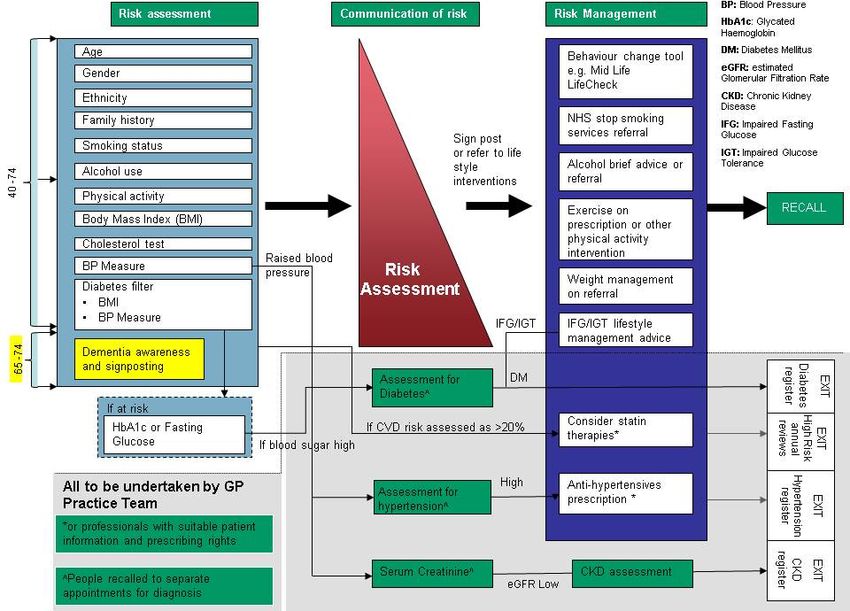
Before introducing the policy DH undertook a comprehensive NHS Health Check: risk assessment
analysis of the evidence and the economic case for the NHS measurements
Health Check programme. This suggested that the Age
programme is both clinically and cost effective. Gender
Mindful of transition, PHE will allow the system time to Ethnicity
stabilise, while continuing to review existing and potential Family history
new elements for the programme, ensuring they are Smoking status
evidence based. Alcohol use
PHE will also ensure governance is in place to review any Physical activity
future proposed changes. Decision makers will be cognisant Body-mass index
of concerns raised by commissioners and providers, Cholesterol test
including the time pressures and practicalities of introducing Blood pressure measure
new elements and their affect on the effectiveness of the Dementia awareness*
NHS Health Check. Diabetes filter (BMI and BP measure)
Action 6 If at risk: HbA1c/Fasting Glucose tests
* Awareness and signposting only for those aged 65-74
PHE will set up clear programme governance arrangements, including an expert clinical and
scientific advisory panel to assure that any additional elements of the programme are evidence
based. It will keep the programme under review and advise the DH and ministers accordingly.
See Appendix B for programme governance structure.
24 NHS Health Check implementation review and action planIssue 7: provider competency
Some commissioners are worried that providers are not
appropriately skilled to deliver behaviour change interventions
PHE recognises that the success of NHS Health Check lies in part with the ability
of the chosen provider to inspire behaviour change in those attending.
“The health check
Through this review, PHE has identified that risk assessment delivery varies consultation is
nationally, from those that focus on prevention through lifestyle advice to those perceived as a
focusing on early detection of disease and other clinical elements. Some series of clinical
practitioners have suggested that they do not feel equipped to undertake lifestyle tests by attendees;
discussions. There is therefore a risk that the programme’s impact is not lifestyle
fully realised. discussions are
PHE has a role in supporting local authorities in commissioning local programmes seen as secondary
focused on behaviour change using and building on NICE guidanceref 20 and in to testing”
working with its partners (professional bodies and training providers) to support (Commissioner)
enhanced delivery.
Action 7a
PHE will work with Health Education England (HEE) to build upon existing competency
frameworks for use by providers and commissioners to ensure high quality training for those
delivering the NHS Health Check.
Action 7b
PHE will work with local commissioners, training providers and professional bodies to develop
a professional development programme of work on NHS Health Checks to enhance the focus
on behaviour change for better health outcomes.
25 NHS Health Check implementation review and action planIssue 8: consistency
There is a lack of consistent, quality driven roll-out
Every person eligible for an NHS Health Check should be offered a good quality,
consistent risk assessment interview and follow-up, irrespective of where they live, “The major problem
or the provider commissioned to deliver it. is that there just
isn’t a QA
This review has highlighted a desire in some for a national quality assurance
programme in
process. While PHE may consider this in the future, supporting delivery of a
place, either
consistent offer is considered the priority at present. The programme is a mandated
centrally or
service in order to help to drive this.
regionally, that you
Commissioning and management of the programme has been the responsibility of PCTs see for other
and through this review PHE has identified a disparity in approaches and investment. programmes”
PHE accepts that some local authorities may wish to add elements to their local (Commissioner)
NHS Health Check services to reflect local need, but stresses that additional
elements should not compromise the quality of the standard offer.
Encouraging consistency will support and further develop local and national
evaluation of the NHS Health Check programme.
Action 8
PHE will release and review on a regular basis best practice guidance describing all the
elements and standards it would expect of a quality programme such as quality of delivery
and robustness of data capture and reporting. It will raise awareness, promote adoption and
explore opportunities for quality assurance programmes in local authorities.
26 NHS Health Check implementation review and action planIssue 9: proving the case
Some of the public health and clinical communities are concerned
about the evidence base for the NHS Health Check intervention
Each of the individual elements contained within the NHS Health
Check are evidenced by NICE guidance [ref 12] and have a strong “I would like PHE to
economic case, supporting their inclusion in the NHS Health Check highlight the benefits of the
programme. However some leading pubic health professionals and programme, as the critical
clinical providers continue to have questions about the evidence base. national voice. This will
encourage GPs and other
The case for the programme is clear and research is currently organisations to buy into it.
underway to provide an early assessment of programme outcomes There is a debate about
since phased implementation began in 2009. This work will also the evidence for health
highlight a range of implementation and delivery issues for future checks. PHE should
consideration. See February’s e-bulletin for more details. provide clear evidence of
PHE will work with its partners to develop data collection techniques their value”
and research proposals to support evaluation of the (Commissioner)
NHS Health Check programme.
Action 9
PHE will work with system partners to facilitate future research and evaluation of the NHS
Health Check programme at a national and local level. This will provide the implementation
evidence required to ensure effective roll-out and improvement.
27 NHS Health Check implementation review and action planIssue 10: expected roll-out
Some local authorities are worried that they will not meet
expected delivery targets
NHS Health Check is a mandated service and the regulations state that “We’ll be lucky if we get
local authorities must achieve a 100% offer rate in their eligible anywhere near 10%...
populations after five years. Some GPs have really
Ideally local authorities will offer the NHS Health Check to 20% of their gone for it and smashed
eligible population each year, reaching 100% over five years. Enabling their targets, but those
them to commission a programme in steady state and supporting the with low engagement are
development of clinical and lifestyle follow-on services. bringing the average
down.” (Commissioner)
Funding has been allocated to support this scenario and is modelled on an
uptake rate of 75%. Ideally local authorities will want to show annual “The massive thing is the
improvement in uptake rates aiming for and beyond 75%. sheer variability in
PHE is aware that local authorities are taking on programmes in varying delivery. You get some
stages of implementation and with widely varying performance. Reporting star performers and
by PHE of delivery and take-up by local authorities will be cognisant of this some people just don’t
being a five year rolling programme. engage with it”
(Commissioner)
Action 10
PHE will support those local authorities taking on challenging programmes. It will work with
LAs to achieve offers to 20% of the target population annually with a vision to realise at least
75% uptake per year. This will support local authorities to achieve offers to 100% of their
eligible population over five years.
28 NHS Health Check implementation review and action planExecutive summary Context Findings – issues and actions Next steps 29 NHS Health Check implementation review and action plan
Next steps
     2012-13, the first full year of the NHS Health Check programme, saw 2.7 million offers
     made and 1.26 million NHS Health Check appointments received, during a time of so
     much transformation across the health system. This provides a solid base on which
     to build.

     Over the coming year and beyond, PHE will work with our key partners to:

          •   support effective implementation and monitoring
          •   facilitate the sharing of best practices
          •   support evaluation and research
          •   make sure that any new strategic developments are based on the best
              evidence
          •   support strong, challenging and robust governance

     Our challenge now is to increase national coverage so that all areas are offering access
     to this mandated public health programme. We must also strive to increase further
     levels of uptake and referral to appropriate risk management services, particularly in
     those communities at greatest risk.

30      NHS Health Check implementation review and action plan
Annex A: methodology
Dates of
Stage Information
Completion
Commissioned by the Public Health England Transition Team to:
1. Research Works qualitative
• assess the experiences of commissioners and providers in delivering the
research: ‘Understanding the
NHS Health Check programme February 2013
implementation of NHS Health
• gain an understanding of the engagement of public health professionals
Checks’
with NHS Health Check and the process of implementing the programme
Two workshops held. Stakeholders represented the following organisations:
2. Workshops help to establish the DH, local government (Birmingham, Cheshire & Merseyside, North January 2013 &
views of senior stakeholders Lincolnshire, West Midlands, Worcestershire, York), LGA, NHS England, February 2013
NHS IQ, PHE, Research Works, UK National Screening Committee
Comments sought from PHE’s National Executive, the project working
group and wider stakeholders, with an interest in the NHS Health Check
programme:
3. Comments sought via the PHE’s
a) after the second stakeholder meeting in February 2013 May 2013
engagement mailbox
b) after the launch of our initial findings at the NHS Health Check Learning
Network Event in April 2013.
• 17 sets of comments were received.
Engagement meetings held with:
• Members of the Delivering Transition Steering Group (DTSG)
4. Meetings held with ‘opinion
• PHE Centre directors May 2013
leaders’ from across England
• Leading GPs
• Association of Directors of Public Health [June 2013]
5. Analysis agreed with the PHE
Final report agreed with the PHE National Executive and Felicity Harvey
Programme Board chaired by the June 2013
(Director General – Public Health Directorate, DH)
Director General of DH
31 NHS Health Check implementation review and action planAnnex B: NHS Health Check governance 32 NHS Health Check implementation review and action plan
Acronym list
                                                           Acronym                     Full title
                                                      CCG            Clinical Commissioning Group

                                                      CHD            Coronary Heart Disease

                                                      CVD            Cardiovascular disease

                                                      DTSG           Delivering Transition Steering Group

                                                      HEE            Health Education England

                                                      HWB            Health and Wellbeing Board

                                                      LA             Local Authority

                                                      LGA            Local Government Association

                                                      NHAIS          National Health Authority Information System

                                                      NHS CB         NHS Commissioning Board

                                                      NHS DAKC       NHS Diabetes and Kidney Care

                                                      NHS IQ         NHS Improving Quality

                                                      NICE           National Institute for Health and Care Excellence

                                                      PCT            Primary Care Trust

                                                      PHE            Public Health England

                                                      QALY           Quality Adjusted Life Year

                                                      RCGP           Royal College of General Practitioners

                                                      SHA            Strategic Health Authority

33   NHS Health Check implementation review and action plan
Useful documents Local Government Association (2013) NHS Health Check frequently asked questions Centre for Public Scrutiny (2013) NHS Health Check – what council scrutiny needs to know 34 NHS Health Check implementation review and action plan
References
1.    Murray, C.J.L, et al., (2013) UK health performance: findings of the Global             11.   The National Archives. (2013) The Local Authorities (Public Health Functions and Entry to
      Burden of Disease Study 2010. The Lancet. 381(9871), 997-1020. [Link to                       Premises by Local Healthwatch Representatives) [online] Available at:
      document]                                                                                     http://www.legislation.gov.uk/uksi/2013/351/contents/made [Accessed 20 March 2013]
2.    Department of Health. (2013) Living well for longer: a call to action on avoiding       12.   Department of Health. (2013) NHS Health Check: Best Practice Guidance.
      premature mortality. London: Department of Health. [Link to document]                         London: Department of Health (In Draft) [Link to document]
3.    Department of Health. (2013) CVD Outcomes Strategy: Improving outcomes for              13.   Wittenburg, et al., (2012) Care for older people. London: The Nuffield Trust.
      people with or at risk of cardiovascular disease. London: Department of Health.               [Link to document]
      [Link to document]                                                                      14.   Dame Carol Black. (2008) Working for a healthier tomorrow. London: Crown.
4.    Department of Health. (2008) Economic Modelling for Vascular Checks. London:                  [Link to document]
      Department of Health. [Link to document]                                                15.   International Centre for Lifecourse Studies. (2010) ICLS Briefing note 2:
5.    Department of Health. (2009) Putting prevention first – vascular checks: risk                 Ethnicity and Health. London: ICLS. [Link to document]
      assessment and management – Impact Assessment. London: Department of                    16.   Khunti, K., Kumar, S., & Brodie, J. (2009) Recommendations on diabetes
      Health. [Link to document]                                                                    research priorities for British South Asians. London: Diabetes UK. [Link to
6.    Department of Health. (2013) Free NHS Health Check: Helping you prevent                       document]
      heart disease, stroke, diabetes, kidney disease and dementia. London: Warren            17.   British Heart Foundation. (2009) Stroke Statistics in the UK. London: British
      Lea [Link to document]                                                                        Heart Foundation. [Link to document]
7.    Comptroller and Auditor General. (2008) Department of Health: Reducing                  18.   Department of Health, Social Services and Public Safety. (2004) Inequalities
      Alcohol Harm: health services in England for alcohol misuse. London: National                 and unfair access issues emerging from the DHSSPS (2004) ‘Equity and
      Audit Office. [Link to document]                                                              Inequalities in Health and Social Care: A statistical overview’ Report. DHSSPS:
8.    Diabetes UK. (2012) State of the Nation 2012: England. London: Diabetes UK.                   Northern Ireland. [Link to document]
      [Link to document]                                                                      19.   Research Works Limited. (2013) Understanding the implementation of NHS
9.    Yusuf, S, et al., (2004) Effect of potentially modifiable risk actors associated with         Health Checks. Research Report – February 2013. St. Albans, UK: Research
      myocardial infarction in 52 countries (the INTERHEART study): case control                    Works Ltd. [Link to document]
      study. The Lancet. 364(9438), 937-952. [Link to document]                               20.   The most appropriate means of generic and specific interventions to support
10.   Department of Health and NHS Diabetes and Kidney Care. (updates 2013)                         attitude and behaviour change at population and community levels [link to
      Ready Reckoner Tool. London: Department of Health. [Link to Tool]                             http://guidance.nice.org.uk/PH6}

      35       NHS Health Check implementation review and action plan
You can also read


