NORTH CAROLINA HEALTH INFORMATION EXCHANGE AUTHORITY - North Carolina Diabetes Advisory Council Meeting Vanessa Green, MOR, MBA
←
→
Page content transcription
If your browser does not render page correctly, please read the page content below
NORTH CAROLINA HEALTH
INFORMATION EXCHANGE AUTHORITY

North Carolina Diabetes Advisory Council Meeting

Vanessa Green, MOR, MBA
Health Analytics Lead,
NC Health Information Exchange Authority

We connect health care providers to safely and securely share health information through
     a trusted network to improve health care quality and outcomes for North Carolinians.

        S TAT E   D E S I G N AT E D           S E C U R E                PA R T N E R S H I P
           North Carolina’s state-     Secure statewide network for    Housed within the Department
             designated health          physicians and other health     of Information Technology’s
           information exchange           care providers in North       Government Data Analytics
                                        Carolina to share important         Center (GDAC). Our
                                       patient health information to     technology partner is SAS
                                           improve patient care                  Institute.

2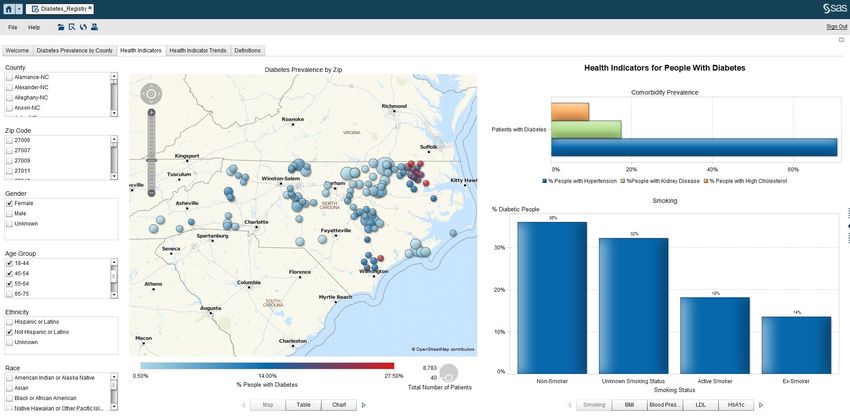
The Vision for Connectivity
  North Carolina set out a vision to create
  communities of connected health care
  providers electronically across the state.

  • Allow providers to view their patients’
    longitudinal health record in real-time
  • Improve health care quality, enhance patient
    safety, improve health outcomes

  • Consolidate data reporting requirements across
    the state to ease administrative burden and
    create efficiencies by eliminating duplicative
    data integrations

  • Create outbound services to give providers
    insight to their at risk patient population
What Does the Law Mandate?
    Hospitals as defined by G.S. 131E-176(3), doctors (licensed to practice under Article 1 of Chapter 90 of the
    General Statutes), and mid-level practitioners who provide Medicaid services and who have an electronic health
    record were required to connect by June 1, 2018.

    All other providers of Medicaid and state-funded services shall connect by June 1, 2019 except;

    • Dentists and ambulatory surgical centers are required to submit clinical and demographic data by June 1, 2021
    • Pharmacies are required to submit claims data pertaining to State services once per day by June 1, 2021 using
      pharmacy industry standardized formats

4
4
What is Health Information Exchange (HIE)?
A Health Information Exchange (HIE) is a secure, electronic network that gives authorized health care providers the ability to
            access and share health-related information across a statewide information highway.

                                                        pharmacy

                                 ambulatory care
                                                                                 behavioral health

                                                        HIE
                          labs
                                                                                      public health

                           long term care                              Primary Care
                                                      hospitals
What are
         the
                A full “picture” of a person’s health,
     clinical   including visits, hospitalizations and
                medications
    benefits    Improved, more accurate and timely
                medication reconciliation that reduces
       of an    errors and avoids unnecessary tests

                Instant access to a full panel of test
       HIE?     results, reducing errors and gaps in
                treatment

6
How Does Health Information Exchange Work?

               Electronic Health
             Electronic
                                                                             Data
                                                                              DataProvided
                                                                                   Provided
                         Health Record
                     Record
         Clinicians enter enter
                          data into EHR and                                  Clinicianswho
                                                                            Clinicians   whohave
                                                                                               havecare
             Clinicians          data                                       care  relationships
                                                                              relationships  withwith
                                                                                                   their
             that data is pulled into HIE
               into EHR and that                                            their patients
                                                                             patients       are able
                                                                                       are able  readily
               data is pulled into                                         readily  access
                                                                                 access     that
                                                                                          that    data
                                                                                               data
                       HIE

    1
        Elements Available                                                 Security in Place
        Current data elements available in NC HealthConnex include:
        Allergies, Encounters, Immunizations, Medications, Problems,
        Procedures, Results
                                                                       2       .
                                                                            All data is protected, stored and accessed only for
                                                                            purposes permissible under federal and state law.

7
What Data Elements Will You Need to Submit?
                                              The NC HealthConnex Data Target
                                       We aim to collect all Meaningful Use Data Elements

Patient ID                Name            Date of Birth           Address/           Language                Race/                   Gender
                                                                   Phone                                    Ethnicity

                                                                                                                        Care Team
          Date of Visit          Visit Number      Reason for Visit      Level of Care        Visit Location             Members

                                                                        Care plan field(s),
       Vital signs (height,                                               including goals                               Medication
        weight, BP, BMI)         Immunization         Referrals                                 Problems                 Allergies
                                                                         and instructions

                                                      Laboratory                                Discharge
          Medications         Laboratory Test(s)                        Smoking Status                                  Procedures
                                                   Value(s)/Result(s)                           Summary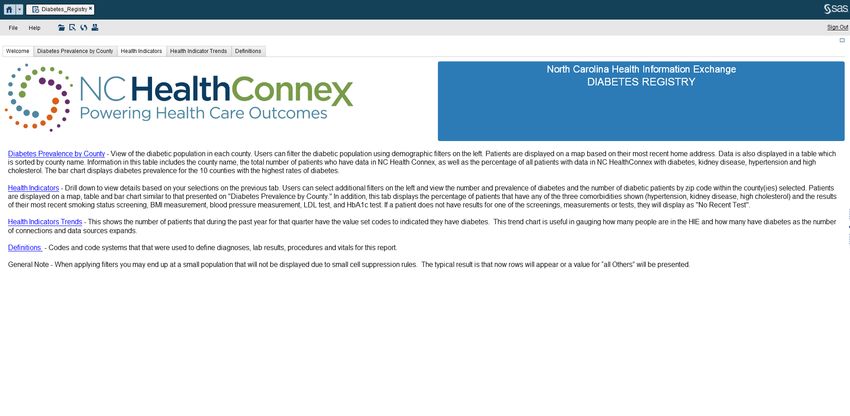
Significant Progress

    Number of Connected Facilities

    Spring 2016         Spring 2017         Summer 2018

    108 Facilities      877 Facilities      4,500+ Facilities

    Number of Facilities in the Onboarding Process

    2016                2017                2018
    158 Facilities      578 Facilities      3,800+ Facilities

9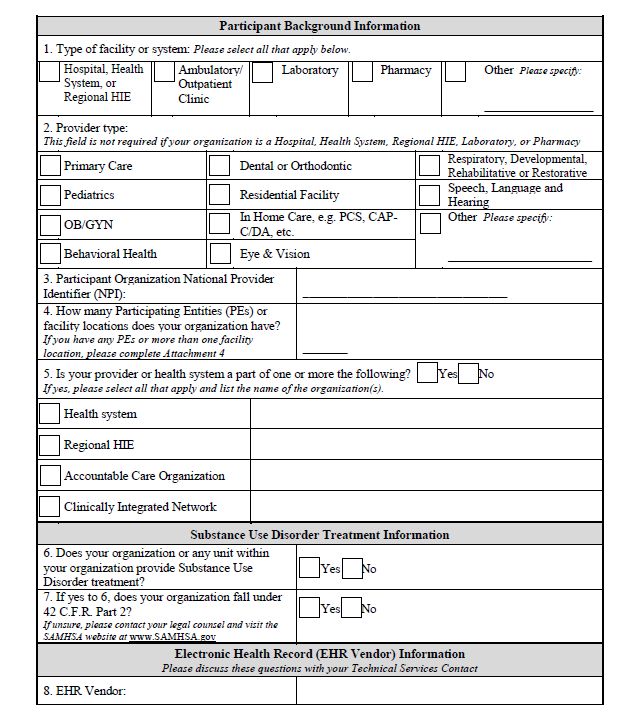
How Do Providers Meet the Mandate?
     There are two steps to determine a practice’s readiness for connection.

     1. Does your practice have an EHR that can send CCD or HL7 messages?

         • Technology in Place: The NC HIEA Participation Agreement requests EHRs that
           are minimally capable of sending HL7 messages, version 2 and higher.

     2. Does your practice have a Participation Agreement in place?

         • The Participation Agreement is the document that governs the exchange of data
           between the practice and NC HealthConnex. This contract must be in place before
           the technical build can begin. Participation Agreements are linked on our website
           for providers to download, sign and return.

10
NC HealthConnex Participation Agreement
The contract governing data sharing between the NC HIEA and Health Care Organization
How do I complete?
Log on to:
nchealthconnex.gov/how-to connect
✓ Complete the Participation Agreement
✓ Submit to hiea@nc.govHow Do Providers Connect: The Participation Agreement 12
Once a Participation Agreement (PA) is signed
 Patient    by a health care provider, Patient Education
            materials are provided to that organization via
Education   email, which includes a sample Notice of
            Privacy Practices.
& Opt-Out
            Providers and patients also have easy access
            to Patient-Opt out materials on the NC
            HealthConnex website.

            Providers generally have around 3 months after
            they sign a PA before they are connected to NC
            HealthConnex. Providers can use this time to
            educate their patients about the new
            relationship between your practice and NC
            HealthConnex.

            All NC HIEA Policies are posted on our website,
            nchealthconnex.gov.

20
Privacy and Security
• Privacy and Security Policies
• Highest security standards as
set by federal and state law
• HIPAA regulations and state
law
• HITECH Act
• Regular monitoring and audits
• Data Encryption via Direct
Secure MessagingSuite of Services
Exchange Notify Communicate Connect Contribute
Flexible Delivery NC*Notify Direct Secure Message Provider Directory Public Health Reporting
Custom delivery methods Notifies providers as their Connection with other More than 21,000 secure Diabetes Public Health
integrate into varied patients receive services providers by sending and messaging addresses of Registry and NC
provider workflows across the care continuum receiving secure, encrypted health care providers Immunization Registry (help
messages. providers meet MU/MIPS)Diabetes Disease Registry
• Partnership between the NC DHHS’s DPH and
NC HealthConnex.
• Starting June 1, supports attestation for Meaningful Use
Stage 3 and Modified Stage 2 for eligible hospitals, eligible
critical access hospitals, and eligible professionals as well
as Medicare Quality Payment Program Advancing Care
Information for eligible clinicians
• Also includes a subscription based service for Participants
where detail clinical data is provided based on a list of
Participant’s Patients
• Currently evaluating other clinical registries beyond
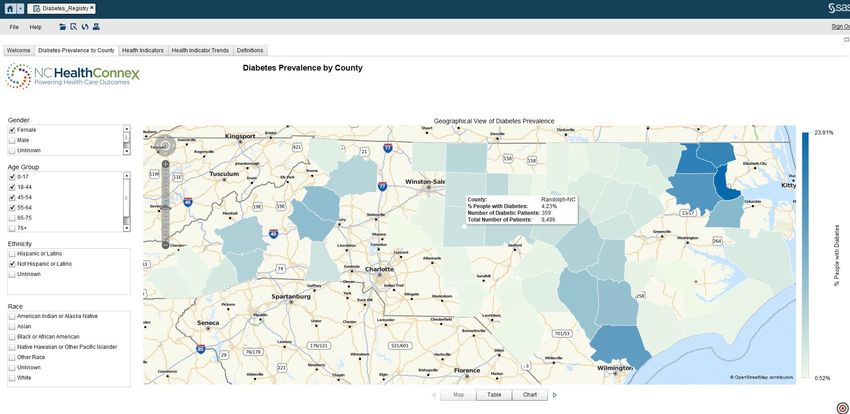
DiabetesDiabetes Disease Registry NC DHHS’s DPH regularly receives data and visualizations used for tracking the clinical care and outcomes of the patient population in North Carolina diagnosed with or presenting signs or symptoms of Diabetes. This information is used to: ✓ Identify where there may be geographic areas and/or other populations that would benefit from public health programs ✓ Augment other Public Health data sources with de-identified clinical information about patients with Diabetes
Question of Interest

Let’s assume an organization is developing a targeted
intervention for the following type of diabetic patient:

    • Non-Hispanic

    • Females

    • Under the age of 65

  How can the NC HealthConnex Diabetes Registry
              support this question?
Step 1: Filter your data
Step 2: Review data geo-spatially
Step 3: Review data in the tabular form
Step 4: Review data in chart form
Step 5: Review other prevalent health indicators for this population
Step 6: Review other prevalent health indicators trends for this population
What are some of NC HealthConnex Participants’ challenges?

• Knowing where their patients receive care outside
  of their Organization or EHR

• Limited patient search capabilities in the clinical
  portal -- Finding events in the HIE requires the
  Provider explicitly search for a Patient

• Ensuring and supporting successful transitions of
  care if they are not notified of events in a timely
  manner
Step 1                         Step 2                            Step 3
    Participant Submits Patient     Other Participants Submit            Participant Receives
    File for NC HealthConnex to   Admission & Discharge Messages           Notification File
               Monitor                        (ADT)
                                                                              Technical Details
            Technical Details                                      •   Flat file with patient
•    Flat file with patient                                            demographics and visit details
     demographics                                                  •   Sent via sFTP
•    Sent via sFTP                                                 •   Participant defines delivery
                                                                       schedule
NC*Notify – How to Enroll Full participation agreement Complete NC*Notify enrollment form Send patient list (sent via Secure FTP) Mechanism for receiving alerts (Secure FTP)
Benefits - NC*Notify
   • Providers are notified when their patients have received care in other care settings
   • Schedule follow up appointments with patients
   • Follow up on medications prescribed or other discharge instructions
   • Insight to provide continuity in care to reduce avoidable readmissions
   • Insight to achieve financial goals under value-based care contracts
   • Utilize for compliance with state and federal quality initiatives, including Meaningful
     Use/Promoting Interoperability
Questions?
Reminder: Please use the Q&A feature in
your chat function of the WebEx Feature
For more information visit,
www.nchealthconnex.gov
Tel: 919-754-6912
E-mail: hiea@nc.gov
39You can also read


