NORTH CAROLINA Strong, Resilient, Ready - GOVERNOR'S SUPPLEMENTAL RECOMMENDATIONS - NC.gov
←
→
Page content transcription
If your browser does not render page correctly, please read the page content below
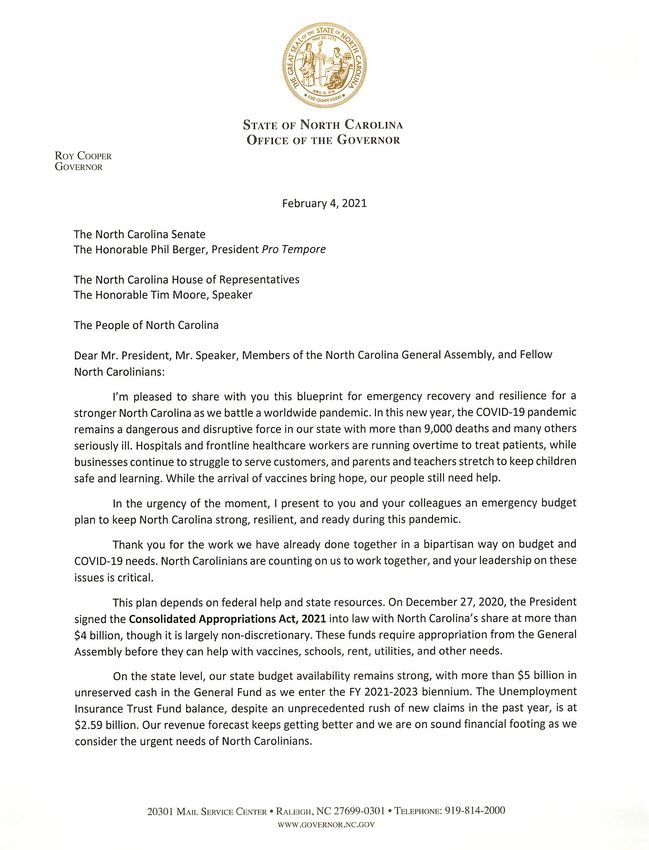
GOVERNOR’S SUPPLEMENTAL
                                 RECOMMENDATIONS
                                            2020-21

NORTH CAROLINA
Strong, Resilient, Ready
February 4, 2021
Page 2
Accordingly, I recommend that in addition to appropriating the federal stimulus funds you
appropriate $695 million from the unreserved state General Fund balance to address immediate
needs resulting from COVID-19. People need help now, and we have both the means and the power
to help them. Among the most urgent state needs are the following items:
• Continued hazard duty pay for state employees on the frontlines of COVID-19, especially law
enforcement and corrections personnel who face COVID-19 every day.
• Replenishment of the North Carolina State He�lth Plan, which has incurred significant costs
responding to COVID-19.
• Bonuses for educators and school personnel in public K-12 schools, Community Colleges and
the University System. These educators were not a part of the raises approved in the last
biennium for state employees, yet they have done extraordinary work to teach, feed and care
for students throughout this pandemic.
• Extending the reach of high-speed internet to all corners of the state and other urgent
connectivity initiatives, such as IT infrastructure, security for community colleges and
enhancement of 35,000 hotspots used for education.
• Support for small business with a particular focus on historically underutilized businesses
{HUBs), including small business counselling, marketing for tourism and hospitality,
ReTOOLNC program for HUBs, and the business loan program at Golden L.E.A.F.
• Expansion of state unemployment benefits, which are still among the lowest in the country.
Our healthy Trust Fund balance and the ongoing need of North Carolinians out of work due
to the pandemic means we can and should help now. North Carolina should increase the
maximum duration of benefits to 26 weeks-- the median amount offered nationwide--and
increase the maximum benefit from $350 to $500 per week.
These are urgent needs for North Carolinians, and together we can address them now to give
certainty to our state that we will emerge from this pandemic stronger and healthier. I ask for your
careful consideration of these recommendations and ask that we continue our productive dialogue
on these and other important needs for North Carolina.
Sincerely,
Roy Cooper
CC: The Honorable Dan Blue
The Honorable Robert ReivesConsolidated Appropriations Act, 2021
Through the Consolidated Appropriations Act, 2021, the federal government will provide more than $4
billion to North Carolina for COVID-19 response work. Like the actions in Section 4.1 of S.L. 2020-4, the
Governor recommends fully appropriating these allocations based on the amounts in the award letters.
Program NC Allocation
Education
Governor's Emergency Education Relief Fund (GEER) $42,920,546
Governor's Emergency Education Relief Fund -
Emergency Assistance to Non-Public Schools (EANS) $84,824,393
Elementary and Secondary School Emergency Relief Fund (ESSER) $1,602,590,987
Higher Education Emergency Relief Fund (HEER) 2
$287,509,335
Transportation
Highway Infrastructure $258,995,900
FTA Enhanced Mobility for Seniors with Disabilities $1,424,686
Airport Grants-in-Aid $63,938,525
Agriculture
Specialty Crop Block Grants TBD*
Farm Stress Program Block Grants $500,000
Fisheries Disaster Assistance $5,460,000
Nutrition
Supplemental Nutrition Assistance Program (SNAP) TBD*
Emergency Food Assistance Program (TEFAP) $12,813,000
Commodity Supplemental Food Program TBD*
Older Americans Act - Congregate and Home Delivered Meals $5,172,595
School Nutrition and Child and Adult Care Food Program TBD*
Health & Human Services
CDC - Vaccines $94,768,784
CDC - Testing, Tracing, and Prevention $603,677,156
Child Care and Development Block Grant $336,300,000
Head Start $6,164,684
Community Mental Health Services Block Grant $47,465,800
Substance Abuse Prevention and Treatment Block Grant $41,994,387
Housing
Emergency Rental Assistance Program $546,596,104
Total $4,043,116,882
*Final federal award amounts are still pending
1North Carolina State Budget
Governor's Supplemental Recommendations, 2020-21
Summary of Additional COVID and Other Immediate Needs
Amount
1 Continuity of Operations
2 Hazard Duty Pay/Emergency Compensation $ 50,000,000
3 Operational Needs for Fee-Supported Entities $ 10,000,000
4 Agency COVID-related Operational Needs $ 20,000,000
5 COVID-Related Expenses for State Health Plan $ 64,500,000
6 Local Government Commission Financial Assistance Program $ 1,000,000
7 Subtotal $ 145,500,000
8
9 Rebuilding and Strengthening Our People and Economy
10 Food Banks $ 10,000,000
11 Highspeed Internet Access $ 30,000,000
12 Small Business Counseling $ 3,000,000
13 Marketing (business, tourism, attractions, agriculture) $ 3,000,000
14 Golden LEAF/Rural Center Business Assistance Program $ 11,100,000
15 HUB Small Business Grants (ReTOOLNC) $ 20,000,000
16 Housing Assistance $ 4,500,000
17 Waive Annual ABC Renewal Fees (~$25m GF revenue impact)
18 Subtotal $ 81,600,000
19
20 Critical Education Services
21 Educator Bonuses $ 468,000,000
22 Teachers and Principals - $2,500
23 Noncertified Public School Employees - $1,500
24 UNC and Community Colleges - $2,000
25 Subtotal $ 468,000,000
26
27 Total $ 695,100,000
2North Carolina State Budget
Governor's Supplemental Recommendations, 2020-21 General Fund
General Fund (1XXXX)
FY 2020-21 Recommended
R Changes NR Changes Adjustments
Continuity of Operations
1 Hazard Duty Pay / Emergency Compensation
Funds the expected costs of additional Communicable Disease Emergency Pay for Department of Public Req $ - $ 50,000,000 $ 50,000,000
Safety employees who work in conditions that put them at an increased risk of exposure to COVID-19, such as Rec $ - $ - $ -
Correctional Officers and Law Enforcement Officers, through June 30, 2021. App $ - $ 50,000,000 $ 50,000,000
FTE 0.000
2 Operational Needs for Fee-Supported Entities
Provides funds to continue critical operations at agencies that traditionally receive a large portion of revenue Req $ - $ 10,000,000 $ 10,000,000
from fees. Due to the pandemic, many entities have seen a substantial decline in revenue but must continue Rec $ - $ - $ -
to deliver services and plan for activities post-pandemic. App $ - $ 10,000,000 $ 10,000,000
FTE 0.000
3 State Government Operations
Provides funds to support the continuity of operations for state agencies that are experiencing increased Req $ - $ 20,000,000 $ 20,000,000
costs due to the COVID-19 pandemic. The funds may be used for incurred COVID-19 related expenses, to Rec $ - $ - $ -
purchase needed supplies and equipment to mitigate operational disruptions, to continue providing critical App $ - $ 20,000,000 $ 20,000,000
services, and to ensure the safety of both staff and the public. FTE 0.000
4 State Health Plan COVID-19 Related Expenses
Provides funds to reimburse the State Health Plan for additional costs incurred during calendar year 2020 due Req $ - $ 64,500,000 $ 64,500,000
to the COVID-19 pandemic. Rec $ - $ - $ -
App $ - $ 64,500,000 $ 64,500,000
FTE 0.000
5 Local Government Commission Financial Assistance Program
Provides funds to the Local Government Commission (LGC) in the Department of State Treasurer. Monies Req $ - $ 1,000,000 $ 1,000,000
would be used to support essential services to local governments on the Unit Assistance List. This Fund would Rec $ - $ - $ -
only be accessed if the LGC takes action under statute to assume financial control of the government unit. App $ - $ 1,000,000 $ 1,000,000
FTE 0.000
6 Growing Rural Economies with Access to Technology (GREAT) Program Support
Replaces Coronavirus Relief Funds (CRF) appropriated for the GREAT program within the Department of Req $ - $ - $ -
Information Technology (DIT) with General Fund support by offsetting approximately $37.25 million in CRF Rec $ - $ - $ -
eligible General Fund expenditures and providing those funds to DIT. A corresponding special provision App $ - $ - $ -
provides additional details. FTE 0.000
Rebuilding and Strengthening Our People and Our Economy
7 Unemployment Insurance Benefit Changes
Extends the maximum number of weeks individuals are eligible to receive benefits from 12-20 weeks, based Req $ - $ - $ -
on the state's recent average unemployment rate, to 26 weeks and increases the maximum weekly benefit a Rec $ - $ - $ -
recipient can receive from $350 to $500 per week. App $ - $ - $ -
FTE 0.000
8 Direct Assistance to Food Banks
Provides funds to the Department of Agriculture and Consumer Services to provide direct aid to NC Food Req $ - $ 10,000,000 $ 10,000,000
Banks experiencing an increase in demand due to the COVID-19 pandemic. Rec $ - $ - $ -
App $ - $ 10,000,000 $ 10,000,000
FTE 0.000
9 Highspeed Internet Access & Educational Opportunities
Provides funds for a multi-pronged approach to enhance community and student access to highspeed Req $ - $ 30,000,000 $ 30,000,000
internet. Projects include but are not limited to IT infrastructure and network security improvements for 20 Rec $ - $ - $ -
community colleges, the replacement of approximately 35,000 internet hotspots currently servicing NC App $ - $ 30,000,000 $ 30,000,000
students, aid to State libraries serving as critical connectivity access points, tower infrastructure, equipment FTE 0.000
for indigent communities, virtual and in-person community training, and student, parent and educator
participation support.
10 Small Business Counseling
Provides funding for counseling services provided through Small Business Centers within the NC Community Req $ - $ 3,000,000 $ 3,000,000
College System, Small Business and Technology Development Centers within the University System, and Rec $ - $ - $ -
Business Link North Carolina within the Economic Development Partnership of North Carolina. App $ - $ 3,000,000 $ 3,000,000
FTE 0.000
3North Carolina State Budget
Governor's Supplemental Recommendations, 2020-21 General Fund
R Changes NR Changes Adjustments
11 Statewide Marketing to Aid in Pandemic Recovery
Provides funds to market North Carolina to assist in post-pandemic recovery. Funds would be used to market Req $ - $ 3,000,000 $ 3,000,000
North Carolina as a business and tourism destination as well as to market North Carolina's agricultural Rec $ - $ - $ -
products and state-owned attractions. App $ - $ 3,000,000 $ 3,000,000
FTE 0.000
12 ReTOOLNC Program
Assists the economic recovery of state-certified minority and women-owned businesses by funding the Req $ - $ 20,000,000 $ 20,000,000
ReTOOLNC program administered by the Office for Historically Underutilized Businesses, in partnership with Rec $ - $ - $ -
the Carolina Small Business Development Fund and The Institute. App $ - $ 20,000,000 $ 20,000,000
FTE 0.000
13 Golden LEAF/Rural Center Business Assistance Program
Provides funding to businesses that qualified and were awarded loans via the Rapid Recovery Loan program. Req $ - $ 11,100,000 $ 11,100,000
Rec $ - $ - $ -
App $ - $ 11,100,000 $ 11,100,000
FTE 0.000
14 Alcoholic Beverage Control Permits
Waives Alcoholic Beverage Control permit fees, including permit renewal from May 2021 through April 2022 Req $ - $ - $ -
and new and temporary permits from March 2021 through June 2022. This waiver will provide relief to small Rec $ - $ - $ -
businesses in the restaurant and hospitality industries, which have struggled during the pandemic. Waiving App $ - $ - $ -
these fees would reduce General Fund nontax revenue collections by approximately $22 million in FY 2020- FTE 0.000
21, $3 million in FY 2021-22, and $0.5 million in FY 2022-23.
15 Housing Legal Services Support
Provides funding to support housing-related legal services through NCPRO and the Office of Administrative Req $ - $ 4,500,000 $ 4,500,000
Hearings. Funds would be used to provide grants and to establish temporary positions for needed Fair Rec $ - $ - $ -
Housing support to renters and homeowners who are experiencing hardship and risk eviction or foreclosure App $ - $ 4,500,000 $ 4,500,000
due to the pandemic. Fair Housing Discrimination case filings have increased 10% during COVID relative to FTE 0.000
filings in 2019, and OAH anticipates a further 25% increase in case filings once the current moratorium on
evictions expires.
Critical Education Services
16 Teacher, Instructional Support, and School-based Administrator Bonuses
Provides a one-time $2,500 bonus to teachers, including state agency teachers, instructional support Req $ - $ 280,000,000 $ 280,000,000
personnel, principals and assistant principals employed on February 1, 2021. These employees did not receive Rec $ - $ - $ -
increases, other than a step increase, in FY 2019-20 and FY 2020-21. The bonus shall be paid in April 2021 and App $ - $ 280,000,000 $ 280,000,000
shall not be considered compensation for retirement purposes. FTE 0.000
17 Noncertified Local Education Agency Employee Bonuses
Provides a one-time $1,500 bonus to non-certified school personnel employed on February 1, 2021. Req $ - $ 77,000,000 $ 77,000,000
Noncertified school personnel did not receive an increase in FY 2019-20 or FY 2020-21. The bonus shall be Rec $ - $ - $ -
paid in April 2021 and shall not be considered compensation for retirement purposes. App $ - $ 77,000,000 $ 77,000,000
FTE 0.000
18 UNC and NC Community College System Bonuses
Provides a one-time $2,000 bonus to NC Community College and UNC System personnel employed on Req $ - $ 111,000,000 $ 111,000,000
February 1, 2021. Community College and UNC System personnel did not receive an increase in FY 2019-20 or Rec $ - $ - $ -
FY 2020-21. The bonus shall be paid in April 2021 and shall not be considered compensation for retirement App $ - $ 111,000,000 $ 111,000,000
purposes. FTE 0.000
Total Change to Requirements $ - $ 695,100,000 $ 695,100,000
Total Change to Receipts $ - $ - $ -
Total Change to Net Appropriation $ - $ 695,100,000 $ 695,100,000
Total Change to Full-Time Equivalent (FTE) 0.000
Recommended Net Appropriation Changes (Recurring + Nonrecurring) $ 695,100,000
Recommended Total FTE Changes 0.000
4COVID Package Provisions
1. Appropriate New Federal Funds
Appropriate all funds received from federal grants authorized under the Consolidated
Appropriations Act, 2021 in the amounts provided in the notification of award.
The following list includes estimates of North Carolina’s allocations from the Consolidated
Appropriations Act, 2021 and are illustrative of funds the state expects to receive:
Governor's Emergency Education Relief Fund (GEER II) $42,920,546
Governor's Emergency Education Relief Fund - Emergency Assistance to
$84,824,393
Non-Public Schools (EANS)
Elementary and Secondary School Emergency Relief Fund (ESSER) $1,602,590,987
Higher Education Emergency Relief Fund (HEER) $287,509,335
Highway Infrastructure $258,995,900
FTA Enhanced Mobility for Seniors with Disabilities $1,424,686
Airport Grants-in-Aid $63,938,525
Specialty Crop Block Grants TBD
Farm Stress Program Block Grants $500,000
Fisheries Disaster Assistance $5,460,000
Supplemental Nutrition Assistance Program (SNAP) TBD
Emergency Food Assistance Program (TEFAP) $12,813,000
Commodity Supplemental Food Program TBD
Older Americans Act - Congregate and Home Delivered Meals $5,172,595
School Nutrition and Child and Adult Care Food Program TBD
CDC - Vaccines $94,768,784
CDC - Testing, Tracing, and Prevention $603,677,156
Child Care and Development Block Grant $336,300,000
Head Start $6,164,684
Community Mental Health Services Block Grant $47,465,800
Substance Abuse Prevention and Treatment Block Grant $41,994,387
Emergency Rental Assistance Program $546,597,070
52. Retain NC Pandemic Recovery Office
Amend S.L. 2020-4, Sec. 4.3 to strike the final sentence of this provision to authorize the NC
Pandemic Recovery Office to continue through the duration of the pandemic and use of COVID-
19-related federal funding.
3. Align CRF Expenditure Deadlines with the Consolidated Appropriations Act, 2021
Amend S.L. 2020-4 as amended to align any deadlines for CRF expenditures or eligible
expenditure periods to conform with new deadline of December 31, 2021.
4. Extend Emergency Procurement Authority
Amend S.L. 2020-97, Sec. 1.7.(b) to extend emergency procurement authority provided in Sec.
1.7.(a) from December 30, 2020, to December 31, 2021.
5. Extend Deadline for $645.4m Offset of General Fund
Amend S.L. 2020-64, Sec. 8(d) to extend the deadline for OSBM to complete the $645.4m
General Fund offset from Dec. 30, 2020 to June 30, 2021.
6. Adjust Due Date for OSBM Report on Use of Funds
Amend S.L. 2020-4, Sec. 1.7 as amended by S.L. 2020-80 to extend reporting date from April 1,
2021 to April 1, 2022.
7. Replace Coronavirus Relief Funds Appropriated for the GREAT Program with
General Fund
Direct OSBM to offset $37,250,000 of the $39,000,000 in Coronavirus Relief Funds appropriated
to the Department of Information Technology for the GREAT program with General Fund
appropriation on or before June 30, 2021. The Department estimates this portion of the funds
cannot be utilized on GREAT program grants by the CRF deadline of December 31, 2021.
8. Extend Medicaid Provider Rate Increases
Amend SL 2020-4, Section 4.6 to provide DHHS authority to extend fee-for-service Medicaid
provider rate increases to June 30, 2021.
6Enhance Unemployment Insurance Benefits
Policy Recommendation
• Increase the maximum duration of state unemployment insurance (UI) benefits to 26 weeks for new claims
filed after November 28, 2020 [estimated state cost: $340-$400 million through 2023];
• Increase the maximum weekly benefit amount to $500 for new claimants after February 20, 2021
[estimated state cost: $180-$220 million through 2023]; and
• Change the Trust Fund balance calculation to accelerate the decrease in the base tax rate to 1.9% in 2022. 1
The recommendation above balances maximum use of federal funds for UI benefits while preventing the
maximum duration of total benefits from falling below 20 weeks for UI-eligible workers. Increasing the
maximum duration for workers laid off in the final weeks of 2020 would displace an estimated $10-$15 million in
federal funding with state funding, but it would ensure that eligible workers can claim at least 20 weeks of state
and federal UI benefits. This proposal provides greater equity between North Carolinians laid off in March and
April of 2020, most of whom are eligible for up to 50 weeks of state and federally funded UI benefits, and those
laid off later, for whom the maximum benefit duration under current law decreases gradually to 15-16 weeks for
those laid off on or after the week ending on December 19, 2020. 2
Increasing the maximum weekly benefit for new claimants, rather than new and current claimants, would
simplify administration of the benefit calculation. Current claimants when this policy is implemented would
receive $300 federal supplemental payments for at least some of their period of UI eligibility.
Trust Fund Impact
The state UI base tax rate
increased from 1.9% in 2020 to
2.4% in 2021 due to the state’s
UI Trust Fund falling slightly
below 1.25% of annual wage
and salary earnings as of
September 1, 2020. Under
current law, the base rate may
fall back to 1.9% in 2022,
depending on wage growth in
the state, UI tax collections,
and state spending on UI
benefits. The costs from this
proposal increase the risk the
base tax rate would not fall to
1.9% until 2023 or later. To address this potential concern, this recommendation proposes changing the trust-
fund balance calculation to use total wages of taxable employers (instead of all covered employers) to
accelerate the fall in the base tax rate to 1.9%.
1
Estimates are preliminary, assume gradual recovery in state labor market, and will vary with revisions to the economic
outlook and as additional UI data becomes available.
2
The maximum duration of state benefits increased from 12 weeks for workers laid off in 2020 to 16 weeks for workers laid
off on or after January 3, 2021.
7Small Business Relief: Waiving ABC Permit Fees
To sell alcohol in North Carolina, a vendor must possess a permit from the North Carolina Alcoholic
Beverage Control Commission (ABC Commission).
Proposal
Waive the fee associated with ABC permit required to sell alcohol in North Carolina to provide relief to
small businesses that hold these permits and have struggled during the pandemic.
Estimated Fiscal Impact
Permit fee revenue is remitted to the General Fund as nontax revenue and does not fund the ABC
commission (G.S. § 18B-902(g)). Waiving these fees will result in a loss of this revenue for the General
Fund over the next several fiscal years as follows:
Estimated Loss of
Fiscal Year General Fund Revenue
FY 2020-21 $22 million
FY 2021-22 $3 million
FY 2022-23 $0.5 million
The waiver would have no expected impact on the operations of the ABC Commission or ABC
Warehouse; operations are funded through surcharges added to the sale of liquor.
Background
Most ABC permits are valid for one year—May 1 to April 30 (G.S. § 18B-903(a)). However, businesses
may acquire a temporary or one-time permit for singular events like weddings, fundraisers, etc. Permit
fees can be as low as $50 (limited special occasion permit) and as high as $1,000 (mixed beverages
permit). Most permit fees fall in the range of $100 to $400 (G.S. § 18B-902(d)).
The ABC Commission collects these permit fees and remits this revenue to the General Fund as nontax
revenue (G.S. § 18B-902(g)). The following table shows the total revenue deposited into the General
Fund for the past five years:
General Fund
Nontax Revenue FY 15-16 FY 16-17 FY 17-18 FY 18-19 FY 19-20
ABC Permits $24,025,000 $24,682,000 $25,829,000 $26,524,000 $23,157,000
Source: North Carolina Comprehensive Annual Financial Report for the Fiscal Year Ended June 30, 2020.
https://www.osc.nc.gov/public-information/2020-cafr.
Waiving the ABC permit fees for the next permit cycle—May 1, 2021 to April 30, 2022—will provide
relief to many small businesses that have remained closed, experienced reduced hours, or served fewer
customers during the pandemic.
8You can also read


