NORTHERN COMMUNICATIONS AND INFORMATION SYSTEMS WORKING GROUP - NBDC ICT Summit - Iqaluit NU!
←
→
Page content transcription
If your browser does not render page correctly, please read the page content below
NORTHERN COMMUNICATIONS AND
INFORMATION SYSTEMS WORKING GROUP

     NBDC ICT Summit - Iqaluit NU!

                            31 October 2012!
Northern Communications and
Information Systems Working Group

• Sub-committee to the Arctic Security Working Group !

• Pan-territorial, federal and territorial level
  departments and agencies !

• First meeting in Yellowknife NT, 26 – 27 January
  2010!

• First meeting - 34 federal reps and 1 territorial rep
  attending!

• Whitehorse meeting – 20 federal reps and 17
  territorial reps attending!

Executive Committee

•   Ms Lisa Badenhorst, GY, Co-Chair!
•   Mr Dilprit Shergill, PS, Co-Chair!
•   Mr Michael Corbett, CANNOR!
•   Maj Tom Bachelder, DND, JTF(N)!
•   Brad Herriot, GNWT!
•   Mr Jeff Bisson, GNU!

Membership

•   Canadian Northern Economic Development Agency !
•   Canadian Space Agency!
•   Communication Research Centre Canada!
•   DND/CF – ADM(IM) J6 Coord!
•   DND/CF – Combined Joint Operations Command!
•   DND/CF – DAEPM R&CS!
•   Environment Canada!
•   GNWT CSO, MACA, HR, ENR, TSC (PWS), Dept of Fin, DOT!
•   GNU CGS, Education, CGS!
•   GY Wildland Fire, Prot Svcs, HPW, Education, Env!
•   Shared Services Canada!
•   Aboriginal Advisors and Northern Development Canada NWT, NU!
•   Industry Canada!
•   Justice Canada!
•   Public Safety Canada!
•   Public Works Government Services Canada !
•   Royal Canadian Mounted Police!
•   Canadian Radio-television and Telecommunications Commission!
•   Aurora College !
Purpose

• To develop an overall understanding of
  communication capabilities in the north!
• Identify what assets that are available to all
  concerned parties!
• Identification of communication deficiencies
  and redundancies affecting individual
  departments or everyone!
• Provide a forum for mutual discussion and
  development in the field of communications. !

Vision

The NCIS WG exists to create better
and more robust communications
capabilities in the North!
Arctic Communications
Infrastructure Assessment
Why an Assessment?!
§ 2009 Exercise
Operation Nanook!
Who was Behind the
Assessment?!
§ ASWG à NCIS WG!
§ www.aciareport.ca !Objectives of the ACIA • A. Identify and Map Current Infrastructure! • B. Identify Future Requirements! • C. Conduct a Fit/Gap Analysis! • D. Assess Community Development Implications!
The Report Contents (2011)
• A. Current State!
§ Chapter 3: Government Needs Today!
§ Chapter 4: Technical State Today!
§ Chapter 5: Issues Today!
• B. Future State (3-5 years)!
§ Chapter 6: Government Future Needs!
§ Chapter 7: Future Technical Capacity!
• C. Community and Economic Development Implications!
§ Chapter 8: Insights into the Economics of ‘Broadband’!
• D. Fit/Gap Analysis and Strategy Forward!
§ Chapter 9: Addressing the Issues: Recommendations!
§ Chapter 10: Strategy for Moving Forward!Government Needs – Chapter 3
• AANDC’s services include
economic development
initiatives, land management,
and administering funding
programs to name a few.!
• Service Canada deliver direct
! federal services such as
supporting Canadians in
retraining, family support
programs, employment
programs, retirement programs
such as Canada Pension,
supporting Service Canada
activities etc.!Government Needs – Chapter 3
• All officers require 99.9%
reliable communications
capability into and out of every
Arctic community no matter
how small!
• CBSA requires constant
! connectivity from remote
border locations in order to
conduct critical queries on
travelers entering Canada,
requiring robust networks that
can communicate with
southern servers.!Government Needs – Chapter 3
• Public Safety concerns itself with ensuring
emergency response organizations located
throughout the territories are properly connected,
and that systems used can interoperate with each
other in the field in the event of an emergency.!
• JTFN requires robust connectivity to DND
headquarters in the south, similar to any other
federal government office located in the north.
DND has many initiatives and responsibilities that
require advanced communication services in
locations outside of communities. DND connects
various remote Arctic military sites to DND
headquarters, participates in search and rescue,
and are responsible for sovereignty up to the North
Pole.!Government Needs – Chapter 3
• Canadian Coast • Parks Canada!
Guard! • Natural Resources
• Environment Canada!
Canada! • Nav Canada!
• Polar Continental • Justice Canada!
Shelf Researchers! • Corrections Service
Canada!Nunavut Government
• More than any other territorial • Clearly, connectivity to meet
jurisdiction, Nunavut’s government’s ability to operate
government relies on a robust effectively is a top priority to
communication infrastructure in carry out the internal work of
order to operate efficiently.! government, due to the
decentralized nature of the
• Of the 3,800 government government offices.!
employees, 1,500 work in
Iqaluit. The 10 decentralized • The need is great for
communities - those with communication services in
government offices - all have at Nunavut to support government
least 100 government positions, delivery of services to the public
with Rankin Inlet having over as well -- whether they live in a
400.! ‘decentralized’ community or
not.!Nunavut Government Challenges
• Educators need distance education tools. Human resources requires intelligent systems for
managing human resources. Every department wants to make use of videoconferencing to
reduce costs and improve access to services. But currently most of these initiatives are not
yet implemented. The good news is, that all 25 communities face essentially the same basic
infrastructure challenges, since all are served by satellite. This means that when planning
service delivery, Nunavut can choose systems that if they work in Arviat, they can be made
to work in Grise Fiord.!
• The bad news is, that due to their infrastructure challenges and overall youth of their
government, they have not yet been able to take advantage of many of the digital services
being developed in the NWT and Yukon yet.!Nunavut Government Challenges
• Nunavut also has the added challenge that the majority of people speak Inuktitut
as their first language, with a significant portion of the population unilingual
Inuktitut speakers.!
• All public services must be available in Inuktitut and English, and are also often
offered in Inuinaqtun and French which are also official languages in Nunavut. In
addition, Inuktitut in the Kivalliq and Baffin region use a syllabic font, (not roman
orthographic that is universally recognized by computers) requiring all software
to recognize unicode in order for Inuktitut to be sorted and displayed properly
over digital communication tools. The need for using a syllabic writing system
adds another level of complexity when managing databases in Inuktitut and
communicating over the Internet.!Issues Today (2011)
Chapter 5Issues Today (2011)
Chapter 5
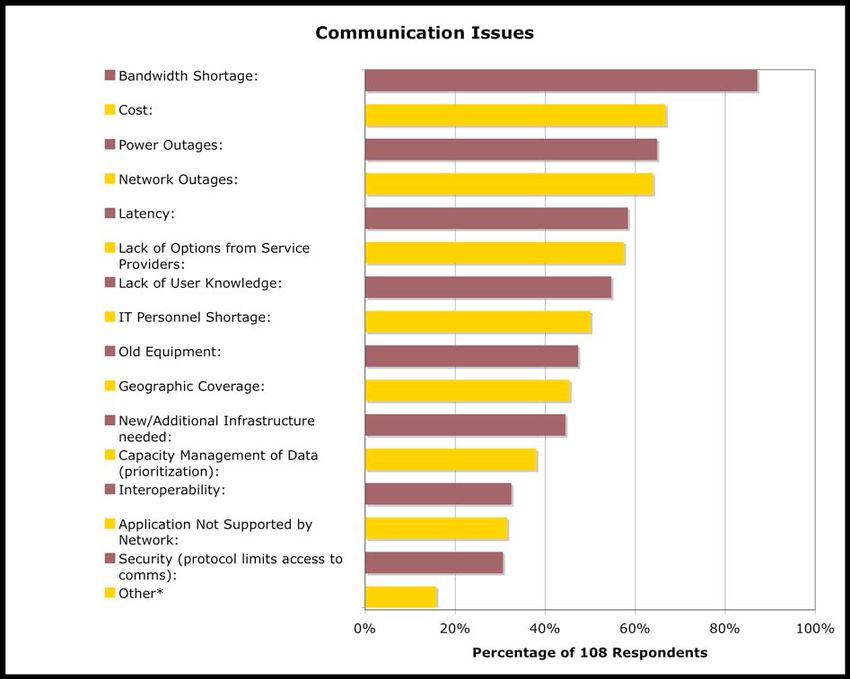
• 1. No service parity within Arctic, or between North and South!
• 2. Affordable bandwidth shortage and latency!
• 3. High costs to end user!
• 4. Reliability, network outage problems!
• 5. Geographic coverage between communities inadequate!
• 6. Emergency response challenges!
• 7. Rapid pace of technological change leaves Arctic scrambling
to catch up!
• 8. Lack of choice, procurement challenges, regulatory system
challenges!
• 9. Human resource shortage!Recommendation # 1
• Establish Minimum Standards/Service Parity!
§ To: Federal and territorial policy makers !
§ Commit to service parity among Arctic communities, and set minimum
connectivity standards for all Arctic communities that assure service parity to
southern urban centres.!
• SSI agrees with the overall intent of the recommendation. Where technically possible, every
community (and user) in the Arctic should have similar access compared to the other Arctic
communities – SSI Micro RFP Response!
• ICE is committed to service parity for Arctic communities and service parity to southern urban
centres to the extent technologically feasible. – ICE RFP Response!
!
• Northwestel believes the evidence is clear that service parity has positive impacts on social
well-being and economic development. – Nwtel RFP response!
• There is sufficient satellite capacity in-orbit and in operation today to provide comparable
services to what Canadians enjoy in Southern Canada, a satellite solution will provide parity
amongst all Northern Communities immediately – Telesat RFP Response!
• In the remaining unfibred communities Arctic Fibre believes that sufficient bandwidth can be
procured from existing satellite feeds to bring them to a standard of 1.5 mbps (down) 0.5 mbps
(back) to enable residents of such communities to upload and download video applications and
most software applications without inconvenience.– Arctic Fibre RFP Response!Recommendation #2
• Develop Arctic Specific Communications Strategy!
§ To: Infrastructure investors, the CRTC, federal and territorial policy makers !
§ Develop an Arctic-specific strategy with clearly defined rules, that articulates
a sustained, multi-year funding commitment for communications network
development to meet connectivity standards set by policy makers. !
• SSi agrees with this recommendation as it reflects the fact that conditions in the Arctic are unique
(compared to the south) and that funding must be sustained and multi-year to ensure commitment by some
suppliers. The most important suggestion we can make is to involve the various suppliers and the potential
users as early and as often as possible. – SSi Micro RFP response!
• Propose multi-year funding commitment of at least a decade to maintain stability and certainty - a specific
program for the North. Propose a PPP approach to funding: Public Federal and Territorial Governments +
Private Investors in partnership with the community stakeholders – Telesat RFP Response!
• Northwestel supports the idea of creating clear rules that set out a sustained, multi-year funding
commitment to achieve set connectivity standards. We believe this could be implemented in a way that will
meet the bandwidth needs of customers and reduce costs to end users. – Nwtel RFP Response!
• We are now undertaking a multi-year funding commitment for communications network development and
are prepared to work with policy makers to meet connectivity standards. –ICE RFP Response!Recommendation # 3
• Ensure Redundancy/Continuity of Service!
§ To: Policy makers, service providers, and NCIS-WG members!
§ Ensure there is a redundant connection into every Arctic community to
avoid gaps in the provision of essential communication services. !
• To achieve higher levels of redundancy, an entirely different physical route is recommended to avoid the
impacts of large scale events such as forest fires, earthquakes or other disasters. The technology exists to
achieve this recommendation. – Nwtel RFP Response!
• Telesat has already begun to work with Northern governments and service providers to install earth stations
providing access to Anik F3 by mid-2013 ($6M investment – privately funded and is above the $10M
commitment associated with Telesat’s Northern Arctic Initiative proposal) - Telesat RFP response!
• SSi recommends a separate independent study on this specific recommendation to create an Arctic
Communications Redundancy Plan that can be implemented over time by the suppliers and the users.
– SSI Micro RFP Response!
• In many communities the existence of ICE as a competitive supplier provides important redundancy
components.ICE rerouted its traffic over satellite through SSI Micro’s Telesat connection and provided
service to ICE cell phone customers during the two days of the outage. – ICE RFP Response!Recommendation # 4
• Create ‘on the land’ connection project Inventory!
§ To: NCIS-WG members and service providers!
!
§ Create an inventory of Arctic communications technology projects and
services that aim to connect people from remote locations outside of
communities in order to share experiences, best practices, and lessons
learned. !
• We also support the idea of people coming together (physically or virtually) to share ideas about the best
way to solve communications challenges in remote areas. As an organization, we already attend the NCIS-
WG and regularly attend industry conferences to share knowledge. We have hosted northern specific
events such as Talking IT and other networking events for interested parties to come together to discuss
approaches to solving communication challenges in The North. – Nwtel RFP Response!
• Telesat proposes a sub-working group of NCIS be formed to track the best practices. Shared video
conference facility could be implemented to facilitate communications between communities. - Telesat RFP
Response
• ICE is prepared to contribute information on its technology and services to an inventory. In our view, this
inventory should be undertaken by a government agency that is neutral among competitors. The
companies can then participate as part of a marketing and education function. - ICE RFP ResponseRecommendation # 5
• Establish Surge Capacity Protocols with Service Providers!
§ To: NCIS-WG members and service providers!
!
§ Identify communication services that will be required in a variety of emergency
settings, developing protocols with service providers for surge capacity requests
and prioritization of public communications networks for emergency responders
within communities. Maintain an inventory of what is commercially available in
communities.!
• SSi agrees with this recommendation. We recommend that a separate activity be initiated to identify a few,
expected emergency situations. Based on those agreed scenarios, the primary network operators should be
asked to review the scenarios and together with government staff, propose and document emergency protocols
that fit the scenarios. Where possible the emergency protocols should be shared between the primary suppliers
so that emergencies that involve only one supplier can be meshed properly with the services of other available
suppliers. - SSI Micro RFP Response!
• ICE is prepared to support a government agency that is neutral among competitors in developing protocols with
other service providers for emergency situation including dealing with surge capacity requests and prioritization
for emergency responders and to contribute to the inventory. - ICE RFP Response!
• Northwestel believes that these requirements can be met and supports the concept of working with various
agencies to establish services, protocols and priorities that would go into effect in the event of an emergency.
– Nwtel RFP Response!Recommendation # 6
• Investment plans to Recognize rate of Technological change!
§ To: CRTC, infrastructure investors, federal and territorial policy makers!
!
§ Investment strategies for Arctic communication networks must include
provisions for the increasing rate of change of technology, and the
continuous introduction of new consumer services and devices. !
• SSi believes that the convergence of data and voice networks, the availability of Internet Protocol (IP) standards
and equipment and the use of consumer devices that have both voice and data functions will escalate. We believe
that the Arctic must stay abreast of these advances in order to maximize the delivery of applications and services
that are fast becoming available (health, education, communications) due to the lower cost of these new access
technologies. Policy and planning roles in the governmental and regulatory organizations should encourage this
convergence and should ensure that any barriers to launching the converging services are removed.– SSI Micro
RFP Response
• ICE strongly supports this recommendation. A competitive environment will help increase the rate of
change of technology, the continuous introduction of new consumer services and devices as well as create
market pressure to contain pricing and enhance customer service. - ICE RFP Response!
• Telesat in a Public/Private Partnership is prepared to make $40M contribution towards modernizing and
expanding the Northern networks – Telesat RFP ResponseRecommendation # 7
• Encourage Competition!
§ To: Policy makers, CRTC, service providers!
!
§ Investment models should allow for, and encourage competing services in as
many market segments as possible, thereby promoting consumer and
government choice, and innovation and improved services. !
• PPP model is essential for deployment of state of the art infrastructure and services. Reliance on standards-
based technology, competitive procurement processes will drive competition and innovation in the Northern
markets. – Telesat RFP Response
• we would like to underline that a critical component of developing these investment models is to create funding
mechanisms and project structures that allow for competitive interconnection under equitable terms and
conditions, including pricing. – ICE RFP Response!
• SSi is certainly interested in providing new services into communities now served by fibre and microwave facilities
provided that the backbone prices are competitive and that SSi can compete on an equitable basis with the incumbent
monopoly Northwestel. – SSI Micro RFP Response
• We support consumer choice and innovation from various players in the market...Co-opetition is a phrase coined
to describe markets that are based on a combination of cooperation and competition. This comes from an
understanding that business competitors can create more value when they work together on some aspects of
business while competing on others. –Nwtel RFP Response !Recommendation #8
• Issue Technology Neutral RFPs!
§ To: Procurement officers, service providers!
!
§ Government procurement officers are to encourage innovation through
RFPs that focus on business outcomes requirements and technology
neutral RFPs to stimulate innovative solutions from service providers. !
• Northwestel agrees that Government RFPs should focus on business outcomes and not delivering any
specific technology architecture. RFPs are a critical part of evaluating suppliers and ensuring a fair
selection process. Northwestel supports a balanced approach to RFP development, which addresses
issues of innovation but also includes elements such as evaluating the approach to engagement
management, customer references, depth of resources, past experience, and alliances. - Nwtel RFP
Response!
• RFP’s that focus on business outcomes requirements and are technology neutral will help to avoid making
assumptions about what is available or possible and will help to stimulate innovative solutions. – ICE RFP
Response!
• SSi agrees that RFPs should ideally describe the requirements while leaving it to the marketplace to assess
and propose the exact technology that may meet the requirements. RFPs that focus on the technology tend
to describe older, existing services and perhaps may exclude newer and more effective services. – SSI
Micro RFP Response!Recommendation # 9
• Design for Community Human Resource Capacity!
§ To: NCIS-WG members, IT developers, all government departments !
!
§ Recognize the reality of community capacity, and design applications and
networks that will allow for effective remote service delivery. !
• SSi’s community based equipment resides in specially designed communications shelters
containing all the necessary backup equipment to minimize failures and prolonged outages.
– SSI Micro RFP Response!
• Our organization has extensive experience in keeping applications running across The
North and the challenges created by the uneven distribution of skilled technical personnel
across various geographic locations. – Nwtel RFP Response !
• ICE supports this recommendation. We have been doing this successfully in our existing
service areas and plan to expand both the types of services we provide and the number of
communities we serve. – ICE Wireless RFP Response!Recommendation # 10
• Use ICT Networks to Deliver Training!
§ To: NCIS-WG members, IT developers, all government departments !
!
§ Take advantage of robust networks to deliver training to government
workers using new communication tools. !
• Training to government workers through the use of interactive technologies and high-
definition videoconferencing is readily available and cost effective. Telesat RFP Response!
• Northwestel provides some of the tools to implement remote training and education
programs, such as voice and video conferencing services, online collaborative and sharing
tools, and various hosting services. – Nwtel RFP Response!
• SSi offers specialized consumer-like services that are ideal for training of workers as well as
general use in connecting with people whether they are students, workers or the general
public. – SSI Micro RFP Response!You can also read


