NOTRE DAME'S JORDAN HALL OF SCIENCE
←
→
Page content transcription
If your browser does not render page correctly, please read the page content below
W H AT W O R K S S T O R I E S F R O M T H E C O M M U N I T Y
NOTRE DAME’S JORDAN HALL OF SCIENCE
“What will the science of future be like?” This was one of the questions driving the
planning of Jordan Hall of Science, the new facility for undergraduate science in
biology, chemistry and physics at Notre Dame. Their recognition that “...imaging Dennis C. Jacobs
was becoming important in all of the sciences, that new technologies were making Vice President
it possible to image everything from individual atoms to galaxies...” gave faculty Associate Provost
a metaphor for their planning, one that influenced how they designed and University of Notre Dame
equipped classrooms, hallways, laboratories, and Jordan’s digital visualization
Jeanne L. Narum
theatre. But those planning these spaces also asked, “How do the students of
Director
today learn?” Their answers to that question are visible throughout— from the
Project Kaleidoscope
design of the large-enrollment classrooms to that of the lounges.
Jeanne L. Narum: You served in the role of what PKAL calls the “project
shepherd” in the process of shaping the new spaces at Notre Dame— Jordan
Hall, which serves undergraduate programs in chemistry, physics, and biology.
As you know, the PKAL planning premise starts with an understanding of how
and what the students are to learn in the spaces to be realized. Tell us something
about what happens in your classrooms.
Dennis C. Jacobs: I’ve been teaching chemistry at the University of Notre
Dame for eighteen years. My area of specialty in physical chemistry involves
looking at how reactions occur on surfaces. Right now, for example, we have
experiments flying on the international space station to understand how
materials erode in that environment.
In addition to my research, I really enjoy teaching— that’s why I became a
faculty member. I treasure that undergraduate education is very important
to Notre Dame and that our students are committed to learning. This is a
wonderful environment in which to work.
After seven years here, I began teaching general chemistry. Like at many
research universities, this is a large enrollment class, with sections of about
250 students each. This was the most challenging teaching environment I have
experienced, and it wasn’t until I began teaching gen chem that I realized the
deficiencies in the way I was teaching.
To that point, I had always judged my performance in the classroom by asking
myself, “Did I get it right? Was I accurate in what I was trying to express in
terms of content? Did I answer questions clearly?” If I could answer ‘yes’ to all of
those questions, I would pat myself on the back and say, “That was a good class.”
But, once I began teaching first-year students, I recognized many were having
a very tough transition from high school to college. Notre Dame’s demands
and expectations for their performance were very different from what they
had experienced in high school, where memorization and regurgitation of
information seemed to be adequate.
X
Volume IV: What works, what matters, what lasts 1
© Copyright 2007 - Project Kaleidoscope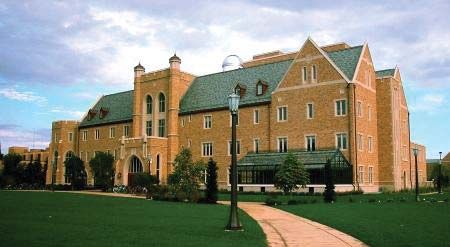
W H AT W O R K S S T O R I E S F R O M T H E C O M M U N I T Y
NOTRE DAME’S JORDAN HALL OF SCIENCE
Where, when asked to figure out To simultaneously engage all 250 In these two lecture halls, the floor is
problems, they had only to memorize students in the process, I began gradually sloped, with only five levels
and reproduce algorithms, recipes, using wireless clickers, á la Eric of seating, and just two rows of tables
procedures. What we were doing here Mazur. These alternative approaches and chairs on each level.
at Notre Dame was challenging these transformed both the way I teach and
first-year students to think through the way I use learning spaces. Although the tables are built-in, it is
new systems and applications, to easy for students in each odd row to
apply concepts in ways that were very Narum: So when the planning turn and interact with students in the
foreign to them. team was thinking about what kind even row behind them on the same
of learning was to happen inside level; teams of two or four can be
So, in their first six weeks of the your new spaces, were you alone in formed very easily.
first semester of college an alarming thinking about these new ways of
number of students were failing or teaching? Were others comfortable Narum: Chairs on wheels?
dropping out of my gen chem course. with staying in theater-style, faculty- Jacobs: Yes, all chairs are on wheels.
As my office hours seemed to be filled centered teaching spaces? If you remember how I integrate
with students who were struggling, demonstrations into my teaching— as
I felt that there was something that do many of my colleagues, we wanted
these students were not doing. to make certain that these lecture
Soon, however, I realized I was not halls supported demonstrations.
helping them make the transition into So, the lecture halls are well-equipped
a different mind-set about learning with full glass fume hoods, but the
science, and thus began rethinking most important thing to mention
how I teach. The challenge was is the integrated system of cameras
how to change my style of teaching and projection screens that allow
in a space that was constrained, for different types of imaging and
with theater-seating, when I was projection simultaneously— with
trying to get students to think about three independent large projection
and apply what they are learning, screens on the front end of the room,
receive accurate feedback, and have Jacobs: No, there was actually a we can be projecting live demos,
opportunities to discuss, voice their great deal of support across all the images from PowerPoint, and 2-D
ideas, conceptions, misconceptions, departments involved. Cooperative or 3-D objects through a document
etc. learning had spread to other camera, all at the same time.
classes in chemistry; the physics
So I went in a few different directions. department adapted it extensively for In summary, the faculty recognized
One is to make the course more their introductory physics courses; the value of different pedagogical
interactive— using a lot of concept Biological Sciences is using the approaches and wanted to ensure
questions in class, building those clickers in the teaching of genetics. that the space was flexible enough
around demonstrations so that to support a wide variety of teaching
students are challenged to apply the We all agreed that our plans for the and learning styles within our large
concepts we have learned in order two 250-student capacity lecture enrollment courses.
to make accurate predictions about halls in Jordan would have to
what will occur in experimental support various cooperative learning Narum: What other kinds of
demonstrations. approaches. pedagogies are you and your
colleagues experimenting with?
X
2 Volume IV: What works, what matters, what lasts
© Copyright 2007 - Project Kaleidoscope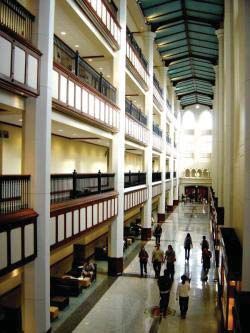
W H AT W O R K S S T O R I E S F R O M T H E C O M M U N I T Y
NOTRE DAME’S JORDAN HALL OF SCIENCE
Jacobs: There are lots of different Construction lasted approximately 2½ It is an all digital system built around
types of experimentation in all years. We moved into the building in a pair of Sony SRX-S110 projectors,
departments: guided inquiry; Just- summer 2006 and were ready for the a new level of very sharp, very
in-time Teaching; etc. This diversity first day of classes on August 22, 2006. bright projectors used in IMAX
of approaches is good, and Notre theaters, combined with a new lens
Dame has a Center for Teaching Narum: What questions did you system to project the two images
and Learning that helps facilitate ask about how science is changing, seamlessly onto the 50-foot diameter
conversations and communications how did you bring the future into the dome. Notre Dame has the first full
around different modes of teaching. present planning? installation of this technology in the
This is a very supportive place for a Jacobs: Through all our planning United States.
variety of modes of teaching. conversations, we began to recognize
Narum: Talk to me about the that imaging was becoming important
planning process. across all the sciences, that new
technologies were making it possible
Jacobs: The departments of physics, to image everything from individual
biological sciences, and chemistry/ atoms to galaxies.
biochemistry each contributed three
or four faculty to an advisory group, All of us— chemists, biologists and
which also included a representative physicists— realized that imaging
from the provost’s office and the kept coming up, again and again, at
university architect. the cutting edge in their field.
We worked for two years, meeting So, the jewel in Jordan Hall is what we
probably every two weeks. We started are calling the Digital Visualization
with ‘programming’ what we needed Theater. It is a 136-seat capacity room Let me illustrate the power and
to put into the space, what we needed with a 360-degree domed ceiling, like versatility of the software driving
to accomplish in the space, and from you would see at a planetarium. the Digital Visualization Theater.
there laying out the kinds of spaces in A chemist might say, “here’s a
But the reason we call it the Digital target molecule we’re trying to
the building that would facilitate the Visualization Theater rather than a
kind of learning we wanted to foster. develop for cancer therapy,” then
planetarium is because it is intended electronically transfer the graphics
Early in the process, the architectural to serve all the sciences and even file to the master computer. A cluster
firm S/L/A/M was engaged, bringing Notre Dame students in fields outside of microprocessors then performs a
in consultants as needed. Because of science. real-time 3-D rendering of the target
our campus policy states that all Students will be able to experience molecule and projects it on the dome.
the money has to be in hand before what it is like to be inside a cell, or
construction can begin, after two As the enormous molecule rotates
see the transcription of DNA to or moves across the dome at the
years of aggressive planning, the messenger RNA, or to experience
project was put ‘on hold’ for about instructor’s command, students feel as
what it would be like to visit King if they have been transported into the
18 months before we could break Tut’s tomb, etc.
ground. molecule’s universe.
They can begin to appreciate how
subtle changes in the linkages between
a few atoms can impact the molecule’s
three-dimensional structure and its
subsequent reactivity.
X
Volume IV: What works, what matters, what lasts 3
© Copyright 2007 - Project Kaleidoscope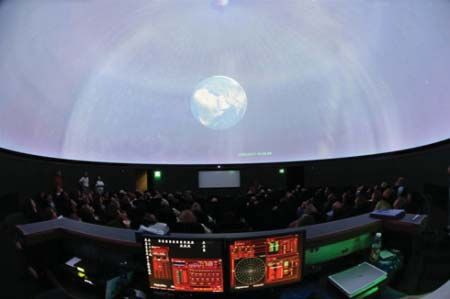
W H AT W O R K S S T O R I E S F R O M T H E C O M M U N I T Y
NOTRE DAME’S JORDAN HALL OF SCIENCE
The astrophysics faculty are ecstatic Of course there are also highly They are carpeted and well lit with
that they now can have their students specialized labs in the building. very comfortable furniture. When
fly through space and visit any corner You can easily identify the organic we designed the space and selected
of the galaxy. These astronomical chemistry lab, because of the way it the furniture our goal was to develop
journeys can be scripted in advance or is configured, and nobody else will lounge spaces that were inviting
driven in real time at the whim of the use it but organic chemists. But, there to students, where students could
instructor. The Digital Visualization are other places that are intentionally easily congregate spontaneously in
Theater leaves students with an flexible enough for many different small groups, and where students
indelible image of the intricacies of kinds of uses. and faculty could follow up on
nature. conversations that began in class or
Interdisciplinary courses are lab. Portable white boards on casters
becoming increasingly important; can be rolled up to a cluster of seats
therefore, the biochemistry lab is if students want to write or draw on a
adjacent to the cell biology/genetics surface.
lab, and analytical chemistry is
adjacent to ecology, for example. The building is “cathedral gothic”
on the outside, consistent with the
By locating certain lab spaces in close rest of the Notre Dame campus.
proximity, the College of Science The dominant interior feature is the
is well positioned to innovate its north-south galleria standing four
curriculum in ways we cannot stories high.
currently imagine, without being
constrained by the building layout. Lining the western side of the
galleria are balconies through which
Narum: Talk a little bit about the students access the labs on the upper
psychology of the space. Was there a levels. The eastern wall is filled with
vision for fostering community in the cathedral style windows, illuminating
science building? all floors of the building.
Jacobs: There was. We designed a The galleria further captures our
This visualization facility is an lot of common space throughout the
example of faculty coming together vision of imaging; the first floor is
building, including a coffee bar area. lined with display cases, starting at the
across departments and disciplines The study lounges within Jordan Hall
with a vision of the future. southern end with the microscopic
are arguably the most attractive space (what’s inside a nucleus), then
We tried to think of using spaces with on campus for students to hang out. moving up to atoms, molecules, cells,
greater synergy and collaboration, organisms, and by the time you make
rather than just carving the building it to the opposite end of the hallway,
into thirds. We tried to create spaces you are up to galaxies.
like the Digital Visualization Theater
and the lecture halls that we all could
take advantage of.
X
4 Volume IV: What works, what matters, what lasts
© Copyright 2007 - Project KaleidoscopeW H AT W O R K S S T O R I E S F R O M T H E C O M M U N I T Y
NOTRE DAME’S JORDAN HALL OF SCIENCE
The display, which integrates all the But the existing spaces for our The second challenge in terms of the
disciplines, is organized by scale. departments are separate buildings, planning is that this committee of
Halfway down the hallway is the and so we have effectively created ten faculty, architects, etc. focused
museum of biodiversity, a unique a place for teaching that is apart entirely on the facility and on the kind
collection of 600,000 plant, insect, from faculty offices and research. of teaching and learning we wanted
and vertebrae specimens. When you So the plus side is that it is 202,000 the space to enable.
arrive at the north end of the galleria, square feet designed completely for
you are at the entrance to the Digital undergraduate education. There was not a similar amount of
Visualization Theater! planning about the resources we will
The minus side is that there are only need to fill and utilize the space. What
There is a greenhouse with four twenty faculty offices in the building, kinds of scientific instrumentation
independent climate zones with with the majority of the faculty, will we need to purchase, and
computer controlled lighting, research labs and graduate students how much will it cost? How many
temperature, and humidity settings. housed elsewhere. additional staff and teaching assistants
will be needed to provide and support
On the rooftop is an observatory deck So we needed to compensate by instruction in the newly designed
with a dozen portable telescopes and making the space very inviting for space?
one large fixed telescope with CCD faculty and graduate students so they
imagery; students can remotely point would want to spend time here even Everybody on the planning
the telescope and capture images in when they were not scheduled to be committee focused on the budget
real time for projection anywhere in here (one reason for the attention to for the building— the “project” as
the building. the lounges). we say— the one time cost of the
building, but what was not included
We are also working with a firm to It remains to be seen as to whether in that discussion was a thorough
produce a video, probably about a we can develop a satellite community analysis of the implications of certain
fifteen-minute repeating reel, that of science in a space that is physically architectural designs on the recurring
captures undergraduates engaged in separate from where most faculty expenses needed to staff and supply
cutting-edge research at Notre Dame. spend the majority of their time, in the instructional space.
their office and their research lab.
The video will be projected on a wall In part, this omission was a result of
in the building, a way of sending a But this was a compromise in siting, leadership changes during the project
message to students that what they because there just was not a footprint planning, which meant we didn’t have
are learning in Jordan Hall connects surrounding our existing science some of the difficult discussions we
with research at the frontiers of buildings to expand them in ways really should have had about where
science and technology. that would have allowed us to put the and how to compromise on the
teaching and research together. building design to lessen the impact
Narum: Any lessons learned?
However, the building is adjacent to that the new space will have on the
Jacobs: Two come to mind. From the athletic complex, an important operating budget.
the beginning, this project was to be site for our campus, so although we
solely for undergraduate education. The faculty were there to inform the
did not have a lot of options for where design process from the perspective
There was a conscious decision to to put the building, we think we’ve
make it interdisciplinary, put all the of how and what we wanted students
designed a first floor space that even to learn, but the administrative voice
sciences together, and I think that was one passing through can’t help but be
a good decision. expressing potential concerns about
exposed to all kinds of science and to the long-term impact of using this
feel welcome to join our community new space was largely absent.
of science.
X
Volume IV: What works, what matters, what lasts 5
© Copyright 2007 - Project KaleidoscopeW H AT W O R K S S T O R I E S F R O M T H E C O M M U N I T Y
NOTRE DAME’S JORDAN HALL OF SCIENCE
Narum: Does that mean issues of The majority of space within the Overall, Jordan Hall stands out as
sustainability and greenness were also building is allocated to undergraduate a beautiful, creative, well-designed,
off the table? teaching laboratories. In terms of and technologically advanced space
classroom space, the building is that invites students and faculty to
Jacobs: The issues that are coming relatively modest: two 250-seat explore nature together. I am eager to
back to challenge us are not so much lecture rooms; one 136-seat Digital see the clever ways in which students
energy efficiency, which was built into Visualization Theater; and two 40-seat and faculty make use of the space to
the building, we were very mindful classrooms. advance scientific understanding and
of waste emissions, for example. In to develop the scientific leaders of
landscaping, students and faculty On the other hand, there are forty tomorrow.
made it into a living classroom, with specialized teaching laboratories
native species from Indiana. within the building, an observatory,
a greenhouse, and a museum of
The piece that was missing though biological diversity. I should point out
is really that in order to fully utilize that there are some interesting hybrid
the space we would need to add spaces.
how many staff, how many graduate
students, etc.— personnel issues. For example, all of the labs used for
first- and second-year chemistry
There wasn’t a full anticipation of the courses are connected to “data
equipment and instrumentation needs analysis rooms,” which look and
because that was not considered part function like classrooms.
of the project; only after the designs
were all completed and the building The notion is that we want students to
was under construction did it become move fluidly back and forth from the
known to the administration that laboratory space, in which students
we have to raise additional funding must wear lab aprons and goggles in
in order to fill the building with the accordance with safety protocol, and
appropriate instrumentation to make a comfortable carpeted space with
it all work. movable chairs where students can
sit down with their laptops and lab
Narum: When you walk into the partners to analyze and discuss the
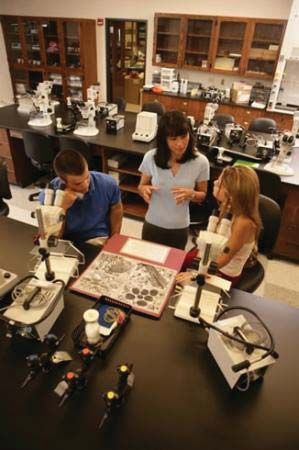
building what does your heart say to data they just collected or plan out the
you? procedure that they want to try next
Jacobs: I think Jordan Hall is a visually in lab.
striking building because of the The data analysis rooms can be
magnificence of the galleria, the large used for pre-lab lectures or post-lab
amount of natural light, the attractive discussions, so there is adjoining
display of science everywhere, and the space next to these labs that allows for
comfortable way in which the public a different kind of learning experience.
spaces foster community. It just jumps
out and draws you in.
6 Volume IV: What works, what matters, what lasts
© Copyright 2007 - Project KaleidoscopeYou can also read


