Observations of infanticide and cannibalism in four species of cordylid lizard (Squamata: Cordylidae) in captivity and the wild - Biotaxa
←
→
Page content transcription
If your browser does not render page correctly, please read the page content below
Herpetology Notes, volume 14: 725-729 (2021) (published online on 21 April 2021)

 Observations of infanticide and cannibalism in four species of
cordylid lizard (Squamata: Cordylidae) in captivity and the wild

          Daniel van Blerk1,†, Jens Reissig2,†, Julia L. Riley 3,†, John Measey1,*, and James Baxter-Gilbert1

  Cannibalism, the consumption of conspecifics,                of Africa (Reissig, 2014), from Ethiopia to South Africa
is taxonomically widespread and occurs across a                (latitudinally) and Angola to Ethiopia (longitudinally).
diversity of reptilian species (Polis and Myers, 1985).        Here, we present observations of cannibalism by four
A long-standing, yet antiquated, perspective views             species of cordylid lizard, two from free-living wild
cannibalism as an aberrant behaviour (as discussed             populations and another two from captive settings. Since
in Fox, 1975), but contemporary investigations have            the natural history of many cordylid species remains
noted its important role in the ecology and evolution of       deficient, and several species have been observed to
many wild populations (Robbins et al., 2013; Cooper            display reasonably high degrees of sociality, like group-
et al., 2015; Van Kleek et al., 2018). Examples of this        living in Armadillo Lizards, Ouroborus cataphractus
include habitat partitioning and optimising resource           (Boie, 1828) (Mouton, 2011) and Sungazers, Smaug
availability, as seen in juvenile Komodo Dragons,              giganteus (Smith, 1844) (Parusnath, 2020), these
Varanus komodoensis Ouwens, 1912, taking to the trees          observations provide important insights into one of the
to avoid ground-confined adults (Imansyah et al., 2008),       potential mechanisms shaping cordylid ecology and
or Skyros Wall Lizards, Podarcis gaigeae (Werner,              sociality.
1930), optimising resource availability in dense or
insular populations by eliminating future rivals through         Blue-spotted Lizard, Ninurta coeruleopunctatus
infanticide (i.e., the killing of juvenile conspecifics)       (Hewitt & Methuen, 1913)
and obtaining food resources immediately through                 Ninurta coeruleopunctatus is a medium-sized cordylid
cannibalism (Cooper et al., 2015). The evolutionary            (maximum snout–vent length, SVL = 82 mm) endemic
costs and benefits of infanticide and cannibalism              to the southern Cape Fold Mountains and found along
become further complicated when a parent is killing            the moist fynbos regions of the Garden Route, South
and consuming their offspring (i.e., filial cannibalism),      Africa (Bates et al., 2014; Reissig, 2014). This species is
leading to fitness trade-offs (Huang, 2008). For example,      a diurnal, active forager with a primarily insectivorous
increased predation pressure causes mother Long-tailed         diet, which is often found on outcrops, cliffs, and inside
Sun Skinks, Eutropis longicaudata (Hallowell, 1857),           crevices, yet these lizards have also been seen to use
to consume their offspring to recover energy from a            burrows (Reissig, 2014). On 14 January 2021, within
perceived inevitable clutch failure (Huang, 2008).             Tsitsikamma National Park, Eastern Cape, South Africa
  The family Cordylidae consists of 70 species of sub-         (centred on 33.9390°S, 23.8915°E), we observed an
Saharan lizard (Uetz et al., 2020) that reside across much     adult N. coeruleopunctatus preying upon a juvenile
                                                               conspecific.
                                                                 Initially the focal adult was seen to be chasing several
                                                               lizards – a Red-sided Skink, Trachylepis homalocephala
1
  Centre for Invasion Biology, Department of Botany and        (Wiegmann, 1828), a Rock Agama, Agama atra Daudin,
   Zoology, Stellenbosch University, Stellenbosch, Western
                                                               1802, a conspecific adult, and lastly a juvenile N.
   Cape, 7600 South Africa.
                                                               coeruleopunctatus. We initially thought this behaviour
2
  Ultimate Creatures, PO Box 62, Kelvin, Gauteng, 2054 South
   Africa.                                                     was related to potential territorial disputes, but when
3
  Department of Biology, Dalhousie University, 1355 Oxford     the adult N. coeruleopunctatus eventually caught the
   Street, Halifax, Nova Scotia B3H 4R2, Canada.               juvenile conspecific, it took hold of it by the head and
*
  Corresponding author. E-mail: jmeasey@sun.ac.za              neck and after a short time (approximately 30 s) the
†
  Joint first authors                                          juvenile appeared dead. The adult N. coeruleopunctatus
© 2021 by Herpetology Notes. Open Access by CC BY-NC-ND 4.0.   then fled with the juvenile secured in its mouth. The act
726 Daniel van Blerk et al.
of capturing, killing, and carrying away a prey item is or cannibalistic behaviour was observed in these
consistent with hunting behaviour and we presume the three species, although they were housed in identical
adult lizard consumed the juvenile shortly after we lost conditions to that of the K. polyzonus.
sight of it.
Swazi Dragon Lizard, Smaug swazicus Bates &
Southern Karusa Lizard, Karusasaurus polyzonus Stanley, 2020
(Smith, 1838) Smaug swazicus is a medium-sized cordylid
Karusasaurus polyzonus is a medium-sized cordylid (maximum SVL = 145 mm) with a restricted distribution,
(maximum SVL = 116 mm) with a wide distribution near-endemic to eSwatini (ca. 90% of its range) and
across western South Africa and Namibia (Reissig, extending southward into South Africa (ca. 10%; Bates
2014). Karusasaurus polyzonus is found across a variety and Stanley, 2020). This diurnal species is often found
of rocky habitats of the Nama-Karoo, Succulent Karoo, within rocky habitats, typically living within deep
and Renosterveld (Bates et al., 2014; Reissig, 2014). crevices along hillsides and usually in areas partially
This lizard is diurnally active, with a diet consisting shaded by vegetation (Bates and Stanley, 2020). To
primarily of insects (Broeckhoven and Mouton, 2014). date no formal examination of the diet of S. swazicus
They are generally thought to be largely solitary, has been conducted, but closely related Smaug species
however they can be found in basking groups of up to are known to predominately feed on invertebrates, such
three individuals (J. Riley, unpublished data). as insects and land snails, but will also take vertebrate
In April 2019, during a study of wild-caught, gravid prey, like frogs and lizards (Bates and Stanley, 2020).
cordylid lizards in captivity, females were brought into At midday on 25 February 2020, within Ithala Game
a lab at Stellenbosch University (centred on 33.9327°S, Reserve, KwaZulu Natal, South Africa (centred on
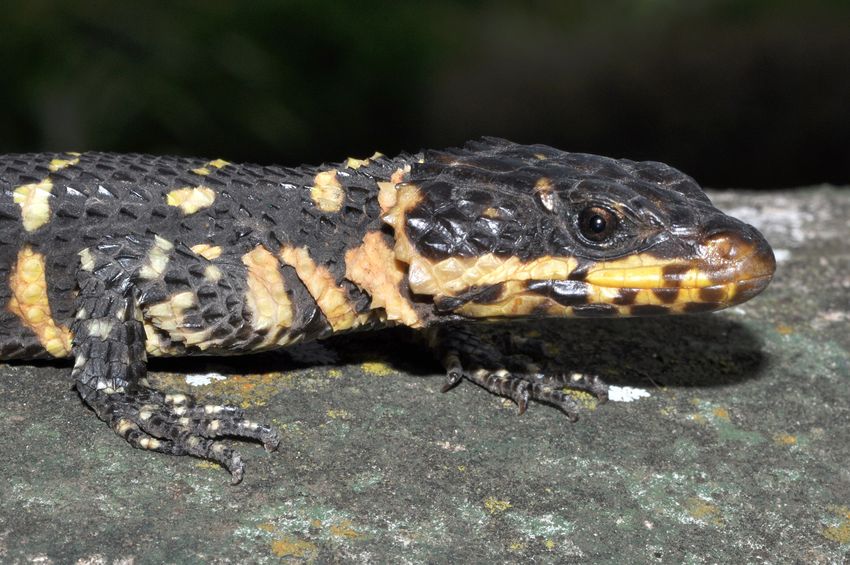
18.8637°E) and housed individually. During this time, 27.5064°S, 31.2988°E), we observed an adult S. swazicus
we noted four occurrences of infanticide by K. polyzonus engaging in infanticide and cannibalism. The focal adult
mothers soon after parturition. These interactions were (Fig. 1) left the refuge of a rock crevice and moved about
not directly observed, but their results were encountered 5 m to capture a conspecific juvenile that was basking
and documented during daily husbandry procedures. In outside another crevice. Once captured and subdued,
one of these four infanticidal events, the offspring was the adult then carried the prey item to the entrance of its
ingested by the mother (i.e., filial cannibalism). In all original crevice and was observed to consume it.
cases, the deceased were the first-born individual of the
litter. Transvaal Girdled Lizard, Cordylus vittifer
After these events occurred, we altered our husbandry (Reichenow, 1887)
protocol and separately fed females and offspring Cordylus vittifer is a medium-sized cordylid (maximum
outside of their home enclosure, with the goal of SVL = 95 mm) with a distribution covering northeastern
disassociating the feeding response of mothers from South Africa and eSwatini, with the species range
the vicinity of their young. This approach appeared extending into southern Mozambique and southeastern
to be successful, as no other instances of infanticidal Botswana (Bates et al., 2014; Reissig, 2014). They are
behaviour, or subsequent cannibalism, were observed. diurnally active and are commonly found within rocky
Although cannibalism appeared to be related to the outcrops in grasslands and savannah (Bates et al., 2014;
mother’s feeding response, other factors may also Reissig, 2014). To the best of our knowledge no formal
play a role in the occurrence of filial cannibalism in examination of the diet of C. vittifer has been conducted.
K. polyzonus. The captive environment may increase a Early accounts of the species, including captive feeding
lizard’s perceived predation risk, which can in turn lead observations, have suggested these lizards forage
to filial cannibalism as mothers try to pre-emptively widely for invertebrate prey, particularly beetles, but
recuperate energy from what they perceive to be an this assertion is speculative (Jacobsen, 1972).
inevitable clutch failure (e.g., E. longicaudata; Huang, On 19 January 2018, a captive gravid female was seen
2008). Interestingly, during the same period when we to engage in infanticide and filial cannibalism on one
made these observations, three other cordylid species of her own recently-born offspring. After parturition,
– O. cataphractus, Cordylus macropholis (Boulenger, two of three juveniles freed themselves from their
1910), and Namazonurus peersi (Hewitt, 1932) – were embryonic sac and were left alone by their mother,
also in captivity to monitor parturition. No infanticidal however the remaining individual which did notInfanticide and Cannibalism in Four Species of Cordylid Lizard 727
Figure 1. A wild adult Swazi Dragon Lizard, Smaug swazicus Bates & Stanley, 2020, after capturing, killing, and consuming a
juvenile conspecific.
break free immediately was promptly consumed. The the only vertebrate prey item recovered in that study,
cannibalised juvenile appeared to be alive, but simply from a relatively large sample size of stomach contents
had yet to emerge from the embryonic sac. Accounts (n = 480), where all other prey items were invertebrates
from the herpetocultural community have noted that (Van Wyk, 2000). This may suggest that even when
mother cordylids will consume stillborn offspring and natural diets are almost exclusively invertebrate-
undeveloped ova (J. Reissig, unpublished data), which centric, individuals will occasionally take conspecific
aligns with published accounts from other squamates prey, albeit rarely. With respect to the two instances of
(Lourdais et al., 2005; Mocino-Deloya et al., 2009; infanticide and filial cannibalism of captive cordylids, it
Caldwell et al., 2018). This observation is notable since is difficult to disentangle from natural feeding behaviour
the juvenile consumed appeared alive prior to the attack, or captivity stress. However, previously this behaviour
making this account more akin to what we describe has been recorded for S. giganteus adult males in captive
about filial cannibalism in K. polyzonus. settings (Marais, 1984) and generalised statements have
been made about species from the genera Smaug and
Discussion Pseudocordylus as known to cannibalise juveniles in
herpetocultural collections (Reissig, 2014).
Infanticide and cannibalism have not previously
Cordylid lizards are well-known to display a diversity
been reported in any of these four species. This
of social systems, ranging from solitary to group-living
is of particular interest for the observations of N.
species (Mouton, 2011). In another social squamate
coeruleopunctatus and S. swazicus, as the only other
group, Australian skinks of the subfamily Egerniinae,
account of cordylid cannibalism occurring in the wild
filial cannibalism has also been observed in captive
– as far as we are aware – is from a dietary study on
settings, such as in Egernia striolata (Peters, 1870)
S. giganteus, where a juvenile was recovered from the
(J. Riley, unpublished data). Similarly, infanticide has
stomach content of an adult female (Van Wyk, 2000).
been recorded in wild populations of several egerniine
Interestingly, the cannibalised juvenile S. giganteus was728 Daniel van Blerk et al.
skinks, including E. saxatilis Cogger, 1960 (O’Connor polyzonus (Squamata: Cordylidae). Biological Journal of the
and Shine, 2004), E. stokesii (Gray, 1845) (Lanham Linnean Society 111: 823–833.
Caldwell, A.J., Cree, A., Hare, K.M. (2018): Parturient behaviour
and Bull, 2000), and Liopholis whitii (Lacépède,
of a viviparous skink: evidence for maternal cannibalism when
1804) (Sinn et al., 2008). Infanticide is thought to be
basking opportunity is low. New Zealand Journal of Zoology
commonplace in egerniine skinks (While et al., 2015) 45: 359–370.
and an important driver for the evolution of parental Cooper, W.E., Jr., Dimopoulos, I. Pafilis, P. (2015): Sex, age, and
care and kin discrimination in this clade. In fact, population density affect aggressive behaviours in island lizards
simple associations between mother egerniine skinks promoting cannibalism. Ethology 121: 260–269.
and offspring can virtually eliminate the threat of Fox, L.R. (1975): Cannibalism in natural populations. Annual
Review of Ecology, Evolution, and Systematics 6: 87–106.
infanticide by other conspecifics (O’Connor and Shine,
Huang, W.S. (2008): Predation risk of whole-clutch filial
2004). As the social and mating systems of cordylid
cannibalism in a tropical skink with maternal care. Behavioural
lizards are largely undescribed, the role of infanticide Ecology 19: 1069–1074.
in the evolution of social behaviours, such as parental Imansyah, M.J., Jessop, T.S., Ciofi, C., Akbar, Z. (2008):
care, remains unknown. Future research on this topic is Ontogenetic differences in the spatial ecology of immature
likely to be fruitful and may serve to inform hypotheses Komodo dragons. Journal of Zoology 274: 107–115.
regarding convergent evolution of reptile sociality. Jacobsen, N.H.G. (1972): Some notes on the biology and
behaviour of the Transvaal girdled lizard (Cordylus vittifer)
In general, there remain significant gaps in our
in captivity. The Journal of the Herpetological Association of
understanding of many aspects of cordylid natural
Africa 9(1): 35–37.
history, including the potential ecological, evolutionary, Lanham, E.J., Bull, C.M. (2000): Maternal care and infanticide in
and social impacts of conspecific aggression, the Australian skink, Egernia stokesii. Herpetological Review
infanticide, and cannibalism. Ostensibly, it appears that 31: 151.
under normal, natural conditions the rate of cannibalism Lourdais, O., Brischoux, F., Shine, R., Bonnet, X. (2005):
in cordylids may be relatively low (as reported by Van Adaptive maternal cannibalism in snakes (Epicrates cenchria
maurus, Boidae). Biological Journal of the Linnean Society 84:
Wyk, 2000), yet the potential for it to impact spatial
767–774.
ecology and social structure, particularly across
Marais, J. (1984): Notes on the giant girdled lizard, Cordylus
ontogeny, does exist. We hope our observations can giganteus A. Smith. British Herpetological Society Bulletin 10:
spur future research into the intraspecific interactions 30–33.
of this fascinating and diverse family of African lizards, Mocino-Deloya, E., Setser, K., Pleguezuelos, J.M., Kardon, A.,
particularly in wild settings. Lazcano, D. (2009): Cannibalism of nonviable offspring by
postparturient Mexican lance-headed rattlesnakes, Crotalus
Acknowledgments. We thank the DSI-NRF Centre of polystictus. Animal Behaviour 77: 145–150.
Excellence for Invasion Biology (DvB, JBG, JM) and the Natural Mouton, P.L.F.N. (2011): Aggregation behaviour of lizards in
Sciences and Engineering Research Council of Canada (JLR) the arid western regions of South Africa. African Journal of
for their support. All research and observations of wild-caught Herpetology 60: 55–70.
captive cordylids at Stellenbosch University was conducted O’Connor, D.E., Shine, R. (2004): Parental care protects against
with authorization from Cape Nature (permit CN44-28-4989) infanticide in the lizard Egernia saxatilis (Scincidae). Animal
and with approved clearance from the Stellenbosch University Behaviour 68: 1361–1369.
Research Ethics Committee (ACU-2019-6766). Parusnath, S. (2020): Population genetics and sociality in the
Sungazer (Smaug giganteus). Unpublished PhD thesis,
University of the Witwatersrand, Johannesburg, South Africa.
References
Polis, G.A., Myers, C.A. (1985): A survey of intraspecific predation
Bates, M.F., Stanley, E.L. (2020): A taxonomic revision of the among reptiles and amphibians. Journal of Herpetology 19:
south-eastern dragon lizards of the Smaug warreni (Boulenger) 99–107.
species complex in southern Africa, with the description of a Reissig, J. (2014): Girdled Lizards and their Relatives: Natural
new species (Squamata: Cordylidae). PeerJ 8: e8526. History, Captive Care and Breeding. Frankfurt, Germany,
Bates, M.F., Branch, W.R., Bauer, A.M., Burger, M., Marais, J., Edition Chimaira.
Alexander, G.J., De Villiers, M.S., Eds. (2014): Atlas and Red Robbins, T.R., Schrey, A., McGinley, S., Jacobs, A. (2013): On
List of the Reptiles of South Africa, Lesotho and Swaziland. the incidences of cannibalism in the lizard genus Sceloporus:
Suricata 1. Pretoria, Gauteng, South Africa, South African updates, hypotheses, and the first case of siblicide. Herpetology
National Biodiversity Institute. Notes 6: 523–528.
Broeckhoven, C., Mouton, P.L.F.N. (2014): Under pressure: Sinn, D.L., While, G.M., Wapstra, E. (2008): Maternal care in a
morphological and ecological correlates of bite force in the rock- social lizard: links between female aggression and offspring
dwelling lizards Ouroborus cataphractus and Karusasaurus fitness. Animal Behaviour 76: 1249–1257.
Uetz, P., Freed, P. & Hošek, J. (2020): Cordylidae. The ReptileInfanticide and Cannibalism in Four Species of Cordylid Lizard 729
Database. Available at: http://www.reptile-database.org.
Accessed on 1 February 2021.
Van Kleeck, M.J., Smith, T.A., Holland, B.S. (2018): Paedophagic
cannibalism, resource partitioning, and ontogenetic habitat
use in an invasive lizard. Ethology Ecology & Evolution 30:
497–514.
van Wyk, J.H. (2000): Seasonal variation in stomach contents
and diet composition in the large girdled lizard, Cordylus
giganteus (Reptilia: Cordylidae) in the Highveld grasslands of
the northeastern Free State, South Africa. African Zoology 35:
9–27.
While, G.M., Chapple, D.G., Gardner, M.G., Uller, T., Whiting,
M.J. (2015): Egernia lizards. Current Biology 25: R593–R595.
Accepted by Philipp WagnerYou can also read


