Optimising the duration of Cooling in Mild Neonatal Encephalopathy The COMET trial Group - Sudhin Thayyil - Imperial College ...
←
→
Page content transcription
If your browser does not render page correctly, please read the page content below
Optimising the duration of Cooling in Mild
       Neonatal Encephalopathy

               Sudhin Thayyil

         The COMET trial Group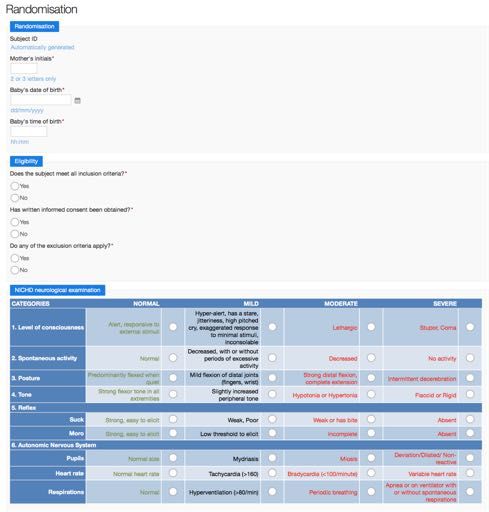
2

    Back ground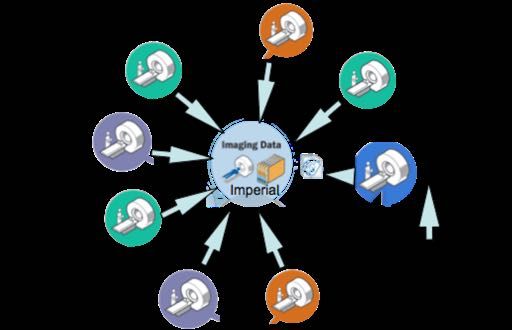
Cooling in moderate and severe encephalopathy
3

      ?
                                   Cooling   Usual care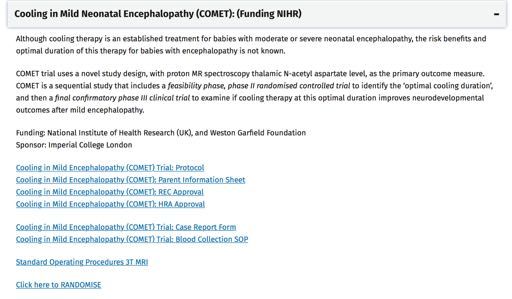
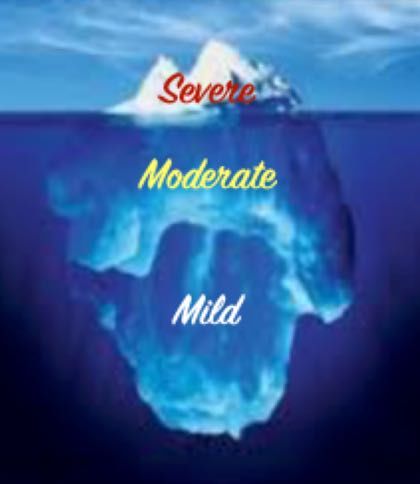
Long term outcomes after mild encephalopathy
4

                    Severe                                Severe
                     NE

                Moderate NE                            Moderate

                  Mild NE                                   Mild

                                          Adverse outcome in > ¼
        No Neonatal Encephalopathy (NE)   Murray et al., Pediatrics 2016
                                          Gagne-Loranger, Am J Perinatol, 2016 (MRI)
                                          Walsh et al, J Pediatric, 2017 (MRI)
                                          DuPont et al, J Peds, 2013
                                          Chalak et al (PRIME study)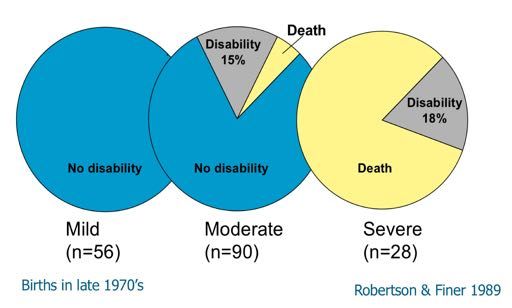
Preclinical data on cooling in mild encephalopathy
5

     Hypoxic Injury +      Hypoxic Injury +           Sham control (normal
     normothermia          hypothermia (3.5h)         hippocampus)

        3.5 hours cooling prevents brain injury in mice model
        of mild encephalopathy
                                         (Koo et al. Ped Res 2017)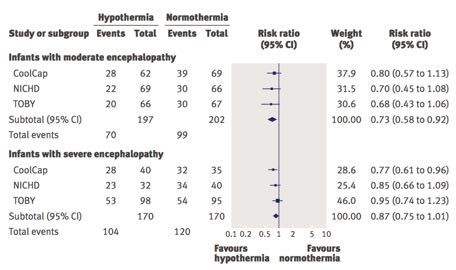
Cooling healthy brain induce apoptosis
6

    •   Increased apoptosis with cooling healthy brain (Wang et al Neuroscience 2016).

                                                Wang et al., Neuroscience 2017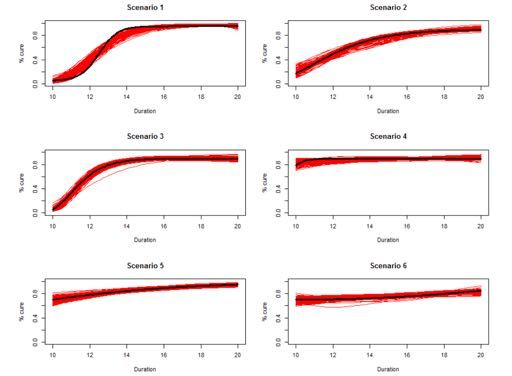
Cooling in mild encephalopathy: a meta-analysis
7

Effect of cooling on moderate or severe disability/death after mild encephalopathy

                                                Kariholu et al., PAS 2018
Cooling in Mild Encephalopathy – National Survey
8

                          Low risk adverse outcome         High risk adverse outcome

                            Cooling has side effects       Cooling very safe

                      No evidence to support cooling       Litigation

                                                           Difficult to grade HIE

                                       Hospital stay

                                                           May progress to moderate

100%                 50%                               0                                50%         100%
              Do not offer cooling                                                  Offer cooling

       25% of the cooling centers                               75% of the cooling centres

                                                                Oliveira et al., Arch Dis Childhood 2018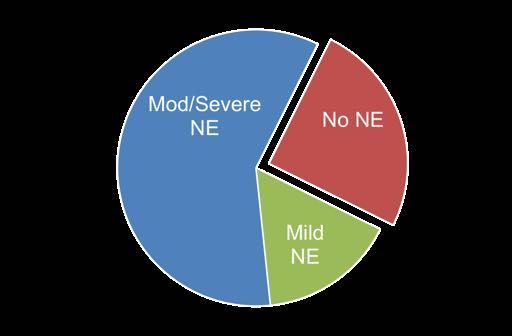
London neonatal transport for cooling
9

    145 cooling transfers in London (2011-12)
       – a quarter of the babies cooled had “no encephalopathy”

                                              Goel et al., ECPM 2015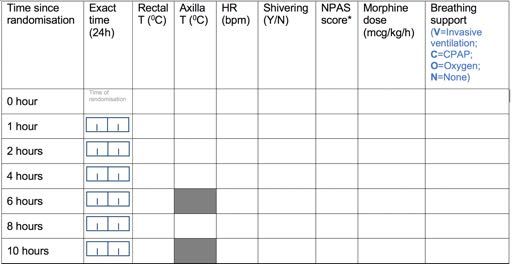
Prognostic accuracy of MR biomarkers
10

Lally et al., Lancet Neurology (in press)
Optimising treatment durations
11

     Quartagno et al., Clin Trials 2018
COMET Trial design
12
N=32 N=200 N=1200COMET Trial design
13
N=32 N=200 N=1200COMET Trial design
14
N=32 N=200 N=120015
ProtocolAims
16
• To examine the feasibility of recruiting and randomising
babies with mild neonatal encephalopathy to multiple
cooling durations.
• To examine the feasibility of obtaining adequate quality
data on the primary outcome for the phase II trial (i.e.
thalamic N-acetyl aspartate level) in the recruited babiesInclusion criteria
17
• Age less than six hours.
AND
• Evidence of acute perinatal asphyxia (any one)
– Metabolic acidosis (pH-16) in cord and/or within 1h of birth
– If blood gas not available or borderline (7.0 to 7.15, -10 to -16) in cord and/or blood
gas within 1h of birth, at least one of the following criteria is required
• Evidence of an acute obstetric event e.g. cord prolapse, abruption, shoulder
dystocia
• Need for continued resuscitation or ventilation at 10 minutes and/or a 10 min
Apgar scoreDefining mild encephalopathy
18
CATEGORIES NORMAL MILD MODERATE SEVERE
1. Level of Alert, responsive to Hyper-alert, has a stare, Lethargic Stupor, Coma
consciousness external stimuli jitteriness, high pitched cry,
exaggerated response to minimal
stimuli, inconsolable
2. Spontaneous Normal Decreased, with or without Decreased No activity
activity periods of excessive activity
3. Posture Predominantly flexed Mild flexion of distal joints Strong distal Intermittent
when quiet (fingers, wrist) flexion, complete decerebration
extension
4. Tone Strong flexor tone in Slightly increased peripheral tone Hypotonia or Flaccid or Rigid
all extremities Hypertonia
5. Reflex
Suck Strong, easy to elicit Weak, Poor Weak or has bite Absent
Moro Strong, easy to elicit Low threshold to elicit Incomplete Absent
6. Autonomic Nervous System
Pupils Normal size Mydriasis Miosis Deviation/Dilated/
Non-reactive
Heart rate Normal heart rate Tachycardia (>160) Bradycardia Variable heart rate
(80/min) Periodic breathing Apnea or on
ventilator +
spontaneous
respirations
• At least 2 categories in mild, moderate or severe
• Not more than 2 categories under moderate or severeStandardisation of neonatal neurological exam
19
• NICHD neurological examination extensively validated in several high
profile clinical trials
(Shankaran et al. NEJM 2005, NEJM 2012,JAMA 2014, JAMA 2016, Laptook et al
JAMA 2017)
• TOBY trial did not standardise neurological examination and relied on
aEEG instead
(Azzopardi et al NEJM 2009)
• aEEG within six hours have very poor prognostic accuracy
(Chandrasekheran et al., Am J Perinatology 2017)Problems with the Thompson score
20
• Developed for use in low resource African settings
• Not validated in any cooling trials
• Intervals and cut-off are inaccurate
• No physiological basis, e.g. double counting of autonomic system
disturbances
• Do not correlate with brain injury or major clinical outcomes
• Has crept into clinical practice in some UK neonatal units/Badger net
• Please do not use it !Rationale for a certification process
21
• Ensure objective inclusion criteria
• Subjectivity of the examination can be minimized by certification
• Most neonatal trainees/consultants get very little training in neonatal
neurological assessments
• Without specific training it is easy to under or over interpret
neurological signs in encephalopathy.
• Lack of neurological examination skills and the fear of missing
babies with moderate or severe encephalopathy, leads to cooling of
all babies with perinatal asphyxia without allocating the Sarnat stage
in many UK centresNICHD Examination: Certification process
22
• PI and Co PI at each centre will be certified as gold standard examiner
(GSE)
• 4 stage certification process
a. Slides discussion/lecture with the GSE (approx. 30 minutes)
b. Scoring on videos of HIE babies
c. Simultaneous (independent) scoring with GSE on 2 babies
d. Concordance check and final sign off by Prof ShankaranNICHD Examination: Certification process
23
• Screen for appropriate infants ≥ 36 weeks GA admitted to NICU or
in observation/transition area
• Type of infant for examination
• Hypoxia-ischemia (fetal acidemia, low Apgars)
• Abnormal neurological state from non-HI conditions
• Post-operative infants
• Number of examinations: 2
• Two infants with neurological abnormalities are preferable but
not required
• At least one examination should have abnormal findings in the
categories to be scoredNICHD Examination: Certification process
24
• GS and MD independently examine the infant
• Exams performed within 1 hour of each other
• Each examiner completes a neurological exam form
• Total the number of abnormalities
• Determine level of encephalopathy
• GS examiner reviews exam with MD
• Resolve any differences in exam, scoring and form completion
• The neurological examination will be sent to Prof Shankaran who
will review and inform site PI if MD is certifiedNICHD Examination concordance scoring 25
Exclusion criteria
26

     • Babies without encephalopathy (i.e. less than 2 abnormal signs)

     • Babies with moderate or severe encephalopathy who meet the current
       NICE/AAP guidelines for cooling therapy.

     • Babies with seizures (clinical and/or aEEG/EEG)

     • Babies with moderate or severe abnormalities on aEEG voltage
       criteria.

     • Babies with life threatening congenital malformations
Seizures after enrollment
27
• Seizures aged < 6 h: Cooling for at-least 72 hours
• Analysis by intention to treat and per protocol
• Seizures after 6 h:
– If in the cooled arm, give full 72 h cooling
– If in the usual care, continue usual care (normothermia) or cool
based on local policyCOMET feasibility study - centers
28
• Participating centers
need to have 3T MRI
and MR spectroscopy
• London Units can send
babies to Imperial for
3T MRI and MRS
Homerton Bristol
Total Recruitment: 32 babiesStudy procedures
29
Term/Late preterm baby requiring resuscitation at birth and requiring admission to NICU
NICHD neurological examination between (1 to 6h after birth)
Mod/Severe Encephalopathy
Mild Encephalopathy and/or seizures
Mod/Severe
aEEG Exclude (Cool for 72h)
voltage abnormality
Normal voltage
(4 to 7 d)
Parental consent 3T MRI/MRSStudy Website https://www.imperial.ac.uk/perinatal-neuroscience/current-research/ 30
Randomisation
31
Study procedures
32
Temperature data collection
33

      Group                 Rectal temperature               Axilla temperature

      Normothermia                   Nil               4 hourly from 0 hours until 80 h

      24 hours cooling     2 hourly until 36 hours     4 hourly from 36 hours until 80 h

      48 hours cooling     2 hourly until 50 hours     4 hourly from 50 hours until 80 h

      72 hours cooling     2 hourly until 80 hours                    Nil

     NB: In addition all cooling groups require temperatures at 0,1, and 2 hours, and
     usual care babies require axillary temperature at 0,1 and 2 hours
Other clinical data collection 34
Blood collection
35
The COMET group
36

                       United Kingdom
                       •    Imperial NHS Trust
                       •    Medway NHS Hospital
                       •    Birmingham Children’s Hospital
                       •    University Hospital of Coventry
                       •    Norwich Hospital
                       •    Liverpool Women’s Hospital
                       •    Newcastle Royal Infirmary
                       •    St Michael’s Bristol
                       •    Homerton Hospital
                       •    North Middlesex hospital
                       •    Nottingham University Hospital
                       •    University College London

                       USA
                       •   Wayne State University
You can also read


