OREGON BOARD OF DENTISTRY 2019 - 2021 BUDGET PRESENTATION - Joint Committee On Ways and Means Subcommittee On Education February 4, 2019
←
→
Page content transcription
If your browser does not render page correctly, please read the page content below
OREGON BOARD OF DENTISTRY

       2019 - 2021 BUDGET PRESENTATION

Joint Committee On Ways and Means Subcommittee On Education

                       February 4, 2019

                            Presented by:
                   Stephen Prisby, Executive Director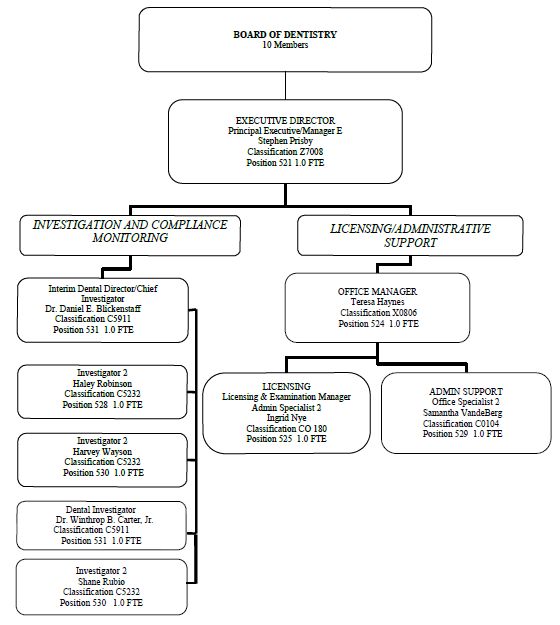
OREGON BOARD OF DENTISTRY
                                            2019-2021 Budget Presentation

                           Joint Committee On Ways and Means Subcommittee On Education

AGENCY OVERVIEW

The Board of Dentistry was established in 1887 to regulate the practice of Dentistry. In 1946, Dental Hygiene was
established as a licensed profession in Oregon and added to the purview of the Board. The Mission of the Board is to
promote high quality oral health care in the State of Oregon by equitably regulating dental professionals.

There are ten members appointed to this policymaking Board and eight permanent full-time staff. The ten Board members
include six dentists, one of whom must be a specialist, two dental hygienists and two public members. Members of the
Board are appointed by the Governor and confirmed by the Senate.

The Board’s highest priorities are the enforcement, monitoring, licensing and examination of Dentists and Dental
Hygienists in Oregon.

The Board’s goals are to protect the public from unsafe, incompetent or fraudulent practitioners; encourage licensees to
practice safely and competently in the best interests of their patients; and educate the public on acceptable and
appropriate dental and hygiene practices.

The OBD’s funding is 100% Other Funds generated primarily from fees paid by licensees and applicants for new licenses,
license renewals and various permits and certifications. A portion (less than six percent) of the Board’s revenue is from
miscellaneous revenues generated from civil penalties, the sale of documents, late fees and interest.

Board of Dentistry
2019-2021 Budget Presentation
Page 1 of 15
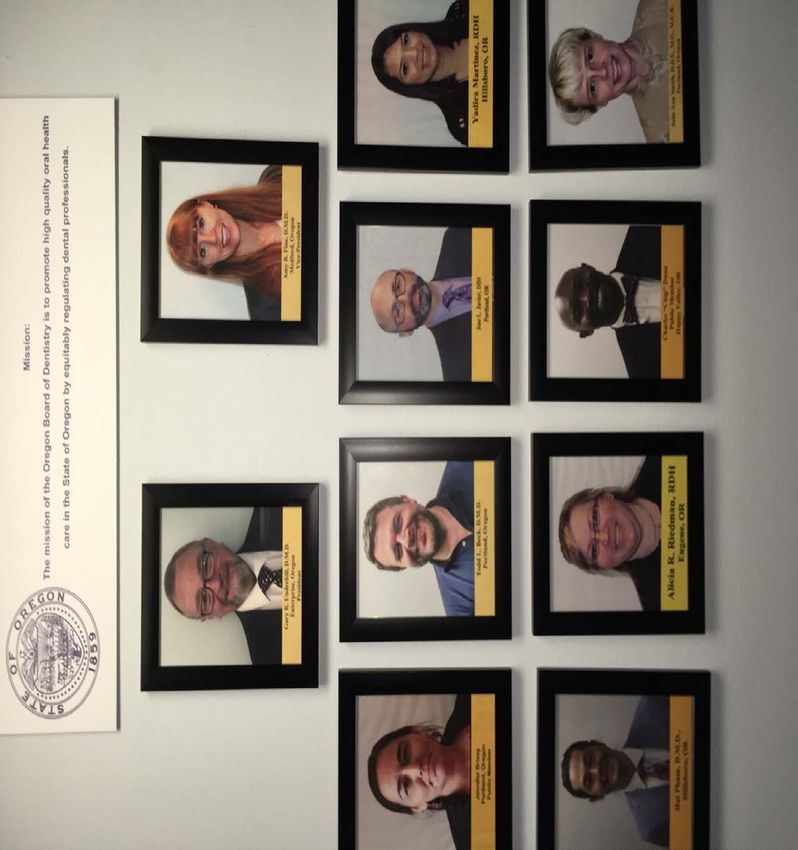
Current Board Roster Name Location Term ends Gary Underhill, DMD - President Enterprise 4/1/2022 Amy B. Fine, DMD - Vice President Medford 4/1/2022 Yadira Martinez, RDH Hillsboro 4/1/2022 Alicia Riedman, RDH Eugene 4/30/2021 Julie Ann Smith, DDS, MD, MCR Happy Valley 5/10/2019 Todd Beck, DMD Portland 3/31/2021 Charles "Chip" Dunn Happy Valley 4/2/2021 Hai Pham, DMD Hillsboro 4/2/2021 Jose Javier, DDS Portland 4/1/2020 Jennifer Brixey Portland 4/6/2020 Board of Dentistry 2019-2021 Budget Presentation Page 2 of 15
Board of Dentistry
2019-2021 Budget Presentation
Page 3 of 15
Board of Dentistry
2019-2021 Budget Presentation
Page 4 of 15
AGENCY PERFORMANCE OVERVIEW

                                       OREGON BOARD OF DENTISTRY
                                ANNUAL PERFORMANCE PROGRESS REPORT 2018
                                       (the full report is posted on OLIS)
                      Performance Measure Definition         2018 Goal     2018 Performance

                    #1 Percent of licensees in                 100%             100%
                    compliance with continuing
                    education requirements

                    #2 Average time from receipt of a       7.5 months        7 months
                    new complaint to completed
                    investigation (ready to be submitted
                    to the Board)

                    #3 Average Number of working days         7 Days           7 Days
                    for the receipt of completed
                    paperwork to issuance of license
                    (new or renewal)

                    #4 Agency Overall Satisfaction –        85% Positive     80% Positive
                    Percent of customers rating their        Response         Response
                    overall satisfaction with the agency
                    above average or excellent.

                    #5 Board Best Practices – Percent of       100%             100%
                    total of best practices met by Board.

Board of Dentistry
2019-2021 Budget Presentation
Page 5 of 15
PROGRAM PRIORITIES The Board has three major areas of service: • Licensing and Examination The Board licenses dentists and dental hygienists, establishes standards for the use of anesthesia in dental offices, issues four levels of anesthesia permits, and certifies dental assistants. Background checks are conducted on all new applicants. Applicants must pass a written national examination; a clinical examination conducted by a dental testing agency recognized by the Board, and passes the Board’s Jurisprudence examination. 15% of all licensees renewing their licenses each year are audited for compliance with the Board’s Continuing Education requirements. In addition, when an investigation is opened, the continuing education records are also requested from the Licensee involved in the matter. As of January 1, 2019 there are 3843 licensed dentists and 4321 licensed dental hygienists. We anticipate issuing about 900 new licenses in the 2019-2021 biennium almost equally divided between dentists and dental hygienists. During the 2017 – 2019 biennium, 915 new licenses were issued. We anticipate that the total number of Licensees will slightly decline over the next two to six years. Demographics point to a steady flow of retirements and licenses lapse for any number of reasons along with practitioners moving out of state. Each year (through the last four) approximately 375 licensees chose to stop practicing in Oregon. Oregon’s net inflow population migration has also slowed and is projected to continue decreasing in the near future. The Board offers licensure through examination; by credential: and for dental specialists, the ability to be examined by the Board’s designated testing agency in a particular specialty and then the license is limited to that special area of expertise; i.e., Oral and Maxillofacial Surgery, or Pediatric Dentistry. Applicants for a general dental license or a dental hygiene license must pass a written examination, called the “National Boards,” which is conducted by the American Dental Association’s Commission on Dental Education. Applicants must also pass a clinical examination conducted by any state or regional testing agency as described in statute. Board of Dentistry 2019-2021 Budget Presentation Page 6 of 15
10000

                         8000
                                                               Total Licenses
                                                      8110                                  8179                          8168                            8164
                         6000

                         4000
                                               4256                      3911    4268                              4304                            4321
                                        3854                                                               3864                           3843
                         2000

                              0
                                               2015                              2016                              2017                            2018
             Dental Licenses                   3854                              3911                              3864                            3843
             Hygiene Licenses                  4256                              4268                              4304                            4321
             Total Licenses                    8110                              8179                              8168                            8164

       600
                                               New Licenses Issued per Biennium
                                                                                                     518
                                                                                                                  458            475
       500                                                         434                447                                                    440
                                                                                                            404            400         400                  420
                                                                                               397                                                    380
       400                        350            355 375
                  322                                        305
                        294             291                                     298
       300

       200

       100

        0
                   03-05          05-07           07-09      09-11              11-13              13-15     15-17        17-19 est    19-21 est     21-23 est
                                                                    Dental            Dental Hygiene

Board of Dentistry
2019-2021 Budget Presentation
Page 7 of 15
Total Licenses with projections through 2023
10000
8000
6000
4000
2000
0
2009 2010 2011 2012 2013 2014 2015 2016 2017 2018 2019 2020 2021 2022 2023
est est est est est
Total Licenses 6680 6989 7359 7726 7907 8011 8110 8179 8168 8164 8125 8100 8000 7950 7900
Revenue stream is uneven during a biennium, with a 2 –year licensing period. Each year one-half of our dentists renew
their licenses between January – March and one-half of our dental hygienists renew every July – September.
$400,000
Revenue Per Month - an example of a typical fiscal year
$360,000
$350,000 $320,000
$300,000 $264,000 $260,000
$250,000 $230,000
$200,000 $180,000
$150,000
$100,000 $74,000 $70,000
$54,000
$36,000 $24,000
$50,000 $20,000
$0
1 2 3 4 5 6 7 8 9 10 11 12
Board of Dentistry
2019-2021 Budget Presentation
Page 8 of 15The table below shows the historical and projected workload for the agency in licensing.
Licensing and Examination 2003-05 2005-07 2007-09 2009-11 2011-13 2013–15 2015-17 2017-19 2019-21
Workload Actual Actual Actual Actual Actual Actual Actual Est Est
Licenses Issued:
Dental 311 350 355 305 340 397 402 420 410
Dental Hygiene 294 335 375 434 450 518 447 450 440
Total New Licenses Issued: 616 685 731 739 790 915 849 870 850
Licenses Renewed:
Dental 3254 3300 3325 3389 3400 3431 3482 3450 3400
Dental Hygiene 3180 3265 3386 3613 3700 3715 3633 3600 3600
Total Licenses Renewed: 6434 6595 6712 7002 7100 7146 7354 7050 7000
Specialty Examinations
9 5 3 3 3 4 3 0 0
Conducted
Candidates Examined 7 5 3 5 3 4 3 0 0
Anesthesia Permits
3795 3969 3750 4359 4400 4783 5092 5100 5000
Issued/Renewed
Dental Assistants Certified 1751 2260 2449 2638 2650 2263 1873 1900 1900
Dental Assisting Instructor
102 124 106 110 125 131 143 145 145
Permits Issued/Renewed
Limited Access/Expanded
Practice Dental Hygiene 59 67 84 171 300 534 676 700 700
Permits Issued/Renewed
Board of Dentistry
2019-2021 Budget Presentation
Page 9 of 15• Enforcement and Monitoring
The Board conducts investigations of complaints filed with the Board alleging unacceptable patient care or other issues
ranging from unprofessional conduct, improper prescribing practices, substance abuse, unauthorized use of auxiliaries,
advertising or disciplinary action in another state. The majority of cases involve allegations of unacceptable patient care.
Investigations are also conducted based on reports of malpractice claims that are submitted by insurance companies.
Disciplinary actions are reported to the National Practitioners Data Bank and to the Healthcare Integrity and Protection
Data Bank. Licensees under disciplinary sanction are actively monitored to assure their compliance with the terms of
their Order including licensees with substance abuse issues who have long-term treatment and recovery needs.
There are usually about 60 - 70 Licensees being monitored on a regular basis. During fiscal year 2018 the Board opened
272 complaints and closed 260 case investigations. Disposition of those cases are shown in the table below
Dismissed 114
Letter of Concern 67
Disciplinary Actions 89
Statute gives the Board wide latitude in types of discipline that the Board may impose. These are common types of
discipline:
• Formal Reprimand
• Civil Penalty/Restitution payment
• Require Education/Training including community service
• Accept license resignation
• Evaluation/Treatment Monitoring
Board Actions 2014 2015 2016 2017 2018
No Violation 61 59 50 56 52
No Further Action 41 84 38 58 62
Letter of Concern 62 50 76 77 67
Discipline 31 45 60 57 89
Total 195 238 224 248 270
(There is typically more than one type of discipline incorporated in a disciplinary action; i.e. reprimand, civil penalty and community service is the
standard discipline for working without a current license or allowing a person to perform duties for which they do not hold the appropriate license or
permit.)
Board of Dentistry
2019-2021 Budget Presentation
Page 10 of 15• Administration
Administrative activities include implementation of Board policy, communication and collaboration with the Oregon
Health Authority, professional associations, the OHSU School of Dentistry and other educational programs, related
licensing agencies such as the Board of Pharmacy, the Oregon Medical Board and the Board of Denture Technology in
addition to State Boards of Dentistry in other states. Administration also includes legislative activities, budget
development, monitoring, and staffing. A major component of Administration is carrying out the Board’s primary goal of
communicating with licensees and the public. This includes maintenance of a web site, production of newsletters each
year, and scheduling and presenting information to students, licensees and the public about the Board and its activities.
We strive to maintain great working relationships with the Oregon Dental Association, Oregon Dental Hygienists’
Association and the Oregon Dental Assistants Association.
Agency accomplishments during 2017- 2019 include:
• Onboarding of 1 new Board Member.
• Retirement of Dental Director/Chief Investigator who had over 28 years of experience.
• Retirements of two other investigators who had about 20 years of experience each.
• These retirements have been managed well by staff with transition of new hires and retention of institutional
knowledge for agency.
• New OBD Website became operational in January 2019 after months of preparation
• Transition to new IT support provider for desktop and other user support.
• OBD Strategic Plan initiatives continue to be addressed with significant work on dental implant and anesthesia
safety workgroups meetings and recommendations forwarded to the Board.
• Continued to cultivate and strengthen positive relationships with ODA, ODHA, ODAA, OHA and OHSU School of
Dentistry and all dental hygiene and dental assisting programs with a continuation of the outreach programs
including a presentation to Washington state’s equivalent Board of Dentistry and Idaho scheduled in 2019.
• The Board created and implemented Bylaws.
• Board Members participate in national dental organizations like the American Association of Dental Boards to stay
current and up to date on national oral health issues and trends.
• Executive Director elected as an officer to the American Association of Dental Administrators, a national group of
state dental board executive directors.
Board of Dentistry
2019-2021 Budget Presentation
Page 11 of 15Financial Notes for 2019 - 2021
• The initial beginning balance for the 2017-19 Biennium was approximately $240,000 higher than
budgeted.
• The anticipated ending balance for 2017 -19 will be approximately $800,000 higher than originally
budgeted. Ending balance for 2017- 19 is projected to be approximately $1.5 million versus LAB
$700,000.The variance can be attributed to some key factors:
• The beginning balance for 2017-19 was higher than what was initially projected.
• Higher revenue collected for Fines (civil penalties) is projected to be over $350,000 versus the LAB of
$100,000.
• Interest revenues are also tracking a little higher than LAB by about $45,000.
• Personal Services expenses are projected to be under LAB projections by about $250,000, with most of t h e
vacancy savings attributed to retirements and positons unfilled as the replacements were recruited and hired. All
positions are now filled.
• Services and supplies expenses are projected to be under LAB projections by about $80,000 with a variety of
expenses in this category accounting for this surplus in this category.
Key budget data points on the next page will provide more detail on balances and projections.
Board of Dentistry
2019-2021 Budget Presentation
Page 12 of 15Dental Board Actuals and Projections through November 2018
%
% 2017-19 %
change
change 2017-19 2017-19 change 2019-21
2013-15 Actuals 2015-17 Actuals
from 13-
November from 15-
2019-21 CSL from 17-
LAB Projected Revised 19
15 Actuals 17
projected
Beginning
Balance 645,548 508,012 -21.3% 719,701 963,946 963,946 9.9% 950,000 1,528,557 58.6%
Biz License/Fees 2,536,541 3,168,850 25.0% 3,350,000 2,291,671 3,499,723 10.4% 3,270,000 3,617,200 4.9%
Non-biz Fees 10,200 7,050 -30.1% 10,000 8,800 10,000 10,000 10,000
Charges for
Services 17,108 23,818 39.2% 17,500 18,897 20,000 20,000 20,000
Fines and
Forfeitures 101,500 201,200 98.2% 100,000 355,805 350,000 74.0% 200,000 350,000
Interest 7,642 16,842 7,500 37,889 54,000 20,000 60,000
Other Revenue 45,286 38,959 14.0% 50,000 11,195 20,000 50,000 50,000
Total Revenue 2,718,277 3,456,719 27.2% 3,535,000 2,724,257 3,933,723 15.8% 3,570,000 4,107,200
Transfers Out (204,775) (179,189) (226,800) (105,598) (150,000) (226,800) (226,800)
Available
Revenue 3,159,050 3,759,956 19.0% 4,027,901 2,618,659 4,747,669 26.3% 4,293,200 5,408,957 13.4%
Expenditures 2,650,838 2,821,996 6.5% 3,328,763 2,232,328 2,934,712 6.3% 3,491,238 3,609,564 23.0%
Ending Balance 508,012 963,946 89.7% 669,138 1,528,557 58.6% 801,862 1,799,393 22.6%
4.6 months 8.2 months 12.5 months 12.0 months
Board of Dentistry
2019-2021 Budget Presentation
Page 13 of 15POLICY OPTION PACKAGES:
Package 100 – IT support and database transition to new environment
• Estimated Cost - $100,000
• Ongoing per Biennium
• The OBD is in process of transitioning to a new IT provider, which will entail migrating over to ETS for email and server
support and find a new vendor to transition our current database to a new system. A firm cost estimate is very hard to
determine but a conservative estimate of $100,000 is provided. This figure is based on a survey of other Boards who have
gone through a similar transition (Pharmacy Board, Optometry Board, etc…) spent on their transition, which ours will be very
similar to.
• How Achieved: The Oregon Board of Dentistry will work with the state procurement, CIOS’s Office and other affected
boards.
• Staffing Impact: Current staff will be impacted with implementation, based on experiences other boards shared with the
OBD.
• Services and Supplies: TBD
• Revenue Source: The Board of Dentistry’s funding is 100% Other Funds generated primarily from fees paid by licensees and
applicants for licenses and permits
Package 105 - Fee Implementation - Non-Resident Dental Permit Background Check Fee
• $14,000
• Initiate fee $100
• Ongoing
• The purpose of this package is to allow the Board to charge a background check fee for those requesting a Non-Resident
Dental Permit. This has been discussed by the OBD a few years back, as the number of requests for the Non-Resident
Permit have grown from previous years. Dentists from other states and countries may come to Oregon to demonstrate or
receive instruction in the practice of dentistry to a dental organization or a dental study club. The staff time and resources
needed to process these permits, is substantial enough that we are requesting a background check fee be implemented, to
ensure these practitioners meet our agency’s mission to protect the public.
• How Achieved: The Oregon Board of Dentistry will update fees and forms to reflect this background check fee.
• Staffing Impact: None
• Services and Supplies: None
Board of Dentistry
2019-2021 Budget Presentation
Page 14 of 15Agency goals for 2019-2021 include:
• Continue work and Implementation of 2017-2020 Strategic Plan Initiatives.
o Transition of key employees with retirements and training new hires
o Focus on patient safety – dental implants and anesthesia safety recommendations will be acted on by the
Board
o Retain Agency Autonomy
• Continue to promote and encourage participation in the Statewide HPSP diversion program for licensees with
substance abuse addictions.
• Continue to promote and encourage participation in the volunteer Dentist/Dental Hygienist program to increase
access to quality dental care.
• Continue to us OBD/OAGD Mentoring Program as one avenue to resolve disciplinary cases.
• Continue to promote the Prescription Drug Monitoring Program to all licensees in conjunction with OHA and new
rules regarding compliance with signing up and continue promoting safe prescribing practices
• Utilize the website, newsletter and personal presentations to communicate Board policies and expectations.
• Continue to collect data on the ethnic and racial makeup of licensees and work with policy makers, educators, and
students to encourage a representative diversity in the dental workforce.
• Refine participation in the Health Care Workforce Initiative project to address the issues of health care workforce
shortages and access to care.
Agency challenges for 2019-2021 and beyond:
• 2017- 2020 Strategic Plan initiatives and objectives
• Onboarding of new Board members & staff
• Retention of employees
• Database Vendor selection, transition and implementation
Board of Dentistry
2019-2021 Budget Presentation
Page 15 of 15You can also read


