Part L Dwellings-NZEB & Major Renovations and Part F-Ventilation - DHPLG NZEB, Wexford - Engineers Ireland
←
→
Page content transcription
If your browser does not render page correctly, please read the page content below
Part L Dwellings–NZEB & Major
         Renovations
              and
       Part F-Ventilation

                 Seán Armstrong,
                 Senior Adviser,
                 Building Standards Section,
                 DHPLG
NZEB, Wexford
Outline
• EPBD Requirements
• Part L Dwellings
  – NZEB
  – Major Renovations to cost Optimal
• Part F
• Regulatory Impact Assessment
• Next Steps

Energy Performance of Buildings Directive
        (EPBD) NZEB and Major Renovations
• Article 9
  Member states to ensure that all
  new buildings are “Nearly Zero
  Energy Buildings” by 31st Dec 2020

• Article 7
  Major Renovations to be at Cost
  Optimal Level in Building Codes
EPBD Definition- Nearly Zero Energy
       Buildings & Major Renovation
‘nearly zero-energy building’ means a building that has a very high energy
performance, as determined in accordance with Annex I. The nearly zero
or very low amount of energy required should be covered to a very
significant extent by energy from renewable sources, including
energy from renewable sources produced on-site or nearby;

‘major renovation’ means the renovation of a building where more than 25 % of the
surface of the building envelope undergoes renovation;

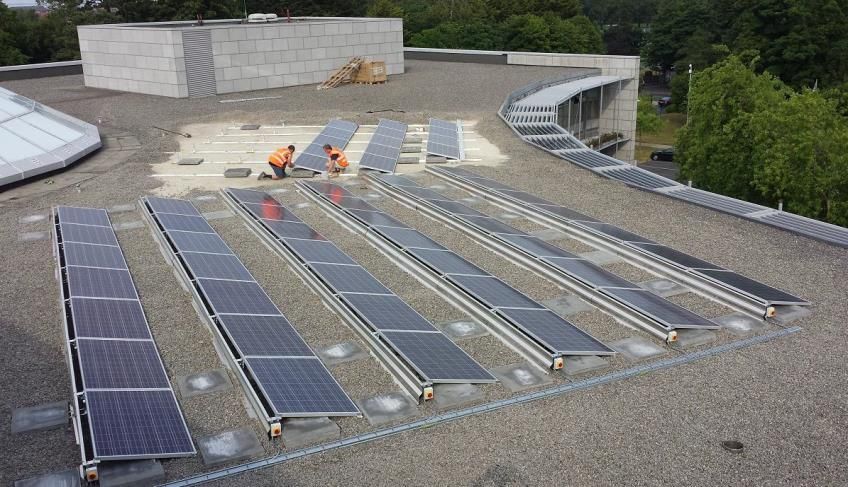
                                  RTE PV Array
Building Regulations Part L
                       Development - Dwellings
            200   BER* D1/C3
            180
                               BER C1
            160
            140
                                                    40%             60%             70%
kWh/m2/yr

            120                                     Improvement     Improvement     Improvement
                                                    BER=B1          BER=A3          BER=A2
            100                                                                     NZEB
             80
             60
             40
             20
             0
                    1991       2005                2007           2011            2018

                               *Building   Energy Rating (BER)
Implementation of NZEB-Dwellings
• SI 4 of 2017 amended Building
  Regulations to include the definition of
  NZEB on 17th Jan 2017

• TGD L 2011-Dwellings has been
  amended to include numerical indicators
  for NZEB Dwellings on the 22nd Feb 2017.
  The numerical indicators provide MPEPC
  of 0.30 and MPCPC of 0.35 for dwellings.

• A full review of Part L for NZEB Dwellings
  in 1H 2018 to apply from early 2019
Achieving compliance with 2018
                     Draft L Dwellings
                                Minimum Threshold Level
                                Compliance
                                TGD L Sections:
                                    1.2 Renewable Energy Ratio
                                    =0.20
                                    1.3 Building Fabric
 Overall Compliance                      U-Values (Backstops)
 Sect. 1.1 calculation in                Thermal Bridging ACDs           Compliance
 DEAP by achieving
 MPEPC (0.3) and            +
                                         Air Tightness 5m3/hr/m2
                                    1.4Building Services
                                                                     =      with
                                                                           Part L
 MPCPC(0.35)                             Boiler Efficiency 90%
                                         Space Heating Controls
                                                                          Dwellings
 (equivalent to 70%
 Reduction on 2005)                      (zoning and time control)
                                         Insulation
                                         Mechanical Ventilation
N.B. Check                                 System Efficiency
                                    1.5 Construction Quality
Overall compliance                      and Commissioning
Prior to Commencement               1.6 User Information
Overview of key changes to TGD L 2018
• Introduction of NZEB, MPEPC=0.30, MPCPC=0.35
• Introduction of Major Renovations to a cost optimal
level where technically, economically and
functionally feasible.
• Introduction of a Renewable Energy Ratio (RER) of
20% as per ISO EN 52000 (to replace
10kWh/m2/yr).
• Reduction of air tightness backstop from 7m3/hr/m2
to 5m3/hr/m2
• Table 1- Reduction of wall backstop UV from
0.21W/m2K to 0.18 W/m2K
• Table 1- Reduction of window backstop UV from
1.6 W/m2K to 1.4 W/m2K
• Inclusion of guidance to avoid overheating in
dwellings
• Par 1.3.2.5 –removal of variation of U Value with
percentage glazingOverview of key changes to TGD F 2018 • Mechanical Ventilation guidance for AP< 3m3/hr/m2 • Guidance provided for Continuous Mechanical Extract Ventilation • Introduction of certification of ventilation systems installation • New examples for apartments • Installation and Commissioning guide for Ventilation systems
TGD L App. E-Specification to achieve 70% improvement for semi-
                       detached dwelling
                                   Part L 2011 compliant        Proposed Part L 2018        Proposed Part L 2018
        Elements                        specification           specification with gas        specification with
                                                                        boiler                   heat pump
        External Wall U-value      0.13                        0.13                        0.13
        (W/m².K)
        Floor U-value (W/m².K)     0.14                        0.14                        0.14
        Roof U-value (W/m².K)      0.11                        0.11                        0.11
        Windows and glazed         1.3                         0.9                         0.9
        doors U-value (W/m².K)
        Window type                Double glazed, low E        Triple glazed, low E (En = Triple glazed, low E (En
                                   (En = 0.05, soft coat),     0.05, soft coat), argon    = 0.05, soft coat), argon
                                   argon filled, PVC           filled, PVC frames         filled, PVC frames
                                   frames
        Windows and glazed         0.63                        0.6                         0.6
        doors g-value
        External door U-value      1.5                         1.5                         1.5
        (W/m².K)
        Thermal Bridging Y-        0.05                        0.05                        0.05
        value
        Ventilation strategy and   Natural ventilation with    1. Natural ventilation      1. Natural ventilation
        Air Permeability (m³/hm²   intermittent extract fans       with intermittent           with intermittent
        @ 50Pa)                    in wet rooms                    extract fans in wet         extract fans in wet
                                                                                 3     2                     3     2
                                                                   rooms at 5 m /hr/m          rooms at 5 m /hr/m
                                                                     or                    or
                                                               2. continuous               2. continuous
                                                                   mechanical                  mechanical
                                                                   ventilation at 3            ventilation at 3
                                                                     3      2                    3      2
                                                                   m /hr/m air                 m /hr/m air
                                                                   permeability                permeability
        Space heating and hot      Mains gas condensing        Mains gas condensing       Heat Pump Space
        water system               gas boiler, room sealed,    gas boiler, room sealed, Heating efficiency
                                   flue fan. Efficiency        flue fan. Efficiency 91.3% 350%; Hot Water
                                   91.3%                                                  efficiency 175%
        Secondary space            Gas fire, closed front,     None                        None
        heating system             fan assisted, balanced
                                   flue, 80% efficient
        Controls                   Boiler interlock            Boiler interlock            Time and temperature
                                   Time and temperature        Time and temperature        zone control
                                   zone control                zone control
        Central heating pump       High efficiency pump        High efficiency pump        High efficiency pump
        Hot water demand                                       1 shower with 6 litres/min 1 shower with 6
                                                               flow restrictor            litres/min flow restrictor
                                                               125litres/person/day       125litres/person/day
        Hot water cylinder         100mm factory               100mm factory insulated     100mm factory
        insulation                 insulated                                               insulated
Specification to achieve 70% improvement for semi-detached
dwelling
Element TGD L 2011 TGD L 2018 TGD L 2018
with gas boiler with heat pump
Lighting 100% low energy 100% low energy 100% low energy
lighting lighting, conforming to lighting, conforming to
the following the following
specification: specification:
· A+ Rated Bulbs · A+ Rated Bulbs
· 94 lumen/cW · 94 lumen/cW
· 4 W/m2 · 4 W/m2
PV panels orientation East/ West East/ West NA
PV system tilt 30 30 NA
PV system over-shading None None NA
PV system size (kWp) 1.05 (7.9m2) 1.15 (8.63m2) NoneTGD L Appendix E- Example
performance
TGD L 2011 TGD L 2018 TGD L 2018
Dwelling heated Dwelling Dwelling
by mains gas heated by heated by heat
mains gas pump
Primary energy 56 43 42
[kWh/m2/yr]
CO2 emissions 10 8 7
[kg/m2/yr]
EPC 0.40 0.30 0.28
CPC 0.37 0.28 0.24
Renewable Energy 0.18 0.24 0.35
Ratio (RER)TGD L 2018-Dwellings Major Renovations
• Where more than 25 % of the surface of the building envelope undergoes
renovation the energy performance of the building or the renovated part thereof
is upgraded in order to meet minimum energy performance requirements with a
view to achieving a cost optimal level in so far as this is technically, functionally
and economically feasible.
• The cost optimal performance level to be achieved is 125 kWh/m2/yr when
calculated in DEAP.
• Alternatively,
Table 6 Cost Optimal Works activated by Major Renovation
Major Renovation > 25%
surface area1,2,3 Works to bring dwelling to cost optimal level
a. Insulation at ceiling with U Values less than Table 5,
b. Oil or gas boiler replacement & Controls Upgrade where the oil or
gas boiler is more than 15 years old and efficiency less than 86%
External wall renovation
c. Replacement of electric storage heating systems where more
than 15 years and with with heat retention not less than 45%
measured according to IS EN 60531.
1Where works are planned as a single project.
2 Where major renovations to walls, roofs and ground floors constitute essential repairs
e.g. repair or renewal of works due to fire, storm or flood damage or as a result of a
material defect e.g. reactive pyrite in sub-floor hardcore, it is not considered economically
feasible to bring these renovations to a cost optimal level.
3Major Renovation of external wall elements should also meet the requirements of Table 5Draft Transitional Arrangements – TGD L Dwellings to apply to new Dwellings commencing construction from 1st April 2019 subject to transition. – Transitional arrangements to allow TGD L 2011-Dwellings to be used where planning permission has been applied for prior to the application date of 1st April 2019 and substantial completion is completed within 1 year ie by 31st March 2020 “Substantial work has been completed” means that the structure of the external walls has been erected.
RIA Modelling –Dwelling Types & Packages
     Building Category                  Building Type               Floor Area
Single Family Buildings             Semi-Detached House                 126 m2
                                       Detached House                   160 m2
                                            Bungalow                    104 m2
Apartment Block                         Mid-Floor Flat                  80 m2
                                        Top-Floor Flat                  80 m2
                               Heating and Ventilation                    PV (kWp)
Semi           Gas Boiler , Continuous Mechanical Vent. at AP 3             1.15
Detached
               Gas Boiler, MVHR + AP of 3                                   0.85
               Heat Pump, Continuous Mechanical Ventilation @ AP of 3           0

               Heat Pump, MVHR + AP of 3                                        0
RIA-Uplift in Costs • Uplift costed across the dwelling types using different combinations • The average uplift in cost across all dwelling types modelled was 1.9% over current construction costs depending on the dwelling archetype and design specification applied • The range of uplift was 0.7% to 4.2%.
Overheating risk
•   CIBSE TM59 was used to assess the
    risk of overheating. It is a new
    methodology specifically developed to
    assess the risk of overheating in
    residential buildings. It is based on the
    use of thermal modelling; IES Virtual
    Environment software was used for this
    evaluation.

•   An overheating assessment was
    undertaken on 5 building types

•   All dwellings passed with some
    mitigation required (reduced solar
    transmittance, appropriate use of
    blinds).

•   New guidance in TGD L to avoid
    overheating
High Rise apartment blocks
• Multiple storey apartment
blocks modelled
• Photovoltaics with gas boiler
viable up to 12 floors
• Heat pumps viable for all
heights
Passive House Tower –New York -27 Floors
http://www.ctbuh.org/News/GlobalTallNews/tabid/4810/
Article/2972/language/en-US/view.aspxTraining/Skills
• Waterford Wexford Educational Training Board are
developing NZEB vocational add on qualifications for
existing crafts persons (awareness, blocklayers,
carpenters, foremen, plasterers, plumbers,
electrician) to be available for delivery nationally by
ETBs for 2h 2018
• Government policy has supported the upskilling of
professionals through Springboard funding of DIT
Postgraduate Certificate in Digital Analysis and
Energy Retrofit course to date.
• CPD delivered by professional bodies (eg.
EI,RIAI,SCS,CIBSE,CIF,ACEI,IGBC)
• DEAP updates to be facilitated by SEAI
• Qualibuild has developed a curriculum for crafts and
trained 80 trainers
• SOLAS training schemes for air tightness and
thermal bridging onsite skills
• Advanced engineering and architectural qualifications
available through 3rd Level Institutes. http://www.qualibuild.ie/wp-
content/uploads/2015/01/D2.3-
• NSAI Certification schemes (Thermal Bridging, Air
Tightness, Window Energy Performance, EWI,CWI, WEPS) QualiBuild-FES-Training-Manual-
Final_PU.pdfSummary • Previous reviews to Part L in 2007&2011 mean uplift to NZEB for a typical dwelling is a change from BER A3 to BER A2. • Impact on design and cost is relatively small • New method for calculating renewables RER- facilitates cost effective design • More examples in TGD L- appendix E • More guidance for ventilation in TGD F • Major Renovation applies to wall upgrades (125kWh/m2/yr)
Public Consultation-Closes Fri. 8th June
Next steps-Part L Dwellings
• NZEB and Major Renovation & DEAP for Public
  Consultation – Closing 8th June 2018

• Publication of Part L and TGD L Dwellings-July 2018

• Publication of DEAP-Sept. 2018

• Proposed Application to new dwellings commencing – 1st
  April 2019 with 1 year transition arrangements
www.housing.gov.ie
  email:buildingstandards@housing.gov.ie
You can also read


