PLAN ANNUAL PERFORMANCE - Eastern Cape Gambling Board
←
→
Page content transcription
If your browser does not render page correctly, please read the page content below

EASTERN CAPE GAMBLING BOARD ANNUAL PERFORMANCE PLAN 2020 - 2022

                     ANNUAL
                     PERFORMANCE

                     PLAN
                      FOR THE FISCAL YEARS
                      2020 - 2022
                              ILLEGAL GA
                         ATED           MB
                      ISC                 LIN
                   ONF                       G
                  C                            M
                F                               AC
               O                                  H
             N                                     I
            O
                                                       N
        I
      CT

                                                        ES
    RU

                                                          AN
  ST

                                                            D
DE

                                                             DE
                                                               VIC
                                                                  ES
FOREWORD BY THE CHAIRPERSON OF THE EASTERN CAPE GAMBLING BOARD

                           The Eastern Cape Gambling Board (ECGB) has an overriding responsibility of
                           regulating all gambling activities, as well as protecting punters and informing the
                           public about legal and illegal gambling in terms of the Eastern Cape Gambling Act
                           (Act 5 of 1997), (as amended).

                           We have developed a three-year (2020 - 2022) Annual Performance Plan (APP) and
                           we believe that our clear and consistent strategy demonstrates the required
                           combination of focus and flexibility to deliver results against limited budget
                           allocation, as reflected in the planned targets of the APP.

The ECGB’s three-year (2020 - 2022) APP is guided by the Medium-Term Strategic Framework (MTSF),
which reflects specific outcomes contributing towards the achievement of the seven national priorities of
government outcomes, as outlined in the NDP Five-Year Implementation Plan and aligned with seven
provincial strategic priorities. As such, the Board has a responsibility to ensure that the work of the ECGB is
aligned to achieve these priorities, both provincially and nationally.

The development and implementation of the APP is taking place at a time when the country which was
already facing significant fiscal pressures brought about by a shrinking economy, was further impacted by the
unprecedented COVID-19 pandemic and nation-wide lockdown. This necessitated an urgent review and
reduction of some of the key targets for the 2020/21 financial year as noted in part C of this document. All of
us, including the management of the ECGB, are therefore called upon to ensure that financial prudence is
exercised while also ensuring that policy priorities are implemented.

Over the Medium-Term Expenditure Framework (MTEF) period we aim to achieve a revenue collection target
of R450 million for the provincial fiscus over the three-year period ending 2022/23 while also intensifying
compliance in the gaming industry.

The Board of Directors, as the accounting authority, is therefore confident that management will implement
this Annual Performance Plan and management has the support and commitment of the Board to ensure that
the priorities for the next three years are implemented.

Adv N Mayosi
Chairperson of the Board

                                                       2
OFFICIAL SIGN-OFF

It is hereby certified that this Annual Performance Plan:

·       Was developed by the management of the Eastern Cape Gambling Board under the guidance of the
        members of the Board of ECGB and the Executive Authority of Finance, Economic Development,
        Environmental Affairs and Tourism;
·       Takes into account all the relevant policies, legislation and other mandates for which the ECGB is
        responsible; and
·       Accurately reflects the impact, outcomes and outputs which the ECGB will endeavour to achieve over
        the 2020/21 – 2022/23 financial years.

Mr L Tshoko                                                 Signature:
Head Official Responsible for Planning and
Programme Three

Mr R Hill                                                   Signature:
Chief Financial Officer: Programme One

Mr B Jaxa                                                   Signature:
Executive Manger Gambling Regulation
& Consumer Protection and Programme Two

Mr RM Zwane                                                 Signature:
Chief Executive and Accounting Officer

Approved by:
Adv. N Mayosi                                               Signature:
Accounting Authority &
Chairperson of the Board

Endorsed:
Hon M Mvoko, MPL                                            Signature:
MEC for Finance & Economic Development,
Environmental Affairs and Tourism
Executive Authority

                                                        3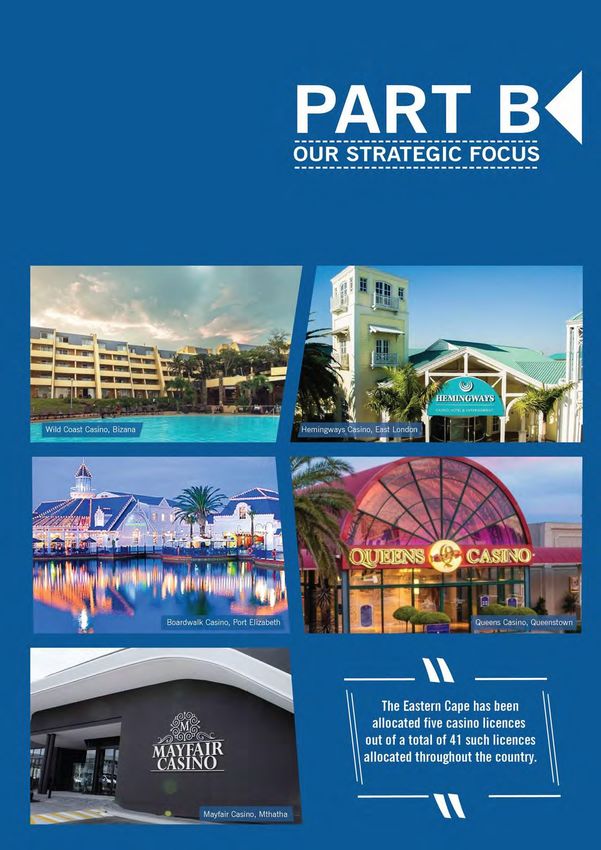
CONTENTS

Foreword by the Chairperson of the ECGB                                                           2
Official Sign-off                                                                                 3
Table of Contents                                                                                 4
List of Tables and Figures                                                                        6
List of Acronyms and Abbreviations                                                                7
Statement by the Accounting Officer (CEO) of the ECGB                                             8

PART A: OUR MANDATE                                                                               9

1.     Relevant Legislative and Policy Mandates                                                   10
2.     Institutional Policies and Strategies                                                      10
3.     Relevant Court Rulings or Litigation Matters                                               11

PART B: OUR STRATEGIC FOCUS                                                                       12

4.   Situational Analysis                                                                         13
4.12 External Environment Analysis                                                                22
4.17 Internal Environment Analysis                                                                30

PART C: MEASURING PERFORMANCE                                                                     35

5.     Institutional Performance Information                                                      36

6.     Budget Programme One: Corporate Services Management & Administration                       36
6.1    Purpose of the Budget Programme                                                            36

7.     Budget Sub-Programme: Financial Management Services                                        36
7.1    Purpose of the Budget Sub-Programme: Financial Management Services                         36
7.2    Budget Sub-Programme: Outcomes, Outputs, Selected Key Performance Indicators &
       Annual Targets                                                                             36

8.     Budget Sub-Programme: Strategic Management Services                                        36
8.1    Purpose of the Budget Sub-Programme: Strategic Management Services                         36
8.2    Budget Sub-Programme: Outcomes, Outputs, Selected Key Performance Indicators & Annual
       Targets                                                                                    37

9.     Budget Sub-Programme: Office of the CEO                                                    37
9.1    Purpose of the Budget Sub-Programme: Office of the CEO                                     37
9.2    Budget Sub-Programme: Outcomes, Outputs, Selected Key Performance Indicators & Annual
       Targets                                                                                    37

10.    Budget Sub-Programmes: Selected Key Performance Indicators, Annual and Quarterly Targets   37
10.1   Budget Sub-Programme: Financial Management Services                                        37
10.2   Budget Sub-Programme: Strategic Management Services                                        38
10.3   Budget Sub-Programme: Office of the CEO                                                    38

11.    Explanation of Programme One: Planned Performance and Risk Appetite over the
       Medium-Term Period                                                                         38

12. Programme One Resources Consideration: Budget Allocation                                      39
12.1 Contribution of Resources Towards Achievement of Outputs                                     39

13.    Key Risks Identified                                                                       40

14. Budget Programme Two: Gambling Regulation and Consumer Protection                             41
14.1 Purpose of the Budget Programme                                                              41

                                                      4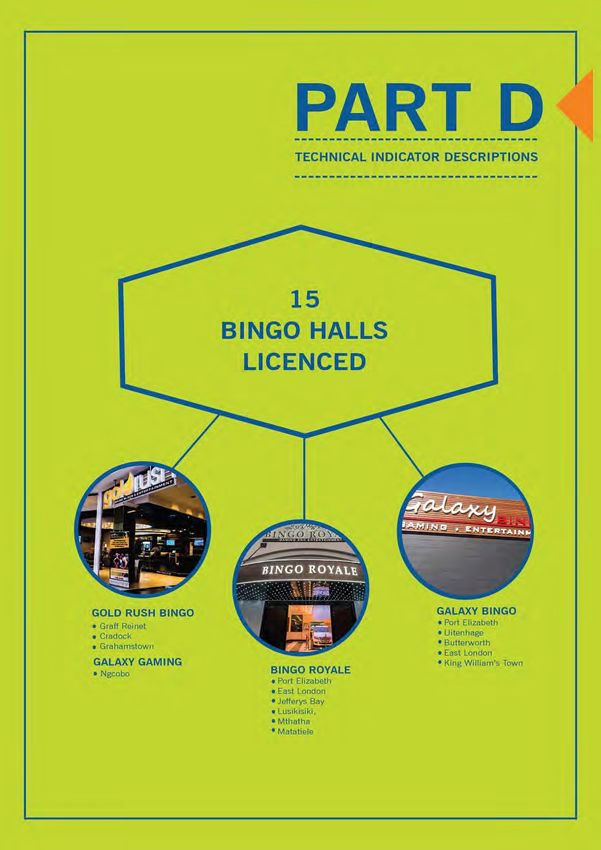
15. Budget Sub-Programme: Investigation and Licensing Administration                             41
15.1 Purpose of the Budget Sub-Programme: Investigation and Licensing Administration             41
15.2 Budget Sub-Programme: Outcomes, Outputs, Selected Key Performance Indicators & Annual
     Targets                                                                                     41

16. Budget Sub-Programme: Law Enforcement & Gaming Control                                       41
16.1 Purpose of the Budget Sub-Programme: Law Enforcement & Gaming Control                       41
16.2 Budget Sub-Programme: Outcomes, Outputs, Selected Key Performance Indicators &
     Annual Targets                                                                              42

17. Budget Sub-Programme: Audit and Compliance Services                                          42
17.1 Purpose of the Budget Sub-Programme: Audit and Compliance Services                          42
17.2 Budget Sub-Programme: Outcomes, Outputs, Selected Key Performance Indicators &
     Annual Targets                                                                              42

18.    Budget Sub-Programme: Selected Key Performance Indicators, Annual and Quarterly Targets   42
18.1   Budget Sub-Programme: Investigation and Licensing Administration                          42
18.2   Budget Sub-Programme: Law Enforcement & Gaming Control                                    42
18.3   Budget Sub-Programme: Audit and Compliance Services                                       43

19. Explanation of Programme Two: Planned Performance and Risk Appetite over the
     Medium-Term
Medium-Term PeriodPeriod                                                                         43

20. Programme Two Resources Consideration: Budget Allocation:                                    43
20.1 Contribution of Resources Towards Achievement of Outputs                                    43

21.    Key Risks Identified                                                                      44

22. Budget Programme Three: Research and Public Education                                        45
22.1 Purpose of the Budget Programme                                                             45

23. Budget Sub-Programme: Empirical Research & Information Management                            45
23.1 Purpose of the Budget Sub-Programme: Empirical Research & Information Management            45
23.2 Budget Sub-Programme: Outcomes, Outputs, Selected Key Performance Indicators &
     Annual Targets                                                                              45

24. Budget Sub-Programme: Responsible Gambling, Public Education & Communications                45
24.1 Purpose of the Budget Sub-Programme: Responsible Gambling, Public Education &
     Communications                                                                              45
24.2 Budget Sub-Programme: Outcomes, Outputs, Selected Key Performance Indicators &
     Annual Targets                                                                              46

25. Budget Sub-Programmes: Selected Key Performance Indicators, Annual and Quarterly Targets…. 46
25.1 Budget Sub-Programme: Empirical Research & Information Management                          46
25.2 Budget Sub-Programme: Responsible Gambling, Public Education & Communications              46

26.    Explanation of Programme Three: Planned Performance and Risk Appetite over the
       Medium-Term Period                                                                        46

27. Programme Three Resources Consideration: Budget Allocation                                   47
27.1 Contribution of Resources Towards Achievement of Outputs                                    47

28.    Key Risks Identified                                                                      47

PART D: TECHNICAL INDICATOR DESCRIPTIONS                                                         48

PART E: ANNEXURES                                                                                55
Annexure A: Theory of Change Process                                                             56
Annexure B: List of Reporting Indicators                                                         64

                                                    5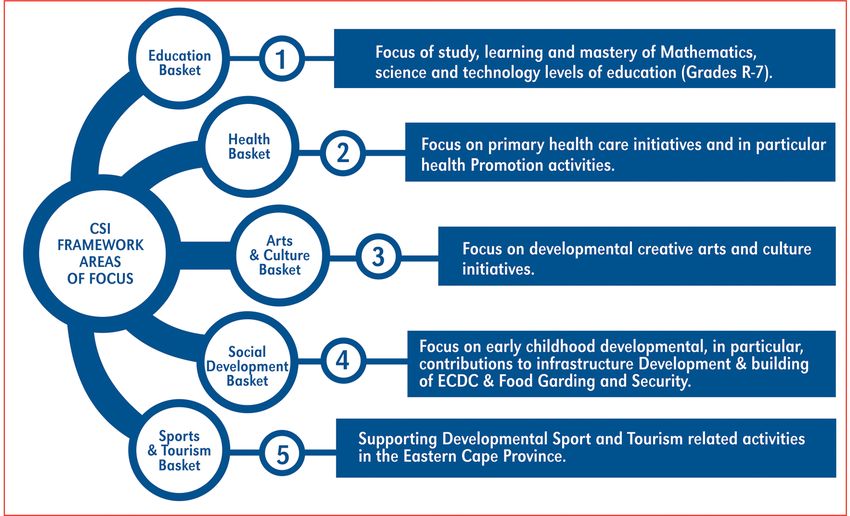
LIST OF TABLES

Table 1: Revenue Collected for the Eastern Cape Fiscus over the Past Five Years               13
Table 2: Gambling Industry Facilitated Sustainable Job Opportunities                          14
Table 3: Functional and Operating Eastern Cape Casino Profile on Infrastructure Development   15
Table 4: Profile of Gambling Industry Sustainable Job Opportunities Created and Maintained    15
Table 5: Eastern Cape Casinos Per Zone or Municipal Boundaries                                16
Table 6: Profile of Operating Eastern Cape Casinos                                            16
Table 7: Profile of Eastern Cape RO and LPMs                                                  17
Table 8: Independent Site Owners (ISO) Type D                                                 17
Table 9: Profile of the Eastern Cape BM industry                                              18
Table 10: Profile of the Eastern Cape Totalisator and Racecourse                              18
Table 11: Profile of Eastern Cape Operational Bingo Halls                                     19
Table 12: ECGB Workforce Profile                                                              33
Table 13: Budget Estimates by Economic Classification                                         34

LIST OF FIGURES

Figure   1:   Barometer on Compliance Level of Licensees                                      24
Figure   2:   CSI Framework Focus Areas / Baskets                                             25
Figure   3:   Organisational Structure & Capacity                                             31
Figure   4:   Budget and Programme Structure of the ECGB                                      33

                                                     6
LIST OF ACRONYMS AND ABBREVIATIONS

AFS      Annual Financial Statements                            IA            Internal Audit

AGSA     Auditor-General of South Africa                        IDP           Integrated Development Plan

AO       Accounting Officer                                     IGR           Inter-Governmental Relations

APP      Annual Performance Plan                                IPAP          Industrial Policy Action Plan

         Broad-Based Black Economic Empowerment                 ICT           Information Communication
B-BBEE
                                                                              Technology
BCMM     Buffalo City Metro Municipality                        ISO           Independent Site Operator

CAPEX    Capital Expenditure                                    IT            Information Technology

CEO      Chief Executive Officer                                IYM           In-Year Monitoring

CFO      Chief Financial Officer                                LPM           Limited Payout Machine

CSI      Corporate Social Investment                            MEC           Member of the Executive Council

         Department of Economic Development, Environmental      MPAT          Management Performance Assessment
DEDEAT
         Affairs & Tourism                                                    Tool
DPME     Department of Planning, Monitoring and Evaluation      MPL           Member of the Provincial Legislature

DPSA     Department of Public Service Administration            MTEF          Medium-Term Expenditure Framework

DRDAR    Department of Rural Development & Agrarian Reform      MTSF          Medium-Term Strategic Framework

DSRAC    Department of Sports, Recreation, Arts & Culture       NDP           National Development Plan

EC       Eastern Cape                                           NGB           National Gambling Board

ECGB     Eastern Cape Gambling Board                            PAIA          Promotion of Access to Information Act

ECLB     Eastern Cape Liquor Board                              PAJA          Promotion of Administrative Justice Act

FICA     Financial Intelligence Centre Act                      PDI           Previously Disadvantage Individual

GG       Government Gazette                                     POE           Portfolio of Evidence

GGR      Gross Gaming Revenue                                   PSACF         Public Sector Audit Committee Forum

GIMS     Gaming Information Management System                   REMCO         Remuneration Committee

GRAF     Gambling Regulators Africa Forum                       SED           Socio-Economic Development

GTAC     Government Technical Advisory Centre                   SMME          Small Medium Micro Enterprise

HDI      Historically Disadvantaged Individual                  SPV           Special Purpose Vehicle

HoD      Head of Department                                     Type A: LPM   3-5 Limited Payout Machines

HRM      Human Resource Management                              Type B: LPM   20-40 Limited Payout Machines

HRD      Human Resource Development                             Type C: LPM   6-15 Limited Payout Machines

HR       Human Resource                                         Type D: LPM   40 Limited Payout Machines

                                                            7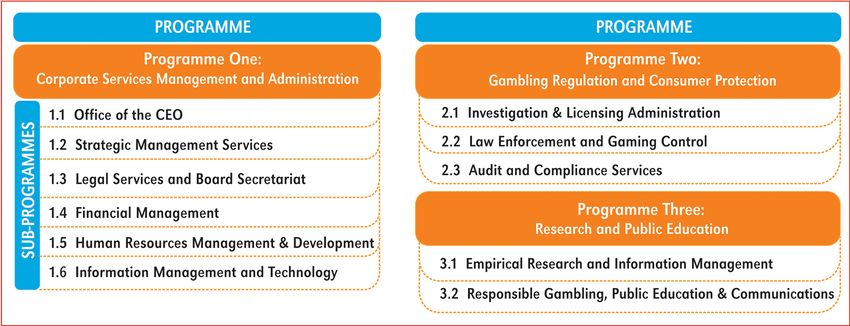
STATEMENT BY THE ACCOUNTING OFFICER (CEO) OF THE ECGB

                                The 2020 - 2022 Annual Performance Plan (APP) of the ECGB has been
                                developed in line to provincial and national priorities in order to contribute to
                                the desired growth of the economy of the Eastern Cape, thereby creating
                                sustainable job opportunities for all.

                                Conscious and deliberate efforts have been made to ensure that the work of
                                the ECGB is geared towards achieving the seven national and provincial
                                priorities, in line with the current electoral term.

                                Given the challenges of the current Covid-19 pandemic and the post Covid-19
                                period, an urgent review and reduction of some of the key targets for the
                                2020/21 financial year was conducted.
 The Board will invest its energy and limited resources in ensuring that the planned activities are implemented
 and reported accordingly during this challenging period.Over the next three years of the MTEF, the ECGB will
 implement the following targets seeking to achieve the identified strategic outcomes:

   § Sixteen (16) key gambling licences awarded to suitably qualified applicants following adherence to the
     ECGB’s rigorous licensing process.
   § R450 million gambling taxes collected from licensees and disbursed to the provincial fiscus, as
     required by the Eastern Cape Gambling Act (Act 5 of 1997), (as amended).
   § Level three compliance maturity reached by all new and existing operators to ensure that the gambling
     industry in the province is compliant with statutory requirements and licence conditions.
   § One hundred and seventy five (175) revenue audits conducted to ensure provision of quality assurance
     on the completeness, accuracy and validity of taxes and fees by verifying, recalculating and reporting
     the findings.
   § Twenty six (26) sweeps conducted in the Eastern Cape in order to detect, investigate and prevent
     illegal gambling operations.
   § Fifteen (15) gambling economic opportunities awareness sessions conducted to attract new
     entrepreneurs into the gambling space and promote awareness about available economic opportunities
     associated with gambling. Furthermore, encourage as many people as possible to exploit economic
     opportunities relating to gambling business activities within the provincial gambling sector.
   § One million three hundred thousand (1.3 million) people confirm that they have heard, listened to or
     read responsible gambling messages.
   § Twelve (12) CSI projects implemented within the limited budget allocation, with priority given to the
     implementation of projects in communities located within the identified poorest wards in the province.
   § Three (3) research outputs commissioned in generating a reliable body of valid data and research
     information about gambling in the province that will ensure all decisions relating to gambling are
     evidence-based.
   § Level 3 Organisational Maturity on assessment of organisational performance maturity will be
     administered every two years to ensure that the effective functionality of all governance processes
     and components of the ECGB are pitched at a maximum level

As the Accounting Officer, I wish to endorse this 2020 – 2022 Annual Performance Plan and further express
my sincere appreciation to the Board of ECGB, the Chairperson of the Board and the Hon MEC and
management of DEDEAT for their continued guidance, support and commitment to the regulation of the
gaming industry and the protection of the public in our province.

Mr Reuben Mabutho Zwane
CEO and Accounting Officer

                                                      8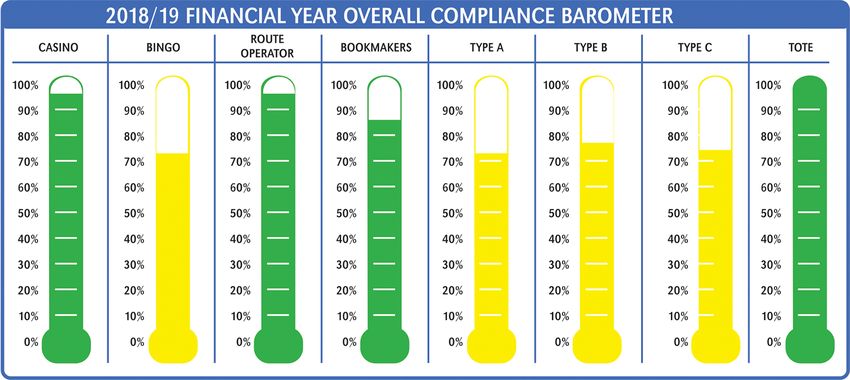
9
PART A: OUR MANDATE

1.      RELEVANT LEGISLATIVE AND POLICY MANDATES

Although there has been no update on relevant pieces of legislation and policy mandates during the
development of the Five-Year Strategic Plan and Three-Year Annual Performance Plan, the ECGB is governed
by the following pieces of legislation:

1.1     Eastern Cape Gambling Act (Act 5 of 1997), (as amended);
1.2     National Gambling Act (Act 7 of 2004), (as amended);
1.3     Public Finance Management Act (Act 1 of 1999), (as amended);
1.4     Promotion of Access to Information Act (Act 2 of 2000);
1.5     Promotion of Administrative Justice Act (Act 3 of 2000);
1.6     National Treasury Regulations;
1.7     Labour Relations Amendment Act (Act 6 of 2014), (as amended);
1.8     Basic Conditions of Employment Amendment Act (Act 20 of 2013), (as amended);
1.9     Companies Act (Act 71 of 2008), (as amended); and other pieces of legislation incidental thereto.

2.      INSTITUTIONAL POLICIES AND STRATEGIES

Although there has been no update on institutional policies and strategies during the development of the five-
year Strategic Plan and three-year Annual Performance Plan, the following internal policies, strategies and
frameworks guide the work of the ECGB:

2.1     Eastern Cape Provincial Development Plan;
2.2     Eastern Cape Provincial Priorities;
2.3     Integrated Provincial Anti-Poverty Strategy;
2.4     ICT Policy;
2.5     Business Continuity Policy;
2.6     Safety Health Environment Risk Quality;
2.7     Occupational Health and Safety Policy;
2.8     Records Management Policy;
2.9     Training and Development Policy;
2.10    Health and Productivity Management Policy;
2.11    Human Resources Management Policy or Manual;
2.12    Complaints Investigation Policy;
2.13    Performance Information Management Policy;
2.14    Intergovernmental Relations Policy;
2.15    Bursary Policy;
2.16    Wellness Management Policy (Former Employee Assistant Policy);
2.17    Funeral Policy;
2.18    Donations, Gifts and Sponsorships Policy;
2.19    Recruitment and Selection Policy;
2.20    Retention and Succession Policy;
2.21    Resettlement Policy;
2.22    Remunerative Work Outside Employment;
2.23    Directive on Leave Policy;
2.24    Supply Chain Management Policy;
2.25    Petty Cash Management Policy;
2.26    Subsistence and Travel Policy;
2.27    Enterprise Risk Management Policy;
2.28    Code of Ethics and Business Conduct;
2.29    Whistle Blower Policy; and
2.30    Communication and Social Media Policy.

                                                     10
3. RELEVANT COURT RULINGS OR LITIGATION MATTERS
Listed below are relevant court rulings and litigation matters that may have influence in the mandate of the
organisation in the form of precedent, as well as litigation matters that are currently before the Board:
ONGOING COURT CASES:
3.1 EMFULENI RESORTS (PTY) LTD v GALAXY BINGO PORT ELIZABETH (PTY) LTD t/a GALAXY BINGO
& OTHERS;
3.2 VUKANI GAMING EASTERN CAPE (PTY) LTD v EASTERN CAPE GAMBLING BOARD & OTHERS;
3.3 EMFULENI RESORTS (PTY) LTD v EASTERN CAPE GAMBLING BOARD;
3.4 FREEPLAY - SUN INTERNATIONAL LIMITED v WESTERN CAPE GAMBLING & RACING BOARD;
3.5 GAUTENG OFF-COURSE BOOKMAKERS ASSOCIATION v PHUMELELA (PTY) LTD (Judgment was
reserved);
3.6 SOUTH AFRICAN BOOKMAKERS ASSOCIATION & OTHERS v NATIONAL GAMBLING BOARD OF
SOUTH AFRICA & OTHERS (Filed a Notice to Abide);
DECIDED CASES:
3.7 ELITE BINGO (UTH) (PTY) LTD & ANOTHER v MABUTHO ZWANE N.O & OTHERS – APPEAL
(Appeal dismissed with costs in favour of the ECGB. This was a significant outcome in support of the
licensing process and decision-making of the Board in awarding of licences.)
3.8 VUKANI GAMING EASTERN CAPE (PTY) LTD v EASTERN CAPE GAMBLING BOARD – INTERDICT
APPLICATION (The interdict application was dismissed with costs in favour of the ECGB.)
3.9 EMFULENI RESORTS (PTY) LTD v EASTERN CAPE GAMBLING BOARD & OTHERS – INTERDICT
APPLICATION (The interdict application was dismissed with costs in favour of the ECGB.)
1112
PART B: OUR STRATEGIC FOCUS

4.       SITUATIONAL ANALYSIS

The situational analysis provides the context for implementing the planned initiatives over the medium-term
period and must be reviewed regularly. During the first year of the five-year planning cycle, the situational
analysis in the Annual Performance Plan (APP) must be the same as that in the Strategic Plan (SP).

From the second year of the planning cycle, the information in the SP at the beginning of the planning cycle
must be updated annually in the APP, with changes in the institution’s internal and external environment
guiding the development of the APP. Reviewing the situational analysis must take account of evaluation
reports and performance information from the previous financial year; relevant research into emerging trends
and the status of women, youth and people with disabilities (where applicable); and decisions taken through
the use of planning tools such as scenario planning, SWOT analysis, PESTEL analysis, Fishbone analysis and
Problem and Solution Tree analysis.

The key areas below are reflected in the new five-year Strategic Plan of the ECGB:

4.1          Strategic Focus of the Institution over the Five-Year Planning Period.

The Strategic Focus of the Institution over the five-year planning period and beyond include the following:

             § Grow the revenue and gambling taxes at a rate of 1.5 times the upper limit of the inflation
               target;
             § Enhance regulatory compliance by the gambling industry in the province whilst providing
               comprehensive support to industry to be sustainable and transformed;
             § Invest more energy, time and resources on harm minimisation as a result of excessive and
               irresponsible gambling and institutionalisation of a culture of responsible gambling in the
               province;
             § Empower communities located in areas where there is a gambling footprint, as well as
               impoverished areas;
             § Conduct empirical research as well as programme evaluation for policy and strategy decisions;
               and
             § Maintain and sustain sound and effective corporate governance while making the ECGB an
               employer of choice.

4.2          Recent Statistics Relevant to the Institution and Sector

In developing the five-year Strategic Plan, the following statistics have been considered:

4.2.1       Revenue Contribution to the Provincial Fiscus

The ECGB is the second largest contributor to the provincial fiscus, following revenue emanating from motor
vehicle licensing. The ECGB’s total contribution to the provincial fiscus in the last five years (2014/15 -
2018/19) from gambling and betting taxes and fees, including interest received, was R842.6 million. Table 1
below indicates the sources of revenue and revenue collected over the past five years.

Table 1: Revenue Collected for the Eastern Cape Fiscus Over the Past Five Years
                                                    2014/15       2015/16      2016/17       2017/18    2018/19
 Revenue to Fiscus
                                                      R'000          R'000        R'000        R'000      R'000
 Casinos                                             98 119        99 935       97 158        96,057     95 168
 Bookmakers & Totalisator                             7 686         9 106       11 107        11 759     12 799
 Bingo                                               11 395        21 944       31 411        38 291     45 582
 Limited Payout Machines                             23 880        27 140       31 142        35 234     37 771
 Total Taxes                                        141 080       158 125      170 818       181 341   191 320
 Growth Rate                                          15.6%         12.1%         8.0%          6.2%      5.5%
Source: ECGB Annual Report

                                                       13
Over the past five years the ECGB has stimulated gambling tax revenue growth primarily through the licensing
and rollout of bingo and Limited Payout Machines (LPMs). This has resulted in significant growth in tax
revenues paid to the fiscus at rates higher than national averages (9.5% on average per annum, which is
2.7% higher than the national average over this period.) The growth rate is, however, reflecting a decreasing
trend and in 2019/20 the year-on-year growth at the end of the third quarter was 3.3%. This slower growth is
expected to continue over the next three years due to prevailing economic conditions and less licensing activity
planned.
4.2.2 Decent Employment Opportunities Through Inclusive Growth
Employment in the gambling industry requires high levels of integrity, honesty and morality. The Board is
responsible for receiving applications and approving key persons and gambling employees. The number of key
gambling employees has increased in response to the continued development of the LPM, bookmaking and
bingo industries.
The gambling industry continues to create sustainable job opportunities, promote tourism and facilitate and
contribute to significant infrastructural development and investments, even in non-metropolitan areas which
stimulate the local economy through procurement of goods and services within the province. Table 2 below
reflects the number of sustainable job opportunities created by the provincial gambling sector in the Eastern
Cape as at December 2018.
Table 2: Gambling Industry Facilitated Sustainable Job Opportunities
Bizana Port Elizabeth East London
Queenstown Mayfair Total
Casinos Wild Coast Boardwalk Hemingways
Queens Casino Casino Employment
Sun Casino Casino Casino
Total Employees
520 508 410 155 232 1 825
for Casinos
RO and LPMs Vukani Gaming Eastern Cape (Pty) Ltd Pioneer Slots (Pty) Ltd
Total Employees 836
420 416
for RO & LPMs
Independent Site Op erators
130
Total Employees for ISOs
Bookmakers (Total of 9 Licensed Bookmakers)
392
Total Employees for Bookmakers
Totalisator and Racecourse
15
Total Employees for Totalisator & Racecourse
Bingo Halls (Total of 15 Licensed Bingo Halls)
778
Total Employees for Bingo Halls
Grand Total 3 976
Source: ECGB Gambling Information Management System (GIMS)
4.2.3 Contributions Towards Infrastructure Development in the Eastern Cape1
As a result of the conditions imposed on gambling licensees, casino investments reached beyond the
development of the immediate gambling premises and resulted in the establishment of new hotels, shopping
malls, entertainment centres and convention centres. Table 3 on the following page depicts the casino profile
on infrastructure development in the Eastern Cape.
1
Contributions towards infrastructure development in the Eastern Cape province address National Outcome 06: “An
efficient, competitive and responsive economic infrastructure network.”
14Table 3: Functional and Operating Eastern Cape Casino Profile on Infrastructure Development
Bizana: East London:
Port Elizabeth: Queenstown: Mthatha:
Description Wild Coast Sun Hemingways
Boardwalk Casino Queens Casino Mayfair Casino
Casino Casino
Date Opened 2009 2010 2011 2017 2018
Total Capital
R2.6 Billion R1 Billion* R400 Million* R151 Million R141 Million
Investment (Rm)
*These are reinvestments and do not represent the market value or original investment on the first award of licences
4.3 Reference to the Medium and Long-Term Policy Environment
The Cabinet adopted 14 government outcomes as per the National Development Plan (NDP) within which to
frame public service delivery priorities and targets. Cabinet ministers have signed performance agreements
linked to these outcomes. More detailed delivery agreements have since been developed to extend targets and
responsibilities to national and provincial departments, agencies and municipalities.
The provincial Department of Economic Development, Environmental Affairs and Tourism has developed a set
of Policy Initiatives / Imperatives to be implemented by all public entities that report to the Department. The
Eastern Cape Gambling Board, as one of these public entities, has the responsibility of demonstrating how it
will implement some of the Policy Initiatives and Imperatives over a period of time.
Furthermore, the Eastern Cape province has pronounced seven provincial strategic priorities, with the
DEDEATs Group Priorities and the focus on the ECGB included five priorities. From a planning perspective, the
ECGB, within its regulatory functions, is obliged to demonstrate how it plans to add value and contribute
towards the achievability of the seven national priorities of government outcomes, as outlined in the NDP Five-
Year Implementation Plan aligned with the seven provincial strategic priorities.
Specific outcomes contributing towards the achievability of the seven national priorities of government
outcomes, as outlined in the NDP Five-Year Implementation Plan aligned with the seven provincial strategic
priorities, are expressed under Part C.
The ECGB, as a gambling regulator, will also consider the above policy imperatives and ensure that its
strategic outcomes and planned targets are aligned to these policy imperatives, where possible.
4.4 Evidence-Based Analysis of the Strategic Context and Priorities Relating to Women,
Children, Youth and People with Disabilities
Table 4 below indicates various type of licensees and the total number of persons employed as a result of
licences issued in terms of the designated groups. The table thus depicts the total number of 4 509
sustainable job opportunities created cumulatively as at 19 December 2019.
Table 4: Profile of Gambling Industry Sustainable Job Opportunities Created and Maintained
NON- FEMALES YOUTH DISABLED PDI NON-PDI
TYPE OF GAMING
GAMING Non- Non- Non- Non- Non-
LICENSEES TOTAL Gaming Gaming Gaming Gaming Gaming
TOTAL Gaming Gaming Gaming Gaming Gaming
Casinos 831 619 393 438 260 386 6 4 598 772 21 59
Bookmakers 410 298 63 340 65 330 0 0 291 388 7 22
Route Operator &
986 307 153 403 93 268 0 1 290 883 17 103
Site Operators
Bingos 429 337 267 301 198 183 1 1 321 394 16 35
Totalisator 58 31 0 51 26 0 0 0 29 54 2 4
Certificate of
Suitability 73 4 8 40 8 24 2 0 0 63 4 10
Manufacturers 11 15 16 23 10 26 0 0 14 11 1 0
ISO 81 19 13 3 2 5 0 0 15 72 4 9
TOTAL 2 879 1 630 913 1 599 662 1 222 9 6 1 558 2 637 72 242
Source: ECGB Gambling Information Management System (GIMS)
154.5 Profile of Types of Gambling Licences awarded to the Qualified Applicants
4.5.1 Casino Licences Operations
The Eastern Cape has been allocated five casino licences out of a total of 41 such licences allocated
throughout the country. The ECGB allocated the provincial licences to five zones in an endeavour to ensure
that a measure of geographic spread was applied to the distribution of casino gambling activities. Table 5
below depicts the five casino licences awarded in the province, including their expiry dates.
Table 5: Eastern Cape Casinos per Zone or Municipal Boundaries
Expiry Term of
District Municipality Zone Casino Location
Date Licence
Nelson Mandela Bay Metropolitan Emfuleni Resorts (Pty) Ltd t/a Port
Zone 1 2025 15 Years
Municipality The Boardwalk Casino Elizabeth
Buffalo City Metropolitan Tsogo Sun Emonti (Pty) Ltd t/a
Zone 2 East London 2026 15 Years
Municipality Hemingways Casino
Zitolor (Pty) Ltd
Chris Hani District Municipality Zone 3 t/a Queens Casino Queenstown 2037 20 Years
Mayfair Casino (Pty) Ltd
(2014/147296/07)
OR Tambo District Municipality Zone 4 Mthatha 2038 20 Years
t/a Mayfair Casino
Transkei Sun International Ltd Mzamba 2019*
Alfred Nzo District Municipality Zone 5 10 Years
t/a Wild Coast Sun Casino Bizana
*Licence Extended Until 29 February 2020 Pending Finalisation of the Licensing Process
Casino operations generated gross gaming revenues of R1.17 billion and contributed R95.2 million to the
Provincial Revenue Fund during 2019/20. Table 6 below depicts an overall profile of operational Eastern Cape
casinos.
Table 6: Profile of Operating Eastern Cape Casinos
Bizana: East London:
Port Elizabeth: Queenstown:
Description Wild Coast Sun Hemingways Mayfair Casino
Boardwalk Casino Queens Casino
Casino Casino
December
Date Opened October 2009 October 2010 September 2011 December 2017
2018
Zitolor (Pty)
Wild Coast Sun Emfuleni Tsogo Sun Ltd t/a Queens Mthatha Casino
Operator
International Ltd Resorts (Pty) Ltd Emonti (Pty) Ltd Casino (Pty) Ltd
Tsogo Sun Casino No
Management Sun International Sun International African Pioneer
Management management
Company Management Ltd Management Ltd Gaming (Pty) Ltd
Company company
Total Capital
R2.6 Billion R1 Billion R400 Million R151 Million R141 Million
Investment (Rm)
Total Employees 520 508 410 155 232
Slot Machines 622 790 541 181 154
Tables 24 38 21 10 8
Electronic Player
- 8 - 8 16
Terminals
Source: ECGB Gambling Information Management System (GIMS)
It is evident that the casino component of the Eastern Cape gambling industry is significant and contributes to
sustainable job creation in the province. As at the end of the 2019/20 financial year the casino component
employed about 1825 people in permanent and temporary jobs. More than R4 Billion has been invested by the
casino industry in the province, which attracted over 6 million visitors during 2019/20.
164.5.2 Route and Site Licence Operations
Apart from casino licence operations, the provincial gambling industry also consists of route and site licence
operations. These operations are located at recreational and leisure amenities such as taverns, clubs and pubs2.
To date, the ECGB has awarded two route operator licences in terms of Section 49 of the Eastern Cape Gambling
Act.
Vukani Gaming Eastern Cape (Pty) Ltd, trading as V-Slots, has established a number of site licence operations
distributed widely across the province. In this regard, the Limited Payout Machine (LPM) industry clearly fulfills a
demand for entertainment facilities different to those provided by casino-type operations. V-Slots is currently
operating 820 LPMs from 89 sites. A second route operator, Pioneer Slots (Pty) Ltd, has been licensed to
operate 1000 LPMs and is currently operating 844 LPMs from 67 operational sites. Both these route operator
licences are valid for a period of 15 years.
Site operations are made up of Type A (3-5 LPMs), Type B (20-40 LPMs) and Type C (6-15 LPMs) site licences.
The route and site operations generated gross gaming revenues of R377.7 million and contributed R37.8 million
gambling tax to the Provincial Revenue Fund during 2019/20. Table 7 below depicts an overall profile of
licensed Eastern Cape route operators.
Table 7: Profile of Eastern Cape Route Operators and Limited Payout Machines
Description Vukani Gaming Eastern Cape (Pty) Ltd Pioneer Slots (Pty) Ltd
Date Licence Issued 29/03/2012 01/03/2013
Date Licence Expires 31/03/2027 29/02/2028
Number of Sites Licensed 89 67
Registered Employees 420 416
Total Slot Machines 820 844
Source: ECGB Gambling Information Management System (GIMS)
In line with legislative amendments to the regulations on LPMs, the Board has also created a fourth category of
site licence, namely Independent Site Owners (ISO), referred to as Type D, with 40 LPMs. The ISO will be
independently owned by the site owners with no link or profit sharing with the route operator. Table 8 below
page depicts Independent Site Owners (ISO) (Type D) licences.
Table 8: Independent Site Owners (ISO) (Type D)
District
Licensed Location of ISO Date Licence Date Licence Employment No. of
Municipalit Investment Value
ISO in the province Issued Expiry Created LPMs
y or Metro
Spin & Win No new
Nelson Uitenhage 29/03/2018 28/03/2038 25 40
Uitenhage investment3
Mandela Bay
Metro Bay West, Port
Royale Aces 27/09/2019 26/09/2039 33 40 R5.6 Million
Elizabeth
Spin & Win No new
Mbizana 29/03/2018 28/03/2018 27 40
Alfred Nzo Mbizana investment4
District Spinners Mount
Mount Frere 01/11/2019 31/10/2039 26 40 R2.3 Million
Frere
Joe Gqabi Golden Palace
Sterkspruit 07/11/2019 31/10/2039 19 40 R928,974.69
District Sterkspruit
Total 130 200 R8.8 Million
Source: ECGB Gambling Information Management System (GIMS)
Note: The other five (5) ISO licences are not yet operational
2
Regulation 60(3) of the ECGB Regulations indicates that limited gambling machine site licences may be granted to a wide
range of facilities, including sporting or social clubs, licensed taverns and shebeens, racecourses, bookmakers’ outlets,
totalisator outlets, hotels and nightclubs, licensed sports bars, bingo halls, pool or snooker establishments and licensed
bars.
3
This was a conversion of an existing Type B to a Type D
4
This was a conversion of an existing Type B to a Type D
174.5.3 Bookmaking and Totalisator Operations
Bookmaking Operations
Betting activities related to horseracing are conducted by nine registered bookmakers in the province who have
41 licensed branches. The bookmaking industry has shown a steady growth recently and a number of new
bookmakers with a national footprint have applied, with existing bookmakers also applying for additional
premises. Sports betting continues to grow in popularity, despite delays in legislative amendments to zero rate
sports betting.
The horseracing industry remains a significant source of employment and provides access to a wide range of
specialised job opportunities, supported by comprehensive training and skills development programmes
conducted by the racecourse operator which extends to jockeys, trainers and breeders.
Sports betting and horseracing operations generated gross gaming revenues of R308.2 million and contributed
R11.8 million to the Provincial Revenue Fund during 2017/18. Table 9 on below reflects an overall profile of
licensed Eastern Cape bookmakers.
Table 9: Profile of the Eastern Cape Bookmaker Industry
Date Licence
Licensed Bookmakers Date Licence Issued No. of Branches Employees
Expires
Hollywood Sportsbook Eastern Cape
23/06/2016 22/06/2021 10 100
(Pty) Ltd t/a Hollywood Bets
Vandastar (Pty) Ltd t/a G-bets
01/03/2013 14/05/2020 5 63
Eastern Cape
WH van der Vyver (Pty) Ltd t/a
01/01/2018 31/12/2022 9 52
Marshalls World of Sport
Lucky Bet (Pty) Ltd t/a Soccer Shop 24/11/2017 23/11/2022 3 26
BetXchange Eastern Cape (Pty) Ltd
17/12/2015 16/12/2020 1 14
t/a BetXchange
FEE Gaming (Pty) Ltd t/a iGaming 07/08/2017 06/08/2022 6 56
Vincent Tattersalls CC t/a Vincent
18/03/2019 17/03/2024 2 3
Tattersalls
KJI Company (Pty) Ltd t/a Supabets 11/08/2017 10/08/2022 3 70
Boss Bookmaker (Pty) Ltd t/a
13/12/2017 12/12/2022 2 8
G-Bets Eastern Cape
Totals 41 392
Source: ECGB Gambling Information Management System (GIMS)
Totalisator and Racecourse Operations
The ECGB re-licensed Phumelela Gaming and Leisure Ltd (Totalisator) with new totalisator and racecourse
licences valid for a five-year period. Operations extend to 16 totalisator branches and agencies. Phumelela
Gaming and Leisure Ltd currently operates the only racecourse in the province - Fairview Racecourse in Port
Elizabeth – which is approximately 2,700m² in circumference and has an 800m run-in. Table 10 below
depicts an overall profile of the licensed Eastern Cape totalisator and racecourse.
Table 10: Profile of the Eastern Cape Totalisator and Racecourse
Licensed Totalisator and Racecourse Phumelela - Totalisator Fairview - Racecourse
Date Licence Issued 20/12/2016 20/12/2016
Date Licence Expiry 19/12/2021 19/12/2021
Registered Employees 15
Source: ECGB Gambling Information Management System (GIMS)
*Includes Employees Working at Fairview Racecourse
184.5.4 Bingo Licence Operations
A market feasibility study was commissioned in 2010 to ascertain the introduction of bingo as a new form of
gambling in the Eastern Cape. The outcome of the study influenced the development of a policy framework
that culminated in the awarding and issuing of 15 bingo licences in the Eastern Cape.
The bingo sector generated gross gaming revenues of R382.7 million and contributed R38.2 million to the
Provincial Revenue Fund during 2017/18. Table 11 below depicts an overall profile of Eastern Cape
operational bingo halls.
Table 11: Profile of Eastern Cape Operational Bingo Halls
No. of
District Location of Date Date
Licensed Employment Electronic Investment
Municipality Bingo Halls in Licence Licence
Bingo Halls Created Bingo Value
or Metro the Province Issued Expiry
Terminals
Galaxy Bingo Port Elizabeth (Pty)
Ltd (2012/136896/07) t/a Port Elizabeth 19/03/2014 18/03/2029 87 300 R11 Million
Nelson Galaxy Bingo & Entertainment
Mandela Bay
EC Gaming Uitenhage (Pty) Ltd
Metropolitan
(2012/136900/07) t/a Galaxy Uitenhage 31/08/2017 31/08/2032 82 235 R17 Million
Municipality Bingo & Entertainment
(Cacadu
District) Bingo Royale Cleary Park (Pty)
Ltd (2012/18692/07) t/a Bingo Port Elizabeth 05/09/2014 04/09/2029 62 211 R11 Million
Royale Port Elizabeth
Amathole Galaxy Bingo Butterworth (Pty)
District Ltd (2012/136895/07) t/a Butterworth 04/09/2015 03/09/2030 43 123 R5 Million
Municipality Galaxy Bingo
Galaxy Bingo East London (Pty)
Ltd (2012/136888/07) t/a
East London 07/03/2014 06/03/2029 56 177 R5 Million
Galaxy Bingo Gaming &
Entertainment
Buffalo City
Galaxy Bingo King William’s
Metropolitan
Town (Pty) Ltd
Municipality King William’s
(1997/005815/07) t/a Galaxy 02/02/2017 01/02/2032 67 161 R8 Million
(Amathole Town
Bingo and Entertainment King
District)
William’s Town
Bingo Royale Buffalo City CBD
(Pty) Ltd (2012/112914/07) t/a East London 19/09/2014 18/09/2029 62 157 R5 Million
Bingo Royale East London
Goldrush Bingo EC No.5 (Pty)
Ltd (2014/0352210/07) t/a The Grahamstown 12/06/2015 11/06/2028 36 92 R10.8 Million
Sarah Goldrush Bingo Grahamstown
Baartman Goldrush Bingo Eastern Cape
District No.3 (Pty) Ltd t/a Goldrush Graaff Reinet 23/09/2015 22/09/2030 32 89 R6 Million
Municipality Bingo Graaff Reinet
Bingo Royale JBay (Pty) Ltd t/a
Jeffreys Bay 16/03/2015 15/03/2030 52 122 R5 Million
Bingo Royale JBay
Goldrush Bingo Eastern Cape
No.4 (Pty) Ltd t/a Goldrush Cradock 29/01/2016 28/01/2031 34 89 R7 Million
Chris Hani
Bingo Cradock
District
Municipality Galaxy Gaming Zone 4 (Pty) Ltd
(2006/02153/07) t/a Galaxy Ngcobo 27/10/2016 26/10/2031 30 80 R5 Million
Bingo Gaming & Entertainment
K2014016993 (Pty) Ltd
(2014/016993/07) t/a Bingo Lusikisiki 19/02/2016 18/02/2031 30 121 R 5.3 Million
OR Tambo
Royale Lusikisiki
District
Municipality Arvodex (Pty) Ltd
(2012/112949/07) t/a Bingo Mthatha 06/12/2013 05/12/2028 57 165 R5 Million
Royale Mthatha
Alfred Nzo Bingo Royale Matatiele (Pty) Ltd
District (2014/0169944/07) t/a RITZ Matatiele 21/11/2015 20/11/2030 48 81 R3.5 Million
Municipality Bingo Matatiele
Total 778 2 203 R110 Million
Source: ECGB Gambling Information Management System (GIMS)
194.6 Spatial Information Guiding Planning
Spatial planning is a strategic process that seeks to organise how the economy, society, and the built
environment operate in space, whilst also seeking to ensure the protection, restoration and management of the
natural environment, underpinned by evidence-based and normative town and regional planning approaches.
In rolling out gambling licences, the ECGB has been guided by the ECGB Act and its regulations including
various policy imperatives which determine the location of regulated gambling operations.
Over and above the legislative requirements to roll out gambling licences and operations in the province, the
ECGB is planning to undertake a study to investigate the extent or levels of saturation (oversaturation or
undersaturation) and/or over-concentration of gambling modes, sites and agencies in local municipal areas and
in particular towns, townships, villages or wards that constitute a local municipal area in terms of the
Municipal Boundaries Act.
The findings and recommendations of the study will assist the ECGB to utilise spatial information to roll out
gambling licensees in the province appropriately.
4.7 Challenges Experienced by the Institution in the Performance Environment and
Mechanisms to Address the Challenges over the Planning Period
Consultation of the industry in developing the new five-year strategy has revealed the following challenges,
which have been taken into consideration to be addressed during this five-year period.
BM, LPM, RO, TOTE BM, LPM, RO, TOTE BINGOS AND ISOs CASINOS
AREAS OF
(PORT ELIZABETH) (REGENT HOTEL) (OSNER HOTEL) (BORDER CRICKET)
ENGAGEMENT
(03/09/2019) (10/09/2019) (16/09/2019) (26/09/2019)
1. ECGB oversight can have 1. LA2 forms and other 1. Management of Self-Exclusions – 1. Lack of induction
significant impact on application forms tedious to - to improve feedback from the conducted by
operations complete. ECGB operators
2. Pressure on operators to 2. Rules and manuals need to - clarify the process moving forward 2. A need for
employ more staff whereas be constantly updated e.g. - prescribe the process on standardisation of
they want to follow a lean gambling equipment within upliftment casino rules
manufacturing approach the province and machine 2. Food and Beverage – many local 3. Oversaturation
3. Public hearings can be logbooks suppliers are not compliant; concerns (revenue
intimidating, suggestion that 3. Socio-economic liquor is costly and expensive decline)
commitments are made in development: 3. Manufacturing - Issue of technical 4. Lack of PDI
writing, not verbally · Board to assist with list of repairs, no local carpet cleaning Development
4. Alignment requested in approved organisations company which meets the Framework (Training
terms of the Board’s · Trust fund for community standard, there is no local risk Plan)
requirement on external development programmes assessment company as a
audit and the Companies 4. Delays encountered in specific example with regulated
Act investigation processes may operators
5. Improved consistency in increase, for example the
Challenges applying regulations in a cost of lease agreements
Experienced by clear framework. before approval of licence
Licensees / 6. Guidelines on requirements 5. PDI supplier challenges:
Stakeholders of primary vs secondary Suppliers over-charging,
During the business monopoly, awareness, liquor
Previous Cycle: 7. Oversaturation concerns - suppliers are not B_BBEE
proximity /radius - fair recognised by ECGB
competition 6. Non-attendance of
8. Employee licences / engagement sessions
registration - delays 7. Lack of technical training on
encountered in receiving pieces of legislation /
permanent licences, out of policies
R/O and S/O control 8. Lack of knowledge &
9. Advanced technology - incompetence of staff
submission of documents 9. Absence / loss of
should be allowed information
electronically to ECGB
10. Challenges on the cashless
system - player cards
contain player information
which is easier for FIC but
may chase a portion of
punters away
204.8 Emerging priorities and opportunities which will be implemented during the planning
period
Following consultation and strategic conversation with the stakeholders of the ECGB, and in light of challenges
highlighted above, the following opportunities will be explored for implementation and aligned to strategic
outcomes and planned targets for the five-year period starting in 2020/2021:
§ Exploration of other revenue generation options due to the current model subsiding.
§ Conducting a study on possible new markets on propensity to gamble, which will be aligned with the
current research agenda of the ECGB, including a proposed study to evaluate the saturation of
gambling within the province.
§ Advances in technology (GRS, cell phone technology for effective regulatory service and reporting
purposes).
§ Recruitment of qualified counselling staff to address challenges associated with harmful effects of
excessive gambling, including follow-up of self- and third-party excluded punters in the province.
§ Management of the exclusion programme and the emerging data of those who are on the exclusion list
and following up with them in order to reduce excessive gambling.
§ Setting up of gambling anonymous support structures for self- and third-party excluded punters in the
province.
§ Development of clear mechanism for monitoring and reporting on trusts and foundations that are
established through licence conditions to disburse proceeds of gambling.
§ The organisation need to embrace the 4th industrial revolution and its impact on employees, including
preparing employees for a paperless environment.
§ Innovating internet interventions for problem gambling in the province for ease of access and
reduction of costs during this new five-year period should also be a priority during the sixth
administration.
§ Alignment of the organisational structure / organogram to the new strategy, including the development
and re-alignment of management responsibilities.
4.9 Information on the Capacity of the Institution to Deliver on Its Mandate
The ECGB is able to implement its mandate and fulfil its responsibilities with its current limited available
capacity. Additional responsibilities and functions have emerged, and a number of officials have been
requested to manage and implement these responsibilities.
During the sixth administration, the current organisational structure will need to be reviewed, especially
functions that require support of administration services, as these are limited and have the potential of creating
exhaustion and resulting in inefficiencies to line function responsibilities.
4.10 Relevant Stakeholders Who Contribute to the Institution’s Achievement of its Outcomes
The ECGB has an approved Stakeholder Management Strategy which outlines, among other aspects, a list of
key stakeholders who have an influence on the regulatory work of the ECGB and those that the ECGB rely or
depend on to implement its various activities. A copy of the approved Stakeholder Management Strategy with
the list of all identified stakeholders is available and also listed on the ECGB website.
Stakeholders were engaged and consulted regarding the development of this strategy as they provided valuable
and objective inputs to frame the new strategy.
214.11 Identified Challenges to be Addressed and Proposed Interventions
This table below captures significant challenges and proposed interventions that have a direct impact on the
implementation of the planned targets for the next five years, and beyond.
NO. CHALLENGES THAT EMERGED PROPOSED INTERVENTIONS
Exploration of possible regulation mechanisms and
Unregulated internet gambling may lead to potential loss of /or legislation or policy reform.
1
revenue for the fiscus Benchmark with other international jurisdictions
where internet gambling is regulated
Engagement, benchmarking and intensive seminars
A need to embrace the 4th industrial revolution in gambling and learning regarding identification and
2
regulation, risk mitigation and in the overall ICT strategy implementation of core activities of the 4th industrial
revolution within the gambling sector
Engage the department of Economic Development,
Proposed merger between Eastern Cape Liquor Board and
3 Environmental Affairs & Tourism to facilitate the
ECGB, with no feasibility study performed
process, as instructed by the MEC
Develop an information and knowledge management
A need for effective management of information generated strategy that will outline the effective management
4
within the organisation processes of information generated within the
organisation
Litigation against Board decisions on awarding licences as the Develop a clear risk management plan to mitigate
ECGB operates in a highly litigious environment and its challenges against Board decisions to award licences
5
decisions may be challenged and /or reviewed by applicants
and / or any interested persons
Develop a framework or policy that will outline
Lack of pro-active management of self and third-party
management of exclusions, including feedback and
6 exclusion list with regard to feedback from ECGB and
upliftment process, in consultation with the gambling
prescribed process on upliftment
Industry
A newly developed Gambling Regulation System
Benchmarking and monitoring of turnaround times for
7 (GRS) will be enhanced to improve turnaround
employee registration certificates
times.
4.12 External Environmental Analysis
In conducting an external environmental analysis, a SWOT and PESTEL analysis methodology was utilised,
including a reflection on issues or processes that should be changed, strengthened, improved, enhanced and
introduced, or discarded or excluded in terms of operations, regulatory and support services of the ECGB in the
next five-year cycle.
Based on the above processes, the core elements of external environment in this section emerged for
consideration:
4.12.1 Background Information on the Demand for Services and Other Factors which Informed
the Development of the Strategic Plan
Herewith important and significant background information on demand for services are rendered by the ECGB:
4.12.1.1 Licensing and Regulatory Services of the ECGB
The ECGB creates opportunities for industry role players to apply for different types of gambling licences in
terms of the Eastern Cape Gambling Act (Act 5 of 1997), (as amended) (“the Act”). A Request for Proposal
(RFP) is published inviting individual business organisations or entrepreneurs to apply for available types of
licences. The following activities are therefore implemented by the ECGB:
· Gathering of information with respect to the applicant’s business activities and those of related parties in
order to ensure that gambling is conducted in a manner that promotes the integrity of the gaming industry
and does not cause harm to the public interest;
22· Reviewing the applicant’s supporting documentation (and assertions made therein), included in their
application for such licences, to establish if the information truly reflects the integrity and sound financial
position of the applicant and its shareholders;
· Ensuring that the applicant and related parties are in compliance with the respective laws, viz the Eastern
Cape Gambling Act, the National Gambling Act, FICA as well as other statutory and ethical codes of
conduct;
· Gathering and assessing relevant information about the applicant with the objective of making
recommendations to the Board in respect of the suitability of the applicant with reference to criteria
spelled out in the applicable gambling legislation and/or RFP;
· Facilitating the registration of all applicants and awarding of licences and registration certificates to
suitably qualified applicants.
4.12.1.2 Audit and Compliance Services to Regulate the Gambling Industry
Following the allocation of temporary and permanent licences to qualified operators, the signing of conditions
of licence and the commencement and functionality of a licensed gambling establishment, audit and
compliance services ensure adherence to legislation and other regulatory instruments. The following services
are demanded by the industry and provided by the ECGB:
· Provision of quality assurance on the completeness, accuracy and validity of taxes and fees by verifying,
recalculating and reporting the findings;
· Conducting compliance audits to ensure adherence to conditions of licence, bid commitments, FICA and
ECGB legislation by inspecting, corroborating, enquiring and confirming the completeness, accuracy and
validity of the information and reporting on the findings;
· Audit adherence to ECGB legislation by observing the process of installing gaming software and testing its
functionality;
· Audit the viability of the licensee’s operations by analysing their audited or reviewed annual financial
statements;
· Review and approval of the licensee’s internal control systems and/or procedure manual;
· Maintain compliance barometer; and
· Conduct annual reviews of licence period financial guarantees.
The Board has since introduced the utilisation of a compliance barometer, an internally developed tool, to
measure compliance by licensees.
Compliance Barometer
The purpose of the compliance barometer is to provide a high-level overview of the level of compliance by the
various licensees in terms of the terms and conditions of licence, bid commitment, the ECGB Act, rules and
regulations. It is also to monitor the compliance level of licensees and to detect frequency of transgressions.
The compliance barometer has been introduced by the ECGB and widely welcomed by licensees. Regular
sessions are held with each category of licensee to assist them in developing compliance action plans to
implement remedial action and thus serves as their audit tracking tool.
Benefits Derived from Utilising the Barometer
The compliance barometer:
· Measures levels of compliance by licensees and thus enables them to gauge improvement on a year-to-
year basis;
· Allows for easy detection of licensees disregarding compliance adherence from year to year and failure to
show commitment to improve and implement recommendations of previous audits;
· Serves as a dashboard for the user to monitor the level of compliance at a glance;
· Allows for the effective monitoring of the number of transgressions by a licensee and also serves to
incentivise and reward licensees with good compliance histories, e.g. reduced cost of guarantees for
licensees; and
· Promotes interaction with the licensees to ascertain the level of knowledge or understanding about what
is required in terms of the licence conditions and ECGB legislation.
23Figure 1 below depicts compliance level by licensees as at 31 March 2019
The compliance level is 80% or more
The compliance level is between 60% and 80%
The compliance level is below 60%
Figure 1: Barometer on Compliance Level of Licensees
Figure 1 shows average compliance level is above 60%.
Risk-Based Audits
Since the introduction of the compliance barometer, the Audit and Compliance unit has utilised a risk-based
approach in assessing the compliance history of each licensee within a specific type of licence over a period
of a year. The compliance barometer is updated on a quarterly basis. This risk-based approach impacts on
the frequency of audits at a specific licensee.
As a result of the compliance barometer outcomes, the frequency of revenue audits has been reduced from
quarterly to annually for casinos and bingo halls due to their compliance maturity level. Reliance is also
placed, where relevant, on the work of the internal audit departments of the licensees who submit their
quarterly reports to the Board for review.
Our regulations also require that the external auditors of each licensee must evaluate and report on the licence
holder’s compliance with its system of internal control, as approved by the Board. These reports must be
submitted to the Board with their audited annual financial statements, or bi-annualy. The ECGB will reinforce
this requirement to ensure full compliance by all licensees, in particular the smaller category of licensees. The
ECGB also acknowledges that some of the smaller licensees operate as sole proprietors and proposed
amendments, awaiting MEC approval, have been made to this regulation.
4.12.1.3 Law Enforcement and Gaming Control Services
In mitigating all forms of illegal gambling (slot machines/on-line gambling) and unfair competition, as well as
protecting both operators and punters from unscrupulous gambling operators the, following activities are
rendered by the ECGB:
§ Conducting compliance inspections and verifications of gambling related activities in all licensed gaming
establishments and operations in the province in order to ensure compliance with gambling laws, rules,
regulations, licence conditions and internal control systems;
§ Monitoring and ensuring the integrity of all systems and procedures pertaining to gambling devices;
§ Liaising with other provincial gambling boards regarding certified testing laboratories, manufacturers and
licensees;
24You can also read


