Postal networks: actors in the Social and Economic Development of Latin America
←
→
Page content transcription
If your browser does not render page correctly, please read the page content below
Postal networks:
actors in the Social
and Economic
Development
of Latin America

Regional Development Plan 2017–2020
Development and Cooperation Directorate
Table of contents

Postal sector contribution to socio-economic development                               7

    Posts in the 21st century		                                                         7
      A three-dimensional network: physical, electronic and financial                   7
      Posts by numbers		                                                                9
      Universal service and social role                                                 9

    Economic impact of postal activity		                                               10

    The UPU as a driver of sector development                                          10
      Overview of the UPU                                                              10
      Technical cooperation at the UPU                                                 11
      Examples of UPU projects                                                         12

Postal sector contribution to the implementation
of the Sustainable Development Agenda		                                                13

The postal sector and socio-economic development
in Latin America in the 2017–2020 cycle                                                19

    Regional analysis of the actions carried out during
    the 2013–2016 cycle: analysis of the situation in the region
    at the end of 2016 and short-term trends                                           19
      Actions carried out in Latin America during the 2013–2016 cycle                  19
      Analysis of the situation in the Latin America region at the end of 2016         21
      Short-term trends in Latin America                                               21

    Intervention strategy in Latin America for the 2017–2020 cycle                     22
      Improvement operational efficiency and effectiveness and developing e-commerce   22
      Contribution to the digital transformation of postal networks                    22
      Implementation strategy for postal sector reform in 2017–2020                    23
      Contribution to the digital transformation of postal networks                    24
      Create robust postal networks                                                    24

    Link to regional development agendas in Latin America                              26

Conclusion			                                                                          26

Postal networks: actors in social
and economic development
In a rapidly changing world, the essential role that Posts     In 2015 and 2016, the UPU, a specialized agency of
play in ensuring the right to communication through            the United Nations, worked with regional partners to
the exchange of messages, the transport of parcels or          identify the intervention priorities for its development
the sending of money is now more relevant than ever.           cooperation activities. Using the UPU’s Vision 2020,
Postal networks are vital to e-commerce development,           which focuses on the three key pillars of innovation,
ensuring the delivery of millions of parcels each day.         inclusion and integration, each region selected three
Postal networks also contribute to trade facilitation, in      to five areas for which projects would be formulated.
particular for micro, small and medium enterprises, by         Accordingly, during the 2017–2020 cycle, projects will
offering products and services tailored to the needs of        be developed in the areas of e-commerce, financial
those businesses. In addition, over 1.5 billion people         inclusion, trade facilitation, measuring and reducing the
around the world have access to financial services             postal sector’s carbon footprint, disaster risk manage-
via the post office, making Posts the world’s second           ment, and bridging the digital divide. All interventions
biggest stakeholder in financial inclusion.                    will be designed to make the best use of the postal
                                                               infrastructure, in particular in rural and remote areas,
In a world in which new technologies are constant-             in order to contribute to the development of countries.
ly being developed, the Posts demonstrate day after
day their capacity for innovation. The use of drones or        I urge all partners to work with the UPU and its
driverless vehicles to deliver parcels, the launch of hybrid   192 member countries to ensure that their activities in
mail, the development of mobile payment services or            the area of socio-economic development have a greater
cryptocurrency for money transfers, and the creation of        impact. I know that by joining forces and using postal
mobile virtual network operators are just some of the          networks to their full potential, we can contribute to the
examples of how Posts are able to adapt to, and even           achievement of the Sustainable Development Goals.
anticipate, changes in the environment in which they
operate.

Consequently, in the majority of countries, postal
networks constitute an essential infrastructure for an
inclusive and effective economy. The purpose of this
document is to show government authorities and devel-
opment partners (international organizations, develop-                                                Bishar A. Hussein
ment agencies, United Nations system institutions, etc.)                                               Director General
how postal networks can serve as catalysts for devel-
opment. The document comprises three parts. The first
part looks at the global postal sector and highlights its
importance as an economic infrastructure. The second
part highlights the contributions Posts make to the
Sustainable Development Goals, in particular in the
areas of socio-economic development, climate change,
and financial and social inclusion. Lastly, the third part
offers insight into the postal sector in the Latin America
region, examining its strengths and weaknesses, and
provides a brief description of some of the key projects
that the UPU intends to implement in the region during
the 2017–2020 cycle.
LATIN AMERICA
Postal sector Furthermore, if a high degree of postal connectivi-
ty is combined with the proper functioning of other
contribution to communication networks (air transportation and social
and mobile networks), the correlation between postal
socio-economic
connectivity and development becomes even stronger.
This study thus shows that if a country’s postal network
development
is adequately developed, engages in exchanges with
the postal networks of a number of other countries,
and has a solid infrastructure (airlines, mobile networks,
etc.), its impact on the country’s economic growth will
The postal sector is currently in a period of profound be all the more positive.
change. Technological developments, challenges to the
traditional economic model, liberalization, new custom- A three-dimensional network:
er expectations and significant shifts in consumption physical, electronic and financial
patterns are all factors that are pushing Posts to reinvent
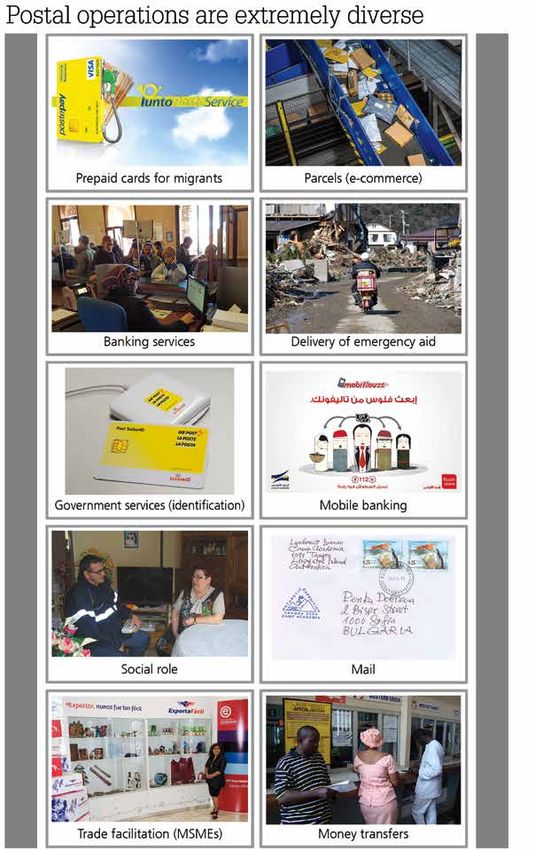
themselves. One thing, however, remains unchanged: To better understand the importance of the postal
postal networks continue to be an essential part of a sector, a few of its characteristics should be examined:
country’s socio-economic infrastructure.
•• Posts form the largest integrated distribution
network in the world: With over 660,000 offic-
es operating in the 192 UPU member countries,
Posts in the 21st century the postal network makes it possible to physically
connect everyone around the world. In addition to
One of the first things that comes to mind when one these post offices are the 1.4 million postal carriers
thinks of the Post is letters or postcards. However, postal who visit hundreds of millions of households each
operators around the world offer a whole host of other day. The postal network is made up of two million
products and services: parcel delivery, bank accounts, points of contact around the world, not including
bill payment services, applications for or renewals of mailboxes and other automatic dispensers.
official documents, delivery of fresh products, home
services for the elderly, delivery of vaccines or books for •• An electronic network: To ensure the physical distri-
school children, and so on. The postal sector is thus an bution of items (letters, parcels, e-commerce deliv-
essential infrastructure that facilitates the functioning of eries), Posts use an electronic network that inter-
the global economy. connects the various operators and enables them to
exchange electronic data in real time. The comple-
A study1 conducted in 2016 by the UPU, the United mentarity between the physical and electronic
Nations Global Pulse initiative and the University of dimensions makes Posts key players in e-commerce,
Cambridge, analyzing the postal flows of 184 countries as the final link in the supply chain that connects
over a four-year period, reveals a very strong correlation distributors, websites and customers.
between postal connectivity and gross domestic product
per capita and the rate of poverty. Postal connectivity is •• A key player in financial inclusion:2 Around the world,
defined as the capacity of the postal network to engage 1.5 billion people send money to their families, pay
in exchanges with a large number of countries. There- their bills or receive social payments via the Post.
fore, the more the Post of a country exchanges with other Globally, 91% of postal operators offer financial
Posts, the greater the growth in the country’s econo- services directly or in partnership with other finan-
my and the greater the decrease in its rate of poverty. cial institutions, making Posts the world’s second
largest contributor to financial inclusion, behind
banks but well ahead of mobile phone operators
and microfinance institutions.
1
Hristova D., Rutherford A., Ansón J., Luengo-Oroz M., Mascolo C. (2016) The International Postal Network and Other Global Flows as Proxies for
National Wellbeing. PLoS ONE 11(6): http://journals.plos.org/plosone/article?id=10.1371/journal.pone.0155976.
2
Clotteau N., Measho B., 2016, Global Panorama on Postal Financial Inclusion, Universal Postal Union, http://www.upu.int/uploads/tx_sbdown-
loader/globalPanoramaOnPostalFinancialInclusion2016En.pdf.
7REGIONAL DEVELOPMENT PLAN 8
LATIN AMERICA

Posts by numbers                                                           Universal service and social role

As facilitators of international and domestic trade,                       The governments of the UPU member countries are
e-commerce and financial inclusion, postal networks                        obligated to provide a universal postal service, that is,
represent a basic infrastructure that is essential to                      to provide all citizens in their territories with basic postal
economic development.                                                      services at affordable rates. Each country designates a
                                                                           postal operator (known as a designated operator or DO)
Traditional mail is on the decline in industrial-                          responsible for ensuring access to the postal service. In
ized countries, but the significant growth in                              contrast to other institutions that focus on major cities
e-commerce is largely counterbalancing that trend.                         or the most developed areas, DOs are obligated to cover
Indeed, according to eMarketer,3 online sales will reach                   the entirety of the national territory and to offer their
1.915 trillion USD in 2016, accounting for 8.7% of                         services at a uniform rate.
retail spending worldwide, a percentage expected to
reach 14.6% in 2020. Posts – key partners in e-com-                        In this context, Posts typically take on public service
merce – are part of this trend. For several years now,                     missions, which are not always remunerated. France’s
the postal sector has seen extremely strong growth,                        postal bank, for example, is legally obligated to open a
with an annual rate of +14% between 2012 and 2014.                         bank account for anyone who applies, regardless of that
                                                                           person’s resources. In many countries, DOs are legally
Aside from its extremely dense network, the postal                         obligated to collect and deliver letters and parcels to
sector boasts 5.24 million employees; handles over                         people’s homes, five or six days a week.
300 billion items a year, including 8 billion parcels; and
serves 1 billion customers who have a bank account                         The postal network is thus a network of proximity
with a postal financial institution.                                       and trust that facilitates the implementation of public
                                                                           policies.

3
    https://www.emarketer.com/Article/Worldwide-Retail-Ecommerce-Sales-Will-Reach-1915-Trillion-This-Year/1014369.

                                                                                                                            9
REGIONAL DEVELOPMENT PLAN
Economic impact All of these factors demonstrated that rural areas, until
then excluded from traditional economic networks, are
of postal activity able to develop when provided with adequate infra-
structure. The postal network is able to play an impor-
An analysis of a series of programmes instituted by the tant role in that process.
Brazilian government in the late 1990s and early 2000s
and using the postal network perfectly illustrates the
potential of Posts to stimulate economic growth. The
government launched two programmes in particular.
The UPU as a driver
One involved implementing a simplified export process of sector development
accessible to all via the post office. The idea was to
enable micro, small and medium enterprises (MSMEs) Overview of the UPU
to reach new markets in an accessible and affordable
manner, without needing any particular expertise in Created in 1874, the UPU is an intergovernmental
international trade. At the same time, the government organization and a United Nations specialized agency.
enacted new banking regulations allowing banks to It is the primary forum for cooperation between postal
recruit agents to distribute financial products, and it sector players (governments, regulators, operators)
encouraged the Post to get involved. Correios, Brazil’s and plays a coordinating, advisory and even regulatory
designated operator, partnered with Bradesco, a large role. In that capacity, the UPU drafts various interna-
private bank, to distribute banking products via all the tional treaties and standards for the exchange of letters
country’s post offices. and parcels and for postal money transfers. Within the
UPU, a large number of technical and operational issues
The combined impact of these two policies was relating to international postal exchanges are discussed.
measured by means of various UPU studies,4 which Furthermore, through its Postal Technology Centre, the
found the following: UPU provides Posts around the world with cutting-edge
technical solutions to help them secure their exchanges
•• Between 2002 and 2008, the trade facilitation and improve quality of service. The UPU thus creates
programme Exporta Fácil enabled over 10,000 the conditions that enable the world’s Posts to offer
MSMEs to access international markets. This businesses the infrastructure needed to engage in
programme enjoyed particular success in the exchanges in the safest and most secure manner.
country’s poorest regions and in the less service-ori-
ented regions. Moreover, as a centre of expertise, the UPU produc-
es studies and analyses, in particular to demonstrate
•• Similarly, an econometric analysis of each of Brazil’s the postal sector’s impact on economic development.
5,564 municipalities showed the effect achieved Lastly, since its creation, the UPU’s mission has been to
by the creation of Banco Postal, the partnership carry out cooperation activities aimed at strengthening
between Correios and Bradesco. In the municipali- the postal networks of developing countries.
ties in which a Banco Postal agency was introduced,
the creation of new businesses increased by 23% The UPU works with specialized regional organizations,
in comparison to the municipalities with no such called restricted unions, that play an important role in
agency. Furthermore, job creation increased by ensuring a link between global, regional and national
14%, while the number of new banking agencies activities. By aligning their missions and agendas with
increased by 56%. A definite formalization of the UPU priorities, the restricted unions have become key
economy and an increase in the average size of players in facilitating the implementation of global strat-
businesses was noted. egies at the regional level.
4
Ansón J., Bosch Gual L., Caron J., Toledano J, 2008, Postal Economics in Developing Countries: Posts, Infrastructure of the XXI Century?
10LATIN AMERICA
Technical cooperation at the UPU •• Sector reform: Since 2005, the UPU has been
working with the governments of nearly 70
The postal sector is a universal network. This is the basis countries to reform their postal sector. In concrete
for the concept of the single postal territory, expressing terms, this process involves adopting a suitable legal
the idea that the postal operators of countries world- framework, defining a consistent and sufficiently
wide are able to ensure global coverage and that people broad sector policy, and modernizing the DO. One
around the world can send letters, parcels or money success story is Uruguay, where the government
orders to anyone, anywhere. fully supported postal reform and put in place all the
necessary prerequisites to ensure optimal function-
However, just as a chain is only as strong as its weakest ing of the market, with a strong national operator
link, a network is only as strong as its constituent parts. responsible for implementing a number of public
For that reason, the UPU has implemented a coopera- policies.
tion policy aimed at supporting the Posts of developing
countries. Cooperation activities can be broken down •• Technical assistance for DOs: The UPU imple-
into the following categories: ments regional and national projects designed to
strengthen the capacity of Posts to offer services
•• Public policy support: As a centre of knowledge tailored to the needs of citizens. Such assistance
and expertise, the UPU regularly publishes studies can take various forms: procurement of equipment,
on the postal sector that highlight best practic- roll-out of new services, advice, training, and so on.
es, offer impact analyses of various public policies
and ensure a better understanding of the business The UPU’s cooperation programmes are implemented
models adopted by different operators. In recent by its Development and Cooperation Directorate and
years, one of the key areas of focus has been the in particular by its seven regional offices, which act as
use of big data to better quantify the postal sector’s the link between UPU headquarters and partners in the
contribution to the United Nation’s Sustainable field.
Development Goals (SDGs).
11REGIONAL DEVELOPMENT PLAN
Examples of UPU projects hit the north-eastern part of the country, leaving
720,000 people in need of assistance and severe-
The UPU, in the context of its cooperation policy, has ly affecting the postal network. In all three cases,
achieved many successes in recent years: the UPU, through its Emergency and Solidarity Fund
(ESF) and the contributions of certain UPU member
•• E-commerce: The UPU is involved in e-commerce countries and restricted unions, provided Posts in
at two levels. At a global level, the UPU establish- those countries with vital assistance, not only re-es-
es standards, develops services and defines proce- tablishing service (reconstructing a sorting centre
dures to be applied internationally. This provides a and post offices, procuring vehicles and reconnect-
framework for designated operators to fully play ing offices to the Internet network), but also rebuild-
their part as key stakeholders in the e-commerce ing infrastructure in accordance with the appropriate
supply chain. The UPU also intervenes at national standards to make the network more resilient. Since
and regional level in developing countries through 2013, the UPU has been helping member countries
major strategic projects. Technical and financial put in place risk reduction strategies to ensure that
assistance is provided to governments and Posts Posts are better able to face natural disasters and
to ensure that they can enter the international can play an active role in providing humanitarian
e-commerce market. Between 2013 and 2016, over assistance in the wake of such events.
100 countries received training and technical assis-
tance in the areas of security, customs, quality of •• Introduction of a postal addressing system
service and/or transport. Posts are also provided in South Africa: People without an address are
with tools that make it possible to connect the unable to register with the civil registry or vote.
entire supply chain, track all items transported Emergency services (fire, ambulance) cannot reach
within the postal network, and ensure the security their homes, and it is virtually impossible to obtain a
of the network. telephone landline or connect to the electrical grid.
Without addresses, governments have a difficult
•• Reduction in the cost of migrant remittan- time collecting taxes or conducting censuses. The
ces in West Africa: In 2008, in partnership with United Nations Development Programme estimates
the International Fund for Agricultural Develop- that four billion people worldwide are exclud-
ment, the UPU began implementing a series of ed from the legal system. This means that many
projects in Asia-Pacific, Central Asia and Africa to of them do not have clearly identified addresses,
use the postal networks in rural areas to roll out which prevents them from accessing a range of
secure and affordable money transfer services. services. The UPU provides technical assistance
For example, between 2008 and 2010, in six West to many countries to help them institute national
African countries, the average cost of transfers – via addressing systems. As an example, a wide-scale
the Post as well as via traditional money transfer project in South Africa resulted in the assignment
agencies – decreased by between 30% and 50%, of addresses to eight million homes in rural areas.
which helped migrants and their families, who are As a result, rural populations were able to access
the recipients of these remittances. public services, open bank accounts with Postbank,
and receive home deliveries from the Post and many
•• Emergency projects: In 2010, Haiti was devastated merchants.
by an earthquake that killed over 200,000 people.
In 2013, in the Philippines, Typhoon Haiyan, the
most intense tropical cyclone on record, killed over
5,000 people and devastated the Tacloban
region. In April 2016 in Ecuador, an earthquake
12LATIN AMERICA
Postal sector contribution
to the implementation
of the Sustainable Development Agenda
The 17 Sustainable Development Goals (SDGs) and The postal sector can play a key role in the attain-
169 targets adopted by the United Nations in Septem- ment of the SDGs nationally, regionally and internati-
ber 2015 serve as a roadmap for the international onally. The diverse network and global presence of
community to build a sustainable future and foster Posts make them a potential strategic driver of the
social advancement and human well-being. Their sustainable development programme. The sections
implementation calls for active and collaborative below detail how postal services can, and indeed must,
partnerships between all countries and stakeholders. be part of the solution for each of the approved goals.
13REGIONAL DEVELOPMENT PLAN
Because of their extensive network and logistics
capabilities, Posts are considered in many countries as
valued partners in their governments’ national disaster
risk management and recovery plans. Their knowledge
of the communities they serve and their infrastruc-
ture allow them to operate and intervene efficiently,
especially in remote areas where the post office is often
SDG 1: the only government presence.
End poverty in all its forms everywhere Following Typhoon Haiyan, PHLPost (the Post of the
Philippines) and partners delivered cash grants to
Ensure equal rights to economic resources and access around 18,000 beneficiaries of the United Nations
to basic services and financial services (target 1.4) World Food Programme and made total cash payments
of approximately 15 million PHP, around 350,000 USD,
Reduce vulnerability to environmental shocks to more than 6 million victims of the disaster.
and disasters (target 1.5)
Posts are the second biggest contributor
to financial inclusion worldwide after
the banking sector
Financial inclusion is recognized in the SDG framework
as playing a key part in fighting poverty and fostering
development for all.
SDG 2:
Today, 91% of Posts worldwide offer financial services, End hunger, achieve food security and
including domestic and international money transfer improved nutrition and promote
services, including domestic and international money sustainable agriculture
transfer services. They provide accounts for roughly a
billion people, making them the second biggest global Provide secure and equal access to financial services
player in financial inclusion. and markets (target 2.3)
Owing to their very dense physical networks, unique
presence in rural areas and trusted status, Posts are The Post enables and provides
vital players in financial inclusion in a variety of different infrastructure for rural development
contexts: through financial inclusion
•• The Brazilian Post was a pioneer of the banking A joint study by the World Bank and the UPU showed
agency model in the early 2000s, with 10 million that Posts are better placed than banks to provide
accounts opened over a 10 year period, mostly for accounts to people excluded from the financial system,
unbanked or underbanked people. especially those in rural areas or precarious economic
situations. This is particularly important in a rural devel-
•• The Moroccan Post now provides accounts to around opment context, where the need for appropriate finan-
20% of the country’s population, mainly in low- and cial products and economic opportunities is greatest.
medium-income segments. For example, in Burundi in 2013, the Post implement-
ed a government programme aimed at facilitating the
distribution of fertilizers to around 350,000 families,
helping to establish Burundi as a net exporter of rice.
14LATIN AMERICA
Development in rural areas can only occur where
there is adequate infrastructure. In the vast majority of
countries, the postal network is the largest network in
rural and remote areas to offer financial, communica-
tion, logistic and other retail and government services.
This was shown in the examples above in the areas of
financial inclusion, access to ICT, and trade facilitation in
rural and under-served areas.
SDG 8:
Posts assist local small-scale producers to develop local Promote sustained, inclusive and
and international marketplaces for the sale and distribu- sustainable economic growth, full
tion of food. As early as 1986, Korea Post created the and productive employment and
ePOS postal ordering system for typical local products decent work for all
as a way of regenerating the local economy in farming
and fishing communities. Promote the formalization and growth of micro, small
and medium-sized enterprises, through access to
financial services (target 8.3)
Strengthen the capacity of domestic financial
institutions to encourage and expand access to
banking, insurance and financial services (target 8.10)
SDG 5:
Achieve gender equality and empower
all women and girls
Give women equal rights to economic resources,
as well as access to financial services (target 5.a) SDG 9:
Build resilient infrastructure for all,
promote inclusive and sustainable
Posts as drivers of financial inclusion industrialization and foster innovation
for women
Increase the access of small-scale industrial and other
A 2015 joint study by UN Women and the UPU demon- enterprises, in particular in developing countries
strated the non-discriminatory nature of Posts in the (target 9.3)
provision of financial services
Significantly increase access to information and
On average in developing countries, postal financial communications technology and strive to provide
institutions (postal banks or postal savings banks) have universal access to the Internet in least developed
twice as many female customers as other financial insti- countries (target 9.c)
tutions. This phenomenon is even more marked in rural
areas.
15REGIONAL DEVELOPMENT PLAN
Postal financial inclusion serves not only
individuals excluded from the banking
sector but also businesses, especially
MSMEs
Leveraging its network of over 40,000 branches
extending to all parts of the country, the Postal Savings
Bank of China (PSBC) fills the access-to-finance gap for
farmers and MSMEs in rural China. According to the
SDG 10:
Consultative Group to Assist the Poor (CGAP), between Reduce inequality within
its launch in 2007 and 2013, the PSBC “served over and among countries
7.5 million microcredit business beneficiaries, handling
over 13 million transactions amounting to over Promote social and economic inclusion (target 10.2)
811 billion RMB (over 130 billion USD)”.5 )”. The PSBC
is therefore an indispensable banking institution willing By 2030, reduce to less than 3% the transaction
to provide services to those not considered priorities by costs of migrant remittances and eliminate
traditional banks. remittance channels with costs higher than 5%
(target 10.c)
The postal sector as a tool for bridging
the digital divide
A network for social
The postal network is a unique asset for extending the and economic inclusion
information society to under-served populations.
With more than 660,000 post offices in the world,
In Botswana, the development of Internet access and postal presence in rural areas is unmatched by any other
the provision of various communication services in post network for the facilitation of social and economic
offices through knowledge centres has increased the inclusion.
revenue of connected post offices by an average of
25% and provided local communities with a full range Post offices: the world’s cheapest
of e-services. provider of fund transfer services
Tanzania Postal Corporation runs 36 Internet cafés According to the World Bank, post offices are the
and six post offices containing community information world’s cheapest providers of remittance services.
centres which offer e-learning and other Internet-based Posts have already achieved the 5x5 objective, with an
services to local communities. average cost of about 5%. In Sub-Saharan Africa alone,
if all remittances were to be channelled through post
offices at that cost, migrants and their families could
save up to 3.2 billion USD a year.
5
M. Zhang y Z. Liu, Postal Savings Bank of China: Inclusive Finance in Rural China, CGAP, 2014.
16LATIN AMERICA
Posts are key players in the local, national and inter-
national transport supply chain. More and more postal
operators are calculating and reporting their carbon
footprint. In developing and least developed countries,
Posts are supported by the UPU through its specially
designed carbon management tool OSCAR.
SDG 11:
Make cities and human settlements
inclusive, safe, resilient and sustainable
Approximately a quarter of the world’s urban popula-
tion lives in slums (UN-Habitat 2013). Lack of addressing
infrastructure can exacerbate inequalities and under-
mine economic growth. Posts are helping to establish SDG 13:
and provide addressing systems for all populations. The Take urgent action to combat climate
UPU, through its “Addressing the World – An address change and its impact
for everyone” initiative, is adopting a coordinated
multi-stakeholder approach to help Posts in developing Strengthen resilience and adaptive capacity to natural
countries and least developed countries provide address- disasters in all countries (target 13.1)
ing systems to excluded populations. Quality addressing
and postcode systems are an essential part of nation- Integrate climate change measures into national
al infrastructure and are crucial to the socio-economic policies (target 13.2)
development of countries. They also facilitate trade and
hence contribute to countries’ economic growth.
Making Posts more resilient enables them to play a more
effective role in managing natural disaster risks and the
aftermath of the catastrophes, and in improving the
resilience of local communities. More and more Posts
are implementing disaster risk management and resil-
ience programmes in order to be better prepared and
thus better able to meet the needs of all the population.
Mitigating the environmental impact of postal activities
SDG 12: is high on the agenda of a growing number of Posts,
not only in industrialized parts of the world, but also in
Ensure sustainable consumption developing and least developed countries. Many Posts
and production patterns are developing low carbon strategies through their
postal products and the use of renewable energy in
Encourage companies, especially large their vehicles and buildings.
and transnational companies, to adopt sustainable
practices and to integrate sustainability information
into their reporting cycle (target 12.6)
17REGIONAL DEVELOPMENT PLAN
SDG 16: SDG 17:
Promote peaceful and inclusive societies Strengthen the means of implementation
for sustainable development, provide and revitalize the global partnership for
access to justice for all and build sustainable development
effective, accountable and inclusive
institutions at all levels Significantly increase the exports of developing
countries, in particular with a view to doubling the
least developed countries’ share of global exports by
As public institutions in many countries, Posts are deliv- 2020 (target 17.11)
ering government services and acting as public policy
enablers. For example, they help to organize elector-
al processes and deliver identity papers and official Posts as key enablers of trade
documents, and enable public access to information
through the distribution of print media. In Lebanon, for Posts are playing an ever-greater role in trade facilita-
example, the Post, which has more than 90 branches tion, especially in the context of e-commerce. The imple-
throughout the country, has concluded partnerships mentation of trade facilitation programmes by Posts has
with several public and private institutions to provide had a significant impact on export trends, in particular
services on their behalf. This enables citizens to renew for SMEs in rural areas of developing countries. This
passports, pay taxes, have official documents certified is the case in Latin America, where trade facilitation
and apply for work permits in all post offices. More than programmes developed by Posts in cooperation with
120 different services can be facilitated by postal staff, the relevant national authorities and the restricted
and millions of these operations are performed every postal union have been a success. In Ecuador, where
year. such a programme has been implemented by the Post,
the value and volume of exports from MSMEs through
this channel have more than tripled in two years.
18LATIN AMERICA
The postal sector During the 2013–2016 cycle, the UPU spurred efforts to
drive forward the following means of achieving success:
and socio-economic •• Support to governments in the launch of postal
development in
reform initiatives;
•• Technical and theoretical impetus for promoting
Latin America
the acquisition and transfer of knowledge (experts,
methodological tools and sharing of good practic-
in the 2017–2020
es in order to develop a clear roadmap for postal
reform);
•• Mobilization of resources to guarantee the imple-
cycle mentation of reform, such as training, and techni-
cal and technological investment by governments
to modernize the postal services and operations of
This final part of the regional development plan takes an designated operators.
overview of the sector in 2016 and the role the postal
sector can play in supporting the social and economic Financial inclusion and remittances
development of the countries in the region. This part is
divided into three sections: 1) Regional analysis of the Financial inclusion means the provision of basic finan-
actions carried out during the 2013–2016 cycle: analysis cial services (savings, payments, transfers, insurance,
of the situation in the region at the end of 2016 and credit) to those without access to banking services. As a
short-term trends; 2) Main areas of intervention in the platform for information and technical assistance to the
region; and 3) Relationship to the regional development postal sector, the UPU helps its member countries intro-
priorities and agendas. duce and/or develop sustainable and inclusive financial
services.
An example of this is the Correogiros electronic
Regional analysis of the money-transfer project, which facilitates coordination
actions carried out during the between the network’s nine Latin American countries.6
2013–2016 cycle: analysis of Considerable progress has been made in developing the
the situation in the region at e-mail network in the region in order to promote the
service to other operators, thereby helping the inhab-
the end of 2016 and short-term itants of the most remote rural areas to access remit-
trends tance services, while significantly cutting the associated
transfer costs.
Actions carried out in Latin America Strengthening the supply chain
during the 2013–2016 cycle
In a number of countries in the region, the lack of
Reform and modernization of the postal sector standardized, monitored processes and adequate
quality management has contributed to the deteriora-
A well-organized and efficiently run postal sector is a tion of the services provided by designated operators.
driver of communications, economic and social devel- In order to strengthen the provision of basic postal
opment for the country’s citizens and businesses. services while also promoting a platform for the devel-
The governments of the UPU member countries are opment of innovative services such as e-commerce and
responsible for launching the postal sector reform and postal exports, the UPU carried out a number of activ-
modernization process in order to ensure: ities between 2013 and 2016. These activities were
undertaken in cooperation with the region’s restricted
•• Provision of the basic postal service to which the union, the Postal Union of the Americas, Spain and
population is entitled but which, owing to the lack Portugal (PUASP), which co-financed the work:
of resources in the region, is not always considered
a fundamental right;
•• Compliance with the regulations to maintain healthy
market competition.
6
Correogiros member countries: Argentina, Chile, Colombia, Cuba, Dominican Republic, Ecuador, Paraguay, Peru and Uruguay, not forgetting
Spain, which is an essential partner in money transfers to and from Latin America.
19REGIONAL DEVELOPMENT PLAN
•• Carry out operational audits; Sustainable development and risk management
•• Map the main postal processes to promote their
standardization; Sustainable development activities carried out between
•• Formulate quality action plans to improve services 2013 and 2016 were organized around the three pillars
and increase mail and parcels volumes handled by of development (environmental, social and econom-
the designated operator; ic), and showed very promising results. 2016 saw the
•• Finance teams of consultants and consultancy launch of an initiative with 12 of the region’s countries.
missions to develop the postal network; Its aim was to promote the acquisition of convention-
•• With the support of regional experts, develop al and electric bicycles as a healthy and environmen-
practical guides and manuals that are easy to use tally-friendly means of transport for conducting postal
and apply in order to improve services. operations. A parallel element of the project was to
measure this initiative’s impact on sustainable develop-
Given the highly specialized technical content of the ment, by periodically compiling and analyzing statistics
postal business, a key element of quality of service is to feed in to economic, social and environmental indica-
continuous staff training. To this end, the Regional tors. Based on the results obtained, it may be decid-
Postal Training Centre was created at PUASP head-quar- ed to reproduce this initiative on a larger scale in other
ters in 2014 to provide a base for training in the various countries and regions of the world.
operational and service areas of the Post. Since it start-
ed operating, the Centre has trained 1,135 people. Of The earthquake which struck Ecuador in April 2016
this number, 181 attended the Training Centre, and 954 provides a concrete example of risk management
were trained through the multiplier effect. actions: at the height of the crisis, the postal network
provided support for the government-driven relief and
rehabilitation efforts, which led subsequently to the
launch of a project to ensure the restoration of opera-
tions in post offices in the areas affected by the earth-
quake.
20LATIN AMERICA
Analysis of the situation in the Latin Short-term trends in Latin America
America region at the end of 2016
The development of new information technologies has
Governments in Latin America are increasingly aware of affected the region’s postal services, which have been
the relevance of the postal sector as a factor in econom- eclipsed by the immediacy and innovation of the new
ic development and in communications, social and forms of communication. However, the e-commerce
financial inclusion in their respective countries. In most era also offers the sector the opportunity to take back
of the countries in the region, the State is therefore its dominant position.
willing to support initiatives to promote the develop-
ment of postal services. As the majority of the designat- According to statistics processed by the UPU, Latin
ed operators providing postal services are government America has seen a steady fall in the number of letter-
entities, either independent or attached to a ministry, post items over the last 23 years (1991–2014), in line with
the government’s willingness to work with the UPU can the global trend (-2.9% across the region compared
reap rich rewards. with -1.4% in the industrialized countries). However,
as a result of the increase in e-commerce transactions,
However, there are wide disparities across the region in the average weight of items has increased, as has the
terms of levels of management, planning, technological number of parcels sent. According to figures for 2014,
support and standardization of operations. Significant the regions of the world with the greatest increase in
differences exist in the extent of coverage and in the parcels volumes are Latin America and the Caribbean
quality and efficiency of the services provided. Although (+18% in the domestic service and +7% international-
some countries have planning and management struc- ly). The region has seen a significant increase in desig-
tures organized at national level, there remains more to nated operators’ revenue from parcels and the provi-
be done in this field. sion of logistical services, from 8% in 2004 to 22.7%
in 2014.
Financial and management weaknesses, as well as
shortcomings on the structural and operational side, are The global trend indicates a steady rise in designated
exacerbated by a lack of investment in the sector. This operators’ revenue from the parcels service, mainly
creates a vicious circle of lack of investment and poor as a result of the growth of e-commerce activities;
results, with no recognition of the sector’s true poten- meanwhile, letter-post revenue is falling. Similarly,
tial as an infrastructure for economic development and other postal business, such as financial services (remit-
a factor in social and financial inclusion. tance, payments, insurance) and e-services are gaining
ground as new lines of income-generating business.
The region’s designated operators are keen to acquire
the means and tools to respond to their custom-
ers’ needs. The last 10 years have seen rapid growth
in postal demand for the flow of products relating to
e-commerce, and an increasing need for a robust logis-
tics chain and broad coverage of financial services.
For historical reasons, postal operators in some Latin
American countries do not include financial services
among their traditional range; they are, however, begin-
ning to offer them. According to UPU data for 20167,
89% of the region’s operators currently offer financial
services. They are using this product as an opportuni-
ty for improvement in the years to come, for example
by devising partnership strategies with local or regional
banks.
7
Global Panorama on Postal Financial Inclusion, Universal Postal Union, 2016.
21REGIONAL DEVELOPMENT PLAN
Intervention strategy What
in Latin America for the By rolling out a series of training activities, moderniz-
2017–2020 cycle ing processes and implementing state-of-the-art IT
technologies, the project will ensure that Posts are in a
Growth trends in parcels markets resulting from the position to address the needs of customers and e-retail-
increase in e-commerce, the need for online businesses ers. For example, tracking tools will allow both custom-
and purchasers alike to have comprehensive logistical ers and e-merchants to follow their shipments in real
services (dispatch, distribution, delivery and return of time. Tracking will also improve customs transit, e.g. by
goods) and the incorporation in government priorities enabling compliance with international security stand-
of trade facilitation, economic development and inclu- ards. Additional tools will also allow clients to choose
sion make the postal sector more relevant than ever. In delivery locations and in some cases delivery schedules,
response to these new needs, the UPU has developed giving them the flexibility that is expected nowadays.
an intervention strategy for the region, focused on the Lastly, processes will be developed to facilitate seamless
following four areas: product returns.
Improvement operational efficiency A particular emphasis will be placed on integrating the
and effectiveness and developing various links in the supply chain (transport companies,
e-commerce airlines, customs authorities, security agencies, postal
operators, e-merchants) into end-to-end processes
Aim of the project and IT tools with a view to maximizing the operational
efficiency of cross-border e-commerce.
The project dovetails with the UPU’s strategic objec-
tive of helping postal operators become key players How
in e-commerce. To meet the challenges posed by the
e-commerce market, the UPU must adopt a global and The project will be implemented by the UPU and
integrated approach based on a market and customer postal operators in coordination with airlines, handlers,
focus. For the 2017–2020 cycle, the UPU’s main goal customs authorities and other project stakeholders
is to ensure the “operational readiness” of Posts for through workshops, training, on-site missions, organ-
seamless cross-border e-commerce. The ultimate objec- izational audits and twinning activities as part of a
tive is to ensure that online merchants have adequate global four-year plan.
distribution infrastructure to develop their business.
Contribution to the digital
The aim of the project are to address obstacles that transformation of postal networks
prevent consumers from making online cross-border
transactions, to help participating designated opera- According to the World Bank8, only 51% of the adult
tors modernize operational processes, and to use all population in Latin America has access to banking
available standardized IT tools and end-to-end systems services. However, financial services are offered by
to implement operational solutions that meet e-com- 89% of the region’s Posts, most of which are develop-
merce requirements. By improving end-to-end delivery ing strategies to expand their range of services. Within
performance and reliability, providing consumers with this framework, several postal operators in the region
more visibility through EDI message exchanges, and have great potential to contribute to financial inclusion
establishing more customer-oriented solutions (delivery for their citizens, possibly through partnerships with
options, data capture at source, return solutions, simple banking institutions.
customer services, etc.), postal operators will contribute
to the continued growth of the e-commerce market.
8
Demirguc-Kunt, Klapper, Singer & Van Oudheusden, 2015, “The Global Findex Database 2014: Measuring Financial Inclusion around the World”.
Policy Research Working Paper 7255, World Bank
22LATIN AMERICA
Postal money transfers Implementation strategy
for postal sector reform in 2017–2020
In this context, during the 2017–2020 cycle, the UPU
will carry out a series of activities to strengthen the One of the UPU’s objectives, as set out in the preamble
contribution of Posts to financial inclusion in the region. to its Constitution, is to afford all the world’s citizens
In the early 2000s, the UPU developed the Internation- access to communication services. To this end, it
al Financial System (IFS), a money transfer tool that it provides technical assistance to its member countries
makes available to Posts. In accordance with SDG 10.c, in order to ensure the smooth running of their postal
which is to reduce to less than 3% the transaction costs sectors. For instance, it has developed an approach to
of migrant remittances by 2030, the UPU helps Posts help governments restructure their postal sectors by
offer their customers secure and affordable services. means of a coherent methodology based on national
Over 80 Posts currently use IFS, which was updated analyses and the specific realities of each country.
in 2013 for use on mobile devices and which can be
managed remotely via cloud computing for Posts that The responsibility for implementing postal sector
do not have sufficient technical capacity. reform lies directly with the countries, and decisions
in this regard are made at the national level. For the
For the 2017–2020 period, the UPU will continue to 2017–2020 cycle, the UPU’s role in the context of postal
develop this network through the following actions: sector reform will primarily be to support countries that
have launched transformation processes, namely by
•• Increasing the number of IFS users; facilitating access to methodological tools and provid-
•• Conducting on-site audits to improve quality of ing specialized experts.
service and security;
•• Deploying mobile solutions in countries with no The UPU will strengthen dialogue with governments
such solutions in place; and stress both the postal sector’s new role in the socie-
•• Implementing remote payment solutions in the area ties and national economies of developing countries
of e-commerce for unbanked customers. and the need to establish structured reform processes.
In the 2017–2020 cycle, the UPU’s work in this connec-
Digitalization of financial services tion will be guided by the following principles:
In addition to its efforts in the area of money trans- •• Providing beneficiary countries with methodological
fers, the UPU has also put in place a technical assistance tools for the different areas of postal sector reform;
fund to help Posts digitalize their financial services.
At least 20 Posts will benefit from this programme in •• Establishing an integrated approach, including a
2017–2020, with the goal of ensuring that the finan- policy to mobilize resources, at national and region-
cial services offered by Posts (money transfers, bill al levels;
payments, government payments, savings services,
insurance, etc.) are available digitally. Assistance will be •• Continuing to serve as a platform for the sharing of
available in various areas: best practices in postal sector reform among UPU
member countries;
•• Defining an effective digitalization strategy;
•• Implementing technological tools; •• Strengthening capacity building at national and
•• Developing a digital ecosystem; regional levels.
•• etc.
23REGIONAL DEVELOPMENT PLAN
Contribution to the digital Digital postal services
transformation of postal networks
In this context, during the 2017–2020 cycle, the UPU
Connected people: on average, eight in 10 individuals will carry out a series of activities to strengthen the
in the developing world own a mobile phone, and the contribution of Posts to digital inclusion.
number is steadily rising. Even among the bottom fifth
of the population, nearly 70% own a mobile phone. Digital postal networks
However, Internet adoption lags behind considerably:
only 31% of the population in developing countries had •• Help countries to define effective national Internet
access in 2015, compared with 80% in high-income strategies involving Posts;
countries. •• Increase the number of countries using .POST;
•• Create a digital ecosystem for postal services for
Connected businesses: Internet adoption has consumers and businesses.
increased across businesses in all country income
groups. Nearly nine out of 10 businesses in high-income E-commerce platforms
OECD countries had a broadband Internet connection
in 2014, compared with seven for middle-income and Define effective national e-commerce strategies that
four for low-income countries. But adoption rates leverage the capacities of Posts.
for technologies such as secure servers, enterprise
networks, and e-commerce are much lower in most Introduce e-commerce platforms in countries without
developing countries. such solutions.
Connected governments: governments are increas- E-government services
ingly going digital and, in comparison with the private
sector, a greater share of government jobs in developing •• Define effective national e-government strategies
countries are ICT-intensive. However, according to the that leverage the capacities of Posts;
2016 United Nations E-Government Survey9, only 60 •• Define effective digitization strategies;
countries have online services to register a business and •• Implement technological tools.
20 have multipurpose digital identification platforms.
Create robust postal networks
ICT is a pillar of sustainable economic growth. According
to a 2016 World Economic Forum report on the digital According to the Third United Nations World Confer-
transformation of businesses10, the future of countries, ence on Disaster Risk Reduction, held in March 2015,
businesses and individuals will depend more than ever more than 1.5 billion people were, in some form or
on their adoption of digital technologies. another, victims of natural disasters between 2005 and
2014, representing total economic losses of more than
In 2012, the UPU launched the .POST project, the aims 1.3 billion USD.
of which are to define the role of Posts in the digital
economy and to provide developing countries with a The postal sector was also severely affected by natural
platform for accessing secure cloud-based services. disasters that caused destruction and disrupted servic-
At the end of 2016, 25 countries were already using es. However, Posts can play a key role in disaster
.POST to provide secure Internet services. Thanks to response, e.g. by providing logistical infrastructure
the provision of digital services, Posts are playing an and distribution points for emergency supplies, money
important role in connecting people, businesses and transfer services in affected areas and a basic means of
governments. They are also contributing significantly communication when all other systems are unavailable.
to the attainment of United Nations Sustainable Devel-
opment Goal 16, target 9, which aims to provide a
digital identity for all.
9
https://publicadministration.un.org/en/Research/UN-e-Government-Surveys
10
http://reports.weforum.org/digital-trahttp://reports.weforum.org/digital-transformation-of-industries/wp-content/blogs.dir/94/mp/files/pages/files/
wef-digital-transformation-of-industries-2016-exec-summary.pdf
24LATIN AMERICA
In terms of the benefits of disaster risk management •• implementing a special certification process enabling
activities in the 2017–2020 cycle, given both the need designated operators to improve their natural disas-
for postal networks that are resilient to natural disasters ter risk management strategies and measure their
and the advantages that member countries stand to implementation in respect of the UPU Disaster Risk
gain from strengthening the role of designated postal Management Guide;
operators in pre- and post-disaster situations, the UPU
will carry out specific technical assistance and capaci- •• nationally distribute the UPU Disaster Risk Manage-
ty-building activities, including: ment Guide, a practical guide describing all of the
steps to be taken by designated postal operators to
•• providing support, especially to the designated implement a disaster risk management strategy at
operators of developing countries and least devel- all levels of the postal organization;
oped countries, in the form of specialized training
modules and technical assistance projects (which •• share best practices between Posts via communi-
will be based on a specific method aimed at provid- cation platforms and at regional workshops and
ing high-quality assistance to designated operators seminars.
and the authorities responsible for the implementa-
tion or improvement of disaster risk management
policies and business continuity planning);
25You can also read


