Present at the Re-Creation: A Global Strategy for Revitalizing, Adapting, and Defending a Rules-Based International System - Atlantic Council
←
→
Page content transcription
If your browser does not render page correctly, please read the page content below

Present at the
Re-Creation:
A Global Strategy for Revitalizing,
Adapting, and Defending a
Rules-Based International System
Ash Jain and Matthew Kroenig
Foreword by Madeleine Albright and Stephen J. Hadley

Present at the Re-Creation:
         A Global Strategy for Revitalizing, Adapting, and
         Defending a Rules-Based International System

The Scowcroft Center for Strategy and Security works to develop
sustainable, nonpartisan strategies to address the most important
security challenges facing the United States and the world. The
Center honors General Brent Scowcroft’s legacy of service and
embodies his ethos of nonpartisan commitment to the cause of
security, support for US leadership in cooperation with allies and
partners, and dedication to the mentorship of the next generation
of leaders.

This report is written and published in accordance with
the Atlantic Council Policy on Intellectual Independence.
The authors are solely responsible for its analysis and
recommendations. The Atlantic Council and its donors do not
determine, nor do they necessarily endorse or advocate for, any
of this report’s conclusions.

© 2019 The Atlantic Council of the United States. All rights
reserved. No part of this publication may be reproduced or
transmitted in any form or by any means without permission
in writing from the Atlantic Council, except in the case of brief
quotations in news articles, critical articles, or reviews. Please
direct inquiries to:

Atlantic Council
1030 15th Street NW, 12th Floor
Washington, DC 20005

For more information, please visit
www.AtlanticCouncil.org.

ISBN-13: 978-1-61977-076-8

Cover: Scala/Art Resource, NY

Title: Galileo and Viviani
Artist: Tito Lessi
Year: 1892
Location: Museo Galileo, Florence, Italy

In this painting, Galileo is sitting with Vincenzo Viviani, his last pupil,
while under house arrest. Galileo was forced to live out his life under
house arrest after being condemned in the Inquisition for his support
of heliocentrism, or the idea that the Earth revolves around the sun.
ATLANTIC COUNCIL STRATEGY PAPERS

EDITORIAL BOARD

Executive Editors
Mr. Frederick Kempe
Dr. Alexander V. Mirtchev

Editor-in-Chief
Mr. Barry Pavel

Managing Editor
Dr. Matthew Kroenig


TABLE OF CONTENTS
FOREWORD 2

EXECUTIVE SUMMARY 4

THE CURRENT RULES-BASED INTERNATIONAL SYSTEM AND ITS BENEFITS                10

   The Benefits of the Rules-Based System 13

THE STRATEGIC CONTEXT       16

   Global Trends 17

   Challenges from External Actors 21

   Internal Challenges 25

POSSIBLE FUTURE PATHS 28

GOALS OF THE STRATEGY 30

ELEMENTS OF THE STRATEGY 32

   Revitalize Support for the Key Principles of a Rules-Based International System 33

   Adapt the Institutions of the System for the Twenty-First Century 41

   Defend the System to Ensure Its Success 52

CHALLENGES AND OPPORTUNITIES FOR IMPLEMENTATION 60

CONCLUSION 63

ABOUT THE AUTHORS 64

PRESENT AT THE RE-CREATION

                        FOREWORD

                       I
                            n the immediate aftermath of the Second World War, the
                            United States and other leading democracies built an inter-
                            national system that ushered in an almost 70-year period of
                            remarkable peace and prosperity. Founded on democratic
                        and open-market principles, its institutions and rules have pro-
                        moted global economic growth and development, lifted hun-
                        dreds of millions out of poverty, and advanced the cause of
                        freedom. After three decades of largely uncontested primacy,
                        however, this rules-based system is now under unprecedented
                        challenge, both from within and without.
                          In March 2018, we launched an initiative under the auspices
                        of the Atlantic Council aimed at revitalizing the rules-based
                        international system and reinvigorating support for its core
                        tenets. We were joined by a distinguished group of former offi-
                        cials and strategists in creating a Declaration of Principles for
                        Freedom, Peace, and Prosperity—offering seven statements
                        that we believe are foundational for a revitalized international
                        system and reflect the common aspirations of the human spirit.
                        The principles are intended to provide a clear and compelling
                        statement of values—a “north star”—around which political
                        leaders and the broader public can rally in demonstrating their
                        support for the rules-based system.
                          But principles alone are not enough. We need a new strat-
                        egy—one ambitious enough to meet the moment, and one
                        innovative enough to fit the challenges and opportunities of
                        the 21st century.
                          In this paper, Present at the Re-Creation, Ash Jain and
                        Matthew Kroenig propose a visionary but actionable global
                        strategy for revitalizing, adapting, and defending the rules-
                        based international system.
                          The strategy sets forth three key pillars:
                          First, the authors call for a renewed effort to rally demo-
                        cratic states—not just those of the transatlantic alliance, but

2
also democracies across Asia, Africa, and Latin America—to work
together to defend and advance the common values that unite
them. At the same time, the authors argue that these states must
engage the autocratic great powers, including China and Russia, to
seek their support for those elements of the rules-based system on
which their interests and those of the democratic states align.
   Second, the international system must be significantly adapted
and redesigned to address existing shortcomings and to reflect
new realities. To this end, the authors propose several new institu-
tions designed for the needs and challenges of today’s world.
   Finally, this revitalized and adapted system must be defended.
The authors argue for a more systematic approach to monitoring
and incentivizing compliance with core rules, to defending democ-
racy against autocratic backsliding and interference, and to con-
fronting the dangers posed by revisionist powers, nuclear prolif-
eration, terrorism, disruptive technology, and other global threats.
   Implementing such a strategy will not be easy—especially given
the erosion of support for democratic principles in the United
States and other leading democracies around the world. But the
first step in dealing with such challenges is to identify a compelling
vision and then to articulate a way to achieve it. This paper does
exactly that.

Madeleine Albright                       Stephen J. Hadley
Former US Secretary of State             Former US National Security Advisor

                                                                               3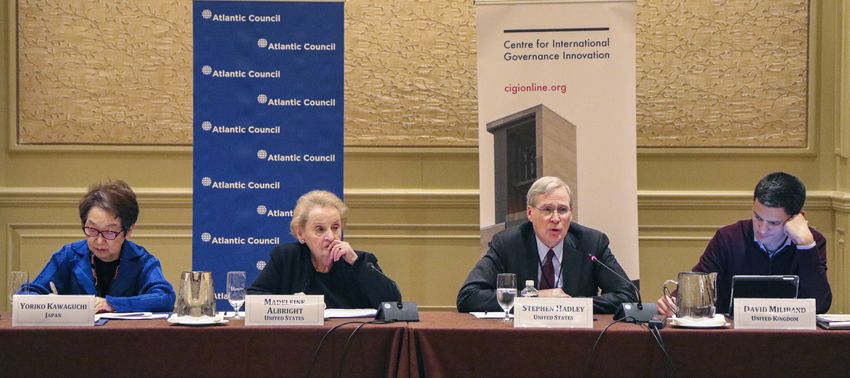
PRESENT AT THE RE-CREATION

                       EXECUTIVE SUMMARY

                      T
                                  he United States and its victorious allies in World War
                                  II led the construction of the international system we
                                  inhabit to this day.1 Following two devastating global
                                  conflagrations, they devised a system of rules and
                       norms, backed by alliances and international institutions, which
                       provided forums for states to settle political disputes and help
                       societies rebuild from economic depression and war. This rules-
                       based international system proved successful beyond even the
                       expectations of its architects. Over the past seven decades, the
                       world has become much more peaceful, prosperous, and demo-
                       cratic than at any time in history.
                          Yet, today, this system faces new challenges. The global distri-
                       bution of power is shifting. Revisionist, autocratic states seek to
                       disrupt or displace the existing system. Authoritarian state capi-
                       talism is challenging the Western model of free markets and poli-
                       tics as the best way to order society. In addition, new issues, such
                       as emerging disruptive technologies, have arisen for which the
                       original system was never designed.
                          Across the West, there is a loss of confidence in its own polit-
                       ical model. Growing inequalities are leading many to ques-
                       tion open-market economics and provoking a backlash against
                       global engagement. All of this is taking place as the leading
                       champion and defender of this order, the United States, is reveal-
                       ing increasing uncertainty about both its ability and willingness
                       to continue to play its traditional role in advancing the rules-
                       based system.
                          In the face of these challenges, many analysts have suggested
                       that the rules-based system as we have known it is destined to
                       deteriorate.2 According to this argument, the United States and
                       its democratic allies and partners no longer have the global influ-
                       ence, nor the domestic political backing, to decisively shape out-
                       comes internationally. They conclude, therefore, that the United
                       States and its allies have no choice but to scale back their global
                       ambitions and find ways to accommodate rival great powers in a
                       new, less liberal, world system.
                          Others contend that the recent troubles with the rules-based
                       system can be attributed largely to short-lived political disrup-
                       tions, such as the populist wave sweeping across many democ-
                       racies around the globe. Once these temporary obstacles pass,
                       this narrative suggests, the United States and its allies can dust
                       off the old playbook and return to the traditional model of doing
                       business.

4
Both of these viewpoints are misguided. The post-World
War II order has proven unmatched in its ability to provide for
global peace, prosperity, and freedom. It would be unwise to
abandon it—or significantly reduce its scope—because it is
coming under new strains. At the same time, it is impossible to
return to a world that no longer exists. Global conditions have
fundamentally changed, and it makes little sense to cling to a
static and dated system in the face of new realities. The United
States and its democratic allies must find a new way forward
that steers between these alternate dangers of defeatism and
nostalgia.
   This strategy paper advocates for the revitalization, adap-
tation, and defense of a rules-based international system.3
Instead of retrenchment, the United States and its allies and
partners around the world must double down and seize the
current moment as an opportunity to expand and deepen a
rules-based international system, grounded in liberal norms
and values. Indeed, despite common misperceptions to the
contrary, the United States and its extensive network of allies
and partners continue to possess the preponderance of
power necessary to advance a liberal, rules-based system. In
addition, democratic publics are much more willing to sup-
port global engagement than conventional wisdom sug-
gests, provided that leaders lead with a compelling vision
for the future. A rules-based approach can continue to func-
tion and even flourish, but a new strategy is required. The task
ahead for those of us “present at the re-creation” is to trans-
late the enduring principles on which the postwar order was
constructed into a significantly redesigned system capable of
meeting the challenges and opportunities of the twenty-first
century.4
   First, the United States and its democratic allies must act to
revitalize support for the principles of a rules-based system. A
sustainable global system will require reaffirming democratic
values and deepening cooperation among the world’s democ-
racies, while at the same time building an inclusive framework
that ensures that all major global powers, including China, can
contribute to and benefit from the system’s success.
   In a revitalized system, the United States should continue
to lead, but it will ensure a favorable balance of power for the
free world by more proactively linking together and driving
collaboration among its democratic allies and partners. These
core democratic powers, united around the new Declaration
of Principles, should take the mantle to collectively advance
and steer a revitalized rules-based system. They should be
joined by the world’s rising democracies, such as India, Brazil,
Mexico, and South Africa, to work more closely together
to advance and defend the common values that unite them.

                                                                    5
PRESENT AT THE RE-CREATION

                       Democratic publics, especially in the United States, must be con-
                       vinced of the benefits of committing the resources necessary to
                       maintain global leadership.
                          At the same time, such a system must extend beyond the dem-
                       ocratic core to seek the active participation or, at a minimum, the
                       acquiescence of autocratic great powers. Like it or not, Russia
                       and China have the power to disrupt the functioning of an effec-
                       tive system, and they must be made to see the benefits of con-
                       tributing to a peaceful and stable global system. The free world
                       should work with Russia and China to identify shared norms and
                       principles, and to forge an agreed-upon set of international rules.
                       The free world can, and should, pursue hardheaded engagement
                       without compromising its fundamental values.
                          This strategy paper, therefore, advocates a two-track
                       approach. The integrated democracies of the free world should
                       provide consistent and principled systemic leadership to
                       advance a rules-based system, while seeking to identify com-
                       mon interests and extend areas of cooperation to a more inclu-
                       sive group of global powers.
                          Second, the rules-based system of today needs to be signifi-
                       cantly adapted and redesigned to address existing shortcomings
                       and reflect new realities, including the diffusion of global power
                       and emergence of disruptive technologies. The United States
                       and its democratic allies need an ambitious effort to re-create
                       and update, not abandon, the institutions uniting the system’s
                       democratic core. This paper calls for adaptations including: rein-
                       venting the Group of Seven (G7) as a new elevated “D10” that
                       will serve as a steering committee of democracies; forging a new,
                       global, and formal Alliance of Free Nations (AFN); and negoti-
                       ating a Free World Trade Agreement (FWTA) that will link the
                       economies of the democratic world.
                          At the same time, the interests of all states, including autocra-
                       cies, must be represented in a revamped global system. This is
                       not a strategy focused on institution building in the democratic
                       world to the exclusion of autocracies. On the contrary, it is nec-
                       essary to build an inclusive order that brings in other major pow-
                       ers. The Group of Twenty (G20) should take on an expanded role
                       as a global decision-making body on a wider range of political,
                       economic, and security matters. New dialogues should be estab-
                       lished within the G20 framework for major powers to find com-
                       mon ground on new technology and on reforming the global
                       trading system. Meanwhile, the United Nations—particularly the
                       Security Council—should continue to serve as a universal forum
                       for dialogue and cooperation among all states. With both tracks
                       firmly grounded in a revitalized international system, leading
                       global powers can begin to develop the new rules and norms

6
EXECUTIVE SUMMARY
necessary to meet the demands of the twenty-first century.
Finally, this revitalized and adapted system must be
defended. Leading powers need to put in place a more sys-
tematic approach to monitor compliance with core rules,
incentivize state compliance with these rules, and develop
measures to punish major challengers to the system. In the
near term, this will mean that the democracies at the core of
the rules-based system must ramp up for a new era of great-
power competition. They should also defend democracy
against autocratic backsliding and interference. At the same
time, a larger group of global powers must seek to cooperate
to confront the dangers posed by nuclear proliferation, terror-
ism, disruptive technology, and other global threats.
The strategy set forth here may strike some as unrealis-
tic. However, as discussed further below, the approach out-
lined in this paper does reflect current geopolitical realities
and is well-suited to address them. The United States and
its allies and partners retain the capability and the domestic
political support to lead a revitalized international system, and
Russia, China, and other major powers will find that their inter-
ests will be better served by engaging with, rather than being
isolated from, this effort.
At the end of the day, this strategy will succeed if it is able
to convince all major states that their interests are best pur-
sued within a rules-based system. Not only can they expect
substantial benefits for participation within the new system,
but they will know that any significant efforts to challenge or
undermine the system will be futile.
The rest of this paper will continue in six parts. First, it will
describe the fundamental features of the current rules-based
international system and the benefits it provided over the past
seventy years. Next, it will analyze the present-day strategic
landscape to understand the factors challenging the existing
system. Third, the paper will identify possible future scenarios
of the state of global order. Fourth, the paper will identify stra-
tegic objectives. Fifth, it will articulate the major elements of
the proposed three-part strategy for advancing a new rules-
based system. Finally, the paper will discuss how this strategy
can be realistically implemented and offer a brief conclusion.
7PRESENT AT THE RE-CREATION
WHAT NEEDS TO CHANGE?
TOWARD A REVITALIZED
INTERNATIONAL SYSTEM
Revitalize
characteristics of the prior system recommendations for change
The West sought to accommodate The United States and its allies implement a
autocratic great powers within the rules- two-track approach, deepening cooperation
based system, in the hope that they would with the world’s democracies to advance
behave as “responsible stakeholders.” the rules-based system, while seeking
cooperation with all global powers on areas
of mutual interest.
The United States largely developed its The United States actively and consistently
own strategies and policies on global coordinates with European and Asian allies to
challenges and, at times, acted unilaterally. develop and implement joint strategies and
policies.
The transatlantic community served as Leading democracies worldwide rally around
the core of the rules-based international a new set of principles for a revitalized and
system. adapted system.
Rising democracies generally followed a Rising democracies align with the United
nonaligned foreign policy. States and other like-minded partners to
advance the rules-based system.
Public support for the rules-based system Democratic governments worldwide respond
began to dissipate as large segments of to legitimate concerns and effectively
democratic societies were left behind by advocate for a rules-based system to rebuild
globalization and failed to appreciate the public support.
broader benefits.
8Adapt
characteristics of the prior system recommendations for change
A range of institutions sought to address A new D10 and an empowered G20 serve
global challenges in an uncoordinated as the dual-track steering committees of an
fashion. adapted rules-based system.
The UN Security Council served as the A new Alliance of Free Nations (AFN)
primary decision-making body on matters provides a complementary platform to the
of international peace and security. UN for addressing international security and
economic challenges.
The liberal trading system was enhanced A new Free World Trade Agreement (FWTA)
by multilateral and bilateral free-trade links major democracies into a single,
agreements. comprehensive free-trade zone.
Europe served as the focal point for Asia serves as the focal point for geopolitical
geopolitical tensions, and regional tensions, and a new Indo-Pacific Partnership
architecture focused on European and and an Enhanced Seven-Party Framework are
transatlantic institutions. established.
International technology rules and norms New technology-focused committees linked
were developed piecemeal to govern to the D10 and G20 develop an integrated
the most important innovations of the set of rules and norms for the emerging
twentieth century. technologies of the twenty-first century.
Defend
characteristics of the prior system recommendations for change
Responses to violations of the rules- Penalties for violations of the rules-
based system were inconsistent and often based system are more consistently and
subject to political whim. systematically enforced by the leading
democracies.
Russia and China acted aggressively The United States and its democratic allies
toward their neighbors and built strategies reinvest in their defenses to shore up a
and capabilities that erode the US and favorable balance of power for the free world.
allied military advantage.
State-led capitalists preyed on the global The democratic core counters unfair trading
trading system to gain unfair advantage. practices, in order to defend the integrity of
the global economic system.
Sovereignty was absolute, and sovereignty Sovereignty is recognized as contingent on
norms prohibited interference in the states’ compliance with core principles of the
domestic politics of other states. rules-based system.
Foreign interference by adversaries to The United States and its allies strengthen
undermine democratic governance met defenses against foreign interference in
with insufficient resistance. domestic politics and effectively counter
efforts to undermine democracy.
Democratic transitions were beset by Effective models of democratic transition
violence, extremism, backsliding, and are developed and implemented in priority
political instability. countries, resulting in an expansion of
democracy around the world.
9PRESENT AT THE RE-CREATION
The rules-based system consists of formal and informal institutional bodies,
kazuhiro nogi/pool via reuters
such as the G20, aimed at advancing multilateral cooperation.
CHAPTER 1
THE CURRENT RULES-BASED
INTERNATIONAL SYSTEM
AND ITS BENEFITS
W
hat is the rules-based international system? Largely con-
structed by the United States and its democratic allies at
the end of World War II, the system reflects a set of norms
and principles pertaining to global security, economics, and
governance. The architects of the postwar order sought to advance “more
ambitious ideas about economic and political cooperation.”5 As Secretary
of State Cordell Hull explained in September 1943, the goal of the postwar
order was to replace “the anarchy of unbridled and discordant nationalism”
with international “rules of morality, law, and justice.”6 At the same time, the
advancement of these norms coincided with shared US and European inter-
ests in an expanding global economy, and a more stable and secure interna-
tional environment. The system was not established in a single stroke, but
evolved gradually over time to constitute what is today a dense set of par-
tially overlapping organizations and institutions.
10This paper prefers the term “rules-based system” because a distinguish-
ing feature of this system is a dense set of rules, norms, and institutions—
both formal and informal—that governs relations among states (for a list
of the major features of the current rules-based system, see Appendix 1).
While not always obeyed, even by its chief architects, the sheer breadth of
norms and institutions that govern major aspects of global security, eco-
nomics, and governance is unique to this current era, as is the universality
or near universality of membership in many of the most important bodies.
Moreover, while there are many notable exceptions, the degree to which the
system leader has created, propagated, and enforced rules—and has even
constrained its own behavior by them— is remarkable.
This system has alternately been referred to as a “liberal international
order,” the “US-led global order,” “multilateral order,” or “democratic world
order.” This paper uses these terms interchangeably, but “rules-based sys-
tem” may be the best encapsulation of the core idea of what makes the cur-
rent era unique.
The term “system” is preferred to “order” because it is more precise.
“Order” is a broader term that means the pattern by which various things
are related to one another. “System” is defined as a set of principles or pro-
cedures working together as part of an interconnected network.
In the American political context, there is ambiguity in the term “lib-
eral,” as it can refer both to the classical liberal philosophy of free mar-
kets and politics and the word’s modern connotation, meaning left-lean-
ing or social-democratic politics. Throughout its history, however, both
“liberal” and conservative politicians and political parties in the West have
embraced the rules-based system. The term “US-led system” risks over-
looking the centrality of US allies and partners, which have been essen-
tial to maintaining the international system. At certain times, and on cer-
tain issues, they have been more forceful advocates for the system than the
United States itself.
The primary attributes of the rules-based system include the following.
A set of rules encouraging peaceful, predictable, and cooperative behav-
ior among states that is consistent with liberal democratic values and prin-
ciples, inter alia, respect for sovereignty, limits on the use of force, free flows
of global capital and trade, respect for individual rights and freedoms, the
rule of law, and democracy.
Formal institutional bodies that serve to legitimize and enforce these rules.
This includes organizations, such as the United Nations (UN), NATO, and
the World Bank, and more flexible arrangements, like the G7. These institu-
tions are designed to defend the system, advance compliance with interna-
tional rules and norms, and provide a forum to discuss and settle disputes.
The role of powerful democratic states to help preserve and defend the sys-
tem. The United States and its democratic allies and partners in Europe and
Asia have played a central role in promoting and defending the rules-based
system by: serving as the core of regional and bilateral security alliances;
leading the establishment of global economic institutions and promoting
11PRESENT AT THE RE-CREATION
free trade and financial flows; providing international public goods; sustain-
ing open and accessible domestic economies that became the engine for
global economic growth; modeling and promoting good governance and
democracy; and offering benefits and threatening to impose costs to incen-
tivize other actors to comply with established rules.
In the security realm, the system is characterized by rules that protect state
sovereignty and territorial integrity, and place limits on the use of military
force. The Law of Armed Conflict provides prescriptions and proscriptions
about the causes, conduct, and cessation of legitimate uses of military force.
The system also includes treaties and agreements designed to stop terror-
ism and the proliferation of weapons of mass destruction, the centerpiece
of which is the Treaty on the Nonproliferation of Nuclear Weapons (NPT).
This security order is underpinned by the US-led formal alliance structures in
Europe and Asia that have provided geopolitical stability in both regions. It
includes the UN Charter and the UN Security Council (UNSC), which serves
as a forum for major powers to deliberate and make decisions about threats
to international security. The system is also supported by a wide variety of
other arrangements, including various bilateral, regional, and global treaties
and agreements on issues of war and peace.
In the economic domain, the rules-based system has served to promote an
interconnected global economy based on free markets and open trade and
finance. The core principle, as enshrined in the Bretton Woods system and its
key institutions, is that an open economic system, including the free move-
ment of goods and capital, increases global standards of living and reduces
the incentives for international conflict. These institutions include: the World
Trade Organization (WTO), the World Bank, the International Monetary Fund
(IMF), and a wide variety of other bilateral and regional trade and financial
agreements. These institutions were designed to help states rebuild from
world war, to promote freer trade and financial policies to avoid repeat-
ing the harmful protectionism of the interwar years, and to spur economic
growth in developing countries so that they could better participate in the
international economy.
Finally, in the realm of governance, the rules-based system has sought to
advance the universal applicability of democratic values and human rights.
As enshrined in the Universal Declaration of Human Rights, these princi-
ples hold that human beings are entitled to freedoms— including freedoms
of speech, religion, the press, peaceful protest, and assembly, as well as the
right to choose their own leaders—and that governments should refrain from
actions that violate these rights. The leaders of the international system
incentivized other states to adhere to these principles through a variety of
mechanisms. For example, economic assistance or membership in regional
institutions often included terms of conditionality tied to economic and gov-
ernance reforms.
The system includes many other global, regional, and functional institu-
tions. Some, such as the European Union, cut across all three domains, while
others focus on specific issues or challenges, such as those related to envi-
ronmental protection, development assistance, narcotics trafficking, refu-
gees and migration, and global health.
12THE CURRENT RULES-BASED INTERNATIONAL SYSTEM AND ITS BENEFITS
Realist international-relations scholars are skeptical of the causal force of
international institutions, and this skepticism is often warranted.7 What made
this international system different, however, was the degree to which it was
backed by US power and the support of the United States’ democratic allies.
The system worked because it was underwritten by a global power that had
a strong interest in ensuring geopolitical stability, an open international eco-
nomic system, and good governance and democracy.
The Benefits of the Rules-Based System
T
his international system, while not perfect, has proven to be more
successful than any in human history at providing security, economic
prosperity, and freedom. The evidence of this is apparent in the num-
bers. Before 1945, major powers frequently engaged in direct war-
fare on a massive scale, as in the Napoleonic Wars, World War I, and World
War II. Since 1945, however, there have been zero great-power wars. As shown
in Figure 1, the percentage of people killed in armed conflict has drastically
declined in the post-World War II era. Armed conflict killed an average of 1–2
percent of the human population from 1600 to 1945. During the Cold War, an
average of 0.4 percent of the world’s population perished due to war. Since
the year 2000, less than one one-hundredth of 1 percent of people have died
this way.8 Under a rules-based system, the world has continued to make prog-
ress in reducing deaths from all kinds of war, including often-intractable civil
conflicts.9
Turning to economic prosperity, the global gross domestic product (GDP)
per capita in 1945 was $4,079.10 Today it is $11,570.11 This drastic increase in
global living standards is evident in Figure 2. The share of the global popula-
tion living in poverty has dramatically decreased. In 1929, the number of peo-
ple living in extreme poverty (defined as earning less than 1.90 international
dollars per day) was 1.35 billion, almost two-thirds of the world population at
the time. In 2015, that figure was 733.48 million, or slightly less than 10 percent
of the world population.12 China itself has been one of the biggest beneficiaries
of this system, as geopolitical stability in Asia and integration into the global
economy helped to lift four hundred million Chinese out of poverty.
In the realm of good governance, the number of democracies has substan-
tially increased. With the end of World War II and decolonization, the num-
ber of democracies increased from seventeen to forty-eight between 1945
and 1989.13 That number further skyrocketed at the end of the Cold War, as
countries formerly behind the Iron Curtain rushed to join the West. In the year
1900, there were twelve democracies in the world. Today there are ninety-six.14
The percentage of the world’s population living under democratic govern-
ments has also increased from about 12 percent in 1900 to more than 55 per-
cent today.15 This trend is visible in Figure 3.
To be sure, these outcomes are the result of an enormous and intercon-
nected range of factors. International-relations scholars, for example, believe
that nuclear deterrence and the absence of a multipolar distribution of
power also contributed to great-power peace.16 In addition, globalization and
13PRESENT AT THE RE-CREATION
FIGURE 1
Wartime Casualties throughout History
% of total population
2.5%
Rules-Based
System
2.27%
2% WWII
1.75%
1.5%
WWI
1.12%
1.15% 1.31%
1%
0.5%
0.4%THE CURRENT RULES-BASED INTERNATIONAL SYSTEM AND ITS BENEFITS
FIGURE 3
Trends in Democratic Governance, 1800–2017
# of countries Democracies
100
Rules-Based
System
80
60
40
20
0
1850 1870 1890 1910 1930 1950 1970 1990 2010
SOURCE: Center for Systemic Peace
economic development have been fueled by new technological developments.
Further, global norms on democratic governance and human rights have come
a long way since the early twentieth century.17
Still, it is doubtful whether this dramatic improvement in the human con-
dition could have been achieved in the absence of the rules-based interna-
tional system. Moreover, many of these other driving forces are themselves
constitutive of, if not partially the result of, that system. Global bipolarity, and
then unipolarity with the United States at its center, was critical for the post-
war development of a rules-based system, which may not have been possi-
ble in a more multipolar distribution of international power, or with a non-dem-
ocratic hegemon at the system’s apex. The splitting of the atom could have
resulted in widespread nuclear-weapons proliferation and nuclear use had
it not been for the NPT and extended US nuclear deterrence in Europe and
Asia.18 The most important technological advances for globalization, including
the Internet, occurred and flourished in the free world, defended by the United
States and its democratic allies and partners.19 Finally, the United States and its
democratic partners, along with nongovernmental organizations and individ-
uals operating in these states, were the most important norm entrepreneurs
propagating global norms around issues of good governance, democracy, and
human rights.
In sum, the rules-based international system that has been the defining fea-
ture of global order for the past seventy years has coincided with—and was
almost certainly essential in bringing about—the most secure, prosperous, and
well-governed world humanity has ever known.
15PRESENT AT THE RE-CREATION
Revisionist great powers are seeking to
kenzaburo fukuhara/pool via reuters
disrupt or displace the rules-based system.
CHAPTER 2
THE STRATEGIC CONTEXT
D
espite this record of unprecedented and enduring success, the
rules-based international system is currently besieged by a
number of challenges unleashed by rapid and dramatic global
change. Understanding the current strategic context, including
global trends and threats both external and internal to the system’s demo-
cratic core, is a necessary first step toward devising a strategy to revitalize,
adapt, and defend a rules-based international system.
16Global Trends
T
he system is currently buffeted by several worldwide trends,
including global shifts in the balance of power, the emergence
of disruptive technology, the threat of nuclear proliferation, the
rise of nonstate actors, and the consequences of climate change.
Global Diffusion of Power. The international distribution of power, as
defined by relative economic weight, is shifting away from the founders of
the post-World War II system to other emerging economies. As recently
as the 1990s, nearly 70 percent of global economic activity occurred in
Europe and the Americas. By the 2040s, that number is expected to drop
to roughly 40 percent. At the same time, the Asian share of global GDP
will increase from 32 percent at present to 53 percent in 2050, meaning
that, by that time, the majority of all economic activity on Earth will occur
in Asia.20
While the United States remains the world’s most powerful state mil-
itarily and economically, it is declining relative to other rising powers,
particularly China. When corrected for purchasing-power parity (PPP),
China’s GDP has already surpassed the United States. The better metric
for international power and influence, however, is real GDP; here, too, the
US advantage is narrowing, but more slowly.21 At the conclusion of World
War II, the United States possessed roughly 50 percent of global GDP.22
From the 1970s through today, that number has held steady at roughly 25
percent.23 Despite a common misperception, the United States’ share of
global power is not declining in absolute terms.
Rather, other powers—especially China—are rising. China’s share
of global GDP rose from 4.6 percent in the 1990s to 15 percent today.24
Many economists predict that China could surpass the United States as
the world’s largest economy by 2030. It is noteworthy, however, that in
2009, economists predicted that this transition would happen by 2020.
That date has been pushed back a decade as Chinese growth has slowed.
Future projections depend entirely on assumptions about growth rates
in the United States and China that cannot be known with certainty.
Still, most economists expect that China will, at some point, surpass the
United States as the world’s largest economy.
China is joined by other emerging economies with rapid growth
rates, including India, Indonesia, and others. US allies, including Japan,
Germany, and the United Kingdom, remain among the wealthiest nations
on Earth, but their share of global power is also declining relative to the
rise of the rest.
This shift is significant because international orders function best when
their formal attributes at least roughly reflect the underlying balance
17PRESENT AT THE RE-CREATION
FIGURE 4
Share of Global Power (Percent of World GDP)
Democracies retain a preponderance of global power
1991 2018
US, Allies, & Democracies: 88% US, Allies, & Democracies: 75%
6% 6% 19%
24%
10% 26%
6%
16%
52% 35%
United States US Treaty Allies Other Democracies Rest of World Autocratic Challengers
SOURCE: World Bank and Center for Systemic Peace
of power. While only one measure of global influence, economic power is
central given the leverage it provides over trade and investment, and the
resources it offers to sustain military and security advantages.
It is also important to point out, however, that the United States and its
formal treaty allies continue to possess a preponderance of power in the
international system. As Figure 4 shows, the United States and its formal
allies currently produce 59 percent of global GDP. When including other
countries considered to be “democracies” by the widely used Polity scores,
that number rises to 75 percent of global GDP. Democracies continue to
retain global influence because more countries have transitioned to democ-
racy since the end of the Cold War, and overall economic growth in demo-
cratic countries has outpaced that in autocratic states since 1991.
The major shift since the dawn of the post-Cold War world, therefore, is
not that the power of the United States and its democratic allies and part-
ners has declined substantially. The major difference is that the share pos-
sessed by autocratic challengers, especially China, has grown. As Figure 4
shows, the world is approaching a more bipolar distribution of power, with
more wealth concentrated in the democracies and in a grouping of auto-
cratic challengers led by China.
This means that, if they are able to work together more cohesively, the
United States and its democratic allies and partners still have the power
and influence necessary to significantly shape international outcomes.
Moreover, if they are able to expand their ranks to court other nonaligned
democracies like India, Indonesia, and Mexico, their influence on the inter-
national system can be even more decisive.
18THE STRATEGIC CONTEXT
The disruptive
technologies of the
Fourth Industrial
Revolution will
have profound
boston dynamics
implications for
security, the
economy, and
society.
Disruptive Technologies. New technologies—including artificial intelli-
gence (AI), robotics, quantum computing, and biotech, among others—are
being developed at an exponential pace, and have the promise to transform
society. They will determine how people live and function in the twenty-first
century, significantly shaping the global economy, international security,
and the course of geopolitics.
Throughout history, progress has been built on technological innovation,
ranging from Thomas Edison’s light bulb to Henry Ford’s assembly line to
the silicon chip, the personal computer, and the Internet. While new tech-
nology promises improved productivity and quality of life, it will bring seri-
ous downside risks, including economic dislocation and weapons prolifera-
tion. AI, for example, is already being widely adopted in the private sector
to achieve great efficiencies and cost savings.25 At the same time, auto-
mation threatens to put millions out of work as jobs once performed by
humans are replaced by machines. Moreover, AI is also being introduced
into national militaries. A logical next step is fully autonomous weapons
that can select and engage targets without a human in the decision-mak-
ing loop. Some warn that these “killer robots” introduce many ethical and
security risks, including the fear that they may turn on their creators and
threaten humans’ very existence or, indeed, what it means to be human.26
Henry Kissinger warns, “We are in danger of losing the capacity that has
been the essence of human cognition.”27
The existing international system was designed to deal with the most
important dual-use technologies of the twentieth century, such as nuclear
power, but it must be updated to deal with the technologies of the twen-
ty-first century. As with nuclear energy, the international community needs
19PRESENT AT THE RE-CREATION
an entirely new set of international norms, standards, and agreements for
responsible uses of new technologies that mitigate their downside risks, while
maximizing their upside potential.
Since the time of Edison, the United States has been the world’s most inno-
vative country, but it is at risk of losing that title to China and other coun-
tries that aim for the first-mover advantage in the next round of technological
breakthroughs. Throughout history, technological progress and international
leadership have gone hand in hand. Think of roads and aqueducts in ancient
Rome, the steam engine in nineteenth-century Great Britain, and the Internet
in the United States. If China or another country takes the lead in the new tech
arms race, Beijing may be in a better position to rewrite the international sys-
tem’s rules.
Nuclear Proliferation. Even as the world grapples with the technological
challenges of the twenty-first century, century-old technological challenges
remain. The NPT may be the most successful treaty in history, but its future
is uncertain. North Korea has become the only country in history to sign the
treaty, withdraw, and build nuclear weapons. If North Korea is allowed to
become an accepted nuclear-weapons state, it would pose a severe threat to
international peace and security. Other members of the treaty may also recon-
sider their nuclear options. In particular, South Korea and Japan may be at risk
of pursuing nuclear-weapons programs if the program in Pyongyang contin-
ues to advance and the United States is unwilling or unable to provide Seoul
and Tokyo with adequate security assurances.
Iran’s nuclear program was allowed to operate within strict limits according
to the terms of the Joint Comprehensive Plan of Action (JCPOA), but the US
withdrawal from that agreement may lead Tehran to accelerate its nuclear pro-
gram or dash to achieve a nuclear weapon. A bomb in Iran could also instigate
further regional nuclear proliferation.28 Officials in Saudi Arabia, for example,
have declared that if Iran acquires nuclear weapons, Riyadh will follow suit.
A proliferation cascade in East Asia or the Middle East would undermine
the global nonproliferation regime and fuel regional insecurity. Moreover, new
technologies such as additive manufacturing may make it easier for future pro-
liferators to build nuclear-weapons programs, and harder for the international
community to catch and stop them.29
The additional spread of a weapon that remains the ultimate instrument of
military force could threaten the global security and stability necessary for the
smooth functioning of the rules-based international system.
Ecological Disaster. As with nuclear war, an ecological disaster could con-
stitute a direct threat to humanity’s very existence. While states have made
efforts to address climate change caused by carbon emissions, including in the
Paris Climate Agreement, these steps will not be sufficient to keep emissions
below the target levels set by leading scientific panels. Higher average global
temperatures are leading to rising sea levels, drought, an increased frequency
of violent storms, and forced migrations, all of which are threatening vulnera-
ble societies, undermining already-weak national governments, and contribut-
ing to conflicts over natural resources.
20THE STRATEGIC CONTEXT
Nonstate Actors. The rules-based system must also contend with import-
ant nonstate actors, including multinational corporations, nongovernmen-
tal organizations, and regional and local governments. These supra- and
sub-national actors are not incorporated effectively into a system designed
by and for the nation state. For example, major firms, and even individu-
als, are developing new technologies and, in so doing, creating new realities
and setting ethical standards on their own, with little input from govern-
mental bodies. In order to deal with many global challenges, including set-
ting standards for new technologies, these nonstate groups must be effec-
tively brought into a revised international system.
Challenges from External Actors
F
or the first time in more than two decades, the United States and
its democratic allies face a challenge from revisionist great powers
aiming to disrupt or displace the rules-based system.30 Since the
ancient world, competition among the major powers has been a
recurring feature of international politics. For a half century during the Cold
War, the free world faced a security and ideological threat from the Soviet
Union. After 1989, however, the United States enjoyed a respite from major-
power rivalry that lasted twenty-five years. That period has ended. Great-
power competition has returned, but, at the same time, this does not mean
that the transnational challenges that were the major focus of the post-
Cold War era have gone away. Rogue states pursuing weapons of mass
destruction and violent extremist organizations continue to pose a threat
to the successful functioning of a rules-based system.
Russia. In 2008 and 2014, Russia invaded Georgia and Ukraine, respectively,
redrawing the map of Europe at gunpoint for the first time since World
War II. In 2015, it intervened militarily in Syria, establishing itself as a Middle
Eastern power broker for the first time since the 1970s. Moscow has made
thinly veiled military threats against the rest of Europe, and has been con-
ducting influence operations to divide the NATO alliance politically. Russia’s
meddling in foreign elections, and its attempts to coerce its neighbors
through military intimidation, economic boycotts, energy disruptions, and
arms sales, are inconsistent with norms relating to self-determination and
foreign interference.31 In addition, Moscow’s support for autocratic gov-
ernments, from Syria to Zimbabwe to Venezuela, has undermined Western
attempts to advance human rights and democracy. Many fear that Russia is
seeking to disrupt the rules-based international system on its way toward
reestablishing a Russian sphere of influence in Eastern Europe and beyond,
including in the Western hemisphere.
China. If Russia seeks to disrupt the order, some fear that China may ulti-
mately seek to replace it. In his November 2017 speech to the 19th National
Congress of the Communist Party of China, President Xi Jinping declared
that, by 2049, China will be a “global leader in terms of composite national
21PRESENT AT THE RE-CREATION
strength and international influence.”32 It may be on a path to achieve
that goal. China’s economy has slowed, but it continues to grow, and may
soon become the largest on Earth. It is transferring its economic capacity
into military might, shifting the balance of power in Asia and calling into
question the ability of the United States to defend traditional allies in the
region. In recent years, China has used military coercion to seize contested
territory in the South China Sea. Through its Belt and Road Initiative (BRI),
its secretive United Front Work Department, and other efforts, China has
increased its political influence in every major region of the world. Its
global ambitions are also evident in its growing number of overseas mili-
tary bases.
As it has risen, China has frequently violated fundamental principles and
norms of the rules-based system. Beijing’s assertion of its “nine-dash line”
in the South China Sea, its self-proclaimed air-defense identification zones,
and its claims of “indisputable sovereignty” over disputed territories with
the Philippines, Malaysia, and Vietnam—despite the recent international
arbitration tribunal ruling against it—underscore its ambitions to carve out
a regional sphere of influence.33 On the economic front, China’s trade and
economic policies—including subsidies, theft of intellectual property, con-
straints on market access for foreign firms, and reliance on state-run enter-
prises—run contrary to liberal economic norms and have provided Chinese
companies with unfair commercial advantages. Moreover, China remains
fundamentally opposed to the expansion of democratic norms and princi-
ples. It is detaining more than one million Muslims in “re-education” camps
in Xinjiang, as part of an egregious ethnic-cleansing campaign. Beijing has
also sought to frustrate Western efforts to censure regimes such as North
Korea, Iran, and Myanmar over human-rights violations. China remains
deeply dependent on the stability of the international system to fuel its
economic rise, but it is not committed to the fundamental norms that
underpin the system.
The presence of autocratic states intent on undermining the rules-based
system poses a major challenge. After the end of the Cold War, many had
hoped that Russia and China might become “responsible stakeholders” in
a liberal, rules-based system.34 That may still make sense as a long-term
goal, but seems impossible in the near term. A central question for pre-
serving and adapting the system will be how to deal with these near-peer
competitors.
Rise of Authoritarian State Capitalism. The China challenge goes beyond
aggregate shifts in the balance of power to questions about how to best
organize societies and markets. At the end of the Cold War, analysts pro-
claimed an “end of history” as democracy and capitalism proved them-
selves better than any other system at delivering prosperity and liberty.35
In recent years, however, the global financial crisis, perceptions of politi-
cal dysfunction in the West, and fears of US withdrawal from its predomi-
nant global role have led many to question the core tenets of democratic
capitalism. To many around the world, the alternative, Chinese model of
22THE STRATEGIC CONTEXT
Rogue states, such as Iran and North
rfe/rl
Korea, are violating fundamental
norms of a rules-based system.
authoritarian state-led capitalism now seems more appealing. It offers the
promise of political stability (but not political participation) along with high
and steady rates of economic growth. To many dictators and would-be
autocrats, this is becoming a legitimate model of development that, unlike
the “Washington Consensus,” has the additional benefit of not threaten-
ing their personal hold on power. While experts debate whether China and
Russia are consciously exporting their domestic political-economic models,
there is no doubt that their example and their willingness to engage with
countries without regard to their domestic political situations, have helped
to make the world increasingly safe for autocracy.36 While slowing growth
in China may take some of the luster off the China model, the fact remains
that there is a viable alternative to liberal market democracy for the first
time since the collapse of communism.
Iran. Unlike the autocratic great powers of Russia and China, rogue states
and terrorist organizations do not pose a direct threat to the foundations
of the rules-based system. Still, they are significant challenges that must be
addressed as part of a global strategy to revitalize and adapt the system.
Following the US withdrawal from the JCPOA, Iran expanded its nuclear
program beyond previously agreed-upon limits, and it retains the capacity
to dash to a nuclear-weapons capability in about one year. Tehran possesses
the most advanced missile program in the Middle East, which continues to
expand in the face of multiple UNSC resolutions demanding its cessation.
23PRESENT AT THE RE-CREATION
Iranian support for terrorist organizations—including Hezbollah in Lebanon
and the Taliban in Afghanistan, militant groups in Iraq and Yemen, and Shia
political groups—is aimed at establishing an anti-Western sphere of influ-
ence and promoting instability across the Arab world and beyond. Tehran
has intervened directly in Syria to defend the regime of Bashar al-Assad,
and has been complicit in Assad’s brutal and violent assault against civil-
ians. Iran’s support for terrorism against the United States, Israel, and other
allies—including the alleged 2011 plot to assassinate the Saudi ambassador
in Washington—violate fundamental norms. The US State Department has
consistently labeled Iran the world’s most significant state sponsor of terror.
Iran’s defenders will point out that there are other problematic coun-
tries in the Middle East. While it is true that other states in the region also
have atrocious human-rights records, Iran stands alone in the threat it pres-
ents to the rules-based system. Unlike other states in the region, Tehran
espouses explicit geopolitical goals of resistance to the United States
and of exporting revolution; possesses a latent nuclear-weapons capabil-
ity; maintains the largest missile stockpile in the Middle East, in defiance of
international law; directly provides material and financial support, as a mat-
ter of government policy, to terror and proxy groups; and has an expansion-
ist foreign policy, with forces actively fighting on the ground in at least four
other regional countries.
North Korea. North Korea has become the first state in history to sign the
NPT, cheat on the agreement, and succeed in building nuclear weapons. It is
now believed to possess dozens of nuclear warheads and missiles capable
of reaching most of Asia, and is on the verge of developing intercontinental
ballistic missiles (ICBMs). North Korea has repeatedly attacked and threat-
ened its neighbors, including the shelling of a South Korean island and the
sinking of a South Korean warship in 2010. North Korea defies international
law by engaging in black-market activities, including smuggling and coun-
terfeiting, to prop up its dysfunctional economy. Finally, Pyongyang contin-
ues to propagate a brutally repressive, totalitarian system of government
that flagrantly violates the human rights of its citizens.
As regional powers that threaten international security and blatantly defy
core principles of the rules-based system, Iran and North Korea must be
addressed in a revised global strategy.
Violent Extremists. Terrorists and violent extremists continue to pose
a threat to global order. Although al-Qaeda and the Islamic State of Iraq
and al-Sham (ISIS) have sustained great territorial losses in recent years,
the conditions that led to their rise—including a deficit of effective gov-
ernance in the Middle East and South Asia, and radical interpretations of
Islam—show no sign of abating. Other terrorist groups, including Hamas
and Hezbollah in the Middle East and Jemaah Islamiyah in Southeast Asia,
continue to pose threats to free societies and to broader regional stability.
Moreover, new technology may be placing greater destructive power in
the hands of individuals and small groups, making terrorism an attractive
tool for other types of fringe organizations with radical political objectives,
24You can also read


