Presenters - Supporting Aboriginal and Torres Strait Islander people to stop vaping - NACCHO Aboriginal Health News Alerts
←
→
Page content transcription
If your browser does not render page correctly, please read the page content below
Supporting Aboriginal and Torres Strait Islander
    people to stop vaping

    Thursday 27 January 2022, 12.30pm AEST
    Ms Alice Nugent
    Prof Renee Bittoun

                     This activity has been developed in partnership with NACCHO and Prof Renee Bittoun.
        Materials or sections of materials from Prof Bittoun’s presentation should not be used without acknowledgment.

1

    Presenters

                                                                             Prof Renee Bittoun
                Alice Nugent                                   Professor, Nicotine Addiction Unit, Lifestyle
        NACCHO Pharmacist Advisor,
                                                                    Medicine, Avondale University &
       Medicines Policy and Programs
                                                              Professor, Medical School, University of Notre
                                                                                  Dame
                                                                                 No conflict of Interests

2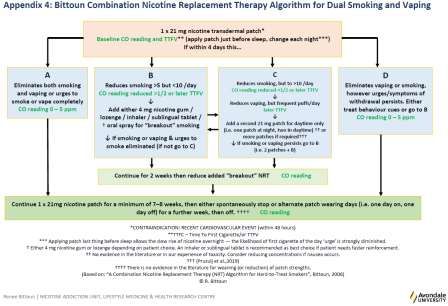
Acknowledgement of Country

    We recognise the traditional custodians of the lands and seas
    on which we live and work.

    We pay our respects to Elders past and present.

3

     Learning outcomes
      By the end of this webinar, participants will

      1. Discuss approach to vaping and dual (tobacco and nicotine vaping products) use and
         cessation
      2. Understand issues related to vaping in young people including NRT options
      3. Identify validated tools for assessment and cessation support available

4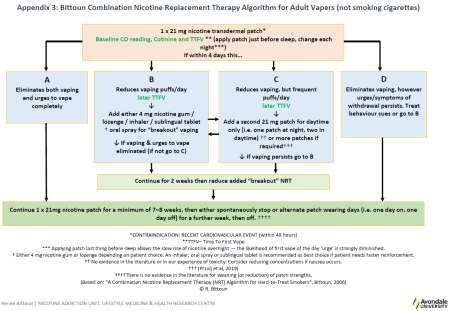
Context
    • We all know smoking is bad!
    • Smoking contributes to 30% of all deaths in Aboriginal and Torres
      Strait Islander peoples
    • Last webinar with Professor Emily Banks Australian National
      University- National Centre for Epidemiology and Population Health
      discussed why vaping is not the solution

5

                Do e-cigarettes help people to quit smoking?
    • Not sure!
    • Systematic review: >6,000 articles searched
    • Major international reports, 12 RCTs
    • Limited evidence nicotine e-cigarettes efficacious for smoking
      cessation compared to approved nicotine replacement or no
      intervention/standard care
    • Freebase nicotine: no evidence on nicotine salts

6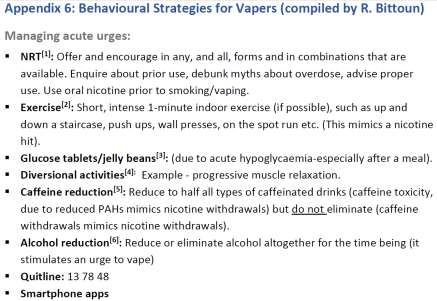
Do e-cigarettes help people to quit smoking?
             •   Main trial (Hajek et al, 2019)
                  – 886 smokers attending stop smoking clinic
                  – 438 nicotine e-cigarettes, 446 usual care
                  – Of those randomised to e-cigarettes, six months later, 18% quit smoking
                      • 4% quit smoking and were not using e-cigarettes

                      • 14% quit smoking and were still using e-cigarettes

                      • 25% kept smoking and using e-cigarettes

                  – In supported trial conditions, more dual users
                    than quitters

7

    NACCHOs work
    • Health Promotion
    • Continue to promote first line, evidence based treatments for smoking
    • Share your stories- what is working to help prevent people start smoking or
      vaping? Talk to the kids that don’t vape!
    • Ask! Should we be getting our software providers to add extra field about
      vaping to smoking demographics?
    • Contribute to research

8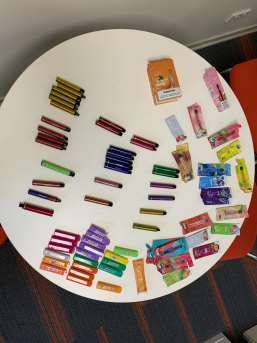
9

10
XXL Vape
               Proports 1000 puffs
       Note: Does not mark nicotine content

11

              Mega Vape
          Proports 3000 puffs
     Bought and used by 15 year old

12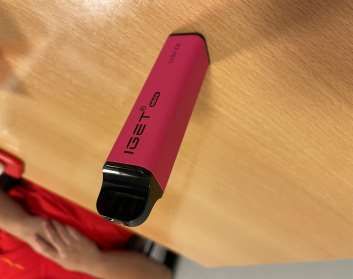
Prevalence Data
     •   Prevalence of vaping changing daily
     •   You can contribute by surveying usage in YOUR community
     •   Do a poll NOW
     •   Do another poll in 6 months
     •   What impact have YOU had?

13

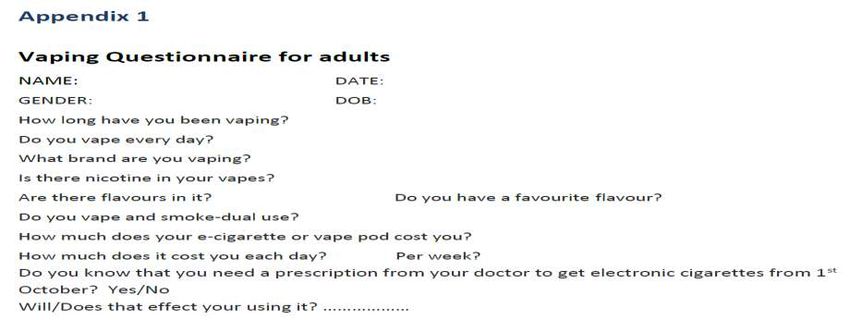
     Take a patient/client/consumer history

14
15

16
Treatments for Adults to Quit Vaping

17

18
19

     Adolescent Vaping

20
Nicotine in adolescents
• There is an increased susceptibility of adolescent brains to
harms caused by early nicotine exposure – including greater
risk of long-term nicotine addiction.
• ‘Never smokers’ who vape have three times the risk of smoking
in future compared with those who never vape
• No evidence that Australian adolescents would have become
smokers!
21
Key points
• Nicotine addiction can begin with the first cigarette/vape.
• The most susceptible youths lose autonomy over tobacco/vaping within a
day or 2 of first inhaling nicotine.
• The appearance of tobacco/vaping withdrawal symptoms and failed
attempts at cessation can precede daily smoking/vaping
• It develops faster in girls.
• It is well underway prior to daily smoking/vaping.
22A little about susceptibility
GENETICS
• High heritability to responding to nicotine in the brain
• High heritability to metabolising (breaking down) nicotine in the
liver
• Fast metabolisers need more nicotine
23
Australian adolescent vaping
Adolescents (12-17 years of age)
▪ In Australia, around 14% of 12 to 17-year-olds have ever tried an e-
cigarette, with around 32% of these students having used one in the past
month.
▪ Students who had vaped most commonly reported getting the last e-
cigarette they had used from friends (63%), siblings (8%) or parents (7%).
Around 12% of students reported buying an e-cigarette themselves.
▪ Reports of lining up at school toilets to vape.
24Pitching to the young
• The dramatic increase in e-cigarette
use among U.S. youth in 2018 was
immediately preceded by the
introduction of flavoured forms of
these high-nicotine-content products
to the e-cigarette product market
25
Nicotine & the developing brain
Ages 12 - 25
Nicotine-exposed youths tend to have several mental health
problems throughout their lives including:
• Poor academic performance: significant behavioral disruptions, including
ADHD, aggressive behaviors, and future substance abuse.
• Higher risk of suicide and suicide ideation
26Vapes seized in one Sydney private school by staff,
Early 2021
27
ANALYSING THE NICOTINE IN VAPES
Vapes volunteered for analysis to the TATU team by adolescents from years 7 to 10 - Redfern NSW
Samples analysis date: May 26, 2021
mg of Nicotine per cartridge
Brand & Flavour Mg of nicotine
Iget XXL Energy Drink 49.50
Iget Mixed Fruit 46.00
Iget BlueRazz 61.60
HQD Curvie Tangerine Ice 8.90
Iget Pineapple Ice 39.60
Iget Grape 52.30
HQD Curvie +Apple Peach 96.90
Iget Cola Ice 8.30
Iget Grape 57.20
Iget Grape 40.20
Analysed by the NSW Forensic & Analytical Science Service, Lidcombe NSW 1825
28How does it affect adolescents?
Initially start doing it “For fun”- influencers, peers
▪ “Head-spin” or “Buzz”
Get a positive effect - or not
▪ “Like doing it” “Like a pacifier” “Calms you down”
▪ “Stress release”
▪ Weight control
▪ Become dependent very quickly
▪ Faithful to flavours
▪ Doing it daily → at home alone → as soon as they wake up
29
Signs of nicotine addiction
SIGNS OF WITHDRAWALS SIGNS OF ADDICTION
BETWEEN PUFFS Wake up and do it within ½ hour
Irritable Hide vapes close by- in bed/in pocket
Angry Strong cravings and urges to use
Headaches Increase quantity and frequency
Poor concentration in class Inability to restrain or quit
30Negative physical effects
(NicSic) too much nicotine)
▪ Feel sick
▪ Throwing up
▪ Coughing
▪ Chest pains
▪ Asthma and phlegm
Other documented long-term health effects in adolescents exposed to
nicotine:
– Impaired function of the endocrine, reproductive, respiratory, cardiovascular, and
neurologic systems.
31
What can be done in the community?
▪ Education and workshops about vaping-debunking myths
▪ Discuss and describe addiction to nicotine and long-term
consumption
▪ Vape detectors in school and other public toilets as deterrents
▪ Non-vaper rights
▪ Do people and youth have the confidence to discuss and describe
passive vaping as they once did about passive smoking?
32Adolescent Vaping
• Rising costs → “chroming” or cigarette use
• Effects on adolescent development, particularly brain
33
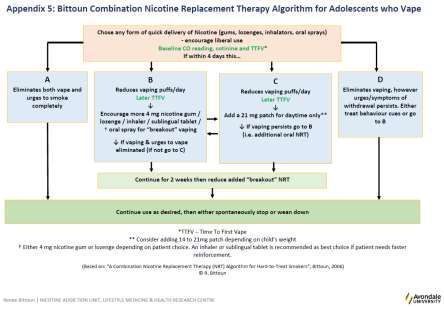
Treatments for Adolescents to Quit
Vaping
34Take a patient/client/consumer history 35 36
37

     Valid Behavioural Interventions

38
39 40
EVIDENCED-BASED SMOKING and VAPING CESSATION
                                                       Behavioural
                                                     Change Strategies
                                                  And Relapse Prevention

     B
     a
     r
     r   Lives with smoker or
                                Smokes or Vapes
     i          Vaper                                                          Drinks alcohol          Family history
                                     in the car       Drinks caffeine                                                                                  Strong Urges
         and/or most friends                                                    Avoid for the         (blood relatives)      Fear of weight gain
     e                          or others smoke in    coffee/colas/tea                                                                              to Smoke or Vape
            Smoke or Vape                                                      first two weeks         Smoke or Vape
                                      the car
     r
     s

     S
     o
     l       Be consistent
              Everyone,                                                                                                       Glucose helps
     u                          Get out of the car     Reduce by half            Reduce and          Discuss heritability                              Short exercises
           including guests,                                                                                                   Eat breakfast
                                    to smoke         DO NOT STOP coffee            separate          of nicotine addiction                               Quick walk
     t    go outside or you          or Vape                                 Smoke or Vape outside      lifelong risk of
                                                                                                                              Short exercises
                                                                                                                                                   Glucose /jelly bean helps
                                                     Smoke or vape outside
               go outside                              drink coffee inside
                                                                                                                             Excessive weigh-
                                or everyone out                               drink alcohol inside         relapsing                                   Time your urges
     i        Socialise in                                                                                                     gain test TSH
         non-smoking venues
     o
     n
     s

41

          Nicotine Addiction & Smoking
                    Cessation
                         Post-graduate Microcredential Course

              Lecturer - Professor Renee Bittoun

                                         Enquire now for 2022
                                                            0405 445 151

42
References Balfour, D. J. K., Benowitz, N. L., Colby, S. M., Hatsukami, D. K., Lando, H. A., Leischow, S. J., Lerman, C., Mermelstein, R. J., Niaura, R., Perkins, K. A., Pomerleau, O. F., Rigotti, N. A., Swan, G. E., Warner, K. E., & West, R. (2021). Balancing consideration of the risks and benefits of e-cigarettes. American journal of public health, e1-e12. https://doi.org/https://doi.org/10.2105/AJPH.2021.306416 Benjamin W. Chaffee, Bonnie Halpern-Felsher, Peyton Jacob, Gideon St.Helen, Biomarkers of nicotine exposure correlate with the Hooked on Nicotine Checklist among adolescents in California, United States (2022) Addictive Behaviors,Volume https://doi.org/10.1016/j.addbeh.2022.107235. Chadi, N., Hadland, S. E., & Harris, S. K. (2019). Understanding the implications of the “vaping epidemic” among adolescents and young adults: A call for action. Substance Abuse, 40(1), 7-10. https://doi.org/https://doi.org/10.1080/08897077.2019.1580241 DiFranza, J. R., Savageau, J. A., Fletcher, K., O’Loughlin, J., Pbert, L., Ockene, J. K., McNeill, A. D., Hazelton, J., Friedman, K., Dussault, G., Wood, C., & Wellman, R. J. (2007). Symptoms of tobacco dependence after brief intermittent use: The development and assessment of nicotine dependence in Youth–2 Study. Archives of Pediatrics & Adolescent Medicine, 161(7), 704-710. https://doi.org/10.1001/archpedi.161.7.704 Dugas, E. N., Sylvestre, M.-P., & O’Loughlin, J. (2020). Type of e-liquid vaped, poly-nicotine use and nicotine dependence symptoms in young adult e-cigarette users: A descriptive study. BMC public health, 20(1), 922. https://doi.org/https://doi.org/10.1186/s12889-020-09056-y 43 References cont… Grant, J. E., Lust, K., Fridberg, D. J., King, A. C., & Chamberlain, S. R. (2019). E-cigarette use (vaping) is associated with illicit drug use, mental health problems, and impulsivity in university students. Ann Clin Psychiatry, 31(1), 27-35. https://doi.org/https://doi.org/10.1080/10401230490281366 Larsen, P. D. (2020). Vaping and adolescents: The next public health crisis. Rehabilitation Nursing, 45(1), 1-2. https://doi.org/https://doi.org/10.1097/RNJ.0000000000000246 Morphett, K , Doug Fraser,1Ron Borland, Wayne Hall, Natalie Walker, Chris Bullen, Coral Gartner (2021) A pragmatic randomised comparative trial of e-cigarettes and other nicotine products for quitting or long-term substitution in smokers. Nicotine and Tobacco Research https://doi.org/10.1093/ntr/ntab266 Martinelli, T., Candel, M. J. J. M., de Vries, H., Talhout, R., Knapen, V., van Schayck, C. P., & Nagelhout, G. E. (2021). Exploring the gateway hypothesis of e-cigarettes and tobacco: A prospective replication study among adolescents in the Netherlands and Flanders. Tobacco control, tobaccocontrol-2021-056528. https://doi.org/https://doi.org/10.1136/tobaccocontrol-2021-056528 Salloum, R. G., Tan, A. S. L., & Thompson, L. (2021). What parents need to know about teen vaping and what they can do about it. JAMA Pediatrics. https://doi.org/https://doi.org/10.1001/jamapediatrics.2020.6689 Smith, T. T., Nahhas, G. J., Carpenter, M. J., Squeglia, L. M., Diaz, V. A., Leventhal, A. M., & Dahne, J. (2021). Intention to quit vaping among United States adolescents. JAMA Pediatrics, 175(1), 97-99. https://doi.org/https://doi.org/10.1001/jamapediatrics.2020.2348 44
References cont…
 Soule, E. K., Lee, J. G. L., Egan, K. L., Bode, K. M., Desrosiers, A. C., Guy, M. C., Breland, A., & Fagan, P. (2020). “I cannot
 live without my vape”: Electronic cigarette user-identified indicators of vaping dependence. Drug and alcohol dependence, 209,
 107886. https://doi.org/https://doi.org/10.1016/j.drugalcdep.2020.107886

 Sun, T., Lim, C. C. W., Chung, J., Cheng, B., Davidson, L., Tisdale, C., Leung, J., Gartner, C. E., Connor, J., Hall, W. D., &
 Chan, G. C. K. (2021). Vaping on TikTok: A systematic thematic analysis. Tobacco control, tobaccocontrol-2021-056619.
 https://doi.org/10.1136/tobaccocontrol-2021-056619

 Thomas, S. P. (2019). The alarming increase in vaping among youth. Issues Ment Health Nurs, 40(4), 287-288.
 https://doi.org/https://doi.org/10.1080/01612840.2019.1578142

 Yoong, S. L., Hall, A., Leonard, A., McCrabb, S., Wiggers, J., Tursan d'Espaignet, E., Stockings, E., Gouda, H., Fayokun, R.,
 Commar, A., Prasad, V. M., Paul, C., Oldmeadow, C., Chai, L. K., Thompson, B., & Wolfenden, L. (2021). Prevalence of
 electronic nicotine delivery systems and electronic non-nicotine delivery systems in children and adolescents: A systematic
 review and meta-analysis. The Lancet Public Health, 6(9), e661-e673. https://doi.org/https://doi.org/10.1016/S2468-
 2667(21)00106-7

45

 Useful resources
     • Therapeutic Goods Administration, Nicotine vaping products. https://www.tga.gov.au/nicotine-vaping-products

     •   TGO 110 Standard for Nicotine Vaping Products. https://www.legislation.gov.au/Details/F2021L00595

     •   E-cigarettes and personal vaporisers. https://www.industrialchemicals.gov.au/consumers-and-community/e-cigarettes-and-
         personal-vaporisers

     •   Tackling Indigenous Smoking. https://tacklingsmoking.org.au/e-cigarettes/
     •   NICNAS 2019 report 'Non-nicotine liquids for e-cigarette devices in Australia chemistry and health
         concerns’. https://www.industrialchemicals.gov.au/sites/default/files/2020-08/Non-nicotine%20liquids%20for%20e-
         cigarette%20devices%20in%20Australia%20chemistry%20and%20health%20concerns%20%5BPDF%201.21%20MB%5D.pdf

     •   A review of evidence on the prevalence of and trends in cigarette and e-cigarette use by Aboriginal and Torres Strait Islander
         youth and adults. https://openresearch-
         repository.anu.edu.au/bitstream/1885/210569/1/Aboriginal%20cigarette%20ecigarette%20prevalence%20trends_2020.pdf

     •   National guide to a preventive health assessment for Aboriginal and Torres Strait Islander people: Chapter 1 – Smoking.
         https://www.racgp.org.au/FSDEDEV/media/documents/Clinical%20Resources/Resources/National-guide-3rd-ed-Sept-2018-
         web.pdf

46
Useful resources cont…
• ATRAC Yarning Tool. www.ahmrc.org.au/programs/public-health/health-promotion/aboriginal-tobacco-resistance-and-
control/
• Supporting smoking cessation: a guide for health professionals. https://www.racgp.org.au/clinical-resources/clinical-
guidelines/key-racgp-guidelines/view-all-racgp-guidelines/supporting-smoking-cessation
• Guidelines for preventive activities in general practice (the Red book) – Smoking. https://www.racgp.org.au/clinical-
resources/clinical-guidelines/key-racgp-guidelines/view-all-racgp-guidelines/guidelines-for-preventive-activities-in-general-
pr/prevention-of-chronic-disease/smoking
• Smartphone apps for smoking cessation. https://www.racgp.org.au/clinical-resources/clinical-guidelines/handi/handi-
interventions/apps/smartphone-apps-for-smoking-cessation
• Preventing and managing patient aggression and violence. https://www.racgp.org.au/running-a-practice/practice-
management/business-operations/preventing-and-managing-patient-violence
• Have GPs been supported for vaping to go prescription-only from October? https://www1.racgp.org.au/newsgp/clinical/have-
gps-been-supported-for-vaping-to-go-prescript
47
Any questions…
48You can also read


