Prevalence of Neck Pain and Back Pain in Computer Users Working from Home during COVID-19 Pandemic: A Web-Based Survey
←
→
Page content transcription
If your browser does not render page correctly, please read the page content below
International Journal of Health Sciences and Research
                                                                                         Vol.11; Issue: 2; February 2021
                                                                                                  Website: www.ijhsr.org
Original Research Article                                                                               ISSN: 2249-9571

Prevalence of Neck Pain and Back Pain in Computer
   Users Working from Home during COVID-19
         Pandemic: A Web-Based Survey
                                      Manali Shah1, Ruchi Desai2
                  1
                   Assistant Professor, L J Institute of Physiotherapy, L J Campus, Ahmedabad.
                  2
                   Assistant Professor, L J Institute of Physiotherapy, L J Campus, Ahmedabad.
                                           Corresponding Author: Manali Shah

ABSTRACT

A survey of 129 participants between the ages of 18-65 years was conducted to find out prevalence
and measure functional disability of neck pain and back pain in computer users working from home
during COVID-19 Pandemic. In our study 70.5% participants had pain or discomfort in body out of
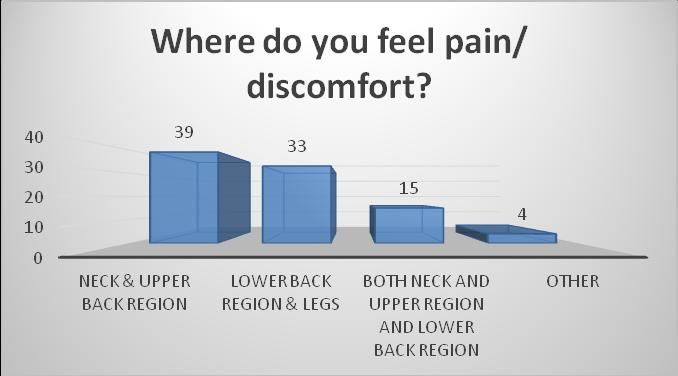
which 42.9% had pain in neck and upper back region, 36.3% had pain in the lower back region and
legs whereas 16.5% had pain or discomfort in both region. Those who had pain were asked to fill NDI
and /or ODI questionnaire and we found 41.9 %, 24.8 % and 3.1% participants had mild, moderate
and severe functional limitation due to neck pain and 67.4%, 31.8% and 0.8% participants had mild,
moderate and severe functional limitation due to low back pain. We also found that only 30
participants (23.2%) were following ergonomic advices. Thus, it is important to spread more
awareness among young working professionals regarding the correct work ergonomics while working
on computer at home and workplace.

Keywords: work from home, computer users, MSDs, ergonomics.

INTRODUCTION                                                  found new ways to keep their work going on
         Ever since COVID-19 was declared                     during lockdown and even after that.
a pandemic by WHO (World health                                       However, the numbers of new cases
organization), leading to a nationwide                        and deaths have been continuously
lockdown, a majority of people in India                       increasing. In India most of the corporates,
have faced changes in work pattern and                        IT companies, software companies and
lifestyle both, which we had never                            many businesses offices have shifted to
experienced before.                                           work from home (WHF). (1, 2) Even
         On March 24, 2020, the prime                         education sector is still not allowed to have
minister of India called for a nationwide                     off line mode of learning till date for all.
lockdown to ensure the safety of people,                      Owing to this many people in India are
which was supposed to last for 21 days, but                   using many electronic gadgets (like, laptop,
owing to increase in number of cases it was                   desk tops, mobile phones etc.) for video
extended in various phases till May 31,                       conferencing, meetings and attending
2020. During lockdown all companies,                          lectures.
businesses, schools, colleges, parks, malls,                          The work from home culture may be
public transports etc. were forced to shut                    followed not only during pandemic but
down. Gradually in unlock phase some of                       might be even after till the security of all
the sectors opened up with many rules and                     will be ensured.
norms to be followed. Every sector has                                Many studies have already found
                                                              that laptop, mobile phones and tablets have

                      International Journal of Health Sciences and Research (www.ijhsr.org)                          26
                                           Vol.11; Issue: 2; February 2021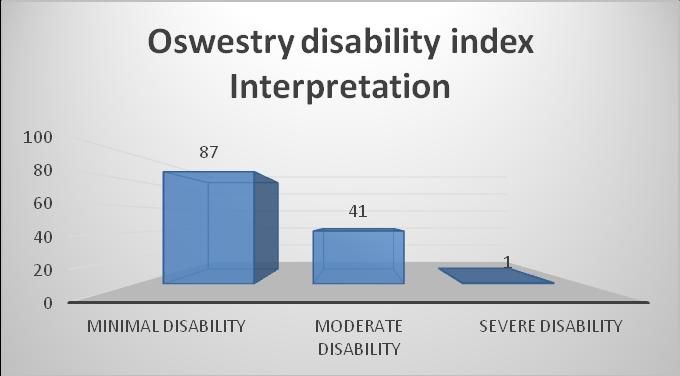
Manali Shah et.al. Prevalence of neck pain and back pain in computer users working from home during
COVID-19 pandemic: a web-based survey.

replaced the desktops in last decade. So,              working hours, working place, knowledge
portable gadgets like laptop allow people to           about ergonomics etc. and also included
assume any posture they want ranging from              neck disability index and Oswestry low
sitting in a chair to lying in a bed. These are        back pain questionnaire. In the beginning of
going to put stress on spine and other areas           questionnaire consent was taken from
of body if proper posture for long work                participants. It was given to different IT
duration is not maintained. (3, 4, 5, 6, 7)            company heads and HR department. They
         So, this study is aimed to find out           approved the content of questionnaire with
prevalence and measure functional disability           few modifications. Then that form was
of neck pain and back pain in computer                 distributed to employees working from
users working from home during COVID-                  home during COVID-19 Pandemic through
19 Pandemic.                                           digital platform. The data was collected by 3
                                                       weeks and analyzed using SPSS version 20.
Need of study:
        Many studies have found use of                 Data analysis:
computer for long working hours in faulty                      Using SPSS version 20 the data was
posture may lead to neck and back pain in              managed and analyzed. Continuous
adults and elderly. During COVID-19                    variables were expressed as mean and SD
pandemic need of work from home has                    whereas     categorical    variables    were
increased all over the world for computer              expressed in the form of frequency table and
users. In India work from home culture is              percentages. The histogram was also used to
new and it is necessary to find out                    see the normality of quantitative data.
prevalence and reasons for neck and back
pain in computer users who are working                 RESULT
from home to maintain their work efficiency                        Table 1. Showing Gender distribution.
and health.                                            Gender             Frequency                Percent
                                                       Female             34                       26.4
                                                       Male               95                       73.6
METHODOLOGY                                            Total              129                      100.0
        An observational study was carried
                                                                     Table 2. Showing age distribution.
out on computer users working from home                Age Group               Frequency              Percent
during COVID-19 pandemic using random                  18-30                   48                     37.2
                                                       31-40                   72                     55.8
sampling method. Out of 137 participants               >40                     9                      7.0
total 129 males and females working from               Total                   129                    100.0
home on computer due to COVID-19
                                                         Table 3. Showing distribution of occupation of participants
pandemic were included in this study.                  Occupation                         Frequency        Percent
        8 participants were excluded who               IT/ SOFTWARE                       83               64.3
                                                       STUDENTS/TEACHERS                  11               8.5
had pain and / or any medical conditions               OTHERS                             35               27.1
affecting cervical and lumbar spine. (For              Total                              129              100.0
example, Ankylosing spondylitis, arthritis,            Table 4. Showing distribution of place for working on
disc degeneration etc…) before covid-19                technology during work from home.
pandemic. Those who were working from                  Category At which place do you Frequency Percent
                                                                   prefer to work at home?
home for more than 8 months were also                  A           office table/ study table/ 63      48.8
excluded.                                                          dining table
                                                       B           bed/ sofa/ comfort chair   55      42.6
                                                       C            A +B                      11      8.5
Methods:                                                           Total                      129     100.0
       A Google Survey form was                                    Table 5: showing interpretation of NDI
generated and circulated among computer                NDI score                Frequency              Percent
                                                       No Disability            39                     30.2
users working from home in November                    mild                     54                     41.9
2020. The form was a self-generated form               Moderate                 32                     24.8
with questions about their demographics,               Severe                   4                      3.1
                                                       Total                    129                    100.0

                 International Journal of Health Sciences and Research (www.ijhsr.org)                             27
                                      Vol.11; Issue: 2; February 2021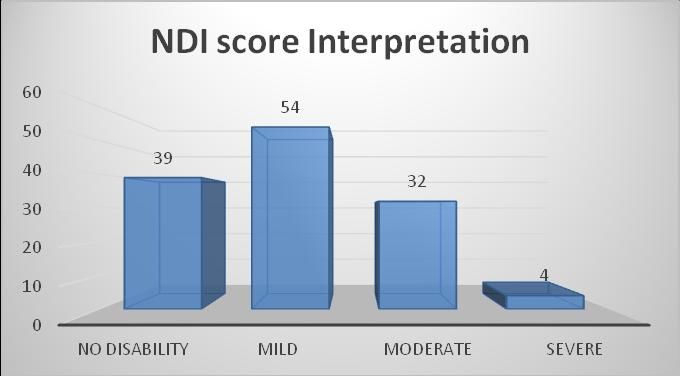
Manali Shah et.al. Prevalence of neck pain and back pain in computer users working from home during
COVID-19 pandemic: a web-based survey.

           Table 6: showing interpretation of ODI                  table.2. In our findings we divided our
ODI SCORE                     Frequency          Percent
Minimal Disability            87                 67.4              participants in 3 categories according to
Moderate Disability           41                 31.8              their profession, IT/ Software professionals
Severe Disability             1                  .8
Total                         129                100.0             (n=83), academicians (n=11) and others
                                                                   (n=35) (like CA, Businessmen, Self
                                                                   Employed, Manager, Advocate, Private
                                                                   Sector Job, Housewife , data scientist ,
                                                                   MNC worker etc… ) and shown in table 3.
                                                                   Working hours of participants was found
                                                                   minimum 4 hours per day and maximum 12
                                                                   hours per day. We found that the
                                                                   technologies more frequently used during
                                                                   work from home were laptop, mobile
                                                                   phones, desktop and tablets. The place
                                                                   which they prefer to work at home was
                                                                   categorized in 3, and shown in table 4.
                                                                   Presence of pain or discomfort in body,
  Chart 1: Showing presence of pain or discomfort in body.
                                                                   region affected and knowledge of
        Out of 129 participants 95 were male                       ergonomics of participants are shown in
(73.6%) and 34 were female (26.4%) (See                            chart 1, 2 and 3 respectively. We also found
table 1). Their age was between 18-65 years                        that 30 participants (23.2%) were following
and age distribution of the study is shown in                      ergonomic advices.

                                      Chart 2: showing region of pain/ discomfort in body.

                                                                            Neck Disability Index (NDI): the
                                                                   NDI score which was used to assess their
                                                                   function showed that 41.9 %, 24.8 % and
                                                                   3.1% participants had mild, moderate and
                                                                   severe functional limitation due to neck
                                                                   pain. Shown in table 5 and chart 4.
                                                                            Oswestry Low Back Pain Disability
                                                                   Index (ODI): the ODI score which was used
                                                                   to assess their function showed that 67.4%,
                                                                   31.8% and 0.8% participants had mild,
                                                                   moderate and severe functional limitation
                                                                   due to low back pain. Shown in table 6 and
 Chart 3: showing knowledge of ergonomics of participants.
                                                                   chart 5.

                      International Journal of Health Sciences and Research (www.ijhsr.org)                 28
                                           Vol.11; Issue: 2; February 2021
Manali Shah et.al. Prevalence of neck pain and back pain in computer users working from home during
COVID-19 pandemic: a web-based survey.
Chart 4: showing interpretation of NDI
Chart 5: showing interpretation of ODI
DISCUSSION participants were between 31-40 years of
The study was cross-sectional survey age group. 64.3% participants were
which was conducted to find out prevalence IT/Software professionals and 75.19 % of
and functional disability of neck pain and participants were working for ≥8 hours/day
back pain in computer users working from on computer. Study also showed that 48.8%
home during COVID-19 Pandemic. A and 42.6 % participants were using office
questionnaire was given to computer users table / study table / dining table and bed /
working from home which included sofa / comfort chair respectively for
questions about their demographics, working at home. We found that 58.1%
working hours, working place, knowledge participants were not aware about
about ergonomics etc. and also included ergonomics to be followed while working
neck disability index and Oswestry low on computer.
back pain questionnaire. From which we In our study 70.5% participants had
found out statistical information regarding pain or discomfort in body out of which
the occurrence of neck and low back ache. 42.9% had pain in neck and upper back
Score were interpreted and analyzed and region, 36.3% had pain in the lower back
showed that neck and back pain can cause region and legs whereas 16.5% had pain or
mild disability in computer users during discomfort in both region. Those who had
work from home. pain were asked to fill NDI and /or ODI
The study showed that most of the questionnaire and we found 41.9 %, 24.8 %
participant were male (73.6%) and 55.8% and 3.1% participants had mild, moderate
International Journal of Health Sciences and Research (www.ijhsr.org) 29
Vol.11; Issue: 2; February 2021Manali Shah et.al. Prevalence of neck pain and back pain in computer users working from home during
COVID-19 pandemic: a web-based survey.
and severe functional limitation due to neck help to reduce the absenteeism and to
pain and 67.4%, 31.8% and 0.8% increase productivity and efficiency of the
participants had mild, moderate and severe work. Thus, it is important to spread more
functional limitation due to low back pain. awareness among young working
It has already been reported in the professionals regarding the correct work
past literature that even small postural ergonomics while working on computer at
changes increase the load on the home and workplace.
musculoskeletal system. As seen in our
study most of our participants worked for Limitations
long hours, sitting on a chair or bed without 1. Due to COVID – 19 pandemic situations
desk while working on computer at home by we were not able to conduct one on one
which we can assume that their faulty data collection from the participants.
posture is giving raise to pain in neck and
upper back or lower back region.(3) Future recommendation
Many studies have found significant 1. Further studies can be done with large
relationship between level of disability and population
intensity of pain as well as working hours in 2. Objective measures for assessment of
computer professionals with neck pain and posture during computer use at home
back pain. (7, 8, 9, 17) Geetha Suresh had can be further analyzed.
suggested in her study that need for proper
workspace and ergonomic guidelines for REFERENCES
computer users working from home to 1. Aritra Ghosh, Srijita Nundy, Tapas
prevent MSDs or postural pain in future. (10) K.Mallick. How India is dealing with
Some studies also suggested that frequency COVID-19 pandemic. Sensors International
of breaks during use of computer for long 2020;1
2. Iqbal, N. & Dar, K. A. Coronavirus disease
duration can help reduce stress on cervical (COVID-19) pandemic: Furnishing
and lumbar spine. (11) In past many studies experiences from India. Psychological
have found beneficial effects of long term Trauma: Theory, Research, Practice, and
ergonomic intervention in prevention and Policy. 2020; 12(1): 33-34.
reduction of symptoms in neck and back http://dx.doi.org/10.1037/tra0000770
pain. (12, 13, 15, 16) recently Lubkowska et.al 3. Gold, J., Driban, J., Yingling, V. and
suggested the use of computer software Komaroff, E. Characterization of posture
program is to help configure computer and comfort in laptop users in non-desk
workstation correctly and adopt the correct settings. Applied Ergonomics. 2012; 43(2):
body position during work, which reduces 392-399.
the risk of health problem. (14) 4. Moras, R. A survey of ergonomic issues
associated with a university laptop program.
Journal of Education and Human
CONCLUSION Development. 2007; 1(2).
For any individual the degree of 5. Straker, L., Burgess-Limerick, R., Pollock,
discomfort, ache and pain experienced is C., Coleman, J., Skoss, R. and Maslen, B.
highly subjective but it can still be related to Children's Posture and Muscle Activity at
external factors like work environment and Different Computer Display Heights and
ergonomics assumed while working on During Paper Information Technology Use.
computer. With this study we have found Human Factors: The Journal of the Human
that neck and upper/lower back pain is Factors and Ergonomics Society. 2007;
common MSDs in computer users during 50(1): 49-61.
this pandemic and as work from home may 6. Lee, S., Lee, Y. and Chung, Y. Effect of
changes in head postures during use of
remain for longer duration everyone must laptops on muscle activity of the neck and
follow ergonomics at home as well as at trunk. Physical Therapy Rehabilitation
work place to prevent MSDs which will Science. 2017; 6(1): 33-38
International Journal of Health Sciences and Research (www.ijhsr.org) 30
Vol.11; Issue: 2; February 2021Manali Shah et.al. Prevalence of neck pain and back pain in computer users working from home during
COVID-19 pandemic: a web-based survey.
7. Kumar S, Sambyal S, Vij J. Analysis of 14. Lubkowska, Wioletta. The potential of
disability and pain in computer computer software that supports the
professionals with neck pain. IOSR-JNHS. diagnosis of workplace ergonomics in
Dec 2013; 3(1): 06-09. shaping health awareness. AIP conference
8. Khan A and Faizan M. Neck pain in proceding. Nov 2017; 1906(1)
computer users. Panacea journal of medical 15. Chaharmahali L and Gandomi F. The effect
sciences. May-August, 2016; 6(2):88-91. of observing ergonomic principles and
9. Vora T. A survey of musculoskeletal musculoskeletal pain on the Quality of Life
symptoms associated with work from home Dimensions of Computer users in Hamedan
culture in COVID 19. International journal city. Occupational Hygiene and health
of scientific journal of science research. promotion. 2020; 4(3).
September 2020: 9(9). 16. Greene BL, DeJoy DM, Olejnik S. effects of
10. Geetha Suresh. Workspace and postural an active ergonomics training program on
challenges in work from home scenario. risk exposure, worker beliefs and symptoms
IJGDC. 2020; 13(2):12-20. in computer users. Work. 2005; 24 (1): 41-
11. Sabeen F, Bashir MS, Hussain SI, Ehsan S. 52.
Prevalence of neck pain in computer users. 17. Rodrigues MS, Leite R, Lelis CM, Chaves
Annals. April-June2013; 19(2). T. Differences in ergonomic and
12. Mekhora K, Liston CB, Nanthavanij S, Cole workstation factors between computer office
J. The effect of ergonomic intervention on workers with and without reported
discomfort in computer users with tension musculoskeletal pain. Work. 2017; 57(4):
neck syndrome. International journmal of 563-572.
industrial ergonomics. Sept 2000; 26(3):
367-379. How to cite this article: Shah M, Desai R.
13. Vledder NV and Louw Q. The effect of Prevalence of neck pain and back pain in
workstation chair and computer screen computer users working from home during
height adjustment on neck and upperback COVID-19 pandemic: a web-based survey. Int J
musculoskeletal pain and sitting comfort in Health Sci Res. 2021; 11(2): 26-31.
office workers. S Afr J Physiotherapy. Nov
2015; 71(1):279
******
International Journal of Health Sciences and Research (www.ijhsr.org) 31
Vol.11; Issue: 2; February 2021You can also read


