Protecting health care workers in the front line: Innovation in COVID-19 pandemic - Journal of ...
←
→
Page content transcription
If your browser does not render page correctly, please read the page content below
Protecting health care workers
in the front line: Innovation in

                                                                                                                                       VIEWPOINTS
COVID-19 pandemic
Zihui Tan, Deborah Wen Shi Khoo, Ling Antonia Zeng, Jong-Chie Claudia Tien,
Aaron Kwang Yang Lee, Yee Yian Ong, Miqi Mavis Teo, Hairil Rizal Abdullah

Department of Anesthesiology, Division of Anesthesiology and Perioperative Medicine, Singapore General Hospital, Singapore

                       T
                               he COVID-19 pandemic has now infected almost 700 000 people, killing more than 30 000 peo-
                               ple. Although Singapore was previously able to control the rapid rise in daily cases through tight
                               quarantine, rapid contact tracing and strict social distancing measures, our health care institutions
                       are now facing a second surge from imported cases. The protection of health care workers (HCWs) is vi-
                       tal in continuing patient care in health care systems that are currently challenged by the pandemic, but
                       also important in ensuring they do not spread the virus. In our country, there are no guidelines or unified
                       practices as to the degree of HCW protection required for performing routine throat swabs. A unique fea-
                       ture of many testing venues in Singapore is that they are outdoors with the average of 30°C tropical weath-
                       er, rendering the prolonged use of conventional personal protective equipment (PPE) or full-body pro-
                       tection uncomfortable. The widespread incidence and expected protracted duration of the COVID-19
                       pandemic has also prompted concerns for minimising the use of PPE especially for high-volume or brief
                       procedures with a short duration of high-risk patient contact, such as throat swabbing. We offer this in-
                       vention as a versatile component of a modular system that can be adapted to several situations and clin-
                       ic setups. HCWs no longer have to change their disposable face shield, cap and gown between patients.
                       This has allowed us to conserve our current PPE supply. In time when testing may be carried out more
                       extensively in community settings, we hope that this would ease logistic difficulties in streamlining the
                       need to test a heavy caseload.
                       It has been close to three months since the first COVID-19 case was diagnosed in Singapore [1]. The CO-
                       VID-19 pandemic has now infected almost 700 000 people, killing more than 30 000 people [2]. Although
                       Singapore was previously able to control the rapid rise in daily cases through tight quarantine, rapid con-
                       tact tracing and strict social distancing measures, our health care institutions are now facing a second
                       surge from imported cases. Given our country’s unique geographical location, and inherent lack of natu-
                       ral resources and raw materials, we are ultimately dependent on open trade borders to maintain our sup-
                       ply chain. As more countries start to implement travel and border restrictions and in various countries; a
                       total lockdown, this will compromise our ability to maintain a comfortable supply of personal protective
                       equipment.
                       The protection of health care workers is vital in continuing patient care in health care systems that are
                       currently challenged by the pandemic, but also important in ensuring they do not spread the virus. In
                       Hubei, China more than 3000 health care workers have been infected and in Italy 20% of responding
                       health care workers were infected [3,4]. Our Singapore public health institutions have had 8 cases of CO-
                       VID-19 infections among staff [5]. Singapore also depends on an intensive testing programme with one
                       of the highest rates of testing globally at 6800 tests per million people as of 25 March 2020 [6].

www.jogh.org   • doi: 10.7189/jogh.10.010357                        1                           June 2020 • Vol. 10 No. 1 • 010357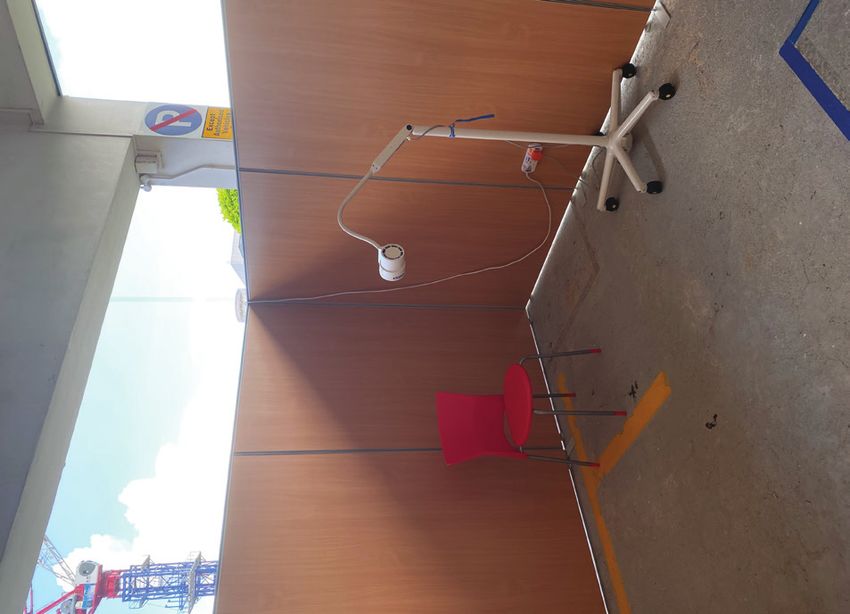
Since January, our emergency department colleagues have been at the front-
                                                                line battling the surge in attendance due to the pandemic. Throat swabs of
                                                                suspected patients from the community are taken in a designated fever area
                                                                (Figure 1). Up to 70 patients are seen daily in this area and the number will
                                                                only increase. Although full personal protective equipment (PPE) is provided,
                                                                concerns regarding PPE wastage and the need for conservation have surfaced.
                                                                This is due to the continuing rapid increase in the number of patients seen in
VIEWPOINTS

                                                                the community.
                                                                Another important consideration is the proximity of the health care worker
                                                                to the suspected patient especially when the patient sneezes, coughs or gags.
                                                                Whilst nasal swabs were initially taken, there has been a shortage of these.
                                                                Therefore, we have moved to throat swabs for testing. One study showed that
                                                                throat swabs have a lower pick up rate as compared to nasal swabs [7], hence
                                                                the importance of proper swabbing technique to accurately diagnose COV-
                                                                ID-19. By providing better protection for the health care workers (HCW), we
                                                                hope to reduce the incidence of false negatives and hence false assurance.

             Figure 1. Designated fever area for throat swab.

                               SG-SAFE (SINGAPORE SWAB ASSURANCE FOR EVERYONE)
                               Together with a local bioengineering company, The Biofactory Pte Ltd, we proposed a screen between
                               the patient and the HCW that fits the following criteria:
                                       • Protect HCW from droplet ± aerosol contamination,
                                       • Clear barrier for visualization,
                                       • Light source to visualize oropharynx,
                                       • Good dexterity, ie able to use both hands for tongue depressor and swab,
                                       • Easy to clean, meets local infection control standards,
                                       • Mobile,
                                       • Easy for storage,
                                       • Dual functionality, ie, it can be inverted to contain the patient as well.
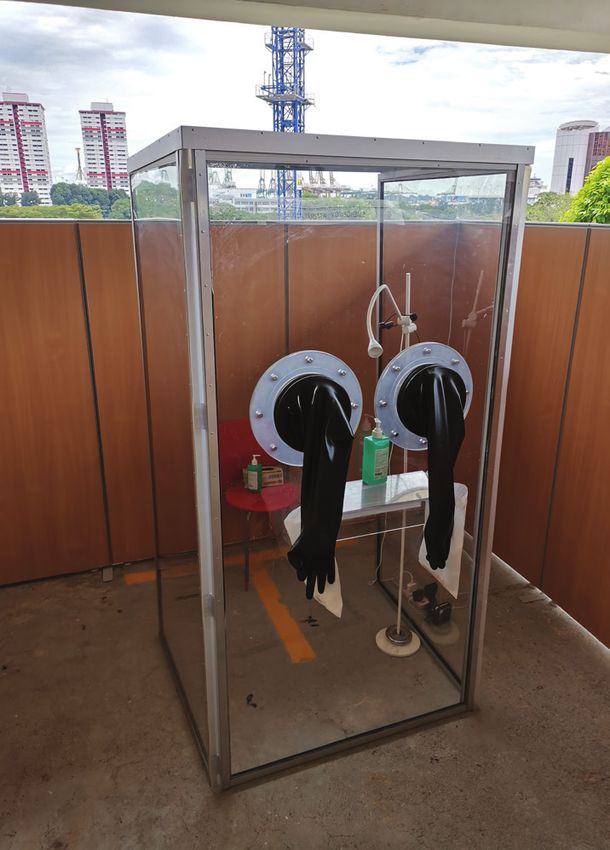
                               The first prototype was subsequently tested and used in the Emergency department (Figure 2). HCW
                               expressed increased confidence for personal safety despite the high number of suspected patients seen
                               daily.
                               More importantly, HCWs no longer have to change their disposable face shield, cap and gown between
                               patients. This has allowed us to conserve our current PPE supply in view of the potential supply short-
                               age if the pandemic continues for a prolonged period of time.
                               Innovation in health care is itself difficult, balancing the competing concerns for patient and operator
                               safety, infection control, resource conservation and cost. The current pandemic has exacerbated these
                               restrictions, but ironically made it all the more urgent that efficient and innovative solutions are sought
                               out to address surging patient loads and high infectivity.
                               Reported examples of innovation in this pandemic range in scale from individuals repurposing scuba
                               diving masks with 3D-printed “Charlotte valves” [8] to vacuum cleaner and automotive manufacturers
                               producing ventilators [9,10].
                               Testing suspected patients is a cornerstone of epidemiologic control of this outbreak. Various devices
                               have been described, from the South Korean “phone booth” [11] to simple plastic shields shown in me-
                               dia from the UK and Taiwan [12] The aim of these devices is both to contain infection as well as protect
                               a HCW exposed to tens to hundreds of suspect cases. Some of the features of these existing devices are
                               seen in Table 1.
                               In our country, there are no guidelines or unified practices as to the degree of HCW protection required
                               for routine testing. A unique feature of many testing venues in Singapore is that they are outdoors with

             June 2020 • Vol. 10 No. 1 • 010357                                2                             www.jogh.org   • doi: 10.7189/jogh.10.010357
the average of 30-degree-Celsius tropical weather [13], rendering the pro-
longed use of conventional PPE or full-body protection uncomfortable.
The widespread incidence and expected protracted duration of the COV-
ID-19 pandemic has also prompted concerns for minimising the use of PPE
especially for high-volume or brief procedures with a short duration of
high-risk patient contact, such as throat swabbing. While single-use items
have been the erstwhile gold standard of HCW protection and reduction
VIEWPOINTS
of cross-contamination, we recognise that this is also reliant on supply
chains and in many cases overseas manufacturer capacities (that are them-
selves subject to stresses of the pandemic in their own countries).
We offer this invention as a versatile component of a modular system that
can be adapted to several situations and clinic setups. In time when testing
may be carried out more extensively in community settings, we hope that
this would ease logistic difficulties in streamlining the need to test a heavy
caseload.
Our innovation allows for a reversal of the traditional model where an infec-
tious patient is in a negative pressure room, as this requires significant time
and labour to disinfect the room between patients. By allowing the health care
worker to be protected inside and the patients to pass through outside in an
Figure 2. SG-SAFE – Singapore Swab outdoor setting, it will allow for much shorter times between patients and thus
Assurance for Everyone.
be able to rapidly collect swabs for large numbers of patients if the outbreak
worsens.
Table 1. Advantages and disadvantages of current devices used during testing of COVID-19 patients
Feature Advantage Disadvantage
South Korean “phone Negative pressure environment contains Intensive sanitisation required between patients for
booth” aerosols and airborne particles generated by reusable parts eg, semi-permanent gloves
patient
Virtually zero contact between operator and Power source/generator required to maintain
patient negative pressure environment; difficult to adapt
for community/field use
Plastic shield with Easily manufactured, reproducible, portable No light source
circular arm holes Plastic must be able to withstand high-level
disinfection or be prone to degradation
Limited protection for HCW whose limbs and
hands must be enclosed in separate PPE
PPE alone / with added Highly portable, versatile to any clinical Resource-intensive if single-use per patient
plastic face shield situation
HCW – health care worker, PPE – personal protective equipment
Difficulties encountered in the production of this device were exacerbated by the rapid evolution of man-
agement strategies for the pandemic. As a relatively “unknown enemy”, the requirements of infection con-
trol policy and organisational directives were developing as practitioners on the ground sought to counter
practical challenges such as the heat and fatigue from rapid and repeated donning and doffing of PPE.
Ready access to bioengineering expertise enabled the rapid production of a prototype. The use of tech-
nology to visualise and transmit ideas allowed for multiple practitioners to give their input remotely.
Video-conferencing platforms allowed for immediate remote previewing of a physical prototype, while
mobile messaging facilitated rapid transfer of images and feedback to and from multiple parties and
stakeholders. More importantly, tele-communication also reduced the need for physical meetings and
also prevented spread of infection by allowing for physical distancing without hampering or slowing
the innovation process.
Emergency grants would accelerate device production in view of the ongoing pandemic, similar to the
additional publication of COVID-19 related research in medical literature. An extraordinary time in
www.jogh.org • doi: 10.7189/jogh.10.010357 3 June 2020 • Vol. 10 No. 1 • 010357human history calls for special measures to match the needs of a shifting and transforming battleground.
As various industries turn their efforts to addressing the needs of health care, those on the ground
should be equipped to contribute their first-hand expertise by all means possible.
Acknowledgements: The authors would like to acknowledge the Division of Anaesthesiology and Perioperative
VIEWPOINTS
Medicine, Singapore General Hospital.
Disclaimers: The views expressed in the submitted article are his or her own and not an official position of the
institution or funder.
Funding: None.
Authorship contributions: Conception and design: Dr Zihui Tan, Dr LA Zeng, Dr MM Teo, Dr DWS Khoo, Dr
YY Ong, Dr H Abdullah. Manuscript writing: all authors. Final approval of manuscript: all authors.
Competing interests: The authors completed the Unified Competing Interest form at www.icmje.org/coi_disclo-
sure.pdf (available upon request from the corresponding author), and declare no conflicts of interest.
1 Ministry of Health. News Highlights. Available: https://www.moh.gov.sg/news-highlights/details/confirmed-imported-
case-of-novel-coronavirus-infection-in-singapore-multi-ministry-taskforce-ramps-up-precautionary-measures. Accessed:
REFERENCES
30 March 2020.
2C oronavirus N. (2019-nCoV) situation reports. Available: https://www.who.int/emergencies/diseases/novel-coronavirus-2019/
situation-reports. Accessed: 31 March 2020.
3 Chinadaily.com. Medical worker infections under control. Available: https://www.chinadaily.com.cn/a/202003/06/
WS5e6246c8a31012821727d0bc.html. Accessed: 5 April 2020.
4 Remuzzi A, Remuzzi G. COVID-19 and Italy: what next? Lancet. 2020. Online before print. Medline:32178769.
doi:10.1016/S0140-6736(20)30627-9.
5 The Straits Times. Coronavirus: At least 8 cases of virus among staff at public healthcare institutions. 2020. Available:
https://www.straitstimes.com/singapore/health/at-least-8-cases-of-virus-among-staff-at-public-healthcare-institutions.
Accessed: 5 April 2020.
6 Ministry of Health. News highlights. Available: https://www.moh.gov.sg/news-highlights/details/statement-by-mr-gan-
kim-yong-minister-for-health-at-parliament-on-the-update-on-whole-of-government-response-to-covid-19. Accessed: 5
April 2020.
7 Yang Y, Yang M, Shen C, Wang F, Yuan J, Li J, et al. Evaluating the accuracy of different respiratory specimens in the
laboratory diagnosis and monitoring the viral shedding of 2019-nCoV infections.Medrvix. https://doi.org/10.1101/202
0.02.11.20021493.
8 isinnova. Easy – Covid19 ENG | Isinnova. Available: https://www.isinnova.it/easy-covid19-eng/. Accessed: 31 March
2020.
9 Bashir N, Business CNN: James Dyson designed a new ventilator in 10 days. He’s making 15,000 for the pandemic fight.
2020. Available: https://edition.cnn.com/2020/03/26/tech/dyson-ventilators-coronavirus/index.html. Accessed: 31 March
2020.
10 Valdes-Dapena P, Wattles J. Ford to build 50,000 ventilators in 100 days. CNN 2020.
11 CAN. South Korea dials up COVID-19 testing with hospital “phone booths.”Available: https://www.channelnewsasia.
com/news/asia/coronavirus-covid19-south-korea-hospital-testing-booths-12548580. Accessed: 31 March 2020.
12 Focus Taiwan-CNA English News. Taiwanese doctor creates cheap protective device amid virus crisis - Focus Taiwan.
Focus Taiwan - CNA English News 2020. Available: https://focustaiwan.tw/society/202003220009. Accessed: 31 March
2020.
13 Weather. Available: https://www.nea.gov.sg/weather. Accessed: 1 April 2020.
Correspondence to:
Dr Zihui Tan
Mb ChB, MMed (Anaesthesia)
Associate Consultant
Department of Anesthesiology, Division of Anesthesi-
ology and Perioperative Medicine
Singapore General Hospital
Singapore
Outram Road
Singapore 169608
tan.zihui@singhealth.com.sg
June 2020 • Vol. 10 No. 1 • 010357 4 www.jogh.org • doi: 10.7189/jogh.10.010357You can also read


