Recommended Grass and Clover Lists for England and Wales - Handbook - British Society of Plant Breeders
←
→
Page content transcription
If your browser does not render page correctly, please read the page content below
Handbook

Recommended Grass
and Clover Lists
for England and Wales

              2021/22
Recommended Grass and
Clover Lists
– who are they for?
Knowing the performance                                      There are three steps to
                                                             making the best use of
characteristics of grass and clover                          this booklet:
is immensely useful for grassland
producers. It allows appropriate                             1. Is it on the list? –
                                                             when looking at mixtures
selection of varieties that will perform                     check that the varieties
well under a particular system.                              are listed in this booklet
The Recommended Grass and Clover Lists for England           2. Is it right for the job?
and Wales are drawn up after rigorous testing for            – make sure the type of
attributes such as yield, persistency, quality and           grasses or clovers listed
disease resistance. The data come from trials carried        in a mixture are fit for the
out by the NIAB-TAG, Barenbrug, IBERS, DLF Seeds,            purpose
DSV, AFBI and SRUC, and are evaluated by a panel
of experts.                                                  3. Which varieties fit the
                                                             job? – refinements can
The scheme has changed – it is no longer partially           be made to mixtures in
funded by merchants, which means the data are                consultation with your
available to all. The testing is funded by plant breeders    merchant
through the British Society of Plant Breeders and the
ruminant levy boards Agriculture and Horticulture
Development Board and Hybu Cig Cymru.

    This booklet is produced for use in England and Wales.
    Farmers in Scotland should consult the Scottish
    recommended grass and clover varieties list.
Why are grass
and clover important?

The cost of production per litre of                 Few farmers these days
milk or kg of liveweight gain is a                  would want to use
                                                    bull or ram genetics
major consideration for all livestock
                                                    from the 1950s in their
producers. One of the best ways to
                                                    livestock breeding, yet
reduce costs is to produce more forage              they continue to use
on the farm rather than buying feed in.             outdated varieties in
There is huge potential on grassland farms in       their grassland.
England and Wales to increase the amount and        By relying on old
quality of the grass and clover that is grown and   varieties, farmers are
eaten.                                              missing out on millions
                                                    of pounds worth of
                                                    investment made
                                                    by plant breeders to
                                                    produce new grasses
     As few as 1 in 20 varieties                    that are far superior in
      of ryegrasses tested will                     important aspects such
       actually make it to full                     as yield, digestibility
    recommendation on the list                      and spring growth.

                                                                               1
Is it time to reseed?
                                                          The ideal grass/clover
                                                          balance across the
                                                          grass growing season
                                                          is 30% white clover to
                                                          70% grass – but clover
                                                          content can vary widely
                                                          between and within
                                                          fields.
    The percentage of ryegrass (or other
    sown species) in a sward is a better                  Reseeding or
    indicator of a need for reseeding than                over‑seeding allows
    the age of the ley.                                   farmers to increase
                                                          the performance of
                                                          their swards by sowing
    Pulling up a handful of grass plants allows farmers
                                                          improved grass and
    to assess how much perennial ryegrass (PRG) there
                                                          clover varieties that
    is by looking for a red base to their stem.
                                                          match individual field
    Weed grasses, such as annual meadow grass, take       objectives – i.e. long
    every opportunity to invade sown pastures and         term grazing or shorter
    do not have red stem bases. Weed grass species        term cutting.
    yield poorly, are of poor feed quality and do not
    respond well to nitrogen.

           Consider reseeding if there is less than
                50% sown species in the ley

2
Which type of grass?
Mixtures                                                            Perennial, Italian and
                                                                    Hybrid ryegrasses
In GB farmers tend to reseed with a mixture of different
grasses and clover, rather than sowing a single variety.            Ryegrass is the most
                                                                    important sown grass grown
Mixtures can produce yield benefits when compared to the            in GB due to its productivity
same varieties sown individually. They also allow farmers to        and suitability to the climate
capitalise on the strengths of different species. For instance      and farming systems.
the digestibility of Perennial ryegrass (PRG) can be combined
with the yield of a hybrid ryegrass (HRG) and the superior          Perennial ryegrasses (PRG)
nutrient value of white clover in one field.                        produce persistently good
                                                                    yields of high quality forage.
Heading Dates                                                       Italian ryegrass (IRG) yields
                                                                    higher than PRG but has poor
Grasses are classified according to heading date – which
                                                                    persistence.
is the date on which 50% of the ears in fertile tillers have
emerged.                                                            Hybrid ryegrass (HRG) is a
                                                                    cross between perennial and
Early varieties of ryegrass reach their heading date in the first
                                                                    Italian varieties, combining
two weeks of May; intermediate varieties head during the
                                                                    the strengths of the two
second half of May and late varieties reach this stage during
                                                                    parent species, e.g. the sward
the first two weeks of June.
                                                                    density of PRG and the
In general, early heading varieties grow earlier in the spring,     out-of-season growth of IRG.
are more erect, tiller less freely and are easier to cut for
conservation than later heading varieties, which tend to be
more prostrate and persistent and give good mid-season
growth.

          For 2 year leys – use tetraploid and diploid Italian ryegrasses
     For 3-4 year leys – use hybrid ryegrass and early perennial ryegrasses
      For long term leys – use intermediate and late perennial ryegrasses.

                                                                                                     3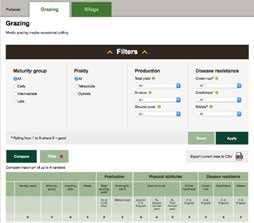
Choosing the right type of grass
    Ryegrass

    Each type of grass has different growth and                             Diploids vs
    quality characteristics. When reseeding it is                           Tetraploids
    important to select the most appropriate grasses
                                                                            Tetraploids have twice the
    and clovers for the situation and to meet the                           number of chromosomes
    objectives set for each field.                                          of diploid varieties, which
                                                                            makes all their cells bigger.
    Perennial ryegrass                                                      This means they have larger
    ●   Most effort by plant breeders has been concentrated on PRG          seeds and leaves and tend
    ●   Establishes rapidly, even from autumn sowing                        to establish quickly. They are
    ●   High yields in first harvest year                                   more able to compete when
    ●   High sugar content makes it good for silage-making                  used for over-seeding.
    ●   Produces dense and persistent swards so useful for long term leys
        and establishing permanent pasture
                                                                            Tetraploids have a more
                                                                            upright growth habit and
        Good for all types of management e.g. silage or hay                 are suited to drier growing
           production, extensive or intensive grazing                       conditions. In some cases
                                                                            they have better digestibility
    Italian ryegrass                                                        and palatability than
    ● Produces heavy crops of silage or hay                                 diploids.
    ● Useful for short term leys of one to three years                      Diploids tend to be more
    ● Long growing season gives opportunity for ‘early-bite’ grazing        persistent and tiller more
      followed by leafy hay or silage cut                                   freely and are generally
                                                                            better suited to wetter
               Good for cutting, but can also be used
                                                                            growing conditions.
                   for intensive spring grazing
                                                                            Well-managed diploid leys
    Hybrid ryegrass                                                         will usually produce denser
    ● Better ground cover and longer lived than IRG                         swards.
    ● Good winter hardiness and disease resistance
    ● Mid-season digestibility better than IRG, but poorer than PRG
    ● First year yields lower than IRG, but yield improves in second and
      third year
    ● More drought resistant than IRG

                   Good for silage production and
                      cattle rotational grazing

4
Choosing the right type of
Timothy and clover
Timothy Key information on each
of the different grass and
● Grows at lower temperatures than ryegrass so can be good
for early season grazing, especially in cold, late springs clover species is contained
in the tables on pages
● Good mid-season growth can fill the gap when ryegrass 9 to 19.
growth falters
● Good winter hardiness and ground cover The data provided has
● Can be slow to establish and yields are likely to be lower been extracted from the
than PRG full Recommended Grass
● Best utilised in cooler, wetter areas and Clover Lists. The full
lists are available to all and
Good for extensive grazing and hay production can be found on the British
Grassland Society website
White clover www.britishgrassland.com
● High nutritional value, particularly protein and mineral
content
● High palatability
● Good animal performance
● Can provide 150kg/ha (120 units/acre) of nitrogen for grass
growth
● Match leaf size to stock (small for continuous, hard sheep
grazing; medium for frequent cutting and rotational
grazing; and large for cutting and cattle grazing)
Good for grazing and cutting
Red clover
● High protein content up to 19% in silage depending on
percentage in sward
● High yields, even with no or low N fertiliser
● Early red clovers produce two main cuts and a small
autumn cut
● Generally only lasts for three years
Good for cutting and finishing stock in autumn
5Tips for reseeding
Once the decision to reseed has been made, it is The Nutrient Management
important to follow some key steps: Guide (RB209) provides
recommendations for grass
Preparation establishment:
● Spring or autumn reseeding are equally advantageous and
the choice will depend on the farming system plus when ● For spring sown reseeds
the field is available and conditions are good the recommendation is
60kgN/ha
Remember that any mixture containing red clover ● For autumn reseeds the
needs to be in by August and white clover needs to recommendations for
be in by September. moderate soil nitrogen
supply situations is 0-50kg
● Take a soil sample at a depth of 15cm – deeper than soil per ha depending on
sampling in established swards as cultivation will disturb sowing date and soil
the soil Nitrogen supply
● Check for any soil structure issues – a plough may sort
● Grass and clover reseeds
some of them out, but if the issue is deeper a sub-soiler
have no requirement for
may be needed
nitrogen at establishment
● Aim to deal with major weed problems in the old sward
● Correct any nutrient deficiencies For phosphate and potash:
Phosphate Potash
For lime Guidelines for lime P or K (P2O5) (K2O)
application index
kg/ha kg/ha
Apply before ploughing so it can
be mixed in during cultivations Tonnes Tonnes 0 120 120
and remember that it can take pH per per
ha acre
nine to twelve months for pH to 1 80 80
increase so planning ahead is
important. 6.2 0 0 60 (2-)
2 50
40 (2+)
These guidelines are based on 6.0 0 0 3 30 0
material with neutralising value of
50. This is a simplified version as it >3 0 0
has combined recommendations 5.5 3-4 1.2-1.6
for different soil types. Look at
Table 1.2 on page 14 in RB209
5.0 5-7 2.0-2.8 Remember to deduct
Chapter 1 - Principles of nutrient
management and fertiliser use. any nutrients applied
See https://ahdb.org.uk/nutrient- To calculate from tonnes/ha to in the seedbed from
management-guide-rb209 for tonnes/acre multiply by 0.4046 the first season’s
more information. Seek advice Apply no more than 7.5 t/ha
from a FACTS-qualified adviser.
grazing or silage/hay
at one time.
requirements.
6Full reseed
● For a full reseed, spray the old sward using a product containing glyphosate
Ensure there is enough leaf area remaining to take up the product and manufacturer’s
instructions are followed.
Consider how pests like leather jackets can be controlled – without chemicals.
● For a full reseed, plough, press and work down to a firm and reasonably fine seedbed
● Drill or broadcast the seed on to the rolled seedbed, to place it no deeper than 1cm
● Ring roll or light harrow to ensure maximum contact between seed and soil, but avoid
burying the seed below 1cm, especially small seeded species such as clovers and timothy
Over-sowing
● Over-sowing or stitching-in can be a way to rejuvenate old or damaged grass without the
cost of a full reseed
● As existing grass or weeds can out-compete the new seedlings, good soil structure and
nutrients are still important
● The best time is summer as the existing grass is less vigorous and soil temperatures will be
high, although soil moisture may be a limiting factor
● The seedlings need light so 40% of bare ground should be seen before over-sowing is
considered – harrowing in two directions may help
● The seed can be broadcasted or direct drilled and the existing sward can be sprayed off
beforehand or “checked” by hard grazing or cutting
● Seed to soil contact is still important, so roll after sowing or allow sheep to graze the field
for 7-10 days to tread the seed in
● Seed rate will change depending on sward conditions – a minimum of 8kg per acre and
up to 15kg for badly damaged swards
● Do not apply nitrogen as it will only boost the growth of the existing sward (if it has not
been sprayed off )
Post-establishment
● Once the grass is established (after five to six weeks), graze lightly with sheep or young
stock when the grass reaches 8-10cm to firm in roots and encourage tillering. Do not graze
it down lower than 4cm
● Weed control in a new ley is usually necessary to ensure good establishment and to avoid
variable ground cover
● If significant weed problems are expected, consider establishing the ley without clover
and introduce it once the weed problems have been solved
All grass and clover species can be successfully established by
following the above guidelines, however, tetraploid ryegrasses are
likely to establish quicker and easier than diploids as they have
larger seeds and are more competitive against the existing grasses.
Source: Wynnstay, Germinal GB Ltd, AHDB
7How to use the Recommended
Grass and Clover Lists
The tables on the following pages contain data extracted from
the Recommended Grass and Clover Lists for 2021/22. They
are provided to help producers to check and formulate seed
mixtures in conjunction with their merchant.
The data produced are based on cutting trials in North Yorkshire, Shropshire,
Oxfordshire, Gloucestershire, Worcestershire, Devon and Ceredigion, plus additional
information from Northern Ireland and Scotland. Each variety is sown for two or
more seasons.
The cost of grass seed is a small proportion of the expense
of reseeding – yet taking time to select the right varieties
will reap productivity and lifespan benefits.
Your grass seed merchant will have a more
in-depth booklet with more information
about each variety on the Recommended
Grass and Clover Lists. It can found at
www.britishgrassland.com/publications
An online tool is available at
https://ahdb.org.uk/recommended-
grass-and-clover-lists
It can be used to compare perennial
ryegrasses for various traits to help
choose the correct varieties for the job.
8Recommended List of Early
Perennial Ryegrass Varieties
2021/2022
OK for short term cutting and grazing leys.
Can lose quality quickly as head early.
Simulated grazing Conservation
management management
Variety Total D-value Total D-value
Suitable for my farm
Ground cover
annual Midsummer annual 2nd
Crown rust
Drechslera
Heading date
yield yield conservation
cut
Average = Average =
100 at 100 at
9.81t DM/ha 15.05t DM/ha
1 = poor 9 = good
Diploids
Genesis 10 May 98 76.4 104 70.8 6.9 6.2 6.0
Moyola 13 May 101 76.1 104 70.6 6.8 6.0 5.4
Kilian 16 May 97 76.8 98 71.1 6.9 6.9 [5.7]
Glasker 18 May 99 77.1 102 72.3 6.5 5.3
Tetraploids
AberTorch 8 May 97 76.9 101 71.8 6.6 4.7 6.5
Cooky 17 May 96 77.2 100 72.5 6.2 5.3 7.2
Yield D-value
For yield figures, 100 equals the average yield D-value is a measure of quality and refers to the
for the varieties on the Recommended Lists. percentage of the dry matter that can be digested by
For example, if a variety has a yield of 105, an animal. A higher number is better.
it is above average. If it has a yield of 95, it is
below average. It is measured in tonnes of dry Crown rust and Drechslera
matter per hectare. Score relates to resistance. A higher number is better.
[ ] Limited data.
9Recommended List of
Intermediate Perennial
Ryegrass Varieties 2021/2022
Simulated grazing Conservation
management management
Variety Total D-value Total D-value
Suitable for my farm
Ground cover
annual annual
Crown rust
Drechslera
Midsummer 2nd
Heading date
yield yield conservation
cut
Average = Average =
100 at 9.81t 100 at 15.05t
DM/ha DM/ha 1 = poor 9 = good
Diploids
Boyne 21 May 98 75.3 103 69.7 6.4 5.9 4.4
Galgorm 22 May 105 77.9 103 74.8 6.1 5.2 4.4
AstonConqueror 24 May 98 77.4 99 73.9 6.7 2.6 4.8
Nifty 24 May 101 77.6 100 71.8 6.4 5.2 4.6
Moira 24 May 99 76.4 101 74.2 5.9 4.6 5.8
Glenariff 25 May 98 75.4 97 72.8 6.5 6.2 4.9
AberZeus 27 May 103 78.2 101 74.3 7.3 6.3 4.6
AberMagic 28 May 101 77.8 99 72.0 6.5 6.1 3.5
AberWolf 28 May 99 78.3 99 72.3 7.0 4.9 4.1
Gosford 29 May 99 77.5 99 73.6 6.4 5.7 4.2
Agaska 30 May 100 76.6 98 71.8 6.3 7.0 [4.9]
Elyria 30 May 97 76.8 95 72.4 6.9 6.2 6.0
AberGreen 30 May 103 77.7 100 73.3 7.0 5.6 4.8
10Good for cutting, but can also be used for intensive
spring grazing.
Simulated grazing Conservation
management management
Variety Total D-value Total D-value
Suitable for my farm
Ground cover
annual Midsummer annual 2nd
Crown rust
Drechslera
Heading date
yield yield conservation
cut
Average = Average =
100 at 9.81t 100 at 15.05t
DM/ha DM/ha
1 = poor 9 = good
Tetraploids
Fintona 20 May 101 77.3 104 74.3 5.4 2.2 7.2
Glenstal 22 May 98 76.8 100 72.0 5.9 2.2 6.4
Seagoe 22 May 99 77.1 105 73.1 5.9 6.1 6.0
Nolwen 22 May 97 77.2 101 73.3 6.3 8.6 6.9
AberRoot 22 May 98 79.3 100 73.5 5.0 4.2 [6.8]
AberClyde 25 May 94 77.5 99 72.6 6.0 6.4 6.5
Ritchie 25 May 102 76.2 102 70.1 6.7 5.8 [7.4]
AstonVision 26 May 99 77.8 97 74.8 6.2 6.4 5.5
Chatsworth 27 May 102 78.3 100 72.4 6.1 4.2 [8.2]
AberSpey 29 May 104 78.7 102 74.3 5.8 5.1 6.5
Convey 29 May 101 76.9 100 73.1 6.0 5.5 [7.9]
Dunluce 30 May 100 77.5 100 72.9 5.5 2.3 6.8
Caledon 30 May 100 76.5 102 70.7 5.2 5.9 8.4
Diwan 30 May 95 76.7 102 71.8 5.2 7.5 6.9
Triwarwic 30 May 95 76.5 102 72.5 5.7 6.4 5.4
Federer 31 May 98 77.0 99 73.4 6.1 6.4 [6.1]
Pensel 31 May 96 75.2 101 70.1 5.5 5.9 7.6
Montova 31 May 96 75.3 100 71.1 6.0 4.2 6.5
AstonEnergy 1 Jun 96 78.1 95 75.1 5.1 6.6 7.2
[ ] Limited data.
11Recommended List of Late
Perennial Ryegrass Varieties
2021/2022
Simulated grazing Conservation
management management
Crown rust
Drechslera
Suitable for my farm
Ground
Variety Total annual D-value Total annual D-value
cover
yield yield
Heading
Midsummer 2nd
Average = 100 Average = 100 conservation
date
cut 1 = poor 9 = good
at 9.81t DM/ha at 15.05t DM/ha
Diploids
Kendal 31 May 97 76.2 99 73.4 6.7 7.1 [6.5]
Wetherby 31 May 102 77.7 102 73.3 6.8 7.6 [5.5]
Callan 2 Jun 102 75.8 100 73.3 6.6 4.4 [3.7]
AberTest 2 Jun 102 79.5 95 76.4 6.7 6.5 [6.3]
Ballyvoy 2 Jun 100 77.4 102 75.4 6.8 3.1 [4.3]
Toddington 2 Jun 96 75.9 96 72.2 6.6 6.8 5.5
Dundrod 2 Jun 98 76.2 97 72.8 6.5 6.4 5.8
AberAvon 3 Jun 99 77.7 95 74.0 7.0 6.1 4.1
AstonKing 3 Jun 99 75.6 97 72.8 6.0 6.3 [4.2]
Oakpark 4 Jun 100 76.6 98 72.8 6.7 4.6 [5.6]
Romark 4 Jun 96 76.8 91 74.8 6.4 5.7 4.7
Drumbo 4 Jun 97 77.3 94 74.8 6.1 4.9 4.8
Glenarm 4 Jun 98 76.9 100 73.9 6.3 6.3 4.0
Gleneagle 5 Jun 100 76.3 97 71.9 6.7 4.4 [5.6]
Cavendish 5 Jun 96 75.4 96 73.4 7.0 6.6 4.5
Clanrye 5 Jun 96 75.9 98 71.4 6.3 5.1 5.3
Timing 5 Jun 98 75.5 97 72.5 6.6 6.8 4.8
Smile 6 Jun 100 77.2 97 73.5 6.4 3.4 4.8
Zorgue 6 Jun 97 76.6 95 74.5 7.4 7.3 [6.3]
AberBann 7 Jun 107 77.8 100 72.6 6.4 4.9 [5.3]
AberLee 7 Jun 98 79.1 92 75.3 7.3 6.4 4.2
Swan 8 Jun 101 74.8 96 73.1 6.9 6.5 [5.6]
Delika 8 Jun 102 76.9 97 73.7 6.4 8.3 [5.5]
AberChoice 10 Jun 103 77.0 98 72.4 6.0 3.8 3.0
Cancan 12 Jun 101 75.9 93 73.1 6.5 4.2 4.8
Bowie 18 Jun 102 75.9 93 71.7 6.6 4.4 [4.3]
12Diploids – Good for long term Tetraploids – Good for medium
grazing and cutting leys. Good term cutting leys and in
for ground cover. grazing mixtures.
Simulated grazing Conservation
Ground cover
management management
Crown rust
Drechslera
Suitable for my farm
Variety Total D-value Total D-value
annual Midsummer annual 2nd
Heading date
yield yield conservation
cut
Average = Average =
100 at 9.81t 100 at 15.05t 1 = poor 9 = good
DM/ha DM/ha
Tetraploids
Ballintoy 31 May 103 77.3 105 72.4 5.5 3.7 6.1
Bijou 1 Jun 100 75.1 103 71.6 5.9 7.2 6.9
Gracehill 1 Jun 104 76.8 106 73.1 5.5 7.0 [9.0]
Meiduno 2 Jun 103 76.6 103 73.6 5.1 6.0 7.6
Weldone 2 Jun 103 77.4 100 73.5 5.9 6.3 [8.3]
Hurricane 3 Jun 97 76.8 101 72.9 6.0 6.6 6.9
Calao 3 Jun 100 77.4 102 73.3 5.9 6.8 6.4
Aspect 3 Jun 100 77.1 100 73.2 6.0 4.5 6.7
AberGain 4 Jun 106 78.0 106 72.8 5.9 6.2 6.5
Nashota 5 Jun 105 77.6 105 74.2 6.4 6.6 [7.7]
AberBite 5 Jun 102 77.7 99 74.3 5.7 6.1 6.7
Twymax 6 Jun 98 77.5 99 73.9 6.1 4.7 6.4
Youpi 6 Jun 98 77.1 97 73.5 6.0 7.9 8.5
Thegn 6 Jun 103 77.2 99 72.8 6.2 6.4 [7.7]
Hopi 9 Jun 103 76.6 98 72.3 5.9 6.7 7.7
[ ] Limited data.
13Recommended List of Italian
Ryegrass Varieties 2021/2022
Good for silage production and cattle rotational grazing.
Variety Total D-value Early 1st
annual 2nd spring Conserv-
Suitable for my farm
Ground cover
yield conservation growth ation cut
Crown rust
resistance
cut
Average = 1st harvest Average
Heading date
Mildew
100 at 16.53t year =100 at
DM/ha Average = 6.60t DM/ha
100 at 1.69t
DM/ha 1 = poor 9 = good
Diploids
Shakira 18 May 99 65.3 101 103 3.5 6.7 6.5
Syntilla 19 May 100 64.6 112 97 4.1 7.6 [6.6]
Muriello 20 May 100 65.5 102 94 4.0 6.4 6.7
Meribel 20 May 98 65.1 98 95 3.8 2.5 6.5
Fox 20 May 100 65.9 104 98 4.0 7.1 6.8
Pinaco 21 May 102 65.8 93 99 4.1 6.2 [7.0]
Steel 21 May 99 65.6 103 101 3.9 7.7 6.3
Alamo 21 May 101 66.1 99 97 4.2 6.4 7.0
Abys 22 May 100 65.4 103 97 4.3 7.1 7.1
Sendero 22 May 104 66.4 111 98 4.2 7.5 [7.2]
Melprimo 23 May 100 64.4 106 95 4.1 7.2
Belluna 23 May 100 65.6 100 94 3.9 6.8 6.9
Davinci 23 May 102 65.7 101 97 4.0 6.5 6.6
Javorio 24 May 99 66.2 97 99 3.8 5.5 6.6
14Variety Total D-value Early 1st
annual spring Conserv-
Ground cover
2nd
Suitable for my farm
conservation
Crown rust
yield growth ation cut
resistance
cut
Mildew
Average = 1st harvest Average
Heading date
100 at 16.53t year =100 at
DM/ha Average = 6.60t DM/
100 at 1.69t ha
DM/ha 1 = poor 9 = good
Tetraploids
Itarzi 17 May 100 66.7 95 104 3.7 6.8 6.2
Udine 18 May 99 66.2 94 103 3.8 7.5 7.0
Hunter 19 May 100 65.3 98 105 3.5 5.6 6.7
Melsitra 20 May 100 65.6 105 100 3.1 7.6 [7.3]
Barmultra II 20 May 101 66.5 104 104 3.8 7.7 6.2
Kigezi 1 20 May 101 65.8 99 104 3.6 7.7 6.3
Gemini 20 May 102 66.5 97 102 3.4 1.0 6.7
Messina 20 May 102 66.5 108 102 3.7 7.6 6.6
Arman 20 May 100 66.6 106 103 3.1 7.5 [7.0]
Cazzano 21 May 101 66.9 96 100 3.5 3.9 7.4
Barimax 21 May 101 65.5 90 104 3.2 7.1 [6.4]
[ ] Limited data.
15Recommended List of Hybrid
Ryegrass Varieties 2021/2022
Good for silage production and cattle rotational grazing.
Suitable for my farm
Variety Total D-value Early spring
Ground cover
annual growth
Crown rust
resistance
2nd
Heading date
yield conservation 1st harvest year
Mildew
cut
Average = Average = 100 at
100 at 15.16t 1.52t DM/ha
DM/ha 1 = poor 9 = good
Diploids
Pirol 21 May 100 65.7 117 3.8 5.9 4.4
Barsilo 25 May 96 67.1 112 3.4 3.7 7.2
Barclamp 26 May 97 65.5 109 3.7 6.4 5.6
Tetraploids
AberSheen 13 May 106 68.2 98 3.6 3.2 8.2
AberEcho 16 May 101 70.5 101 4.2 3.5 6.2
Crusader 19 May 101 69.8 109 4.2 6.0 7.2
Bannfoot 20 May 100 71.9 82 4.5 6.1 7.0
Enduro 20 May 100 69.9 95 4.3 7.1 6.5
Tetragraze 20 May 99 70.1 79 4.6 4.2 6.6
Novial 21 May 100 70.5 95 4.3 7.0 6.5
Perkins 21 May 101 68.7 110 4.6 6.2 8.3
RGT Cordial 22 May 103 70.3 93 4.7 6.9 5.9
AberNiche # 22 May 101 66.1 115 3.7 5.6 6.7
Kirial 23 May 101 70.0 101 4.1 6.6 7.2
Bahial 23 May 100 70.2 96 4.4 6.4 6.0
Amalgam 24 May 98 70.5 82 4.8 6.8 5.5
Perseus # 25 May 100 67.7 101 4.1 7.8 6.1
AberImage 26 May 102 67.6 99 4.1 2.6 6.8
[ ] Limited data. # Festulolium type variety.
16Recommended List of
Timothy Varieties 2021/2022
Good for extensive grazing and hay production.
Good for wetter soils.
Simulated grazing Conservation
management management
Suitable for my farm
Variety Total D-value Total D-value
hardiness
annual Midsummer annual 2nd
Heading date
Ground
Winter
yield yield conservation
cut cover
Average = Average =
100 at 10.06t 100 at 13.95t
DM/ha DM/ha 1 = poor 9 = good
Presto 7 Jun 100 73.3 99 65.1 4.9 7.2
Comer 8 Jun 102 71.7 102 64.5 4.7 7.2
Dolina 8 Jun 102 71.8 103 64.3 4.5 7.2
Promesse 8 Jun 95 73.5 95 65.0 5.2 6.9
Comtal 9 Jun 100 72.3 98 64.8 5.2 7.0
Winnetou 10 Jun 96 74.1 99 65.9 5.3 6.7
Moverdi 11 Jun 101 73.1 98 65.9 3.8 6.6
Baronaise 13 Jun 101 74.5 99 67.3 5.2
Motim 16 Jun 96 72.5 97 64.6 5.6 6.8
17Recommended List of
White Clover Varieties 2021/2022
Good for grazing and cutting.
Total yield Total yield Autumn ground cover
of clover of grass + 1 = poor, 9 = good
Suitable for my farm
clover
Variety Leaf 3rd harvest 3rd harvest
area year year After light After hard
(mm2) Average = 100 at Average = 100 at defoliation defoliation
4.25t DM/ha 10.62t DM/ha
AberAce 423 73 92 4.8 7.9
Aber S.184 640 80 95 5.8 7.6
Coolfin 820 98 98 6.6 7.5
AberHerald 827 114 104 7.3 6.2
Buddy 848 93 97 5.6 7.1
Iona 869 97 96 5.9 6.7
G Bounty 938 91 99 6.5 8.3
AberDai 957 95 99 6.4 6.3
AberSwan 959 116 102 6.9 7.0
AberSirius 1078 124 110 7.0 5.0
Dublin 1092 110 104 6.9 6.9
Violin 1097 113 104 7.3 7.5
Alice 1155 102 100 6.3 5.9
Barblanca 1174 112 102 7.5 7.8
Aran 1470 109 102 6.7 4.9
Brianna 1591 115 103 7.0 6.3
18Recommended List of
Red Clover Varieties 2021/2022
Good for cutting and finishing stock in the autumn.
Conservation management
Suitable for my farm
Variety Yield of 1st cut Total annual Crude protein Ground cover
in 1st harvest yield % in 1st cut of 1st % (2nd harvest year)
year Average = 100 at 11.91t harvest year
Average = 100 at 5.06t DM/ha
DM/ha
Diploids
Merviot 112 97 17.1 45
Lemmon 101 100 17.5 57
AberClaret 99 105 17.0 56
AberChianti 85 99 17.1 60
Harmonie 100 100 18.2 60
Metis 95 94 17.4 58
Discovery 105 100 16.2 46
Sinope 110 101 17.9 55
Fearga 95 106 17.1 59
Tetraploids
Amos 105 101 18.1 56
Maro 102 99 17.9 50
Atlantis 103 104 17.8 57
Magellan 98 101 18.0 57
19Useful Contacts
Aberystwyth University Germinal GB Ltd INRA Chez Agri-Obtentions S.A.
(IBERS) Camp Road Chemin de la Petite Miniere
Gogerddan Witham St Hughs 78280 Guyancourt
Aberystwyth Lincolnshire France
Ceredigion LN6 9QJ 0033 130482300
SY23 3EE 01522 868714
01970 823000
Limagrain UK Ltd
Agri-Food and Biosciences DLF Seeds Ltd Rothwell
Institute 10, Westerton Road Market Rasen
Manor House East Mains Industrial Estate Lincolnshire
Loughgall Broxburn LN7 6DT
Co Armagh West Lothian 01472 371471
Northern Ireland EH52 5AU
BT61 8JA 01506 674800
RAGT Seeds Ltd
02838 892344
Grange Road
Barenbrug UK Ltd DSV Ickleton
33 Perkins Road Wardington Road Essex
Rougham Industrial Estate Wardington CB10 1TA
Bury St Edmunds Banbury 01799 533700
Suffolk Oxfordshire
IP30 9ND OX17 1FE
01295 758800 Teagasc
01359 272000 Crops Research Centre
Semences de France Grasslanz Technology Ltd Oak Park
Activité fourragère et gazon Grasslands Research Centre Carlow
62 rue Léon Beauchamp Tennent Drive Co. Carlow
59930 La chapelle Private Bag 11008 R93 XE12
d’Armentières Palmerston North 4442 Ireland
France New Zealand 00353 599170200
0033 320 48 41 41 0064 6 351 8255
Goldcrop Ltd NIAB
Carrigtwohill ILVO Plant Headley Hall
Co. Cork Caritasstraat 39 Spen Common Lane
Ireland 9090 Melle Tadcaster
T45 F685 Belgium North Yorkshire
00353 214882800 0032 9 272 28 59 LS24 9NT
20What’s different in
this year’s RGCL?
New varieties
On the 2020/21 RGCL, nine new varieties have been added.
The challenge with new varieties is that seed availability may not be high
enough for them to be in many mixtures, but they are ones to watch.
Name Type Page
Intermediate perennial
AberRoot 10
ryegrass
Intermediate perennial
Ritchie 10
ryegrass
Wetherby Late perennial ryegrass 12
Zorgue Late perennial ryegrass 12
Delika Late perennial ryegrass 12
Pinaco Italian Ryegrass 14
AberSheen Hybrid Ryegrass 16
RGT Cordial Hybrid Ryegrass 16
Abersirius White clover 18
21What do I want?
Field name:______________________________________________
Recommended Grass
and Clover Lists are
For: Beef Sheep Dairy Mixed grazing funded by plant
breeders through
It is likely to be: the British Society of
Grazed only Silaged once Silaged 2-3 times Plant Breeders and
the ruminant levy
Needs to last: boards (AHDB and
1 year 2 years 3-4 years 5 years HCC).
10 years is for overseeding only
My soil pH is: 5 - 5.5 6 - 6.5 6.5+ The full Lists can be found at
www.britishgrassland.com/rgcl
P and K indexes are: P: _______________ K: _______________
Nitrogen use: None Low Medium High
My priority is: Yield Quality Balance of both
I wish to include varieties for:
Early spring growth Mainly mid-season growth
Late autumn grazing Extended spring and autumn grazing
Crown rust resistance is:
Very important Moderately important Not important
Other diseases I am concerned about include:_______________
Species must include:
White clover Red clover High digestibility grasses
Timothy Other__________________________________
Other requirements:______________________________________
________________________________________________________
These measures are a legal requirements for the
Complying with spray UK and its farmers through the UK’s Sustainable
Use Regulations. Non-compliance could lead to
legislation at a glance prosecution and threaten your Single Farm Payment.
They will also feature in Red Tractor standards.
These measures apply to
grassland weedkillers
• Demonstrate Integrated Pest Management (IPM) is H2OK? Think Water –
followed on your farm
• The sprayer operator on your farm must hold a Keep it Clean
Recognised Certificate; Grandfather rights are no Many grassland weedkillers are detected in drinking
longer valid water sources, take extra care to protect water when
• All pesticide application equipment (excluding filling and washing the sprayer and avoid over-
handheld equipment) in use must have a valid spraying ditches and streams.
National Sprayer Testing Scheme (NSTS) Certificate. For more advice visit www.voluntaryinitiative.org.ukYou can also read


