REEF PROBATION REPORT - Australian Marine Conservation Society
←
→
Page content transcription
If your browser does not render page correctly, please read the page content below
FIGHT FOR THE REEF PARTNERS

  REEF PROBATION REPORT
  The Australian and Queensland governments made a promise to
  the World Heritage Committee to protect the Great Barrier Reef…
  How well have they performed?
  A report by WWF-Australia and the Australian Marine Conservation Society,
  November 2016
2   REEF PROBATION REPORT                                                                                                                                         FIGHT FOR THE REEF   3

                                     © The Ocean Agency
                                                          CONTENTS
                                                          The world is watching                                                                                   p.5

                                                          Coral bleaching disaster hits Great Barrier Reef                                                        p.7

                                                          Tree-clearing crisis continues                                                                          p.12

                                                          Pollution is smothering the Reef                                                                        p.14

                                                          Massive funding shortfall puts Reef in peril                                                            p.18

                                                          Ban on sea-dumping a welcome win for the Reef                                                           p.20

                                                          The solutions are within our reach                                                                      p.23

      Filming coral bleaching,
      Lizard Island, Great Barrier
                                                          COVER IMAGE: The devastating coral bleaching event that hit the Reef in 2016 affected all types of marine life.
      Reef, March 2016.
                                                          This photo shows a clownfish sheltering in a bleached sea anemone, Lizard Island, March 2016
                                                          © CoralWatch / WWF-Aus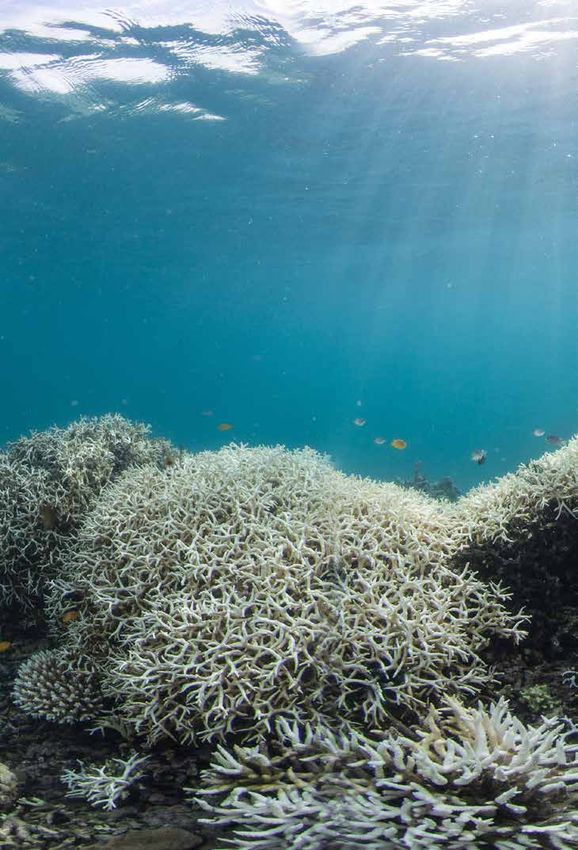
4   REEF PROBATION REPORT                                                                                                                                                                                FIGHT FOR THE REEF   5

                                  © Vanessa Dale
                                                   THE WORLD IS WATCHING
                                                   Australia must keep its promises to protect the Great Barrier Reef or risk
                                                   being called to front the World Heritage Committee again in 2017.
                                                   The Great Barrier Reef is one of the most well-                                                   to UNESCO by 1 December 2016 on progress in
                                                   known, valuable and loved World Heritage areas on                                                 implementing its promises. The Committee warned
                                                   the planet, but its health is in decline, and it faces                                            that “if in their assessment the anticipated progress
                                                   growing threats.1 Almost every year since 2011 the                                                is not being made” the issue could be placed on the
                                                   health of the Reef, and Australia’s management                                                    agenda “for consideration at the subsequent session
                                                   of this global treasure, have been put in the                                                     of the World Heritage Committee in 2017”.2
                                                   spotlight at annual meetings of the UN’s World                                                         They also gave Australia a deadline of December
                                                   Heritage Committee. Several times the Committee                                                   2019 to demonstrate it has halted the decline of the
                                                   considered placing the Reef on the list of World                                                  Reef’s health, or once again put the Reef at risk of an
                                                   Heritage sites “in-danger”, which would have caused                                               ‘in-danger’ listing in 2020.
                                                   great damage to Australia’s international reputation.                                                  WWF-Australia and the Australian Marine
                                                        In 2015 Australia presented a rescue plan                                                    Conservation Society are very supportive of the
                                                   dubbed the ‘Reef 2050 Plan’ that included a long list                                             renewed efforts to protect the Reef that have been
                                                   of promised actions to turn around the health of the                                              triggered by the World Heritage Committee’s
                                                   Reef, and preserve it for future generations.                                                     concerns. However there are some key areas where
                                                        On the strength of these promises, the World                                                 Australia is failing to live up to its promises. This
                                                   Heritage Committee voted to place Australia ‘on                                                   report details those and highlights the damage done
                                                   probation’ – giving the Australian and Queensland                                                 by the recent coral bleaching event, showing it is
                                                   governments another chance to prove that they                                                     more important than ever for the world to keep
                                                   would implement their promises to turn around the                                                 watch over the Great Barrier Reef.
                                                   health of the world’s greatest coral reef.
                                                        The first condition of the Committee’s
                                                   probationary ruling was that Australia must report

                                                   The World Heritage Committee “requests [Australia] to rigorously
                                                   implement all of its commitments including where necessary through their
                                                   inclusion in legislation, in order to halt the current documented declines in
                                                   the property [the Great Barrier Reef]”.3

                                                         PROMISE
                                                         “The [Reef 2050] Plan changes the path for the future… This Plan will work. The commitment is
                                                         absolute.” - Greg Hunt, Australian Minister for the Environment and Stephen Miles, Queensland
                                                         Minister for the Great Barrier Reef, 2015.4

                                                         REALITY
                                                         This report outlines four major areas where Australia is currently not living up to its promises to
                                                         the World Heritage Committee to protect the Great Barrier Reef: water pollution, tree-clearing,
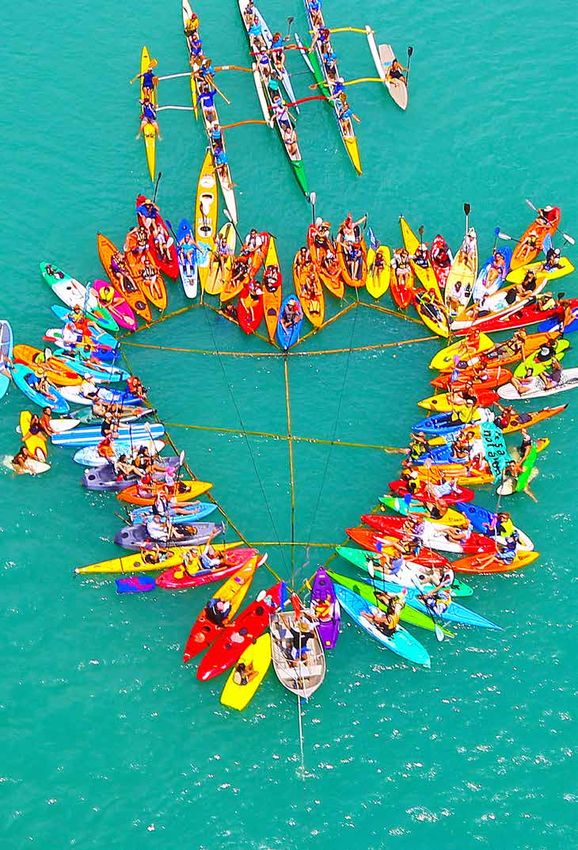
      This colourful protest at                          investment in Reef repair, and responding to coral bleaching. The report recognises the welcome action
      Airlie Beach in 2014 was                           by the state and federal governments to fulfil their promise to ban sea-dumping of industrial dredge
      part of an international                           spoil, and explains the rapid changes needed from both governments to get back on track to meet all
      community campaign                                 our promises and protect the Reef for future generations.
      calling on the World
      Heritage Committee to
      stand up for the Reef.                       1. GBRMPA Great Barrier Reef Outlook Report 2014   2. World Heritage Committee Decision: 39 COM 7B.7   3. World Heritage Committee Decision: 39 COM
                                                   4. Reef 2050 Plan p.iv 7B.7
6 REEF PROBATION REPORT FIGHT FOR THE REEF 7
CORAL BLEACHING DISASTER
© WWF / Geza Aschoff
HITS GREAT BARRIER REEF
The coral bleaching event that hit the Reef in early 2016 was a major
environmental disaster caused by global warming. It killed at least 22%
of the Reef’s corals and seriously damaged the region’s World Heritage
values. Despite this, Australia is not doing its fair share to tackle climate
change and prevent coral bleaching events becoming more frequent.
Australia’s rescue plan for the Great Barrier Reef, of only 26-28% emission reduction by 2030, far
- the ‘Reef 2050 Plan’, - acknowledges that climate less than what’s needed to save the Reef. The
change is the biggest threat facing the Reef, but Paris Agreement will require Australia to do even
doesn’t include any new actions or targets to address more than the Climate Change Authority’s earlier
the problem. The Australian Government says recommendation. What’s more, Australia’s current
that’s because climate change is a global problem climate policies are unlikely to meet its current
that needs a global solution. But rather than lead woefully inadequate target.11 To have a chance
the charge to protect the Reef, Australia’s emission of avoiding dangerous climate change, the Australian
Dermot O’Gorman CEO of WWF-Australia and Christoph Heinrich, Conservation Director WWF-Germany
reductions targets put us at the back of the pack. Government needs to reduce emissions by 65-85%
handing over the Reef petition to Maria Böhmer, German Head of State and Chair of the 2015 UNESCO Meeting.
The petition was signed by 563480 supporters to Draw The Line on the destruction of the Great Barrier Reef. The Paris Agreement on climate change, which (on 2005 levels) by 2030.12
Australian has ratified, sets a goal of limiting global Australia is also a large exporter of coal to
warming to well below 2 degrees C and to pursue other countries and the Queensland and Australian
efforts to limit warming to 1.5 degrees C. Experts governments continue to approve and support the
tell us that to preserve the Great Barrier Reef – and development of large thermal coal mines despite
all coral reefs – for future generations we must go the climate crisis we are facing. For example, the
AUSTRALIA’S PROMISES TO THE WORLD COMMUNITY even further.9 This means all countries around the recently approved Carmichael mine in the Galilee
world must urgently work together to decarbonise Basin will be one of the largest coal mines in the
At the World Heritage Committee meeting in by 2018 as a first step toward the new 2025 clean
their economies, including moving away from world and the mining and burning of coal from this
Germany in 2015, Australia promised to lift its game water targets6
polluting fossil fuels towards 100% renewable energy. mine will generate an estimated 4.7 billion tonnes
and protect the Reef for future generations. Key • Provide ‘adequate and sustained financing’ to As guardians of the Great Barrier Reef, you’d think of greenhouse gas emissions.13 The coal from the
promises made by the Australian and Queensland ensure the Reef 2050 Plan can be implemented,
Australia would lead the way by doing its fair share. mine will be exported for the next 60 years from
governments include: and meet its targets for Reef repair.7
In the lead up to the Paris Agreement, the an expanded port at Abbot Point and shipped out
• Ban sea-dumping of industrial dredge-spoil and
• Strengthen laws to stop the destruction of trees government’s own Climate Change Authority through the Great Barrier Reef.
restrict port development in the World Heritage
in Reef catchments – a leading cause of erosion recommended Australia set a 2030 emissions If Australia wants to convince the world we’re
Area8
and sediment pollution in Reef waters5 reduction target of between 45-65% below 2005 serious about tackling climate change to save the
• Cut farm pollution from fertilisers by 50% and levels, to meet Australia’s fair share of the global Reef, we need to step up and become global leaders,
sediment pollution by 20% in priority catchments carbon budget to limit warming to 2 degrees C.10 not laggards.
Instead, the federal government adopted a target
THE CHOICE FACING THE WORLD HERITAGE COMMITTEE IN 2017 “Australia argued to UNESCO that the outstanding universal value of the
Early in 2017, experts at the UN’s environment • Keep Australia on probation for another three
agency, UNESCO, will assess whether Australia years? World Heritage area is intact because we have this northern 30% of the
is living up to its promises, and make a OR Reef where everything is hunky dory. That is no longer the case. In the
recommendation to the World Heritage Committee. • Include Australia’s management of the Great
Should they: Barrier Reef on the agenda for the World Heritage
space of a month or two, the northern third is now more degraded than the
Committee meeting in Poland in July 2017? southern two thirds.”14 Professor Terry Hughes, James Cook University
5. Reef 2050 Plan Actions EHA20 and EHT3 6. Reef 2050 Plan Target WQT1 7. World Heritage Committee Decision: 39 COM 7B.7 9. GBRMPA (2015) Submission on Australia’s post-2020 greenhouse gas emissions reduction target https://www.dpmc.gov.au/taskforces/unfccc/public-submissions/great-barrier-reef-marine-park-authority ;
8. Reef 2050 Plan Actions WQA18 and WQA14 ISRS (2015) Consensus Statement on Climate Change and Coral Bleaching http://www.gci.uq.edu.au/climate-change-threatens-survival-of-coral-reefs 10. Climate Change Authority (2014) Targets and Progress
Review, Recc 9 p.126 http://www.climatechangeauthority.gov.au/reviews/targets-and-progress-review-3 11. Climate Action Tracker assessment, Nov 2016 12. WWF(2015) Submission to Climate Change
Authority Special review: Australia’s Greenhouse Gas Emissions Reduction Goals http://climatechangeauthority.gov.au/sites/prod.climatechangeauthority.gov.au/files/submissions/2015/WWF%20Australia.pdf TCI
(2015) The Paris Climate agreement and Implications for Australia. http://www.climateinstitute.org.au/verve/_resources/Post-Paris-Brief-16122015.pdf 13. Taylor & Meinshausen (2014) Joint Report to the Land
Court of Queensland on “Climate Change – Emissions” http://envlaw.com.au/wp-content/uploads/carmichael14.pdf 14. Chandler, J. (2016) Grave Barrier Reef, The Monthly Magazine https://www.themonthly.
com.au/issue/2016/june/1464703200/jo-chandler/grave-barrier-reef
8 REEF PROBATION REPORT FIGHT FOR THE REEF 9
© The Ocean Agency
PROMISE
“This [Reef 2050] Plan will provide the best insurance for the Great Barrier Reef against climate change
by reducing direct and indirect threats and therefore increasing its resilience.”16
REALITY
In 2016 at least 22% of the Reef’s corals were killed during the worst ever coral bleaching event to hit the
Great Barrier Reef. Unless the Paris targets are met, climate change will cause more bleaching events.
Australia’s 2030 target “is not in line with most interpretations of a
“fair” approach to reach a 2°C warming limit, let alone with the Paris Australia’s Paris Agreement targets compared to other countries
Agreement’s stronger 1.5°C limit: if most other countries were to follow
the Australian approach, global warming would exceed 3–4°C.”15 Switzerland 50.96%
Norway 44.36%
Climate Action Tracker Assessment
Iceland 41.25%
US - 28% 39.15%
US - 26% 34.89%
EU 33.92%
Canada 30%
New Zealand 30%
Australia - 28% 28%
Australia - 26% 26%
Japan 25.40%
South Korea 4%
0% 10% 20% 30% 40% 50%
2030 emissions reductions targets on 2005 levels. Source: ABC Fact Check 201624
PROMISE
“Australia is committed to taking strong domestic and international action on climate change.”17
Under the Paris Agreement on climate change Australia has committed to reduce our greenhouse
emissions by:
• five percent below 2000 levels by 2020.18
• 26-28% below 2005 levels by 2030.19
REALITY
• Australia’s climate targets are less than our fair share of the global effort needed to keep global
warming below the dangerous threshold of 2 °C, or work towards the Paris Agreement limit of 1.5
degrees C
• Australia’s greenhouse emissions are now 3 per cent above 2000 levels.20
• Expert analysis shows Australia’s current policies will fall well short of meeting our promise under
the Paris Agreement. Without major policy changes, Australia’s emissions are set to increase to
more than 21% above 2005 levels by 2030.21
• In 2017 construction is due to begin on a massive new coal mine in Queensland’s Galilee Basin, with
the coal to be shipped out across the Great Barrier Reef.
Coral bleaching, Lizard Island,
Great Barrier Reef, March 2016. 15. Climate Action Tracker assessment, Nov 2016 16. Reef 2050 Plan p.22 17. Department of Environment and Energy, Australia and the Paris Agreement https://www.environment.gov.au/climate-change/
international/paris-agreement 18. Reef 2050 Plan p.22 19. Department of Environment and Energy, Australia and the Paris Agreement https://www.environment.gov.au/climate-change/international/paris-
agreement 20. Reputex (2016) Media Release: Australian greenhouse gas emissions rise to 3% above 2000 levels analysis of 2015 http://www.reputex.com/media-releases/testing-media-release/
21. Climate Action Tracker assessment, Nov 2016 24. ABC Fact Check March 2016 How do Australia’s carbon emissions targets compare? http://www.abc.net.au/news/2015-12-01/australias-carbon-emissions-
targets-compare-paris-2015/6938844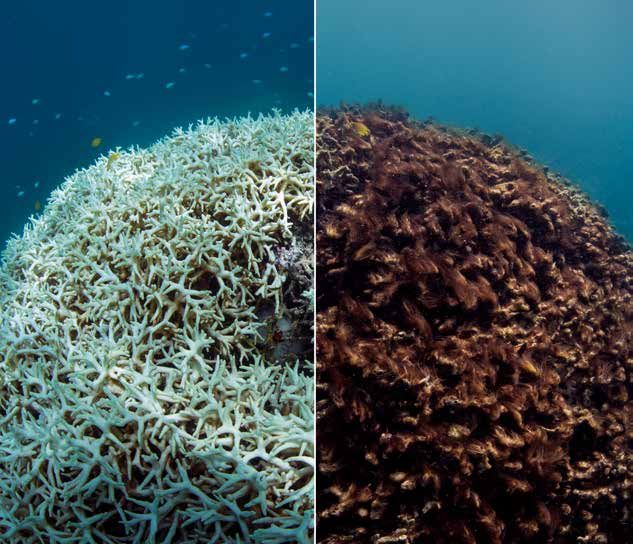
10   REEF PROBATION REPORT                                                                                                                                                                                                                                                                  FIGHT FOR THE REEF   11

                                                                                                                                                                                                  OBSERVED BLEACHING AS AT 13 JUNE 2016
                                                                                                                                                                                     Observed bleaching as at 13 June 2016

                                                                                                                                                                © The Ocean Agency
                                                                                                                                                                                                                  Severe

                                                                                                                                                                                            Cooktown                    Moderate - severe
                                                                                                                                                                                                    Cairns

                                                                                                                                                                                                                                     Minor - severe
                                                                                                                                                                                                     Townsville

                                                                                                                                                                                                                      Mackay                                   Minor - moderate
                                                                                                                                                                                                  QLD                   Rockhampton
                 Before (March - left) and after (May - right) images of bleached coral, Lizard Island, Great Barrier Reef, Queensland.
                 In March 2016 WWF in conjunction with XL Catlin Seaview Survey photographed coral bleaching along the Lizard
                 Island reef.  A few months later, in May, the group returned to film the coral and document its progress. They found
                 the dead coral skeletons were covered in turf-algae and the soft coral was decomposing and detaching from the                                                                                                       Bundaberg
                 reef structure.

                                                                                                                                                                                         Severe                 Moderate to severe       Minor to severe           Minor to moderate

           CORAL BLEACHING DEATH TOLL                                                                                                                                                Source: Australian Government, Great Barrier Reef Marine Park Authority - Bleaching Status June 2016
           The coral bleaching event that hit the Great Barrier                                            surface temperatures caused by climate change and
           Reef in early 2016 was the worst we’ve ever seen.22                                             amplified by a strong El Niño weather season.23
           Climate scientists and GBRMPA have confirmed that                                               The worst bleaching was in the far north, with the                        GBR Legacy’s video of John Rumney diving the Monolith
           the unprecedented underwater heatwave that caused                                               southern Reef less seriously affected.
           the bleaching was triggered by record-breaking sea
                                                                                                                                                                                     – an ancient coral killed by bleaching

                 Region                                                                                     Average coral death, June 2016

                 Far North (Cape York)                                                                      50% of corals dead

                 Cooktown to Cairns                                                                         16% of corals dead

                 Townsville to Whitsundays                                                                  3% of corals dead

                 Mackay to Yeppoon                                                                          0% of corals dead

                 Overall mortality                                                                          22% of corals dead
           Note: this death toll is expected to rise once the results of final mortality surveys in Oct-Nov 2016
           are available. Source: Great Barrier Reef Marine Park Authority
                                                                                                                                                                                     Source: www.youtube.com/watch?v=jfIh7_dibuM
           22. GBRMPA Interim Bleaching Report 2016 p.iv   23. GBRMPA Interim Bleaching Report 2016 p.iv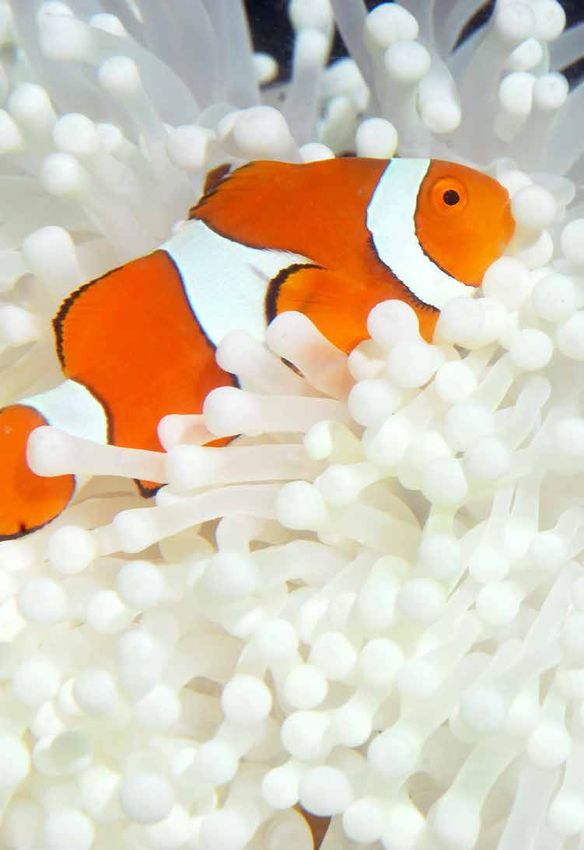
12 REEF PROBATION REPORT FIGHT FOR THE REEF 13
TREE-CLEARING PROMISE
Strengthen Queensland laws to control tree-clearing in Reef catchments. 30
CRISIS CONTINUES REALITY
This promise has not been met. Queensland’s tree-clearing crisis continues, with 108,000 hectares of
bushland lost in Reef catchments alone in 2014-15. Queensland Parliament blocked a government bill
to strengthen tree-clearing controls, and other existing state and federal laws are not being used to
control tree-clearing.
Australia is failing to meet its promise to control tree-clearing in Reef
catchments, a major source of sediment pollution.
© Barry Traill
Native bushland is vital for the health of the Reef Committee not to place the Reef on the ‘in-danger’
because trees and other vegetation hold riverbanks list in 2015.
together, prevent erosion and stop sediment from Earlier this year the Queensland Government
being flushed down-river onto the Reef.25 Bulldozing introduced draft laws to State Parliament that
trees disturbs soils and increases run-off, leading would have gone a long way toward implementing
to spikes of soil erosion.26 Eroded soil washes the promise to control tree-clearing. However
downstream where it smothers and kills seagrass the hung parliament voted down the changes – so
beds and corals. Queensland’s tree-clearing crisis continues unabated
In 2013 the previous state government and the promise by the Queensland Government
weakened the laws that controlled tree-clearing in to strengthen laws to protect bushland in Reef
Queensland, and since then the bulldozing of native catchments has failed.
bushland has skyrocketed. Latest government figures As well as controls at a state level, the
show that 108,000 hectares of bushland was cleared Australian Government can use the national
in Great Barrier Reef catchments in 2014-15, an environmental law to control large-scale tree-
increase of 46 per cent since 2011-2012.27 clearing in Reef catchments. However, with
The Reef 2050 Plan includes a promise to two exceptions (out of at least 200 instances),
strengthen laws to protect bushland in Reef the federal government is failing to use national Queensland’s tree-clearing
catchments, and ensure there is no net loss of environmental law to help fulfil this vital promise to crisis continues. Here a
wetlands and riverside vegetation.28 This was one of the international community. poplar box tree is culled
in Augathella.
the key pledges that convinced the World Heritage
THE AUSTRALIAN GOVERNMENT IS FAILING TO USE NATIONAL ENVIRONMENTAL LAWS
TO PROTECT AND CONSERVE NATIONALLY THREATENED PLANTS, ANIMALS AND PROMISE
No net loss of wetlands and riverside vegetation in Reef catchments. 31
ECOSYSTEMS AND OTHER MATTERS OF NATIONAL ENVIRONMENTAL SIGNIFICANCE REALITY
Under national environment laws, any activity • Number of properties with more than 100 Latest government figures show that in 2014-15 almost 15,000 hectares of riverside vegetation was
that could have a significant impact on a nationally hectares of recent or planned bulldozing of bulldozed in Reef catchments, that’s over 1,300 kilometres of riverbank left vulnerable to soil erosion.32
threatened plant, animal or vegetation community nationally protected habitat: 213
must be referred to the federal environment • Area of nationally protected habitat that has been,
department for assessment and approval. At least or will be bulldozed on these properties: 156,000
that’s how the system is supposed to work! hectares (that’s equivalent to 185,000 football “The government has committed hundreds of millions of dollars to improve
fields)
In reality, WWF has uncovered hundreds of
• Number of these properties that have applied for a
Reef water quality. Yet ongoing land clearing in Reef catchments will reverse
examples where bushland mapped as habitat for
nationally protected species has been bulldozed federal environment approval: 0 many of the gains these programs aim to achieve.”33
without seeking an approval from the federal • Number of stop work orders or voluntary Group of concerned senior environmental scientists, 2016.34
government. WWF’s analysis of the latest suspensions issued by the federal government: 2
government data shows:29
• Number of prosecutions: 0
25. Concerned group of senior Queensland environmental scientists (2016) Submission to Qld Parliament VMOLA Bill Inquiry https://www.parliament.qld.gov.au/documents/committees/AEC/2016/11- 30. Reef 2050 Plan Action EHA20 31. Reef 2050 Plan Target EHT3 32. WWF Analysis based on government data – methodology available on request 33. Maron et al (2016) Queensland land clearing is
VegetationMangt/submissions/504.pdf 26. Thornton et al. (2007) The Brigalow Catchment Study: II. Clearing brigalow (Acacia harpophylla) for cropping or pasture increases runoff. Soil Research 45, 496–511. undermining Australia’s environmental progress, The Conversation http://theconversation.com/queensland-land-clearing-is-undermining-australias-environmental-progress-54882 34. Concerned group of
Cited in WWF Submission to VMROLA 27. Qld Govt (2016) Land cover change in Queensland 2014–15, p.27 28. Reef 2050 Plan Action EHA20 and Target EHT3 senior Queensland environmental scientists (2016) Submission to Qld Parliament VMOLA Bill Inquiry https://www.parliament.qld.gov.au/documents/committees/AEC/2016/11-VegetationMangt/submissions/504.pdf
29. WWF Analysis based on government data – methodology available on request. A map of these properties, including those outside of Reef catchments, is available online https://fusiontables.google.com/
DataSource?docid=1Z1eCiFzpof9UwuokJ8T558yvqUlfKBjGTdyTCRh#map:id=3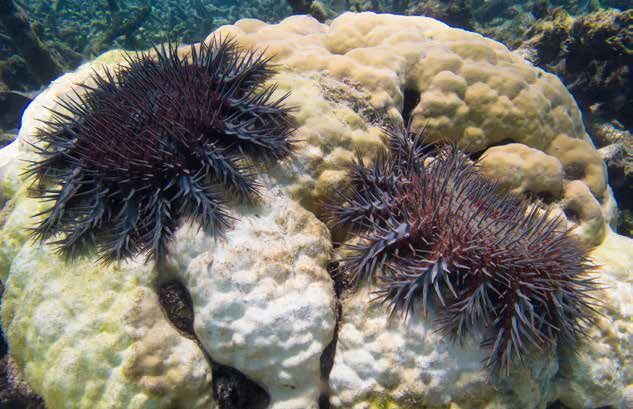
14   REEF PROBATION REPORT                                                                                                                                                                                                FIGHT FOR THE REEF           15

           POLLUTION IS

                                                                                                                                                                                                                                     © Lee Middleton
           SMOTHERING THE REEF
           In the Reef 2050 Plan, Australia promised bold new targets to cut farm
           pollution and give the Reef the clean water it needs to survive. However,
           we’re a long way behind our 2018 pollution reduction targets, and will
           urgently need to raise our game in order to meet the targets for 2025.
           The good news is we still have time to turn things around but we have to
           act fast.
           The Great Barrier Reef needs clean water to survive,                                                 • increased funding for catchment repair and
           but for decades sediment and fertiliser run-off from                                                   improved farming practices;                              Karen Middleton (nee Holst) viewing coral on
           farms along the coast has been polluting the Reef’s                                                  • an education program for farmers to get                  what was locally known as “Coral Gardens”
           waters.                                                                                                widespread adoption of profitable pollution-cutting      early 1950’s located opposite the old Sugar
                                                                                                                                                                           Wharf in Dickson Inlet, Port Douglas.
                Farm pollution is one of the major drivers of                                                     practices.
           the Reef’s decline – it smothers and blocks sunlight                                                      Australia is well behind in meeting its 2018
           from corals and seagrass, it drives outbreaks of the                                                 pollution targets, and unless there is a rapid scaling-
           coral-eating crown-of-thorn starfish, and it makes it                                                up, we are highly unlikely to meet a key promise to
           harder for coral to recover from impacts like coral                                                  the world community. The latest government Reef
           bleaching.                                                                                           Report Card showed only moderate progress has
                As part of the Reef 2050 Plan, the Australian                                                   been made on pesticide and sediment reduction; for
           and Queensland governments committed to science-                                                     nitrogen fertiliser pollution the assessment is very
           based targets to reduce farm pollution and give the                                                  poor. This means that currently we are also way off
           Reef the clean water it needs to recover by 2025.                                                    track to achieve the more challenging 2025 targets.
                An expert advisory group, the Great Barrier                                                          Whilst some farmers are moving to best
           Reef Water Science Taskforce, was established by                                                     practice we need laws to ensure everyone plays their
           the Queensland Government to identify the most                                                       part to cut pollution.  There are insufficient levels of
           effective actions and investments to achieve the Reef                                                compliance with current regulations, and the current
           2025 water pollution targets.                                                                        legal standards are too low to achieve necessary
                After months of work, the 22 scientists and                                                     pollution reductions. We need to rapidly implement
           experts on the Taskforce released their final                                                        the Reef Taskforce recommendations including: new
           report in May this year. They welcomed the efforts                                                   regulations to limit pollution; proper enforcement;
           so far by farmers and land managers to reduce                                                        and a major new investment package, so we can clean
           water pollution, but concluded that “the resulting                                                   up Reef waters and help save this global treasure.
           changes have not been rapid or widespread enough                                                          So far the Queensland Government has
           to improve or even maintain water quality on the                                                     endorsed the solutions put forward by the expert
           Reef”. 35 They said “transformational change is needed                                               Taskforce but implementation is in its early stages
           over the next 5-10 years if the targets have any                                                     and needs to be sped up. Cooperation by both               Coral rubble, silt and algae
           chance of being achieved”. 36                                                                        levels of government is essential to implement the         inshore off Port Douglas, 2016.
                The Water Science Taskforce also came up                                                        Taskforce recommendations, and meet Australia’s
           with a comprehensive set of actions that are needed                                                  promise to the World Heritage Committee to
           to fix the problem, and which urgently need to be                                                    deliver clean water for the Reef.
           actioned, including:                                                                                                                                                 Sugar-wharf building location
           • strengthening regulations to limit pollution;

           35. Qld DEHP (2016) GBR Water Science Taskforce Final Report p.23   36. Qld DEHP (2016) GBR Water Science Taskforce Final Report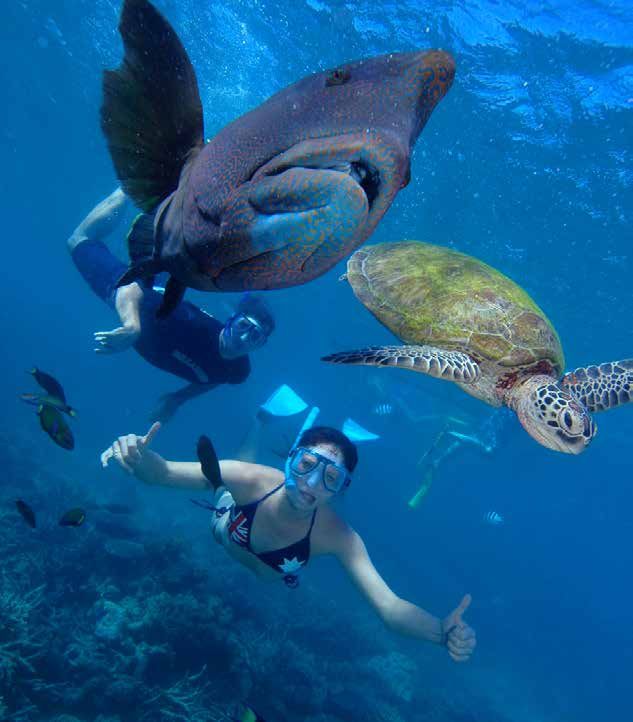
16 REEF PROBATION REPORT FIGHT FOR THE REEF 17
Nitrogen and Sediment load reductions required to meet 2025 targets
100%
PROMISE
In the Reef 2050 Plan the Queensland Government promised to ensure agricultural businesses would
have an accredited best management practice (BMP) program in place or operate under a regulated
90% Pollution cuts needed
to protect the Reef management plan for pollution39
80% 2025 nitrogen
target 80%
REALITY
Although farmers are starting to get involved in best management practice programs, not nearly
enough have accredited BMP plans in place:
% reduction in pollutant load
70%
• There are 836 sugarcane farmers engaged in BMP programs (out of over 3700 properties) including
60% 86 farmers with an accredited BMP40
• There are 402 graziers engaged in BMP programs (out of over 8500 properties) including 27
2018 nitrogen 2025 sediment
50%
target 50% target 50%
graziers with an accredited BMP41
Recently the Queensland Government recommenced enforcement of pollution regulations but there
40% are no regulated farm management plans, and compliance with regulated standards is low.
30%
20%
“If we carry on as we are with poor water quality, we are stuffed with a
2018 sediment
target 20% Our current pathway,
without major policy
capital S” Prof Geoff Garrett, Queensland’s Chief Scientist42
10% change
0% THE STARFISH THAT EAT THE REEF
2008-09
2009-10
2010-11
2011-12
2012-13
2013-14
2014-15
2015-16
2016-17
2017-18
2018-19
2019-20
2020-21
2021-22
2022-23
2023-24
2024-25
Right now, there are millions of crown of thorns Reef waters, which juvenile starfish feed on, allowing
starfish eating their way through the Reef. One adult them to survive in unnatural numbers and eat vast
starfish can eat a dinner plate-sized patch of coral areas of coral. Outbreaks of these destructive pests
Dissolved Total suspended Reduction pathway Reduction pathway
every day. Crown of thorns starfish are a natural are a major reason we lost half the Reef’s coral cover
inorganic nitrogen sediment required to meet 2025 required to meet 2025
nitrogen target sediment target part of the marine ecosystem, but when too much in just 27 years.43 To prevent starfish plagues, we
nitrogen runs off farms it leads to algal blooms in have to clean up farm pollution.
This graph from the Final Report of the GBR Water Science Taskforce shows that improvements
are occurring but that rapid scaling-up is urgently needed in order to meet either the 2018 or 2025
© Lisa Bostrom Einarsson / WWF-Aus
water quality improvement targets. 37
PROMISE
• By 2018 cut farm pollution from nitrogen fertilisers by at least 50% and from sediment by 20% in
priority catchments
• By 2025 cut farm pollution from nitrogen fertilisers by up to 80% and from sediment by up to 50% in
priority catchments38
REALITY
Water pollution is still high and it’s damaging the Reef. Annual Reef Report Cards show that currently
not enough is being done to cut farm pollution. However, if we rapidly implement the Reef Taskforce
Recommendations and urgently ramp up actions we can achieve the transformational change needed
to give the Reef clean water.
Australia’s promise: 2018 targets Reef Report Card Results for 2015
50% reduction in fertiliser pollution Very Poor ‘E’ – 18%
20% reduction in sediment pollution Moderate ‘C’ – 12%
Crown of thorns starfish (Acanthaster
90% of sugarcane lands managed to best practice standard Poor ‘D’ – 23%
planci) feeds on Porites coral head.
90% of cattle grazing land managed to best practice standard Poor ‘D’ – 36% Lizard Island, Great Barrier Reef, Australia
37. Adapted from Qld DEHP (2016) GBR Water Science Taskforce Final Report 38. Reef 2050 Plan Target WQT1 39. Reef 2050 Plan Action WQA 3 40 GBR Water Science Taskforce Report May 2016 and Reef Report Card 2015 41. GBR Water Science Taskforce Report May 2016 and Reef Report Card 2015 42. Sydney
Morning Herald 25 May 2016, http://www.smh.com.au/environment/great-barrier-reef-stuffed-with-a-capital-s-if-we-dont-act-chief-scientist-20160525-gp3f63.html 43. De’ath et al (2012) The 27–year decline of
coral cover on the Great Barrier Reef and its causes, PNAS journal http://www.pnas.org/content/109/44/17995.full
18 REEF PROBATION REPORT FIGHT FOR THE REEF 19
MASSIVE FUNDING SHORTFALL
© Troy Mayne
PUTS REEF IN PERIL
The Great Barrier Reef is an irreplaceable natural treasure, and it’s also
vital for our economy. So far Australia has not committed anywhere near
enough funds to meet our promise to the World Heritage Committee to
protect the Reef for future generations.
PROMISE
“The Australian and Queensland governments will ensure sufficient financial and other resources are
available to achieve the [Reef 2050] Plan’s outcomes”44
REALITY
A government study shows there is a funding gap of at least $6 billion between what the Australian
and Queensland governments have committed so far, and what’s needed to save the Reef over the
next ten years.45
The Reef generates $6 billion a year for the is only about $1 billion over 10 years.49 Without a
Australian economy and supports 70,000 jobs.46 major increase in investment there will clearly be a
Despite this, governments have been reluctant to significant shortfall in the funds necessary to deliver
commit the real funds required to solve the problems the promises Australia committed to in the Reef
that threaten our Great Barrier Reef. 2050 Plan.
The decision adopted by the World Heritage The good news is, by making a down-payment
Committee in 2015 welcomed Australia’s promise to now, and implementing the most cost-effective
fully fund the Reef 2050 Plan, saying “the proposed actions straight away, we can go a long way towards
investment framework should be established as a reaching our clean water targets over the next few
matter of priority and should provide a convincing years. For example, the main driver of crown-of-
demonstration that the necessary investment thorns starfish outbreaks is nitrogen pollution from Great Barrier Reef -
June 2006 snorkelling at
to achieve the plan is being made and will be fertiliser. The costing study calculates that with an
the Great Barrier Reef
sustained”.47 investment of around $400 million, Australia could amongst the marine life
Since then, a new study commissioned by the come close to meeting its promise to cut nitrogen and coral.
Queensland Government has quantified how much pollution by up to 80%. That’s good for the Reef and
it’s likely to cost to reverse the problem of water good for the tourism industry. Sediment pollution
pollution degrading the Reef. The report ‘Costs of smothers seagrass and corals, but the report
achieving the water quality targets for the Great estimates that we could get half way to meeting the
Barrier Reef’ found that meeting the 2025 clean
water targets would cost more than $8 billion over
promised cuts in sediment pollution for around $530
million.
IS THE GOVERNMENT’S $1 BILLION REEF FUND JUST SMOKE AND MIRRORS?
During the recent federal election, the Australian Government announced a new $1 billion over 10 years
ten years. That sounds like a huge sum, but the Reef We can afford to save the Reef, and we must,
Reef Fund50 to provide loans to deliver clean energy, reduce emissions and improve water quality in Great
is worth it. for the sake of future generations and a sustainable
Barrier Reef catchments. However, the money was already assigned to support clean energy projects and by
As well as being an irreplaceable natural economy. Australian governments must commit to requiring this money to be spent in Reef catchments the carbon reduction benefits will be no greater, at best.
treasure, loved by all Australians, the Reef is likely fully fund the actions needed to fulfil the promises Investment in water quality is only optional and the amount of money that will go to water quality as well as
to generate over $60 billion in fishing, tourism and made in the Reef 2050 Plan, and make an immediate the quantum of pollution reductions is unclear. As the money is a concessional loan, not a grant, the overall
other direct economic benefits over the next ten down-payment to get moving on the cost-effective economic incentive provided to farmers to take actions to reduce pollution is likely small. This raises grave
years. In these circumstances, the $800 million a year actions recommended by experts as priorities for the doubts about whether the fund will be effective in reducing Reef pollution.
needed to protect the Reef is a sensible investment. next few years. This is the least they should do to
However, current funding for water quality programs secure the future of the Great Barrier Reef.
44. Reef 2050 Plan p.58 45. Alluvium (2016) Costs of achieving water quality targets for the GBR 46. Deloitte Access Economics (2013) Economic Contribution of the GBR, published by GBRMPA, Townsville 50. The Coalition Policy Invest in Our Great Barrier Reef released 13 June 2016 https://www.liberal.org.au/coalitions-policy-invest-our-great-barrier-reef
47. World Heritage Committee Decision : 39 COM 7B.7 48. Alluvium (2016) Costs of achieving water quality targets for the GBR. NOTE: This figure only includes achieving only around 75% of the targets in the
high-priority Wet Tropics region so more investment will likely be needed. 49. GBR Water Science Taskforce Report May 201620 REEF PROBATION REPORT FIGHT FOR THE REEF 21
BAN ON SEA-DUMPING A WELCOME WIN Expanding ports along the Reef coast
FOR THE REEF … BUT FIGHT CONTINUES The Port Authority is seeking approval
for 1 million cubic metres of dredging to
expand a shipping channel for bigger cruise
ships. One option involves dumping dredge
spoil on an environmental reserve across
the harbour at East Trinity.57
Thanks to pressure from the world community, Australia has lived up to its
promise to ban sea-dumping of industrial dredge spoil in the Reef World The Port of Townsville is planning a major port
Heritage Area and limit port development. However, the fight continues expansion, including 11.4 million cubic metres of
dredging for an expanded shipping channel. The
to reduce risks to the Reef from millions of tonnes of dredging, increased Cairns dredge spoil is to be used in land-reclamation
ship traffic, and port expansions. project inside World Heritage Area. A similar
project in Gladstone in 2011 contributed to major
environmental problems in the harbour. 56
PROMISE Townsville
Ban sea-dumping of industrial dredge spoil within the Great Barrier Reef World Heritage Area51
Abbot Point The mining company Adani plans to build a second
REALITY terminal at Abbot Point to ship out coal from its
Carmichael mega-mine in the Galilee Basin. The
The Australian and Queensland governments worked together to impose an immediate ban on expansion would involve 1 million cubic metres of
sea-dumping of dredge spoil from port developments across the whole World Heritage Area. dredging, with dredge spoil to be stored onshore
Sea-dumping from other dredging operations is exempt. 52 beside sensitive coastal wetlands.55
PROMISE QLD Gladstone Ports Corporation is still
Protect greenfield areas by restricting new port development within and adjoining the World Heritage Gladstone
Area53 planning a major new shipping channel
that would involve 12 million cubic
REALITY metres of dredging, but the project has
been postponed to 2020.54
Unspoiled parts of the Reef coast like the Fitzroy River Delta and Cape York are now protected from
major port developments, but there are still plans to expand a number of existing ports on the Reef
coast, including millions of tonnes of dredging.
© Kiwi / AMCS Collection
MAINTENANCE DREDGING
Did you know? On average around 1 million metres of maintenance dredging occurs every
cubic metres of dredge spoil from ‘maintenance’ year. Although maintenance dredging is necessary,
operations is still dumped in Reef waters every sea-dumping of dredge spoil from maintenance
year. 58 Shipping channels gradually fill up with operations should be phased out in the World
silt, and need regular maintenance dredging to Heritage Area. Dredge spoil can and does spread
keep them open. For example, in Cleveland Bay for tens of kilometres and smothers seagrass and
offshore of Townsville around 400,000 cubic corals.
Abbot Point, Queensland
- 16 September 2014
51. Reef 2050 Plan Action WQA18 52. Queensland Sustainable Ports Development Bill (2015) 53. Reef 2050 Plan Action WQA14 54. Gladstone Ports Corporation Channel Duplication Project EIS http://www.gpcl.com.au/development/channel-duplication-project 55. North Queensland Bulk Ports, Abbot Point Terminal Zero and Growth
Gateway projects http://www.nqbp.com.au/abbot-point/ 56. Townsville Port Expansion Project Supplementary EIS 2016 http://statedevelopment.qld.gov.au/assessments-and-approvals/townsville-port-expansion.
html 57. Cairns Shipping Development Project Supplementary EIS 2016 http://statedevelopment.qld.gov.au/assessments-and-approvals/cairns-shipping-development-project.html 58. Based on figures for actual
sea-disposal of dredge spoil 2000-2013, from GBRMPA (2014) Dredge Synthesis Report Appendix B http://hdl.handle.net/11017/293522 REEF PROBATION REPORT FIGHT FOR THE REEF 23
© Viewfinder Australia Photo Library
THE SOLUTIONS ARE
WITHIN OUR REACH…
Urgent action is needed from the Australian and
Queensland governments to:
1. Control tree-clearing in Reef catchments
2. Stop farm pollution harming the Reef
3. Commit to fully fund the Reef 2050 Plan, and make a down-payment right now
4. Deliver a rapid shift to renewable energy and away from fossil fuels
5. Create a strong new champion for the Reef
1. CONTROL TREE-CLEARING these Reef safe practices can help give the Reef the
clean water it needs to rebuild its coral gardens.
IN REEF CATCHMENTS Successive governments have set pollution reduction
targets and invested in programs to help farmers
There are many things the state and federal adopt cleaner, more efficient practices.
governments could do right now to protect native However, as the Reef Taskforce Report found,
bushland in Reef catchments, and across Queensland. current programs and investments, while making
For example: progress, fall far short of targets and unless there
The Queensland Government should: is rapid scaling up, pollution reduction targets are
• create ‘declared areas’ along Reef watercourses, to unlikely to be achieved.
ban clearing of riverside vegetation where it poses a To deliver clean water for the Reef, the full
high risk to the Reef package of reforms recommended by the Reef
• tighten the ‘self-assessable’ codes that now regulate Water Science Taskforce must be adopted by the
most tree-clearing activities Queensland and Australian governments, and rapidly
• update official vegetation maps to reflect the latest implemented. These include:
science, to make sure all known threatened species
• A legislated limit on pollution loads entering the
habitat is protected
Reef which reduces until clean water targets are
The Australian Government should: met.
• enforce existing laws that require landholders to • Minimum standards for all industries which improve
get a federal environmental approval before clearing over time to meet clean water targets.
bushland that could contain nationally threatened • No increases in pollution from new development.
plants or animals and other matters of national • A broadscale communications program to assist all
environmental significance farm businesses to implement the latest profitable
• publicly and politically support the Queensland pollution cutting practices.
Government’s proposed legislation to control tree- • Catchment restoration to repair degraded pollution
clearing. hot spots.
Meeting the 2025 clean water targets is critical
2. STOP FARM POLLUTION if we are to avoid the next crown-of-thorns starfish
outbreak, and give the Reef the best chance of
HARMING THE REEF recovery from coral bleaching. A legal cap on
pollution entering the Reef is the only mechanism
We know that precision farm practices can cut that can provide certainty that the targets will be
Great Barrier Reef
- Aerial view of pollution whilst boosting profits. With the right mix met.
Hardy’s Reef (off of regulations and incentives, widespread uptake of
the Whitsundays)24 REEF PROBATION REPORT FIGHT FOR THE REEF 25
The Australian and Queensland governments
can support agricultural enterprises to meet this
4. DELIVER A RAPID SHIFT 3. Leadership: As the government champion for
the Great Barrier Reef, GBRMPA should be given
challenge by providing a major investment package
to assist farmers to adopt profitable, low-polluting
TO RENEWABLE ENERGY AND responsibility to lead implementation of the Reef
2050 Plan and investment strategy.
practices, and repair the landscape, as described
below.
AWAY FROM FOSSIL FUELS 4. Smarter government investment: increase
GBRMPA’s budget by approx. $20 million per year.
The devastating coral bleaching event that hit the
Reef earlier this year shows how urgent it is for all 5. On-ground: increase resourcing and effectiveness
3. COMMIT TO FULLY FUND countries to limit global warming to 1.5 C or less. As of GBRMPA’s field management and compliance
programs to stop the current high rate of breaches
guardians of the Great Barrier Reef, Australia should
THE REEF 2050 PLAN, AND MAKE lead the way by doing its fair share. of marine park rules.
6. Innovative: Establish a Great Barrier Reef research
A DOWN-PAYMENT RIGHT NOW • Commit to a target of 100% renewable electricity
by 2035. strategy to deliver the critical research required to
A long-term, multi-billion dollar investment package • Commit to targets of at least 50% of total underpin effective management of the Great Barrier
is needed to support agricultural enterprises to renewable energy (electricity, transport, and Reef and coastal ecosystems.
adopt precision farm practices that can cut pollution industrial process) by 2030 and 100% before 2050. 7. Transparent and accountable: Enhance the
whilst boosting profits. The investment package • Implement policies to support the rapid growth of independence and credibility of the 2019 Great
must also fund much needed catchment repair, renewable energy Barrier Reef Outlook Report given its crucial role for
such as restoring wetlands and riparian forests, and • Phase out fossil fuel subsidies deliberations by the World Heritage Committee in
rehabilitating streambanks and gullies to halt soil • Rule out any new thermal coal mines or coal mine 2019/2020.
erosion and filter out pollutants before they reach expansions
the Reef. • Transition out coal-fired power plants before 2035
© Oliver Minnett / WWF-Aus
The Queensland Government’s costings report
has estimated that it will cost over $8 billion to
achieve the clean water targets by 2025 or $800
5. A STRONG NEW
million a year. Governments need to fully deliver the
investment needed to achieve Reef 2050 targets.
CHAMPION FOR THE REEF
Initially the most cost-effective actions should be The problems facing the Great Barrier Reef have
funded to drive rapid progress with $800 million a outgrown the capacity of the institutions and systems
year over five years put in place to protect it a generation ago.
STEP 1 - Commit to an Investment Strategy that will There is often a disconnect between the long-
fully fund all the actions promised in the Reef 2050 term and stable policies required to conserve and
Plan and specifies the budget that each government recover the Reef and federal and state electoral
will allocate each year. cycles. That’s why the Reef needs a strong,
independent watchdog that can ensure the Reef’s
STEP 2 - Immediately commit the funds needed
interests are represented and defended when
over the next 5 years to implement the most
important decisions are made and developments
cost- effective actions to clean up water pollution.
proposed.
The new Reef Water Quality Protection Plan for
A stronger, better resourced and more
2017-2021 should set out the annual actions and
independent Great Barrier Reef Marine Park
investment to deliver specified pollution reduction
Authority (GBRMPA) is needed, that places
targets including:
conservation and recovery of the Reef above all
• The actions and investment needed to deliver other priorities and strengthens the way Australia
the full nitrogen reduction target of up to 80% manages this World Heritage icon.
(estimated to be around $400 million) as this is the To meet the many challenges facing the Reef,
most cost effective area to cut Reef pollution GBRMPA should have the following roles, powers
• The actions and investment needed to deliver 75% and resources:
of the 2025 target to halve sediment pollution A child at an Earth Hour
1. Independence: Governed by an independent chair
(estimated to be $3.6 billion) by 2021 event in Sydney, 2014.
and an expertise based board of international stature
• Innovations programs to prove up more cost- People around the world
effective actions to fully achieve the 2025 clean 2. Strong: Ensure GBRMPA has approval powers for are calling for faster action
water targets by the due date. all developments and activities that are likely to have on climate change, to save
a significant impact on World Heritage values of the natural treasures like the
Great Barrier Reef Region Great Barrier Reef.26 REEF PROBATION REPORT FIGHT FOR THE REEF 27
REFERENCES
1. GBRMPA Great Barrier Reef Outlook Report 2014 carbon emissions targets compare? http://www.abc. 45. Alluvium (2016) Costs of achieving water quality targets 54. Gladstone Ports Corporation Channel Duplication
2. World Heritage Committee Decision: 39 COM 7B.7 net.au/news/2015-12-01/australias-carbon-emissions- for the GBR Project EIS http://www.gpcl.com.au/development/
targets-compare-paris-2015/6938844 46. Deloitte Access Economics (2013) Economic channel-duplication-project
3. World Heritage Committee Decision: 39 COM 7B.7
25. Concerned group of senior Queensland environmental Contribution of the GBR, published by GBRMPA, 55. North Queensland Bulk Ports, Abbot Point Terminal
4. Reef 2050 Plan p.iv
scientists (2016) Submission to Qld Parliament Townsville Zero and Growth Gateway projects http://www.nqbp.
5. Reef 2050 Plan Actions EHA20 and EHT3 VMOLA Bill Inquiry https://www.parliament.qld.gov.au/ com.au/abbot-point/
47. World Heritage Committee Decision : 39 COM 7B.7
6. Reef 2050 Plan Target WQT1 documents/committees/AEC/2016/11-VegetationMangt/ 56. Townsville Port Expansion Project Supplementary EIS
48. Alluvium (2016) Costs of achieving water quality targets
7. World Heritage Committee Decision: 39 COM 7B.7 submissions/504.pdf 2016 http://statedevelopment.qld.gov.au/assessments-
for the GBR. NOTE: This figure only includes achieving
8. Reef 2050 Plan Actions WQA18 and WQA14 26. Thornton et al. (2007) The Brigalow Catchment Study: only around 75% of the targets in the high-priority and-approvals/townsville-port-expansion.html
II. Clearing brigalow (Acacia harpophylla) for cropping Wet Tropics region so more investment will likely be 57. Cairns Shipping Development Project Supplementary
9. GBRMPA (2015) Submission on Australia’s post-2020
or pasture increases runoff. Soil Research 45, 496–511. needed. EIS 2016 http://statedevelopment.qld.gov.au/
greenhouse gas emissions reduction target https://
Cited in WWF Submission to VMROLA assessments-and-approvals/cairns-shipping-
www.dpmc.gov.au/taskforces/unfccc/public-submissions/ 49. GBR Water Science Taskforce Report May 2016
great-barrier-reef-marine-park-authority ; ISRS (2015) 27. Qld Govt (2016) Land cover change in Queensland development-project.html
50. The Coalition Policy Invest in Our Great Barrier Reef
Consensus Statement on Climate Change and Coral 2014–15, p.27 58. Based on figures for actual sea-disposal of dredge spoil
released 13 June 2016 https://www.liberal.org.au/
Bleaching http://www.gci.uq.edu.au/climate-change- 28. Reef 2050 Plan Action EHA20 and Target EHT3 coalitions-policy-invest-our-great-barrier-reef 2000-2013, from GBRMPA (2014) Dredge Synthesis
threatens-survival-of-coral-reefs 29. WWF Analysis based on government data – Report Appendix B http://hdl.handle.net/11017/2935
51. Reef 2050 Plan Action WQA18
10. Climate Change Authority (2014) Targets and methodology available on request. A map of these
52. Queensland Sustainable Ports Development Bill (2015)
Progress Review, Recc 9 p.126 http://www. properties, including those outside of Reef catchments,
climatechangeauthority.gov.au/reviews/targets-and- is available online https://fusiontables.google.com/ 53. Reef 2050 Plan Action WQA14
progress-review-3 30. Reef 2050 Plan Action EHA20
11. Climate Action Tracker assessment, Nov 2016 31. Reef 2050 Plan Target EHT3
SELECTED REFERENCES
12. WWF(2015) Submission to Climate Change Authority 32. WWF Analysis based on government data –
Special review: Australia’s Greenhouse Gas Emissions methodology available on request
Reduction Goals http://climatechangeauthority.gov.
33. Maron et al (2016) Queensland land clearing is
au/sites/prod.climatechangeauthority.gov.au/files/
undermining Australia’s environmental progress, The
submissions/2015/WWF%20Australia.pdf TCI (2015)
Conversation http://theconversation.com/queensland-
The Paris Climate agreement and Implications for
land-clearing-is-undermining-australias-environmental-
Australia. http://www.climateinstitute.org.au/verve/_
progress-54882
resources/Post-Paris-Brief-16122015.pdf Alluvium (2016) Costs of achieving the water quality Special Review on Australia’s Climate Goals and Policies:
34. Concerned group of senior Queensland environmental
13. Taylor & Meinshausen (2014) Joint Report to the Land targets for the Great Barrier Reef by Alluvium Consulting A Minority Report, Canberra. https://www.climatecouncil.
scientists (2016) Submission to Qld Parliament
Court of Queensland on “Climate Change – Emissions” Australia for Department of Environment and Heritage org.au/cca-minority-report
VMOLA Bill Inquiry https://www.parliament.qld.gov.au/
http://envlaw.com.au/wp-content/uploads/carmichael14. Protection, Brisbane. www.qld.gov.au/documents/costings- Queensland Government (2016) Land Cover Change in
documents/committees/AEC/2016/11-VegetationMangt/
pdf report.pdf Queensland 2014–15, Brisbane https://publications.qld.
submissions/504.pdf
14. Chandler, J. (2016) Grave Barrier Reef, The Monthly Climate Action Tracker (2016) Country Assessment: gov.au/dataset/landcover-change-in-queensland-2014-15/
35. Qld DEHP (2016) GBR Water Science Taskforce Final
Magazine https://www.themonthly.com.au/issue/2016/ Australia http://climateactiontracker.org/countries/ resource/872e9c96-b40b-45ae-95dc-1f040efac5c1
Report p.23
june/1464703200/jo-chandler/grave-barrier-reef australia.html Queensland Department of Environment and Heritage
36. Qld DEHP (2016) GBR Water Science Taskforce Final
15. Climate Action Tracker assessment, Nov 2016 Commonwealth of Australia (2015) Reef 2050 Long Protection (2016) Great Barrier Reef Water Science
Report
16. Reef 2050 Plan p.22 Term Sustainability Plan https://www.environment.gov. Taskforce Final Report, DEHP, Brisbane. www.gbr.qld.gov.
37. Adapted from Qld DEHP (2016) GBR Water Science au/system/files/resources/d98b3e53-146b-4b9c-a84a- au/documents/gbrwst-finalreport-2016.pdf
17. Department of Environment and Energy, Australia and Taskforce Final Report 2a22454b9a83/files/reef-2050-long-term-sustainability- World Heritage Committee (2015) Decision: 39 COM
the Paris Agreement https://www.environment.gov.au/ plan.pdf
38. Reef 2050 Plan Target WQT1 7B.7 Great Barrier Reef (Australia) (N 154) http://whc.
climate-change/international/paris-agreement
39. Reef 2050 Plan Action WQA 3 Department of Environment and Heritage Protection unesco.org/en/decisions/6216
18. Reef 2050 Plan p.22
40. GBR Water Science Taskforce Report May 2016 and (2016) Great Barrier Reef Report Card 2015 Reef Water
19. Department of Environment and Energy, Australia and Quality Protection Plan, DEHP, Brisbane. Available for
Reef Report Card 2015
the Paris Agreement https://www.environment.gov.au/ download at: http://www.reefplan.qld.gov.au/measuring-
climate-change/international/paris-agreement 41. GBR Water Science Taskforce Report May 2016 and
success/report-cards/2015/
Reef Report Card 2015
20. Reputex (2016) Media Release: Australian greenhouse GBRMPA (2014) Great Barrier Reef Outlook Report 2014,
gas emissions rise to 3% above 2000 levels analysis of 42. Sydney Morning Herald 25 May 2016, http://www.smh.
GBRMPA, Townsville
2015 http://www.reputex.com/media-releases/testing- com.au/environment/great-barrier-reef-stuffed-with-
a-capital-s-if-we-dont-act-chief-scientist-20160525- http://www.gbrmpa.gov.au/cdn/2014/GBRMPA-Outlook-
media-release/ Report-2014/
gp3f63.html
21. Climate Action Tracker assessment, Nov 2016
43. De’ath et al (2012) The 27–year decline of coral cover GBRMPA (2016) Interim report: 2016 coral bleaching
22. GBRMPA Interim Bleaching Report 2016 p.iv event on the Great Barrier Reef, GBRMPA, Townsville.
on the Great Barrier Reef and its causes, PNAS journal
23. GBRMPA Interim Bleaching Report 2016 p.iv http://www.pnas.org/content/109/44/17995.full http://elibrary.gbrmpa.gov.au/jspui/handle/11017/3044
24. ABC Fact Check March 2016 How do Australia’s 44. Reef 2050 Plan p.58 Hamilton & Karoly (2016) The Climate Change Authority’sREEF PROBATION REPORT NOV 2016
A report by WWF-Australia and the Australian Marine Conservation Society
WWF-Australia Australian Marine Conservation Society
GPO Box 528 GPO Box 5815
Sydney NSW 2001 West End QLD 4101
Tel:+1800 032 551 Tel:+61 7 3846 6777
enquiries@wwf.org.au amcs@amcs.org.au
wwf.org.au amcs.org.auYou can also read


