Referencing your sources/avoiding plagiarism 17/10/2018 - Shaun Theobald Student Learning Advisory Service
←
→
Page content transcription
If your browser does not render page correctly, please read the page content below
Referencing your
sources/avoiding plagiarism
        17/10/2018
         Shaun Theobald
         srt@kent.ac.uk
Student Learning Advisory Service

                                    1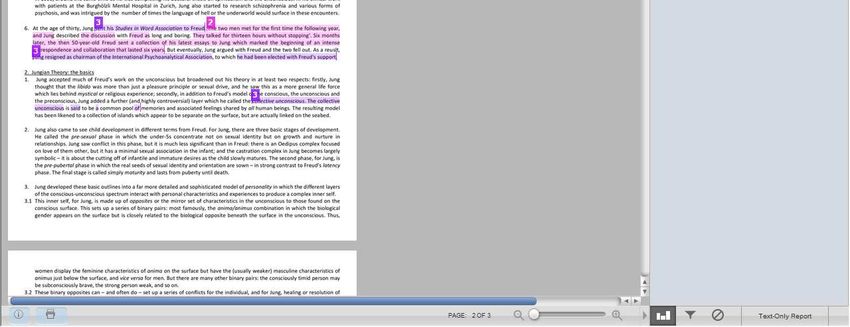
Workshop Agenda
• What is plagiarism?
• How & what do I have to
  reference?
• Introduction to the basic principles
  of referencing
• Referencing guidelines

                                         2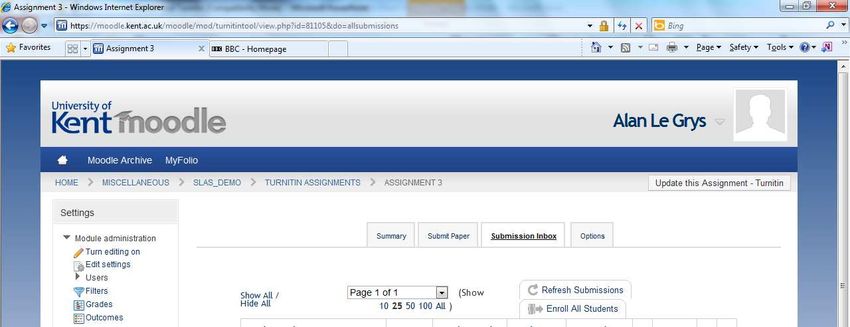
Quiz

True or False?

                 3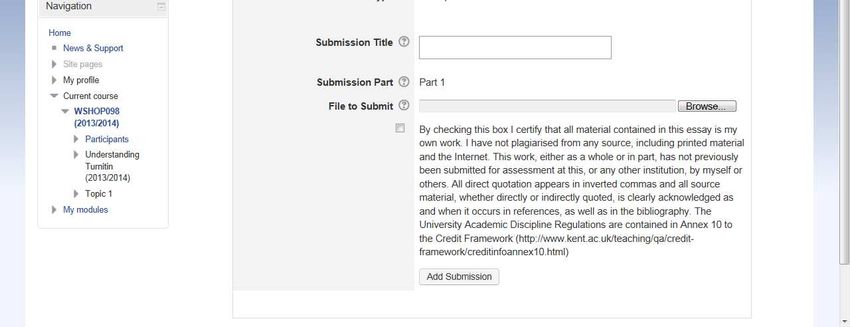
True or False ?
1. Submitting the same work, or section, for more
   than one module constitutes plagiarism.
   True “Duplication of material”
2. Plagiarism may occur in oral or graphic work as
   well as in written work.
   True
3. There is no need to cite well-known facts.
   False, this depends on the context
4. Within a group or pair work project students
   can hand in the same work without worrying
   about plagiarism.
   False, this depends on the instructions and
   marking criteria “Conspiring with others”     4
True or False ?
5. It is not plagiarism when I take short phrases
   from a number of sources and put them together
   in my own words to make a coherent whole, then
   acknowledge the sources in the bibliography.
   False
6. All quotes need to be in quotation marks.
   False - depends on length of the quote

                                               5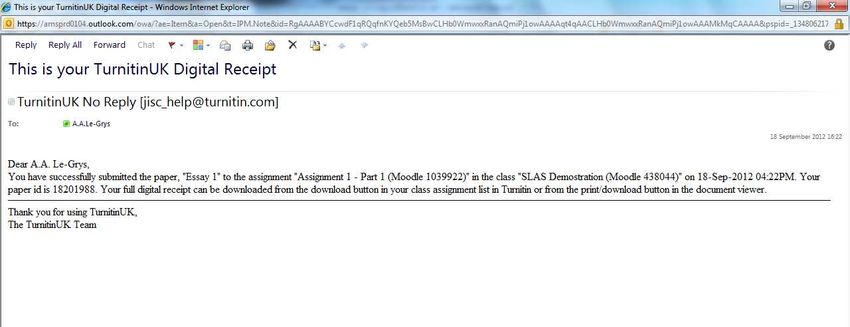
True or False ?
7. In source A, source B is quoted. When using
   this quote in my essay I need only
   acknowledge source A.
   False
8. I am allowed to change a quote to make it fit
   grammatically into my own writing.
   True, but you need to indicate the changes
9. When finding information or ideas in several
   sources, I need to cite all of them.
   False, this depends on what you are hoping
   to demonstrate
                                               6
What is Plagiarism?
“Academic misconduct”
Presenting other people’s work
as if it were your own
Cheating and Deceiving
Though often unintentional!
For further information, see:
www.kent.ac.uk/teaching/documents/quality-
assurance/credit-framework/creditinfoannex10.pdf
7Before this discussion
continues@
• 3 IMPORTANT POINTS!
• 1. Plagiarism is not always intentional – it
can be unintentional/accidental!
– But even if it is unintended, penalties occur!
• 2. There are straightforward things you
can do, and learn, to avoid plagiarism
• 3. There is no need to be frightened of
using sources/citing sources!
8It IS plagiarism when you@
• Copy ideas and words from books, journals, websites, etc.
and present them as your own
• Copy from unpublished material (e.g. essays by other
students or from essay services)
• Resubmit/recycle your own work
• Submit work produced by others
• Fail to reference correctly
- failing to reference facts (inc. charts, tables, etc.)
- failing to reference ideas
- failing to reference paraphrased material
9It IS plagiarism when you@
• It does not have to be ‘cut & paste’ to be
plagiarism
• It does have to be from a website to be
plagiarism
• ANY source improperly used creates
problems of plagiarism@
• And penalties are incurred whether
plagiarism is intentional or unintentional!
10Causes of Plagiarism
• Lack of confidence
• Undeveloped essay writing skills
• Undeveloped note-taking techniques
• Ignorance of academic conventions
• Incorrect/ inadequate referencing
• Time pressure
• [But sometimes also: intention to deceive]
11How to Avoid Plagiarism
• The best defence against plagiarism is
proper referencing, and understanding
the principles of referencing
• Once you have understood the principles
of referencing and academic writing, you
will be fine!
• Don’t be afraid of plagiarism; learn –
constructively – how to avoid it
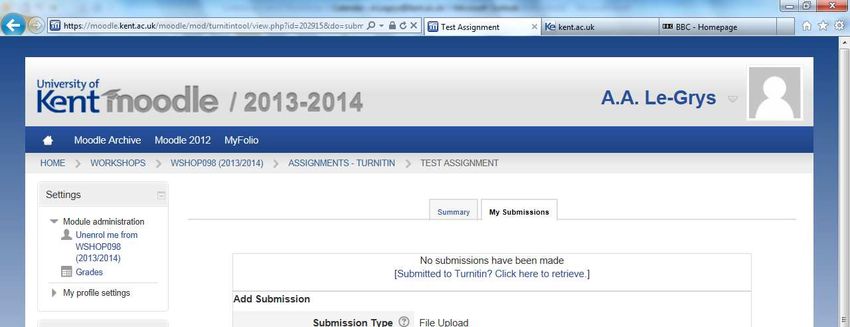
• Learn how to submit through/use Turnitin
12Fill in details
‘Sign’ the Anti-plagiarism statement
1314
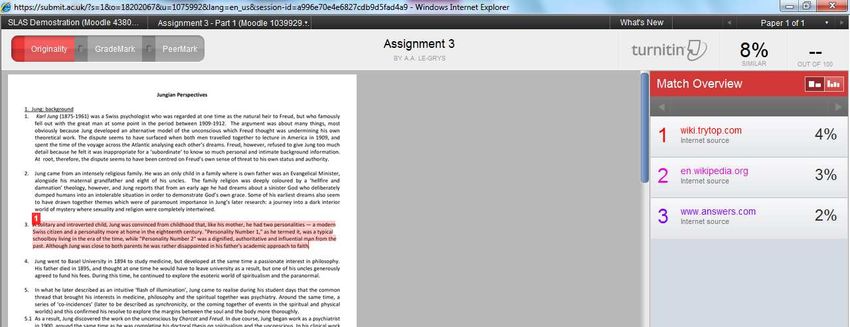
Originality Report: Student View

                               15
Turnitin: Document View
16Summary – simplifying the
process!
• In every assignment/essay/document, you
need to show@
• WHAT sources you used
Author-date citation/footnote/number
• WHERE you used them
Author-date citation/footnote/number
• HOW they can be traced
Bibliography/reference list
17Simplifying 2
• BEFORE you write the first draft, make
sure you have the reference information
for all your sources
• AFTER you have finished the first draft,
edit carefully paragraph by paragraph
– Each paragraph will have some evidence
– Each piece of evidence must be referenced!
– Two questions – where are the paragraphs;
where is the evidence!
18Why do you need to Reference?
• To develop good academic practice
• To show which ideas are not your own
• To demonstrate your reading/research
• To demonstrate understanding of the topic
• To let the reader know where the facts and
ideas have come from
19Why do you need to Reference?
• To show how you have learnt from your
sources
• To show how your sources have informed
your critical thinking and scholarship
• To allow tutor to check details
• To avoid the problem of Plagiarism!
20What Do I Need to Reference?
Basically, everything....
Any idea, fact, concept, theory, opinion, snippet, etc...
• It does not have to be an exact quotation
– any idea or piece of information has to be referenced
• It does not have to come from a book
– any source MUST be referenced
• Journals, websites, CDs/DVDs, Youtube, Moodle, essays....
• You MUST show where everything has come from
– even personal emails or conversations must be referenced
Always acknowledge the work of other people 21Academic Language
• Citation: the act of formally recognising,
within your work, the resources from which
you have obtained (any) information
– Citations are usually indirect summaries
• “In Patel (2015), socialisation is@”
• Quotation: reproducing (word for word)
another person’s words in your text
- Quotes MUST be always exact/precise
• As Patel (2015, p.87) observes, “@socialisation
is@”
22Academic Language
• Referencing: the act of writing out a
detailed record of the resource from which
you have obtained information
– In-text author-date/number/footnote + end-of-
page or end-of-text reference list/ bibliography/
full footnote information
• Bibliography: a list of all the resources you
consulted for an assignment regardless of
whether or not you actually used them
23Referencing Styles
Author – Date Footnotes
• APA (psychology) • MHRA (humanities)
• Harvard (mainly • OSCOLA (law)
social sciences) • Chicago (politics/IR)
• MLA (languages and
linguistics) Numbered
• IEEE (computing
and electronics)
www.kent.ac.uk/ai • Vancouver
(biomedical) 24Elements of referencing
Style or format depends on conventions and
material, but you will always need
information about:
• author
• date of publication
• place of publication
• full title
• PAGE numbers (if paginated source)
• date consulted/used (www sources)
25Harvard Type (Author-Date Style) In text: Under the states of emergency, however, the police detained many labour leaders, and in February 1988 Cosatu was prohibited from engaging in political activities (Baskin, 1991, p.59). Later, in 1989... (Baskin, 1991, p86) In bibliography: Baskin, J. (1991) Striking Back: A History of Cosatu (Johannesburg: Ravan) 26
Footnote Style
In text:
Under the states of emergency, however, the police
detained many labour leaders, and in February 1988
Cosatu was prohibited from engaging in political
activities.¹ Later, in 1989....2
___________________
1. Jeremy Baskin, Striking Back: A History of Cosatu (Johannesburg:
    Ravan, 1991), p.59.
2. Baskin, Striking Back p.90
In Bibliography:
Baskin, Jeremy Striking Back: A History of Cosatu (Johannesburg, Ravan,
1991).
                                                                     27
Numbered Style (Vancouver)
In text:
Under the states of emergency, however, the police
detained many labour leaders, and in February 1988
Cosatu was prohibited from engaging in political
activities [1].
[Note this is the number used for this source throughout
the whole of the document you create!]
In List of references:
[1] Baskin J 1991 Striking Back: A History of Cosatu
(Johannesburg: Ravan), p.59
28Harvard Type (Author-Date Style)
Basic approach
1. In the main body of the text:
- Author’s name
- Date of publication
- Page numbers
2. In the bibliography:
- Author’s name
- Date of publication
- Full title
- Place of publication & publisher 29In-Text Citations
If author’s name occurs in the sentence:
Cottrell (1999, p23) claims that students @
If the name does not occur in the sentence:
Students should not @ (Cottrell, 1999, p23)
30Harvard Type (Author-Date Style)
Secondary citations:
There was clear evidence in the research of genetic
mutations appearing in the plant (White, 2001, cited in
Murray and Saint, 2007, p.182).
In bibliography:
Murray MJ and Saint R (2007) The Plant Genome
Project (Chicago, Chalmer’s Press)
31Harvard Type (Author-Date Style)
Variations:
• Journal articles
- Author, date, title, Journal, volume,
issue number, page(s)
• Chapters in edited book
- Author, date, title, ‘in’ editors, book title,
place of publication, publisher, pages
• eBooks
- Author, date, title [Internet], place, publisher, available
at [web address] (accessed on [date]) 32Harvard Type (Author-Date Style)
Basic Variations:
• Journal articles
In text: (Mayer, 2009, p...)
Mayer, J (2009). ‘Parallel algorithms for solving linear systems
with sparse triangular matrices’ in Computing 86 (4), pp.291-312
• Chapters in edited book
In text: (Crane, 1991, p....)
Crane, A (1991) ‘How Biochemistry Changes’ in
(eds) Hudson, W. & French, C. Living Biochemistry.
Massachusetts, MIT Press, pp.80-83
• eBooks
In text: (Peterson, 2007, p....)
Peterson, L. (2007) Computer Networks a Systems approach (Boston,
Morgan Kaufmann) [Online] available at 33
https://catalogue.kent.ac.uk/Record/758226 (accessed on 05/01/11)Harvard Type (Author-Date Style)
Web citations:
1. Known author shown on website
In text: (Grice, 2011) [no page number on website]
Grice, A. (2011), Lib Dem support hits all-time low [Internet] Available at
http://www.independent.co.uk/news/uk/politics/lib-dem-support-hits-alltime-
low-2176158.html. (Accessed on 05/01/11)
2. No named author shown on website: main website name
In text: (BBC, 2009) [no page number on website]
BBC (2009) Netanyahu to form Israel cabinet [Internet] Available at
http://news.bbc.co.uk/1/hi/world/middle_east/7901486.stm. (Accessed on
20/02/09)
3. Web Pages with organisations as authors
In text: (British Red Cross, 2008)
British Red Cross (2008) Open Gardens [Internet] Available at
http://www.redcross.org.uk/index.asp?id=39992. (Accessed on 05/01/11)
34Harvard: Further Examples
Class Handouts and Lectures
– Tutor, Year, Lecture title, Module, location, date
– E.g. In-text: (Le Grys, 2011)
– Le Grys, A. (2011) Postmodernity (Lecture to TH562
students) Canterbury, 19th January
Moodle
– Author, Year, title, module no., web address, date
– E.g. Le Grys, A. (2010) ‘Week 3: Aristotle and Virtue
Theory’ [Online] available at:
https://moodle.kent.ac.uk/moodle/course/view.php?id
=11609 (accessed on 05/01/11)
35Bibliography: Harvard Style Always arrange alphabetically: BBC (2011) Activists target Tunisian Government sites [Internet]. Available at http://www.bbc.co.uk/news/technology-12110892 (accessed on 20/02/11) Faulkner, X. (2000) Usability Engineering (Basingstoke, Macmillan) Grice, A. (2011), Lib Dem support hits all-time low [Online]. Available at http://www.independent.co.uk/news/uk/politics/lib-dem-support-hits- alltime-low-2176158.html (accessed on 05/01/11) Long, L. and Long, N. (2005) Computers: Information Technology in Perspective (12th edition, New Jersey, Pearson Education) Mayar, J. (2009) ‘Parallel algorithms for solving linear systems with sparse triangular matrices’ Computing Vol. 86 No. 4 pp.291-312 Schneider, G.M. and Gersting, J.L. (2007) Invitation to Computer Science (3rd edition, Boston Mass. Thomson Course Technology) Snyder, L. (2011) Fluency with Information Technology (4th edition, 36 Boston, Pearson)
Preparing to Reference
Referencing takes time:
• Spend time to save time
  – Always keep detailed bibliographic information
  – Do this as you go along – reading, note-taking
  – Keep records of every source (including Internet)
• Record everything
  – Title of book/journal/webpage, author, pages, etc
  – Only exception: ‘common knowledge’
     • E.g. Theresa May is Prime Minister
     • Key test: did I know this before I started this course?
                                                            37
Preparing to Reference
Visual Pleasure and Narrative Cinema in
Visual and Other Pleasures (Laura Mulvey, 2nd As you take notes:
ed. Palgrove Macmillan 2009)
A Political Use of Psychoanalysis • ALWAYS make a note of full
Film is fascinating, but this gives the medium a
powerful political role in controlling understanding
bibliographic details
–perhaps even playing into traditional • ALWAYS make a note of the
stereotypes.
Cinema poses questions about the way the PAGE NUMBERS
subconscious structures perception. (p14f)
Hollywood at its best works through skilled You WILL need this information
manipulation of visual pleasure. (p16) later for your references@..
Film is supremely voyeuristic, with the audience
in darkness giving the spectator the illusion of • By all means develop own
looking into a private world. (p17)
Lacan argues that each child goes through a
shorthand BUT remember you
‘mirror phase’ before they have language, in must be able read your notes!
which they see their own image in a mirror as a
more perfect version of themselves – an ego • Note only what you need@.
ideal. (p18). It is this misrepresentation which
constitutes the first sense of ‘I’-ness. • Highlight key points
38RefWorks
Software
• Download references from databases
• Keep a personal “library” of references
• Insert references into MS Word documents
• Automatically formats citations, bibliographies
and references according to selected style
(Harvard, MHRA, Vancouver etc.)
• https://www.kent.ac.uk/library/resources/referenc
e-management/refworks/index.html
39Further Help
For further information on both referencing
and plagiarism, see:
www.kent.ac.uk/ai
40You can also read


