Research Integrity - a key priority for a fast-rising and research-intensive Asian university - Centres
←
→
Page content transcription
If your browser does not render page correctly, please read the page content below
Research Integrity – a key
priority for a fast-rising and
 research-intensive Asian
          university
                                                                  Tony Mayer
                                                        Research Integrity Officer, NTU
                                                    Co-Chair, 1st,2nd & 5th World Conferences
                                                             on Research Integrity

                Inaugural Singapore Research Ethics Conference
                               01/02 March 2018
Research Integrity is about Good Research
    Practice/Responsible Conduct of Research
     Research Integrity ≠ Research Misconduct

‘In general terms, responsible conduct in research is
 simply good citizenship applied to professional life’

             Professor Nick Steneck, University of Michigan
             Making Mistakes and Making Breakthroughs: Taking Risks in
             Our Academic Life
             16 March 2017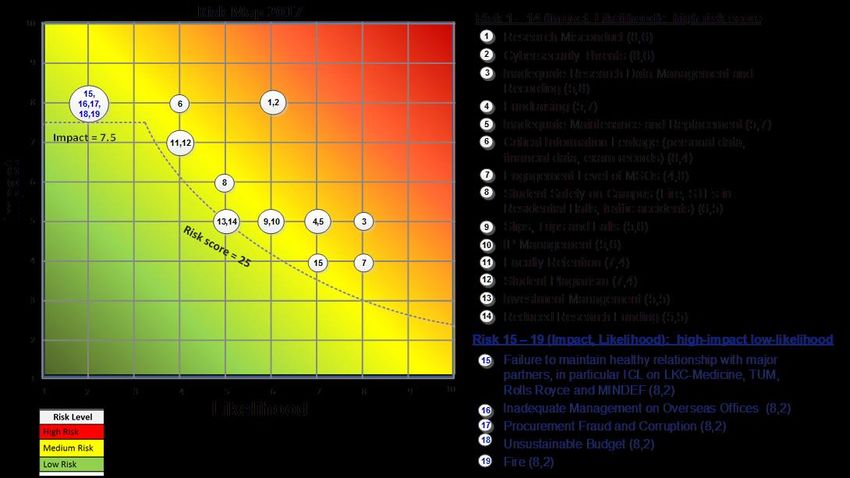
The “Sage
of Omaha”
speaks…..

Risk of irresponsible research: research misconduct
                                heat map
               HIGH

                            AUTHOR
                            DISPUTES
PROBABILITY

              MEDIUM
                                       PLAGIARISM

                                                    FALSIFICATION

               LOW                                                  FABRICATION

                          LOW          MEDIUM               HIGH
after Paul Taylor, RMIT                 IMPACT
Reasons for Misconduct                           Part VI - 6

  ■ Poor laboratory practice                                      ■ Indifference
  ■ No face to face discussion                                    ■ Poor role models

                                         Research
           ■ Family pressure
                                         Misconduct
                                                                      ■ Fear of failure
           ■ Illness                                                  ■ Perfectionism
           ■ Financial stress              Competitive
                                            Pressures

                          ■ Publications ■ Funding ■ Positions ■ Prestige

Courtesy Tim White, NTU
Responsibility and Accountability of Individuals
                and Institutions

                                                          Collaborators
                        Publishers

                                                                          Government

                     Grant
                    Agencies
                                                Institution

                                                               Students
                                         Professors
                          Professional
                          Bodies
                                                                                       Industry

  Professor Mai Har Sham, The University of Hong Kong
In the Spotlight

NTU is No.1 in Asia in
      research
Need for Openness

                                                          Paolo Macchiarini

                       Exposed by Swedish TV

KI fires fallen star surgeon Paolo Macchiarini, papers retracted and court cases
KI Rector, Anders Hamsten, resigns
KI Dean of Research, Prof Hans-Gustaf Ljunggren, resigns
Secretary General of the Nobel Assembly and the Nobel Committee in Physiology or
Medicine, Prof Urban Lendahl, resigns
Lars Erik Ansgar Leijonborg, former Minister and Chair, Board of Trustees resigned
and Board dismissed New Board of Trustees to be appointed
KI Chancellor Prof. Harriet Wallberg-Henriksson dismissed as chair of Swedish Higher
Education Authority - Universitetskanslersämbetet (KVA)
Openness

Open Access
Open Data
Open Integrity

But we also need safeguards for personal privacy, intellectual
property and ‘dual-use’ research

Research Misconduct - Is it an Asian Problem?
                                 0.018
                                 0.016     Data taken from RG Steen,
                                 0.014     J Med Ethics 2011;37:113-117
            PubMed 2000 - 2009             Retractions in the scientific literature: do
                                 0.012
               % Retractions

                                 0.010     authors deliberately commit research fraud?
                                 0.008
                                 0.006
                                 0.004
                                 0.002
                                 0.000
                                         France

                                                                                                       Others
                                                  Germany

                                                                                               Italy

                                                                                                                USA

                                                                                                                              Iran
                                                                                                                                     S Korea
                                                                                                                      Japan

                                                                                                                                               China
                                                                     UK

                                                                                      Turkey
                                                                          Australia
                                                            Canada

                                                                                                                                                       India
Courtesy Tim White, NTU
The NTU Policy
• Based on ‘zero tolerance’
• Subscribes to national and international protocols:
• Singapore Statement on Research Integrity
• Montréal Statement
• Global Research Council Statement of Principles
• Joint statement on publication by A*STAR, NTU, NUS and
SUTD
• Applies to all researchers including faculty, visiting professors, research staff and
students (mainly PhD students)
• Applies to all research conducted with external bodies in Singapore and abroad
and includes partner universities, agencies and companies
• Provides a process and procedure for investigating all allegations of research
malpracticeUniversity Enterprise Risk Management (ERM)
12 of 30Major Cases in NTU
Imagery Plagiarism & Related Matters ‘Classical’ Life Sciences case of
fraudulent imagery manipulation
Professor Dismissed
Involved NTU, A*STAR & NUS &
across countries: Singapore / United
States of America / New Zealand
2 Doctorates revoked; Professor
dismissed; 9 papers
retracted/corrected/withdrawn
Research Fellow accused or plagiarism. Found Complex case in sensitive area
guilty of plagiarism/falsification/unethical Fabricated data provided by
publication practice. Later found to have
falsely claimed IRB approval in 9 papers ‘missing person’
Research Fellow reported to have hacked
False address of missing person’s into Elsevier review site 122 times
NTU demanding retraction
organisation Reason was an attempt to improve the
Fellow dismissed papers retracted respondent’s own citation record
Assistant Professor dismissed
Fellow resigned – dossier sent to
More than 20 papers retracted the Police
13 of 30Frequency of Misconduct
• Of the 2,212 researchers surveyed, 201 instances of likely misconduct were
observed over a three-year period. Source: Titus, S. L., Wells, J.A.,
Rhoades, L.J., (2008). Repairing
• That's 3 incidents per 100 researchers per year research integrity, Nature, 453, pp 980-
982.
• Occurs in ALL disciplines and research endeavours
The potential size of the problem:
With an intake of say 800 students per year statistically approx. 25 p.a. will be
guilty of some serious research integrity infringement
Est. total NTU research community 7000+ including faculty, research fellows
and staff, project officers and graduate studentsHow would you rate your own
Research Integrity Performance?
Select 1 answer
A. Outstanding: cannot
contemplate FFP
53%
B. Quite good, but could do
better: e.g. sometimes
plagiarise
C. A bit ashamed: e.g. claimed 34%
as a published research
idea as my own
D. I have a guilty conscience:
e.g. collected or treated
data inappropriately 6% 6%
E. I am embarrassed: e.g. 0%
gained advantage by
claiming co-authorship A. B. C. D. E.
undeservedly
Courtesy Tim White, NTU
15What are we doing? • All conducting research must sign a Declaration to abide by our policies and procedures on good research practice on arrival at NTU • Now created a Research Integrity & Ethics Office to provide support especially in education & information • Updating online educational programmes with package for faculty • Reviewing PhD education which will include RI as an essential part with more dedicated face-to-face instruction
RIEO: Research Integrity & Ethics Office
                                       President & Vice-President (Research)

            RIC                                         RIO                                    Provost
Research Integrity Committee                         Research                            Formal Investigation
     Academic Leaders                 Policy         Integrity         Preliminary                 &
    RI Points-of-Contacts          Development        Officer         Investigation    Disciplinary Committees
                                                                         Reports

                                       RIEO Research Integrity & Ethics Office

    Education &                              Research Integrity Manager                         Publicity &
      Training                                                                                   Outreach
                                    Assistant Manager        Assistant Manager
                                    + Senior Executive       + Senior Executive

             IACUC                            Data Management Plan                             IRB
 Institutional Animal Care & Use
                                                                                     Institutional Review Board
            Committee
                                                                     CITS                Academic Leaders +
 Academic Leaders + Veterinary
                                           Library               Centre for IT    Independent Doctors + External
      Practitioner + External
                                                                   Services                   Laypersons
            Laypersons
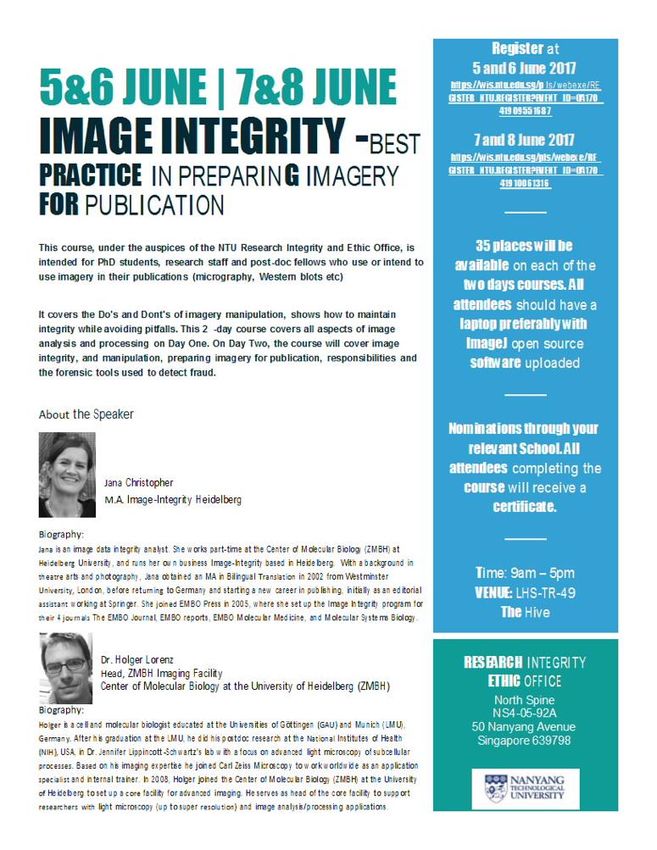
Education and Training • Now becoming a funding agencies requirement • NTU has implemented the Epigeum Research Integrity programme (five tracks: biomedical sciences, natural sciences, engineering, social sciences and arts & humanities) • All research students and research staff have to take the course and be certified • This has to be followed up in Schools & Institutes with mentoring and further education (possible RIPOC responsibility) • Now a requirement for all Faculty to take a course and be certified– new Epigeum Concise • All certifications (RI, IRB and IACUC) are valid for 3 years after which renewal is required
Need for
 specialist
  training

 Course on
  Imagery
Manipulation
Data Management Now a Major Issue
• Becoming increasingly important with open access, archiving and
data mining and IP protection as well as good practice
• Hard copy notebooks in place
• Moving towards electronic systems:
Data Management Plans to be put in place and archived at
start of research projects
Electronic research notebooks
Email thread archivingNew Grant Condition on research integrity in Singapore – now common to all funding agencies • Each Investigator shall use his/her best endeavours to…….carry out……….consistent with internationally recognised good research practices and ethical standards. Each Institution shall ensure that the Research Personnel..….undertake and properly discharge the foregoing obligations. • The Host Institution should be responsible for ensuring that the Investigators adopt the highest achievable standards, exhibit impeccable integrity and follow all prevailing guidelines on good research practices in Singapore (or internationally established guidelines, where applicable) in the conduct of the Research; • ensuring, where applicable, that local IRB, research ethics committee and multi-centre research ethics committee approvals are granted for the Research and that no research requiring such approval is initiated before it has been granted
New Challenges (1)
• Increasing collaborative research (in Singapore, internationally and with the private sector)

• Funding agencies now imposing RI grant conditions

• Changing and more stringent legislative background e.g. Human Biomedical Research Act (HBRA)

• NRF (and other funding agencies?) seeking grant repayment with proven misconduct cases

• Need to ‘vet’ all external application for plagiarism and other problems

• Need to work more closely with NUS, A*STAR and other universities to create a common Singapore approach
New Challenges (2)
• Ensuring best Authorship practice (Vancouver Protocol & ICMJE)

• All authors are responsible and only those who have made
  ‘significant’ intellectual inputs should be co-athors

• Some people are publishing papers every one or two weeks – this
  has to change

• One substantial paper is better than many insignificant ‘notes’

• Need to solve data issues across the university – already have a
  DMP and a DR-NTU system in place: Large costs & use need to be
  considered
New Challenges (3)

 • Better training for all (both general and specialist)

 • Mentoring the mentors

 • Mentors have to take responsibility for inculcating best practice in their mentees –
   no ‘contracts’ with students to write papers

 • Possible under-reporting of incidents/cases at School/Institute level to the centre

 • Contract cheating on PhD theses is starting to appear across the Globe
New Challenges (4) - Compliance
 • Compliance is a Board of Trustees Priority

 • For Human Subjects Research (IRB) compliance is part of the
   HBRA Regulations

 • Compliance checks are required when working with animals

 • Starting point will be the Data Management Plan
Are men more likely to commit scientific fraud?
        Males Are Overrepresented among Life Science Researchers
                    Committing Scientific Misconduct
               by Ferric C Fanga, Joan W Bennettb and Arturo Casadevallc

University of Washington, School of Medicine, Seattle, Washington, USAa;
Department of Plant Biology and Pathology, Rutgers University, New Jersey, USAb;
Departments of Microbiology & Immunology and Medicine, Albert Einstein College of Medicine, New York, USAc

                                                                                   mBio 4(1):e00640-12. doi:10.1128/mBio.00640-12.

  Study based on an analysis of 228 US Office of Research Integrity (ORI) ORI reports between 1994 and 2013
Are men more likely to commit scientific fraud? “…it may be tempting to explain the preponderance of male fraud in terms of various evolutionary theories about Y chromosome-driven competitiveness and aggressiveness.” But such “simplistic generalisations” have a lot of pitfalls, Fang and colleagues write, and in any case: “We cannot exclude the possibility that females commit research misconduct as frequently as males but are less likely to be detected.” Still, the authors note: “…men are more likely to engage in risky behaviours than women and that crime rates for men are higher than those for women.”
Singapore Statement on Research Integrity
                                     Principles:
                                     • Honesty in all aspects of research
                                     • Accountability in the conduct of research
                                     • Professional courtesy and fairness in working with others
                                     • Good stewardship of research on behalf of others

1. Integrity: Researchers should take responsibility for the trustworthiness of their research.
2. Adherence to Regulations: Researchers should be aware of and adhere to regulations and policies related to research.
3. Research Methods: Researchers should employ appropriate research methods, base conclusions on critical analysis of the evidence and report
findings and interpretations fully and objectively.
4. Research Records: Researchers should keep clear, accurate records of all research in ways that will allow verification and replication of their
work by others.
5. Research Findings: Researchers should share data and findings openly and promptly, as soon as they have had an opportunity to establish
priority and ownership claims.
6. Authorship: Researchers should take responsibility for their contributions to all publications, funding applications, reports and other
representations of their research. Lists of authors should include all those and only those who meet applicable authorship criteria.
7. Publication Acknowledgement: Researchers should acknowledge in publications the names and roles of those who made significant
contributions to the research, including writers, funders, sponsors, and others, but do not meet authorship criteria.

                                              2nd World Conference on Research Integrity 2010
Singapore Statement on Research Integrity
8. Peer Review: Researchers should provide fair, prompt and rigorous evaluations and respect confidentiality when reviewing others' work.
9. Conflict of Interest: Researchers should disclose financial and other conflicts of interest that could compromise the trustworthiness of
their work in research proposals, publications and public communications as well as in all review activities.
10. Public Communication: Researchers should limit professional comments to their recognized expertise when engaged in public
discussions about the application and importance of research findings and clearly distinguish professional comments from opinions based
on personal views.
11. Reporting Irresponsible Research Practices: Researchers should report to the appropriate authorities any suspected research
misconduct, including fabrication, falsification or plagiarism, and other irresponsible research practices that undermine the trustworthiness
of research, such as carelessness, improperly listing authors, failing to report conflicting data, or the use of misleading analytical methods.
12. Responding to Irresponsible Research Practices: Research institutions, as well as journals, professional organizations and agencies that
have commitments to research, should have procedures for responding to allegations of misconduct and other irresponsible research
practices and for protecting those who report such behaviour in good faith. When misconduct or other irresponsible research practice is
confirmed, appropriate actions should be taken promptly, including correcting the research record.
13. Research Environments: Research institutions should create and sustain environments that encourage integrity through education,
clear policies, and reasonable standards for advancement, while fostering work environments that support research integrity.
14. Societal Considerations: Researchers and research institutions should recognize that they have an ethical obligation to weigh societal
benefits against risks inherent in their work.
2nd World Conference on Research Integrity 2010Research Integrity – a Singapore Approach
Workshop jointly organised by NTU, A*STAR and NUS with involvement of SUTD, SMU and others with MOE, NRF etc -350 participants attended on 22
November 2016
Key Principles of Joint NTU, NUS, SUTD and A*STAR Statement
• Leadership: Senior research personnel must lead by example in upholding the highest standards and provide
active oversight and management of the research work that goes into publication.
• Honesty: Research personnel must ensure consistency in data that are represented in the publication and
prevent inappropriate or fraudulent data manipulation.
• Reproducibility: Research personnel must maintain accurate and detailed research records of procedures and
results (for a minimum of 10 years), to allow others to replicate the work, and ensure reproducibility of one’s
experimental results.
• Citation: Research personnel must provide appropriate citation for all usage of text, data or figures from other
publications, sources or individuals, including from one’s previous publications. Plagiarism, including self-
plagiarism, is unacceptable.
• Acknowledgement: Research personnel must appropriately recognize individuals who have contributed to their
publications. Individuals and organisations who have contributed to the publication must be acknowledged, and
those who have provided substantial intellectual contribution, and/or who have participated in the drafting of the
publication, should be recognized as authors.
• Reporting: Research personnel must be proactive in reporting suspicious practices that do not meet these key
principles to their respective institutions.
We are committed to adopting the highest standards of research and publication ethics and standards at all times.
Any breach of these principles will be dealt with by the respective institutions’ disciplinary procedures. Respective
institutions may require records to be kept for a period longer than 10 years to fulfil other requirements at their
discretion.Research Integrity – a Singapore Approach
Second Meeting 2018
• Theme: Reproducibility
• Keynote Speaker: Dr Philip Campbell Editor in Chief Nature
• Intention is to have an ‘All’ Singapore meeting including all relevant
institutions, agencies and industry
• Likely Date: 23 or 24 October 2018No university or institution
can be immune to research misconduct and poor
practice
We all need to commit to promoting Good Research
Practice
WE CAN ALL LEARN FROM EACH OTHER!谢谢!
Thank You!
Vielen Dank! Merci!
Diolch!
Terima kasih !
ありがとうございます!You can also read


