Resettlement Plan Cao Bang Province
←
→
Page content transcription
If your browser does not render page correctly, please read the page content below
TRANSPORT CONNECTION
            IN NORTHERN MOUNTAINOUS PROVINCES PROJECT

Resettlement Plan
Cao Bang Province

Project Number : TA7245-VIE
April 2011 (FINAL DRAFT)
PPTA 7245-VIE: Transport Connection in Northern Mountainous Provinces Project
Resettlement Plan
CURRENCY EQUIVALENTS
(As of March 2011)
Currency Unit = Dong (VND)
$1.00 = VND 20,900
ABBREVIATIONS
ADB = Asian Development Bank
CARB = Compensation, Assistance and Resettlement Board
CPC = Commune People’s Committee
DARD = Department of Agriculture and Rural Development
DP = Displaced Person
DOF = Department of Finance
DONRE = Department of Natural Resources and Environment
DPC = District People’s Committee
FHH = Female-headed household
GOV = Government of Viet Nam
HH = Household
IMO = Independent Monitoring Organization
IOL = Inventory of Losses
LMO = Land Management Organizations
LURC = Land Use Rights Certificate
MARD = Ministry of Agriculture and Rural Development
MOLISA = Ministry of Labour, Invalids and Social Assistance
NGO = Non-government Organization
PDOT = Provincial Department of Transport
PPC = Provincial People’s Committee
PPMU = Provincial Project Management Unit
RCS = Replacement Cost Study
ROW Right of Way
RP = Resettlement Plan
RT = Resettlement Taskforce
SC = Steering Committee
Cao Bang Province Page iiPPTA 7245-VIE: Transport Connection in Northern Mountainous Provinces Project
Resettlement Plan
GLOSSARY
Assistance Means additional support provided to DPs losing assets (particularly
productive assets), incomes, employment or sources of living, to supplement
payment of compensation for acquired assets, in order to achieve, at a
minimum, full restoration of living standards and quality of life.
Cut-off date Means the date prior to which the occupation or use of any part of the
project area makes residents or occupiers or users of the same eligible to be
recognized as DPs. In this Project, the cut-off date coincides with the
completion of the inventory of losses survey.
Detailed Means the finalization and/or validation of the results of the inventory of
Measurement losses (IOL), severity of impacts, and list of DPs. The final cost of
Survey (DMS) compensation, assistance and resettlement is determined following
completion of the DMS. The DMS will be done by different Compensation,
Assistance and Resettlement Board in the phase of RP implementation once the
benchmarks of the project site demarcation are put on the ground.
Displaced Person Displaced Persons in a project area could be of three types:
(DP) (i) persons with land use rights to land lost in its entirely or in part;
(referred to as (ii) persons who lost the land they occupy in its entirely or in part
“Affected Persons” who have no land use rights to such land, but who have claims
as per Government to such lands that are recognized or recognizable under
law) national laws; and
(iii) person who lost the land they occupy in its entirely or in part
who have neither land use rights nor recognized or recognizable
claims to such land.
The involuntary resettlement apply to all three types of displaced persons
Livelihood Means the re-establishment or improve of sources of income and livelihood
restoration of relevant DPs through the RP policy and its implementation.
Inventory of Losses Means the process of identification, location, measurement and valuation of
(IOL) replacement cost of all fixed assets that will be recovered or adversely
affected by or as a result of the project. These include, (without limitation or
being an exhaustive list) lands used for residence, commerce, agriculture,
ponds; dwelling units, stalls and shops, other structures, such as fences,
tombs, wells; trees with commercial value, sources of income and livelihood.
It also includes the assessment of the severity of the impact of land and
property on the affected assets and the severity of impact to the livelihood
and productive capacity of DPs. IOL is carried in the phase of RP
preparation.
Land recovery (also Means the processes by which all or part of land and property owned,
referred to land possess, occupies or uses, are compulsorily recovered or otherwise
acquisition) acquired from an individual, household, firm or private institution by the
State or are acquired by agreement. Decision on land recovery will be done
through two steps (i) Decision at the provincial or city for the whole project
areas and subsequently (ii) Decision by the district to each individual.
Resettlement or Means the physical relocation of an DP from the DP’s pre-project place of
Relocation residence and/or business.
Replacement Cost Means the amount calculated before displacement which is needed to
replace an affected asset without deductions for taxes, and/or costs of
transaction as follows:
(i) Productive land (Agricultural, fishpond, garden, forest) based on market
prices that reflect recent land sales of comparable land in the district and
other nearby areas, and in the absence of such recent sales, based on
Cao Bang Province Page iiiPPTA 7245-VIE: Transport Connection in Northern Mountainous Provinces Project
Resettlement Plan
productive value;
(ii) Residential land based on market prices that reflect recent sales of
comparable houses and residential land in the district and other nearby
areas, and in the absence of such recent land sales, based on sales in other
locations with similar attributes;
(iii) Houses and other related structures based on current market prices of
materials and labor without depreciation nor deductions for salvaged
building materials;
(iv) Standing crops equivalent current market value of the crop at the time of
compensation;
(v) Perennial crops and trees, cash compensation equivalent to current
market value given the type, age and productive value (future production) at
the time of compensation.
(vi) Timber trees, the price that would currently be paid for the tress on the
nearest market based on the diameter of each tree at breast height.
Replacement Cost Means the process involved in determining the replacement cost of land,
Study houses and other affected assets based on surveys by qualified appraisers
or assessors.
Vulnerable People Means individuals or distinct groups of people who might suffer
disproportionately or face the risk of being further marginalized by the
effects of land and property recovery or resettlement and specifically
includes: (i) female headed households with dependents (ii) households with
disabled persons, (iii) households falling under the current MOLISA
benchmark poverty line, (iv) children and elderly households who are with
no other means of support, (v) landless households, and (vi) non-integrated
and vulnerable ethnic minorities.
Cao Bang Province Page ivPPTA 7245-VIE: Transport Connection in Northern Mountainous Provinces Project
Resettlement Plan
TABLE OF CONTENTS
EXECUTIVE SUMMARY I
A. Background 1
B. The Cao Bang Subproject Description 1
II. SCOPE OF LAND ACQUISITION AND RESETTLEMENT 2
A. Inventory of Losses (IOL) 2
B. Affected Households 2
C. Affected Land and Non-Land Assets 2
III. SOCIO-ECONOMIC INFORMATION 3
A. Socio-Economic Profile of Subproject Area 3
B. Socio-Economic Profile of Affected Households 3
IV. INFORMATION DISCLOSURE, CONSULTATION AND PARTICIPATION 4
A. Consultations 4
B. Information Disclosure 5
V. GRIEVANCE REDRESS MECHANISM 5
VI. POLICY FRAMEWORK AND ENTITLEMENTS 6
A. Legal Framework 6
B. Reconciliation of Government and ADB Policy on Resettlement 7
VII. PROJECT OBJECTIVES AND ENTITLEMENTS 9
A. Objectives 9
B. Project Entitlements 10
VIII. RESETTLEMENT BUDGET AND FINANCING PLAN 12
A. Source of Resettlement Funds 12
B. Replacement Cost Survey 12
C. Resettlement Costs 13
IX. INSTITUTIONAL ARRANGEMENTS 14
A. Cao Bang Provincial People’s Committee 14
B. Provincial Project Management Unit (PPMU) of PDOT 14
C. District Compensation and Resettlement Board 14
D. Commune Peoples Committee 15
X. IMPLEMENTATION SCHEDULE 15
XI. MONITORING AND REPORTING 16
APPENDIX 1: IOL FORM 17
APPENDIX 2: MINUTES OF COMMUNITY CONSULTATION MEETING 22
APPENDIX 3: LIST OF APS AND AFFECTED ASSETS 23
APPENDIX 4: ADB ACCOUNTABILITY MECHANISM 24
LIST OF FIGURES
Figure 1:Class V Road Cross Section .............................................................................................1
Cao Bang Province Page vPPTA 7245-VIE: Transport Connection in Northern Mountainous Provinces Project
Resettlement Plan
LIST OF TABLES
Table 1: Detailed Road Descriptions 1
Table 2. Number of Affected Households 2
Table 3. Scope of Land Acquisition 2
Table 5 : Public Consultation Conducted Error! Bookmark not defined.
Table 6 : Summary of Perceived Benefits and Adverse Effects of Road Project 4
Table 7: Gaps Between National Laws and ADB Policy 7
Table 8: Entitlement Matrix of the Project 10
Table 9: Summary of Replacement Cost Survey (VND/m2) 13
Table 10: Summary of Compensation and Allowance 13
Table 11: Resettlement Implementation Schedule 15
Cao Bang Province Page viPPTA 7245-VIE: Transport Connection in Northern Mountainous Provinces Project
Resettlement Plan
EXECUTIVE SUMMARY
1. Project. This Resettlement Plan (RP) is developed for the Transport Connection in
Northern Mountainous Provinces Project. For Cao Bang Province, the Project will improve Road
202 with a total length of 30.2 km. The road will be upgraded to Class V with a carriageway of 3.5
meters (m) width and an embankment width of 6.5 m.
2. The RP was prepared based on available design during the Project Preparation
Technical Assistance (PPTA) During loan implementation, following the completion of detailed
design, detailed measurement survey (DMS) will be undertaken to determine the households and
organizations who will be affected, actual impacts on their land and assets. Consultation
meetings will be undertaken with the affected people. The Updated RP will be disclosed to the
affected people, submitted to ADB for review and concurrence. Once the Updated RP has been
agreed between ADB and PPC, PPC can commence implementation of the Updated RP.
3. Scope of Resettlement Impacts. The impacts are not significant. Per results of the IOL
carried out in August 2010, a total of 77households (HHs) will be affected by the project in which
(i) 27 HHs affected with agricultural land; (iii) 33 HHs affected with garden land and, 18 HHs
affected with forest land. All households are marginally affected as loss of land is between (1 to 9
%) of their total landholdings. There is no case of relocation.
4. Socio-Economic Conditions. Affected households are mostly Dao, followed by Nung
and Tay ethnic minority groups. Based on the socio-economic survey, there are 15 households
who are classified as poor households while another three households are headed by women.
5. Consultation, Information Disclosure and Grievance Redress. In the preparation of
this Resettlement Plan, consultation meetings were held, for each of the subproject roads.
Representatives of communal leader, village leader, local NGOs and DPs, with 15 participants
attended the meeting. A grievance redress mechanism has also been established. The RPs will
also be disclosed in all affected communes and a PIB will be distributed to all APs.
6. Government’s Legal Framework, ADB Safeguard Policy Statement, and Project
Objectives. The Project’s objectives and principles are based on the laws and regulations of the
Government of Viet Nam (GOV) and the ADB’s Safeguard Policy Statement (2009). The overall
objective of the policy is to ensure that all people affected by the subproject are able to maintain
and, preferably, improve their pre-subproject living standards and income-earning capacity from
compensation and life rehabilitation assistance for the loss of movable and immovable assets.
7. Cut-off date. The subproject cut off date was the date of completing inventory of losses,
which was August 25th 2010. Hence, all cases arising after this date will not be identified as the
project’s DPs.
8. Project Entitlements. The project entitlements developed and presented in the
entitlement matrix correspond to the impacts identified during the IOL. Compensation will be
based on the principle of replacement cost. Types of assistance will be provided to households
based on the severity of impacts and their vulnerability to hardship. It should be noted that the
entitlements in the RP can not be downgraded but can be enhanced, as necessary
9. Resettlement Budget. The RP Cost Estimates is VND 3,725,0000 (178,200 USD).
Cost of land acquisition, payment for non-land assets, assistance, administration and
contingency costs will be funded by the provincial government.
10. Institutional Arrangement. The PPC and District Compensation and Resettlement
Board will be responsible in the updating, implementation and monitoring of the resettlement
plan. A team of international and national consultants from the Project Coordination Consultant
will provide support and guidance on all resettlement-related activities.
11. Implementation Schedule. PPC will submit the Updated RP based on detailed design
to ADB for ADB review and concurrence prior to resettlement implementation. Compensation
and clearance of land will not commence until the Updated RP has been agreed between the
PPCs and ADB and that provisions in the agreed Updated RP has been satisfactorily
implemented.
Cao Bang Province Page iPPTA 7245-VIE: Transport Connection in Northern Mountainous Provinces Project
Resettlement Plan
12. PPC, through PPMU, will not issue a site possession notice to the Works contract to
commence construction activities for a specific section, until the head of the district resettlement
committee (or board) has officially confirmed in writing that (i) payment and assistance has been
fully provided to the affected persons and rehabilitation measures are in place for that specific
section as per the respective RP; (ii) already compensated displaced persons for that specific
section have been cleared from the area in a timely manner; and (iii) that the specific section of
the project is free from any encumbrances.
Table ES-1: Indicative Implementation Schedule
Main Resettlement Plan Activities Implementation Schedule
Preparation of Resettlement Plan (PPTA)
RP Preparation (IOL, consultation, RCS) Sep, 2009, Jul-Aug 2010
Disclosure of Draft RP to Affected People April 11
PPC submission to ADB for review and concurrence April 2011
Uploading of RP on ADB website May 2011
Updating of Resettlement Plan (Loan Implementation)
Establishment of the District Compensation Board July,2012
Land clearance/boundary setting for the Project July,2012
Training for resettlement staff. July,2012
Consultation with the Affected Households July-Aug ,2012
Conduct of Replacement Cost Survey by a Qualified Appraiser July-Aug ,2012
Detailed Measurement Survey. Jul-Aug,2012
Disclosure of Updated RP to the Affected People Aug 2012
Submission of Updated RP to ADB for review and concurrence Sep, 2012
ADB issues concurrence of Updated RP Sep 2012
Award of Civil Works Contract Sep 2012
Implement Updated Resettlement Plan
Compensation payments Oct-Nov 2012
Implement rehabilitation measures Oct-Nov 2012
Clearance of acquired land Dec 2012
DCARB to issue letter of confirmation that RP has been
Dec 2012
satisfactorily implemented
PPC, through PPMU, to issue Notice of Site Possession to civil
Dec 2012
works contractor
Start of Civil Works Construction Dec 2012- Onwards
Monitoring (from RP updating to civl works construction) July 2011 -onwards
13. Monitoring. Resettlement activities will be monitored by PPC and CARB. The PPMU
will provide guidance and advise as required. No external monitoring organization (EMO) wil be
hired as the impacts are not significant.
Cao Bang Province Page iiPPTA 7245-VIE: Transport Connection in Northern Mountainous Provinces Project
Resettlement Plan
I. PROJECT DESCRIPTION
A. Background
1. The Asian Development Bank (ADB) is funding the Technical Assistance (TA) of the
Transport Connection in Northern Mountainous Provinces Project to help Viet Nam Government
implement its poverty reduction and road improvement programs. The project zone includes 06
provinces in the North of Viet Nam, namely: Bac Kan, Cao Bang, Ha Giang, Tuyen Quang, Lao Cai
and Yen Bai.
2. These provinces have high rate of poverty and ethnic minority population. The road network
consists predominantly of unpaved, narrow roads. Many sections are impassable during the rainy
season. Travel time and cost from mountainous remote areas to social infrastructure will be reduced,
and the economic activities along the roads will be enhanced.
B. The Cao Bang Subproject Description
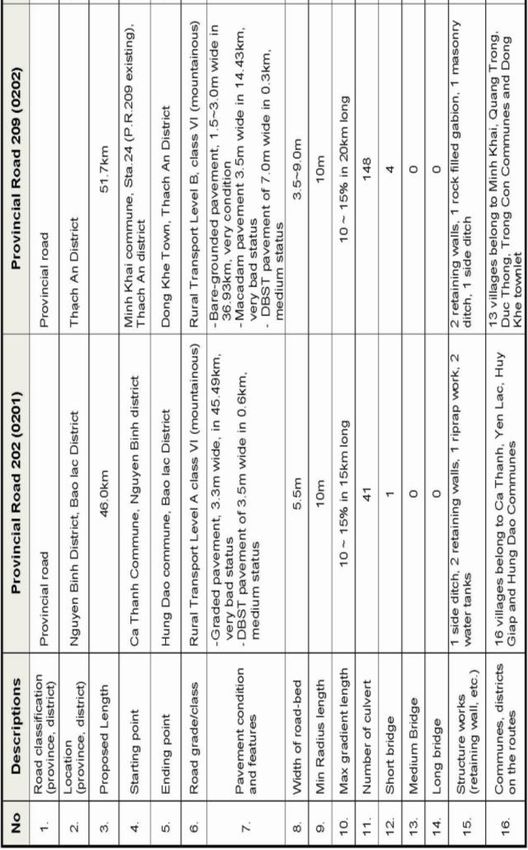
3. For Cao Bang Province, the Project will improve Road 202 (Subproject 0201) with a length of
30.2 km: located in Ca Thanh, Yen Lac and Vu Nong communes of Nguyen Binh District; and Hung
Dao, Huy Giap and Dinh Phung communes of Bao Lac District. The road will be upgraded to Class
V with a carriageway of 3.5 meters (m) width and an embankment width of 6.5 m (see Figure 1).
Figure 1:Class V Road Cross Section
Table 1: Detailed Road Descriptions1
1
The initial project scope included 2 roads; however, the project scope was reduced in March 2011 to 1 road (Road
202). Road 209 has been removed.
Cao Bang Province Page 1PPTA 7245-VIE: Transport Connection in Northern Mountainous Provinces Project
Resettlement Plan
II. SCOPE OF LAND ACQUISITION AND RESETTLEMENT
A. Inventory of Losses (IOL)
4. During design implementation, PPTA Consultants in cooperation with Cao Bang PPMU, local
commune authorities carried out Inventory of Losses (IOL) for all affected land, assets, trees in the
project area. The following summarizes the IOL process and related procedures:
(i) Preparation of the IOL for affected assets in the project area in Sep 2009 and updated in
August, 2010.
(ii) Conducted community meetings with various stakeholders (medical station, local NGOs
and households whose houses are located along the road sides) in order to notify them about
the dates and procedures of the IOL.
5. The survey form used for the IOL is presented in Appendix 1. The Minutes of Community
Consultation Meetings in Appendix 2 and the list of HHs with their affected land/assets in Appendix 3.
B. Affected Households
6. Per results of the IOL, carried out in August 2010, a total of 77 households (HHs) stand to
lose part ot their residential, agricultural, garden and forest land and various fixed assets with the
construction of the project roads. Among the 77 affected households (AHs): (i) 72 HHs will be
affected through loss of residential land; (ii) 27 HHs affected with agricultural land; (iii) 33 HHs
affected with garden land and, 18 HHs affected with forest land, (See Table 2 )
7. All AHs are partially and marginally affected and there is no case of relocation nor loss of
shop or business.
Table 2. Number of Affected Households
2
Number of Households
Routes
Res. Agri. Garden Forest. Total
Road 202 48 27 33 18 77
8. The IOL data on land acquisition are preliminary. A more reliable determination of impacts will
be carried out during the DMS. Detailed provision of land/asset impacts are shown below.
C. Affected Land and Non-Land Assets
9. Land. Total land to be acquired is 209,122 m2. Total affected forest land is 201,272 m2,
accounting for 96,2% of the total land acquisition. The proposed roads are located mainly in
mountainous area dominated by forestry land. All DPs are legal land users. Forestry land belongs to
both private and public owners. Private HHs are losing an average of 232 m2 of forestry land. Private
HH usually own several hectares (between 3.0 to 5.0 has) of forestry land in the project area.
Average agricultural landholding in the area is 500 to 600 m2 in several plots.
Table 3. Scope of Land Acquisition
2
Land Area for Acquisition (m )
Routes
Res. Agri. Garden Forest. Total
Road 202 1,971 2,940 2,939 201,272 209,122
10. Secondary Structures. There are no houses affected by the road improvement. A few
secondary structure such as breeding structures (14 m2) will be affected. For households losing
residential land, a part of their concrete yard (2,998 m2) will be affected.
2
An AP might be affected various kinds of land including residential land, agricultural land and forest land, so sum up
numbers of the affected household could not equal to actual APs numbers mentioned in Column Total.
Cao Bang Province Page 2PPTA 7245-VIE: Transport Connection in Northern Mountainous Provinces Project
Resettlement Plan
11. Crops and Trees. Almost all 77 DPs affected through loss of land, will also lose trees/crops:
19,542 timbers, 155 fruit-trees and 2,940 m2 of paddy rice and maize field.
III. SOCIO-ECONOMIC INFORMATION
A. Socio-Economic Profile of Subproject Area
12. Cao Bang is a mountainous province in the northeast of Vietnam. The national poverty line is
established by Ministry of Labour, Invalids and Social Assistance (MOLISA). For the period from 2006
to 2010; the rural poverty line is VND 200,000/person/month while the urban poverty line is VND
260,000/person/month. The incidence of poverty in Cao Bang province in 2008 was 39.2% (new
standard).
13. Ethnic groups in the province accounts for 95% of the total population. Ethnic composition
includes Tay (41.9%), Nung (32.9%), H’mong (8.3%) and Dao (4.5%). Kinh accounts for 4.6% of the
total population.
B. Socio-Economic Profile of Affected Households
14. The socio-economic survey (SES) was conducted among 51%3 of the total number of DPs
which corresponds to 59 households (270 persons). The respondents, heads of households, stated
that they all went to school and reached high school level.
15. Population and Household Size. Among the 59 surveyed HH, there are 133 are males And
137 females. The average HH size is 4.6 persons/HH.
16. Age Distribution. Regarding the age distribution of the surveyed population, there are about
36.5% (74 persons) between 21 and 60 years old; 50.8% (103) above 20 years old and 12.8% (26)
are those who are 60 years old and above.
17. Ethnic Groups. Among the 59 surveyed HH, all belongs to an ethnic group, mainly Dao (48
HHs), followed by Nung (10 HHs) and Tay (1 HH).
18. Poor and Vulnerable Households. There are 10 households classified as poor households
by the commune following MOLISA poverty criteria. There are no household with disabled persons,
invalids, elderly people without support or war heroes (“policy” households).
19. Households headed by women. The SES found three households headed by women.
20. Income Sources. The main primary source of income of most households is agriculture with
nearly 85.1%. The main crops planted are rice, maize and peanuts. Additional sources of income are
livestock (cows, buffalos), poultry (chicken and ducks) and pig rearing. Business activities accounts
for 13.4% of the main source of income of DPs. It is worth noting that income from women represents
47% of the total income of household. Average income of households is about 1,400,000 VND per
month.
21. Houses and Basic Facilities. Most of the houses are built with permanent materials. All HHs
are connected to the state power network; electricity is used mainly for lightning. Wood or gas are
generally used for cooking.
22. Water and Sanitation. Piped water is not available in the Project area. All HH still use water
from stream and pond. Most of the households surveyed (97%) do not have toilet. Only 2% have in-
house toilet.
3
Rehabilitation of Road 202 has been reduced from 46 km to 30.2 km in March 2011. The total number of affected HH
was first 116.; It has been reduced to 77. The SES was conducted among the 116 affected HH at tte time of the
survey.
Cao Bang Province Page 3PPTA 7245-VIE: Transport Connection in Northern Mountainous Provinces Project
Resettlement Plan
IV. INFORMATION DISCLOSURE, CONSULTATION AND PARTICIPATION
23. Disclosure of information and consultations are conducted during preparation and
implementation of subprojects to ensure that DPs and other stakeholders have timely information
about land acquisition, compensation and resettlement, as well as opportunities to participate in and
express their preferences and concerns regarding the resettlement program. from the commune,
ward and/or village authorities organized meetings and consultation and disseminated information to
ensure that the DPs are well informed and consulted as early as project preparation.
A. Consultations
24. Consultation and information dissemination has been an integral component of the RP
preparation. During the preparation of this RP, significant information dissemination and consultation
with primary stakeholders has been undertaken, through IOL, village level meetings, sample
household surveys, and meetings with other key stakeholders.
25. Two Resettlement Workshops, attended by representatives from the 6 PDOTs, were held in
Lao Cai on October 27th 2009 and in Hanoi on December 7th 2009. The workshops consisted of the
following presentation: Project’s components; ADB Requirements prior to Appraisal and Loan
Negotiation; GOV’s laws and procedures on land acquisition; ADB’s Safeguard Policy Statement;
Project’s Policy Framework and Entitlements; Project Impacts and Entitlements for each type of
impact; Proposed Resettlement Strategies; Preparation of Resettlement Plan; Budget Costs and
Tentative Implementation Schedule. The workshop also allowed the participants to share their opinion
and suggestions in order to improve the preparation and implementation of the Resettlement Plan.
26. In the preparation of Resettlement Plan, the PPTA Social Safeguard Consultants, Cao Bang
PPMU coordinated with the commune local authorities in subproject areas to hold consultation
meetings for each of the project roads. In Road 202, a meeting at the commune level was held on 28
August 2010 and 15 representatives from the households attended the meeting. During the IOL
survey, all HHs were also informed about the proposed project by the survey team. A project map has
also been posted at the commune People's committee billboard, by PPMU and social consultant
27. The purpose of the meeting was to provide information to and consult with DPs and other
stakeholders regarding: (i) project information; (ii) the scope and objectives of the subproject based
on preliminary design; (iii) the policies, principles, entitlement and procedures for land acquisition,
compensation and resettlement; (iv) implementation schedule and, (iii) preliminary estimates of land
acquisition requirements and grievance redress.
28. All participants agreed with the project implementation and the proposed policy for the project.
They expect that the project will be implemented soon so that local people have better opportunity in
economic and social development for communes in the area. Other discussion on the subproject’s
Perceived Benefits and Adverse Effects are provided in Table 6.
Table 4 : Summary of Perceived Benefits and Adverse Effects of Road Project
Benefits Adverse Effects
1. Improved roads will provide safer traffic condition 1. Number of traffic accidents may increase.
for local people. 2. Number of social evils may increase. Improved roads
2. People will have better access to schools by will provide easier access for outsiders who may bring
making roads easier to navigate specially during with them vices such as drug addiction and
rainy season. Easier and safer for children to go to prostitution, trafficking of women and children and
school. spread of communicable diseases.
3. Better transportation contributes in promoting 3. Disruption in daily living of people during construction
product exchanges and trading activities and period like their mobility in going to school and
facilitates the movement of products from source to market.
markets. 4. Households who will be directly affected in terms of
4. Improved roads and transportation will help improve their houses and livelihood are concerned that they
the standard of living of local people. will not be paid on time nor given assistance for
5. The people within the project area can earn repairing their houses or relocating.
additional income from jobs in construction work
Cao Bang Province Page 4PPTA 7245-VIE: Transport Connection in Northern Mountainous Provinces Project
Resettlement Plan
Benefits Adverse Effects
and for providing lodging and food to Contractors
and construction workers coming from outside.
6. The people can benefit from livelihood and crop
production training, awareness rising which are
proposed to be conducted during the project
implementation.
29. In addition, the participants also suggested that they should participate in the project
implementation: (i) during the resettlement implementation, the DPs should be informed, consulted
prior to compensation implementation, and they should be represented as a member in the CARB,
which will participate in implementation of DMS, pricing, and payment process; (ii) during the road
construction, the Contractor should mobilize local people to work as laborers in construction work,
and (iii) they are willing to work in Operation and Maintenance (O&M).
30. During loan implementation, households will continuously be informed and consulted
specifically on the project schedule and activities. Results of the DMS, entitlements and value of
assets will also be disclosed to the DPs. Suggestions from women and other vulnerable households
specific to mitigating impacts or addressing impacts will be carefully taken into account. During RP
updating, separate meetings will be held with women. There will be also announcements during market
days.
31. The updated Resettlement Plan (Draft and approved) will be prepared following the Detailed
Design and disseminated to the affected communities and uploaded on the ADB’s website.
B. Information Disclosure
32. Key information in the draft RP will be disclosed to the DPs through the distribution of public
information booklets in Vietnamese language during market days prior to ADB Management Review
Meeting or before ADB follow-up mission. Disclosure to the DPs will be done prior to submission of
draft RP to ADB. The draft RP and the RP agreed between ADB and Government will be uploaded
on the ADB website.
33. Public Information Booklet. A public information booklet has been prepared (see Annex 5).
V. GRIEVANCE REDRESS MECHANISM
34. Grievances related to any aspect of the Project will be handled through negotiation aimed at
achieving consensus. Complaints will pass through 3 stages before they could be elevated to a court
of law as a last resort.
35. First Stage, Commune People’s Committee. An aggrieved affected household may bring
his/her complaint before any member of the Commune People’s Committee, either through the Village
Chief or directly to the CPC, in writing or verbally. It is incumbent upon said member of CPC or the
village chief to notify the CPC about the complaint. The CPC will meet personally with the aggrieved
affected household and will have 30-45 days following the lodging of the complaint to resolve it (Note:
in remote and mountainous areas, the complaint should be resolved within 45-60 days. The CPC
secretariat is responsible for documenting and keeping file of all complaints that it handles.
36. Upon issuance of decision of CPC, the household can make an appeal within 30 days. If the
second decision has been issued and the household is still not satisfied with the decision, the
household can elevate his/her complaint to the DPC.
37. Second Stage, District People’s Committee. Upon receipt of complaint from the
household, the DPC will have 30-45 days (or 45-60 days if it is in remote or mountainous areas)
following the lodging of the complaint to resolve the case. The DPC is responsible for documenting
and keeping file of all complaints that it handles.
38. Upon issuance of decision of DPC, the household can make an appeal within 30 days. If the
second decision has been issued and the household is still not satisfied with the decision, the
household can elevate his/her complaint to the PPC.
Cao Bang Province Page 5PPTA 7245-VIE: Transport Connection in Northern Mountainous Provinces Project
Resettlement Plan
39. Third Stage, Provincial People’s Committee. Upon receipt of complaint from the
household, the PPC will have 30-45 days (or 45-60 days if it is in remote or mountainous areas)
following the lodging of the complaint to resolve the case. The PPC is responsible for documenting
and keeping file of all complaints that reaches the same.
40. Upon issuance of decision of PPC, the household can make an appeal within 30 days. If the
second decision has been issued and the household is still not satisfied with the decision, the
household can elevate his/her complaint to the court within 45 days. PPC will then deposit the
compensation payment in an escrow account.
41. Final Stage, the Court of Law Arbitrates. Should the complainant file his/her case to the
court and the court rule in favor of the complainant, then PMU-MT will have to increase the
compensation at a level to be decided by the court. In case the court will rule in favor of PPC, then the
amount deposited with the court is what the complainant will receive.
42. The DPs will be provided with support and assistance by local based organizations, in case
they have limited capacity in case they have questions or complaints.
43. If efforts to resolve complaints or disputes are still unresolved and unsatisfactory following the
project’s grievance redress mechanism, the households have the right to send their concerns or
problems directly to ADB’s Operations Department, i.e., Transport and Communications Division,
Southeast Asia Department (SERD) or through ADB Viet Nam Resident Mission. If the households
are still not satisfied with the responses of SERD, they can directly contact the ADB's Office of the
Special Project Facilitator (OSPF) as outlined in the "Information Guide to the Consultation Phase of
the ADB Accountability Mechanism" (Appendix 4).4
VI. POLICY FRAMEWORK AND ENTITLEMENTS
A. Legal Framework
44. The Resettlement Legal Framework and Entitlements for the Project have been built upon the
laws of the Government of Viet Nam and the ADB Safeguard Policy Statement (2009). However,
provisions and principles adopted in the Resettlement Legal Framework for the project supersede the
provisions of relevant decrees currently in force in Viet Nam wherever a gap exists. The overall
objective of the policy is to ensure that all people affected by the subproject are able to maintain and,
preferably, improve their pre-subproject living standards and income-earning capacity from
compensation and life rehabilitation assistance for the loss of movable and immovable assets.
45. The policy is based on the laws and regulations of the Government of Viet Nam (GOV) of Cao
Bang Province and the ADB. The principal Vietnamese laws and regulations include:
The 2003 Land Law dated 26 November 2003;
Decree 181/2004/ND-CP dated 29/10/2004of the Government guiding the execution of
amended land law 2003;
Decree 197/2004/ND-CP date 03/12/2004 of the Government on compensation,
assistance and resettlement in the event of land recovery by the State;
Decree No. 188/2004/ND-CP dated November 16, 2004 of the Government on methods
of determining land prices and land prices framework;
Circular No. 114/2004/TT-BTC dated November 16, 2004 of Ministry of Finance guiding
the implementation of Decree No. 188/2004/ND-CP of the Government;
Decree No. 17/2006/ND-CP dated January 27, 2006 of the Government amending and
supplementing some articles of the Decree guiding the implementation of the Land Law
and Decree No. 187/2004/ND-CP on the transfer state-owned companies into joint stock
companies.
Decree No. 84/2007/ND-CP dated May 25, 2007 of the Government on additional
regulations on the granting of land use right certificates, land acquisition, implementation
4
The information guide is also available on the ADB’s website: http://adb.org/SPF/default.asp .
Cao Bang Province Page 6PPTA 7245-VIE: Transport Connection in Northern Mountainous Provinces Project
Resettlement Plan
of land use rights, compensation order and procedure, resettlement when the State
recovers land and settle claims about land;
Decree No. 123/2007/ND-CP dated 27 July 2007 amending and supplementing some
articles of Decree No. 188/2004/ND-CP dated 16 November 2004 on methods of
determining land prices and frame land prices;
Decree 69/2009/ND-CP dated August 13, 2009 of the Government of Vietnam regulating
additional planning of land use plan, land prices, land acquisition, compensation,
assistance and resettlement;
Circular 14/2009/TT - BTNMT dated January 10, 2009 by MONRE regulating
compensation, assistance and resettlement procedures and land acquisition, land
allocation, land lease in details;
Decision No. 3336/2009/QD-UBND dated December 31th, 2010 of Cao Bang Province
People's Committee promulgating the compensation policy, assistance and resettlement
when the State recovers land in the province of Cao Bang;
Decision No. 3165/2009/QD-UBND dated 22/12/2009 of the Cao Bang PPC promulgating
the table of land prices in the Cao Bang province in year 2010.
Decision 776/2009/QD-UBND dated April 28, 2009 of Cao Bang PPC regulating the unit
price for housing and other architectural objects when acquired in the Cao Bang province;
Decision No.52/2008/QD-UBND dated January 11, 2008 by Cao Bang PPC promulgating
the unit prices for crop and tree when acquired in the Cao Bang province;
B. Reconciliation of Government and ADB Policy on Resettlement
46. With the promulgation of Decree 197/2004/ND/CP (3/12/2004) and Decree 69/2009/ND-CP
and relevant decrees stated above, the policies and practices of the Government have become more
consistent with ADB’s social safeguards policies. Nonetheless, provisions and principles adopted in
this Resettlement Plan will supersede the provisions of the relevant decrees currently in force in Viet
Nam wherever a gap exists, as provided for under Decree 131/2006/ND-CP (November 2006), which
regulates the management and use of official development assistance.
47. It should also be noted that as per Decree 69/2009, Article 23, it states "Apart from the
support prescribed in Articles 18, 19, 20, 21 and 22 of this Decree, basing themselves on the local
realities, the provincial-level People’s Committee shall decide on other supporting measures to
stabilize life and production of persons who have land recovered; special cases shall be submitted to
the Prime Minister for decision”, therefore, if additional gaps not mentioned below are found during
RP updating, the required assistance or support will be included in the Updated RP.
48. The differences between the Government’s Laws and Decrees and ADB Policy with regard to
resettlement and compensation, and how to address these gaps for this Project are shown in the
table below.
Table 5: Gaps Between National Laws and ADB Policy
Key Issues National Laws ADB Policy Project Policy
Definition of Vulnerable households are Vulnerable groups those (i) female headed
Vulnerable those households living below the poverty line, the households with
groups below the poverty line as set landless, the elderly, dependents (ii) households
by MOLISA and social policy women and children, and with disabled persons, (iii)
households who receive Indigenous Peoples. households falling under
special cash allowances the current MOLISA
from the Government. benchmark poverty line,
These households have (iv) children and elderly
household members who households who are with
are invalids, who have no other means of support,
heroic mothers, martyrs, and (v) landless households,
those who made contribution and (vi) non-integrated and
to the revolution. vulnerable ethnic
Cao Bang Province Page 7PPTA 7245-VIE: Transport Connection in Northern Mountainous Provinces Project
Resettlement Plan
Key Issues National Laws ADB Policy Project Policy
minorities; and (vii) social
policy households as
defined by the Government
Provision of Decree 197/2004 (as Provide economically Households who lose less
Assistance to amended by Decree displaced persons with than 30% of their
Economically 69/2009) states that affected needed assistance. agricultural land who are
Displaced households losing 30% or determined to depend
Households. more of their productive land Improve the standards of heavily in agriculture for
will be provided assistance. living of the displaced poor their livelihood will be
and other vulnerable provided with additional
However, Article 23 of groups, including women, assistance similar to those
Decree 69/2009 also states to at least national losing 30% or more of their
that based on actual minimum standards. land.
conditions at the local area,
PPC shall determine other Specific measures will be
assistance methods to provided to ensure that all
ensure accommodation and Focus on strategies to vulnerable groups are
life stabilization. avoid further assisted to improve or at
impoverishment and create least restore living
It also states that new opportunities to standards to pre-project
households who are directly improve status of the poor levels and in a manner that
involved in agricultural and vulnerable people. is culturally sensitive and
production and derive their appropriate.
major income from the land
that are to be acquired by
the Government, PPC shall
consider the assistance level
on a case by case basis
based on actual conditions.
Decree 17, 2006 also states
that In any case where any
household or individual from
whom land is recovered has
a living standard which is
classifies either as a poor
household according to
criteria set for poor
households by MOLISA,
they must be assisted to
overcome the poverty. The
actual amount and time of
assistance will be decided
by the People’s Committee
of a province or city under
Central control but it must
not be less than 3 years and
must not exceed 10 years
counting from the day of
completion of land recovery.
Non-titled Clause 2 of Article 23, Non-titled housheolds, Poor and vulnerable non-
users Decree 69/2009, the including displaced titled users will be provided
Peoples’ Committees of the tenants, sharecroppers and appropriate assistance to
provinces or centrally-run squatters, are not entitled help them improve their
Cao Bang Province Page 8PPTA 7245-VIE: Transport Connection in Northern Mountainous Provinces Project
Resettlement Plan
Key Issues National Laws ADB Policy Project Policy
cities shall consider to compensation for land socio-economic status.
providing such support on but are entitled to payment The type of assistance will
case-by-case basis. for non-land assets and be identified during RP
assistance to restore their updating as per
pre-project living consultation with
standards. If they are poor households.
and vulnerable, appropriate
assistance must be
provided to help them
improve their socio-
economic status.
Unregistered Compensate and support Promptly compensate all Assist displaced
businesses only registered economically displaced persons/households who
manufacturing and business persons for the loss of do not fall under registered
enterprise or households income or livelihood business by providing
sources at full replacement assistance in cash or in-
cost, and assist through kind during transition
credit facilities, training and period.
employment opportunities.
Houses and Decree 197/2004, Articles Structure to be Houses and other
structures 18-20: Houses and compensated 100% of structures on land without
structures constructed prior replacement cost, without sufficient conditions for
to land use plans or the right depreciation and compensation that were
of way announcements will regardless of status of the constructed prior to the
be assisted at 80% of DP on the land as long as decision on land recovery
replacement cost. structure was put prior to (cut-off date) will be
the cut-off date compensated 80% of new
construction price.
Plus: cash assistance
amounting to 20% of new
construction price if at the
time of construction there is
no clear or proper
announcement of land use
plan or ROW.
Entity that Provincial and cities people’s Qualified and experienced Qualified and experienced
conducts the committee under central experts will undertake the experts will be engaged to
valuation of authority will establish valuation of acquired conduct replacement cost
acquired specific land prices based on assets surveys for the project
assets the principles stated in which will be used as input
clause 1, Article 56, Land by the District
Law. Compensation Boards
under the District People’s
Qualified organizations may Committee for determining
provide consultancy on land compensation amounts.
prices (Article 57, Land Law)
VII. PROJECT OBJECTIVES AND ENTITLEMENTS
A. Objectives
49. The overall objectives of the resettlement policy for this RP are (i) to minimize, if not avoidable,
resettlement impacts; (ii) if impacts are unavoidable, RP is prepared in a way to ensure that DPs are
not worse off; rather, they should be able to at least maintain or otherwise improve their pre-project
living standards and income-earning capacity. Principles adopted for this Project, irrelevant to current
Cao Bang Province Page 9PPTA 7245-VIE: Transport Connection in Northern Mountainous Provinces Project
Resettlement Plan
situation but might be relevant in the future in case there will be major changes in alignment designs,
are presented below:
a. Involuntary resettlement and impacts on land, structures and other fixed assets will be
minimized where possible by exploring all alternative options.
b. Compensation will be based on the principle of replacement cost at the time of
compensation.
c. Displaced persons without title or any recognizable legal rights to land are eligible for
resettlement assistance and compensation for non-land assets at replacement cost.
d. Residential land, residential house and agricultural land for replacement should be close
to the previous places as much as possible and be suitable to displaced persons.
e. Meaningful consultation will be carried out with the affected households and concerned
groups and ensure participation from planning up to implementation. The comments and
suggestions of the DPs and communities will be taken into account.
f. The RP will be disclosed to DPs in a form and language(s) understandable to them prior
to submission to ADB.
g. Resettlement identification, planning and management will ensure that gender concerns
are incorporated.
h. Special measures will be incorporated in the resettlement plan to protect socially and
economically vulnerable groups such as households headed by women, children, disabled,
the elderly, landless and people living below the generally accepted poverty line.
i. Existing cultural and religious practices will be respected and, to the maximum extent
practical, preserved.
j. Culturally appropriate and gender-sensitive social impact assessment and monitoring will
be carried out in various stages of the project.
k. Resettlement transition stage should be minimized. Restoration measures will be provided
to displaced persons before the expected starting date of construction in the specific
location.
l. Budget for payment of compensation, resettlement and support will be prepared
sufficiently and made available during project implementation. Sites for resettlement and
restoration will be available as required.
m. Reporting and monitoring will be defined clearly as part of the management system of
resettlement. Independent assessment of the duration and results of the land recovery
should be carried out.
n. PPC, through PPMU, will not issue notice of possession to contractors until CARB has
officially confirmed in writing that (i) payment has been fully disbursed to the displaced
persons and rehabilitation measures are in place as per Updated RP agreed between
PPC and ADB; (ii) already-compensated displaced persons have cleared the area in a
timely manner; and (iii) the area is free from any encumbrances. No land recovery or site
clearing will be done until and after the Updated RP has been agreed between PPC and
ADB and the provisions in the Updated RP have been implemented satisfactorily.
B. Project Entitlements
50. The project entitlements (i.e. compensation and support) developed and presented in the
entitlement matrix below correspond to the impacts identified during the IOL. It should be noted that
these entitlements can not be downgraded. Entitlements may be enhanced, as necessary, following
the conduct of DMS and consultation with DPs. Entitlements adopted are based on government
policies and decisions and ADB policies. Entitled persons are those who satisfy the cut-off-date.
Table 6: Entitlement Matrix of the Project
Impact/ Loss Eligible Persons Entitlements Implementation Issues
and Application(*)
Loss of Households or Cash compensation at DPs who lose 30% or more
Productive Land persons with replacement cost which is of their agricultural land will
(paddy, garden, (i) LURC; or (ii) in the equivalent to current market be provided with additional
forest land) process of acquiring price and free from assistance such as
Cao Bang Province Page 10PPTA 7245-VIE: Transport Connection in Northern Mountainous Provinces Project
Resettlement Plan
Impact/ Loss Eligible Persons Entitlements Implementation Issues
and Application(*)
LURC (iii) are eligible transaction costs (e.g., transitional allowance (e.g.
to acquire LURC taxes, certification, rice allowance).
according to the administration costs). DPs who lose less than 30%
regulations of GoV; Cash assistance equivalent of their agricultural land who
and (iv) covered by to 5 times of the current are determined to depend
customary rights, market price of agricultural heavily in agriculture for their
such as members of land. livelihood and whose land is
ethnic minority below the minimum land
If agricultural land is within
groups. quota in the commune will
the residential area, cash
assistance amounting to also be provided with
20% to 50% of current additional assistance similar
market price of adjacent to those losing 30% or more
residential land. of their agricultural land.
Land Users who have No compensation for public
no formal legal rights land and land allocated by
nor recognized or GoV/ local authorities to
recognizable claims institutions or individual DP,
to such land. but full replacement cost for
non-land assets and
investment on land to land
user.
Loss of Households or Cash compensation at
Residential Land persons with (i) replacement cost which is
LURC; or (ii) in the equivalent to current market
process of acquiring price and free from
LURC (iii) are eligible transaction costs (e.g.,
to acquire LURC taxes, certification,
according to the administration costs).
regulations of GoV;
and (iv) covered by
customary rights,
such as members of
ethnic minority
groups.
Land Users who have No compensation for public
no formal legal rights land and land allocated by
nor recognized or GoV/ local authorities to
recognizable claims institutions or individual DP,
to such land. but full replacement cost for
non-land assets and
investment on land to land
user.
Loss of Houses Owners with or Cash compensation at
and Secondary without acceptable replacement cost which is
Structures proof of rights over equivalent to the current
the land; with or market value of a newly built
without building structure and with no
permit. depreciation or deduction for
salvageable materials.
Impacts on Owners regardless of Annual crops and
Crops, Trees and land tenure status aquaculture products
Aquaculture equivalent to current market
Products value of crops/aquaculture
Cao Bang Province Page 11PPTA 7245-VIE: Transport Connection in Northern Mountainous Provinces Project
Resettlement Plan
Impact/ Loss Eligible Persons Entitlements Implementation Issues
and Application(*)
products at the time of
compensation;
Timber trees based on
For perennial crops trees, diameter at breast height at
cash compensation at current market value.
replacement cost equivalent
to current market value
given the type, age and
productive value (future
production) at the time of
compensation.
Impacts on Public Owners of assets Cash compensation to cover To be agreed between
Facilities, the cost of restoring the PPMU and owner during RP
Communal facilities or assets updating
Owned Assets OR
and Collective
In-kind compensation (such
Assets
as PPMU to replace
materials and/or provide
labor).
Temporary Households or Land. For the portion to be
Impacts During persons with (i) used temporarily during
Construction LURC; or (ii) in the construction: (i) rental in
process of acquiring cash which will be no less
LURC (iii) are eligible than the net income that
to acquire LURC would have been derived
according to the from the affected property
regulations of GoV; during disruption; (ii)
and (iv) covered by restoration of the land within
customary rights, 3 months after use.
such as members of For non land assets,
ethnic minority payment will be based on
groups. replacement cost as
For Non-Land Assets, indicated above.
regardless of tenure
status.
VIII. RESETTLEMENT BUDGET AND FINANCING PLAN
A. Source of Resettlement Funds
51. All land acquisition, compensation and resettlement costs of the subproject are taken from
provincial counterpart funds of Cao Bang province.
B. Replacement Cost Survey
52. All compensation will be based on the principle of replacement cost. Replacement cost is the
amount calculated before displacement which is needed to replace an affected asset without
deduction for taxes and/or transaction costs.
53. A Replacement Cost Survey has been prepared to assess if the compensation rates issued
by the Cao Bang People’s Committee corresponds to replacement costs. The survey took place in the
middle of August 2010. The market rates have been determined through desk study and field survey.
Information about price was mainly collected through direct interviewees with affected and non
affected households, especially households Affected households were prioritized for the selection of
Cao Bang Province Page 12PPTA 7245-VIE: Transport Connection in Northern Mountainous Provinces Project
Resettlement Plan
sample for the survey. However, to have objective results, non affected households who have similar
characteristics (similar location and assets) were also selected for the survey.
54. Households who have recently bought land and built structure on this land were also
interviewed. In addition, information was also collected from various provincial departments and
commune, district and other stakeholders.
55. The results of this replacement cost survey are summarized in Table 9. The market prices
identified through this survey will be used in the costs estimates.
Table 7: Summary of Replacement Cost Survey (VND/m2)
PPC Rates Used for
Market Rates
No Items Compensation Cost Estimates
(VND)
rates (VND) (VND)
A LAND
2
1 Residential Land (m ) 367,000 367,000-400,000 385,000
2
2 Agricultural Land (m ) 23,000 50,000 50,000
2
3 Forest Land (m ) 7,500 - 9,000
2
4 Garden Land (m ) 54,000 - 60,000
B STRUCTURE
2
1 House (m ) 1,050,000 1,050,000-1,500,000 1,250,000
2
2 Secondary structures (m ) 230,000 230,000-300,000 280,000
2
3 Yard (m ) 54,000 54,000-80,000 68,000
C TREE AND CROPS
1 Timber (each) 2,000 2,000-5,000 3,000
2 Fruit Tree (each) 250,000 - 250,000
2
3 Paddy (Rice) (m ) 2,000 2,000-5,000 3,000
C. Resettlement Costs
56. The RP budget is estimated at 3,725,0000 VND (178,200 USD). Table 10 summarizes the
subproject resettlement costs including (i) compensation for land acquired permanently or temporarily;
(ii) compensation for structures, crops and trees; (iii) allowances; and (iv) implementation and
contingency costs. Budget for the RP will be financed by the Government as part of its counterpart
fund.
Table 8: Summary of Compensation and Allowance
Road 202 Unit Price Road 202 Total
No Items Quantity (VND) Amount (VND)
I COMPENSATION & ASSISTANCES
A LAND 2 893 483 946 2 893 483 946
2
1 Residential Land (m ) 1 971 385 000 758 720 193 758 720 193
2 Agricultural Land 4 287 2 940 50 000 146 979 795
3 Forest Land 201 272 9 000 1 811 449 346 1 811 449 346
4 Garden Land 2 939 60 000 176 334 612 176 334 612
B STRUCTURE - 143 821 461 143 821 461
2
1 House (m ) - - -
2
2 Secondary Structures (m ) 14 280 000 4 031 916 4 031 916
2
3 Yard (m ) 2 056 68 000 139 789 545 139 789 545
C TREE AND CROPS - 106 188 188 106 188 188
1 Timber (tree) 19 542 3 000 58 627 350 58 627 350
Cao Bang Province Page 13PPTA 7245-VIE: Transport Connection in Northern Mountainous Provinces Project
Resettlement Plan
2 Fruit Tree (tree) 155 250 000 38 742 050 38 742 050
2
3 Crop/ paddy rice (m ) 2 940 3 000 8 818 788 8 818 788
4 Sub-total (I) - 3 064 124 506 3 064 124 506
II ALLOWANCES -
Allowance for career change (5 x
4 comp. Rate for ag. Land) 2 940 115 000 338 100 000 338 100 000
Sub-total (II) 338 100 000 338 100 000
III MANAGEMENT COST -
1 Administration (2%) 69 631 872 69 631 872
2 Contingency (5%) 174 079 680 174 079 680
Sub-total (III) 243 711 552 243 711 552
TOTAL (I+II+III) 3 725 305 147 3 725 305 147
USD 178 244
57. Once the Updated RP is acceptable to ADB, compensation payment can commence. During
payment, the PPMU and local authorities will require the presence of both husband and wife to
receive payment and sign payment documents. Before handing over of payments to the DPs,
breakdown of compensation will be explained in detail using local language.
IX. INSTITUTIONAL ARRANGEMENTS
A. Cao Bang Provincial People’s Committee
58. The Cao Bang Provincial People’s Committee, is responsible for the following:
a) Review and approve the RP (and its update) prepared for the Project
b) Direct its relevant departments such as Departments of finance, construction, agriculture and
rural development, transport and environment to help in the preparation, updating, and
implementation of the RP.
c) Approve the unit rates submitted by CARB to enable CARB in finalizing the compensation
plans.
d) Approve the compensation plan and overall RP budget which will be reviewed and submitted
by the DOF
e) Settle complaints and outstanding issues.
B. Provincial Project Management Unit (PPMU) of PDOT
59. The responsibilities of the PPMUs under PDOTs are to:
a) Participate as a member of district resettlement committee;
a) Integrate construction, land acquisition and resettlement, indigenous peoples development
plan and gender mainstreaming activities;
b) Establish proper PDP databases for each road sections;
c) Participation in the compensation payment to affected households;
d) Regularly liaise with the concerned RDC and PRC regarding the list of PDPs, compensation
payments and grievance resolution; and
e) Submit regular progress reports to PDOT and SC on civil works, construction and RP
activities.
C. District Compensation and Resettlement Board
60. The responsibilities of the District Resettlement Committee are to:
a) Carry out consultation and dissemination of information on the RP;
b) Organize, plan and carry out land acquisition, compensation, assistance and other
resettlement activities in the district as per agreed RP
Cao Bang Province Page 14You can also read


