Rise of OTT Platforms: Effect of the C-19 Pandemic
←
→
Page content transcription
If your browser does not render page correctly, please read the page content below
Rise of OTT Platforms: Effect of the C-19 Pandemic                                          PJAEE, 18 (7) (2021)

                          "Rise of OTT Platforms: Effect of the C-19 Pandemic"

                             Prof Ria Patnaik1, Prof Reema Shah2, Prof Upendra More3
                   1,2
                         Assistant Professor, Thakur Institute of Management Studies & Research.
                                   3
                                     Assistant Professor, Thakur Global Business School

Prof Ria Patnaik, Prof Reema Shah, Prof Upendra More, Rise of OTT
Platforms: Effect of the C-19 Pandemic, -- Palarch’s Journal Of Archaeology Of
Egypt/Egyptology 18(7). ISSN 1567-214x

Keywords: OTT, Pandemic, Entertainment, Movies, Television.

Abstract
The Covid-19 pandemic has changed the way the Indians consumer consume entertainment. While
previously cinema theatres were synonyms to hangout places and movies nowadays consumers are
more interested in Netflix-n-Chill. For more than a year now, the pandemic has caused consumers
to stay indoors and hence search for more adaptive ways of entertainment. This has naturally
propelled the rise of the OTT platforms which were at a very nascent and struggling stage before
the pandemic. Previously unknown platforms such Disney+Hotstar, Netflix, Amazon Prime etc
have become households. Right from the youngest to the oldest member, these OTT platforms
have something to offer to everyone. This research tries to study the rise of OTT platforms during
the pandemic. It is important to know the extent of increase in the popularity of OTT platforms
during pandemic to know their future scope. It is evident that since their launch OTT platforms
have only observed an upward curve in their popularity and usage but, due to the pandemic there
has been an exponential increase in its popularity due to the change in consumption patterns of
people for entertainment through various media platforms. This research analyzes the opinions of
people regarding OTT platforms, their consumption patterns, and it's comparison with cinema to
see if OTT platforms were slowly taking over the most popular conventional medium of
entertainment. It was found that people used OTT more than any other platforms out of TV and
YouTube to pass their time or for entertainment. Most of them experienced an increase in their
consumption times and were looking forward for movies to be released on OTT at the same time
as in cinemas. People were also okay with watching movies on OTT rather than cinema. But for
some it depended on the movie. This research has shown that there is a huge scope for OTT
platforms in the future and the pandemic has played a major role in it. The research methodology
used in this study is descriptive in nature. A questionnaire was administered to the relevant target
group to analyze their behaviour. Basic statistical tools were used to analyze and generalize their
behaviour. The target audience considered relevant for this study was between the age group of
14-45. Since, OTT platforms cater to all age segments, this particular TG was considered to be apt
for the study. Apart from that, consumers belonging to this age category were also able enough to
                                                                                                                   2277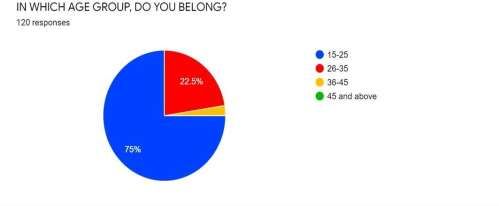
Rise of OTT Platforms: Effect of the C-19 Pandemic                                            PJAEE, 18 (7) (2021)

give their valuable opnion regarding the OTT platforms.

                         Introduction
                         The study deals with the emergence and consumer behavior in the era of pandemic
                         towards a particular sector i.e. OTT, over the top services. This belongs to a very
                         vast industry, The Entertainment Industry. Entertainment in layman’s terms means
                         having fun and enjoying ourselves with either one’s own company or maybe with
                         their loved and close ones. In today’s world entertainment is one of the most leading
                         industries, which includes the sub-fields of theater, film, fine art, dance, opera,
                         music, literary publishing, television, and radio.
                         With the day by day development in technology these industries are being improved
                         at a fast pace. There have been both, cases of cut- throat competition and cases
                         which showed that companies which want to create goodwill in the market. The
                         entertainment industry is unpredictable as the main profits depend upon the TRP of
                         a particular television channel, or the box office collection of some movie, etc. for
                         example, if a movie fetches more than 100-200cr. It is assumed to be a blockbuster
                         and hit movie, whereas sometimes other’s which couldn’t reach this bar at the box
                         office, are assumed to be average, in spite of the fact that those movies might have
                         an amazing script or direction, etc.
                         There are so many ways, (as mentioned above) as how this entertainment can be
                         perceived in various forms. Now a day even the advertisers have understood this
                         concept and are adamant in creating new and eye-catching advertisements for the
                         same. Consumers seek for creativity and out of the box ideas which please them
                         and them make think and remember a Brand or product in a particular way. For
                         example, usually when we see two domino dices, we get reminded of the pizza
                         chain – Dominos’. Similarly, when we see three parallel vertical lines indict
                         towards the brand Adidas.
                         The number of OTT players increased from just nine in 2012 to 32 in 2018. In 2017,
                         the OTT industry in India achieved phenomenal growth of 160 per cent, as the top
                         16 OTT platforms saw their user bases grow from 63 million to 164 million between
                         August 2016 and August 2017.(Rajat kathuria, 2019)
                         India is the second-largest subscription TV market in the Asia Pacific region in
                         terms of the number of subscription in TV households, which reached 154.3 million
                         in 2016. This is expected to expand at 1.6% CAGR to reach 166.9 million by 2021.
                         (alpana kakkar, 2019)
                         The technology is changing with clicks. From online banking methods to e- wallets
                         and what not, with one click everything is available at your doorstep. The upcoming
                         young generation take advantage of the same and recharge their online data packs
                         and download videos and other possible internet based applications.
                         OTT has been enabled by technology advances such as smartphones, super-fast IP
                         networks, open source platforms, innovative services, cutting edge functionalities
                         and shift in consumer preferences towards their “freemium” based business models
                         are seeing an ever increasing adoption rate. (joshi Sujata, 2015) This freemium
                         concept lures consumers. They fail to understand that nothing is free. Firstly, we
                         have to pay for the internet packages and then only something can be surfed upon
                         on the internet. So, ultimately, until and unless the consumer pays for the internet
                         data, he/she won’t be able to use any of the applications, which include data

                                                                                                                     2278
Rise of OTT Platforms: Effect of the C-19 Pandemic PJAEE, 18 (7) (2021)
connection, for example, Netflix, amazon, etc.
From the above, it has concurred that with the advancement in technology there is
a gradual shift in the medium of advertising. TV advertising still assumes an
essential job for the advertiser since it evokes various feelings in the buyer.
Impulsive buying is one such emotion. This research will focus on considering the
achievement of the system that induces such conduct
Literature Review
Keeping in mind the objectives of the research, the review of related literature is
organized in the following way:
According to (purdy, 2018) The OTT market is a complex space dominated by three
powerful players, - Netflix, Amazon Prime, Hulu - the Big 3. It is challenging for
small players for finding their place in fierce market where content rules but more
consumers can be dragged if they focus on providing curated content limiting
account sharing, getting the price right and reducing churn through improved
customer relations. The survey result indicates that although price is an important
factor while purchasing OTT services, content still drives most consumer choices.
A bread mix of quality content tends to be what consumers value from the Big 3,
with “Access to the vast library of content” proved to the top most reason users
subscribe to these services. The small players who promises to provide the services,
taking one of the above mentioned factors, are more likely to attract a big crowd
for their subscription.
Article (singh, 2020) OTT platforms has experienced a surge in consumption and
subscriber can’t, impacted by the COVID-19. The recent survey by InMobi states
that 46% viewers are watching more content online. According to the experts OTT
services could grow further in upcoming days as the television channels run out of
content. “As these channels have been unable to shoot due to lockdown, they are
running old content. In such a scenario people will gravitate towards OTT to watch
fresh content,” says Paritosh Joshi, media consultant and principal, Provocateur
Advisor. To benefit from this increase in demand platform such as Amazon Prime
video and Zee5 have made few of their shows free to watch. Due to this, Zee5 has
witnessed an 80% increase in subscription and over 50% time spend recently.
Thrillers, urban drama and young romance are the top performing genres on the
platform. The viewership for the movies has seen significant increase across the
platforms. Cinema streaming services MIBI has seen 28% rise in viewership on its
platform in March, compared to February.
(Singh D. P., 2019)The advent in Internet is changing the trend of Indian Cinema
very rapidly. Reduced price of internet services lay the foundation for increase in
OTT services like Netflix, Hotstar, Zee5, Amazon Prime and Alt Balaji. Many
ventures are producing video content solely for these OTT services. These new
ventures are changing the way of Indian Television and Cinemas. The OTT services
analyzes the video content watched by the users and keep providing them the
content on similar genres. People liken to enjoy the services for free. Hence, OTT
like Hotter provides very limited content for free. Also the subscription rates of
these services are very low. The users enjoy the variety of International and national
content. Action and Comedy are the favorite genres of movie. According to the
survey, users spend on average, 2 hours a day watching OTT services. Web services
2279Rise of OTT Platforms: Effect of the C-19 Pandemic PJAEE, 18 (7) (2021)
are watched more often in OTT services. Genres like Young romance, action and
urban-drama are into the top tier. Most of the users watch the content at night.
Entertainment is the biggest reason behind the use of OTT. Second biggest reason
behind the use is the mobility of the gadget. Third on its availability of content on
demand
Research Methodology
TARGET GROUP SELECTED
The respondents selected for this research study was consumers of OTT
platforms who belong to the age group of 14 to 45+. To be a part of the study the
respondents were presented with a screening question. This particular category of
respondents were chosen because all OTT platforms cater to all segments of
consumer’s right from kids to toddlers to adult content. Apart from that, consumers
above the age of 14 are assumed to have formed opinions of their own and hence
would discuss about the same.
Objectives
There are 3 main objectives associated with conducting this research study.
The questionnaire was designed to arrive at possible answers on the following three
objectives:
1. To find out and understand the increase in consumption of OTT platforms during
pandemic.
2. To understand the future scope of the OTT platforms.
3. To study the shift in consumption from old entertainment to new.
Research Design
The data collection was primary in nature where a questionnaire was floated
to the relevant TG. The data was analyzed using basic descriptive statistical tools.
The total sample size for this research study was 100 respondents. The
questionnaire was divided into 2 major sections segments: demographics and OTT
consumption behavior which included questions related to OTT usage, earlier
patterns and their views.
Findings and Analysis
1. Age of respondents
2280Rise of OTT Platforms: Effect of the C-19 Pandemic PJAEE, 18 (7) (2021)
The above chart shows that most of our respondent who are a part of our research
study belong to the age category of 15-25. It is usually assumed that consumers
belonging to this age category are more in touch with the latest happenings in OTT
platforms and hence have provided valuable inputs in the making of this research
study.
2. Screening question
The above question was used as screening test for the respondents. 91.7% of the
respondents have used either of the OTT platforms and hence were deemed fit to
be part of the research.
3. Entertainment consumption pattern during the lockdown.
2281Rise of OTT Platforms: Effect of the C-19 Pandemic PJAEE, 18 (7) (2021)
The above question aims at understanding our respondents entertainment
consumption pattern during the lockdown. As can be inferred, consumers find their
source of entertainment in the OTT platforms in comparison to the traditional
entertainment channels. This indicates the rising popularity of OTT platforms
during the lockdown phase.
4. Awareness of the medium
The above question aims to understand the source of information of their current
OTT services. The question aims to understand which source has the highest
influence on the consumers with regard to OTT platforms. As can be inferred, social
recommendations followed by advertisements is what gets the message across the
consumers of OTT platforms.
5. Hours spend on OTT
2282Rise of OTT Platforms: Effect of the C-19 Pandemic PJAEE, 18 (7) (2021)
From the above question, we can infer that on an average, consumers spend
roughly 2 to 4 hours consuming content available on the OTT platforms. i.e out of
the total respondents 42.7% of the consumers spend their at least 2 to 4 hours logged
in to OTT platforms.
6. Impact of lockdown on OTT
The above question once again aims to understand the consumer’s consumption
pattern of OTT platforms in the lockdown. It can inferred that approximately 74%
of the respondents have experienced an increase in usage of OTT platforms.
7. Mode of consumption
2283Rise of OTT Platforms: Effect of the C-19 Pandemic PJAEE, 18 (7) (2021)
With wider availability of smartphones and internet penetration, consumers have
better access to alternate modes of entertainment. The above question aims to
understand which medium is the most popular wrt OTT platforms. From the above
data, we can infer that OTT platforms are most viewed on smartphones followed
by laptop and television.
8. Started using a new OTT platform
The above question aims to understand the timelines for the popularity of OTT
platforms. From the above data we can infer that of the total consumers, 48% of the
consumers started using new OTT platforms during the lockdown. This indicates
that the lockdown was one of the propellers for the rise of OTT platforms.
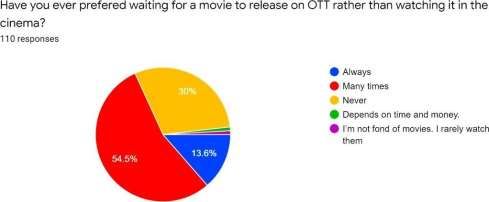
9. Waited for a movie to launch on OTT platform.
The above questions dwells deeper into OTT platforms and its entertainment
capacity. This question aims to understand if consumers have ever preferred waiting
for a movie launch on an OTT platform versus waiting for it to release in the
cinemas. Surprisingly, 55% of the respondents in the study preferred waiting for a
movie to release on a n OTT platform instead of it releasing in the cinemas.
10. Movies release on OTT
2284Rise of OTT Platforms: Effect of the C-19 Pandemic PJAEE, 18 (7) (2021)
In alignment with the above question, this final question aims to understand if
consumers are comfortable with the parallel functioning of OTT platforms and
traditional cinema. From the above data, we can infer that consumers ie 57% of the
consumers would prefer mainstream movies to be released on OTT before or along
with cinema.
Conclusion
The over-the-top videos streaming services explosion in India has led to the
emergence of distinct patterns of content consumption over the past few years. For
one, content consumption has become rampant outside the house, where until
recently because of the Covid 19, the majority of video consumption occurred
inside and that too on a very high scale. The information gathered by the researches
shows that over 91.7% of respondents are aware of the OTT medium, from the
following we can derive that OTT is a wide spread medium in India. Due to the
current situation of the lockdown people are constantly consuming different kinds
of media for their entertainment. Majority of the people (72.7%) resort to OTT for
entertainment followed by YouTube (17.3%) and T.V (9.1%). OTT platforms are
quite popular among the users as a considerable amount of users 42.7% spends 2 to
4 hours consuming it. 29.1% people spend more than 4hours on it and only 28.2%
consumes it for less than 2 hours.
Considering this, on an average user spends approximately 3 hours on the medium.
The lockdown has let to a change in consumption patterns of the users. The
researcher found out that 73.6% of people experienced an increase in their daily
usage of OTT consumption. Users on an average experienced 3 to 4 hours of
increase in their consumption during the lockdown. This proves the first hypothesis
H1. Along with this it also shows that OTT is the go to platform for entertainment
for majority of people during lockdown as they chose to spend more time using
OTT rather than any other mediums. When it comes to the mode of consumption
people prefer smart phone (55.5%) over laptop (24.5%) and T.V (20%). It is safe
to say that due to the lockdown more people have started using T.V for OTT
consumption. 59.1% of people started using a new OTT during the lockdown. This
shows how lockdown has given a push to OTT for generating new customers. When
asked about if the users ever waited for a movie to be released on OTT than
watching it in cinema, 70% said yes. The researcher discovered that 56.4% were
positive and wanted for movies to be released on OTT platforms on the same date
2285Rise of OTT Platforms: Effect of the C-19 Pandemic PJAEE, 18 (7) (2021)
as in cinemas.
Although 44.6% were still negative about it. Furthermore when asked if a movie
would release in OTT and cinema both, what would they prefer, 48.2% said cinema
and 45.5 chose OTT. Still there were a few responses who said that decisions is
based on the type of the movie. This data implies that although still a majority of
people (48.2%) would prefer watching a movie in cinema over OTT (45.5). The
day is not far when the people will see OTT as an equally popular platform for
watching movies. OTT and cinema are two distinct platforms and provide distinct
experiences to their customer and they cannot replace each other but the data shows
that majority of people want movies to be released on OTT on the same date as in
cinemas.
The data collected from the questionnaire survey was interpreted and analyzed in
the previous chapters. Based on the analysis the research on the topic ‘The
emergence of OTT platforms during the pandemic and its future scope’ has been
successfully completed. Since people have started consuming OTT more and more
in the lockdown. The statement that OTT platforms have experienced a substantial
inorganic growth by taking up the market share of other platforms has been proved.
REFERENCES
• alpana kakkar, k. n. (2019, may 15). Analysis of Product Placement in Web
Series and Its Influence on Consumer Buying Behavior. Retrieved from
https://journalofbusiness.org/index.php/GJMBR/article/view/2755
• Basu, R. (2020). Television and OTT. Retrieved from PWC:
https://www.pwc.in/industries/entertainment-and-media/television-and-ott.html
• Dixit, D. (2020, march 6). The rise and ‘desification’ of Indian OTT.
Retrieved from Televisionpost: https://www.televisionpost.com/the-rise-and-
desification-of-indian- ott/
• finance, y. (2018, august 10). how entertainment has changed over time.
Retrieved from yahoo finance: https://in.finance.yahoo.com/news/entertainment-
changed-time- 105245102.html
• Gaikwad, s. (2019, january 6). businesstoday. Retrieved from How Indian
cinema evolved into being one of the most powerful modes of entertainment:
https://www.businesstoday.in/opinion/columns/how-indian-cinema-evolved-into-
being-one-of-the-most-powerful-modes-of-entertainment/story/307454.html
• Girish menon, H. P. (2017). The Digital First, How OTT platforms can be
demand ready. KPMG.
• joshi Sujata, S. S. (2015, February). Retrieved from
http://citeseerx.ist.psu.edu/viewdoc/download?doi=10.1.1.1001.900&rep=rep1&t
ype
=pdf
• Kaushal, S. (2020, May 26). OTT Platforms In India See Subscriber Bases
Surge Up To 80% Amid Coronavirus Lockdown. Retrieved from Forbes:
https://www.forbes.com/sites/swetakaushal/2020/05/26/good-news-amid-
lockdown- ott-platforms-register-60-80-surge-in-subscription-
base/#77d0fab7413a
• Kohli, D. (2019, February 19). Looking into the future - ott trends. Retrieved
2286Rise of OTT Platforms: Effect of the C-19 Pandemic PJAEE, 18 (7) (2021)
from https://yourstory.com/2019/02/looking-into-future-top-ott-trends-2019
• Laghate, G. (2017, March 02). How OTT players are geared up to woo Indian
viewers. Retrieved from Brandequity:
https://brandequity.economictimes.indiatimes.com/news/media/how-ott-players-
are- geared-up-to-woo-indian-viewers/57275909
• matrix, s. (2014). The Netflix Effect: Teens, Binge Watching, and On-
Demand Digital Media Trends. jeunesse : young people, texts, culture .
• purdy, s. c. (2018). KPMG's annual cable & OTT report.
• Rajat kathuria, M. k. (2019, March). Retrieved from https://think-
asia.org/bitstream/handle/11540/9810/An_Analysis_of_Competition_and_Regulat
ory
_Interventions.pdf?sequence=1
• roshan. (2017, july 11). 5 benefits of Video on Demand over Traditional TV.
Retrieved from muvi: https://www.muvi.com/blogs/5-benefits-video-demand-
traditional-tv.html
• sharma, K. (2020, May 19). Will movies releasing directly on OTT platforms
become a norm post-Covid? Experts think otherwise. Retrieved from Business
insider : https://www.businessinsider.in/advertising/media/article/will-movies-
releasing- directly-on-ott-platforms-become-a-norm-post-covid-experts-think-
otherwise/articleshow/75808931.cms
• singh, D. (2020, April 06). How is coronavirus impacting the streaming
platforms with an increasing appetite of viewers. Retrieved from Financial express:
https://www.financialexpress.com/brandwagon/how-is-coronavirus-impacting-
the- streaming-platforms-with-an-increasing-appetite-of-viewers/1919916/
• Sugata ghosh, r. n. (2018, october 18). How affordable over-the-top streaming
has made entertainment a malaise . Retrieved from the economic times:
https://economictimes.indiatimes.com/industry/media/entertainment/how-
affordable- over-the-top-streaming-has-made-entertainment-a-
malaise/articleshow/66266479.cms
• Wayne, M. L. (2017, october 13). Netflix, Amazon, and branded television
content in subscription video on-demand portals. Retrieved from sage journals:
https://journals.sagepub.com/doi/abs/10.1177/0163443717736118
• Xiaobing Xu, R. C. (2015). Competition, Cooperation, and Pricing: How
Mobile Operators. International Journal of Marketing Studies; Vol. 7, No. 6; 2015
.
2287You can also read


