Roaming among humans: noteworthy records
←
→
Page content transcription
If your browser does not render page correctly, please read the page content below
Arxius de Miscel·lània Zoològica, 19 (2021): 197–204                                       ISSN: Laino et al.
                                                                                                 1698–0476

Roaming among humans:
noteworthy records
of jaguar (Panthera onca)
close to human settlements
in the Paraguayan Humid Chaco
R. Laino, K. Musalem, A. Weiler, J. F. González–Maya

Laino, R., Musalem, K., Weiler, A., González–Maya, J. F., 2021. Roaming among humans:
noteworthy records of jaguar (Panthera onca) close to human settlements in the Paraguayan
Humid Chaco. Arxius de Miscel·lània Zoològica, 19: 197–204, Doi: https://doi.org/10.32800/
amz.2021.19.0197

Abstract
Roaming among humans: noteworthy records of jaguar (Panthera onca) close to human
settlements in the Paraguayan Humid Chaco. Jaguars (Panthera onca Linnaeus, 1758)
have been extirpated from nearly 55 % of their original range in America and from almost
24 % in Paraguay. Here we present evidence of the presence of jaguar close to the most
populated areas of Paraguay, in a human–dominated landscape in the Humid Chaco forests,
highlighting how without other pressures, jaguars can inhabit densely populated areas and
potentially disperse between established populations.

Key words: Camera trap, Deforestation, Livestock, Savanna, Wetland, Paraguayan Humid Chaco

Resumen
Deambulando entre seres humanos: registros notables sobre el jaguar (Panthera onca) en
la proximidad de asentamientos humanos en el Chaco Húmedo de Paraguay. Los jaguares
(Panthera onca Linnaeus, 1758) han sido extirpados de casi el 55 % de su área de distribución
original en América y de cerca del 24 % del territorio de Paraguay. En esta comunicación
presentamos evidencias de la presencia del jaguar muy cerca de las áreas más pobladas
de Paraguay, en un paisaje dominado por la presencia humana en los bosques del Chaco
Húmedo, resaltando como, sin otras presiones, los jaguares pueden habitar áreas densamente
pobladas por humanos y potencialmente dispersarse entre poblaciones silvestres establecidas.

Palabras clave: Cámara trampa, Deforestación, Ganadería, Sabana, Humedal, Chaco Húmedo
de Paraguay

Resum
Deambulant entre éssers humans: registres notables sobre el jaguar (Panthera onca) prop
d'assentaments humans al Chaco Humit del Paraguai. Els jaguars (Panthera onca Lin-
naeus, 1758) han estat extirpats de gairebé el 55 % de la seva àrea de distribució original
a Amèrica i de prop del 24 % del territori del Paraguai. En aquesta comunicació presentem
evidències de la presència del jaguar molt a prop de les àrees més poblades del Paraguai,
en un paisatge dominat per la presència humana als boscos del Chaco Humit, la qual cosa

© [2021] Copyright belongs to the authors, who license the journal Arxius de Miscel·lània Zoològica to publish the
paper under a Creative Commons Attribution 4.0 License, which permits its distribution, and reproduction
in any medium, provided the original authors and source, the journal Arxius de Miscel·lània Zoològica, are cited.
                                                                                                             197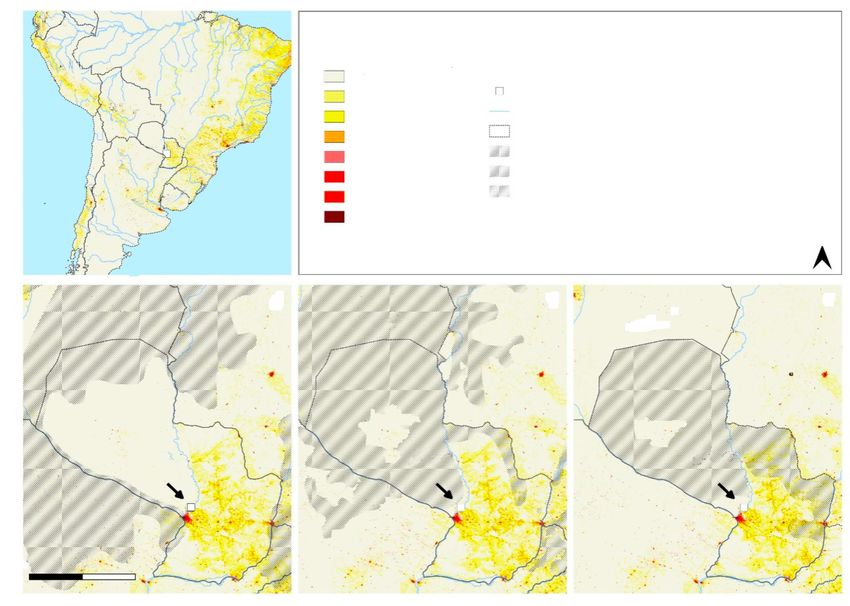
Arxius de Miscel·lània Zoològica, 19 (2021): 197–204                                 Laino et al.

fa palès que, sense altres pressions, els jaguars poden habitar àrees densament poblades
per humans i dispersar–se potencialment entre poblacions silvestres establertes.

Paraules clau: Càmera parany, Desforestació, Ramaderia, Sabana, Aiguamoll, Chaco Humit
del Paraguai

Received: 16/06/2021; Conditional acceptance: 19/07/2021; Final acceptance: 01/09/2021

Rafaela Laino, Karim Musalem, American Chaco Research Center, San José 365, Asun-
ción, Paraguay.– Karim Musalem, World Wildlife Fund for Nature, c/Bernardino Caballero
191, Asunción, Paraguay.– Andrea Weiler, Universidad Nacional de Asunción, Facultad de
Ciencias Exactas y Naturales, Campus Universitario 1039, San Lorenzo, Paraguay.– José F.
González–Maya, Proyecto de Conservación de Aguas y Tierras, ProCAT Colombia/Interna-
tional, Carrera 11 #96–43, Bogotá, Colombia; and Departamento de Ciencias Ambientales,
Universidad Autónoma Metropolitana Unidad Lerma, C.P. 52005, Estado de México, México.

Corresponding author: R. Laino. E–mail: rafilaino@gmail.com

ORCID ID: R. Laino: 0000-0002-3045-5108; J. F. González–Maya: 0000-0002-8942-5157

Introduction

The jaguar (Panthera onca) is the largest wild felid in the Americas, found from the south-
western United States to northern Argentina (de la Torre et al., 2017). The species has
disappeared from over 55 % of its historical range, and recent assessments of its regional
and continental conservation status have concluded that populations continue to decline in
most of its current range (de la Torre et al., 2017; Quigley et al., 2017). Originally, the jaguar
was present right throughout Paraguay, but it has now been extirpated from a large area of
the country (Giordano et al., 2017). Paraguay is a landlocked country in the center of South
America with a surface area of 406,752 km². The country has five natural regions: the Dry
Chaco, the Humid Chaco, the Alto Paraná Atlantic Forest, the Cerrado, and the Pantanal
(Olson et al., 2001). The two most prominent regions are the Eastern and the Western
Regions, the latter also known as the Chaco. The two are very distinct natural regions,
both physically and biologically, separated by the Paraguay River. The Chaco is the portion
of Paraguay that lies west of the Paraguay River. It occupies 60 % of the national territory,
but it has the lowest population density (Mereles et al., 2013; Mereles and Rodas, 2014;
Gill et al., 2020; Mereles et al., 2020). The capital of Paraguay is Asunción, and together
with its surrounding areas it is the most densely populated area of the country, located on
the other side of the Paraguay River in the Eastern Region.
   The forests of the Eastern Region of Paraguay occupy the ecoregion of the Alto Pa-
rana Atlantic Forest (Ribeiro et al., 2009; Avila Torres et al., 2018). They have decreased
dramatically in size since the 1960s, mostly due to the rapid expansion of agriculture. The
forests of the Western Region or Chaco are also currently being converted into pastures
for cattle or agricultural purposes. Annual deforestation rates throughout the Gran Chaco
are estimated to exceed the average rate of loss of all forests globally since the mid–20th
century (Foley et al., 2005). Between 1985 and 2013, 20 % of all the Chaco Forest was
replaced by croplands or grazing lands (Caldas et al., 2013; Hansen et al., 2013; Vallejos
et al., 2015; Baumann et al., 2017). The Chaco is not only affected by an intense process
of deforestation but also from extensive loss of natural grasslands, both on higher lands
and wetlands, with a rate of disappearance even higher than that of the forests (Bucher,
2016; Gill et al., 2020).

                                                                                             198
Arxius de Miscel·lània Zoològica, 19 (2021): 197–204 Laino et al.
Ecuador
Population count (LandScan, 2009)
Peru
Brasil < = 5
5–25 Jaguar records
Bolivia
25–50 Rivers (UNESCO–IHP, 2017)
Paraguay 50–100 Contries
100–500 A. Continental range (de la Torre et al., 2017)
500–2500 B. UICN range (Quigley et al., 2017)
Chile Uruguay C. National range (Giordano et al., 2017)
Argentina 2500–5000
> 5000
N
A B C
Bolivia Bolivia Bolivia
Brasil Brasil Brasil
Paraguay Paraguay Paraguay
Argentina Argentina Argentina
0 200 400 km
Fig. 1. Location of the new records of jaguars in the Humid Chaco of Paraguay in
contrast with the known distribution for the species according to: A, de la Torre et al.
(2017); B, Quigley et al. (2017); and C, Giordano et al. (2017).
Fig. 1. Localización de los nuevos registros de jaguares en el Chaco Húmedo de
Paraguay en contraste con la distribución conocida de la especie según: A, de la
Torre et al. (2017); B, Quigley et al. (2017); C, Giordano et al. (2017).
Material and methods
The study area is located in the Paraguayan Humid Chaco, where the landscape is com-
posed of a mosaic of natural grasslands, palm groves, wetlands, and islands of dense for-
est. Jaguar records were obtained close to the cities of Villa Hayes (30 km) and Benjamin
Aceval (20 km), both of which are among the most populated in the Paraguayan Chaco
(Gill et al., 2020). The city of Asunción is located only 50 km away (in a straight line) but
separated by the Paraguay River (fig. 1).
Results and discussion
Here we present rural records of jaguar sightings from a human–dominated landscape close
to densely populated human settlements. These sightings likely fall outside the currently
estimated or known range for the species according to national (Giordano et al., 2017) and
international (de la Torre et al., 2017; Quigley et al., 2017) reports. The recorded sightings
199Arxius de Miscel·lània Zoològica, 19 (2021): 197–204 Laino et al.
Table 1. New records for jaguar in the Humid Chaco of Paraguay, including location,
date and vegetation type.
Table 1. Nuevos registros de jaguares en el Chaco Húmedo de Paraguay que incluyen
la localización, la fecha y la vegetación tipo del lugar.
Geographic
Record Photo coordinates Date Vegetation type
Jaguar footprint cast Fig. 2A 24º 57' 52'' S 2016 Dense
57º 22' 05'' W subtropical forest
Predation on calves Fig. 2B 24º 57' 47'' S 2016 Natural
57º 22' 02" W grasslands
Jaguar tree–marks Fig. 2C 24º 57' 19'' S 31/03/2020 Riparian forest
57º 19' 54'' W
Jaguar tracks Fig. 2D 24º 57' 40'' S 28/05/2020 Natural
57º 21' 32'' W grasslands
Jaguar tracks Fig. 2E 24º 57' 30" S 18/07/2020 Dense subtropical
57º 22' 19" W forest
Jaguar tracks Fig. 2F 24º 57' 48'' S 13/08/2020 Riparian forest
57º 21' 40'' W
Jaguar sighting – 24º 57' 44'' S 10/2020 Dense
57º21'51" W mesoxerophytic forest
Jaguar photo Fig. 2G 24º 57' 44" S 29/11/2020 Riparian forest
57º 21' 41" W
are located 32 km northeast, 20 km southeast and 40 km south of the previously considered
limits of the species in its southern range according to de la Torre et al. (2017), Quigley et
al. (2017) and Giordano et al. (2017), respectively (fig. 1A, 1B, 1C). The closest records to
this locality, available through the GBIF.org (GBIF, 2021) are at least 110 km away.
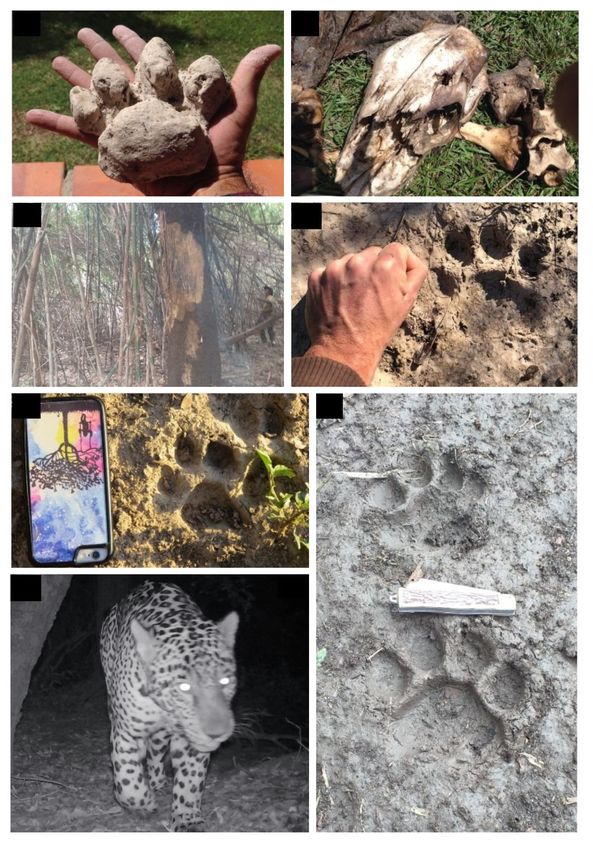
The presence of the jaguar in the area had been suspected in previous years due to the
size of tracks found and alleged predation events on calves that showed very similar signs
of attacks by jaguars in other locations (table 1; fig. 2A, 2B). However, the species was
not recorded during camera trapping efforts conducted at the study site from late 2016 to
mid–2019 (Caballero–Gini et al., 2020; Laino et al., 2020). Months before the species was
recorded by camera trap here, tracks and a tree where jaguars are said to sharpen their
nails were also recorded (table 1; fig. 2C–2F). In addition, a worker on one of the cattle
ranches in the area reported seeing a jaguar on a field trip in October 2020 (table 1). A
photograph of a jaguar walking along a river bank was taken by a camera trap on 29/11/2020
at 22:35 h, thus confirming these previous alleged records of the species, (table 1; fig. 2G).
The jaguar is categorized as Near Threatened by the IUCN Red List of Threatened
Species (Quigley et al., 2017). However, at the austral limit of its distribution the species is
considered Critically Endangered in Argentina (Paviolo et al., 2019) and Paraguay (Gior-
dano et al., 2017), and Vulnerable in Brazil (Gonçalves Morato et al., 2018). Jaguar pop-
200Arxius de Miscel·lània Zoològica, 19 (2021): 197–204 Laino et al.
A B
C D
E F
G
Fig. 2. Evidence of jaguars in the Humid Chaco of Paraguay: A, jaguar footprint cast
found on one of the roads of the cattle ranch (courtesy of K. Musalem); B, skull of a
calf allegedly attacked by a jaguar (courtesy of K. Musalem); C, jaguar tree–marks
at the same locality (courtesy of R. Acosta); D, jaguar footprint found on a road in
the cattle ranch (courtesy of L. Guanes); E, jaguar footprint found on a road in the
middle of the forest (courtesy of P. Roche); F, jaguar footprint found beside the river
(courtesy of R. Acosta); G, camera trap photo of a jaguar walking along a river bank
in the Humid Chaco. (Table 1 gives details of each record).
Fig. 2. Evidencias de jaguares en el Chaco Húmedo de Paraguay: A, molde de una
huella de jaguar encontrada en uno de los caminos del rancho (cortesía de K. Mu-
salem); B, cráneo de ternero supuestamente atacado por un a jaguar (cortesía de
K. Musalem); C, marcas producidas por un jaguar en un árbol en la misma localidad
(cortesía de R. Acosta); D, huella de jaguar encontrada en uno de los caminos del
rancho (cortesía de L. Guanes); E, huella de jaguar encontrada en un camino en
medio del bosque (cortesía de P. Roche); F, huella de jaguar encontrada cerca del río
(cortesía de R. Acosta); G, fotografía de un jaguar caminando por la orilla de un río
en el Chaco Húmedo tomada por una cámara trampa. (Los detalles de cada registro
están disponibles en la tabla 1).
201Arxius de Miscel·lània Zoològica, 19 (2021): 197–204 Laino et al.
ulations in the Chaco Region are low–density and highly threatened by livestock ranching
and persecution (Quigley et al., 2017; McBride and Thompson, 2018).The species is also
potentially threatened in the region by the widespread, accelerated deforestation rates in
the Chaco Forest and the consequent genetic effects on populations, such as inbreeding
and isolation. Such landscape transformations will also likely have severe effects on po-
tential prey species, especially herbivores, due to their own population reductions related
to habitat fragmentation and decreased diversity of plants available (Mereles and Rodas,
2014; Romero–Muñoz et al., 2019).
The jaguar's dispersal is limited by anthropogenic factors. For example, for the Eastern
Region of Paraguay, the few remaining forests are isolated and surrounded by crops,
generating a landscape with a matrix that prevents genetic flow (Haag et al., 2010; Gior-
dano et al., 2017). Thus, maintaining or restoring functional corridors and consolidating
new habitat areas that further promote jaguar conservation beyond the boundaries of the
current protected areas system (Srbek–Araujo et al., 2018; Menchaca et al., 2019) seems
warranted. Because the Humid Chaco connects the Dry Chaco and the Pantanal with the
Alto Paraná Atlantic Forest and Cerrado (Avila Torres et al., 2018), conservation measures
in these habitats will ensure jaguar connectivity (Rabinowitz and Zeller, 2010; De Angelo et
al., 2013; Olsoy et al., 2016). Despite its high biodiversity, the Humid Chaco clearly lacks
sufficient protected areas (Caballero–Gini et al., 2020; Cartes and Yanosky, 2020).
In areas that are threatened by high human density and severe risk of habitat loss, land-
scape management policies should procure not only to conserve the jaguar habitat but also
to ensure the wellbeing of human communities that coexist with this iconic species (de la
Torre et al., 2017; Koprowski et al., 2019). The large home ranges required by jaguars in
Western Paraguay and the low proportion of land under protection in the region, highlight
the importance and potential role that private ranchlands contribute to the long–term con-
servation goals of this and multiple other species (McBride and Thompson, 2018).
Our contribution highlights how jaguars are able to move and inhabit areas in the Humid
Chaco close to densely human populated areas and disperse large distances through hu-
man–dominated landscapes from the closest known breeding populations. It is likely that
without human pressures (such as poaching and retaliatory killing) jaguars could move
through human–dominated landscapes and probably live in proximity to people. Controlling
such pressures and allowing, maintaining or recovering movement and habitats could open
important conservation opportunities for jaguar dispersal through heavily transformed areas.
The Humid Chaco ecosystem in Paraguay is currently at high risk of collapse due to
the intensification of agriculture and livestock production and to a lesser extent due to the
expansion of urban areas. This not only affects the populations of jaguars, but also one
of the world´s most imperiled ecosystems. Strategies that promote effective conservation
of this ecoregion, including tailor–made incentives, are therefore critically needed and will
contribute to the long–term maintenance of its biodiversity.
Acknowledgements
We thank Patricia Roche, Luis Guanes and Ruben Acosta for the photographs taken in the
field and Arlan Mareco for reporting the jaguar sighting.
References
Avila Torres, I., D'Elía, G., Vogt, C., Garcete–Barrett, B. R., 2018. Análisis crítico de la
biogeografía del Paraguay. Reportes científicos de la FACEN, 9(1): 42–50.
Baumann, M., Gasparri, I., Piquer–Rodriguez, M., Pizarro, G. G., Griffiths, P., Hostert, P.,
202Arxius de Miscel·lània Zoològica, 19 (2021): 197–204 Laino et al.
Kummerle, T., 2017. Carbon emissions from agricultural expansion and intensification in
the Chaco. Global Change Biology, 23: 1902–1916.
Bucher, E., 2016. El futuro incierto de los humedales del Chaco: el caso de los bañados
del río Dulce. Paraquaria Natural, 4(2): 11–17.
Caballero–Gini, A., Bueno–Villafañe, D., Laino, R., Musálem, K., 2020. Diversity of mam-
mals and birds recorded with camera–traps in the Paraguayan Humid Chaco. Boletín
del Museo Nacional de Historia Natural del Paraguay, 24(1): 5–14.
Caldas, M., Goodin, D., Sherwood, S., Campos Krauer, J., Wisely, M., 2013. Land–cover
change in the Paraguayan Chaco: 2000–2011. Journal of Land Use Science, 10(1): 1–18.
Cartes, J. L., Yanosky, A., 2020. Evaluation of the Paraguayan System of Protected Areas
after 24 years of its implementation. Tropical Journal of Environmental Sciences, 54(2):
147–164, Doi: 10.15359/rca.54-2.8
De Angelo, C., Paviolo, A., Wiegand, T., Kanagaraj, R., Di Bitetti, M. S., 2013. Understand-
ing species persistence for defining conservation actions: A management landscape for
jaguars in the Atlantic Forest. Biological Conservation, 159: 422–433, Doi: 10.1016/j.
biocon.2012.12.021
de la Torre, J. A., Gonzalez–Maya, J. F., Zarza, H., Caballos, G., Medellin, R. A., 2017. The
jaguar’s spots are darker than they appear: assessing the global conservation status
of the jaguar Panthera onca. Oryx, 52(2): 300–315, Doi: 10.1017/S0030605316001046
Foley, J. A., Defries, R., Asner, G. P., Barford, C., Bonan, G., Carpenter, S. R., Chapin, F.
S., Coe, M. T., Daily, G. C., Gibbs, H. K., Helkowski, J. H., Holloway, T., Howard, E. A.,
Kucharik, C. J., Monfreda, C., Patz, J. A., Prentice, I. C., Ramankutty, N., Snyder, P. K.,
2005. Global consequences of land use. Science, 309: 570–574.
GBIF, 2021. GBIF Occurrence Download – Panthera onca. Available online at: https://doi.
org/10.15468/dl.g33dzt [Accessed on 13 March 2021]
Gill, E. A., Da Ponte, E., Insfrán, K. P., González, L. R., 2020. World Wildlife Fund, German
Aerospace Center, 2020. Atlas of the Paraguayan Chaco. Asunción.
Giordano, A. J., Giménez, D., Martínez, V., Rojas, V., Saldívar, S., Velilla, M., Ayala, R.,
López, J., Velázquez, M., Thompson, J. J., Cartes, J. L., del Castillo, H., Mujica, N.,
Weiler, A., Villalba, L., Ramírez, F., 2017. Carnívora: los carnívoros. In: Libro Rojo de
los Mamíferos del Paraguay: especies amenazadas de extinción: 79–101 (Asociación
Paraguaya de Mastozoología (APM) and Secretaría del Ambiente (SEAM), Eds.). Edi-
torial CREATIO, Asunción.
Gonçalves Morato, R., de Mello Beisiegel, B., Esterci Ramalho, E., Bueno de Campos,
C., Pires Boulhosa, R. L., 2018. Panthera onca (Linnaeus, 1758). In: Livro Vermelho
da Fauna Brasileira Ameaçada de Extinção: Volume II – Mamíferos: 353–357 (Instituto
Chico Mendes de Conservação da Biodiversidade. (Org.). ICMBio, Brasília.
Haag, T., Santos, S., Sana, D. A., Morato, R. G., Cullen Jr, L., Crawshaw Jr, P. G., De Angelo,
C., Di Bitetti, M. S., Salzano, F. M., Eizirik, E., 2010. The effect of habitat fragmentation
on the genetic structure of a top predator: loss of diversity and high differentiation among
remnant populations of Atlantic Forest jaguars (Panthera onca). Molecular Ecology,
19(22): 4906–4921, Doi: 10.1111/j.1365-294X.2010.04856.x
Hansen, M. C., Potapov, P. V., Moore, R., Hancher, M., Turubanova, S. A., Tyukavina, A.,
Thau, D., Stehman, S. V., Goetz, S. J., Loveland, T. R., Kommareddy, A., Egorov, A.,
Chini, L., Justice, C. O., Townshend, J. R., 2013. High–resolution global maps of 21st–
century forest cover change. Science, 342(6160): 850–853, Doi: 10.1126/science.1244693
Koprowski, J. L., González–Maya, J. F., Zarrate–Charry, D. A., Spencer, C., 2019. Local
Approaches and Community–Based Conservation. In: International Wildlife Management:
Conservation Challenges in a Changing World: 198–207 (J. L. Koprowski, P. R. Kraus-
man, Eds.). Johns Hopkins University Press, Baltimore, MD, USA.
Laino, R., Musalem, K., Caballero–Gini, A., Bueno–Villafañe, D., Gonzalez–Maya, J., Chaparro,
S., 2020. Anteaters on the edge: giant and lesser anteaters (Myrmecophaga tridactyla and
203Arxius de Miscel·lània Zoològica, 19 (2021): 197–204 Laino et al.
Tamandua tetradactyla) at their geographic distributional limits in Paraguay. Iheringia, 110:
1–8, Doi: 10.1590/1678-4766e2020007
LandScan, 2009. Geographic Information Science and Technology. Available online at:
https://landscan.ornl.gov/ [Accessed on March 2021].
McBride, R. T., Thompson, J. J., 2018. Space use and movement of jaguar (Panthera
onca) in western Paraguay. Mammalia, 82: 540–549, Doi: 10.1515/mammalia-2017-0040
Menchaca, A., Rossi, N. A., Froidevaux, J., Dias–Freedman, I., Caragiulo, A., Wultsch, C.,
Harmsen, B., Foster, R., de la Torre, J. A., Medellin, R. A., Rabinowitz, S., Amato, G.,
2019. Population genetic structure and habitat connectivity for jaguar (Panthera onca)
conservation in Central Belize. BMC Genet., 20(1): 100, Doi: 10.1186/s12863-019-0801-5
Mereles, F., Cartes, J. L., Clay, R. P., Cacciali, P., Paradeda, C., Rodas, O., Yanosky, A.,
2013. Análisis cualitativo para la definición de las ecorregiones Paraguay occidental.
Paraquaria Natural, 1(2): 12–20.
Mereles, M. F., Cespedes, G., Cartes, J. L., Goerzen, R., De Egea–Elsam, J., Rodriguez,
L., Yanosky, A., Villalba, L., Weiler, A., Cacciali, P., 2020. Biological corridors as a con-
nectivity tool in the Region of the Great American Chaco: Identification of biodiversity
hotspots in the ecoregions of the Paraguayan Chaco. Research in Ecology, 2(1): 27–36.
Mereles, M. F., Rodas, O., 2014. Assessment of rates of deforestation classes in the Par-
aguayan Chaco (Great South American Chaco) with comments on the vulnerability of
forests fragments to climate change. Climatic Change, 127: 55–71.
Olson, D. M., Dinerstein, E., Wikramanaya, E. D., Burgess, N. D., Powell, G. V. N., Un-
derwood, E. C., D’Amico, J. A., Toua, I. I., Strand, H. E., Morrison, J. C., Loucks, C.
J., Allnutt, T. F., Ricketts, T. H., Kura, Y., Lamoreux, J. F., Wettengel, W. W., Hedao, P.,
Kassem, K. R., 2001. Terrestrial ecoregions of the world: A new map of life on Earth.
BioScience, 51: 933–938.
Olsoy, P., Zeller, K. A., Hicke, J. A., Quigley, H. B., Rabinowitz, A. R., Thornton, D. H., 2016.
Quantifying the effects of deforestation and fragmentation on a range–wide conservation
plan for jaguars. Biological Conservation, 203: 8–16, Doi: 10.1016/j.biocon.2016.08.037
Paviolo, A., De Angelo, C., de Bustos, S., Perovic, P. G., Quiroga, V. A., Lodeiro Ocampo,
N., Lizárraga, L., Varela, D., Reppucci, J. I., 2019. Panthera onca. In: SAyDS–SAREM
(eds.) Categorización 2019 de los mamíferos de Argentina según su riesgo de extinción.
Lista Roja de los mamíferos de Argentina. Versión digital: http://cma.sarem.org.ar
Quigley, H., Foster, R., Petracca, L., Payan, E., Salom, R., Harmsen B., 2017. Panthera
onca (errata version published in 2018). The IUCN Red List of Threatened Species
2017: e.T15953A123791436, Doi: 10.2305/IUCN.UK.2017-3.RLTS.T15953A50658693.en
Rabinowitz, A., Zeller, K. A., 2010. A range–wide model of landscape connectivity and
conservation for the jaguar, Panthera onca. Biological Conservation, 143(4): 939–945,
Doi: 10.1016/j.biocon.2010.01.002
Ribeiro, M., Metzger, J., Martesen, A., Ponzoni, F., Hirota, M., 2009. The Brazilian Atlantic
Forest: How much is left, and how is the remaining forest distributed? Implications for
conservation. Biological Conservation, 142(6): 1141–1153.
Romero–Muñoz, A., Torres, R., Noss, A. J., Giordano, A. J., Quiroga, V., Thompson, J.J.,
Baumann, M., Altrichter, M., McBride Jr, R., Velilla, M., Arispe, R., Kuemmerle, T., 2019.
Habitat loss and overhunting synergistically drive the extirpation of jaguars from the Gran
Chaco. Diversity and Distributions, 25(2): 176–190, Doi: https://doi.org/10.1111/ddi.12843
Srbek–Araujo, A. C., Haag, T., Garcia Chiarello, A., Salzano, F. M., Eizirik, E., 2018. Worri-
some isolation: noninvasive genetic analyses shed light on the critical status of a remnant
jaguar population. Journal of Mammalogy, 99(2): 397–407.
UNESCO–IHP, 2017. Metadata: World Rivers. World-wide Hydrogeological Mapping
and Assessment Programme. Available online at: http://ihp-wins.unesco.org/layers/
geonode:world_rivers/metadata_detail [Accessed on March 2021].
Vallejos, M., Volante, J, Mosciaro, M., Vale, L., Bustamante, M., Paruelo, J., 2015. Trans-
formation dynamics of the natural cover in the Dry Chaco ecoregion: A plot level geo–
database from 1976 to 2012. Journal of Arid Environments, 123: 3–11.
204You can also read


