Rotherham Cycling Strategy 2021 - DRAFT FOR CONSULTATION - Photo pending - Meetings, agendas, and ...
←
→
Page content transcription
If your browser does not render page correctly, please read the page content below
DRAFT FOR CONSULTATION

Rotherham Cycling
  Strategy 2021

        Photo pending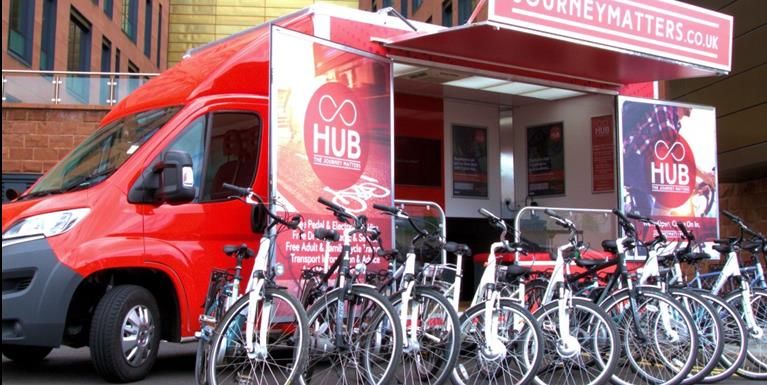
Contents

Foreword

1.0 Introduction

2.0 Background and Strategy Review

3.0 Implementing a Comprehensive Cycle Network

4.0 Priorities for Interventions

5.0 Softer Measures

6.0 Monitoring and Evaluation
Foreword
The Leader and/ or Cabinet Member – to be inserted in final approved strategy.
1.0 Introduction

Cycling has a range of economic, health, wellbeing, traffic management and environmental
benefits and is a high priority within Rotherham and Sheffield City Region. There is
increasing interest in cycling across the region; for example, the mayor is putting cycling and
walking at the centre of regional transport plans.
Rotherham Council is committed to significantly increasing cycling in the borough. As part of
this Rotherham is investing in major high-quality cycling infrastructure through the
Transforming Cities Fund and Active Travel Fund. This Rotherham Cycling Strategy aligns
with key national, regional, and local transport strategies to encourage and enable cycling for
both utility and leisure purposes.
Rotherham has ambitious plans for a high quality
cycle network and this strategy will provide the
principles, approach and broad design standards
required in order to implement a high quality,
comprehensive, safe and accessible network for all
residents, workers and visitors to Rotherham. It will
also outline the priorities on which to base
interventions. In the longer term the focus will be
on improving areas of the road network rather than
individual cycle routes to provide a comprehensive
cycle network that connects with major cycle routes
on main roads where required to facilitate longer
journeys. Some roads will have segregated facilities
while others will have the road environment
improved for cyclists such that dedicated facilities
are rendered unnecessary.
The plan also assesses the condition of the existing
cycle routes and the approach to maintaining these
routes to ensure the network already in place is of
the best condition with the funding available.
Alongside this, the requirement for promotional
measures will be outlined in order to maximise the
uptake in cycling and cycle infrastructure, measures
such as electric and pedal bike hire, bike checks and repairs, training, campaigns and
events.
These combined infrastructure and promotional measures aim to encourage and enable a
significant increase in cycling levels for both utility and leisure purposes, with wide ranging
benefits for the people of Rotherham.
2.0 Background and Strategy Review

2.1 Background
Rotherham’s cycling network measures around 126 km in length - around a tenth of the
length of the local highway network. As with other districts in Sheffield City Region,
Rotherham’s cycle network is limited. Whilst there has been some good, localised
investment in cycle infrastructure and facilities, over a longer period this has been
constrained by the funding available from government, which has previously often been
short term and relatively small. Often funding has been for isolated cycle routes of varying
standards. This has resulted in a network which has some good facilities but also some large
gaps, and there is limited provision at many junctions. Recent focus during the Covid-19
period has demonstrated the value of active travel as a viable travel option and also for its
role in post Covid economic recovery. During this time it became very clear that our cycle
network is not at the required standard that would encourage and enable a large increase in
cycling. Funding constraints have also limited the maintenance of existing cycle routes with
worn lining, the collection of debris and overgrowing vegetation affecting approximately 50%
of our cycle network.
As a consequence, cycling levels in Rotherham and Sheffield City Region are relatively low,
our annual cordon counts and census data indicate around 1% of trips are made by bicycle.
Even for commutes shorter than 5 km (about 3 miles, or 20 minutes by bicycle), still only 1%
cycle, compared against the 59% who drive1. This is broadly in line with cycling levels across
much of the country.

                           Commuting mode share in Rotherham (2011)
                                                                                       [CELLRANGE], [SERIES
                                                                                             NAME]

              All commutes

                                                                                                   [CELLRANGE], [SERIES
                                             [CELLRANGE], [SERIES                                        NAME]
                                                   NAME]

    Shorter than 5 km / 3 mi

                                                      [CELLRANGE], [SERIES
                                                             NAME]
                               0         20,000        40,000       60,000            80,000        100,000      120,000

                       Other       Public transport    Car (including as passenger)      Bicycle      Foot

Source: 2011 Census
Though there is significant potential for cycling in Rotherham, 40% journey to work of trips by
Rotherham residents, accounting for up to 9% of total commuting mileage, are 5 km or
below which is a comfortable cycling distance for most. Converting even a small proportion
of these trips to bike will have significant benefits, in terms of reduced car traffic and
improved health.

1
    Census 2011, table DC7701EWIa
Modelling suggest that, based on 2011 commuting patterns, there is realistic potential to
increase the cycling mode share in the Borough to circa 12% of commutes with origin or
destination in the Borough, and circa 20% of commutes wholly within the Borough.2
Accounting from likely abstraction from walking to cycling (associated with longer walks
becoming more attractive and expedient to cycle), it is estimated the number of trips made
                                              by non-motorised modes can be doubled,
                                              resulting in a reduction in circa 10% of car
                                              trips, and of circa 2% of car mileage. At this
                                              point we do not hold estimates for non-
                                              commuting trips, but a similar impact is thought
                                              possible for these trips.

                                                     These shifts in how we travel can have some
                                                     significant benefits, in terms of contributing to
                                                     the reduction of traffic congestion and local air
                                                     pollution. Providing for cycling may also open
                                                     up new opportunities for people without access
                                                     to cars, and where public transport is unable to
                                                     provide adequate connectivity. The largest
                                                     benefits to society are likely in respect of health
                                                     and economic productivity, potentially saving
                                                     around 90 thousand sick days per annum, and
                                                     bringing savings to society of as much as
                                                     £40m per annum3. Benefits in the community
                                                     would be most keenly felt ‘in the pocket’, with
                                                     cycling affording a new, low cost option for
                                                     travel.
Source: Sheffield City Region Transport Strategy

One of the most pressing challenges locally, regionally and nationally is that of
decarbonisation. Cycling does have potential to ultimately reduce CO2 emissions in the
Borough by up to around 13 thousand tonnes each year; unfortunately, this only amounts to
circa 2% of transport emissions in the borough, or around 4% of car emissions4. This is
because car emissions are predominated by longer distance trips – national travel survey
data indicates 85% of car mileage accrued on trip longer than 5 miles5.

Cycling can only ‘pull its weight’ in respect of climate change if aligned with destination shift
– that is to say, if it facilitates travel to opportunities, facilities and amenities within peoples’
localities, and so reducing the need to travel to other parts of the city region or beyond. This,
amongst other reasons, will require a change in approach – a shift away from large scale
infrastructure to facilitate greater or faster movement (including for cyclists), and instead a
focus on supporting local communities, local businesses and local regeneration, from the
bottom up. The need for decarbonisation dictates that cycling, and our cycling policy, must
enable and support the Borough’s wider priorities rather than constrain them – in particular
to support the themes in the Council’s Year Ahead Plan of thriving neighbourhoods, better
health and wellbeing, and economic recovery.

Major investment in cycling infrastructure and a comprehensive cycle network is required to
support this and in order to encourage and enable cycling, and active travel has become a
significant priority nationally, regionally and locally due to the wide range of benefits that it
brings. Alongside cycling infrastructure there is also wide support for investment in softer

2
  RMBC analysis of Propensity to Cycle, based on ‘Go Dutch’ scenario
3
  RMBC analysis of Propensity to Cycle, based on ‘Go Dutch’ scenario
4
  RMBC analysis of Propensity to Cycle, based on ‘Go Dutch’ scenario
5
  National Travel Survey 2019, table NTS0308
and promotional measures to encourage cycling such as bike hire, bike check up and repairs and cycle training. Research undertaken by Sheffield Hallam University has determined that a combination of investment in infrastructure alongside promotional measures is most effective in encouraging cycling. 2.2 Strategy Review and Objectives Government Strategy for “Gear Change” In 2020 the government released the ‘Gear Change’ strategy which advocates high quality segregated cycle routes and low traffic neighbourhoods to stop rat running and make it easier to cycle and walk, alongside investment in electric bikes, bike maintenance and free cycle training. The government is also encouraging authorities to provide Local Cycling and Walking Infrastructure plans, and these plans have been incorporated into the Sheffield City Region Active Travel Implementation Plan (ATIP). Sheffield City Region Transport Strategy The ATIP has been agreed by the Mayoral Combined Authority and is part of a series of implementation plans which sits within and contribute towards the Sheffield City Region Transport Strategy – however, as a regional document this does not adequately address connectivity and community needs at a sufficiently local scale to be effective on its own. Cycling features strongly in this strategy which intends ‘to better connect our major urban and economic centres to enable the better flow of people, goods, businesses and ideas across the city region, as well as promoting our rural and visitor economies, to secure new investment and grow our economy’. The strategy is underpinned by three main goals: Residents and businesses connected to economic opportunity A cleaner and greener Sheffield City Region Safe, reliable and accessible transport network A high quality and comprehensive cycle network will provide a major contribution towards these goals, the delivery of this strategy, and the vision for transport which puts cyclists and pedestrians at the centre of our transport plans. Active Travel Implementation Plan This sets out how national and regional policy will be taken forward within Rotherham, to meet the needs of our communities, and will also contribute towards the proposals within the ATIP. This sets out that by 2040 a ‘fully connected network of walking and cycling routes will link our region, transforming communities and ensuring that people have the means and the confidence to leave their cars at home, and choose to travel on foot or by bicycle’. The plan provides a 5 year network map and 2040 network map. The 5 year network sets out Sheffield City Region’s priorities over the next 5 years, these are mainly funded cycle projects along with top priority corridors from the Local Cycling and Walking Infrastructure Plan. The 2040 map is a longer term more comprehensive network of routes and low traffic
neighbourhoods. The Rotherham Cycling Strategy will detail the principles and approach
required to implement a comprehensive and high quality cycle network and set out the broad
design principles required for cycle routes.

Rotherham Council
The current Council Year Ahead Plan focuses on the immediate post Covid-19 recovery
period and identifies active travel and cycling as a key objective for support of local recovery.
Its BETTER HEALTH AND WELLBEING theme with the published Year Ahead Plan has
both the following outcome activity relating to cycling stating that “Rotherham is a place
where active travel is accessible, and local people reap the associated health and
environmental benefits”. The key strategic activity here is to “Provide online mapping of
the borough’s cycle routes and agree a cycling strategy.”

Rotherham’s Joint Health and Wellbeing Strategy
This strategy provides a framework for partners across the borough to ensure that
opportunities for improving health and wellbeing are maximised at every opportunity, across
all agendas, policies and strategies. The borough’s Joint Strategic Needs Assessment
provides evidence that the health of people in Rotherham is poorer than the England
average, with life expectancy being ten years lower for men in Rotherham, and seven years
lower for women. Furthermore, residents of the borough are 24% more likely to have a long
term health problem or disability, compared to the national average. Therefore, this strategy
is vital in improving health outcomes in the borough, and links directly to Aim 4 of the Health
and Wellbeing Strategy, working towards the ambition that ‘All Rotherham people live in
healthy, safe and resilient communities’. Furthermore, this strategy will also assist in working
towards the underpinning principles of the Health and Wellbeing Strategy, such as ‘reducing
health inequality’, ‘preventing physical and mental ill-health’, and helping to ‘promote
resilience and independence’.

Rotherham Local Plan 2013-2028
The Rotherham Local Plan Core Strategy sets out how local jobs and homes are to be
provided in the Borough, including how transport infrastructure and services should be
provided to support these. Of most relevant is policy CS 14, which supports enabling of
cycling to be used for shorter trips, and for links to public transport interchanges, as a means
of managing demand for car travel.
Rotherham Transport Strategy
This strategy will also play a major role in the implementation of the Rotherham Transport
Strategy which features proposals to continue to improve the road network in Rotherham
and support sustainable and affordable transport modes through continuing to improve
public transport and promoting more walking and cycling. Walking and cycling features
strongly in Rotherham’s strategy and a high quality connected cycling and walking network is
also a specific action. This is the primary purpose of this cycling strategy along with
supporting promotional measures.

The Council’s priorities
A common theme amongst the above transport strategies is the need for a high quality, safe
and comprehensive cycle network to enable a large increase in cycling by providing
sustainable access to employment, training and retail, and by improving safety and the
perception of a safety. This in turn will bring many benefits such as supporting economic
growth and regeneration, reducing congestion, contributing to improving air quality and
improving the health and wellbeing for Rotherham citizens. This plan details the principles
and approach required to implement the network.
Though there is a finite amount of space on the highway and often competing needs from
different users, therefore we need to be proportionate when designing our cycle network,
and accept that there may be some costs for some users, though equally accept that cycling
is not beneficial at any price. In some cases, it may be necessary to promote new or
improved infrastructure for other modes, to ensure cycling provisions can be delivered
without causing undue adverse impact for other road users, especially for public transport.
Whilst this document considers cycling alone, our approach will treat cycling as part of, and
complementary to, the wider transport system. This will enable greater benefits to be
achieved – for example, by improving access to public transport.
Ultimately, the Council aspires to achieving wider outcomes from our cycling work, to
support the economy and regeneration, a high level of accessibility, and to improve the
health and wellbeing of Rotherham’s citizens. That said, in the first instance for cycling
infrastructure improvement there is a need to acknowledge the starting position which is to
grow the number of active everyday cyclists, and so our principle objective in the near term
is :-
Primary goal 1: to demonstrate that a significant increase in cycling in Rotherham is
achievable, and can bring about wider improved outcomes.
Secondary to this, but nonetheless important in working towards that objective, this strategy
contributes to:
Supporting an integrated, sustainable transport system in Rotherham
Supporting the economy and regeneration by providing high quality access by
bike to employment, training and retail
Ensuring the health and wellbeing of all Rotherham residents and workers is
supported by enabling active and sustainable travel
These objectives will ensure the implementation of the Rotherham cycle network provides
maximum benefits for the people of Rotherham and aligns to the aspirations and policies in
the above strategies to enable a significant increase in cycling in the borough.3.0 Implementing a Comprehensive Cycle Network
3.1 The Council’s approach
Cycle network principles
For most of the public, even in high cycling societies, cycling is principally a mode of
transport used for shorter, local trips of up to around 5 miles; a shorter distance of 5 km, or
around 3 miles, is suggested in the City Region’s ATIP, reflecting the low baseline and less
favourable topography in much of South Yorkshire. Because of the physical effort involved in
cycling, cyclists are especially sensitive to diversion, and so cannot generally be expected to
travel out of their way to utilise designated or preferred cycle routes.
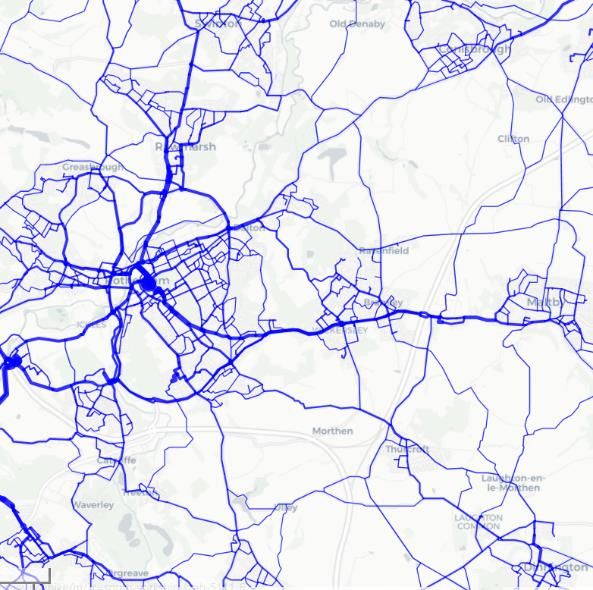
This can be demonstrated with modelling, illustrating what a high-cycling scenario could look
like in Rotherham (below)6. As can be seen, whilst some routes are busier than others,
demand is spread all the way across the network.
Potential Cycling Demand in Rotherham
6
Extract from Propensity to Cycle Tool, ‘Go Dutch’ scenarioConsidering as well that many of the people utilising the busier routes will have travelled
there via quieter points to and from individual premises (a level of detail not considered in
the model), this leads to the Council’s key guiding principle –
The highway network is the cycling network and, therefore, our approach should be to
ensure the comfort, convenience, and safety of cyclists as standard.
In principle, this means all roads and streets in the Borough would fall in to one of two
situations:-
- Distributor roads, accommodating large flows of motorised traffic at speed, providing
cycle tracks to separate cyclists from the danger and nuisance posed by these.
- Access streets, where traffic speeds and volumes are kept low, thus ensuring case
comfortable conditions without provision of separate infrastructure.
Of course, all interventions will be identified to fit site circumstances, and this may
necessitate variations from the above. In particular, the Council may promote schemes of
cycle lanes on distributor roads where neither traffic reduction (i.e. conversion to an access
street) nor provision of cycle tracks is feasible; or on access streets which are, for example,
relatively busy. And where supporting connectivity, the Council will continue to provide and
develop cycleways away from roads and streets entirely.
Cycling in town centres will need to consider how or if cycling can be accommodated in
pedestrianised areas of town centres. The Council will consider this on a case-by-case
basis, to balance the need for connectivity and convenience by bicycle, with the needs and
safety of pedestrians, and the wider aspirations for the town centre, for example, in the
holding of events and markets.
It is intended to produce further detailed guidance on the implementation of this approach as
a Supplementary Planning Document.
Operating in this framework provides three distinct benefits –
- it will help ensure the Council can, over time, build up safe, convenient door-to-door
connectivity by bicycle, able to provide for trips even as demand changes over time;
- over time, Rotherham’s residents will be able to have confidence that their journey
can be made safely by bicycle with only basic knowledge of their route, without
referring to maps or journey planners to identify ‘safe’ routes; and,
- recognising streets are not for cyclists’ alone, and that schemes need to meet a wide
range of needs, this framework gives the flexibility to develop options and choices,
best ensuring supporting cycling can be delivered in a manner that supports the
needs and aspirations of local communities.
The last point is particularly important. Emergency cycling infrastructure promoted across
England in 2020, and the resulting negative response in some cases, demonstrates that
cycling cannot be imposed on the public at any cost. The borough’s cycling aspiration will
inevitably require some adverse impacts in some places, whether this be localised worsened
congestion, less parking or narrower footways – the Council will work with local communities
and key stakeholders openly and transparently to seek to minimise and mitigate adverse
impacts, and ensure the authority does not act in a manner that is disproportionate or unduly
harmful to other road users. In this way, the Council intends to ensure cycling serves our
communities rather than being imposed upon them.This is an ambitious approach; to achieve the maximum potential for cycling in the borough, this will involve expanding our cycle network from the current 126 km nearly tenfold, increasing the length of road provided with cycle track in the borough sevenfold to over 300 km, providing nearly 800 km of traffic-calmed areas, as well as implementing extensive improvements to the existing network. Cycle parking, storage and support facilities There is also a need to ensure that high quality, convenient and secure cycle parking is available at destinations across Rotherham. Alongside this, there is a need to accommodate the increasing number of electric bike users with high quality bike charging infrastructure incorporated into cycle parking specifically for electric bikes. Cycle parking facilities are an essential element of the infrastructure required to encourage and enable cycling and whilst some good quality cycle parking is available, particularly in our town centres, there are gaps in the provision of parking and the quality of facilities on offer. It is important that cycle parking facilities are located where they are safe, convenient to use and secure in order to encourage maximum usage. Their location should be informed by the cycle network proposals, development, existing destinations and locations of onward travel such as popular bus stops, bus interchanges and train stations to ensure cycling and public transport is integrated. The Council also proposes to work with relevant stakeholders to determine where new or upgraded cycle parking is required, in particular to compliment the proposed investment in the cycle network. The type of cycle parking will depend upon the required use. Cycle parking facilities will be considered in two main categories, long and short stay spaces. Long stay spaces These are for commuting cyclists as well as shoppers, workers, visitors and tourists. The type of facility for long stay spaces will be dependent upon the location and space available. Secure cycle parking such as lockers may be considered for town and district centres. Lockers provide protection from the weather and are generally more secure than cycle stands. Though they are larger than cycle stands which may limit available areas. Good quality cycle stands with cover where possible may be provided as an alternative. Short stay spaces These are for cyclists who are only likely to be visiting a destination briefly for example for a short shopping trip. Cycle stands are proposed for these cyclists and such facilities should be provided close to the entrances of buildings for convenience and security. Supporting facilities There is also a lack of cycle hub facilities in Rotherham which may incorporate parking alongside other facilities such as bike repairs and working with partners such as the Business Growth Board to facilitate employment site shower and changing facilities. As part of a package of support measures for cyclists the Council proposes to investigate the potential for cycle hubs at key destinations and public transport facilities such as bus interchanges and train stations, and potentially work alongside cycle vendors to expand the services on offer in Rotherham. This would include charging infrastructure for e-bikes.
3.2 Maintenance
Whilst in the longer term a comprehensive and high quality cycle network is required in order
to significantly increase cycling in Rotherham, in the short term there is a need to improve
the maintenance of existing cycle routes. There are approximately 126 km of cycle routes in
Rotherham of varying standards and approximately 50% of the network is affected by worn
lining, the collection of debris and overgrowing vegetation, discouraging cycling. In order to
address this a number of relatively low-cost interventions are proposed. These include:
The renewal of all worn lining on our cycle network such as advisory and mandatory
cycle lanes, and segregation lines on shared use footways. This will improve the
appearance of cycle routes and cycle lanes in particular, for both cyclists and car
drivers on the road.
Cutting back overgrowing vegetation and removing weeds from on highway cycle
routes. Overgrowing vegetation can significantly reduce the width and usability of
some cycle routes.
Sweeping affected on highway cycle routes to ensure they a free from litter and
debris.
A maintenance level of service is also proposed to ensure that once existing cycle routes are
brought up to a good standard they are well maintained in future years. The proposed level
of service includes:
The inspection for renewal of lining on advisory/ mandatory cycle lanes and
segregation lines on shared use footways at least every 5 years, particularly at areas
subject to overrun by vehicles plan such as at junctions.
Cutting back overgrowing vegetation and removing weeds on highway cycle routes
on an inspect and maintain basis 2 times per year.
Sweeping affected on highway cycle routes 3 times per year so they are clear of
debris and litter and weed treatment 2 times per year.
These measures will ensure that the existing network whilst limited and of variable quality is
brought up to and maintained to a good standard, in order to maximise the attractiveness
and usability of cycle routes for both utility and leisure purposes.
There is also a need to ensure cycle parking facilities are maintained to a good standard.
The maintenance of cycle parking facilities is limited. As a result, some of our cycle lockers
in particular are unappealing due to the collection of litter or not useable due to damage.
Whilst cycle parking stands generally require very little maintenance, there is a need to
ensure any damage to stands is promptly rectified.
In order to address this a regular inspection and maintenance regime is required. It is
proposed to include cycle lockers and stands, particularly in our town centres, within regular
maintenance programmes, to ensure the cycle parking facilities are well maintained.4.0 Priorities for Interventions
At present, cycling as transport is a niche activity in Rotherham, with only around 1% of trips
to work being made by bicycle, for example. Moreover, national travel survey evidence
suggests cycling is an activity currently enjoyed disproportionately, in terms of both number
of trips and especially distance cycled, by the most affluent households in society – a group
significantly underrepresented in Rotherham.
Given this starting point, there will inevitably and understandable be a degree a scepticism
as to whether cycling can really be an inclusive and effective means of transport in
Rotherham. Therefore, in order to address this concern, the first priority will be to invest in
cycling in parts of the borough where there is good evidence that a much wider
demographic than existing cyclists could take up regular everyday cycling. This will mean
ensuring there is a demand for travel, but also having realistic expectations as to how far
people may be prepared to cycle, and in what topography.
The objective is to demonstrate that cycling can be made more accessible, more inclusive in
Rotherham, such that a real uplift can be undertaken. Once this is demonstrated,
prioritisation can then be considered in terms of outcomes such as improved health or
reduced car travel.
The best evidence for demand for travel is currently based on travel to work7. In time, there
will be an understanding of other trips, as well as how commuting patterns may change in
time, particularly should increased teleworking required during the COVID-19 pandemic
continue to some extent into the future. As such the priorities will need to be periodically
reviewed. At this point, based on the best information available, the priority areas for
intervention are as follows –
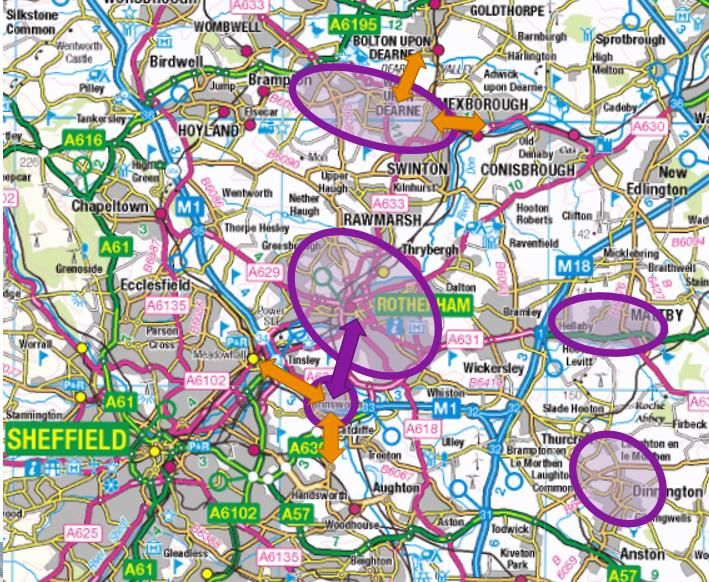
Between and within Maltby and Hellaby;
Between and within Wath, Brampton, West Melton and Manvers, including links into
Swinton and (in liaison with Doncaster and Barnsley Council) Bolton and
Mexborough;
Within and between Laughton and Dinnington;
Links between Rotherham and the following suburbs –
o Herringthorpe;
o Moorgate;
o Eastwood & East Dene;
o Masborough & Bradgate;
o Greasbrough including the strategic housing site at Bassingthorpe Farm;
Brinsworth, including links to Rotherham and (in liaison with Sheffield Council)
Meadowhall, Tinsley, Carbrook, and the Advanced Manufacturing Park/Waverley.
7
RMBC analysis of Propensity to Cycle Tool, ‘Go Dutch’ scenario5.0 Softer Measures
To maximise the potential for cycling in Rotherham and the uptake in cycle infrastructure,
softer or promotional measures are required to support investment. Research from Sheffield
Hallam University suggests that promotional measures alongside high quality cycling
infrastructure is most effective in encouraging and enabling cycling and therefore subject to
available funding it is proposed to continue to invest in successful projects such as:
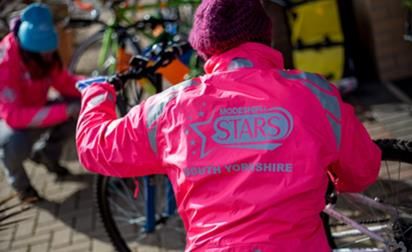
The Rotherham Mobile Cycle Hub
The cycle hub visits businesses and organisations, local communities, town centres
and events offering
Free electric and pedal bike hire
Free bike check ups and repairs
Free adult and Family Cycle Training
Active Travel in Schools
This project promotes and encourages cycling and walking to school through a range
of engaging events and activities.
Source: PWLC Projects
Beat the Street 2021
This project mainly encourages walking though also cycling by targeting local
communities and schools to engage in friendly competition.
Events
Local cycling events to raise awareness of cycling and the benefits.
Personalised Travel Planning
Offering information and advice on sustainable transport modes and assistance on
journey planning. Which where funding can be secured could include adult cycling
training programmes.
Cycle Training in Schools
Cycle training is offered to pupils in primary schools across Rotherham.
Road Safety in Schools
This project highlights the importance of road safety and encourages pupils to travel
safely and sustainably through a range of activities and campaigns.This package of services has been extremely popular and valuable in supporting Rotherham
residents and workers to cycle and access facilities and services safely and sustainably.
The Rotherham Mobile Cycle Hub
The Rotherham Mobile Cycle Hub is a well-established project that has been
successfully encouraging and enabling cycling for a number of years. The hub visits
businesses and organisations, local communities, town centres, parks and events
offering a range of services including:
Free electric and pedal bike hire
High quality bikes are provided to participants for up to 3 months to try cycling
and in particular cycling to work. Offering bikes on a long-term basis allows
participants to enjoy the full benefits of cycling and potentially save money on
commuting. This service is in high demand and has resulted in 92% of
participants continuing to cycle after participating in the project.
Free bike check-ups and repairs
Dr bike sessions are offered at the hub when members of the public can bring
along a bike for a check-up. Minor repairs are undertaken, and participants are
referred to local bike shops for more major repairs. This service has proved to
be extremely popular and valuable for Rotherham residents and workers.
Free adult and family cycle training
A range of one to one and group cycle training sessions are offered to
Rotherham residents and workers including off road sessions at parks and on
road session for those wishing to commute to work. Instructors will advise on
issues such as positioning in the road and tacking junctions alongside planning
appropriate routes with participants.Rotherham has ambitions and aspirations to expand a number of these projects and extend the programme of promotional measures on offer to fully support the proposed investment in high quality and comprehensive cycle infrastructure, though this will rely upon longer term funding for proportional projects and Rotherham alongside Sheffield City Region is pressing the government for this. The Council will work with key partners for example in health, sport and leisure amongst others to maximise the opportunities and benefits of our projects for all residents and workers in Rotherham. Wheels for All As part of the Council’s r ambitions to enhance the promotional services on offer, Rotherham is working with the charity Cycling Projects to establish a Wheels for All Hub in Rotherham. The Wheels for all initiative is a national project that embraces all children and adults with disabilities to engage in a quality cycling activity. The hub will offer a range of specially adapted and accessible bikes sessions for disabled residents to cycle in a safe and controlled environment. Ride leaders will be available to support and assist riders. The hub will welcome all individuals, groups and families to enjoy the benefits of cycling.
6.0 Monitoring and Evaluation

Alongside significant investment in our cycle network there is also a need to ensure a robust
monitoring regime is in place to evaluate our infrastructure projects and the overall cycle
network. This regime will align to the Council’s priorities in this strategy for the cycle network.
The monitoring of cycling levels will be key to this and it is proposed that a more extensive
network of cycle counters will be required, initially targeting those areas and cycle routes
which are a high priority for interventions. Depending upon available funding it is also
proposed to invest in the latest technology to ensure that the data is of the highest quality.
The Council will also work alongside Sheffield City Region to ensure a regional monitoring
and evaluation plan for the Active Travel Implementation Plan meets the needs of
Rotherham and the proposals for a comprehensive and high-quality cycle network.
The cycle infrastructure projects being
introduced will be evaluated to ensure they
meet the aims and objectives of this strategy
and are aligned to the goals in the Sheffield
City Region Transport Strategy. The length and
number of cycle routes implemented and the
treatment of areas to provide an environment
that encourages and enables cycling will also
be monitored, as this will be an indicator of the
Council’s ambitions to provide a high quality,
comprehensive, safe and accessible network.
Promotional projects will also be monitored to
evaluate their effectiveness in encouraging and
enabling cycling. The uptake of the services on
offer such as bike hire, bike check-up and
repairs and cycle training will be monitored
alongside the participation in activities and
events. The travel habits of those engaged with
more intensively will also be surveyed to
determine the success of projects in
encouraging a modal shift towards cycling.
                                                    Source: PWLC Projects

Monitoring & Evaluation embedded in scheme and programme design
Monitoring and evaluating both infrastructure and promotional projects will ensure that the
Council has a comprehensive package of measures in place to determine cycling levels,
modal shift and attitudes towards cycling, and this will provide a good evidence base in
which to determine future projects and to support the case for future funding. In particular,
some of the interventions may be relatively new to Rotherham or to the UK; there is a need
to understand public response to these interventions so as to understand what works well,
and what works less well, for people in Rotherham. To ensure the Council can commit to the
level of analysis required to achieve this monitoring and evaluation, capabilities will become
a requirement of all scheme and programme bids and designs.
You can also read


