RQIA Provider Guidance 2020-2021 Independent Health Care Independent Hospital - www. r qia. org. uk
←
→
Page content transcription
If your browser does not render page correctly, please read the page content below
RQIA Provider Guidance 2020-2021
           Independent Health Care
              Independent Hospital

                   www.rqia.org.uk
Assurance, Challenge and Improvement in Health and Social Care
What We Do
The Regulation and Quality Improvement Authority (RQIA) is the independent body that regulates and
inspects the quality and availability of Northern Ireland’s health and social care (HSC) services. We were
established in 2005 under The Health and Personal Social Services (Quality, Improvement and Regulation)
(Northern Ireland) Order 2003 to drive improvements for everyone using health and social care services.
Through our programme of work we provide assurance about the quality of care; challenge poor practice;
promote improvement; safeguard the rights of service users; and inform the public through the publication
of our reports. RQIA has four main areas of work:
we register and inspect a wide range of independent and statutory health and social care services;
we work to assure the quality of services provided by the HSC Board, HSC trusts and agencies -
through our programme of reviews;
we undertake a range of responsibilities for people with mental ill health and those with a learning
disability; and
we support establishments and service providers to improve the service they deliver.
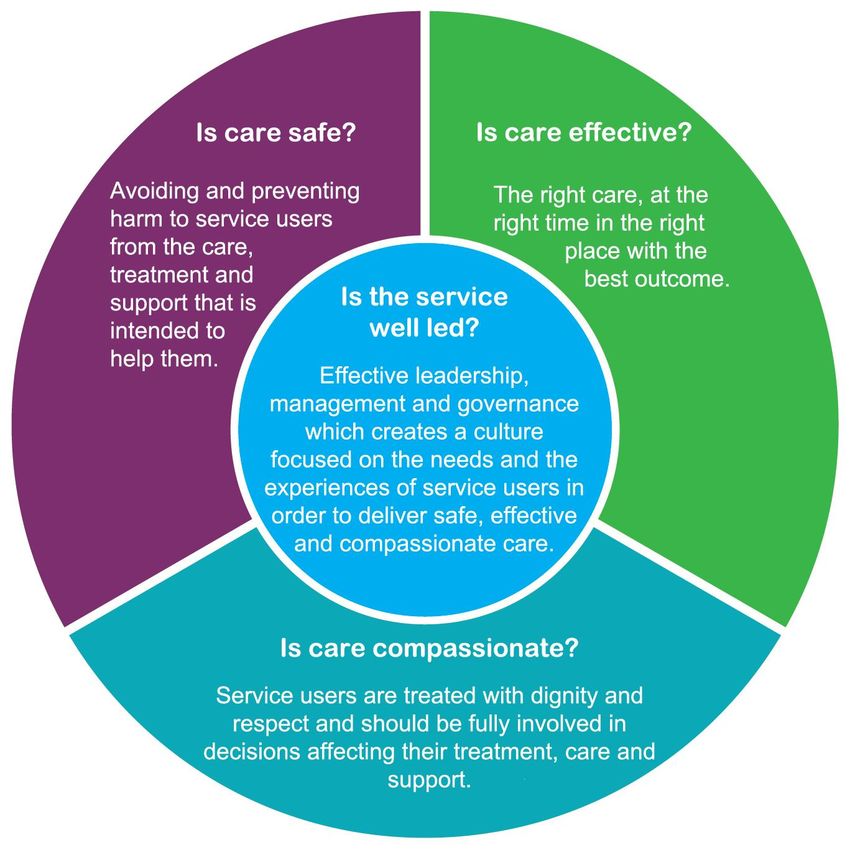
All work undertaken by RQIA is focused on the following four domains:
is care safe?;
is care effective?;
is care compassionate?; and
is the service well led?.
RQIA registers, and inspects and supports a wide range of health and social care services. These include:
nursing, residential care, and children’s homes; domiciliary care agencies; day care settings/centres;
independent health care; nursing agencies; independent medical agencies; residential family centres; adult
placement agencies; voluntary adoption agencies, school boarding departments and young adult supported
accommodation (inspected only).
RQIA Provider Guidance 2020-2021 Independent Hospital
1
The Four Domains

          RQIA Provider Guidance 2020-2021 Independent Hospital

                                                                  2
How We Will Inspect
We will inspect every independent hospital at least annually. Our inspectors are most likely to carry out an
announced inspection, however from time to time we may carry out an unannounced inspection in
response to concerns that may be raised with us.
When we inspect an independent hospital, we aim to provide assurances in respect of the standard, quality
and safety of services delivered. We do this by:
seeking the views of the people who use the service, or their representatives;
talking to the management and other staff on the day of the inspection;
examining a range of records including care records, incidents, complaints and policies;
providing feedback on the day of the inspection to the registered person/manager on the outcome of
the inspection; and
providing a report of our inspection findings and outline any areas for quality improvement.
Our inspections are underpinned by:
The Health and Personal Social Services (Quality, Improvement and Regulation) (Northern Ireland)
Order 2003
The Independent Health Care Regulations (Northern Ireland) 2005
The Regulation and Improvement Authority (Independent Health Care) (Fees and Frequency of
Inspections) (Amendment) Regulations (Northern Ireland) 2011
The Department of Health (DOH) Minimum Care Standards for Healthcare Establishments July 2014
Provider guidance in respect of the maintenance and upkeep of the premises and the management of
medicines are also available on our website here. These documents should be reviewed to ensure
compliance with the minimum standards and legislation.
Should you have additional categories of care, please ensure that you review and adhere to the relevant
provider guidance document i.e. Private Doctor (PD).
RQIA Provider Guidance 2020-2021 Independent Hospital
3What We Look For When We Inspect
To help us to report on whether the care is safe, effective and compassionate and whether the service is
well led, we will look for evidence against the following indicators.
Is care safe?
Avoiding and preventing harm to service users from the care, treatment
and support that is intended to help them.
Indicator S1
There are, at all times, suitably qualified, competent and experienced persons working in the service
in such numbers as are appropriate for the health and welfare of service users.
Examples of Evidence
Staffing
there are arrangements in place to provide cover at all times by appropriately trained and
experienced medical and health care practitioners;
the staffing complement meets the assessed care needs of all patients, taking into account the
size and layout of the hospital, the statement of purpose and fire safety requirements;
there is a defined staffing structure for surgical services that defines lines of accountability,
specifies roles and details responsibilities for areas of activity;
there are sufficient numbers of staff in various roles to fulfil the needs of the hospital and patients;
there is an induction programme in place appropriate to the role;
a system is in place to ensure staff receive annual appraisal, records should be retained;
a system is in place to ensure all staff receive appropriate training to fulfil the duties of their role
including professional body Continuing Professional Development (CPD) and RQIA training
guidance;
a system is in place to ensure that staff receive mandatory training and appropriate training when
new procedures are introduced, records should be retained for inspection;
there are arrangements for monitoring the professional registration status with the regulatory
body (e.g. GMC, NMC, HCPC) of all clinical staff, records should be retained for inspection;
there are arrangements in place for monitoring the professional indemnity for the service and of
all staff who require individual indemnity cover, records should be retained for inspection;
evidence that each private doctor has confirmation of identity, current General Medical Council
(GMC) registration, professional indemnity insurance, qualifications in line with service provided;
evidence of ongoing professional development and continued medical education that meets the
requirements of the Royal Colleges and GMC;
evidence that each private doctor has an appointed responsible officer (RO);
arrangements are in place to link into the wider system of RO’s for doctors with practising
privileges who work in other parts of the NI healthcare system or in other healthcare systems
beyond NI;
evidence of arrangements for revalidation; and
the private doctor is aware of their responsibilities under GMC Good Medical Practice.
Recruitment and Selection
staff have been recruited in line with Regulation 19 (2), Schedule 2 of The Independent Health
Care Regulations (Northern Ireland) 2005, as amended;
there is a written policy and procedure for staff recruitment in keeping with Regulation 19 (2)
Schedule 2 of The Independent Health Care Regulations (Northern Ireland) 2005;
staff personnel files are in keeping with 19 (2) Schedule 2, as amended;
RQIA Provider Guidance 2020-2021 Independent Hospital
4 enhanced AccessNI checks received prior to new staff commencing work;
recruitment and selection records should be retained in keeping with Regulation 21 (3) Schedule
3 Part II; and
an up-to-date staff register should be maintained and retained in keeping with Regulation 21 (3)
Schedule 3 Part II.
Indicator S2
The service promotes and makes proper provision for the welfare, care and protection of service
users.
Examples of Evidence
Surgery
the policies and procedures for surgical services are in accordance with best practice guidelines
as defined by professional bodies and national standard setting organisations including the World
Health Organisation (WHO) Surgical Checklist and Surgical Pause;
all surgical patients are assessed to identify the risk of venous thromboembolism (VTE) and
bleeding in keeping with NICE guideline [NG89];
a fluid management policy in keeping with HSC (SQSD) (NICE CG174) 17/14 and NICE Clinical
Guidance CG174 is in place and audited to provide assurance that the policy is being adhered to;
an anti-microbial/antibiotic stewardship policy in keeping with NICE guideline [NG15] is in place
and audited to provide assurance that the policy is being adhered to;
an appropriate register of all surgical operations performed in the hospital is kept in accordance
with the Independent Health Care Regulations (Northern Ireland) 2005;
a senior registered nurse or operating department practitioner who has operating theatre
experience is in charge at all times in the operating theatre;
scheduling of patients for surgical procedures takes into account patients’ requirements, staffing
levels, nature of surgical procedure, facilities and equipment available. Any associated risks are
managed;
the anaesthetist is present in the operating theatre throughout the operation and is present on-
site until the patient has recovered from the immediate effects of anaesthesia;
the anaesthetist who is to give the anaesthetic visits the patient, assesses the general medical
fitness, and reviews any medication being taken prior to surgery. Possible plans of management
are discussed with the patient and available options are explained, to enable the patient to make
an informed choice;
patients are observed during surgery and in the recovery room on a one-to-one basis by staff
trained in anaesthetics and resuscitation;
the anaesthetist who administered the anaesthesia discharges patients in accordance with
recovery room procedures; and
all patients admitted for elective surgery have a preoperative assessment in keeping with NICE
guideline [NG45].
Safeguarding
Adult
policies and procedures are in line with the regional Adult Safeguarding Prevention and
Protection in Partnership policy (July 2015) and Adult Safeguarding Operational Procedures
(2016);
the practice has identified an adult safeguarding champion (if required);
there is an identified safeguarding lead in the practice and staff are aware of who the
safeguarding lead is;
there are arrangements in place to embed the regional adult safeguarding operational
RQIA Provider Guidance 2020-2021 Independent Hospital
5procedures;
all staff receive the relevant level of training as outlined in RQIA training guidance;
staff training should be in keeping with the Northern Ireland Adult Safeguarding Partnership
(NIASP) Training Framework (revised June 2016);
staff are knowledgeable about adult safeguarding and are aware of their obligations in relation to
raising concerns;
all suspected, alleged or actual incidents of abuse are fully and promptly referred to the relevant
persons and agencies for investigation in accordance with procedures and legislation; written
records must be retained;
where shortcomings are highlighted as a result of an investigation, learning arising should be
assessed, implemented and quality assured; and
staff are familiar with their responsibilities and know how to appropriately recognise poor practice
and raise concerns.
Children
policies and procedures are in line with the regional Co-operating to Safeguard Children and
Young People in Northern Ireland, (August 2017) and Safeguarding Board for Northern Ireland
(SBNI) Procedures Manual (November 2017);
there is an identified safeguarding lead in the practice and staff are aware of who the
safeguarding lead is;
there are arrangements in place to embed the regional procedures manual;
all staff receive the relevant level of training as outlined in RQIA training guidance;
staff training should be in keeping with SBNI Child Safeguarding Learning and Development
Strategy and Framework 2015 – 2018;
staff are knowledgeable about safeguarding children and are aware of their obligations in relation
to raising concerns;
all suspected, alleged or actual incidents of abuse are fully and promptly referred to the relevant
persons and agencies for investigation in accordance with procedures and legislation; written
records must be retained;
where shortcomings are highlighted as a result of an investigation, learning arising should be
assessed, implemented and quality assured; and
staff are familiar with their responsibilities and know how to appropriately recognise poor practice
and raise concerns.
Indicator S3
There are systems in place to ensure that unnecessary risks to the health, welfare or safety of service
users are identified, managed and where possible eliminated.
Examples of Evidence
Best Practice Guidance
the hospital has a procedure in place to review newly published best practice guidance and
develop and implement policies and procedures as necessary; and
the hospital has a policy for the identification and labelling of invasive lines and tubes in line with
the regional guidance.
Risk Management
there are risk management procedures in place;
all risks in connection with the hospital, treatment and services are identified, assessed and
managed;
arrangements are in place to provide evidence of appropriate review of risk assessments. Any
RQIA Provider Guidance 2020-2021 Independent Hospital
6findings/learning arising from risk assessments should be implemented and assured; and
an overarching corporate risk register is in place which details the measures in place to mitigate
and control identified risks.
Resuscitation
a policy in relation to the management of resuscitation and medical emergencies is in place (to
include training arrangements, provision of equipment, emergency medication, checking
procedures, how to summon help, incident documentation and staff debriefing);
staff have received basic life support training, records of training should be retained;
staff have knowledge and understanding of managing resuscitation and medical emergencies;
there is at least one person with advanced life support training (ALS) on duty at all times. Staff
providing medical cover are trained in resuscitation to the appropriate level. This training is
updated in line with RQIA mandatory training and includes paediatric advanced life support
training;
equipment for resuscitating patients is in line with the Resuscitation Council (UK);
resuscitation equipment is checked and restocked to ensure all equipment remains in working
order and suitable for use at all times. Checks are carried out daily by a designated person and
recorded;
resuscitation equipment is cleaned and decontaminated after each use;
all ‘do not resuscitate decisions’ are documented by the most senior health care professional
caring for the patient, with the reason and date for review documented in the patient’s clinical
record. This information is provided to other relevant health professionals and is reviewed and
documented by the planned review date or when there are any significant changes in the
patient’s condition; and
medicines required for resuscitation or other medical emergencies are clearly defined and are
regularly monitored. These medicines are readily accessible in suitable packaging and available
for use at all times. Accessible records are maintained relating to the regular monitoring of
medicines required for resuscitation or other medical emergencies.
Infection Prevention Control and Decontamination Procedures
the hospital is clean and clutter free;
infection prevention and control (IPC) policies and procedures are in place in keeping with The
Northern Ireland Regional Infection Prevention and Control Manual;
all staff receive training in infection prevention and control that is commensurate with their role
and responsibilities, records should be retained;
arrangements are in place to deliver Aseptic Non Touch technique (ANTT) training to appropriate
staff. Staff who have completed ANTT training are competency assessed and a rolling audit
programme is in place to provide assurance that staff are adhering to best practice following
training;
staff have knowledge of infection prevention and control measures in line with best practice;
there are written guidelines for staff on making referrals for advice and support to infection control
nurses, microbiology services and public health medical staff who have expertise in infection
prevention and control;
the risk of cross infection to patients, staff and visitors is minimised by single use equipment or
decontamination of reusable medical devises and equipment in line with manufacturer’s
instructions and current best practice;
there is information available for infection prevention and control for patients, their
representatives and staff;
there is an annual infection control programme of audits in place;
there are clear lines of accountability in relation to IPC and staff are aware of their roles and
responsibilities; and
exploration of any issues identified during inspection.
RQIA Provider Guidance 2020-2021 Independent Hospital
7COVID-19
COVID-19 policies and procedures are in place in adherence to best practice guidance and should
outline the management of operations in response to COVID-19 to include the following
arrangements;
establishment preparation;
staff preparation;
patient pathway;
standard and enhanced infection prevention and control procedures; and
clinical prioritisation.
Arrangements are in place to routinely review the websites listed below:
Public Health Agency (PHA) COVID-19 webpage: https://www.publichealth.hscni.net/covid-19-
coronavirus;
Northern Ireland (NI) direct COVID-19 webpage:
https://www.nidirect.gov.uk/campaigns/coronavirus-covid-19; and
Public Health England (PHE) advice for health professionals:
https://www.gov.uk/government/collections/wuhan-novel-coronavirus.
Indicator S4
The premises and grounds are safe, well maintained and suitable for their stated purpose.
Examples of Evidence
Environment
the hospital is clean, clutter free, warm and pleasant;
there are no obvious hazards to the health and safety of patients and staff;
there are arrangements in place in relation to maintaining the environment (e.g. servicing of
lift/gas/boiler/fire detection systems and fire-fighting equipment, fixed electrical wiring installation,
legionella risk assessment);
arrangements are in place to ensure that environmental risk assessments are reviewed on an
annual basis. Any findings/learning arising from risk assessments should be implemented and
assured;
equipment, installations and facilities are in place to provide services in accordance with the
statement of purpose and are used, serviced and maintained in line with DOH requirements and
manufacturers’ and installers’ guidance; and
there is register of all mechanical and technical equipment used for the purposes of treatment
provided by the hospital.
RQIA Provider Guidance 2020-2021 Independent Hospital
8Is care effective?
The right care, at the right time in the right place with the best outcome.
Indicator E1
The service responds appropriately to and meets the assessed needs of the people who use the
service.
Examples of Evidence
Nutrition and hydration
protected meal times are adhered to by staff;
menu choice/beverages/snacks are available to include specialised dietary requirements and
smaller portion sizes as appropriate;
a designated person is responsible to supervise and co-ordinate the service of meals;
staff prepare the patient for mealtimes (toileting, positioning in chair/bed, remove obstacles from
the bedside tables, hand hygiene);
effective mechanisms are in place to identify patients that require assistance at mealtimes (red
trays or other system to identity patients who require assistance are in use);
there are sufficient staff allocated to support and supervise those who need assistance;
food is appropriately placed in front of patients and assistance given with any food which requires
opening/cutting. Assistance with eating is given in an appropriate manner (timely/staff not
standing over patients);
patients have a drink* available and accessible at the bedside (fresh water is available for all
patients, water in reach of patients, frequency of assistance to offer and encourage patients to
drink);
appropriate tableware is available for all patients including those with reduced dexterity (crockery,
cutlery, drinking cups);
all staff participate in the collection of food trays after meal service to accurately identify/report
patients’ intake at mealtimes;
where a meal is interrupted or missed a replacement meal can be accessed;
where a decision to fast is made, there is evidence in the record of a review and alternative
means of hydration considered;
the regional fluid balance chart is used appropriately and completed effectively;
food charts are used appropriately and completed effectively;
nutritional supplements are prescribed and administered appropriately (not at mealtimes/as a
substitute for meals);
nutritional supplements are offered to adults at risk of, or who have pressure ulcers, or who have
a nutritional deficiency; and
resources to support safer modification of food and drink to include the implementation of
standard terminology to describe texture modification for food and drink in keeping with the
International Dysphagia Diet Standardisation Initiative (IDDSI) framework has been implemented.
Care Pathway
on admission patients have a comprehensive assessment of their health care needs using
evidence based assessment tools;
the results of assessments are used to draw up an individualised person-centred care plan which
reflects pre-operative, intra-operative and post-operative care. Where possible the care plan is
shared and signed by the patient;
all treatment and care is recorded in the patient’s clinical record;
there are arrangements in place to meet the patient’s assessed needs - including, if necessary,
referral to specialised services;
there are arrangements for pre-operative, intra-operative and post-operative care in line with the
patients’ assessed needs;
RQIA Provider Guidance 2020-2021 Independent Hospital
9 arrangements are in place to enable relevant professionals to contribute to the multidisciplinary
review of outcomes of patient care;
there is a planned programme for discharge from the hospital for each patient; and
the discharge plan is co-ordinated with the services involved in the patient’s ongoing care and
treatment.
Records
arrangements are in place for maintaining and updating clinical records;
record keeping is in accordance with legislation, standards and best practice guidance; GMGR
records management;
a policy and procedure is available which includes the creation, storage, recording, retention and
disposal of records;
records are securely stored – electronic/hard copy;
the hospital is registered with the Information Commissioners Office (ICO);
there are systems in place to audit the completion of clinical records and an action plan is
developed to address any identified issues;
staff display a good knowledge of effective records management;
the establishment has arrangements in place to comply with the General Data Protection
Regulation (GDPR) legislation which was effective from May 2018; and
a patient register in keeping with Schedule 3 Part II of the Independent Health Care Regulations
(Northern Ireland) 2005 is maintained and kept-up to date.
Indicator E2
There are arrangements in place to monitor, audit and review the effectiveness and quality of care
delivered to service users at appropriate intervals.
Examples of Evidence
a range of audits, including clinical audits, are undertaken routinely and actions identified for
improvement are implemented into practice;
the medical advisory committee and other key governance committees reviews and comments on
the audit of core key quality indicators;
arrangements are in place to escalate shortfalls identified during the audit process through the
hospitals governance structures; and
there are clear clinical governance arrangements in place to ensure the effectiveness and quality
of care to patients and their representatives.
Indicator E3
There are robust systems in place to promote effective communication between service users, staff
and other key stakeholders.
Examples of Evidence
Informed Decision Making
patients receive all the necessary information about their admission and treatment. This is
available in an alternative language or format when required;
patients receive an explanation of the clinical assessments, which will be carried out by different
members of the health care team. This is communicated in a language and manner which is
appropriate to the patient’s age and understanding;
patients receive verbal and written pre-operative information. There is written information for
RQIA Provider Guidance 2020-2021 Independent Hospital
10patients that provides a clear explanation of any treatment provided and includes effects, side-
effects, risks, complications and expected outcomes. This information is in a format which is
accessible according to the patient’s age and level of understanding and must be provided in
alternative formats if necessary;
the surgeon/practitioner who is to undertake the surgical procedure visits the patient and obtains
consent for the proposed surgery and ensures the consent form(s) are signed prior to surgery;
there is written information for patients post-operatively;
the results of investigations and treatment are clearly explained to patients and any options
available to them are discussed;
a named member of staff is identified as the principle contact for each patient;
the care plan is reviewed with the patient and or their representative in keeping with their changing
needs;
the patient and their representative are kept informed about any changes in the patient’s condition;
information is written which is jargon free, accurate, accessible and up-to-date;
treatment and care services are planned and developed with meaningful patient involvement;
facilitated and supported as appropriate; and provided in a flexible manner to meet individual and
changing requirements;
there are meaningful detailed handover reports;
there is an open and transparent culture that facilitates the sharing of information;
staff meetings are held on a regular basis and minutes retained;
staff can communicate effectively; and
learning from complaints/incidents/near misses is effectively disseminated to staff , implemented
and assured.
Discharge Planning
the planned programme for discharge from the hospital provides the patient and carers with clear,
accessible written information on:
the discharge arrangements;
future management of care;
liaison with community services;
advice and support available; and
where appropriate to the setting and in line with the patient’s wishes, a discharge letter
summarising the patient’s treatment and care is sent to their general practitioner and other
professionals involved in their ongoing treatment and care.
RQIA Provider Guidance 2020-2021 Independent Hospital
11Is care compassionate?
Service users are treated with dignity and respect and should be fully involved
in decisions affecting their treatment, care and support.
Indicator C1
There is a culture/ethos that supports the values of dignity and respect, independence, rights, equality
and diversity, choice and consent of service users.
Examples of Evidence
staff can demonstrate how confidentiality is maintained;
staff can demonstrate how consent is obtained;
there is a written policy and procedure on obtaining informed consent in line with DOH guidance on
consent treatment and care;
discussion with staff and observation of interactions demonstrate patients are treated with dignity
and respect;
there is a suitable location for private consultation;
there is a policy and procedure on maintaining confidentiality which is regularly assured;
patient’s modesty and dignity is respected at all times;
patients and or their representatives rights to make decisions about care and treatment are
acknowledged and respected;
patients and visitors are treated and cared for in accordance with legislative requirements for
equality and rights; and
patients are reassured by the certificate of registration displayed in a conspicuous place.
Indicator C2
Service users are listened to, valued and communicated with, in an appropriate manner.
Examples of Evidence
Informed Consent
there are arrangements in place to support patients to make informed decisions; and
there are arrangements for providing information in alternative formats/interpreter services, if
required.
Breaking Bad News
patients and relatives have bad news delivered by professionals who are well informed and in a
manner that is sensitive and understanding of their needs;
the patient’s consent is obtained before information regarding their bad news is shared with
others;
the procedure for delivering bad news to patients their families and other significant people is
developed in accordance with guidance such as Breaking Bad News regional guidelines 2003;
and
the outcome of breaking bad news to patients the options discussed and future treatment plans
are recorded and with the patient’s consent shared with their general practitioners and relevant
health professionals.
RQIA Provider Guidance 2020-2021 Independent Hospital
12Indicator C3
There are systems in place to ensure that the views and opinions of service users, and or their
representatives, are sought and taken into account in all matters affecting them.
Examples of Evidence
patient consultation (patient satisfaction survey) about the standard and quality of care and
environment is carried out at least on an annual basis;
the results of the consultation are collated to provide a summary report;
the summary report is made available to clients and a subsequent action plan is developed to
inform and improve services;
treatment and care services are planned and developed with meaningful patient involvement;
facilitated and supported as appropriate; and provided in a flexible manner to meet individual and
changing requirements; and
reports summarising patients comments and action taken by the organisation are presented
regularly to the setting’s management group (where appropriate).
Is the service well led?
Effective leadership, management and governance which creates a culture focused on the
needs and the experiences of service users in order to deliver safe, effective and
compassionate care.
Indicator L1
There are management and governance systems in place to ensure the overall quality and safety of
services provided.
Examples of Evidence
Governance Arrangements
where the entity operating the hospital is a corporate body or partnership or an individual owner
who is not in day to day management of the hospital, arrangements are in place to ensure the
registered person/nominated representative monitors the quality of services and undertakes an
unannounced visit to the premises at least six monthly and produces a report of their findings
(where appropriate)The registered person/manager ensures the hospital delivers a safe and
effective service in line with the legislation, other professional guidance and minimum standards;
there are arrangements in place for policies and procedures to be reviewed at least every three
years;
policies are centrally indexed, a date of implementation and planned review is recorded and they
are retained in a manner which is easily accessible by staff;
arrangements are in place in relation to medical governance in accordance with the General
Medical Council (GMC) guidance document “Effective clinical governance for the medical
profession: A handbook for organisations employing, contracting or overseeing the practice of
doctors’;
arrangements are in place to provide evidence of an appropriate review of risk assessments e.g.
legionella, fire, Control of Substances Hazardous to Health (COSHH);
there are clear arrangements for monitoring the quality of clinical care that include as a minimum
unplanned return to theatre, peri-operational deaths as defined by the National Confidential
Enquiry, unplanned re-admissions to hospital, unplanned transfers to other hospitals, adverse
clinical incidents and surgical site infection rates for the hospital;
the hospital has systems in place to audit the quality of service and includes responding to patient
feedback;
RQIA Provider Guidance 2020-2021 Independent Hospital
13 a data protection policy and procedure is in place; and
all clinical and operational governance committees have clear terms of reference, membership
and roles and responsibilities are clearly defined to ensure there is no ambiguity with respect to
who has overall responsibility for clinical governance and operational management.
Medical Advisory Committee (MAC)
there are written terms of reference for the MAC;
the MAC meets quarterly as a minimum, and arrangements are in place for extraordinary
meetings, as necessary;
the MAC reviews information collated by the registered manager on adverse clinical incidents
(broken down by speciality, procedure and by clinical responsibility) on a quarterly basis to
include:
all deaths at the hospital;
all unplanned re-admissions to hospital;
all unplanned returns to theatre;
adverse incidents;
all unplanned transfers to other hospitals or clinics;
other relevant clinical incidents;
complaints and compliments;
the MAC advises on corrective action when necessary;
the MAC advises the hospital on developments in clinical practice;
the MAC assists the senior management team to assure and evidence safe practice;
the MAC provides the expertise to discuss and if necessary challenge practice of individual
medical practitioners; and
minutes of MAC meetings accurately reflect discussions progressed, actions agreed and persons
responsible for taking forward actions within agreed timescales.
Complaints
the hospital has a complaints policy and procedure in accordance with the relevant legislation
and DOH guidance on complaints handling Health and Social Care Complaints Procedure
(Revised April 2019);
there are clear arrangements for the management of complaints from patients;
records are kept of all complaints and these include details of all communications with
complainants, investigation records, the result of any investigation, the outcome and the action
taken;
staff know how to receive and deal with complaints;
arrangements are in place to audit complaints to identify trends and improve services provided;
themes emerging from complaints are analysed with input from the MAC and other relevant
governance committees and any themes identified are disseminated to all staff; and
complaints are triaged to identify if there are any clinical issues which need to be further reviewed
in line with Risk Management procedures.
Statutory notification of incidents and deaths to RQIA
the hospital has an incident policy and procedure in place which includes reporting arrangements
to RQIA;
incidents are effectively documented and investigated in line with legislation;
all relevant incidents are reported to RQIA and other relevant organisations in accordance with
legislation and procedures. RQIA Statutory Notification of Incidents and Deaths; and
arrangements are in place to audit adverse incidents to identify trends and improve service
provided.
Equality
RQIA Provider Guidance 2020-2021 Independent Hospital
14 the management have systems in place to consider equality for patients;
Indicator L2
There are management and governance systems in place that drive quality improvement.
Examples of Evidence
Quality Improvement
there is evidence of a systematic approach to the review of available data and information, in order
to make changes that improve quality, and add benefit to the organisation and patients
Quality Assurance
arrangements are in place for managing relevant alerts;
arrangements are in place for staff supervision and appraisal;
there are procedures to facilitate audit including clinical audit;
working practices are systematically audited to ensure they are consistent with legislation, best
practice guidance and the hospitals documented policies and procedures; and
results of audits are analysed and actions identified for improvement are embedded into practice.
Indicator L3
There is a clear organisational structure and all staff are aware of their roles, responsibility and
accountability within the overall structure.
Examples of Evidence
staff are aware of their roles & responsibilities and actions to be taken should they have a
concern;
the registered person/s have understanding of roles and responsibilities under legislation;
patients are aware of the roles of staff and who to speak with if they need advice or have
issue/concerns;
the registered person is kept informed regarding the day to day running of the hospital;
the registered person/registered manager requires and ensures all staff abide by published codes
or professional practice relevant to their professional role and obtains evidence that professional
registration and revalidation requirements are met;
there are systems in place to ensure that staff receive induction, mandatory training and
appropriate training when new procedures are introduced;
there is a training and development programme that is kept under review and updated at least
annually. It reflects the training needs of individual staff and the aims and objectives of the
hospital;
the effect of training on practice and procedures is evaluated as part of quality management; and
there are opportunities to raise staff awareness through training and education regarding equality
legislation to recognise and respond to patients’ diverse needs.
Practising Privileges
there is a written procedure that defines the process for application, granting, maintenance and
withdrawal of practising privileges;
the MAC makes recommendations to the registered person/manager regarding eligibility for
practising privileges;
there is a written agreement between the medical practitioner and the hospital that sets out the
terms and conditions of granting practising privileges; and
the MAC, together with the registered manager, reviews all members’ practising privileges every
RQIA Provider Guidance 2020-2021 Independent Hospital
15two years.
Indicator L4
The registered person/s operates the service in accordance with the regulatory framework.
Examples of Evidence
the statement of purpose and patient guide are kept under review, revised when necessary and
updated;
insurance arrangements are in place for professional indemnity, public and employers liability;
registered person/s respond to regulatory matters (e.g. notifications, reports/QIPs, enforcement);
any changes in the registration status of the service are notified to RQIA; and
the RQIA certificate of registration is on display and reflective of services provided.
Indicator L5
There are effective working relationships with internal and external stakeholders.
Examples of Evidence
arrangements are in place for staff to access their line manager;
there are arrangements in place to support staff (e.g. staff meetings, appraisal & supervision);
discussion with staff confirmed that there are good working relationships and that management are
responsive to suggestions/concerns;
there are arrangements for management to effectively address staff suggestions/concerns;
the registered person/manager has arrangements in place for dealing with professional alert letters,
managing identified lack of competency and poor performance for all staff including those with
practicing privileges, and reporting incompetence in line with guidelines issued by Department of
Health (DOH) and professional regulatory bodies; and
there is a raising concerns/whistleblowing policy and procedural guidance for staff.
RQIA Provider Guidance 2020-2021 Independent Hospital
16Inspection Reports
Our inspection reports will reflect the findings from the inspection. Where it is appropriate, a Quality
Improvement Plan (QIP) will detail those areas requiring improvement to ensure the service is
compliant with the relevant regulations and standards as a minimum. Where no areas for
improvement result from the inspection this will be reflected in the report.
Once the inspection report is finalised and agreed as factually accurate, it will be made public on
RQIA’s website.
RQIA Provider Guidance 2020-2021 Independent Hospital
1www.rqia.org.uk Assurance, Challenge and Improvement in Health and Social Care
You can also read


