School plan 2018-2023 - September 2018 - UWC Maastricht
←
→
Page content transcription
If your browser does not render page correctly, please read the page content below
School plan 2018-2023

       September 2018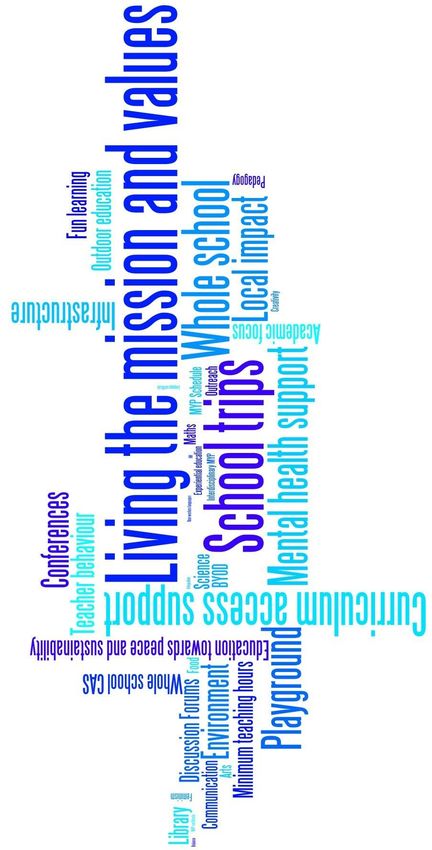
School plan word cloud:
These are the words and
phrases used by our
stakeholders when are asked
to describe in which areas
our school can or should
improve

                     2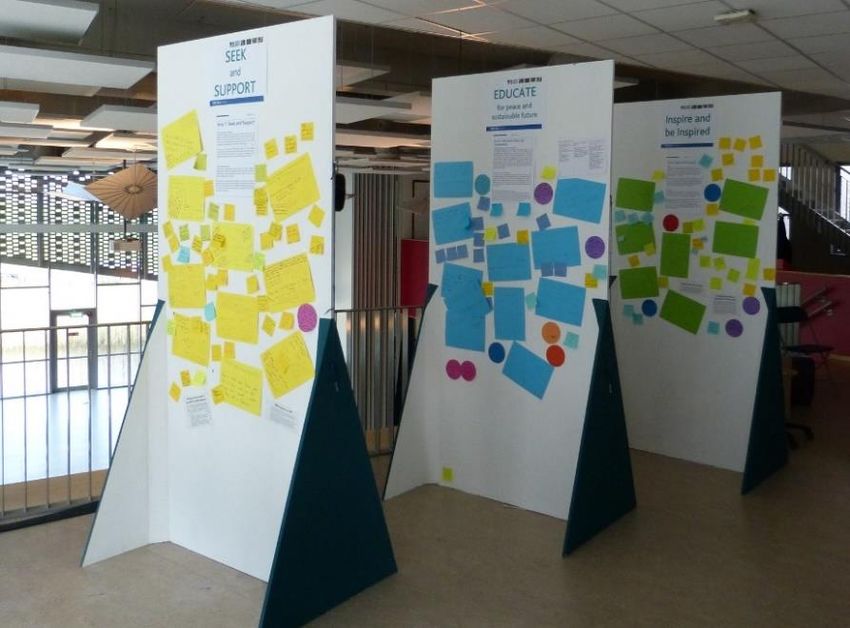
Contents
             Section 1          Learning for today’s world
                                Every school tells a story
                                Challenges of our time
                                Learning to know, be and do
                                The global learning crisis
                                Education in the Netherlands
                                Stepping up (I)
             Section 2          Who we are
                                A global movement
                                UWC global strategy
                                UWC Maastricht: A concise history
                                School identity
                                Three vision statements
             Section 3          What we do
                                Three vision statements
                                Seek & support
                                Educate (for peace and sustainability)
                                Inspire & be inspired
                                Whole-school curriculum
                                Curriculum model
             Section 4          How we improve
                                Stepping up (II)
                                Learning and teaching
                                Recognition of learning
                                People and place
                                Technology and data
                                School culture and organization
             Section 5          What we need to succeed
                                Admissions, Advancement, Alumni, Communications,
                                Community engagement and service, Finance, Facilities and
                                grounds, Governance, Human Resources, Leadership, Outdoor
                                education, Partnerships, Safeguarding, Student support and
                                wellbeing, School culture, Teaching and Learning, Technology
                                and ICT

Cover image: Barbora Lejsková

                                                                                               3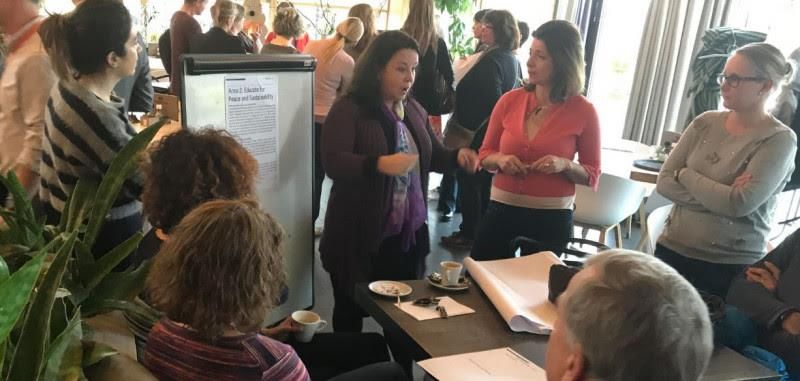
Section 6   How we wrote this school plan
            Accreditation and audits
            Community involvement
            Prioritizing ideas
            Participation Council
            From school plan to implementation
Section 7   Bibliography

                                        “You don’t get lucky if you
                                                plan everything.”
                                                   Joi Ito, MIT Media Lab

                                                                  4
Section 1                      Learning for today’s world
Every school tells a story
As a school community with 925 students from more than one hundred countries, with a staff of 160
professionals who educate the children and teenagers of 700 families from a vast number of ethnic,
religious and socio-economic realities, UWC Maastricht can easily be understood as a scale version of
the world. Due to our diverse backgrounds, there is a need to embrace a shared story about who we
are and what we try to achieve. It will be difficult, if not impossible, to gather the UWC Maastricht
community under a common purpose if this purpose is not articulated in a bold and coherent narrative
about why the school exists and how we pursue our mission and ambitions. This school plan is part of
that story.
    The United World College (UWC) movement is grounded in the conviction that education is our
most powerful pathway to change the world. But before we can contribute to a better world, it is
crucial to first understand the major developments of our times and the challenges students growing
up today will have to solve in their lifetime. This is our purpose in a nutshell: to equip students with
the knowledge, skills and dispositions to understand the world we live in and actively contribute to a
more peaceful and sustainable society. This, we believe, will enable young people to pursue truly
meaningful ambitions, relationships and careers. As parents and staff, we owe this to the young people
under our care. As UWC Maastricht, this is why we exist in the first place.

Challenges of our time
The challenges faced by the planet and our human communities are well-known, yet the solutions to
these challenges remain contested. Our world is characterized by increased volatility, uncertainty,
complexity and ambiguity. The rapid acceleration of technology gives us even less clarity about what
the future may hold. Where past generations could aspire to a chosen career and work hard to try and
succeed, today’s youth don’t have the certainty that their preferred careers will even exist by the time
they graduate from college. It is more likely that they will have to create a job that does not yet exist.
We have a duty to support our students in discovering how to live a meaningful life in a century
characterized by these unprecedented seismic shifts.
   This raises a number of questions. What should our students know, be, and be able to do in order
to live a meaningful life? And what is the most powerful and effective way to prepare them for an
active role in today’s world? And is our school ready for this challenge?

                                                                        “Education is the most
                                                                             powerful weapon
                                                                          which you can use to
                                                                           change the world.”
                                                                                  Nelson Mandela, UWC
                                                                          (Honorary) President 1995-2013

                                                                                                        5
Learning to know, be, and do
What should our students know, be and be able to do in order to live a meaningful life? To rephrase
the question: What knowledge should they acquire in order to make sense of the world we live in?
What dispositions or qualities of mind should they develop in order to live a good and balanced life?
And what types of actionable experiences should they have to develop the skills to make a positive
contribution to society?
    A number of recent international studies by organizations such as UNESCO, the World Economic
Forum, the World Bank, Google and the Boston Consulting Group have reach a remarkably similar set
of conclusions (see Table 1).

                                    Skills Critical thinking/problem solving
            ‘Social & emotional abilities’ Creativity
                                           Collaboration
                                           Communication and listening well
                                           Coaching others
                                Literacies Language literacy
                    ‘Areas of knowledge’ Numeracy
                                           Scientific literacy
                                           Cultural and civic literacy
                                           Economic literacy
                                           ICT literacy
                             Dispositions Empathy
                       ‘Qualities of mind’ Resilience/‘grit’ (physical, emotional)
                                           Curiosity
                                           Initiative/leadership
                                           Social and cultural awareness

             Table 1: Essential skills, literacies and dispositions

The global learning crisis
There is a growing realization in the field of global education that schools the world over are failing to
provide students with the breadth of skills, knowledge and dispositions needed today. Schools
continue to rely on traditional teaching methods suitable for a past era, but not for the present reality.
Schools are only beginning to realize that skills and dispositions like creativity or empathy have less to
do with what is being taught and more to do with how the students are learning. Yet most curricula
still focus almost exclusively on the learning content, thus disconnecting the learning taking place in
schools from the needs of young people and the world they live in. Schools are beginning to step up,
but in almost all cases these accelerations take place in highly developed countries or in private schools
educating a global elite. As a consequence, the difference in achievement and opportunities between
children on the far ends of the socio-economic divide is rapidly growing, making the world more
unequal than it already is. According to UNESCO and the World Bank, this ‘global learning crisis’ is
therefore both an economic and a moral crisis, and it is not a problem for developing countries only.
Although hugely different in scale, some aspects of the global learning crisis can be identified in the
Netherlands too.

                                                                                                        6
Education in the Netherlands
The 2017 annual report from the Dutch Education Inspectorate identified a slow but steady decline in
student’s academic abilities in the Netherlands over the past twenty years. Attainment results have
deteriorated across the subjects and the country has lost its leading international position. The report
shows that the moral crisis identified by the World Bank between socio-economic groups is also visible
in the Netherlands. Segregation between ethnic and socio-economic groups is larger than in other
countries, with fewer opportunities for children from low-income families. Instead of schools being a
force to unite people for peace and a sustainable future, the Dutch education system appear to sustain
or even deepen the various divides within the country. The chief-inspector concluded her report with
a plea for more ambition and innovation, reminding schools and school boards the important role they
play in society.
    These particular features of Dutch education can also be identified in an international innovations
survey by the Center for Universal Education at the Brookings Institution. This report identifies 3,000
educational innovations around the world. A mere six are located in the Netherlands. This compares
weakly with other highly developed countries such as the United States (618 innovations) and Finland
(120), but also with rising economies such as India (320), South Africa (187) and Brazil (130) or even
less developed countries such as Kenya (167), Chile (55) and Bangladesh (38). The Brookings report is
a solid confirmation of the chief-inspector’s advice to step up our educational initiatives and address
the challenges of our time.

Stepping up (I)
The few Dutch educational examples identified in the Brookings report are mostly initiated by our
fellow Ashoka Changemaker Schools. As part of the wider UWC movement, UWC Maastricht features
in this report as a global initiative. We are also recognized by the Harvard Global Education Innovation
Initiative as one of ten most successful organizations worldwide bringing 21st century education into
practice (Chung, 2018).
    UWC Maastricht finds itself in a good position to embrace the challenges of the learning crisis, to
the advantage of our students and the world. We will bring to scale the many things we are doing well,
and step up in those areas where we ought to do better. The present school plan is our five-year
roadmap for this ongoing journey.

                                                    “The moral responsibility of the school, and
                                                  of those who conduct it, is to society. (…) The
                                                  educational system which does not recognize
                                                         that this fact entails upon it an ethical
                                                   responsibility is derelict and a defaulter. It is
                                                  not doing what it was called into existence to
                                                                do, and what it pretends to do.”
                                                                                           John Dewey,
                                                                    Moral Principles in Education (1909)

                                                                                                      7
Section 2                    Who we are
A global movement
UWC is a global movement that embraces Nelson Mandela’s creed that “education is the most
powerful weapon which we can use to change the world.” To this end, the seventeen UWC schools
and colleges bring to each campus a deliberately diverse community of students from around the
world. Our schools and colleges deliver a challenging and transformational educational experience to
young people, inspiring them to become agents of positive change in line with our nine core values:

                  United World Colleges International and intercultural understanding
                               Core values Celebration of difference
                                           Personal responsibility and integrity
                                           Mutual responsibility and respect
                                           Compassion and service
                                           Respect for the environment
                                           A sense of idealism
                                           Personal challenge
                                           Action and personal example

UWC global strategy
In October 2017 the UWC International Board adopted a new strategic plan to inform the work of all
UWC constituents, including UWC Maastricht, from 2018 onwards. The overall aim of this strategy is
to increase UWC’s global impact with a focus on three areas:

          Seek We will seek a deliberately diverse group of students for our schools and
                  colleges from across the globe and strive to enable access to a UWC
                  education for these students independent of socio-economic means
           Educate We will educate our students based on trust, responsibility and autonomy in
                      order for them to develop agency, experience values and gain the attitudes
                      and competencies to be forces for peace, sustainability and social justice
  Inspire We will inspire members of the UWC community to live and act in accordance with the UWC
            mission and we will inspire our partners and other actors in education to embrace values-based
            education celebrating diversity and promoting peace, sustainability and social justice

                                                       “UWC makes education a force to unite
                                                        people, nations and cultures for peace
                                                                    and a sustainable future.”
                                                                              UWC Mission Statement

                                                                                                   8
In addition, the UWC Global Strategy crystallises five principles that all stakeholders of the UWC
movement, including students, parents and staff, adhere to:

                  We create deliberately diverse, engaged and motivated communities united around
                  the UWC mission and values, committed to excellence, driven by an ethos of
          1.      cooperation, transparency and inclusion and willing to engage individually and
                  collectively through action and selfless leadership
                      We give trust, authentic responsibility and appropriate
                      autonomy to our students, staff, participants and volunteers     2.
            We recognise all UWC models of education and our staff, students’ and
   3.       participants’ contribution to the UWC mission, including two year fully residential
            schools, full schools with residential and day students and UWC short courses
        We run UWC schools and colleges as not-for-profit entities and reaffirm the
        importance of UWC’s scholarship programme and our aspiration to strengthen
        it to the point of ensuring access to UWC for students based on promise and           4.
        potential, enabled by meeting all demonstrated financial need
         We work together as an ever closer and united movement, built on the UWC mission,
         values and principles, based on mutual trust and respect, and honouring our
5.       commitment to the celebration of diversity – not just in our student, staff and
         governing bodies, but also in the ways we develop our “UWC-ness”

UWC is unified by one mission, and every school is invited to seek ways in which it can articulate the
mission and values into a curriculum that is meaningful in the school’s local context. The UWC
movement provides the what and why of a UWC education, but as a school we are responsible for its
implementation and execution. It is in the particular how that a UWC education becomes, in our
context, a UWC Maastricht education. UWC provides the ingredients (mission and values), whilst at
UWC Maastricht we create the recipe (the curriculum), build the kitchen (our school and campus) and
prepare and enjoy our meal together (learning and teaching).

UWC Maastricht: A concise history
UWC Maastricht was set up at the invitation of the Dutch Department of Education and is the only
government-sponsored UWC entity within the movement. In 2005, Minister of Education Loek
Hermans invited UWC to consider the establishment of a UWC in the Netherlands, and municipalities
were invited to submit proposals for the development of a new UWC concept in their cities. The
Maastricht proposal was carried by the municipality, the province, the university and companies such
as DSM and Q-Park. For these regional stakeholders, a joint venture with UWC was considered the
most viable route towards attractive schooling opportunities for the local expatriate community. It led
to a unique model within the UWC movement: the merging of two existing international schools
(primary and secondary) embracing the UWC model of education and a residential community largely
selected by the UWC national committees.
   Supported by two parliamentary motions calling for financial support for this initiative, Minister of
Education Marja van Bijsterveldt decided to offer structural funding to UWC Maastricht in December
2007. She did this with the explicit expectation that the school would become a Centre of Expertise in
service learning (an Expertise Centrum voor Maatschappelijke Stages) and a model for innovation
within the Dutch educational landscape.

                                                                                                      9
This illustrates that from the outset, UWC Maastricht was established with a purpose that is both
pragmatic and idealistic, grounded in a tradition of educational excellence (provided by the UWC
model of education and the IB programmes) and an expectation of innovation in values-based learning
and community engagement.
   UWC Maastricht was given ‘final status approval’ as the twelfth member of the UWC family of
schools and colleges in February 2008. The school moved to its purpose-build campus in Amby in
September 2013, with an official opening by the King of the Netherlands and UWC graduate Willem-
Alexander.
   Our take-off years have been characterized by rapid growth in terms of student numbers and the
steady development of a curriculum based on the UWC mission and values. The school has now
reached cruising altitude, with our student enrolment at capacity of over 900 students and a dedicated
and increasingly stable team of staff.

School identity
The following three principles are essential to the identity of UWC Maastricht. We will seek ways to
strengthen these principles and ensure that they are at the forefront of our future planning and
development.

      One school, UWC Maastricht is one school with one mission. All members of our
      one mission community recognize this unity, and we collaborate to develop our
                     school in the pursuit of peace and a sustainable future. We develop
                     whole-school policies and approaches where possible. We align our
                     education across the years from Kindergarten to pre-university
                     graduation to ensure all students regardless of their age and number of
                     years at our school receive a ‘full’ UWC Maastricht education.
           Values first We put our UWC mission and values at the heart of our decision-making.
                          Our education is built around the pursuit of peace and a sustainable future
                          and the nurturing of our values. All elements of our school organization
                          and professional conduct are intentionally designed to support this
                          endeavour. We encourage ongoing dialogue about our mission and values,
                          and we recognize that living the UWC mission can take many shapes and
                          forms.
    We grow and We recognize that we live in an increasingly complex and ‘messy’ world and that the
          adapt purpose of school’s within society is constantly changing. We aim to be a deliberately
                     developmental and adaptive organization and expect our community members to
                     embrace growth and innovation. We stay abreast with developments in education
                     and research, and work with partner organizations to make evidence-based decisions
                     when embracing change. We believe every member of our community is a change
                     leader, and we nurture a culture of initiative, creative collaboration and the tinkering
                     of ideas.

                                                                                                    10
Section 3 What we do
Three vision statements
As the school’s Leadership Team prepared to write this school plan, it was decided to adapt the UWC
Global strategy themes Seek, Educate and Inspire, and develop them into three vision statements
about what UWC Maastricht wants to be. Our three areas are Seek & support, Educate (for peace &
sustainability) and Inspire & be inspired.
Seek & support How do we bring together our deliberately diverse community, and
how do we support our community members whilst they are here?
Educate How do we best educate for peace and a sustainable future
(for peace in all parts of our curriculum? How do we combine this with
& sustainability) the pragmatic educational needs of our students and
parents?
Inspire & How do we increase our impact by inspiring others to engage with our UWC mission?
be inspired How are we inspired by others to ensure we increase our impact?
The below vision statements do not necessarily reflect UWC Maastricht today, but instead describe
our aspired situation. Developing such a vision is an important precondition, as they help us prioritize
and create the circumstances in which our mission and values can be realized.
Seek and support
Seek and support students – We seek a deliberately diverse group of students from across the globe,
selected through our partners in the UWC movement and from the local international community. We
strive to enable access to a UWC Maastricht education for students from diverse backgrounds
independent of socio-economic means. We are an inclusive and caring community for all students
enrolled at the school. We place student support and pastoral care at the heart of our community to
ensure the wellness of our students and their access to the UWC Maastricht curriculum.
Seek and support staff – We seek a deliberately diverse group of staff members, representing different
backgrounds and educational traditions. We unite our staff body under the UWC mission and work as
a team to deliver our curriculum. We provide a professional and adaptive working environment,
allowing employees to continue to grow and develop as teaching and non-teaching educators. We
collaborate with purpose and joy as members of the school community and enablers of the UWC
Maastricht learning experience.
“Freedom as I understand it is to use values
that are most inspiring to us to create the
circumstances in which they can be realized.”
Raoul Martinez, Creating Freedom
11Educate (for peace & sustainability)
Knowing about peace and sustainability – We offer a wide variety of educational programmes that
steer our students towards issues of peace and sustainability. At a level appropriate for their age, they
learn to understand the challenges of our time and discuss ways in which these can be addressed. We
value the importance of academic knowledge, because we cannot contribute to a better world without
a solid understanding of the complexities of society and the planet.
‘Doing’ peace and sustainability – Our students are encouraged to take initiative and actively work
towards a peaceful and sustainable world. Our programmes nurture empathy and collaboration.
Students are challenged to find creative solutions to complex problems and make change
happen. When a student leaves UWC Maastricht, they remain ambassadors of the UWC mission and
values. They are aware of their privileged position in society and are committed to making a positive
contribution towards the greater good.
Being a peaceful and sustainability community – We turn our principles into practice. We are a
peaceful community that celebrates collaboration and team spirit. We are not afraid of conflict as a
mechanism for positive change, but always seek ways to navigate through conflicts in non-violent and
restorative ways. We are a sustainable and eco-friendly school and campus, and take active steps to
become a carbon neutral community.
Inspire & be inspired
Inspire – We inspire each other to make the most of our time at UWC Maastricht. We motivate each
other to take initiative and support and affirm each other in our ideas and actions. We listen to and
learn from each other, and we know that everyone has something to contribute. We check our actions
against our mission and values in every aspect of what we do. We inspire others to make education a
force for peace and a sustainable future. We demonstrate what it means to be a deliberately diverse
community, and we advocate our belief that human differences are worthy of celebration. We engage
with the world of education in the Netherlands and partners in global education worldwide and inspire
others to embrace our mission and values.
Be inspired – We create an environment where we can inspire each other. Our school culture values
collaboration over competition. We believe ideas and initiatives become stronger and more
meaningful if they are shaped through team work and shared conversations. We realize UWC
Maastricht is not a solitary community, but that there are many other like-minded organizations and
schools that we can learn from. We actively seek to be inspired by the ideas and practice of others
through collaborations, shared projects and partnerships. We invite outside experts and consultants
to share their practice and we consider how best to implement those practises within our community.
“The virtue and the strength of UWC is that it
provides small but powerful cells of innovation,
catalysts for change, breaking barriers of habits
and opening broader vistas of experience for both
students and staff.”
Nelson Mandela, UWC (Honorary)
President 1995-2013
12Whole-school curriculum alignment
UWC Maastricht currently offers various educational programmes in the different sections of the
school: A school-designed inquiry-based Kindergarten and Primary curriculum and two IB programmes,
the Middle Years Programme (IBMYP) and Diploma Programme (IBDP). We are also planning to adopt
the IB Career-related Programme (IBCP). Particularly when adopting externally designed and assessed
programmes, it becomes important to articulate how UWC Maastricht tailor-makes these programmes
to suit our own educational mission and values. It is equally important to develop a coherent
understanding of what makes the UWC Maastricht curriculum. This provides clarity on what the key
ingredients are of a UWC Maastricht education and how this translates into the programmes adopted
or designed in each section of the school.
A whole-school understanding of curriculum allows us to align our educational offerings across the
years from Kindergarten to pre-university graduation. It will provide clarity about what a UWC
Maastricht education entails to current and prospective students, parents and staff. It will also allow
us to ensure that all students enrolled at UWC Maastricht, regardless of their age and the number of
years they will stay at our school, receive a ‘full’ UWC Maastricht education. This can be achieved by
dividing the school in a number of multi-year clusters (upper primary, lower secondary etc.). In each
cluster, the curriculum model will inform the development of intentional educational programmes that
nurture the essential literacies, skills and dispositions at a level appropriate for the students’ age and
abilities.
Early years Middle primary Upper primary Lower secondary Upper secondary
> > > > > > > > UWC Maastricht curriculum model > > > > > > > > >
B IB DP
UWCM inquiry-based curriculum IB MYP
IB CP
Figure 1: School clusters and programmes unified by the school curriculum model
Figure 1 above displays which transitions our students go through as they progress in the school. It
thus shows where we must be intentional about how we support students as they transition from one
programme into the next (highlighted in red in Figure 2 below). Examples of this are the transition from
Year 6 into MYP1 or the transition from MYP5 into the IBDP or, in future, into the IBCP. The CIS
accreditation process suggests that we develop a more coherent ‘vertical articulation’ – in other words:
that we become more intentional about these key transitions in the school continuum and bridge the
gaps when and where needed.
Early years Middle primary Upper primary Lower secondary Upper secondary
> > > > > > > > UWC Maastricht curriculum model > > > > > > > > >
B IB DP
UWCM inquiry-based curriculum IB MYP
IB CP
Figure 2: Key transition areas
13Curriculum model
By a ‘full’ UWC Maastricht education we understand an educational experience that nurtures and
develops all the essential literacies, skills and dispositions identified on page 5. Student engage with
the world (e.g. teachers, society and subject content) and each other through meaningful experiences.
Such engaged learning fosters the knowledge relevant in our world today, develops the breadth of
skills needed for twenty-first century living and strengthens the crucial dispositions to enable them to
make a meaningful contribution to society. This process can best be captured in the below curriculum
model.
Empathy Communication and listening well
Language literacy Curiosity
Initiative / leadership Critical thinking /
Scientific numeracy
Problem
solving
Cultural
and
Civic Learning to know Learning to do
literacy “Reading the world” “Writing the world”
Numeracy " Creativity
Economic literacy ICT Resilience / ‘grit’ Collaboration
Literacy Social and cultural awareness Coaching others
Figure 3: The UWC Maastricht curriculum model
Such a curriculum can best be understood as a butterfly with two wings. In order for our students to
fly successfully and sustainably we need to grow and strengthen both wings. In each identified cluster
of the school, our curriculum consists of both programmes where students learn to understand the
world we live in (the knowing programme) and learn to act in the world we live in (the doing
programme). As a consequence, they develop the dispositions needed to become autonomous human
beings equipped to make a meaningful contribution to society. The two butterfly wings enable our
student to reach the sky. In the doing programme, students gain the cognitive knowledge to read the
world we live in. At a level appropriate for their age, they learn to understand the challenges of our
time and discuss ways in which these problems can be addressed. But knowledge is not enough. In
order to make a difference, it is important to also learn how to act. Being able to “read the world” is
key for meaningful living, but developing the skills and dispositions that allow our students to “write
and rewrite the world” is even greater. This is the purpose of the various parts of the doing programme,
the butterfly’s second wing.
Both wings of the butterfly model are equally essential in our educational pursuit. Although they
sometimes compete for time, they do not compete in educational value. Just as a butterfly with one
wing will not be able to fly, students will not be able to contribute to a better and more peaceful world
and prepare themselves for the workplace without a full immersion in both dimensions of learning.
Only if we simultaneously learn how to know and how to act can we truly read and write our world.
An intentional curriculum maps how and in which ways the various literacies, skills and dispositions
are developed, how progress is mapped and assessed and how student learn and develop from
reflecting on their learning. This will be part of our endeavour in the years ahead.
14Section 4 How we improve
Stepping up (II)
To guide and support our strategic development in the next four to five years, we adopt a framework
developed by the Center for Universal Education at the Brookings Institution (Winthrop et al. 2017).
This framework is based on a close analysis of educational innovations worldwide. It provides a horizon
for meaningful improvement and illustrates the practical steps that can we can take in order to
transform how and what our students learn. During the school plan years, we will survey on which step
we are currently positioned, and then identify the ways in which we can move to the next step.
What follows are four models identifying the core elements of education: learning and teaching,
recognition of learning, people and places, technology and data. To suit our purposes, these models
are slightly modified from Winthrop et al. (2017). In short, these models illuminate how we are able to
make all elements of our education increasingly authentic, diverse and student-driven.
Learning and teaching
Students evaluate, design, and create
Students apply information in new original work and question and criticise
Students recall facts and basic situations and draw connections existing work
LEARNING concepts and explain ideas or among ideas Evaluate and create:
concepts Apply and analyse: Apply and analyse +
Remember and understand: Remember and understand + Remember and understand +
LEARNING AND TEACHING – INCREASINGLY STUDENT-CENTRED
Lecture-based: Lecture-based + Lecture-based +
Teacher is in charge; students Interactive: Interactive +
TEACHING passively receive information Teacher sometimes engages Playful:
students in discussion, activities or Learning is driven by students’ inquiry
group work and needs, meaningfully connected to
their lives, it fosters experimentation
and social interaction. Teachers often
act as collaborators and guides
Recognition of learning
Students progress individually as they
demonstrate mastery of content. They
Students progress based on ability, move fluidly between learning groups
to a limited extent. They and have the option of designing their
sometimes move between groups own assessments and pathways
PROGRESSION Students progress based on of peers with similar ability Individual-based:
time and age in a linear fashion Group-based: Group-based +
Pre-determined: Pre-determined + Pre-determined +
RECOGNITION OF LEARNING – INCREASINGLY STUDENT-LED
Education-led: Education-led + Education-led +
The school mediates the Hybrid-led: Hybrid-led +
VERIFICATION verification process. Society The school mediates the Society-led:
recognises the diplomas and verification process in collaboration Society mediates the verification
(Assessment)
other reports from the school. with external agencies. Assessment process in authentic, student-led ways.
Assessment primarily validates validates knowledge, skills and They find ways to directly recognize
acquired knowledge conceptual understanding students’ knowledge, skills and
dispositions that are of particular
relevance to their future ambitions
15People and places
Learning involves community
members, peers, parents, graduates,
Teachers sometimes team with employers, and others, along with
parents, facilitators, students and educators
PEOPLE Teachers bear the entire others Everyone:
responsibility of teaching Teachers team with others: Teachers team with others +
Certified teachers: Certified teachers + Certified teachers +
PEOPLE AND PLACES – INCREASINGLY DIVERSE
In school: In school + In school +
Learning is formal, organized, Connected to outside school: Connected to outside school +
PLACES and occurs inside a defined Learning is primarily organized in a In a diversity of contexts:
space (classroom) and time formal setting, but may sometimes Learning that uses multiple places,
(school day, period) occur outside the school building including schools, community and
and hours – online or in person workspaces. These spaces are
transformed into learning places for
optional, authentic learning
Technology and data
Technology allows for significant task
redesign, or allows for the creation of
new tasks that were previously
Technology acts as a direct tool inconceivable. Technology is integrated
Technology acts as a direct tool substitute, with functional and embedded in learning
TECHNOLOGY substitute with no functional improvement Modification & redefinition
change Augmentation: Augmentation +
Substitution: Substitution + Substitution +
TECHNOLOGY AND DATA – INCREASINGLY LEARNING-ORIENTED
For compliance: For compliance + For compliance +
Collection and analysis of data For programme improvement: For programme improvement +
USE OF DATA is infrequent. Data is mainly Infrequent collection and analysis For transforming learning experiences:
used for routine compliance of data. Data may be used to Collection and analysis of data in real
(e.g. term reports) improve curriculum; limited use of time; data are used to evolve
data to improve learning curriculum, increase transparency and
improve learning experiences. Data are
less compliance oriented and may be
less standardized
“The function of education is to teach one to think
intensively and to think critically. Intelligence plus
character - that is the goal of true education.”
Martin Luther King Jr.
16School culture and organization
To succeed in the four developmental areas described above, we also need to ensure we have a school
culture and organization that is suited for these developments. In order to go from strength to strength
in the pursuit of the UWC mission, we need to grow and adapt in the type of organization best suited
for what we are trying to achieve. The below model illustrates what such a culture and organization
looks like. It is loosely adapted from the work of Laloux & Appert (2017), Kegan & Lahey (2017) and
Schwartz (2018).
People practice what they preach. The
mission and values are internalised as
People walk the walk in most a way of being. The culture is purpose-
areas. Symbols and rituals bind the driven and collaborative. People talk
The organisation articulates community. Pre-existing negative with each other about their ideals and
the desired culture. People perceptions are changing for the ambitions, and everyone experiences a
talk the talk and there is a better. A shared purpose is high sense of excitement at being part
degree of buy-in. A short-term identified by those who visit for an of this organization
CULTURE visitor can identify the extended period of time Internalized culture:
articulated culture Practised culture: Practised culture +
Articulated culture: Articulated culture + Articulated culture +
CULTURE AND ORGANIZATION – INCREASINGLY GROWTH-ORIENTED
Hierarchy-oriented: Hierarchy-oriented + Hierarchy-oriented +
Responsibilities are formally Policies and process-oriented: Policies and process-oriented +
ORGANIZATION defined. Performance A defined long-term vision and Community growth-oriented:
objectives are handed down perspective. Coherent policies and Professional community based on
the organization and micro- processes in place. Solid degree of shared ideals and high level of
managed by (ad hoc) trust in leadership and stability of engagement through participation and
leadership. People seek the organization. Performance deliberate conversations. Individuals
ongoing permission before review based on meritocracy and play different roles at different times
taking initiative. Performance growth. Strategy drives the and feel empowered to take initiative
review based on accountability organizational culture. and innovate. Leadership is distributed
and compliance. Leadership across flexible teams. The organization
defines the organizational is constantly growing and adapting to
culture shifting stakeholders needs. Culture
drives the organizational strategy.
“The whole is greater than the sum of its parts.”
Aristotle, Metaphysics
17Section 5 What we do to succeed
This section highlights how we plan to develop in a number of key areas of the school. This thematic
summary is based on the conversations and information-gathering processes during the spring term
of 2018, and incorporates recommendations from our recent CIS accreditation, the UWC global
strategy and suggestions from various other audits carried out in the course of the academic year 2017-
2018.
Admissions
We develop clear online and paper-based school documentation for new families and students,
including up to date information about (new) subject offerings, special projects and those elements
that make UWC Maastricht different from other international schools and UWC schools and colleges.
We revisit our inclusion policy to enable access to our school for the widest-as-possible variety of
students.
We develop clear policies regarding enrolment, re-enrolment and wait listing, balancing both the
needs of existing families, maximizing socio-economic diversity and healthy financial planning.
We strengthen our collaboration with the Dutch UWC National Committee, ensuring a stable pool of
Dutch NC-selected residential students, within agreed financial parameters.
When and where appropriate and possible, we support families as they transition into and out of our
school and the Netherlands. We will engage with families to discover what such support may look like,
and develop support structures accordingly.
Advancement
Under Advancement we bring together all school operations and activities that contribute to the
development of UWC Maastricht into a more sustainable mission-driven organization, with a key focus
on financial sustainability through branding, communications, fundraising and the development of
long-term partnerships.
We bring together branding, communications and fundraising in one Advancement Team, and
continue to strengthen this team’s activities and engagement with the school and outside community.
We develop a bold and persuasive narrative about UWC Maastricht and actively engage with outside
parties to develop long-term partnerships with major and small donors.
We build up our fundraising capacity with annual budgeted targets for (A) scholarship provision, (B)
school projects and programmes, (C) school improvements in terms of peace and sustainability
education, and (D) the steady build-up of a UWC Maastricht endowment fund.
We develop persuasive special projects and actively seek external funding for these projects. Existing
examples of such projects are the Promise Programme and the UWC Parliament of Student Mayors.
We strengthen our collaboration with UWC International and the UWC schools and colleges through
an aligned fundraising strategy and, where possible, movement-wide information sharing.
Alumni
We continue to engage with our growing alumni network, and build up a dynamic and involved UWC
Maastricht alumni community through our alumni platforms, social media, newsletters, events and
‘time, talent and treasure’ opportunities.
We develop a culture of giving back among our alumni. This includes a UWC-wide generational
commitment: student receiving as much scholarship funding as they need to attend UWC and each
student then seeks to ‘return’ over the course of a lifetime as much as he or she can to support new
students.
We work with our alumni to showcase their stories and as “faces and voices” of UWC Maastricht.
18Communications
Communication was identified by all stakeholders as an area in need of improvement, yet there was
little consensus on what such improvement may look like: some felt a need for more information and
communication, whilst others felt that the school suffered from too much information and that we
need to adopt a less-is-more-approach with fewer but better targeted communications.
We conduct a whole school communications review to identity bottle necks and opportunities in our
internal and external communications, and develop a communications strategy in line with the
recommendations of this review and our one school, one mission identity.
We review our current operating systems and platforms for communications to seek greater clarity
and coherence, for instance in our ongoing communication with parents.
We improve our internal communications for it to become more supportive and engaging for those
working and learning at UWC Maastricht and for our parent community.
Community engagement and service
UWC Maastricht was founded on the promise to the Dutch government that the school would become
a Center of Expertise in service learning and community engagement. It is this element of our mission
– to make education a force for the common good – that led to the invitation to establish a UWC in
the Netherlands and subsequent Ministry of Education funding.
We will heed the founding promise to become a Center of Expertise in service learning and community
engagement, role modelling and advocating the role schools can play in the advancement of society.
We develop a whole school philosophy on Creativity, Action, Service and community engagement, and
develop and (re)design programmes and activities accordingly.
We seek ways to further integrate the various model of learning (in and outside of the classroom) into
intentional and well-articulated programmes, including reflection and innovative forms of assessment
in all areas of learning.
We strengthen our connections with local and national partners to share, learn and contribute to our
host city, region and country.
We establish a social learning think tank/hub, host UWCx projects and/or UWC short courses, and
create spaces for innovations in community engagement.
Finance
We carry out a whole-school financial review (a zero-based budgeting analysis).
We commit to the highest level of financial accountability for our school Cooperative and other
entities/foundations operating under the UWC Maastricht flag.
We create greater coherence and liaison between the admissions and finance departments.
We agree on a target for developing the school’s reserve funds to ensure long-term financial viability.
We increase the financial sustainability of our school through fundraising and partnerships with our
main regional and national stakeholders.
“How can there be peace without people
understanding each other, and how can this be
if they don’t know each other?”
Lester B. Pearson,
Nobel Peace Prize Lecture (1957)
19Facilities and grounds
We develop a realistic growth scenario and liaise with our regional partners (municipality, province) to
address the space limitations in the school. We explore possibilities for special expansion on campus
and/or in the immediate vicinity of our campus.
We analyse how we can make better and more effective use of our current facilities, including the
island grounds. This includes an ongoing commitment to learning through and with nature and outdoor
education.
We commit to making our campus more sustainable, greener and more biodiverse.
We carry out a substantive carbon emissions analysis, and adopt strategies to become carbon neutral
in an achievable but ambitious time frame.
We create more opportunities for creativity, silence and reflection on our campus.
We transform our current library facilities into a multimedia resource environment aligned to our
educational programmes.
In line with best practice in school library provision, we maximize the use of the Library to enhance
student learning and necessary teacher support in areas such as digital citizenship development,
research skills and academic honesty.
We continue to work with external agencies to strengthen our perimeter security.
We acquire an easily accessible on-campus defibrillator and ensure training for appropriate use.
Governance
Following recommendations from CIS, we will:
Consider appropriate training for Board members and collaborative Board-Leadership planning
opportunities.
Create a policy manual for current and prospective board members and ensure it is available for all
stakeholders.
Human Resources
We commit to being a trustworthy employer, allowing our employees to work in a happy and healthy
work environment. Reliable, transparent and supportive HR policies and practices lie at the heart of
our school’s development in the next years. We recognize the constraints of being part of the Dutch
educational framework (including the primary and secondary CLA’s) and of our identity as one school
operated by different governing parties. Recognizing these constraints in shaping an autonomous HR
practice, we will endeavour to embrace our One school, one mission identity and apply this where and
whenever possible in our HR policies and practise. To this end:
We develop whole school HR policies and practices in the area of recruitment, performance review,
professional development, promotion and salary structures. We ensure our HR policies and usage of
data are fully complaint with Dutch legislation and best practices.
We work closely with the Participation Council and consult widely with staff when developing and
implementing new policies.
Following best practice in education, we will conduct regular Employee Satisfaction Surveys to inform
us on areas for improvement.
We ensure our policies and procedures are easily available and understandable for all employees. We
are pro-active in providing information to (prospective) staff on legislation and procedures related to
working in the Netherlands.
We recruit with the commitment to create a deliberately diverse staff community.
Following from our performance review experiment, we will establish a full review cycle for all
employees in line with our mission, values and (emerging) organizational culture.
We create a culture of growth and (professional) development. We align professional development to
our mission and values and ensure teachers are up to standard with developments in UWC-related
20fields of education: peace education, sustainability education and experiential education. We support
– where possible – teachers in obtaining (advanced) teacher qualifications, MA and PhD degrees.
We maximize our pool of teachers involved with the International Baccalaureate, as workshop
participants, workshop leaders, examiners, exam setters and curriculum developers.
We train colleagues to be able to train each other (‘teachers teaching teachers’) and establish a
network of returning external trainers and consultants, thus developing a sustainable process of
school-based professional development.
We ensure staff have access to internal and external trust persons, and that we have a well-trained
Prevention Officer.
We encourage staff to learn Dutch, and liaise with the Dutch language teachers to facilitate this.
Leadership
We need to ensure that our leadership structures are suitable for the ambitions of the school, including
the ambitions presented in this school plan. In addition, a shifting understanding of the type of
organization we aspire to be leads to a redefinition in leadership roles in the school. To this end:
We review current Leadership and Strategy Team positions and seek ways to align our leadership
structures with our mission, values and ambitions for development.
We review senior and middle leadership roles and responsibilities to make them more purposeful and
aligned with our educational goals.
We seek leadership training and coaching for colleagues in positions of leadership.
We offer crisis management training for colleagues in positions of leadership and residence mentors.
We actively participate in the UWC Leadership Development Programme, creating opportunities for
senior and middle leaders to engage with colleagues in other UWC schools and colleges.
Outdoor education
In line with the UWC model of education, we step up our offering of outdoor experiences throughout
the school, including overnight excursions.
We will explore the development of a UWC Maastricht Outdoor Centre in the Heuvelland. This would
ideally be a refurbished farm with outdoor education facilities and farmlands for growing crops.
A UWC Maastricht Outdoor Centre will allow us to organize outdoor experiences for all students on an
ongoing, rotating basis and, simultaneously, allow us to offer the facility as a service to other outside
groups and schools.
Partnerships
As part of the UWC movement and as a Dutch Ashoka changemaker school, we recognise our position
as an influential and innovative organization in the field of global values-driven education.
We foster existing partnerships and seek new ones with foundations, charities, universities, NGOs in
the pursuit of our UWC mission and values and for the benefit of our students’ educational experience.
We encourage staff, students and alumni to inspire and be inspired by our partner organizations.
We designate one person in senior leadership as partnership-lead within the school.
“What we need is a pedagogy of curiosity. Not
a pedagogy of the answer but of the question.”
Paulo Freire
21Safeguarding
We continue to work with partner organisations (e.g. CIS, UWCIO, Augeo) to ensure that our
Safeguarding practices are to the highest international standard.
We ensure our Safeguarding principles and practises are regularly updated and integrated across all
other policies (e.g. recruitment).
We ensure our designated safeguarding specialist will have ongoing, high level training and clear
responsibilities. Likewise, we develop and deliver high level safeguarding training for all staff and for
all students, and where applicable, wider community members.
Student support and well-being
We care about people. We want our staff, students and the whole community to have access to a
healthy, safe, resilient and balanced lifestyle. We realize that the experiences we have at school can
have a major impact on the rest of our lives. We want people to take care of themselves and of each
other. We will support students as much as we can through our specialised student support teams and
we will provide resources and appropriate spaces to equip these teams to deliver a high quality support
system. Our ambition is to create a more holistic approach to student support and wellbeing and
develop methods to systematically track the wellness of our students. To this end:
We review and strengthen our pastoral support system, including a clear articulation of the roles of
tutors, teachers, Heads of Year, students support staff and counsellors.
We review and strengthen the delivery of Life Skills within the school, with a whole school continuum
with clear roles for teachers, tutors, Residence Mentors, support staff and (external) specialist
educators.
We create additional professional development opportunities for staff to support them to provide
access to learning for all students.
We strengthen our expertise and train teachers in socially emotionally sensitive teaching practises,
particular for students from vulnerable backgrounds.
We build an increasingly strong ELL department, and strengthen teachers’ abilities to support ELL
students in their classrooms.
We strengthen our relationships with UWC national committees, allowing us to be more proactive in
supporting committees in selecting resilient students and supporting students as they prepare to arrive
at UWC Maastricht.
We recognise that physical activity is vital to a healthy lifestyle and we commit to finding ways of
increasing our activity offerings for all our students.
School culture
In order to develop and ‘step up’ in the areas described in Section 4, we need to create and foster a
climate of trust, support, courage and a sense of wonder and possibility. To this end:
We develop ongoing opportunities for community interaction through conversations, dialogue, and
debate and community activities.
We will strengthen or create the avenues for voice and participation for all community members. It is
important that everyone in the community feels heard, and that everyone in the community can share
ideas openly towards school improvement. We become deliberate about creating opportunities for
student agency and staff and parent participation, offering authentic leadership and responsibility to
all community members, including our youngest students.
We work with the Participation Council to develop a new Participation Statute (medezeggenschaps-
statuut), to ensure effective participation structures are in place.
We create and articulate frameworks for conflict management and mediation and educate our
community in non-violent communication and restorative justice.
We create comprehensive School Guides (schoolgids) in line with Participatory legislation for the
various sections in our school: Primary, MYP, DP (and CP, if adopted).
22Teaching and Learning
As part of the progressive school movement, UWC embraces a pedagogy of experience to foster more
peaceful and sustainable societies. This means that peace education and sustainability education
through a pedagogy of experiential education (or encounter-based learning) lie at the heart of our
pursuit, both inside and outside the classroom. To this end:
We investigate the possibility of a whole school Director of Education to direct all learning and teaching
and pedagogical professional development in the school.
We articulate a whole school pedagogy and a shared understanding on learning and teaching at UWC
Maastricht, including approaches to assessment, homework, reporting, parental contacts, feedback,
staff-student roles and responsibilities.
We become increasingly intentional about how all aspects of our education relate to peace and
sustainability, and develop pathways to strengthen these features. We will build in-house expertise
and capacity in terms of student-driven learning. We identify inconsistencies in our whole school
curriculum through more extensive collaboration and team work.
We design a philosophy on how technology, ICT and library resources serve our pedagogical practices
and develop accordingly.
We will dedicate Professional Development sessions to collaborative planning for curriculum design
and pedagogy.
We will create more out-of-school partnerships, such as with local companies, to enhance project-
based and real life learning opportunities and create room in the calendar for in-depth project work to
occur.
Across the school, we organize more trips and experiences that take learning outside of the classroom.
All students should have access to trips and experiences and a vertical articulation across subject areas
and year levels will be developed to ensure a fairer allocation and opportunity.
We recognise that learning can and should take place in a variety of ways. We value traditional
classroom learning but also believe authentic learning takes places outside of the timetable or when
you least expect it.
We seek ongoing opportunities for students to experience the UWC educational principles of peace,
sustainability, internationalism, celebration of difference, integrity, respect, compassion and
challenge.
Whether a student has a UWC Maastricht experience for 2 year or for 14 years, we strive to offer them
access to this experiential way of learning to ensure they receive a ‘full’ UWC Maastricht education.
“Education is what remains after one has
forgotten what one has learned in school.”
Albert Einstein
23Technology and ICT
We investigate the appointment of a whole-school tech-leader (a ‘Director Technologies for learning’)
with a brief to optimise opportunities for tech-related teaching and learning.
We develop a philosophy on how ICT and other technology can serve our mission and values. We
establish educational and organizational practices based on this philosophy.
We develop a whole-school understanding and appreciation of the role of technology in our lives.
Following from the understanding that technology functions to serve and not enslave human beings,
we pro-actively support our students navigate the risks of addiction and empower them to make
autonomous decisions in school and in their private lives.
We enhance the abilities of staff to use and develop technologies for learning and for effective
professional communication.
We continue to align technology, ICT and learning, particularly in the area of mapping student progress
and assessment.
We ensure all our ICT and data usage through technology complies with privacy regulations.
24You can also read


