Score Guide for test takers
←
→
Page content transcription
If your browser does not render page correctly, please read the page content below
Score Guide for test takers
           Version 13 – May 2020

© Copyright Pearson Education Ltd 2017. All rights reserved; no part of this publication may be reproduced without the prior written
permission of Pearson Education Ltd.
Table of Contents
Introduction......................................................................................................................................................................... 4

1. Reported Scores: An Overview .......................................................................................................................................... 5
    Overall score ................................................................................................................................................................................... 6
    Communicative skills scores ......................................................................................................................................................... 6
    Enabling skills scores ..................................................................................................................................................................... 7

2. Item Scoring: An Overview ................................................................................................................................................ 9
    Correct or incorrect ........................................................................................................................................................................ 9
    Partial credit ................................................................................................................................................................................... 9
    How all 20 item types are scored ................................................................................................................................................. 9
      Scoring criteria: Pronunciation and Oral fluency................................................................................................................ 17

3. Using PTE Academic Scores ............................................................................................................................................. 20
    How test takers can use PTE Academic scores .......................................................................................................................... 20
      Overall score and communicative skills scores................................................................................................................... 20
      Sending scores to governments or institutions ................................................................................................................. 21

4. Estimates of concordance between PTE Academic, CEFR, TOEFL iBT and IELTS .................................................................. 22
    The PTE Academic Score Scale and the CEFR ........................................................................................................................... 23
    What PTE Academic scores mean .............................................................................................................................................. 24
      Estimate of concordance between PTE Academic scores and TOEFL iBT ....................................................................... 25
      Estimate of concordance between PTE Academic and IELTS ........................................................................................... 25

5. Scored Samples .............................................................................................................................................................. 26
    Automated scoring ....................................................................................................................................................................... 26
      Scoring written English skills ................................................................................................................................................. 26
      Scoring spoken English skills ................................................................................................................................................ 27
      Enabling skill scores and trait scores examples .................................................................................................................. 28
    Spoken samples ............................................................................................................................................................................ 29
      Example Describe image item ............................................................................................................................................... 29
      Test Taker responses .............................................................................................................................................................. 32
    Overall performance rating ........................................................................................................................................................ 34
    Written samples ........................................................................................................................................................................... 35
      Example Write essay item ‘Tobacco’ .................................................................................................................................... 35
      Test Taker Responses ............................................................................................................................................................. 38
    Overall performance rating ........................................................................................................................................................ 41

6. Glossary ......................................................................................................................................................................... 42

 Version 13/May 2020                                                                                                                                                                              2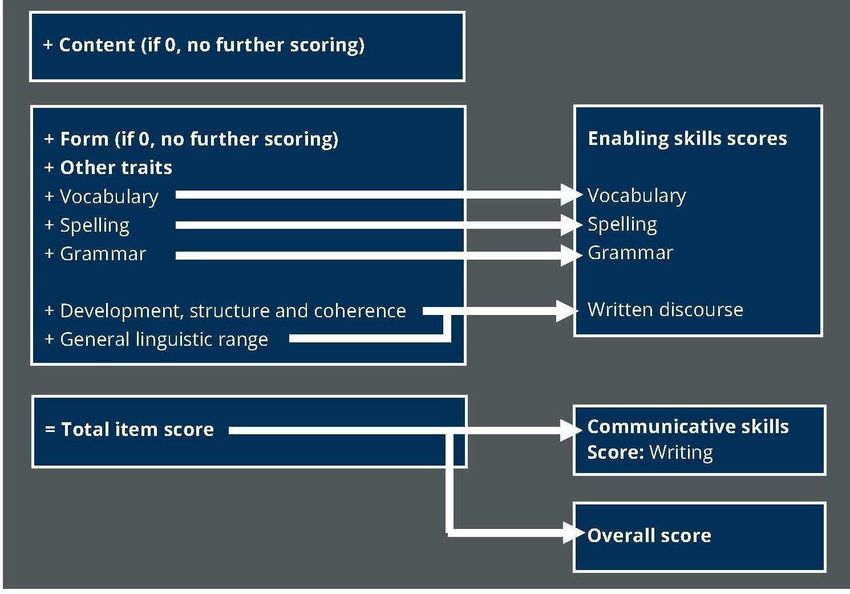
Introduction
Pearson Test of English Academic (PTE Academic) is an international computer-based English
language test. It provides a measure of a test taker’s language ability to assist education
institutions and professional and government organizations that require a standard of academic
English language proficiency for admission purposes.

The Score Guide is designed for test takers who want to learn more about how the
different tasks in PTE Academic are scored. The Guide will help you to understand:
    • What test takers are assessed on
    • How to use scores reported on the score report
    • How to compare PTE Academic scores with scores on other English language tests
    • How automated scoring operates

The Guide has been bookmarked and linked so that you can access sections quickly from
the ‘Contents’ page and dip into the topics you want to know more about.

The contents of this Guide, along with those published on our website, are the only official and valid
information about PTE Academic.

Version 13/May 2020                                                                              4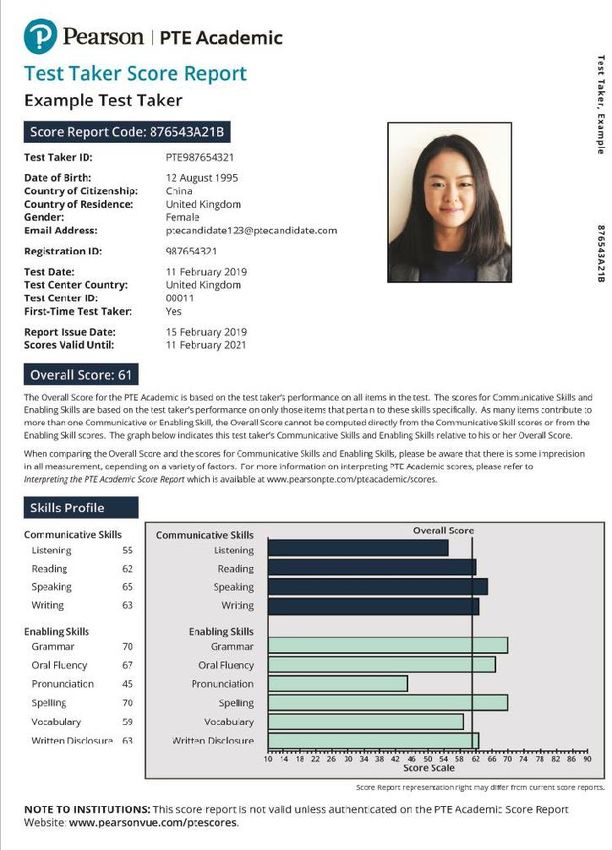
1. Reported Scores: An Overview
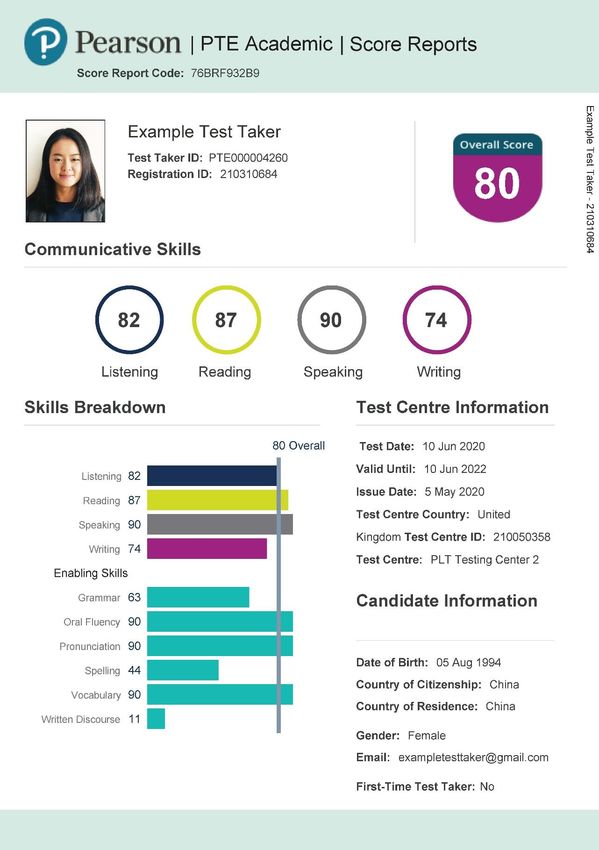
PTE Academic reports an overall score, communicative skills scores and enabling skills scores.
Below is a picture of a full Test Taker Score Report. On the next page, there is a picture showing
the score details, with an explanation of what they mean.

Version 13/May 2020                                                                              5
Overall score
The overall score is based on performance on all test items (tasks in the test consisting of
instructions, questions or prompts, answer opportunities and scoring rules). Each test taker will
answer between 71 and 83 items in any given test and there are 20 different item types. For
each item, the score given contributes to the overall score. The score range is 10–90 points.

Note: the overall score is not an average calculation of the communicative scores.

Communicative skills scores
The communicative skills measured are listening, reading, speaking and writing. These are the
scores you will be judged on for visa/HEI entry. Items testing these communicative skills also test
specific subskills. For items requiring integrated skills (those assessing reading and speaking,
listening and speaking, reading and writing, listening and writing, or listening and reading) the
item score contributes to the score for the communicative skills that the item assesses. The score
range for each skill is 10–90 points.

Version 13/May 2020                                                                                 6
Enabling skills scores

Enabling skills are reported so that test takers can understand areas of strength and areas for
improvement in their language ability. The enabling skills are grammar, oral fluency,
pronunciation, spelling, vocabulary, and written discourse. Enabling skill scores are summaries
of a test taker’s performance on different aspects of language that are scored in different item
types.

Some speaking and writing items are scored against criteria relating to traits in the spoken or
written responses. Traits are characteristics of the response relating to features of language ability.
The traits listed in the table below contribute to enabling skills scores, as well as to overall and
communicative skills scores.

   Enabling skill     Enabling skill definition                     Traits used in scoring
   Oral fluency       Smooth, effortless and natural-paced          Oral fluency
                      delivery of speech
   Pronunciation      Ability to produce speech sounds in a         Pronunciation
                      way that is easily understandable to
                      most regular speakers of the language.
                      Regional or national pronunciation
                      variants are considered correct to the
                      degree that they are understandable to
                      most regular speakers of the language.
   Written            Correct and communicatively efficient         Development, structure
   discourse          production of written language at the         and coherence
                      textual level. Written discourse skills are
                      manifested in the structure of a written      AND
                      text, its internal coherence, logical
                      development, and the range of                 General linguistic range
                      linguistic resources used to express
                      meaning precisely.
   Vocabulary         Appropriate choice of words used to           Vocabulary
                      express meaning precisely in written and
                      spoken English, as well as lexical range
   Grammar            Correct use of language with respect to       Grammar
                      word form and word order at the sentence
                      level
   Spelling           Writing of words according to the spelling    Spelling
                      rules of the language. All national
                      variations in spelling are considered
                      correct.

Version 13/May 2020                                                                                7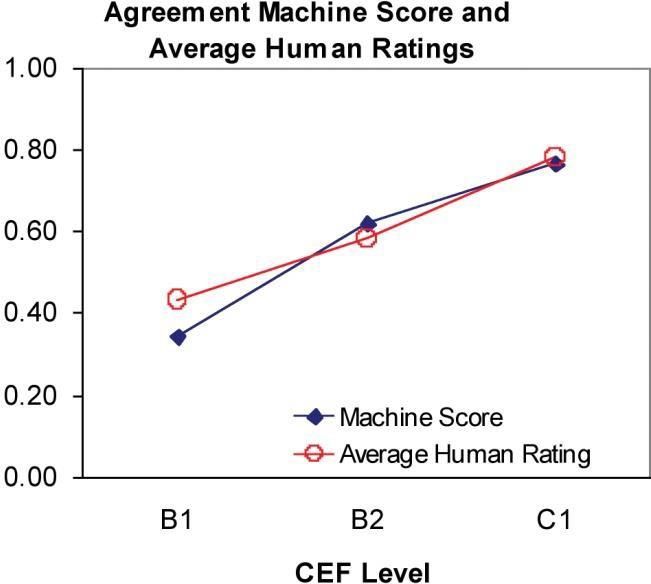
Some speaking and writing items are also scored for Content. Content scores identify how
 appropriately the content of a spoken or written response addresses the item prompt. Some
 writing items are scored for Form. Form scores are based on formal characteristics of the
 response such as the number of words. Content and Form scores contribute to overall and
 communicative skills scores, but do not contribute to any enabling skills scores.

 For some speaking and listening items, when the content of a response to an item is scored
 as not dealing appropriately with an item prompt, or if formal requirements of the response
 are not met, no score points for the response will be given. Here are two examples giving
 descriptions of essay responses that will not receive any score points:

     1. An essay which addresses a completely different topic from the item prompt (content)

     2. An essay which is less than 120 words (form)

 Please see Section 2: Item Scoring for further information on how items are scored.

Version 13/May 2020                                                                            8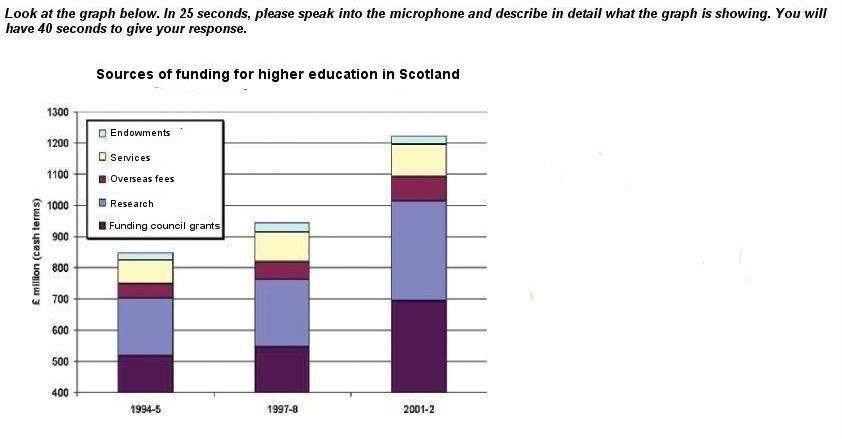
2. Item Scoring: An Overview
All items in PTE Academic are machine scored. Scores for some item types are based on
correctness alone, while others are based on correctness, formal aspects and the quality of the
response.

Formal aspects refer to the form of the response: for example, whether it is over or under the
word limit for a particular item type.

The quality of the response is represented in the enabling skills. For example, in the item type
Re-tell lecture the response is scored on enabling skills such as oral fluency and pronunciation.

Scores for item types assessing speaking and writing skills are generated by automated scoring
systems. There are two types of scoring:

Correct or incorrect
Some item types are scored as either correct or incorrect. If responses are correct, 1 score point
will be given, but if they are incorrect, no score points are awarded.

Partial credit
Other item types are scored as correct, partially correct or incorrect. If responses to these items
are correct, the maximum score points available for each item type will be received. If they are
partly correct, some score points will be given, but less than the maximum available for the item
type. If responses are incorrect, no score points will be received.

How all 20 item types are scored
The tables that follow give an overview of how the 20 item types in the three parts of PTE
Academic (Part 1 Speaking and Writing, Part 2 Reading, Part 3 Listening) are scored. They also
show timings, the number of items in any given test, and the communicative skills, enabling
skills and other elements scored.

Version 13/May 2020                                                                                  9
Part 1 Speaking and Writing (approx. 72–93 minutes)
Item type              Time       Number Scoring               Communicative skills   Traits scored
                       allowed    of items                     scored
Read aloud             30-35      6-7         Partial credit   Reading and speaking   Content, pronunciation, oral fluency
                       minutes                                                        Content:
                                                                                      Each replacement, omission or insertion of a
                                                                                      word counts as one error.
                                                                                      Maximum score: depends on the length
                                                                                      of the item prompt
                                                                                      Pronunciation:
                                                                                      5 Native-like
                                                                                      4 Advanced
                                                                                      3 Good
                                                                                      2 Intermediate
                                                                                      1 Intrusive
                                                                                      0 Non-English
                                                                                      (See detailed criteria on page 20.)
                                                                                      Oral fluency:
                                                                                      5 Native-like
                                                                                      4 Advanced
                                                                                      3 Good
                                                                                      2 Intermediate
                                                                                      1 Limited
                                                                                      0 Disfluent
                                                                                      (See detailed criteria on page 20.)

                                                                                                                                     10
Part 1 Speaking and Writing (approx. 72–93 minutes)
Item type              Time       Number Scoring               Communicative skills      Traits scored
                       allowed    of items                     scored
Repeat sentence                   10-12       Partial credit   Listening and speaking    Content, pronunciation, oral fluency
                                                                                         Content:
                                                                                         Errors = replacements, omissions and
                                                                                         insertions only
                                                                                         Hesitations, filled or unfilled pauses, leading or
                                                                                         trailing material are ignored in the scoring of
                                                                                         content
                                                                                         3 All words in the response from the
                                                                                         prompt in the correct sequence
                                                                                         2 At least 50% of words in the response
                                                                                         from the prompt in the correct sequence
                                                                                         1 Less than 50% of words in the
                                                                                         response from the prompt in the correct
                                                                                         sequence
                                                                                         0 Almost nothing from the prompt in the
                                                                                        response
                                                                                         Pronunciation:
                                                                                         5 Native-like              (See detailed
                                                                                         4 Advanced                 criteria on
                                                                                         3 Good                     page 20.)
                                                                                         2 Intermediate
                                                                                         1 Intrusive
                                                                                         0 Non-English
                                                                                         Oral fluency:
                                                                                         5 Native-like              (See detailed
                                                                                         4 Advanced                 criteria on
                                                                                         3 Good                     page 20.)
                                                                                         2 Intermediate
                                                                                         1 Limited
                                                                                         0 Disfluent

                                                                                                                                              11
Part 1 Speaking and Writing (approx. 72–93 minutes)
Item type Time Number Scoring Communicative skills Traits scored
allowed of items scored
Describe image 6-7 Partial credit Speaking Content, pronunciation, oral fluency
Content:
5 Describes all elements of the image and their
relationships, possible development and conclusion
or implications
4 Describes all the key elements of the image and
their relations, referring to their implications
or conclusions
3 Deals with most key elements of the image
and refers to their implications or conclusions
2 Deals with only one key element in the image
and refers to an implication or conclusion.
Shows basic understanding of several core
elements of the image
1 Describes some basic elements of the image, but
does not make clear their interrelations or
implications
0 Mentions some disjointed elements of the
presentation
Pronunciation:
5 Native-like
4 Advanced (See detailed criteria
3 Good on page 20.)
2 Intermediate
1 Intrusive
0 Non-English
Oral fluency:
5 Native-like (See detailed criteria on
4 Advanced page 20.)
3 Good
2 Intermediate
1 Limited
0 Disfluent
8Part 1 Speaking and Writing (approx. 72–93 minutes)
Item type Time Number Scoring Communicative skills Traits scored
allowed of items scored
Re-tell lecture 3-4 Partial credit Listening and speaking Pronunciation, oral fluency
Pronunciation:
5 Native-like
4 Advanced
3 Good
2 Intermediate
1 Intrusive
0 Non-English
(See detailed criteria on page 20.)
Oral fluency:
5 Native-like
4 Advanced
3 Good
2 Intermediate
1 Limited
0 Disfluent
(See detailed criteria on page 20.)
Content:
5 Re-tells all points of the presentation and describes
characters, aspects and actions, their relationships, the
underlying development, implications and conclusions
4 Describes all key points of the presentation and
their relations, referring to their implications and
conclusions
3 Deals with most points in the presentation and
refers to their implications and conclusions
2 Deals with only one key point and refers to an
implication or conclusion. Shows basic understanding of
several core elements of the presentation
91 Describes some basic elements of the presentation
but does not make clear their interrelations or
implications
0 Mentions some disjointed elements of the
presentation
Part 1 Speaking and Writing (approx. 72–93 minutes)
Item type Time Number Scoring Communicative skills Traits scored
allowed of items scored
Answer short 10-12 Correct/ Listening and speaking Vocabulary
question incorrect 1 Appropriate word choice in response
0 Inappropriate word choice in response
Summarize written 20-30 2-3 Partial credit Reading and writing Form, grammar, vocabulary
text minutes Form:
1 Is written in one, single, complete sentence
0 Not written in one single, complete sentence or
contains fewer than 5 or more than 75 words.
Summary is written in capital letters.
Content:
2 Provides a good summary of the text. All relevant
aspects mentioned
1 Provides a fair summary of the text but misses one
or two aspects
0 Omits or misrepresents the main
aspects of the text
Grammar:
2 Has correct grammatical structure
101 Contains grammatical errors but with no hindrance
to communication
0 Has defective grammatical structure which could
hinder communication
Vocabulary:
2 Has appropriate choice of words
1 Contains lexical errors but with no hindrances to
communication
0 Has defective word choice which could hinder
communication
11Part 1 Speaking and Writing (approx. 72–93 minutes)
Item type Time Number Scoring Communicative skills Traits scored
allowed of items scored
Write essay 20-40 1-2 Partial credit Writing Content; form; development, structure, coherence;
minutes grammar; general linguistic range; vocabulary range;
spelling
Content:
3 Adequately deals with the prompt
2 Deals with the prompt but does not deal with one
minor aspect
1 Deals with the prompt but omits a major
aspect or more than one minor aspect
0 Does not deal properly with the prompt
Form:
2 Length is between 200 and 300 words
1 Length is between 120 and 199 or between 301
and 380 words
0 Length is less than 120 or more than 380 words.
Essay is written in capital letters, contains no
punctuation or only consists of bullet points or very
short sentences
Development, structure and coherence:
2 Shows good development and logical structure
1 Is incidentally less well structured, and some
elements or paragraphs are poorly linked
0 Lacks coherence and mainly consists of lists or
loose elements
12Part 1 Speaking and Writing (approx. 72–93 minutes)
Item type Time Number Scoring Communicative skills Traits scored
allowed of items scored
Write essay Grammar:
2 Shows consistent grammatical control of
complex language. Errors are rare and difficult to
spot.
1 Shows a relatively high degree of grammatical
control. No mistakes which would lead to
misunderstandings
0 Contains mainly simple structures and/or several
basic mistakes
General linguistic range:
2 Exhibits smooth mastery of a wide range of
language to formulate thoughts precisely, give
emphasis, differentiate and eliminate ambiguity. No
sign that the test taker is restricted in what they want
to communicate
1 Sufficient range of language to provide clear
descriptions, express viewpoints and develop
arguments
0 Contains mainly basic language and lacks precision
Vocabulary range:
2 Good command of a broad lexical repertoire,
idiomatic expressions and colloquialisms
1 Shows a good range of vocabulary for matters
connected to general academic topics. Lexical
shortcomings lead to circumlocution or some
imprecision
0 Contains mainly basic vocabulary insufficient to
deal with the topic at the required level
Spelling:
2 Correct spelling
1 One spelling error
0 More than one spelling error
13Part 2 Reading (approximately 31–41 minutes)
Item type Time Number Scoring Communicative skills Traits scored
allowed of items scored
Reading and writing: 32-41 5-6 Partial credit (for Reading and writing
Fill in the blanks minutes each correctly 1 Each correctly completed blank
completed blank) 0 Minimum score
Multiple-choice, 2-3 Partial credit (for Reading
choose multiple each correct 1 Each correct response
answers response. Points - 1 Each incorrect response
deducted for 0 Minimum score
incorrect options
chosen)
Re-order paragraphs 2-3 Partial credit (for Reading
each correctly 1 Each pair of correct adjacent
ordered, adjacent textboxes
pair) 0 Minimum score
Reading: Fill in the 4-5 Partial credit (for Reading
blanks each correctly 1 Each correctly completed blank
completed blank) 0 Minimum score
Multiple-choice, 2-3 Correct/ Reading
choose single incorrect 1 Each correctly completed blank
answer 0 Minimum score
14Part 3 Listening (approx. 44–61 minutes)
Item type Time Number Scoring Communicative skills Traits scored
allowed of items scored
Summarize spoken 20-30 2-3 Partial credit Listening and writing Content, form, grammar, vocabulary, spelling
text minutes Content:
2 Provides a good summary of the text. All
relevant aspects are mentioned.
1 Provides a fair summary of the text, but one
or two aspects are missing
0 Omits or misrepresents the main aspects
Form:
2 Contains 50-70 words
1 Contains 40-49 words or 71-100 words
0 Contains less than 40 words or more than
100 words. Summary is written in capital
letters, contains no punctuation or consists
only of bullet points or very short sentences.
Grammar:
2 Correct grammatical structures
1 Contains grammatical errors with no
hindrance to communication
0 Defective grammatical structure which could
hinder communications
Vocabulary:
2 Appropriate choice of words
1 Some lexical errors but with no hindrance to
communication
0 Defective word choice which could hinder
communication
Spelling:
2 Correct spelling
1 One spelling error
0 More than one spelling errors
15Part 3 Listening (approx. 44–61 minutes)
Item type Time Number Scoring Communicative skills Traits scored
allowed of items scored
Multiple–choice, 23-28 2-3 Partial credit (for Listening
choose multiple minutes each correct 1 Each correct response
answers response. Points - 1 Each incorrect
deducted for response
incorrect options 0 Minimum score
chosen)
Fill in the blanks 2-3 Partial credit (for Listening and writing
each correct work 1 Each correct word
spelled correctly spelled correctly
0 Minimum score
Highlight correct 2-3 Correct/incorrect Listening and reading
summary 1 Correct response
0 Incorrect response
Multiple-choice, 2-3 Correct/incorrect Listening
choose single 1 Correct response
answer 0 Incorrect response
Select missing word 2-3 Correct/incorrect Listening
1 Correct response
0 Incorrect response
Highlight incorrect 2-3 Partial credit (For Listening and reading
words each word. 1 Each correct word
Points deducted - 1 Each incorrect word
for incorrect 0 Minimum score
options chosen)
Write from dictation 3-4 Partial credit (for Listening and writing
each word 1 Each correct word
spelled correctly) spelled correctly
0 Each incorrect or
misspelled word
16Scoring criteria: Pronunciation and Oral fluency
The following scoring criteria apply to the speaking item types that are scored on
pronunciation and oral fluency in PTE Academic.
Pronunciation
5 Native-like All vowels and consonants are produced in a manner that is easily
understood by regular speakers of the language. The speaker uses
assimilation and deletions appropriate to continuous speech. Stress is
placed correctly in all words and sentence-level stress is fully appropriate.
4 Advanced Vowels and consonants are pronounced clearly and unambiguously. A few minor
consonant, vowel or stress distortions do not affect intelligibility. All words are
easily understandable. A few consonants or consonant sequences may be
distorted. Stress is placed correctly on all common words, and
sentence level stress is reasonable.
3 Good Most vowels and consonants are pronounced correctly. Some consistent errors
might make a few words unclear. A few consonants in certain contexts may be
regularly distorted, omitted or mispronounced. Stress-
dependent vowel reduction may occur on a few words.
2 Intermediate Some consonants and vowels are consistently mispronounced in a non- native
like manner. At least 2/3 of speech is intelligible, but listeners might need to
adjust to the accent. Some consonants are regularly omitted, and consonant
sequences may be simplified. Stress may be placed incorrectly on
some words or be unclear.
1 Intrusive Many consonants and vowels are mispronounced, resulting in a strong intrusive
foreign accent. Listeners may have difficulty understanding about 1/3 of the
words. Many consonants may be distorted or omitted. Consonant sequences
may be non-English. Stress is placed in a non-English manner; unstressed words
may be reduced or omitted, and a few syllables added or
Missed.
0 Non-English Pronunciation seems completely characteristic of another language. Many
consonants and vowels are mispronounced, mis-ordered or omitted.
Listeners may find more than 1/2 of the speech unintelligible. Stressed and
unstressed syllables are realized in a non-English manner. Several words
may have the wrong number of syllables.
Oral fluency
5 Native–like Speech shows smooth rhythm and phrasing. There are no hesitations,
repetitions, false starts or non-native phonological simplifications.
4 Advanced Speech has an acceptable rhythm with appropriate phrasing and word emphasis.
There is no more than one hesitation, one repetition or a false
start. There are no significant non-native phonological simplifications.
3 Good Speech is at an acceptable speed but may be uneven. There may be more
than one hesitation, but most words are spoken in continuous phrases.
There are few repetitions or false starts. There are no long pauses and
speech does not sound staccato.
2 Intermediate Speech may be uneven or staccato. Speech (if >= 6 words) has at least one
smooth three-word run, and no more than two or three hesitations, repetitions
or false starts. There may be one long pause, but not two or more.
Version 13/May 2020 171 Limited Speech has irregular phrasing or sentence rhythm. Poor phrasing, staccato or
syllabic timing, and/or multiple hesitations, repetitions, and/or false starts make
spoken performance notably uneven or discontinuous. Long utterances may
have one or two long pauses and inappropriate sentence-
level word emphasis.
0 Disfluent Speech is slow and labored with little discernable phrase grouping, multiple
hesitations, pauses, false starts, and/or major phonological simplifications.
Most words are isolated, and there may be more than one long pause.
Please note: The minimum and maximum timings indicated for the sections of each part of the
test do not add up to the total timings stated. This is because different versions of the test are
balanced for total length. No test taker will get the maximum or minimum times indicated.
Example of item scoring
The diagram below illustrates how different types of scores reported in the PTE Academic score
report are computed for the item type Write essay.
Version 13/May 2020 18The item type is rated on content; form; vocabulary; spelling; grammar; development, structure and coherence; and general linguistic range. The item is first scored on content. If no response or an irrelevant response is given, the content is scored as 0. If an acceptable response is provided (a score is received for content), the item will be scored on form. If the response is of the appropriate length, a score will be given and the response will then be rated on the remaining traits: vocabulary, spelling, grammar; development, structure and coherence; and general linguistic range. The trait scores for content, form, vocabulary, spelling, grammar, development, structure and coherence, and general linguistic range are used to calculate the total item score. The scores for vocabulary, spelling, and grammar contribute to those enabling skills scores. Both the development, structure and coherence trait score and general linguistic range trait score contribute to the written discourse enabling skill score. The total item score contributes to the communicative skills score for writing, as well as to the overall score reported for performance on the entire test. Version 13/May 2020 19
3. Using PTE Academic Scores

How test takers can use PTE Academic scores

Overall score and communicative skills scores

The score report provides an overall score, a score for each communicative skill and a score for
each of the enabling skills.

The overall score is a general measure of a test taker’s ability to deal with English in
academic settings. The score range is from 10 to 90 points.

The communicative skills scores provide information about the listening, reading, speaking and
writing skills of a test taker. These skills are also scored between 10 and 90 points.

Example Institution Score Report

In some university programs, the communicative skills scores may provide useful, additional
information for making admissions decisions. For example, institutions may:
Version 13/May 2020                                                                           20
Set the admission requirement based on the minimum overall score alone, without taking into
account communicative skills scores in admission decisions;

Set the admission requirement based on the minimum overall score in combination with a higher
minimum on one of the communicative skills scores, because it is considered particularly important
for the program the test taker wants to enter;

Set the admission requirement based on the minimum overall score in combination with a lower
minimum on one of the communicative skills scores, because it is considered less important for the
program the test taker wants to enter.

Universities may also consider other combinations of the overall score and one or more of the
communicative skills scores.

Sending scores to governments or institutions

The score submission process is changing.
From April 2019, Pearson will be adding a new Score Report Code (SRC) to your PTE Academic
Score Report to make it easier for institutions to access and verify your score in the future. Since we
are currently in the process of upgrading the tool used by institutions to check scores, please
continue to assign your score to institutions using your PTE Academic account unless you receive a
notice from an institution that they are ready to accept the new Score Report Code.

You must send your PTE Academic score through our secure portal. Institutions do not accept paper
or PDF versions of PTE Academic score reports.

Instructions
1. Login to your account.
2. Click ‘View Score Reports.’
3. Click ‘Send Scores’.
4. Type of name of your chosen institution in the field marked
   ‘Institution/Organization/Department/School’ and click ‘Search’.
5. Tick the box next to the institution’s name when it appears in the list.
6. Review your details, then scroll down the page and click ‘Next’ and then ‘Next’ again to confirm.

Repeat for each institution. (You can send your Score Report to an unlimited number of institutions,
but you can only select up to seven recipients at any one time.)

Applying for a visa to work or study in Australia or New Zealand?
If, when booking your test, you ticked one of the boxes asking for scores to be allocated to the DHA
(Australia) or INZ (New Zealand) your score will have been automatically sent to them.

Version 13/May 2020                                                                             21
4. Estimates of concordance between PTE
Academic, CEFR, TOEFL iBT and IELTS
Based on research and empirical studies, Pearson has produced concordance tables showing the
relationship between the PTE Academic test, the IELTS Academic test and TOEFL. The table on the
next page shows Pearson’s current best estimate of concordance between PTE Academic scores and
the Common European Framework of Reference for Languages (CEFR). In addition, shaded score
ranges indicate the PTE Academic scores that predict some degree of performance at the next CEFR
level.

Please note that any attempt to predict a score on a particular test, based on the score observed on
another test, will contain measurement error. This is caused by the inherent error in each of the
tests in the comparison and in the estimate of the concordance. Furthermore, tests in the
comparison do not measure exactly the same construct.

Version 13/May 2020                                                                         22
The PTE Academic Score Scale and the CEFR

The explanation of the alignment of PTE Academic to the CEFR is that to stand a reasonable chance
at successfully performing any of the tasks defined at a particular CEFR level, learners must be able
to demonstrate that they can do the average tasks at that level.

As students grow in ability, for example within the B1 level, they will become successful at doing
even the most difficult tasks at that level and will also find they can cope with the easiest tasks at
the next level. In other words, they are entering into the B2 level.

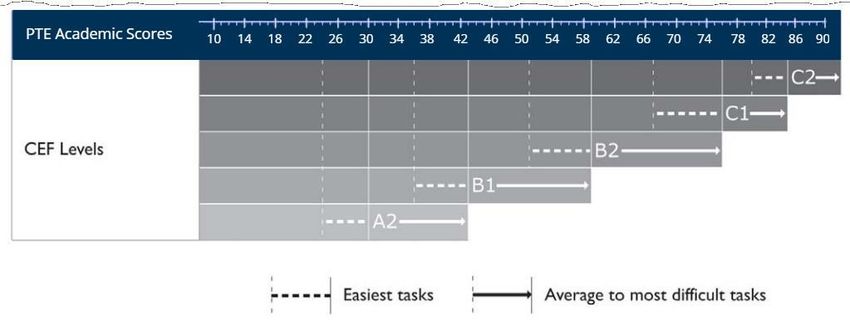
The diagram below shows PTE Academic scores aligned to the CEFR levels A2 to C2. The dotted
lines on the scale show the PTE Academic score ranges that predict that test takers are likely to
perform successfully on the easiest tasks at the next higher level. For example, if a candidate scores
51 on PTE Academic, this means that they are likely to be able to cope with the more difficult tasks
within the CEFR B1 level. At the same time, according to their PTE Academic score, it predicts that
they are likely to perform successfully on the easiest tasks at B2.

       CEFR Levels

Alignment of PTE Academic scores to the CEFR

Version 13/May 2020                                                                              23
What PTE Academic scores mean
PTE Academic alignment with the CEFR can only be fully understood if it is supported with
information showing what it really means to be ‘at a level’. In other words, are test takers likely to
be successful with tasks at the lower boundary of a level; do they stand a fair chance of doing well
on any task, or will they be able to do almost all the tasks, even the most difficult ones, at a
particular level? The table below shows for each of the CEFR levels A2 to C2 which PTE Academic
scores predict the likelihood of a test taker performing successfully on the easiest, average and
most difficult tasks within each of the CEFR levels.
PTE Academic scores predicting the likelihood of successful
performance on CEFR level tasks
CEFR Level Easiest Average Most Difficult
C2 80 85 NA
C1 67 76 84
B2 51 59 75
B1 36 43 58
A2 24 30 42
For example, if a test taker’s PTE Academic score is 36, this predicts that they will perform
successfully on the easiest tasks at B1. From 36 to 43, the likelihood of successfully performing the
easiest tasks develops into doing well on the average tasks at B1. Finally, reaching 58 predicts that a
candidate will perform well at the most difficult B1 level tasks.
Version 13/May 2020 24Estimate of concordance between PTE Academic scores and TOEFL iBT
TOEFL iBT PTE TOEFL iBT PTE
Score Academic Score Academic
Score Score
No data 85 - 90 90 61
120 84 89 60
119 83 87-88 59
118 82 86 58
117 81 85 57
115-116 80 83-84 56
114 79 82 55
113 78 81 54
112 77 79-80 53
110-111 76 78 52
109 75 76-77 51
107-108 74 74-75 50
106 73 72-73 49
105 72 70-71 48
103-104 71 67-69 47
102 70 65-66 46
101 69 63-64 45
99-100 68 60-62 44
98 67 57-59 43
97 66 54-56 42
95-96 65 52-53 41
94 64 48-51 40
93 63 45-47 39
91-92 62 40-44 38
No data 10 - 37
Estimate of concordance between PTE Academic and IELTS
IELTS Score PTE Academic
Score
9.0 86 - 90
8.5 83 - 85
8.0 79 - 82
7.5 73 - 78
7.0 65 – 72
6.5 58 - 64
6.0 50 - 57
5.5 42 - 49
5.0 36 - 41
4.5 29 - 35
No data 10 - 28
Version 13/May 2020 255. Scored Samples Automated scoring As the worldwide leader in publishing and assessment for education, Pearson uses several proprietary, patented technologies to automatically score test takers’ performance on PTE Academic. Academic institutions, corporations and government agencies around the world have selected Pearson’s automated scoring technologies to measure the abilities of students, staff or applicants. Pearson customers using automated spoken and written assessments include eight of the 2008 Fortune Top 20 companies; 11 of the 2008 Top 15 Indian BPO companies; the U.S., German and Dutch governments; world sports organizations, such as FIFA (organizers of the World Cup) and the Asian Games; major airlines and aviation schools; and leading universities and language schools. An extensive field test program was conducted to test PTE Academic’s test items and evaluate their effectiveness as well as to obtain the data necessary to train the automated scoring engines to evaluate PTE Academic items. Data was collected from more than 10,000 test takers from 38 cities in 21 countries who participated in PTE Academic’s field test. These test takers came from 158 different countries and spoke 126 different native languages, including (but not limited to) Cantonese, French, Gujarati, Hebrew, Hindi, Indonesian, Japanese, Korean, Mandarin, Marathi, Polish, Spanish, Urdu, Vietnamese, Tamil, Telugu, Thai and Turkish. The data from the field test were used to train the automated scoring engines for both the written and spoken PTE Academic items. By combining the power of a comprehensive field test, in-depth research and Pearson’s proven, proprietary automated scoring technologies, PTE Academic fills a critical gap by providing a state-of-the-art test that accurately measures the English language speaking, listening, reading and writing abilities of non-native speakers. Scoring written English skills The written portion of PTE Academic is scored using the Intelligent Essay Assessor™ (IEA), an automated scoring tool that is powered by Pearson’s state-of-the-art Knowledge Analysis Technologies™ (KAT™) engine. Based on more than 20 years of research and development, the KAT engine automatically evaluates the meaning of text by examining whole passages. The KAT engine evaluates writing as accurately as skilled human raters using a proprietary application of the mathematical approach known as Latent Semantic Analysis (LSA). Using LSA (an approach that generates semantic similarity of words and passages by analyzing large bodies of relevant text) the KAT engine “understands” the meaning of text much the same as a human does. Version 13/May 2020 26
IEA can be tuned to understand and evaluate text in any subject area and includes built-in
detectors for off-topic responses or other situations that may need to be referred to human
readers. Research conducted by independent researchers as well as Pearson supports IEA’s
reliability for assessing knowledge and knowledge-based reasoning. IEA was developed more
than a decade ago and has been used to evaluate millions of essays, from scoring student
writing at elementary, secondary and university level, to assessing military leadership skills.

Scoring spoken English skills

The spoken portion of PTE Academic is automatically scored using Pearson’s Ordinate
technology. Ordinate technology is the result of years of research in speech recognition,
statistical modeling, linguistics and testing theory. The technology uses a proprietary speech
processing system that is specifically designed to analyze and automatically score speech from
native and non-native speakers of English. In addition to recognizing words, the system locates
and evaluates relevant segments, syllables and phrases in speech and then uses statistical
modeling technologies to assess spoken performance.

To understand the way that the Ordinate technology is “taught” to score spoken language, think
about a person being trained by an expert rater to score speech samples during interviews. First,
the expert rater gives the trainee rater a list of things to listen for in the test taker’s speech during
the interview. Then the trainee observes the expert testing numerous test takers, and, after each
interview, the expert shares with the trainee the score he or she gave the test taker and the
characteristics of the performance that led to that score. Over several dozen interviews, the
trainee’s scores begin to look very similar to the expert rater’s scores. Ultimately, one could
predict the score the trainee would give a particular test taker based on the score that the expert
gave.

This, in effect, is how the machine is trained to score, only instead of one expert teaching the
trainee, there are many expert scorers feeding scores into the system for each response, and
instead of a few dozen test takers, the system is trained on thousands of responses from
hundreds of test takers. Furthermore, the machine does not need to be told what features of the
speech are important; the relevant features and their relative contributions are statistically
extracted from the massive set of data when the system is optimized to predict human scores.

Ordinate technology powers the Versant™ line of language assessments, which are used by
organizations such as the U.S. Department of Homeland Security, schools of aviation around the
world, the Immigration and Naturalization Service in the Netherlands, and the
U.S. Department of Education. Independent studies have demonstrated that Ordinate’s
automated scoring system can be more objective and more reliable than many of today’s best
human-rated tests, including one-on-one oral proficiency interviews.

More information about automated scoring is available on our website:
www.pearsonpte.com/organisations/teachers-teaching-resources/scoring/

Version 13/May 2020                                                                                27
Enabling skill scores and trait scores examples

The PTE Academic test taker’s score report includes:

1. Overall test scores,
2. Communication scores of the four skills of Reading, Writing, Listening and Speaking,
3. Enabling skills in Writing and Speaking – Grammar, Oral fluency, Pronunciation, Spelling,
   Vocabulary, and Written Discourse.

The sections below show examples of how scoring operates for Speaking and Writing items.
The scoring mechanisms in these items are based on collecting data on multiple relevant traits in
each item, giving them each a score, and then converting them all to an overall score in either
speaking or writing. The automated system is trained on the trait scores of hundreds of items
scored by human expert markers. Once trained, our automated systems can then quickly score all
new speaking and writing items quickly and accurately. The traits measured in PTE Academic
include:

•   Content
•   Oral Fluency
•   Pronunciation
•   Form
•   Development, structure and coherence
•   Grammar
•   General linguistic range
•   Vocabulary

Some of these traits are reported also as discrete enabling skills, while other traits are combined to
contribute to more generic enabling skills such as written discourse.

Version 13/May 2020                                                                            28
Spoken samples
The PTE Academic automated scoring system correlates highly with human ratings. Studies have
been carried out to compare human and machine scores for the speaking item type Describe
image using tasks such as the example below.

Example Describe image item

Samples of test taker responses at B1, B2 and C1 were collected as well as comments from the
Language Testing division of Pearson. The ratings on each response include a machine score
and scores from at least two human raters. In cases where the two human rater scores differed,
an adjudicator was used to provide a third human rating.

Scoring

The Describe image item is scored on 3 different traits:

                             Maximum raw
Traits                                              Human rating           Machine score
                             score
Content                      5                      5                      5
Oral fluency                 5                      5                      5
Pronunciation                5                      5                      5
Maximum item score           15                     15                     15

These traits are scored as shown in the chart that follows.

Version 13/May 2020                                                                        29
Content Pronunciation Oral fluency
5: 5 Native-like: 5 Native–like:
Describes all All vowels and consonants are produced Speech shows smooth, rhythm and
elements of the in a manner that is easily understood by phrasing. There are no hesitations,
image and their regular speakers of the language. The repetitions, false starts or non-
relationships, speaker uses assimilation and deletions native phonological simplifications.
possible appropriate to continuous speech. Stress
development and is placed correctly in all words and
conclusion or sentence-
implications level stress is fully appropriate.
4: 4 Advanced: 4 Advanced:
Describes all the key Vowels and consonants are pronounced Speech has an acceptable rhythm
elements of the clearly and unambiguously. A few minor with appropriate phrasing and
image and their consonant, vowel or stress distortions do word emphasis. There is no more
relations, referring to not affect intelligibility. All words are than one hesitation, one repetition
their implications or easily understandable. A few consonants or a false start. There are no
conclusions or consonant sequences may be significant non-native phonological
distorted. Stress is placed correctly on all simplifications.
common words, and sentence level stress
is reasonable.
3: 3 Good: 3 Good:
Deals with most key Most vowels and consonants are Speech is at an acceptable speed
elements of the pronounced correctly. Some consistent but may be uneven. There may be
image and refers to errors might make a few words unclear. A more than one hesitation, but most
their implications or few consonants in certain contexts may words are spoken in continuous
conclusions be regularly distorted, omitted or phrases. There are few repetitions
mispronounced. Stress- dependent vowel or false starts.
reduction may occur There are no long pauses and
on a few words. speech does not sound staccato.
2: 2 Intermediate: 2 Intermediate:
Deals with only one Some consonants and vowels are Speech may be uneven or
key element in the consistently mispronounced in a non- staccato. Speech (if >= 6 words)
image and refers to native like manner. At least 2/3 of has at least one smooth three-
an implication or speech is intelligible, but listeners word run, and no more than two
conclusion. Shows might need to adjust to the accent. or three hesitations, repetitions or
basic understanding Some consonants are regularly omitted, false starts. There may be one long
of several core and consonant sequences may be pause, but not two or more.
elements of the simplified. Stress may be
image placed incorrectly on some words or
be unclear.
1: 1 Intrusive: 1 Limited:
Describes some basic Many consonants and vowels are Speech has irregular phrasing or
elements of the mispronounced, resulting in a strong sentence rhythm. Poor phrasing,
image, but does not intrusive foreign accent. Listeners may staccato or syllabic timing, and/or
make clear their have difficulty understanding about 1/3 multiple hesitations, repetitions,
interrelations or of the words. Many consonants may be and/or false starts make spoken
implications distorted or omitted. performance notably uneven or
Consonant sequences may be non- discontinuous. Long utterances
English. Stress is placed in a non- may have one or two long pauses
Version 13/May 2020 30Content Pronunciation Oral fluency
English manner; unstressed words may and inappropriate sentence-level
be reduced or omitted and a few word emphasis.
syllables added or missed.
0: 0 Non-English: 0 Disfluent:
Mentions some Pronunciation seems completely Speech is slow and labored with
disjointed elements characteristic of another language. Many little discernable phrase grouping,
of the presentation consonants and vowels are multiple hesitations, pauses, false
mispronounced, mis-ordered or starts, and/or major phonological
omitted. Listeners may find more than simplifications.
1/2 of the speech unintelligible. Most words are isolated, and there
Stressed and unstressed syllables are may be more than one long pause
realized in a non-English manner.
Several words may have the wrong
number of syllables
Version 13/May 2020 31Test Taker responses
Test-taker A: mid B1 Level
Listen to audio sample ‘Test taker A’
Comment on response
The response lacks some of the main contents. Only some obvious information from the
graph is addressed. Numerous hesitations, non-native-like pronunciation, poor language use
and limited control of grammar structures at times make the response difficult to understand.
How the response was scored
The table below and subsequent tables under ‘How the response was scored’ show the machine
scores and the human ratings that have been assigned to this response. When the cells in the
adjudicator column are empty, the adjudicator score does not deviate from the scores given by the
first and second human rater.
Maximum Machine Human Human
Trait name Adjudicator
raw score score rater 1 rater 2
Content 5 1.69 2 2
Oral fluency 5 1.62 4 2 2
Pronunciation 5 1.41 2 2
Total item score 15 4.72 8 6 6
Version 13/May 2020 32Test taker B: mid B2 Level
Listen to audio sample ‘Test taker B’
Comment on response
The test taker discusses some aspects of the graph and the relationship between elements, though
some key points have not been addressed. The rate of speech is acceptable.
Language use and vocabulary range are quite weak. There are some obvious grammar
errors and inappropriate stress and pronunciation.
How the response was scored
Maximum Machine Human Human
Trait name Adjudicator
raw score score rater 1 rater 2
Content 5 2.50 2 3 2
Oral fluency 5 3.71 4 5 3
Pronunciation 5 3.28 3 4 2
Total item score 15 9.49 9 12 7
Test taker C: mid C1 Level
Listen to audio sample ‘Test taker C’
Comment on response
The test taker discusses the major aspects of the graph and the relationship between
elements. The response is spoken at a fluent rate and language use is appropriate. There are
few grammatical errors in the response. The candidate demonstrates a wide range of
vocabulary. Stress is appropriately placed.
How the response was scored
Maximum Machine Human Human
Trait name Adjudicator
raw score score rater 1 rater 2
Content 5 2.70 3 4 3
Oral fluency 5 4.03 4 5 4
Pronunciation 5 4.02 5 4 4
Total item score 15 10.75 12 13 11
Version 13/May 2020 33Overall performance rating
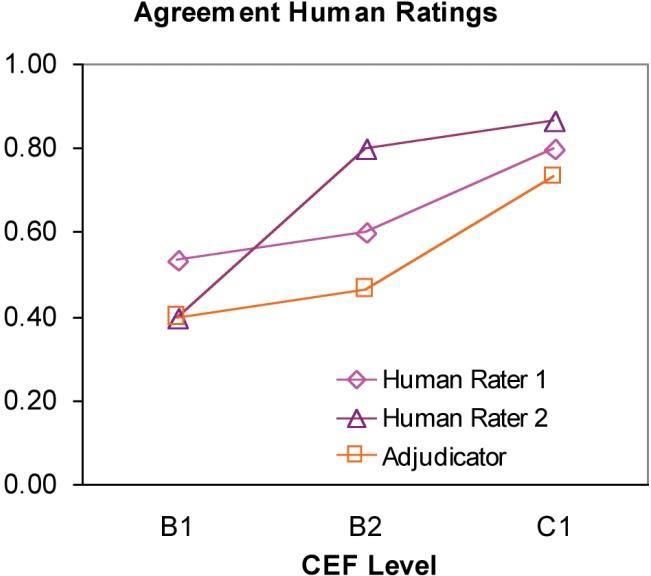
As shown from the scoring tables on the responses presented, the human ratings at trait level
differed up to two score points out of six possible scoring categories (0 - 5). The two graphs
below show the level of agreement of the total item score (sum of traits) of the human raters (graph on
the left) and the agreement of the machine score with the average of the human ratings (graph
on the right). The total item scores are rendered as a proportion of the total maximum item
score (15) for the item. The human ratings vary substantially, especially for the B2 candidate,
from a score that is only slightly higher than the score given to the B1 test taker, to a score that
is close to the one given to the C1 test taker.
Note that these ratings were given by trained raters who had all recently passed a rater’s exam.
This example is therefore not typical for the human rating in general, but it shows that in some
instances, especially for spoken responses, human raters have a hard time deciding on the most
fitting score.
The automatic scoring system that has been trained on more than 100 human raters agrees quite
well with the average human rating as shown in the graph on the right.
The machine-human comparison is part of the validation studies based on the field test
responses for speaking, where 450,000 spoken responses were collected and scored,
generating more than 1 million human ratings. The correlation between the human raw scores
and the machine-generated scores for the overall measure of speaking was 0.89. In order to
neutralize the effect of differences in severity amongst human raters, the human scores were
scaled using Item Response Theory (IRT). The correlation with the machine scores then increases
to 0.96. The reliability of the measure of speaking in PTE Academic is 0.91.
Score type Human-human Machine-human
Raw scores 0.87 0.89
IRT scaled 0.90 0.96
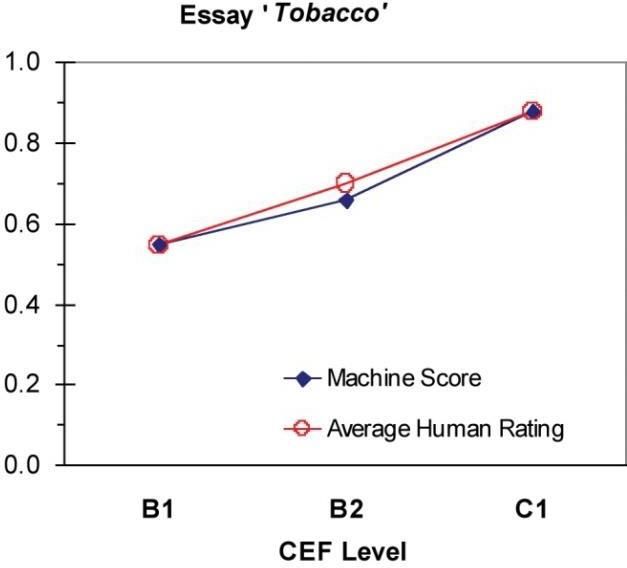
Version 13/May 2020 34Written samples The PTE Academic automated scoring system correlates highly with average human ratings. Studies were carried out to compare human and machine scores for the writing item type Write essay, using tasks such as the example below. Example Write essay item ‘Tobacco’ From the studies using these items, samples of test taker responses at B1, B2 and C1 are given as well as a comment from the Language Testing division of Pearson. Ratings on each response are provided including a machine score and scores from at least two human raters. In cases where the two human rater scores differed, an adjudicator was used to provide a third human rating. Scoring The item type Write essay is scored on 7 different traits: Traits Maximum raw score Human rating Machine score Content 3 3 3 Form 2 Development, 2 2 2 structure and coherence Grammar 2 2 2 General linguistic 2 2 2 range Vocabulary range 2 2 2 Spelling 2 Maximum item score 15 11 15 The form and spelling traits do not require human ratings for training the automatic scoring systems as they can be objectively scored. It can be assumed (if the human raters work error- free) that the human rating on these two traits would have been identical to the machine score. Version 13/May 2020 35
To make the total score from human rating comparable to the machine score, we need to take
the score as a proportion of the maximum obtainable score by dividing the observed total score
by the maximum possible score.

An item is not scored if the test taker’s response does not meet the minimum requirements for
the traits content and form (i.e., when a test taker scores 0 for content and/or form).

The traits are scored as follows:

                                                      Development,
Content                   Form                        structure and               Grammar
                                                      coherence
3:
Adequately deals with
the prompt
2:                        2:                          2:                          2:
Deals with the prompt     Length is between 200       Shows good                  Shows consistent
but does not deal with    and 300 words               development and             grammatical control of
one minor aspect                                      logical structure           complex language.
                                                                                  Errors are rare and
                                                                                  difficult to spot
1:                        1:                          1:                          1:
Deals with the prompt     Length is between 120       Is incidentally less well   Shows a relatively high
but omits one major       and 199 or between          structured, and some        degree of grammatical
aspect or more than       301 and 380 words           elements or paragraphs      control. No mistakes
one minor aspect                                      are poorly                  which would lead to
                                                      linked                      misunderstandings
0:                        0:                          0:                          0:
Does not deal properly    Length is less than 120     Lacks coherence and         Contains mainly simple
with the prompt           or more than 380            mainly consists of lists    structures and/or
                          words. Essay is written     or loose elements           several basic mistakes
                          in capital letters,
                          contains no
                          punctuation or only
                          consists of bullet points
                          or very short
                          Sentences.

Version 13/May 2020                                                                                     36
General linguistic range Vocabulary range Spelling
2: 2: 2:
Exhibits mastery of a wide range Good command of a broad Correct spelling
of language to formulate lexical repertoire, idiomatic
thoughts precisely, give expressions and colloquialisms
emphasis, differentiate and
eliminate ambiguity. No sign
that the test taker is restricted in
what they want to
communicate
1: 1: 1:
Sufficient range of language to Shows a good range of One spelling error
provide clear descriptions, vocabulary for matters
express viewpoints and develop connected to general academic
arguments topics. Lexical shortcomings lead
to circumlocution or some
Imprecision.
0: 0: 0:
Contains mainly basic language Contains mainly basic More than one spelling error
and lacks precision vocabulary insufficient to deal
with the topic at the required
level
Version 13/May 2020 37You can also read


