Secondary School: The Diploma - Secondary School: The Diploma Programme Lakeside Campus
←
→
Page content transcription
If your browser does not render page correctly, please read the page content below
Secondary School: The Diploma Programme
Lakeside Campus

                                          Secondary
                                          School:
                                          The Diploma
                                          Programme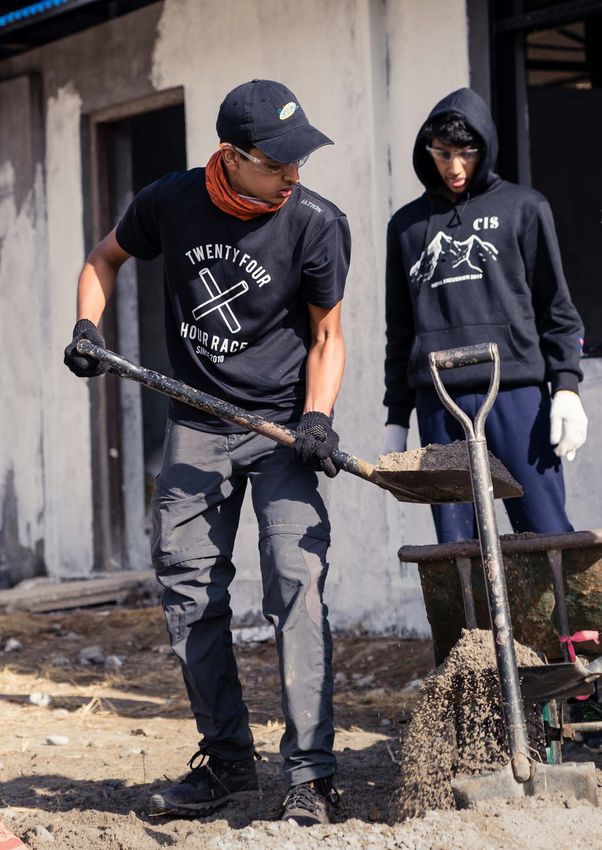
SECONDARY SCHOOL: THE DIPLOMA PROGRAMME

Secondary school:
The Diploma Programme
                                          The Diploma Programme (DP) marks the critical final two years
                                          of your child’s journey with CIS and charts the beginning of their
                                          transition to the world of post-secondary education.

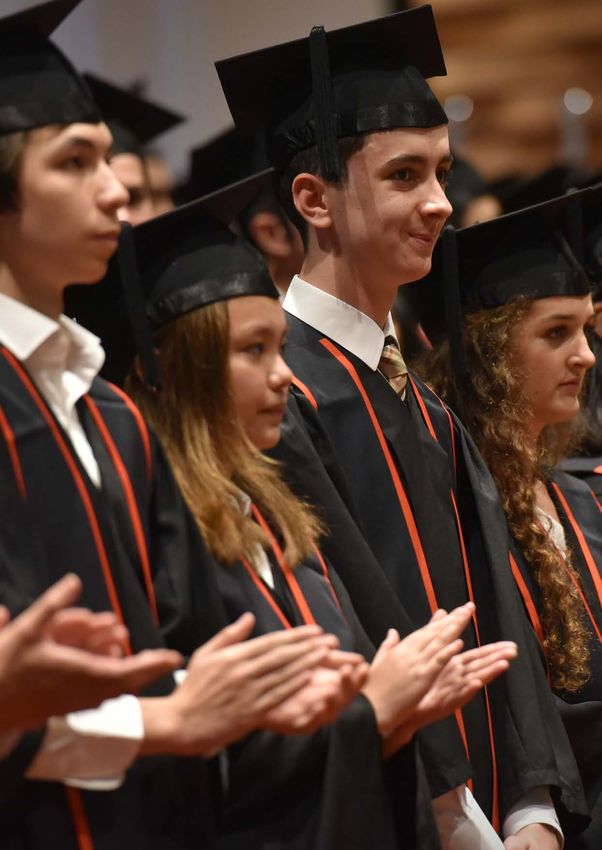
                                          Our graduates leave as confident, compassionate and well-
                                          rounded young men and women welcomed by leading
                                          universities around the world, many with scholarships. Our
                                          students are empowered to chart their own course and envision a
                                          future where anything can be achieved.

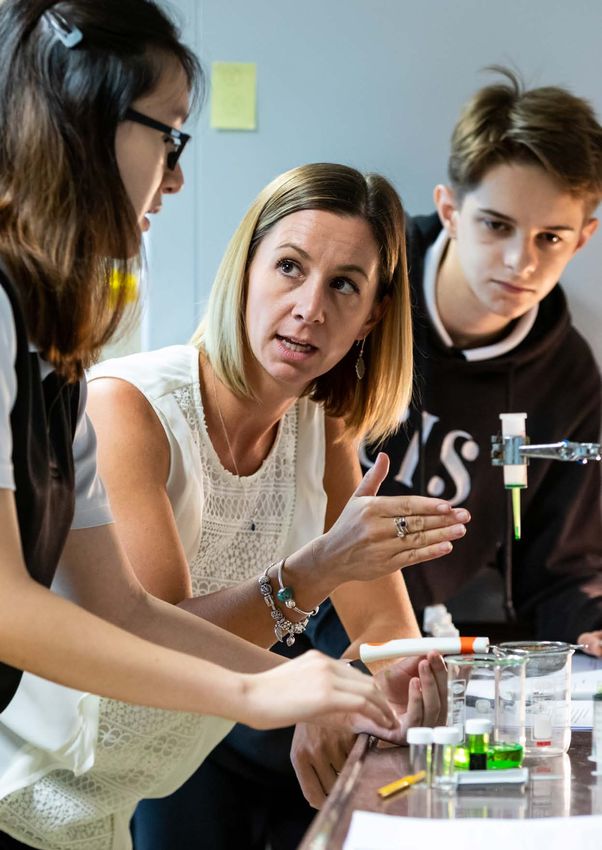
                                          Our teachers are experts in their field, and they teach and lead
                                          by example. They support students as they assume increasing
                                          responsibility for the decisions that will shape their future, and
                                          ensure each child has a successful school experience.

                                          Outstanding curricular and co-curricular programmes nurture a
                                          sense of capability and develop the knowledge and skills students
                                          need to be successful to achieve their goals - anywhere, anytime.

                                          CIS students are able to make practical connections between
                                          their learning and the real world. They develop understanding
                                          and knowledge in traditional subject areas and can see the
                                          relationships between them.

                                          Secondary school is organised into subject areas to foster
                                          discussion and group collaboration. The school day runs from
                                          8.30am to 3.30pm, and many students take part in a range of
                                          activities either before or after school. Secondary students start
                                          the day in advisory and then move about the campus for subject
                                          specific classes.

                                          University planning is a key component of our secondary
                                          school programme, and through our university advisors and
                                          teacher advisor programmes, students graduate as informed
                                          and responsive citizens, ready to take their next step in their life
                                          journey.

 2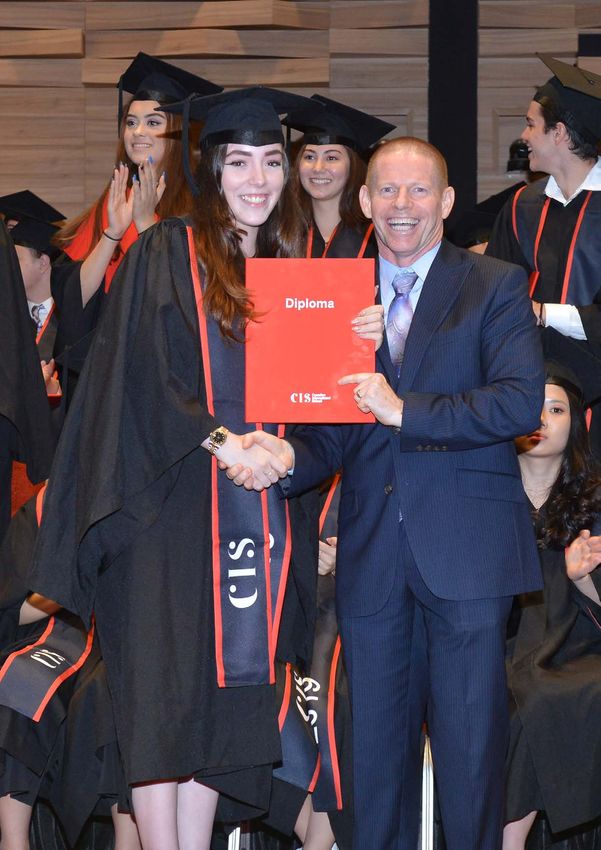
3
SECONDARY SCHOOL: THE DIPLOMA PROGRAMME

The CIS curriculum.
                                          CIS is one of the few international schools in Singapore to offer all
                                          three International Baccalaureate (IB) programmes, from Primary
                                          Years through to the Diploma Programme. Our curriculum is
                                          benchmarked against national curricula globally, allowing students
                                          to transition to another school if and when required, or graduate
                                          and be admitted to leading universities around the world.

                                          The CIS curriculum is represented through learning standards
                                          and conceptual understandings. These are developmentally
                                          appropriate and provide guidance regarding expectations for
                                          students at each grade level. Their purpose is to ensure robust
                                          progression for students as they move throughout the grade
                                          levels.

STANDARDS                                 Each IB Diploma discipline indicates the content and standard
                                          required within that particular unit of work. These standards are
                                          different from those in the Primary and Middle Years Programmes,
                                          and are common to all schools offering the Diploma Programme
                                          worldwide.

BENCHMARKS                                Within the IB Diploma Programme, assessment processes
                                          are designed to best meet the needs of each student as they
                                          progress towards their submission of internal assessments and
                                          their participation in final examinations. All assessment pieces are
                                          benchmarked against these final submissions, making CIS grades
                                          valid and usable in tertiary institutions all over the world.

CONCEPTUAL                                Our learning programme is concept-based. Concept-based
UNDERSTANDINGS                            instruction is driven by ‘big ideas’. It promotes in-depth thinking,
                                          understanding and the application of knowledge.

                                          At CIS, we foster students’ abilities not only to master academically
                                          rigorous content but to use it to think critically, create new
                                          connections, and develop insightful solutions. By having students
                                          consider the context in which they will use their understanding,
                                          concept-based learning brings ‘real world’ meaning to content,
                                          knowledge and skills.

 4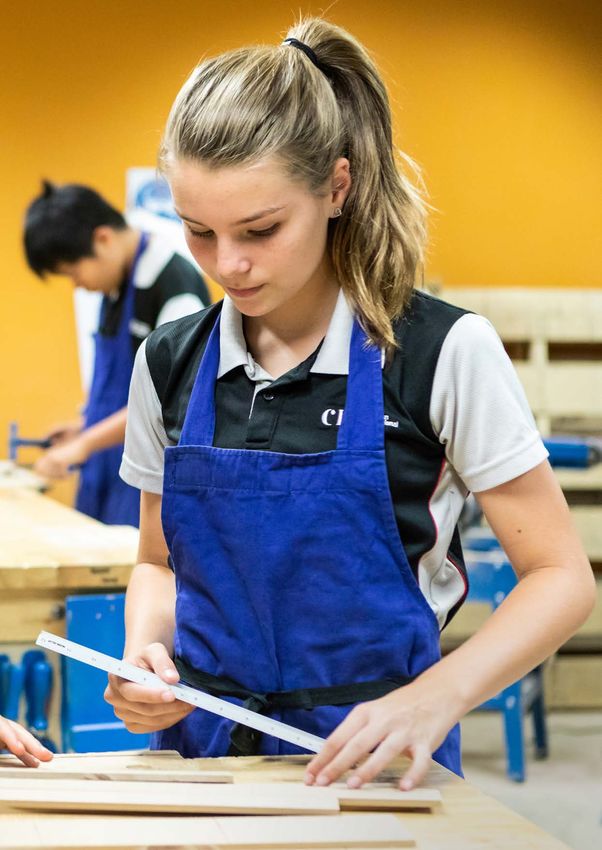
5
SECONDARY SCHOOL: THE DIPLOMA PROGRAMME

The Diploma Programme.
CONCEPTUAL                                The Diploma Programme (DP) in grades 11 and 12 is considered
UNDERSTANDINGS                            the gold standard of secondary programmes, and is accepted
                                          by leading universities around the world. In the DP, students are
                                          challenged to extend themselves in both their academic and
                                          personal development in preparation for college, university or life
                                          after secondary school.

APPROACHES                                The approaches to learning (ATLs) are a set of skills that are
TO LEARNING (ATLS)                        essential for success in the 21st century. The ATL categories are:
                                          1. Thinking skills
                                          2. Communication skills
                                          3. Social skills
                                          4. Self-management
                                          5. Research skills

                                          ATLs are common across all three IB programmes. They provide
                                          a common language used by students and teachers to reflect
                                          on, and articulate, the process of learning. ATLs help students
                                          ‘learn how to learn’. In secondary school they are taught in subject
                                          specific courses and in our secondary advisory programme. These
                                          skills can be learned, taught, and improved with practice.

 6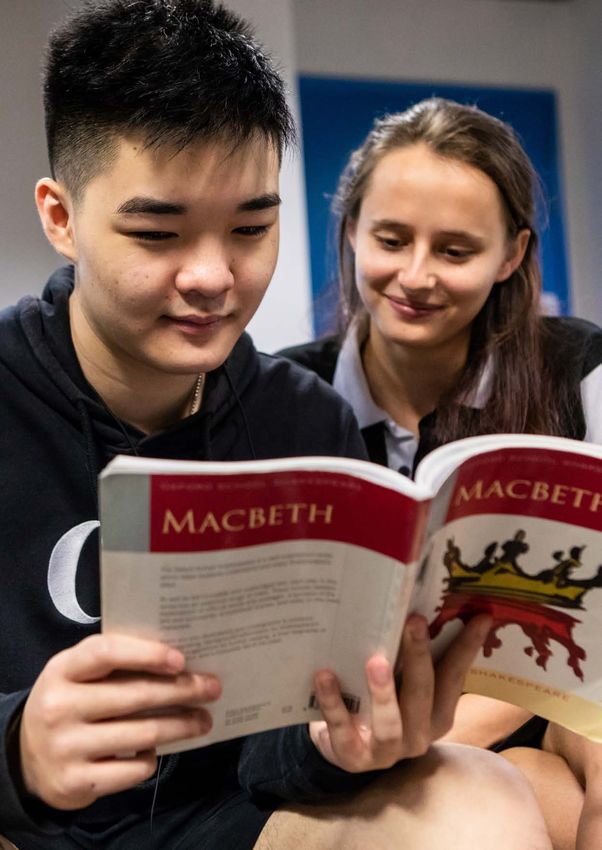
7
SECONDARY SCHOOL: THE DIPLOMA PROGRAMME

The school day.
                                          In secondary school, we have an eight day rotating schedule
                                          designed to maximise teaching and learning time, and minimise
                                          disruptions. Subjects are offered at different times of the day
                                          across the eight-day schedule ensuring the same subjects do not
                                          always occur on the same day or at the same time.

                                          Every Monday begins with a 50-minute advisory period followed
                                          by four 70 minute instructional periods. The instructional day on
                                          Tuesday through Friday consists of four 80-minute blocks.

                                          School hours are 8.30am to 3.30pm.

 8
9
SECONDARY SCHOOL: THE DIPLOMA PROGRAMME

Secondary school timetable.

     Monday (advisory day)
     Advisory                                    8:30 - 9:20                                     50 minutes

                                                 9:20 - 9:25                                     Passing time - 5 minutes

     Block 1                                     9:25 - 10:35                                    70 minutes

                                                 10:35 - 10:50                                   Morning break - 15 minutes

     Block 2                                     10:50 - 12:00                                   70 minutes

                                                 12:00 - 12:05                                   Passing time - 5 minutes

     Block 3                                     12:05 - 1:15                                    70 minutes

                                                 1:15 - 1:45                                     Lunch - 30 minutes

     SMART                                       1:45 - 2:20                                     SMART - 35 minutes

     Block 4                                     2:20 -3:30                                      70 minutes

     After school                                3:30 - 4:30                                     Activities*

*The school day ends at 3.30pm. Participation in activities is encouraged, but not compulsory.

10
Tuesday to Fridays
Registration 8:30 - 8:40 10 minutes
8:40 - 8:45 Passing time - 5 minutes
Block 1 8:45 - 10:05 80 minutes
10:05 - 10:25 Morning break - 20 minutes
Block 2 10:25 - 11:40 75 minutes
11:40 - 11:45 Passing time - 5 minutes
Block 3 11:45 - 1:05 80 minutes
1:05 - 1:35 Lunch - 30 minutes
SMART 1:35 - 2:10 SMART - 35 minutes
Block 4 2:10 - 3:30 80 minutes
After school 3:30 - 4:30 Activities*
11SECONDARY SCHOOL: THE DIPLOMA PROGRAMME
IB Diploma Courses.
Students in the DP choose 3 Higher Level (HL) courses, 3
Standard Level (SL) courses, they must complete also the IB Core
components: Extended Essay (EE), Theory of Knowledge (TOK)
and Creativity, Activity and Service (CAS).
In most cases both SL and HL courses consist of the same
educational aims, core syllabus and curriculum and assessment
models. HL courses typically cover content in more depth and
detail, while some will include additional topics (compared to
standard level courses).
CIS offers a broad range of subjects, with a rich array of online
subjects offered through an IB approved organisation called
Pamoja. The following courses are available at both standard and
higher level (unless indicated) in each of the six subject groups.
• English A: Language & Literature
• English A: Literature
• Chinese A: Language & Literature
Group 1: Studies in Language & Literature
• French A: Language & Literature
• Self Taught Literature
(various languages - SL only)
• English B
• French B
Group 2: Language Acquisition • Chinese B
• Spanish ab initio
• Spanish B
• Business Management
• Economics
• Geography
Group 3: Individuals and Societies
• History
• Information Technology in a Global Society
• Psychology
12• Physics
• Chemistry
• Biology
• Design Technology
Group 4: Sciences • Environmental Systems and Societies (SL)*
• Sport, Exercise & Health Science
* This is an interdisciplinary subject and can
satisfy the requirements for groups 3 & 4.
• Mathematics Applications
Group 5: Mathematics and Interpretations
• Mathematics Analysis and Approaches
• Music
Group 6: Arts* • Theatre
• Visual Arts
• Extended Essay
Core • Theory of Knowledge
• Creativity, Activity and Service
*Students can select an alternate subject for groups 1-4 in place of a group 6 subject
13SECONDARY SCHOOL: THE DIPLOMA PROGRAMME
Subjects and learning areas.
STEAM In the DP, STEAM (Science, Technology, Entrepreneurship, Arts
and Mathematics) is delivered through course work in discrete
subjects areas.
Students connect their learning in these with practices, elements,
design principles, and standards from a range of other disciplines.
The school has invested in the creation of new learning
experiences, additional spaces, resources and staff to expand
STEAM related offerings for secondary students.
LIBRARY The library is a dynamic place and an intrinsic part of daily life at
CIS. Our teacher librarians support a lifelong love of reading and
writing by offering a vast selection of books and digital media, as
well as a range of online educational resources.
Our libraries contain a wide variety of curriculum-related
resources which are appropriate for students’ ages, cultural
backgrounds, and language abilities. Our teacher librarians
support classroom instruction and collaborate with teachers
in fostering students’ research, information literacy, technology,
communication, and critical thinking skills.
DIGITAL LITERACY Technology at CIS is integrated into classroom activities and the
curriculum to provide productive and meaningful 21st century
learning experiences.
Our ‘One to World’ programme ensures our students learn how
to think critically and ethically as they harness technology in their
learning, behave safely and appropriately online, identify what
information is essential online, and use technology as a tool to
showcase their skills and talents.
1415
SECONDARY SCHOOL: THE DIPLOMA PROGRAMME

Outdoor excursions programme.
EXCURSION WEEK*                           Excursion week encourages students to make a difference to the
                                          world and connects the curriculum and service with experiential
*Due to COVID-19 Excursion Week
is cancelled for school year
                                          learning. Our students develop independence, and take positive
2020-2021.                                action to address global issues, and improve the lives of people
                                          living within our region.

                                          All excursions have a concentrated focus on community outreach
                                          and service, and students participate in a range of activities
                                          including house building in Cambodia, and working with NGOs
                                          and local charities to help those in need.

                                          Excursion locations for students in grade 11 are Cambodia, Nepal,
                                          or Singapore.

FIELDWORK                                 Fieldwork in the DP is part of a student’s coursework if they
                                          take geography, biology or environmental systems and societies.
                                          Fieldwork counts towards a student’s internal assessment. It
                                          serves a distinct purpose: to expand and reinforce concepts and
                                          skills that are taught in class. It enriches the study of particular
                                          themes within the course, and adds to students’ knowledge,
                                          understanding and awareness, helping to make learning
                                          engaging and relevant. As they learn through practical work,
                                          students collaborate and develop investigative, analytical and
                                          organisational skills.

SERVICE AND ACTION                        At CIS, we value the connections we have with one another as a
                                          school community, as well as those we build locally, regionally and
                                          globally.

                                          Students participate in local service, where they connect with
                                          members of the school and the Singapore community; as well as
                                          global service, where they work with regional NGOs and partner
                                          organisations. Service activities can be one-time events, year-long
                                          or multi-year commitments, and are normally done through the
                                          CAS (Creativity, Activity and Service) programme. Students are
                                          often involved in leading activities that focus on improving some
                                          aspects of school life, or in raising awareness of issues facing the
                                          community.

                                          DP students must satisfy the CAS requirements in order to
                                          complete the course.

16
17
SECONDARY SCHOOL: THE DIPLOMA PROGRAMME

Activities.
                                          Activities are an integral part of our school life and student
                                          learning. Opportunities are wide in scope, and allow students to
                                          discover and develop individual talents and passions - whether
                                          sporting, intellectual, creative or service related. Activities bring
                                          our students together, encourage the development of skills that
                                          facilitate success in group or team environments, and allow them
                                          to be successful outside the classroom.

                                          Activities, which comprise of sports, extra curricular (a paid
                                          service) and co-curricular (a free service) activities, are offered
                                          across three seasons each school year.

SPORTS                                    CIS provides students with a wide range of opportunities for
                                          sporting development, both recreationally and competitively,
                                          throughout the school year. Secondary has its own representative
                                          teams, which compete in the ACSIS (Athletic Conference of
                                          Singapore International Schools) league. ACSIS provides students
                                          with a competitive framework to excel through both focused
                                          leadership and team play.

                                          The following competitive sports, which are seasonal, make up the
                                          ACSIS programme:
                                          • Badminton
                                          • Basketball
                                          • Cross country
                                          • Football (soccer)
                                          • Gymnastics
                                          • Netball
                                          • Rugby Academy
                                          • Softball
                                          • Swimming
                                          • Tennis
                                          • Track & field
                                          • Volleyball

                                          Community sports, paid programmes organised by independent
                                          providers, run all school year.

18
19
SECONDARY SCHOOL: THE DIPLOMA PROGRAMME

Activities.
ARTS                                      CIS secondary offers an amazingly broad and vibrant co-curricular
                                          arts programme. Students do not need to be studying an arts
                                          course to participate.

                                          There are numerous opportunities for creative expression at
                                          CIS. Traditional theatre productions provide students with
                                          opportunities for on and off stage participation, as well as set,
                                          lighting and sound design. Our vocal and instrumental teaching
                                          programme offers vocal and music lessons on a number of
                                          instruments outside of the academic music curriculum.

                                          Slam poetry, musical celebrations and concerts, fine art studio
                                          sessions, and a wide variety of musical ensembles and rock
                                          bands provide numerous opportunities for our students to express
                                          themselves creatively.

ENRICHMENT                                CIS offers a large selection of enrichment activities that cater to
                                          a wide range of skills and interests. Students can choose to join
                                          an activity for one season, or continue through all three seasons
                                          moving through the different levels available. From Model United
                                          Nations (MUN) to TEDx presentations, to yoga and mindfulness,
                                          the list is almost endless.

LANGUAGES                                 A range of mother tongue and language acquisition classes are
(EXTRA CURRICULAR)                        available after school. These classes provide students with an
                                          opportunity to support their mother tongue skills, or to learn an
                                          additional language that is not included in the regular curriculum.
                                          Language classes are a paid service, and are run by independent
                                          providers.

20
21
SECONDARY SCHOOL: THE DIPLOMA PROGRAMME

Student guidance, support and wellbeing.
                                          In secondary school, the academic, social and emotional
                                          wellbeing of our students is paramount. Our experienced team
                                          of counsellors, advisors, school administrators and teachers work
                                          collaboratively to support a range of developmental issues related
                                          to academics, conflict resolution, crisis management, transition
                                          planning and peer interactions.

ADVISORY PROGRAMME                        Each student is assigned an advisor who they meet with each
                                          morning. The advisor will be your child’s first point of contact. Our
                                          advisors provide each student with ongoing interpersonal and
                                          academic support throughout the school year.

                                          In addition to delivering the wellbeing curriculum at each grade
                                          level, advisors will be instrumental in assisting your child with
                                          approaches to learning, goal setting, time management, exam
                                          practice and study skills.

SOCIAL AND                                As and when needed, there are opportunities for our students to
EMOTIONAL GUIDANCE                        receive support from our highly trained secondary counsellors,
                                          vice principals and school psychologist.

SMART                                     Each day, for 35 minutes, secondary students are engaged in
                                          SMART (Students’ Maximising Achievement Responsibility on
                                          Time). In their SMART block, students participate in a variety of
                                          activities designed to encourage independence and self-directed
                                          learning. Activities are broad in nature and include service
                                          activities, academic enrichment and support, as well as student
                                          led clubs and initiatives such as The Green Machine, Student
                                          Council and Model United Nations.

22
23
SECONDARY SCHOOL: THE DIPLOMA PROGRAMME

Student guidance, support and wellbeing.
UNIVERSITY AND COLLEGE                    With over 6,000 colleges and universities around the world
ADVISORY SERVICES                         and an array of entry conditions, admissions requirements and
                                          programme prerequisites, the application process can be both
                                          daunting and confusing.

                                          Our secondary university advisors are extremely knowledgeable
                                          about entry requirements of colleges and universities globally,
                                          as well as programme prerequisites, scholarship and bursary
                                          opportunities.

                                          Our university advisors are well-connected to the world of
                                          university admissions. They have ongoing personal relationships
                                          with university admissions’ officers, attend conferences, conduct
                                          site visits and have membership in a range of professional
                                          organisations.

                                          Our goal is to ensure the ‘best possible fit’ in terms of students
                                          and universities, as well as helping students to maximise their
                                          chances of gaining acceptance to the university or college of their
                                          choice.

                                          Our advisory teachers and university advisors help guide our
                                          secondary students so that they can:
                                          • Identify future studies and possible career paths
                                          • Decide on university pathways
                                          • Submit university applications

                                          In addition to individual meetings, our university advisors offer
                                          presentations and workshops for students and parents, to help in
                                          planning and decision making around university choices.

                                          Universities from around the world visit CIS each year to speak
                                          with our students and parents.

24
25
SECONDARY SCHOOL: THE DIPLOMA PROGRAMME

Assessment, communication
and reporting.
ASSESSMENT                                Assessment serves a number of purposes, including:
                                          • Determining prior knowledge
                                          • Developing student understanding
                                          • Measuring student achievement

                                          Assessment patterns differ from subject to subject within the DP,
                                          however many courses include a coursework, practical or oral
                                          component. This means that a student’s final grade is based on
                                          both work done during the two-year course (grade 11 and 12)
                                          and on the grade 12 final examination results.

                                          Exactly what is to be assessed for each course, as well as how
                                          it will be assessed, is communicated to students prior to the
                                          commencement of a unit of instruction.

MANAGEBAC                                 ManageBac is CIS’s digital teaching and learning platform.
                                          Students access a wealth of ‘live’ course information that
                                          includes their units of study, information about assessments and
                                          information about academic progress.

                                          Parents can also access a range of similar information in
                                          ManageBac, and can follow their child’s academic progress as
                                          achievement information is added to the progress tab.

26
27
SECONDARY SCHOOL: THE DIPLOMA PROGRAMME

Assessment and communication
and reporting.
REPORTING                                 Feedback and reporting is structured to support a student’s
                                          continual growth and improvement against the intended learning
                                          outcomes. Students and parents are provided with constructive
                                          feedback on all areas of a student’s performance through
                                          gradebook, report cards and conferences.

                                          The secondary annual reporting cycle includes:
                                          • Two progress reports issued in October and April.
                                            Reports include information on student progress, and
                                            comments from teachers and advisors. The April progress report
                                            includes a numerical grade of 1 through 7.
                                          • Two end of semester reports issued in January and June. These
                                            indicate students’ academic progress with a numerical grade of
                                            1 through 7 and include an advisor comment.
                                          • Two parent teacher conferences.

                                          Both progress and semester end reports are available
                                          electronically through ManageBac.

GRADE 12 EXAMINATIONS                     Early in the grade 12 school year, students participate in internal
                                          ‘mock’ examinations. Teachers provide students with detailed
                                          feedback and guidance based on their results.

                                          Feedback from these mock exams assist students with their exam
                                          preparation before they undertake their final DP examinations in
                                          May. The May exams, taken over a three week period, represent
                                          the culmination of learning in each course (subject).

28
29
SECONDARY SCHOOL: THE DIPLOMA PROGRAMME

Graduation requirements.
                                          While the majority of students pursue the IB Diploma in grades
                                          11 and 12, all students have the opportunity to graduate with a
                                          CIS diploma. The CIS Diploma is awarded at the end of grade 12
                                          to students who earn the minimum number of academic credits*
                                          and complete the IB core requirements.

                                          *A half credit is earned each semester by achieving a grade of 3 or above

CIS Diploma requirements                                            IB core requirements
                                           Credits

 English                                   4                        Creativity, Activity, Service (CAS)

 Mathematics                               3                        Theory of Knowledge (TOK)

 Language Acquisition                      3                        Extended Essay (EE)

 Sciences                                  3

 Individuals & Societies                   3

 Physical & Health
                                           1
 Education

 The Arts                                  1

 Design                                    1

 Discretionary credits                     6

 Total credits                             25

30
31
SECONDARY SCHOOL: THE DIPLOMA PROGRAMME

Who to contact.
                                          We understand that selecting a school for your child is a big
                                          decision. Our school administrators, counsellors and teachers
                                          would be happy to answer any questions you might have.

                                          Whether you are looking for more information, or if you just want
                                          to talk to someone about your child and how they will fit in to
                                          school life, we are here to help.

LAKESIDE                                  Jeff Smith			Secondary Principal
SECONDARY SCHOOL                          Nicholas Kolenste		 Vice-Principal (grades 7-9)
                                          John Kernis 		      Vice-Principal (grades 10-12)
                                          Elsa Baptista			    Diploma Programme Coordinator
                                          Christian Yanez		   University Advisor
                                          Kemal Taskin 		University Advisor
                                          Vanessa Kim			      University Advisor

           Admissions hotline
           +65 6734 8088

           Inquire
           admissions@cis.edu.sg

32
33
Notes.
The Canadian International School (CIS) attempts to ensure that the information contained in this publication is correct at the time of
           production (July 2020), however, please note that information may be amended, without notice, at any time.
Contact us
+65 6734 8088
www.cis.edu.sg/inquire
Lakeside Campus
7 Jurong West Street 41
Singapore 649414
CPE Registration No: 199002243H
Period of Registration: 8 June 2019 to 7 June 2023
V2.0 July 2020You can also read


